Introduction
More than 45 different ethnic groups live in Bangladesh. As a group, they are called the “indigenous people” and they raise pigs for a contribution to their livelihoods and are the main consumers of pork and rearers of pig (Sus crofa domesticus) in Bangladesh. In addition, the Christians and some Hindus also consume pork in large amounts. There is also a community of nomadic people called the “Dome”, who rear pigs and sell piglets to the indigenous people. They are the main source of pigs for those people. The pig bought from Dome is called Dome's pig. Another type of native pig is called the “Wakmandi”. A distinctive trait of this pig is a drooping mid-section, which differentiates it from the Dome. About 95 percent of the pigs in Bangladesh are of these native types (Dome and Wakmandi) and the remaining 5 percent are exotic or crosses between native and exotic. There has been no thorough investigation carried out to characterize these native pigs in Bangladesh. In this context, this study was formulated to evaluate the morphological, phenotypic and reproduction attributes of native pigs, specifically in the rural areas of Haluaghat, Durgapur and Nalitabari upazilas of Bangladesh.
Materials and methods
Study area
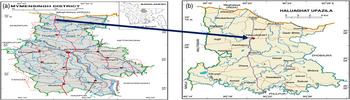
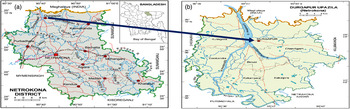
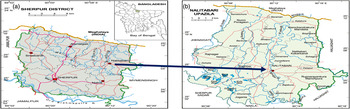
The study was undertaken at four randomly selected villages of the Haluaghat Upazila located at 25.1250°N and 90.3500°E in Mymensingh district (Figure 1), seven villages of the Durgapur Upazila located at 25.1250°N and 90.6875°E in Netrokona district (Figure 2) and three villages of the Nalitabari Upazila located at 25.0833°N and 90.1954°E in Sherpur district (Figure 3). The villages were selected because they were known to have a reasonably high density of pig populations. Before collection of data, a questionnaire (Appendix 1) was prepared in accordance with objectives of the study. Later on, the questionnaire was validated against field conditions.
Map of field unit at Haluaghat upazila in Mymensingh district.

Map of field unit at Durgapur upazila in Netrokona district.

Map of field unit in Nalitabari upazila in Sherpur district.

Study population
All the experimental animals were of the native type (i.e. Dome or Wakmandi) pigs. All pigs were reared by the Garo(s) the indigenous people in the studied areas. A total of 200 household pig owners from the aforementioned sites were selected randomly and interviewed relevant for the study. A total of 200 experimental animals were evaluated, of which 81 were male and 119 were female pigs. One pig from each household was selected randomly.
Data collection
The study was conducted from 1 September 2012 to 30 September 2012. The phenotypic traits such as coat colour, skin pigmentation, head shape, ear direction, ear orientation, tail shape and body shape were recorded based on subjective visual observation. Body weight of piglets was recorded by using a weighing scale, whereas body weights of boars and gilts were estimated by using the following formula:-
Chest girth2 (m) × length from ear to tail (m) × 69.3 = body weight of the pig (kg)
where,
M = meter
69.3 = constant
kg = kilogram
Source: The Old Farmer's Almanac
Body length was determined by measuring the distance between points of shoulder to the pin bone. Chest girth was considered as the largest circumference of the body immediately behind the shoulder. The length from ear to tail was measured from the base of the ear to the base of the tail. Height at wither was considered as vertical distance between the ground and the point of wither. Height at loin region was considered as vertical distance between the surface and the loin region. Head length was measured from the distance between snout and forehead of pig, while head width was the distance between the eyes. The distance between the base and the tip of the pinna was considered as the ear length. Shoulder hairs were used to determine the hair length. The distance between the base and the end of the tail was constituted the tail length. The number of pairs of teats was recorded by visual observation. The litter size was based on the number born alive. Gestation and weaning period were also estimated.
Statistical analysis
The accumulated data were arranged by using Microsoft Excel 2007 and these data were compiled and analyzed by using Statistical Package for Social Science (SPSS) v.11.5. Univariate analysis of variance (ANOVA) was carried out with upazila, sex, age group and sex*age as explanatory variables. The raw and residual correlations among traits were also calculated.
Results and discussion
1. Phenotypic characterization
Coat characteristics
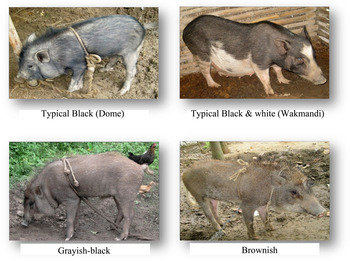
The observed combinations of coat colour of the native pigs were black (95 percent), black and white (2.5 percent), greyish-black (2 percent) and brownish (0.5 percent) (Figure 4). The coat colour of native pig had been recorded as black, white, black with white legs, white with black spot, black with white belly and brown in a previous study conducted by Yaetsu et al. (Reference Yaetsu, Takashi, Ikuo, Katuaki, Takao, Yoshizane, Hasnath, Mostofa, Faruque and Majid1987) in Bangladesh, which is similar to the present study. Most of the native pigs in the study areas had dark skin pigmentation (95 percent).
Coat characteristics of native pig.

Head and ear characteristics
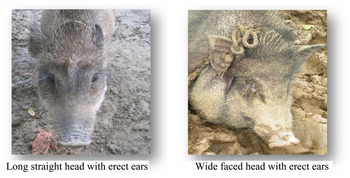
The shape of the head was long and straight in most of the native pigs (75 percent) and the rest were classified as “wide face” (25 percent) (Figure 5). Yaetsu et al. (Reference Yaetsu, Takashi, Ikuo, Katuaki, Takao, Yoshizane, Hasnath, Mostofa, Faruque and Majid1987) conducted an experiment on native pigs in different regions of Bangladesh and reported that a straight face with a pointed snout and erect ears was common for native pig. The present study showed that the native pigs had erect ears that pointed backwards (100 percent) (Figure 5).
Head and ear characteristics of native pig.

Body and tail shapes
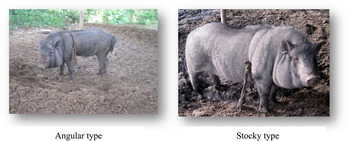
Native pigs were found to have either angular or stocky body shapes where 72.5 percent of them belonged to angular body type and rest were stocky (Figure 6). Thin, straight as well as curled tails were observed among the native pigs. It was found that 98.5 percent of the pigs had a thin, straight tail. The curled tails (1.5 percent) were generally thin and showed an upward curl forming one circle. Yaetsu et al. (Reference Yaetsu, Takashi, Ikuo, Katuaki, Takao, Yoshizane, Hasnath, Mostofa, Faruque and Majid1987) conducted an experiment on native pigs in different regions of Bangladesh and reported that some pigs with somewhat concave back and pendulous belly were found. They also reported that the straight tail was common for all native pigs.
Body shape of the native pig.

2. Morphological characterization
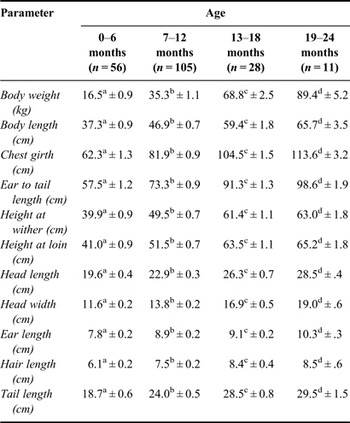
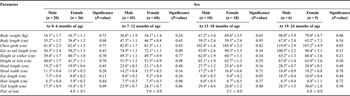
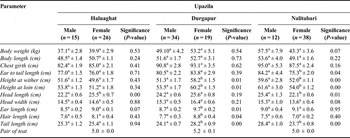
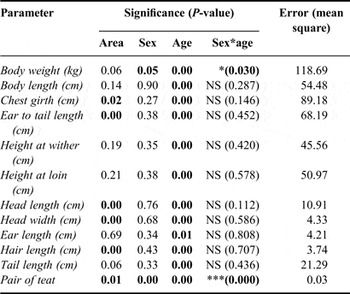
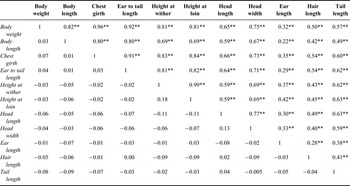
For morphological characterization, body measurements of 81 male and 119 female pigs were taken. Means along with standard errors of means (SEM) of different morphometric characters for pigs are presented in Tables 1–3. Interactions between dependent and independent variables are presented in Table 4. The raw and residual correlations among the studied traits are presented at Table 5.
Morphological characteristic of pigs affected by age (Mean ± SEM).

Different superscripts indicate that values are significantly different at 0.1% level of probability (P < 0.001);
n = number of animals.
Morphological characteristics of pigs as a function of sex (Mean ± SEM).

a,b = Means from the same age group that differ significantly between sexes have different superscripts; n = number of animals.
Morphological characteristics of mature pigs as a function of upazila (Mean ± SEM).

a,b = Means from the same age group that differ significantly between sexes have different superscripts; n = number of animals.
Interactions between dependent and independent variables.

Non-significant (NS) = P > 0.05; * = P < 0.05; *** = P < 0.001
Raw (on the diagonal) and residual (below the diagonal) correlations among traits.

**Correlation is significant at the 0.01 level (two-tailed).
Residuals are computed between observed and reproduced correlations. There are 30 (45.0%) non-redundant residuals with absolute values >0.05.
Not surprisingly, the morphological traits of native pigs were found to increase (P < 0.001) with the advancement of age (Table 1). In general, adult (18–24 months) males tended to be larger than females, whereas no clear pattern was observed at younger ages. Babu et al. (Reference Babu, Naidu, Rao and Vijay2004) conducted an experiment in the rural areas of India and reported that the average body weight of Large White pigs at puberty was 82.3 ± 1.8 kg (mean ± SE), which is similar to the result of present study. The adult body length (7–24 months) ranged from 47–67 cm for males and 46–63 cm for females. Subalini, Silva and Demetawewa (Reference Subalini, Silva and Demetawewa2010) reported that the average body length of Sri Lankan village adult male and female pig was 75.1 ± 1.9 and 69.9 ± 2.4 cm, respectively, which is 15 cm greater than in the present study. The average chest girth for the adult male and female pigs was 82.8 ± 1.7 and 81.3 ± 1.1 cm, respectively. The average length from the base of the ear to base of the tail was higher for females at 0–6 and 13–18 months of age. The height at wither, height at loin, head length, head width, ear length and tail length were higher for females than males at 0–6 months of age. A total of only 20 male and 36 female piglets were measured at 0–6 months of age. Hence, the small sample size might be responsible for this result. Yaetsu et al. (Reference Yaetsu, Takashi, Ikuo, Katuaki, Takao, Yoshizane, Hasnath, Mostofa, Faruque and Majid1987) conducted an experiment on native pigs in different regions of Bangladesh and reported that the average heights at wither at 13–18 months of age in males and females were 56.0 ± 0.0 and 52.8 ± 4.8 cm, respectively, which is lower than the present study. The average pairs of teat of the female pig at 0–6, 7–12, 13–18 and 19–24 months of age was found to be 4.8 ± 0.1, 5.0 ± 0.0, 5.1 ± 0.1 and 6.0 ± 0.0 pairs, respectively. Yaetsu et al. (Reference Yaetsu, Takashi, Ikuo, Katuaki, Takao, Yoshizane, Hasnath, Mostofa, Faruque and Majid1987) conducted an experiment on native pigs in different regions of Bangladesh and reported that the teat pattern of Bangladeshi pigs ranged from four to six pairs. A pattern of five pairs was most frequent in all the populations examined, which is similar to the result of the present study. The correlations among traits were also calculated (Table 5). The correlations were all positive and were significant at the 0.01 level (two-tailed). However, the present study failed to record a significant difference (P < 0.05) between the two sexes (Table 2) except for chest girth and ear length at 19–24 and 13–18 months of age group, respectively. Subalini, Silva and Demetawewa. (Reference Subalini, Silva and Demetawewa2010) conducted an experiment on village pigs in Sri Lanka and found no significant difference (P < 0.05) between two sexes. Sudhakar and Gaur (Reference Sudhakar and Gaur2006) also found that effect of sex was not significant on all body weights and measurements in Indian native pigs, except for weight at birth. The diet for male and females was almost same though. At the present study the differences between two populations (Dome and Wakmandi) was not done for the characteristics measured as the population of Wakmandi was very little. Morphological characteristics of mature pigs affected by upazila (area) are presented in Table 3. Area contributed significant differences (P < 0.05) between males and females in case of parameters such as wither height, loin height, head length, ear length and tail length.
3. Reproduction attributes
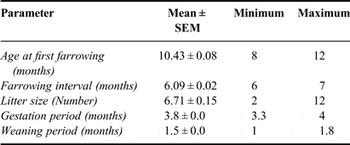
In present study, the average age at first farrowing was found to be 10.43 ± 0.08 months (Table 6). The study conducted by Hossain et al. (Reference Hossain, Chakma, Khatun, Hasanuzzaman, Miah and Biswas2011) using surveyed data on indigenous pigs in hilly areas of Chittagong in Bangladesh, reported that the average ages at sexual maturity in Bangladeshi boar and sow were 8 and 6 months, respectively. Naskar et al. (Reference Naskar, Khan, Anubrata and Bordoloi2007) conducted an experiment on crossbred pigs under the hilly conditions of Meghalaya, India and reported that the average age at first farrowing of pig was 15.3 ± 1.2 months. Subalini, Silva and Demetawewa (Reference Subalini, Silva and Demetawewa2010) conducted an experiment on village pig in Sri Lanka and reported that the average age at first farrowing was 9.50 ± 2.61 months.
Reproductive performance of native pig.

The average farrowing interval of native pigs was found to be 6.09 ± 0.02 months. Babu et al. (Reference Babu, Naidu, Rao and Vijay2004) conducted an experiment in the rural areas of India on Large White pig and reported that the average farrowing interval was 180.19 ± 1.03 days. Subalini, Silva and Demetawewa (Reference Subalini, Silva and Demetawewa2010) conducted an experiment on village pig in Sri Lanka and reported that the average farrowing interval was 8.91 ± 2.49 months.
The average litter size of native pigs in this study was 6.71 ± 0.15. Hossain et al. (Reference Hossain, Chakma, Khatun, Hasanuzzaman, Miah and Biswas2011) reported that the average litter size of indigenous pig at hilly region of Bangladesh was 9.5 ± 0.28. Prakash et al. (Reference Prakash, Ravi, Kumari and Srinivas Rao2008) reported that the average litter size of Indian indigenous pig was 6.78 ± 0.11. Nath and Deka (Reference Nath and Deka2003), conducted an experiment on growth performance of large black pig in Assam, India and reported that the average litter size at birth and weaning were 9.70 ± 0.29 and 8.40 ± 0.32, respectively.
The average gestation period and the average weaning period of these native pigs were 115.35 ± 0.50 and 44.88 ± 0.37 days, respectively. Rajiv and Pandey (Reference Rajiv and Pandey2000) conducted an experiment on the economics of pig rearing in Haryana, India and reported that the average gestation period was 112–114 days. Hossain et al. (Reference Hossain, Chakma, Khatun, Hasanuzzaman, Miah and Biswas2011) reported that the average weaning period of indigenous piglets in Bangladesh was 42 days.
4. Management system of native pigs
Girth tethering was found to be the most popular and widely used housing system for pigs in this study. Pigs were fed thrice a day. Pig owners used to supply boiled rice, rice polish, rice bran, etc. as conventional feeds. Some unconventional feeds were also fed to them. Tube-well or natural reservoir was the source of water for pigs.
According to Ritchil et al. (Reference Ritchil, Faruque, Tabassum, Hossain and Bhuiyan2013), pigs in Bangladesh are reared mostly by poor and landless people (52 percent). The majorities of farmers are housewife (55 percent) or day labour (17 percent). The literacy level is satisfactory. Rearing systems are different and the mean figure is 97 percent for girth tethering. The sanitation condition is not satisfactory. The pig owners use to supply boiled rice, rice polish, rice bran, rice husk, fermented rice, etc. and some unconventional feeds such as cauliflowers, boiled arum, grass or other vegetables for pigs. Pigs are fed thrice a day. Most prevalent diseases are diarrhoea, coccidiosis, pneumonia and haemorrhagic septicaemia. Easy management, adaptability, cost-effectiveness and disease tolerance are the main advantages of native pig farming while malnutrition, lack of scientific knowledge, lack of veterinary and extension services are the major constraints.
Ritchil et al. (Reference Ritchil, Faruque, Tabassum, Hossain and Bhuiyan2013) also found that rearing native pig is very easy for those people who rear and consume it. They believe that it is very much cost effective, available, adaptable and merely affected by diseases. The socio-economic status of the pig rearers is appreciable. Although many constraints are taking part in the management of pig, the meat from pig is the main source of protein for those people who rear and consume it. Therefore, according to Ritchil et al. (Reference Ritchil, Faruque, Tabassum, Hossain and Bhuiyan2013) lack of mature breeding boars, technical knowhow and preventive healthcare services were noticed which need to be extended among the pig rearers for better livelihood and welfare of their keepers. Hence, the observed body weight and reproduction attributes of the native pigs may serve as a base for designing any pig improvement programme in Bangladesh.
Conclusion
Native pigs in Bangladesh showed diversity in their phenotype and morphology and positive reproductive performance, which indicates their potential for economic sustainability through purebred genetic improvement. However, these native pigs are usually raised in conditions with less than optimal husbandry and hence, this aspect needs immediate attention to ensure their conservation through utilization for the food and livelihood of indigenous, Christian and some Hindu people in Bangladesh. This can be done through a well-designed national pig improvement programme, which may include training of the pig rearers on general pig husbandry, supply of preventive vaccines and production and dissemination of quality (heavier but prolific) boars for use in the subsistence farms by the government, non-government organization or organized pig farmers of the country.
Appendix
Appendix 1. An interview schedule for baseline survey on native pig farming in Bangladesh
Sl. No … … .
1. Primary Information

2. Type of pig

3. Feed

4. Production & Reproduction

5. Pig morphology information

6. Phenotypic characters

Date: Name & Signature of enumerator