1 Introduction
Neoclassical economic theory focuses on instrumental behaviour (Stigler and Becker, Reference Stigler and Becker1977). Markets ‘fail’ when individuals respond instrumentally to externalities, public goods and asymmetric information (Schotter, Reference Schotter1984). Policy is designed (to correct market failure) when predictions are premised on instrumental response to tax, subsidy and regulation (Cullis and Jones, Reference Cullis and Jones1998). But there is evidence that policy response differs systematically from predicted instrumental response (Jones and Cullis, Reference Jones and Cullis2003).
Critics express disquiet if policy is designed with unremitting reliance on instrumental motivation. When neoclassical economic theory was applied to redesign blood donor programmes, it focused on the prediction ‘that donors would respond to prices by supplying more than they do at zero price’ (Cooper and Culyer, Reference Cooper and Culyer1973: 131). Titmuss (Reference Titmuss1970) argued that payment might discourage donors and empirical analysis subsequently revealed that blood supply did not always increase when price increased (e.g. Ireland and Koch, Reference Ireland and Koch1973). More recently, Le Grand (Reference Le Grand1997; 2003) has drawn attention to supply of medical care in excess of expectations premised on contractual obligation. Frank (Reference Frank1996) demonstrates that, at compensated wages, individuals supply more work effort than predicted in occupations deemed ‘socially responsible’. Andreoni et al. (Reference Andreoni, Erard and Feinstein1998) focus on the supply of finance for public services. Tax compliance exceeds expectations (‘a purely economic analysis of the evasion gamble implies that most individuals would evade if they are rational because it is unlikely that cheaters will be caught and penalised’ – Alm et al., Reference Alm, McClelland and Schulze1992: 22).
The architects of utility theory were aware that individuals derive satisfaction from action, as well as from outcome contingent on action (Bentham, Reference Bentham1789) but ‘the evolution of the utility concept during our century has been characterized by a progressive stripping away of psychology’ (Lowenstein, Reference Lowenstein1999: 315). Individuals are ‘intrinsically motivated to perform an activity when one receives no apparent reward except the activity itself’ (Deci, Reference Deci1971: 105).
The next section of the paper (Section 2) illustrates the relevance of intrinsic motivation. Le Grand (Reference Le Grand2003: 36) refers to behaviour by ‘act-relevant knights’. Andreoni (Reference Andreoni1988, Reference Andreoni, Smelser and Bates2001) refers to a ‘warm glow’ derived from action. But if individuals are motivated by the intrinsic value of action, outcomes that would otherwise remain undersupplied are achieved.
If perceptions of the intrinsic value of action are potent, is it possible to design social policy to inform perceptions? Section 3 of the paper focuses on policy design features that elicit their own response. Their impact is relevant across different social policies and this is illustrated with reference to the question of whether services should be supplied in kind (e.g. medical care, education, transport, and housing).
If policy design informs perceptions of the intrinsic value of action should policy be designed to acknowledge action by ‘knights’ or ‘good citizens’? When policy is designed only with reference to instrumental motivation it focuses on the impact that instruments (e.g. tax, subsidy, regulation) exert on the constraints individuals face (e.g. prices, incomes) (Stigler and Becker, Reference Stigler and Becker1977). But if policy can be designed to frame the choice individuals make, should policy also be designed to orchestrate support from ‘knights’ or ‘good citizens’?
2 The potency of perceptions of intrinsic value
Instrumental individuals act if they believe action makes a difference (in terms of changing outcomes). In the following example well-disposed ‘knights’ believe that action by one person will not make any significant difference.
A representative altruist, A, cares so much about the elderly that A feels the equivalent of £10 better off to know that a residential home has been provided. A has the opportunity to donate just £5 to a charity intent on this goal. In a ‘large’ group, action by one individual has only a minuscule impact on outcome (Buchanan, Reference Buchanan1968). ‘Knights’ have no incentive to act (because instrumental motivation depends only on the impact of action on outcome). Altruism exudes the hallmarks of a public good (Collard, Reference Collard1978).Footnote 1
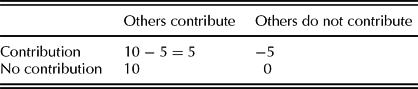
Incentives (illustrated in the Appendix) can be described as follows:
(i) If others contribute, A's best strategy is not to donate. The home for the elderly will be provided (because A's contribution is insignificant). A will feel the equivalent of £10 better off without incurring cost.
(ii) If others do not contribute, A's best strategy is not to donate. The home for the elderly cannot be provided because A's donation is insignificant (£5 will achieve nothing). A will lose by incurring this cost.
When individual action is insignificant, rational altruists choose to ‘free ride’. Each eschews a £5 donation, even though each altruist would be the equivalent of (£10–£5) better off if everyone donated.
In practice, collective action is far more pervasive in ‘large’ groups (Ledyard, Reference Ledyard, Kagel and Roth1995 surveys this literature). Focusing on altruism, Le Grand (Reference Le Grand2003) and Andreoni (Reference Andreoni1988, Reference Andreoni, Smelser and Bates2001) explain that intrinsic value is derived from the act of donating. After statistical analysis, Berman and Davidson (2003: 428) conclude that ‘donors are concerned primarily with the donative act’. How will incentives change if A would feel the equivalent of £6 better off by taking action?
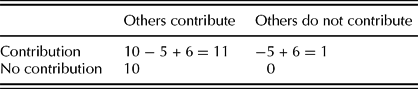
(iii) If others contribute, A's best strategy is now to donate; this action costs only £5 but is worth the equivalent of £6.
(iv) If others do not contribute, A's best strategy is now to donate; this action is worth the equivalent of £6 but it costs only £5.
While the change in ‘payoffs’ is small:
1 Collective action is mobilised by a private ‘consumption’ gain (the equivalent of £6) derived from action. Ex ante, outcome is irrelevant; the motivation to act depends only on the perceived net consumption gain from action (£6–£5). Ex post, outcome is relevant; if all act this way the group is mobilised and the residential home is constructed. Each ‘knight’ also gains (the equivalent of £10) because collective action redresses undersupply. It is as if each individual gains a ‘motivational spillover’ – a ‘spillover’ in the sense that, while outcome is irrelevant for the decision to act, outcome is relevant when assessing the welfare of the individual.
2 Behaviour is sensitive to changes in perceptions of the intrinsic value of action. If only instrumental rationality matters, the value of outcome might increase (from £10 to £100, or to £10,000) but there would be no reason to behave differently (because individual action would always fail to exert a perceptible impact on outcome). But if perceptions of the intrinsic value of action increase, individual behaviour is sensitive (in this example, a small increase in the intrinsic value of action – e.g. from £4 to £6 – turns ‘knaves’ into ‘knights’).
3 This analysis indicates that the efficacy of policy instruments (tax, subsidy) depends on perceptions of the intrinsic value of action. If a subsidy (a ‘gift aid’) were offered to induce a donation, it would reduce the ‘price of giving’ and increase the net intrinsic value of acting as a donor. In the absence of a private consumption gain, the optimal strategy is to attempt to free ride even if the'price of giving’ is very small.
4 Empirical studies show that perceptions of the intrinsic value of action depend on moral considerations and on recognition that action is acknowledged (e.g. Frey, Reference Frey1997). If behaviour in a large group is premised only on instrumental motivation it does not matter how others behave (whether they contribute, or whether they do not contribute). But when action by others informs perceptions of the intrinsic value of action, individuals are more likely to act with reference to intrinsic motivation (as illustrated in the Appendix).
5 Response to social policy exceeds expectations if social policy informs perceptions of the intrinsic value of action. If, for example, individuals’ only motive to give to charity is instrumental (to change outcome), government assistance to beneficiaries of charities will ‘crowd out’ private charitable giving on a one-for-one basis (Warr, Reference Warr1982). But crowd-out is far less than one-for-one (crowd-out parameters are usually close to 0.1 and very rarely as high as 0.6); sometimes there is crowd-in (see Jones, Reference Jones2005 for a survey). Both responses are predictable when ‘the actions of others seem to serve as cues to guide behaviour rather than . . . as strategies to be counteracted’ (Roy, Reference Roy1998: 417).
While individuals may not evaluate action so formally, behaviour is consistent with the proposition that individuals act as if they are motivated by intrinsic value.Footnote 2 Individuals act even when each individual believes that one person cannot make a difference. Services that would otherwise be undersupplied are provided because individuals choose to ‘do the right thing’. Perceptions of the intrinsic value of action are potent. Policy is less effective and costs are formidable if these perceptions atrophy (because ‘knights’ behave like ‘knaves’).
3 Policy design and perceptions of intrinsic value
Policy design emits low-cost signals (e.g. Le Grand, Reference Le Grand2003: 47). When government offers a subsidy to charitable donation it reduces the ‘price of giving’ and it signals collective approval of the act of giving. Similarly, when cigarettes are taxed government increases price and also signals collective disapproval of smoking.
The following policy features elicit response that differs transparently from predicted instrumental response:
(a) Unremitting reliance on monetary incentives
Monetary payment often fails to increase supply if monetary payment demeans perceptions of the intrinsic value of action. Supply only increases if there is an appreciable increase in monetary payment (supply curves shift to the left – Frey, Reference Frey1997; Le Grand, Reference Le Grand2003). A recent case study focused on pupils who collected donations for charity from private households (Gneezy and Rustichini, Reference Gneezy and Rustichini2000a). Only those groups that received a considerable amount of money performed as well as groups that worked for no payment.
Frey (Reference Frey1997) and Le Grand (Reference Le Grand2003) describe instances in which reliance on monetary payment proves ‘excessive’. Frey and Jergen (Reference Frey and Jergen2001: 594) argue that monetary payments can: (i) demean self-esteem from expressive action (‘the person feels that his or her involvement is not appreciated’) and (ii) reduce perceptions of self-determination (‘the locus of control shifts from inside to outside the person involved’). Folbre and Goodin (Reference Folbre and Goodin2004: 21–22) note that, while the ‘quality of care provided by teachers, nurses and aides to the elderly are . . . greatly affected by intrinsic motives’, this can be undermined by ‘high turnover and pressure to produce measurable results’. Frey and Jergen (Reference Frey and Jergen2001: 695) argue that the ‘continuous reduction of private sector wage premiums’ can be explained by the impact such policies have exerted on perceptions of the intrinsic value of action.
Policy can prove counter-productive if it ignores perceptions of the intrinsic value of action. Gneezy and Rustichini (Reference Gneezy and Rustichini2000b) consider policy introduced to improve child day-care provision in Israel. Parents sometimes arrived late to pick up their children and teachers were forced to stay after the official closing time. When a fine for late collection was introduced there was an initial learning phase but, thereafter, the number of late parents increased substantially. The perception was that teachers were paid for staying longer so there was no reason to recognise any further commitment.
(b) Reciprocity
Bowles and Gintis (Reference Bowles, Gintis, Goodin and Tilly2006: 172) survey empirical studies and conclude that individuals are sensitive to the way they ‘are treated by others’. Again, behaviour differs systematically from predictions premised on instrumental motivation. As in Section 2 of the paper, individuals’ response is sensitive to how others behave, even when individual action has no impact on outcome.
Consider evidence in behavioural experiments. In the ‘ultimatum game’ an individual (the ‘proposer’) offers any number of pounds (e.g. from £1 to £10) to a second individual (the ‘responder’). If the responder accepts, the money is shared accordingly; if the responder rejects, both players receive nothing. The game is played only once. An instrumental responder should accept any positive sum (e.g. £1) but proposers usually offer substantial amounts (50 per cent of the total is often the modal offer) and responders reject offers below 30 per cent. By rejecting processes deemed unfair and demeaning, response again differs from response predicted with reference to instrumental motivation. The same willingness to incur cost when process is deemed unfair is reported by Kahneman et al. (Reference Kahneman, Knetsch and Thaler1986); Thaler (Reference Thaler1994); Lind and Tyler (Reference Lind and Tyler1988) and Kramer and Tyler (Reference Kramer and Tyler1996).Footnote 3
Individuals reciprocate positively if action by others appears to acknowledge the intrinsic value of action. Ostrom (Reference Ostrom, Gintis, Bowles, Boyd and Fehr2005: 269) surveys empirical studies and concludes that ‘compliance rates increase when individuals feel that others are also following the rules’ (e.g. Brubaker, Reference Brubaker1975 and Taylor, Reference Taylor1987). Taxpayers are systematically more compliant the more they believe others comply (Cullis and Jones, Reference Cullis and Jones1998). Reflecting on the ‘economics of law’, Cooter (Reference Cooter1998) argues that compliance relies as much on legislative signals (that others comply) as on fear of sanctions.
Negative reciprocity is observed when individuals refuse to identify with behaviour deemed demeaning. Alesina et al. (2001) report that, in the World Values Survey, Americans have much stronger beliefs that poverty is caused by laziness than Europeans. They argue that this explains the smaller size of the American welfare state. Fong (Reference Fong2001) conducted ‘charity’ (or ‘dictator’) games, in which an individual is given a sum of money and asked to give a second player a share. Those ‘randomly assigned to welfare recipients who expressed strong work preferences gave significantly more’ (Fong et al., Reference Fong, Bowles, Gintis, Gintis, Bowles, Boyd and Fehr2005: 284). Wax (Reference Wax2000) claimed that popularity for Clinton's, 1996 welfare reform in the USA depended on signals that assistance was ‘deserved’. Fehr and Gachter (Reference Fehr and Gachter2000: 161) survey empirical analyses of reciprocity and conclude that ‘social policies are much less likely to be endorsed by public opinion when they reward people independent of whether and how much they contribute to society’. Bowles and Gintis (Reference Bowles and Gintis1999: 4) review attitude surveys in the USA and argue that ‘the welfare state is in trouble not because selfishness is rampant (it is not), but because many egalitarian programs no longer evoke, and sometimes offend, deeply held notions of fairness’.
Policy response depends on perceptions of the intrinsic value of expressive action. Support atrophies if policy appears to encourage ‘people to adopt the wrong lifestyles and values’. Support atrophies because individuals’ ‘desire is to bear witness against the behaviour and to disassociate themselves from it, whether or not their action can change it.’ (Bowles and Gintis, Reference Bowles and Gintis1999: 9 – our emphasis).
(c) policy process
Individuals are not simply outcome-regarding, focussed on ‘the quantity and quality of goods and services that they possess and consume’ (Bowles and Ginitis, 2006: 172), individuals are also process-regarding (Bowles and Gintis, Reference Bowles, Gintis, Goodin and Tilly2006). If individuals were solely instrumental, process would simply be a ‘means to an end’ but questionnaire responses reveal preference for process, e.g. Thompson and Elling (Reference Thompson and Elling2000), Mahoney et al. (Reference Mahoney, Kemp and Webley2005).Footnote 4
Once again, policy response differs from predictions premised only on instrumental motivation. Questionnaire respondents reveal dissatisfaction with outcomes in the National Health Service but not with the principle of provision ‘free’ at the point of delivery (Taylor-Gooby and Hastie, Reference Taylor-Gooby, Hastie, Park, Curtice, Thomson, Jarvis and Bromley2002). Le Grand (Reference Le Grand2003: 161) notes, British citizens are ‘most proud of . . . the NHS’; they ‘persist in their pride despite their perception of the service's ongoing difficulties’.
Processes rely on institutions that emit normative signals. Edlund (Reference Edlund1999: 343) argues that institutions are ‘conceived as normative orders, they influence and structure world views and preference among the public’ (also see Rothstein, Reference Rothstein, Goodin and Klingemann1996). Referring to the UK National Health Service and a tradition based on ‘equality, community and rights of citizenship’, Robinson (Reference Robinson1995: 33) asserts that ‘currently the NHS is probably the most important embodiment of this tradition’ (author's emphasis). If policy support were purely instrumental, ‘the value of . . . institutions is to be assessed in terms of the outcomes produced – in a manner analogous to that in which market institutions are judged by reference to the allocation of resources that they induce’ but if policy response depends on expressive motivation, institutions are assessed ‘in terms of what those institutions “stand for”’ (Brennan and Hamlin, Reference Brennan, Hamlin, Galeotti, Salmon and Wintrobe2002: 310).
To illustrate the impact of policy signals, consider an issue that resonates across social policies designed to supply services (medical care, education, housing, transport). Should services be supplied in-kind? When only instrumental response is relevant, economics textbooks prescribe provision of an equivalent cash sum because each recipient can allocate cash to increase welfare. But if design features acknowledge the intrinsic value of action there is more to consider. Response by those who supply services is likely to prove sensitive to the perception that services are supplied in-kind (as a ‘gift’) rather than as a monetary transfer (Frey, Reference Frey1997). The willingness of taxpayers to finance provision is likely to depend on the perception that recipients’ behaviour is more favourably constrained (because recipients are more constrained to consume the service supplied). Work effort (to supply services) is likely to depend on willingness to identify with the normative image of preferred institutions. In each case those who deliver services and those who finance services behave more ‘knightly’ than anticipated.
Policy now also affects supply. There is evidence that individuals are more committed to collective processes the more they feel part of collective processes (Pommerhene Reference Pommerhene, Hart and Feldet al., 1997). Collective action can ‘instil . . . habits of co-operation, solidarity and public spiritness’ and ‘a sense of shared responsibility’(Putnam, Reference Putnam1993: 89–90). If in-kind provision requires more visible collective processes, policy signals also impact on supply in other sectors (e.g. the voluntary sector).
Critics question that collective provision will always enhance perceptions of the intrinsic value of moral commitment. For example, Wagner (Reference Wagner2006) argues that collective provision will demean perceptions of the intrinsic value of moral commitment because it fosters rent-seeking (the pursuit of personal advantage at the expense of the community), that would not be possible in competitive markets. The case for in-kind provision may remain moot but the debate is now quite different. The debate focuses on policy signals. Policy design features that are irrelevant when policy is premised on instrumental motivation now have a role to play.
4 Orchestrating expressive action
If perceptions of the intrinsic value of action are potent and policy can be designed to inform perceptions, should policy be designed to elicit specific forms of action? If ‘act relevant knightly behaviour’ is potent, should policy be designed to orchestrate response by ‘knights’ or ‘good citizens’? Le Grand (Reference Le Grand2003: 168) calls for ‘well designed public policies, ones that employ market-type mechanisms but that do not allow unfettered self interest to dominate altruistic motivations’. When altruistic motivation also depends on the intrinsic value of action, should policy emit signals to increase willingness to supply services (as ‘knights’ or ‘good citizens’)?
Policy can be designed to frame choice. Choice may depend on monetary values of costs and benefits but it also depends on the way costs and benefits are framed (e.g. Jones and Cullis, Reference Jones and Cullis2000). For some, policy that frames individual choice is an unacceptable encroachment on libertarian principles but Sunstein and Thaler (Reference Sunstein and Thaler2003: 5) demonstrate that ‘framing effects are inevitable’. They argue that ‘some organization or agent must make a choice that will affect the behaviour of some other people’ (p. 23 authors’ emphasis). Policy design inevitably emits signals. The question is not whether to signal, the question is how to signal.
Analysis in Section 2 of the paper (and in the Appendix) draws attention to the significance of positive ‘motivation spillovers’. These occur if, ex ante, individuals’ decision depends on a private ‘consumption’ gain derived from action but ex post, individuals are better off because collective expressive action achieves outcomes that would otherwise remain undersupplied (in terms of individuals’ preferences). Altruistic action has long been analysed in terms of externalities. If a ‘knight’ acts to change an outcome other altruists’ welfare increases because the well being of recipients enters each altruist's utility function – Hochman and Rodgers, Reference Hochman and Rodgers1969). The difference here is that act-relevant knights also gain more than anticipated. The individual ignores the impact of action on outcome (because action by only one individual will not change outcome) but, if all act, the outcome will change.
If behaviour is altruistic, spillovers are present and positive: (i) for altruists whether or not they act and (ii) for others in society (because ‘altruism’ is defined with reference to positive utility interdependence – Hochman and Rodgers, Reference Hochman and Rodgers1969). In the earlier example (i) ‘knights’ were better off than they anticipated (because the home for the elderly was supplied) and (ii) the elderly were also better off (because the home was supplied).
The case for acknowledging ‘act-relevant knightly behaviour’ is premised on the presence of positive motivational spillovers. Like the quality of mercy, this action is ‘twice blest’ (‘it blesseth him that gives and him that takes’). Motivational spillovers are positive because action motivated by intrinsic value makes possible outcomes that would have remained undersupplied (in terms of individuals’ preferences).
Of course there are qualifications:
(i) The analysis takes place behind a ‘veil of ignorance’ (outcomes are valued with reference to individuals’ preferences). When the veil is removed ‘outcomes’ (and the meaning of ‘good citizenship’) might be assessed with reference to stronger normative criteria.
(ii) Motivational spillovers are not always positive. They might not be positive for those who choose to act. Analysis in this paper follows the assumption that utility derived from expressive action is additive with utility derived from outcome (Brennan and Hamlin, 2000). In large-number situations utility derived from outcome is heavily discounted (because action by one individual cannot exert a significant impact on outcome). It follows that individuals may act to derive intrinsic value even though outcome reduces welfare (Brennan and Lomasky, Reference Brennan and Lomasky1993). For example, policy might be designed to elicit support from high-income voters (who vote for redistribution because they enjoy a ‘warm glow’ from action). Each high-income voter anticipates that the action of one voter will not change outcome but, if all behave this way, high income voters will face higher taxation.
(iii) Motivational spillovers are not always positive when considering the welfare of others in the community. Expressive action might be motivated by self interest (or malevolence). Minorities might be disadvantaged if collective action by a majority is mobilised by perceptions of the intrinsic value of expressive action (Brennan and Hamlin, 2000).
(iv) When altruists are motivated by the intrinsic value of action they have no incentive to monitor outcomes. When ‘knights’ give to charities they derive a ‘warm glow’ from action but have no incentive to monitor the use of charitable funds. In such circumstances collective expressive action can be manipulated.Footnote 5
‘Good citizenship’ has been analysed simply as a disposition to act and policy might be ‘designed and implemented (to) have a profound influence on people's disposition to behave altruistically or egotistically’ (Pinker, Reference Pinker2006). But just as policy designed to elicit instrumental response to tax, regulation and subsidy can deviate from pursuit of the ‘public interest’ (Mueller, Reference Mueller2003), policy that elicits expressive response might also fail to increase welfare.
With these provisos, policy can be designed to redress ‘undersupply’.Akerlof and Kranton (Reference Akerlof and Kranton2005) review an empirical literature that explains willingness to supply work effort (in the civilian and military sectors). They note that individuals derive utility from action that expresses identity and if identity is expressed as ‘insiders’ collective goals are more easily achieved. It is clear that from ‘the classroom to the boardroom, inculcating in employees a sense of identity and attachment to an organisation is critical to well functioning enterprises’ (p. 11). The parallels with social policy are clear. Policy can achieve collective goals more effectively if action by ‘good citizens’ (as ‘insiders’) creates positive motivational spillovers.
To illustrate the impact of negative motivational spillovers, consider the outcome when individuals express identity by ‘conspicuous consumption’ (e.g. by the acquisition of larger houses or more powerful motor cars). The analytical framework presented in this paper can be applied to explain why individuals are trapped in an acquisition race and why ‘ordinary people end up spending too much time earning money to buy private goods’ (Frank, Reference Frank1997: 1841):
(i) If others incur cost to express status, the best strategy for the individual is to incur cost (to avoid any loss of relative status).
(ii) If others do not incur cost to express status, the best strategy for the individual is to incur cost (to achieve the increase in relative status that is now possible).
Expressive action again produces a collective good (referred to as ‘a frame of reference’ – Frank, Reference Frank1997). This time motivational spillovers are negative (individuals no longer act as ‘insiders’). As illustrated in the Appendix, all incur the cost and therefore there is no gain (to be derived from relative status). ‘Happiness’ is diminished and analysts prescribe income and consumption taxes to alter incentives (Frank, Reference Frank1997; Layard, Reference Layard, Bruni and Porta2005). It is also possible to question whether policy designed to acknowledge the relative intrinsic value of acting as a ‘good citizen’ (acting as an ‘insider’) might also alter incentives.
5 Conclusions
Evaluative studies have reported supply (of work effort, of private giving to charity, of willingness to finance public sector services), that exceeds supply predicted with reference to instrumental motivation. Policy achieves more than anticipated when individuals derive intrinsic value by acting as ‘knights’ or ‘good citizens’ (Frey, Reference Frey1997; Le Grand, Reference Le Grand2003; Jones and Cullis, Reference Jones and Cullis2003). This paper identifies design features capable of eliciting this response and considers whether policy should be designed to acknowledge this response.
The analytical framework presented in this paper focuses on behaviour when there is a consensus that action by one person ‘can't make a difference’ (in terms of outcome). If individuals act when they believe ‘it's the right thing to do’, supply exceeds expectations (even though individuals may never consider the impact of action by one ‘good citizen’ on outcome). Supply exceeds expectations if individuals derive intrinsic value from action that signals self-esteem (to themselves and to others).
Design features deemed irrelevant when policy is premised on instrumental motivation elicit their own response by informing perceptions of the intrinsic value of action. Perceptions depend on moral considerations and on signals that acknowledge action (Frey, Reference Frey1997). The supply of services is sensitive to the signal that individuals’ only motivation is monetary reward. Positive (or negative) reciprocity is possible when policy signals the behaviour of others. Willingness to supply services also depends on willingness to identify with preferred policy processes and institutions.
If individuals are willing to act without ever considering the impact that action will exert on outcome, signals associated with in-kind provision affect supply. Policy premised only on instrumental response focuses on demand (recipients are able to choose how to spend a cash equivalent) but response to design features also proves relevant when analysing supply.
Policy frames the choice presented to individuals. If ‘act relevant knightly behaviour’ is relevant (Le Grand, Reference Le Grand2003), action yields positive motivational spillovers. Individuals who derive intrinsic value from action achieve more than they anticipate (services are supplied that would otherwise have been undersupplied). Those who act and others affected by action achieve more than anticipated if policy is designed to acknowledge that action by good citizens is ‘deserved’ and ‘intrinsically worthwhile’.
Social policy can be appraised with reference to the impact it will exert on motivational spillovers. Not all forms of expressive collective action increase well being (some motivational spillovers are negative). Studies that estimate subjective welfare reveal that ‘happiness’ is diminished when individuals, locked in an acquisition race, express identity by ‘conspicuous consumption’.
Empirical behavioural studies shed insight. It is possible to identify policy design features that elicit a systematic response even when individuals recognise that action by one person ‘can't make a difference’. Policy can be designed to achieve more than the sum of instrumental parts.
Acknowledgement
The author is grateful for helpful comments from two anonymous referees but the author alone remains responsible if there are errors.
Appendix
The first example in the paper is illustrated in Table 1. The net payoff is £5 if the instrumental altruist contributes and others contribute (the individual donates £5 but feels the equivalent of £10 better off). If others do not contribute (and the home is not constructed) a single donation is of no significance; there is a loss of £5. If the individual makes no donation and others contribute, the individual gains £10 (by ‘free riding’); if others also refuse donation the payoff is zero.
Collective action: the free rider problem
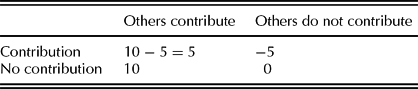
Instrumentally rational individuals free ride; payoffs from ‘no contribution’ always exceed those from ‘contribution’. If each individual acts instrumentally, the solution is 0 (bottom right-hand cell of Table 1) but if each contributed the payoff would be £10–£5.
Incentives change when individuals derive intrinsic value (equal to £6) from expressing identity as an ‘insider’ (to themselves and to others).
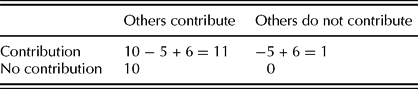
Each individual acts to express identity. Each secures net intrinsic value (£6–£5) and each derives a far greater welfare gain (£16–£5). It is also the case that action is now likely to depend on how others (as a group) behave. In Table 2, perceptions of the intrinsic value of action may depend on now others behave. Expressive action as an ‘insider’ increases welfare.
Collective action: ‘consumption’ gain from action
The welfare effects of expressive action are quite different when individuals choose to express identity by ‘conspicuous consumption’. In Table 3 payoffs are reported when an individual considers whether to spend £4 acquiring a good purely as a status symbol (i.e. to derive a private ‘consumption’ gain from action equal to £5). If others are unable to acquire the good, the payoff from acquisition is (£5–£4) but, if others purchase the good, the status gain of £5 is ‘cancelled’. Of course, if the individual does not acquire the good, the individual is £5 worse off when others purchase the good. In the final cell of Table 3, if no one purchases the good there is no effect on welfare.
Collective action and ‘frames of reference’

Once again, the individual is motivated by the ‘consumption’ gain derived from expressive action (£5–£4) but, if all behave this way (all acquire the good), the outcome is −£4 (in the top left-hand cell). The outcome is worse than if no one acquired the good (i.e. 0 in the lower right-hand cell). Expressive action ‘distinct from the herd’ reduces welfare.