Implications
Alpaca is one of the most important animals producing fine fleece with 22 natural coat colors. In this report, we present results of an alpaca skin EST (expressed sequence tag) sequencing project that has been deposited in GenBank as library name ASCD that we feel will be of particular utility to researchers with an interest in genomics and physiology of skin and of general interest to physiologists/endocrinologists interested in comparative animal biology. Furthermore, these results provide a valuable resource for studying the mechanisms regulating alpaca coat color.
Introduction
Alpaca (Vicugna pacos) are important fiber-producing animals. It's fleece is commercially famous and known as ‘soft gold’. The commercial value of Alpacas is a product of their fleece color diversity. Alpacas exhibit approximately 22 basic colors with many variations and blends (Hoffman, Reference Hoffman2006). The mechanisms responsible for formation of numerous natural fiber colors in alpaca are unknown.
Transcriptional profiling is a powerful approach for identification of genes functionally expressed in various tissues including skin (Kim et al., Reference Kim, Kim, Lim, Lee, Oh, Park, Jang, Kim, Jeon, Choi, Lee, Chung and Kim2006). EST (expressed sequence tag) analyses of gene expression in skin from mouse embryos (Headon and Overbeek, Reference Headon and Overbeek1999), sheep (Adelson et al., Reference Adelson, Cam, DeSilva and Franklin2004) and fish (Karsi et al., Reference Karsi, Cao, Li, Patterson, Kocabas, Feng, Ju, Mickett and Liu2002; Cerda-Reverter et al., Reference Cerda-Reverter, Haitina, Schioth and Peter2005) have led to the identification of many genes associated with skin functions. However, very little information is available regarding the expression of genes and limited research has been conducted to characterize global gene expression in alpaca skin. An example of the limited research on gene expression in alpaca skin includes a previous study from our group showing differential expression of micropthalmia-associated transcription factor gene in skin tissues from alpacas of different coat colors (Zhu et al., Reference Zhu, He, Jia, Jiang, Bai, Yu, Lv, Fan, He, Geng, Dong, Qiao, Lee, Smith and Dong2009).
To investigate genes that may play important roles in alpaca skin, particularly in fiber/coat pigmentation, we constructed a cDNA library from white alpaca skin using SMART technology. The library is non-normalized, and therefore represents a unique source of information on functionally expressed genes. A total of 5359 EST sequences were generated from the library. Analysis of these sequences has resulted in the identification of 14 putative genes associated with alpaca fleece quality, coat color and fiber growth and development. This unique collection of EST sequences provides a valuable genomic resource for future identification and characterization of genes essential for hair growth cycle and coat color determination and the corresponding gene regulation networks in alpaca and other fiber-producing animals.
Material and methods
Alpaca skin sampling and total RNA extraction
Housing and care of alpacas and collection of skin sample for use in described experiments were conducted in accordance with the International Guiding Principles for Biomedical Research Involving Animals (http://www.cioms.ch/frame 1985 texts of guidelines.htm). A healthy 3-year-old white female Huacaya alpaca was selected from the Alpaca farm in Shanxi Agricultural University (Shanxi, China) for sample collection. A piece of skin (2 cm × 3 cm) from the neck was collected surgically and immediately stored in liquid nitrogen. Total RNA from the sample was extracted using Trizol reagent (Invitrogen, Carlsbad, CA, USA) according to the manufacturer's instructions. The RNA integrity was evaluated by gel electrophoresis and the RNA purity was checked by the ratio of OD260/OD280.
cDNA library construction and characterization
The cDNA library was constructed using the SMART cDNA Library Construction kit (LD-PCR; Clontech, Mountain view, CA, USA) according to the manufacturer's instructions. Briefly, 2 μg of total RNA was subjected to reverse transcription for synthesis of first strand cDNA followed by 24 cycles of PCR using SMART primers (SMART IVTM Oligonucleotide: 5′-AAGCAGTGGTATCAACGCAGAGTGGCCATTAC GGCCGGG-3′; CDS III/3′ PCR Primer: 5′-ATTCTAGAGGCCGAGGCGGCCGA CATG-d(T)30N–1N-3′(N = A, G, C, or T; N–1 = A, G, or C). The PCR products were then digested with SfiI restriction enzyme followed by cDNA size fractionation using Chroma Spin-400 columns. The size-selected cDNA fragments were directionally ligated into SfiI-digested λTriplEx2 vector (Clontech). Packaging of the ligated λ was performed in vitro using Gigapack III plus packaging extract (Stratagene, LaJolla, CA, USA). The SMART protocol is designed to generate clones containing 5′ sequence information for the mRNA.
To determine the titer of the unamplified library, diluted phage was mixed with XL1-Blue and plated on LB-agar/MgSO4 plates with melted top agar, and then incubated at 37°C for 6 to 18 h. The plaques were counted and the titer (pfu/ml) of the library was calculated as: (number of plaques) × (dilution factor) × (103 μl/ml)/(μl of diluted phage for plating).
The percentage of recombinant clones was determined by adding IPTG and Xgal to melted top agar before plating the phage-bacteria mixture for blue/white screening. The plates were incubated at 37°C for 6 to 18 h. White (recombinants) and blue plaques (non-recombinants) were counted and the percentage of recombinants was calculated as: (number of white plaques)/(number of white plaques + number of blue plaques) × 100%.
To estimate the representative insert sizes for clones within the library, PCR was performed to amplify cDNA inserts from randomly selected clones using the 3′ special sequencing primer (T7) and the 5′ universal sequencing primer (TCCGAGATCTGGACGAGC-3′). In all, 5 μl of amplified products were analyzed by 1% agarose gel electrophoresis.
cDNA sequencing and sequence analysis
Before sequencing, recombinant λTriplEx2 was converted to pTriplEx2 plasmid according to manufacturers’ instruction. Approximately 12 000 colonies were picked randomly and cultured in plates containing Luria Bertani medium with carbenicillin. DNA sequencing was performed by Huada Gene Company (Beijing, China). Raw sequences were trimmed to remove vector and low-quality sequences using the CrossMatch program (service provided by Huada Gene Company, Beijing, China). All sequences >50 bp were submitted to GenBank.
Trimmed EST sequences >100 bp were assembled using CAP3 program with minimum base overlap of 50 and minimum percentage match of 80 (service provided by Huada Gene Company). The assembled consensus sequences were compared with the sequences in the NCBI nr database using BLASTN program. The known sequences were categorized using terms from gene ontology (GO). Gene annotation was performed using GO software (service provided by Huada Gene Company).
For cross-species comparative analysis of keratin family genes, the contig sequences representing alpaca KRT10, 14 and 15 were compared with their corresponding gene sequences from mouse, human, cattle and sheep (obtained by keyword search of the GenBank or Gene Index database) using bl2seq function at the NCBI server (http://blast.ncbi.nlm.nih.gov/Blast.cgi).
Results
Using SMART cDNA technology, we successfully constructed a cDNA library from white alpaca skin. The titer of the unamplified cDNA library was determined to be 109 pfu/ml. The percentage of recombinants was estimated to be >80% based on blue/white screening. The sizes of cDNA inserts in the library ranged from 250 to 750 bp as shown by colony PCR. A total of 7286 EST sequences > 50 bp were obtained and submitted to the GenBank database (accession numbers: EH218976-EH219025, ES263542-ES263641, ES444048-ES444167, ES605553-ES605692, ES608886-ES609085, ES768454-ES768853, EV254357-EV254756, EV552651-EV554902, EX159842-EX162087, EX656048-EX656750 and EY413719-EY414393). Of these sequences, 5359 were > 100 bp and were used for further analyses. Assembly of these sequences resulted in 3504 unique sequences including 739 contigs and 2765 singletons. The contigs were, respectively, assembled by two ESTs (67.79%), three ESTs (14.22%), four to five ESTs (8.91%), six to 10 ESTs (6.21%), 11 to 20 ESTs (1.61%) and 21 to 50 ESTs (0.95%). The largest contig contained 81 ESTs, which represents an unknown gene.
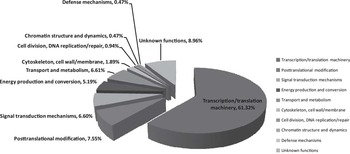
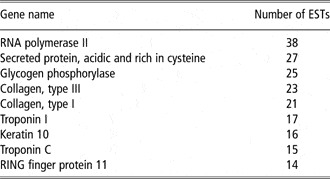
BLAST analysis (E-value < 10−10) revealed that of the 3504 unique sequences, 1287 were highly similar to known sequences from other species in the database and the remaining 2217 had no hit or low identity with sequences in the database, which may represent novel transcripts in alpaca skin. Of the 1287 unique sequences with significant hits, 863 were annotated through GO analysis. These unique genes were grouped into 10 classes based on their putative functions (Figure 1). The majority of these annotated genes were classified as genes involved in the transcription and translation machinery (60.85%). Other known genes significantly represented in the library were classified as genes involved in energy production and conversion (5.19%), transport and metabolism (6.61%), signal transduction mechanisms (6.6%) and post-translational modification (7.55%). Genes highly expressed in alpaca skin included RNA polymerase II, glycogen phosphorylase, collagen types I and III, secreted protein acidic and rich in cysteine (SPARC), troponin C2 and KRT10 (Table 1). The 863 annotated unique sequences with their GO terms are listed in supplementary Table 1.
Classification of 863 annotated genes identified in alpaca skin based on sequence homology to entries in GenBank at E-value < 10−10.

Genes highly expressed in alpaca skin

ESTs = expressed sequence tags.
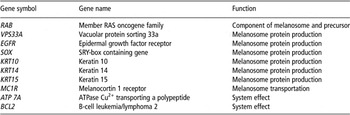
In the ESTs from alpaca skin, a number of genes related to hair development and pigmentation were identified. To date, 127 genes in different pathways controlling hair color formation have been identified in mouse (Bennett and Lamoreux, Reference Bennett and Lamoreux2003). Of these known genes involved in hair color formation, 10 were found to be expressed in alpaca skin (Table 2). A cross-species comparative analysis of the three members (KRT10, 14 and 15) of the keratin gene family revealed that KRT10 (82% to 92% sequence identity) and KRT14 (81% to 93% sequence identity) are more conserved than KRT15 (74% to 84% sequence identity) among the mammalian species studies (Table 3).
Genes expressed in alpaca skin that are associated with coat color formation

Sequence comparison of alpaca and other mammalian keratin genes

GenBank accession numbers for mouse KRT10, KRT14 and KRT15 are NM_010660, BC003325 and NM_008469, respectively.
GenBank accession numbers for human KRT10, KRT14 and KRT15 are NM_000421, BC042437 and NM_002275, respectively.
GenBank accession numbers for cattle KRT10, KRT14 and KRT15 are BC149077, NM_001166575 and BC118284, respectively.
Tentative Consensus (TC) numbers for sheep KRT10, KRT14 and KRT15 are TC38701, TC37618 and TC32219, respectively.
Discussion and conclusion
To investigate genes that may play important roles in alpaca skin, particularly in fiber/coat pigmentation, we constructed a cDNA library from white alpaca skin using SMART technology. The library is non-normalized, and therefore represents a unique source of information on functionally expressed genes. Analysis of EST sequences generated led to identification of putative genes associated with alpaca fleece quality, coat color and fiber growth and development. This unique collection of EST sequences provides a valuable genomic resource for future identification and characterization of genes essential for hair growth cycle and coat color determination and the corresponding gene regulation networks in alpaca and other fiber-producing animals.
Of the known genes identified from EST sequencing, RNA polymerase II was represented at the highest frequency. RNA polymerase II is responsible for transcribing nuclear genes encoding mRNAs and some small nuclear RNAs (Nikolov and Burley, Reference Nikolov and Burley1997). It also plays an active role in mRNA maturation and its export to the cytoplasm (Sims et al., Reference Sims, Mandal and Reinberg2004). The high expression of RNA polymerase II in alpaca skin suggests that alpaca skin is a site of abundant transcription. Glycogen phosphorylase catalyzes the intracellular degradation of glycogen (Johnson, Reference Johnson1992) and is an important determinant of the rate of glycogenolysis (Young et al., Reference Young, Radda and Leighton1996). In addition, glycogen phosphorylase is an archetypal control protein regulated by reversible phosphorylation and by allosteric effectors (Johnson, Reference Johnson1992). The hair follicle is unique in that it is the only organ in the mammalian body which, for its entire lifetime, undergoes cyclic transformations from stages of rapid growth (anagen) to apoptosis-driven regression (catagen) and back to anagen, via an interspersed period of relative quiescence (telogen) (Paus and Foitzik, Reference Paus and Foitzik2004; Tobin et al., Reference Tobin, Hordinsky and Bernard2005). The high expression of glycogen phosphorylase in alpaca skin likely is reflective of use of glycogen as an energy source during hair growth. Members of the collagen family function in providing structural support and strength to the extracellular matrixes of bone, cartilage, skin, blood vessels and other connective tissues (Jimenez et al., Reference Jimenez, Varga, Olsen, Li, Diaz, Herhal and Koch1994; Pace et al., Reference Pace, Corrado, Missero and Byers2003). This study detected transcripts for three collagen members (collagen types I, III and VII). Transcripts for collagen types I and III are abundantly present in the alpaca skin, which is consistent with a previous report (Ala-Kokko et al., Reference Ala-Kokko, Rintala and Savolainen1987) showing collagen types I and III are the main collagen members expressed in human skin (80% to 90% and 10% to 15% of the total collagens, respectively). Increased expression of SPARC is associated with collagen production, and lack of SPARC results in decreased collagen accumulation (Strandjord et al., Reference Strandjord, Madtes, Weiss and Sage1999). It is known that SPARC mediates the association of procollagen I with cells, and its processing and incorporation into the extracellular matrix (Rentz et al., Reference Rentz, Poobalarahi, Bornstein, Sage and Bradshaw2007). Therefore, SPARC is implicated as a key regulator of collagen incorporation in tissues. The high expression of SPARC observed is suggestive of a similar functional role for SPARC in alpaca skin. Results indicate both troponin C2 and KRT10 are highly expressed in alpaca skin. Troponin C2, a typical Ca2+-binding protein, may play a role in epithelial differentiation into cutin stratum (Berridge et al., Reference Berridge, Lipp and Bootman2000; Hwang et al., Reference Hwang, Kalinin and Morasso2005). KRT10 can terminate the differentiation and keratinization of cells directly (Koch and Roop, Reference Koch and Roop2004) by blocking cutin stratum formation (Chen et al., Reference Chen, Cheng, Merched-Sauvage, Caulin, Roop and Koch2006). Thus, troponin C2 and KRT10 may cooperate to protect the epiderma from hyperkeratosis.
Another highly expressed gene detected in alpaca skin was troponin I. Troponin I may help regulate coat color formation by acting competitively with basic fibroblast growth factor (bFGF) for binding to bFGF receptors (Feldman and Rouleau, Reference Feldman and Rouleau2002). Development of hair follicles during the hair growth cycle is regulated by bFGF (du Cros, Reference du Cros1993; Ozeki and Tabata, Reference Ozeki and Tabata2002) and bFGF can increase the activity of dopa oxidase, the main enzyme in melanosome formation thereby increasing skin pigment (melanin) content (Balafa et al., Reference Balafa, Smith-Thomas, Phillips, Moustafa, George, Blount, Nicol, Westgate and MacNeil2005). In the ESTs from alpaca skin, numerous genes related to hair development and pigmentation were identified including thymosin β4 and thymosin β10 (a variant of thymosin β4). Thymosin β4 is known to promote hair growth and increase the number of anagen hair follicles in rat and mouse (Philp et al., Reference Philp, Nguyen, Scheremeta, St-Surin, Villa, Orgel, Kleinman and Elkin2004). In the mouse, 127 genes in different pathways controlling hair color formation have been identified (Bennett and Lamoreux, Reference Bennett and Lamoreux2003). Of the ten alpaca homologes found in this study, the majority are involved in melanosome protein production including three members (KRT10, 14 and 15) of the keratin gene family. Surprisingly, the alpaca keratin genes share more sequence homology with their mouse counterparts than with the keratin genes of other mammalian species including cattle and sheep.
In conclusion, this is the first report of large-scale EST generation and analysis from alpaca skin. Our findings are vital to improve the understanding of the role of skin-expressed genes in alpaca fleece quality, growth and coat color and other physiological functions. These results provide a valuable resource for future studies of the biology of skin and regulation of pigmentation in fiber-producing animals beyond the alpaca.
Acknowledgements
We thank Dr Xinming Li from the University of California (Los Angeles, CA, USA) for assistance with construction of the cDNA library and Dr Runzhi Li from the University of Kentucky (Lexington, KY, USA) for assistance with language editing of the manuscript. This study was supported by a grant from the National Natural Science Foundation of China (no. 30671512) and by Shanxi Province Science Foundation for Youths (no. 2008021038-3).