1. Introduction
A critical question for economic development is the role of international trade in facilitating the adoption and upgrading of technologies. Participating in international trade can support the diffusion through different channels. Regarding imports, the competitive pressure from increased imports of similar goods can incentivize technology upgrading to diversify to other products but also reduce the rents and push some producers to lower quality segments; thus, disincentivizing innovation and technology adoption. Easier and cheaper access to imports can also facilitate the adoption of new technologies via a reduction in costs and by improving availability of such technologies. In addition, participation in international trade and global value chains (GVCs) can facilitate learning and access to existing technologies via learning from customers in more contested markets or learning from suppliers or buyers.
A rapidly growing literature has explored the links between trade and innovation, as well as technology adoption and upgrading. This literature has explored different channels. The largest share of studies has focused on the impact of imports. Particularly through two specific channels: the impact of imports of intermediate inputs and equipment and the competitive pressure from increasing imports in similar products, such as reductions in tariffs or, more importantly, the China shock. The evidence of these studies is mixed,Footnote 1 and emphasizes that the type of market and the type of firm is critical in understanding the impact on technology adoption and innovation from imports.Footnote 2
A smaller second set of studies, the focus of this paper, analyzes the impact of exports on technology upgrading and innovation. Regarding exports, two important channels are at play. First, a scale effect increases the incentives to adopt new technologies. Bustos (Reference Bustos2011) show how tariff reductions in Argentina in the context of MERCOSUR incentivized firms to adopt new technologies given the larger scale and profits. This positive effect, however, concentrated on firms at the top of the productivity distribution. Lileeva and Trefler (Reference Lileeva and Trefler2010) analyze the impact of tariff reductions in the US on Canadian plants and show that this had a positive impact on exporters, especially on lower productivity plants that are export entrants. Thus, the positive scale effect can also benefit lower productivity plants, but only if they enter export markets. A second channel is the ‘learning’ channel. Atkin et al. (Reference Atkin, Khandelwal and Osman2017) conducts an experimental design with Egyptian rug producers by randomly assigning export contracts and find an increase in quality and learning for those producers that get the export contract.
In sum, this literature finds that there is a positive ‘learning’ effect, which also applies to imports of intermediates, and a ‘scale’ effect for exporters that increases their incentives to upgrade their technologies. In their literature review, Shu and Steinwender (Reference Shu and Steinwender2019) find some evidence for all these channels, with some of the positive effects concentrated among firms that are more productive.
Identifying the sign and magnitude of the effects of exporting on technology adoption is challenging for three reasons. First, disentangling the causal direction of these effects is difficult, given that more productive firms tend to export and participate in international markets and, accordingly, are more likely to be technologically sophisticated. In addition, in preparation for exporting, firms may upgrade their technologies to generate competitiveness gains and quality upgrades, allowing them to export. A second challenge is the lack of data on technology use. Most of the evidence focuses on indirect technology measures such as patents or R&D; only Bustos (Reference Bustos2011) and Lileeva and Trefler (Reference Lileeva and Trefler2010) use direct technology measures. Third, the use of technology is multidimensional in its application to different business functions. Establishments use different technologies for different tasks, and even within the same business function. Thus, the export effects on technology adoption may differ for different tasks and technologies.
In this paper, we aim to narrow the existing gap in the literature in understanding the relationship between exporting and the technology gap. We use a unique and novel database, the Firm-level Adoption of Technology (FAT) survey, and explore the impact of exporting on technology sophistication and the adoption of selected individual technologies. The survey includes more than 1,500 firms in Brazil and provides granular information on the adoption of more than 300 technologies for different business functions as well as participation in international trading activities.
To address endogeneity issues, we take advantage of the information collected about the year of adoption of more sophisticated technologies – when adopted – and merge the data with a longitudinal dataset that includes data on export status from Brazil's Ministry of Trade by firm and year. Moreover, to capture longitudinal information on firms’ number of employees and average wages, we combine the dataset with the census of formal workers in Brazil (RAIS). The combined dataset allows us to use a quasi-experimental design to explore the effect of entering export markets on the adoption of sophisticated technologies.
Advancing our key results, we find that entering export markets increases firms’ likelihood of adopting advanced technologies linked to Business Administration and Production Planning (such as Enterprise Resource Planning (ERP)), Supply Chain Management (such as Supplier Relation Management (SRM)) and Quality Control.
The paper is structured as follows. Section 2 describes the data. Section 3 provides some initial correlations between exporting and technology use. Section 4 describes the methodology used to identify the impact of exporting on technology. Section 5 shows the main results. The last section concludes.
2. Data
2.1 The FAT Survey
The Firm-level Adoption of Technology (FAT) survey collects detailed information for a sample of firms about the technologies each firm adopts and uses to perform key business functions necessary to operate in its respective sector (see Cirera et al., Reference Cirera, Comin, Cruz and Lee2020). The survey is composed of five modules. Module A collects information on the general characteristics of the firm.Footnote 3 Module B focus on technologies used for general business functions regardless of the sector where they operate, and sector-specific business functions (module C) focus on technologies that are relevant only for firms in a given sector.Footnote 4 Module D focuses on barriers and drivers of technology adoption, while module E gathers information about the firm's balance sheet and employment.
2.1.1 Technology Grid
A critical feature of the survey is how technology is measured. To design modules B and C, the FAT survey relies on a group of technology experts to determine the business functions relevant to the firm and the list of technologies that can be used to implement the key tasks in each function, as described by Cirera et al. (Reference Cirera, Comin, Cruz and Lee2020). We call the resulting structure the Technology Grid. The grid in FAT has three characteristics. First, it is comprehensive. It includes the main business functions and the full array of technologies in each function, from the most basic to the most advanced technologies available. Second, the business functions and technologies in the grid are relevant to all firms within any given sector. In addition to identifying the key business functions and relevant technologies, technology experts also provided a ranking of the technologies in each business function based on their sophistication. Overall, the FAT survey covers about 300 technologies split into almost 60 business functions, including general business functions (GBF) that apply to all firms, regardless of the sector, and sector-specific business functions (SBF) applied to agriculture (crops and livestock), manufacturing (food processing, wearing apparel, leather, pharmaceutical, and automotive), and services (retail, accommodation, land transport, banking, and health). Appendix A shows the grid for GBF and an example of SBF for the food processing sector.
2.1.2 Technology Questions
The survey contains three types of questions about the technologies used by the firm. First, FAT asks whether the firm uses each of the technologies in the grid to conduct the tasks of the particular business function. After determining the technologies that are used by the firm in a business function, the survey asks which of these technologies is the most widely used in the business function. Third, when a firm uses an advanced technology in a given business function, the survey asks how many years the technology has been adopted. This allows us to produce three types of measures of sophistication. One regarding all the technologies that are used, extensive measure (EXT); one regarding the most frequently used technology, intensive measure (INT); and finally, the years of adoption for advanced technologies.
2.1.3 A Summary Technology Sophistication Index
As an aggregate indicator to measure sophistication, we use a simple cardinal index. Based on the experts’ assessment, we order the technologies in each function f according to their sophistication, and assign each a rank r f ∈ 1, 2, …, R f, from least to most advanced. Because several technologies may have the same sophistication, the highest rank in a function R f may be smaller than the number of possible technologies N f.Footnote 5 We define the relative rank of a technology as  $\hat{r}_f = {{r_f-1} \over {R_f-1}}$. Note that
 $\hat{r}_f\in [ 0, \;1] $. The technology sophistication of business function f in firm j is a monotonic increasing function of the relative rank of the most widely used technology of firm j in function f (
 $\hat{r}_{f, j}$). For example, our baseline sophistication measure is
 $$s_{\,f, j} = 1 + 4\ast \hat{r}_{\,f, j}.$$
Since our baseline sophistication measure is linear, it displays constant increments in sophistication as we move up in the rank. For example, a firm that uses ERP for production planning, the frontier technology has a score of 5, while one that uses specialized planning software would have an index of 4. A priori, the sophistication measures could also be concave or convex in the rank, reflecting diminishing or increasing marginal increments in sophistication as the rank increases. In Cirera et al. (Reference Cirera, Comin, Cruz and Lee2020), we show how this simple index is robust to alternative cardinalizations,Footnote 6 but we use the index only in the descriptive statistics section, moving to adoption of specific advanced technologies in the empirical section.
2.1.4 Sample
We use an original sample of about 1,500 establishments from Brazil. The data include information from formal establishments in agriculture, manufacturing, and services with at least five employees. Table 1 contains detailed information for our sample, disaggregated at narrowly defined industries. For instance, in manufacturing, a large share of establishments is in food processing and wearing apparel, whereas in the services sectors, most establishments are in wholesale and retail. Data were collected face-to-face in 2019 for the state of Ceará. For the states of São Paulo and Paraná, interviews were carried out during 2022.
Sample distribution by sector

Note: Table shows the frequency and share of firms by sectors in Brazil in the FAT survey. FAT = Firm-level Adoption of Technology.
In addition to detailed information on the technology used for each business function, the FAT survey also includes information on several firm characteristics, which we use to control for other covariates likely to explain differences in technology adoption. For example, in addition to firms’ size, region, and sector, the database includes information on managers’ and workers’ education, the use of formal incentives and performance indicators, and innovation practices, among others. Table 2 offers a description of the information available in the database and presents the main differences between exporters and non-exporters. For instance, the first four lines describe the gap between exporters and non-exporters for the logarithm of the four technological indexes. Non-exporters show, on average, 11% to 22% lower indexes, are also significantly smaller, interact less with multinational enterprises (MNEs), and receive less government support. Moreover, fewer non-exporters use formal incentives and performance indicators. The gap is also large for managers with a college degree, experience in large companies, or experience abroad. Finally, exporters are more likely to innovate and show a larger share of R&D employees.
Differences between exporters and non-exporters

Note: *p < 0.10, **p < 0.05, ***p < 0.01. Descriptive statistics and differences by exporter status are shown. The first four rows present the logarithm of the technology indexes including GBF (EXT and INT) and SBF (EXT and INT). The last column is the coefficient of a simple regression of trade status on the variable. GBF EXT = General Business Function Extensive Margin, GBF INT = General Business Function Intensive Margin, SBF EXT = General Business Function Extensive Margin, SBF INT = General Business Function Intensive Margin.
2.2 Linked Longitudinal Data
To address endogeneity issues from using only cross-sectional variation in the FAT data, we construct a panel data to exploit additional time variation for the quasi-experimental design while dealing with firm heterogeneity with firm fixed effects. We first merge the FAT with the Relação Anual de Informações Sociais (RAIS) from 1994 to 2020, which is a linked employer–employee data of all registered firms in Brazil. This allows us to construct the panel of firms with firm characteristics that is linked to the year of the adoption of more sophisticated technologies in FAT. We also link the data to administrative records from the Brazil's Ministry of Trade to get information on export status at the firm-level across years. The linked longitudinal data from 1994 to 2020 allows us to use a quasi-experimental design (difference-in-differences estimator) to explore the effect of entering export markets on adopting advanced technologies. In essence, we compare the adoption rates of treated firms over the short and medium run with the adoption that would have occurred if they had not started to export.
3. Methodology
We begin with examining how exporting status is related to technology adoption using the cross-sectional variation in the FAT data. The data allow us to examine the association between exporting and different levels of technology sophistication across various business functions while controlling for firm characteristics. We use linear regression to estimate the association with the following specifications.
 $$S_i = \alpha + \delta Export_i + {X }^\prime _i { \beta} + u_i$$
where S i is the technology sophistication measured with technology indices (GBF EXT, GBF INT, SBF EXT, and SBF INT) in a firm i, Export i is an indicator for a firm that participates in exporting markets, and the vextor X i is the set of firm characteristics including sector, size, age, multinational and innovation status, use of formal incentives, financial constraint, and manager's education and experience abroad.
Although we use the FAT data to control various firm characteristics that are correlated with both exporting status and technology sophistication, the estimates from linear regressions may suffer from endogeneity issues due to omitted variables and reverse causality. To better identify causality on the effect of entering international markets on the adoption of advanced technologies, we use the linked longitudinal data and exploit the additional time variation created by the years of adoption of advanced technologies and exporting status. The longitudinal data also permit us to control for time invariant unobserved firm heterogeneity with the firm fixed effects.
Specifically, we use an event study and apply the difference-in-differences with multiple periods developed in Callaway and Sant'Anna (Reference Callaway and Sant'Anna2021). As a dependent variable, we focus on adopting advanced technologies for eight general business functions: business administration, production planning, supply chain management, marketing, sales, payment, quality control, and fabrication (only available for firms in manufacturing). The list of technologies for each business function includes: (i) specialized software and ERP for Business Administration; (ii) specialized software and ERP for Production Planning; (iii) non-integrated and integrated Supplier Relation Management (SRM) for Supply Chain Management; Customer Relationship Management software (CRM) and Big data Analytics or Machine learning algorithms for Marketing; (v) computer numerical controlled machine, robots, and advanced manufacturing for Fabrication; (vi) online sales and electronic orders integrated to specialized supply chain management systems for Sales Methods; (vii) online or electronic payment through a bank wire and online payment through platform for Payment Methods; and, (viii) statistical process control with software monitoring and data management and automated systems for inspection for Quality Control. For instance, in the case of business administration, we have information on whether firms adopted specialized software or ERP and, more importantly, the date on which the firm adopted it. Using the years of adoption, we create an indicator for each business function equal to 1 from the year the firm adopted a given advanced technology and 0 in the previous years.
In a typical difference-in-differences setting, we are confronted with two time periods: no firm is treated in the first period, and a group is treated in the second. Nevertheless, in our setting, in addition to multiple periods, firms enter exporting markets at different times, thus creating variation in the treatment timing. Traditionally, the response to this challenge is by estimating a model that includes dummies for cross-sectional units (α i) and time periods (α t) and a treatment dummy (D it). For example, the basic event study model would be:
 $$y_{it} = \alpha _i + \alpha _t + \beta ^{DD}D_{it} + \epsilon _{it}$$
where y it is the outcome of interest. Nevertheless, under the presence of time-varying treatment effects, the difference-in-differences estimator has been found to be biased (Goodman-Bacon, Reference Goodman-Bacon2021; Bakerand et al., Reference Baker, Larcker and Wang2022). In our case, entering export markets could have heterogeneous effects on technology adoption over time, especially considering variation in costs and technology diffusion. To address this issue, we take advantage of recent developments in the difference-in-differences literature and apply the multiple periods estimator proposed by Callaway and Sant'Anna (Reference Callaway and Sant'Anna2021). The method breaks down several treatment periods into group-time average treatment effects (the average treatment effect in period t for the group of units first treated in period g) and aggregates them into meaningful measures of the causal effects.Footnote 7 The average treatment effect on the treated (ATT) for a treatment-timing group g is thus:
 $$ATT( g, \;t) = E[ Y_t( g) -Y_t( 0) \vert G_g = g] , \;{\rm for\;}t \ge g$$
where G g denotes the time when unit i receives treatment and G g = g for all firms that receive treatment at time period g. For instance, take the case where there are five groups, each of which is treated in 2010, 2011, 2012, 2013, and 2014, and the panel ends in 2016. As a result, the model estimates a total of 15 group-time ATTs: 5 ATT(g,t) for the first group, 4 for the second, 3 for the third, 2 for the fourth, and 1 for the last.Footnote 8 In most of our discussion, we focus on a weighted average of post-treatment average effects from t to t + 5 with weights proportional to the group size. The model assumes parallel trends of the potential outcome in the absence of treatment, which we relax to hold, conditional on the covariates. In addition to a dummy indicating firms in the services sector, we add the logarithm of employment and average wages as control variables so that parallel trends hold only after conditioning on a vector of pre-treatment covariates. Finally, estimates use the doubly robust estimator based on stabilized inverse probability weighting and ordinary least squares proposed by Sant'Anna and Zhao (Reference Sant'Anna and Zhao2020).
4. Results
4.1 Cross-Sectional Results
Our starting point in exploring the relationship between exporting and the adoption of advanced technologies is looking at the cross-sectional relationship between trade status and the technology index. Figure 1 shows the coefficient estimates and 95% confidence intervals from the regressions of the different aggregate technology indices on the exporting status, controlling for sector, dummies for firms’ size and age, and additional control variables. The indices include the extensive measure (EXT) and the intensive measure (INT) for both general business function (GBF) and sector specific business function (SBF). The estimates show a positive correlation between exporter status and technology sophistication for all indices.
Technology adoption and participation in international trade
Notes: The coefficients of exporter status with 95% confidence intervals from the regressions for technology sophistication measures are provided. Each technology measure is regressed on a dummy equal to 1 if the firm exports. Linear regressions control for sector, size, age, multinational and innovation status, use of formal incentives, financial constraint, and manager's education and experience abroad.

The results show positive associations between exporting status and different technology sophistication measures. Compared to non-exporters, exporters are likely to have 25% or more larger technology indices in general business functions (both extensive and intensive margin) and sector specific business functions (extensive margin). These associations are statistically significant. The association with the intensive margin of sector specific business functions is positive, but the magnitude of the coefficient is slightly lower (about 15%) and insignificant. In other words, exporters not only adopt more advanced technologies but also intensively use such technologies to perform general business functions. They also adopt advanced technologies for sector-specific business functions, but these technologies may not be used intensively.
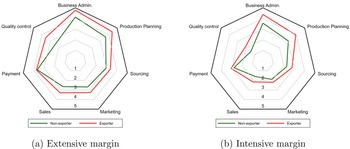
To better understand if the technology gap between exporter and non-exporter varies across different types of business functions, we focus on general business functions and examine the averages of both extensive and intensive margins of disaggregated business functions in Figure 2. In terms of the extensive margin in Panel (a), exporters tend to have higher levels of technology sophistication in all business functions, except for payment. Particularly, the sophistication level is much higher in business administration and production planning. And the gap of the extensive margin is the largest in quality control. With regard to the intensive margin in Panel (b), the average sophistication decreases for both the exporter and non-exporter across all business functions, particularly in sourcing, marketing, sales, and quality control. But the gap does not disappear. Exporters intensively use more advanced technologies than non-exporters.
Technology Sophistication by Business Function by Exporting Status
Note: The simple averages for each group in each business function are given.

Finally, Figure 3 shows the average technology sophistication measures by sector in the sample, excluding services. Differences between the two exporting status groups are larger in food processing and agriculture. These correlation results are consistent and complement other empirical work in developed economies, showing that firms that participate in international trade concentrate a significant number of patents (see Aghion et al., Reference Aghion, Bergeaud, Lequien and Melitz2018, for French firms) and R&D (see Foster et al., Reference Foster, Grim and Zolas2020, for US firms).
Technology sophistication of exporter and non-exporter by sector
Notes: Each technology measure is regressed on a dummy equal to 1 if the firm exports. Linear regressions control for sector, size, age, multinational and innovation status, use of formal incentives, financial constraint, and manager's education and experience abroad. We define the frontier as a technology sophistication index higher than 3.5, representing around 5% of firms in our sample.

4.2 Difference-in-Differences Results Using Linked Longitudinal Data
The results in the previous sections suggest the potential impact of exporting on the adoption and use of technologies. But even after controlling for several key firm characteristics, the associations could be biased due to contemporaneous shocks, omitted variables, or reverse causality. To disentangle the causal effect of trade exporting on technology sophistication, we move on to analyze the linked longitudinal data.
Table 3 shows the main results of estimating the impact of entering export markets on the probability of adopting, which are based on the average treatment effect on the treated from t to t + 5. We find a positive and significant impact of entering the international market on adopting more sophisticated technologies for most business functions, with particularly large coefficients for business administration, production planning, supply chain management, and quality control. For instance, after starting to export, establishments tend to have a 13.7% larger propensity of adopting specialized software or ERP for business administration, compared to those not exporting. Moreover, in the case of quality control, the export status is associated with a 8.9% larger probability of adopting statistical process control with software monitoring and data management or automated systems for inspection. It is also interesting to note that coefficients are positive for all business functions – although not statistically significant in some cases.
Effect of exporting on the adoption of advanced technologies for business functions

Notes: ***p < 0.01, **p < 0.05, *p < 0.1. The estimates of the ATT from the difference-in-differences with multiple time periods are shown. In columns (1)–(7), the sample includes all firms in the FAT data linked to trade and employer–employee data. In column (8), the sample includes manufacturing firms in the linked data. For each business function, the dependent variable is a dummy equal to 1 if a firm adopts the advanced technologies from the year and 0 otherwise. Specifications control the logarithm of wages, the logarithm of total employment, and a dummy for the services sector. Robust standard errors are in parentheses. ATT = Average Treatment on the Treated.
Figure 4, panel (a) shows the disaggregated coefficient estimates for Business Administration from t − 5 to t + 5 from the event study. The results indicate that during the years before treatment, coefficients are not statistically different from zero, which we interpret as an indication that the parallel trends’ assumption holds and that there is no anticipation effect. In contrast, following the treatment, we observe a clear positive effect, which increases over time. The results are consistent with a model in which export increases firms’ managerial layers (Caliendo and Rossi-Hansberg, Reference Caliendo and Rossi-Hansberg2012; Garicano and Rossi-Hansberg, Reference Garicano and Rossi-Hansberg2014). To cope with more complex tasks induced by trade participation, firms raise the number of managers and adopt more sophisticated technologies for business administration. Results are also consistent with the scale effect channel, through which larger demand induces the adoption of new technologies (Bustos, Reference Bustos2011).
Effect of exporting on the adoption of advanced technologies: (a) Business Administration (b) Production Planning (c) Supply Chain Management (d) Quality Control
Notes: The figure shows the estimates of the interaction between time-to-event dummies and a treatment indicator from a regression including firm fixed effects, time-to-event dummies, and year fixed effects. Estimates also include a dummy for the services sector, the logarithm of wages, and the logarithm of total employment as controls. The dependent variable is a dummy equal to 1 if the establishment adopted a advanced technology in each business function. Vertical bars show estimated 95% confidence intervals.

We also find similar results for quality control technologies. Coefficients are positive from t to t + 5, without signs of preparation to export. The findings align with the literature showing that firms increase product quality as they enter international markets (Álvarez and Fuentes, Reference Álvarez and Fuentes2011). Export markets carry higher-quality requirements, and exporting firms produce higher-quality products by increasing the quality of their inputs and varying the quality of their products across destinations (Kugler and Verhoogen, Reference Kugler and Verhoogen2008; Manova and Zhang, Reference Manova and Zhang2012).Footnote 9 Our results show that as firms adapt to more restrictive quality standards, they adopt more advanced technologies for quality control.
Finally, the positive effect on the adoption of advanced technologies in production planning and supply chain management is likely to be associated with the need to manage more efficiently and timely the production process and the increasing number of buyers and suppliers. For instance, availability of high-quality intermediate goods is often limited in developing countries’ local markets. As firms enter export markets, they not only engage with additional buyers but are also likely to expand the range of suppliers to acquire better intermediate goods and better manage risks associated with disruptions in the supply chain, since the costs of not fulfilling export orders are higher.
5. Conclusions
Understanding the role that participating in international trade has in the diffusion of advanced technologies is critical for developing countries. But while a large literature has focused on the import channels for diffusion and adoption, much less is known on the role of entering export markets in facilitating this diffusion and adoption of new technologies. This paper aims to fill the gap in this literature by identifying the impact of exporting on the adoption of more sophisticated technologies in Brazil.
Using a novel dataset with longitudinal information on exporting and technology use, and implementing a difference-in-differences estimator to a sub-sample of establishments in Brazil, we find a positive and statistically significant effect on the likelihood of adopting sophisticated technologies in key business functions for exporting. For example, starting to export is associated with a 13.7% larger probability of adopting specialized software or ERP for business administration; and an 8.9% larger probability of adopting statistical process control with software monitoring and data management for inspection in quality control. We also find positive and significant effects on the probability of adoption in production planning or supply chain management. The evidence presented is consistent with models suggesting that exporting increases the complexity of tasks and processes within the firm, and these require better technologies to help manage these tasks and processes.
While the evidence presented here is aligned with other empirical work showing a positive impact of exporting on innovation, more evidence is needed to identify the key channels that explain this positive relationship. For example, what is the role that international buyers play in transferring these more advanced technologies, or what role does competing in more contested international markets play in incentivizing technology upgrading? These questions need to be investigated in the future studies.
Acknowledgements
We thank Martha Denisse Pierola, Santiago Reyes Ortega, and the participants of the Festschrift conference in honor of Professor L. Alan Winters (Economic policy, Openness and Development), and two anonymous referees for their useful comments and suggestions.
Appendix A Examples of the Technology Grid
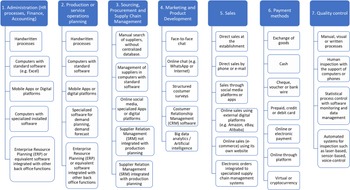
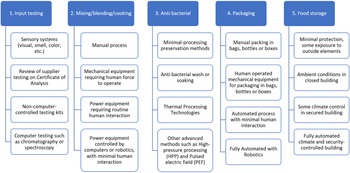
Figure A1 shows the grid for general business functions that all firms, regardless of the sector, respond. Figure A2 shows one example of sector-specific business functions for the food processing sector.
General Business Functions and Their Technologies
Source: Cirera et al. (Reference Cirera, Comin, Cruz and Lee2020).

Sector Specific Business Functions and Technologies in Food Processing
Source: Cirera et al. (Reference Cirera, Comin, Cruz and Lee2020).