Chronic, non-malignant pain disorders, such as neuropathic pain and chronic low back pain, affect approximately 15% of adults in the general population (Verhaak, Kerssens, Dekker, Sorbi, & Bensing, Reference Verhaak, Kerssens, Dekker, Sorbi and Bensing1998). The implications of chronic pain on individuals’ lives are widespread, affecting employment, self-care, financial stability, and relationships (Turk & Okifuji, Reference Turk and Okifuji2002). Psychological treatments, including cognitive behavioural and acceptance-based approaches, have been found to be helpful for chronic pain interference in daily life (Morley, Eccleston, & Williams, Reference Morley, Eccleston and Williams1999; Wetherell et al., Reference Wetherell, Afari, Rutledge, Sorrell, Stoddard, Petkus and Atkinson2011). Better understanding of mechanisms of change and bolsters to interventions will likely increase treatment gains for these individuals. Cognitive behavioural therapy (CBT) has been found to be effective in improving quality of life in patients with chronic pain by targeting cognitions and behaviours that may be maladaptive and distorted (Morley et al., Reference Morley, Eccleston and Williams1999). However, not all patients respond to CBT and may find other psychological interventions to be helpful (McCracken & Turk, Reference McCracken and Turk2002). Acceptance and commitment therapy (ACT) aims to increase non-judgmental acceptance of life circumstances and to identify and motivate life choices in support of one's values. Through these mechanisms, ACT aims to decrease the interference of pain in the lives of those with chronic pain by increasing salience of important life values, such as health, recreation, and interpersonal relationships. By increasing salience of these and other endorsed values, it is theorised that behavioural activation and engagement with valued life directions will increase (Hayes & Duckworth, Reference Hayes and Duckworth2006).
Physical activity was theorised to be an aspect of values engagement that would be important to assess throughout and after treatment. Increased levels of physical activity have been associated with decreased symptoms among individuals with chronic illness (Stewart et al., Reference Stewart, Hays, Wells, Rogers, Spritzer and Greenfield1994). In addition, exercise-based interventions have been helpful in reducing pain symptoms and psychological distress (Mannion, Muntener, Taimela, & Dvorak, Reference Mannion, Muntener, Taimela and Dvorak2001), and helpful in increasing various indices of quality of life and physical and mental wellness in the general population (Byrne & Byrne, Reference Byrne and Byrne1993; Warburton, Nicol, & Bredin, Reference Warburton, Nicol and Bredin2006). However, physical activity may not often be explicitly targeted in manualised psychological interventions for chronic pain. Therefore, this study sought to determine if it is reasonable to assume that physical activity will increase as a function of reductions in psychological distress that are seen reliably with these interventions in a variety of populations, including those with chronic pain (Forman, Herbert, Moitra, Yeomans, & Geller, Reference Forman, Herbert, Moitra, Yeomans and Geller2007; Morley, Reference Morley2011; Pull, Reference Pull2009; Turner, Holtzman, & Mancl, Reference Turner, Holtzman and Mancl2007). Other investigations have pursued similar hypotheses. Wiborg, Knoop, Stulemeijer, Prins, and Bleijenberg (Reference Wiborg, Knoop, Stulemeijer, Prins and Bleijenberg2010) found that CBT was effective in reducing self-reported fatigue among patients with chronic fatigue syndrome; however, this effect was not associated with any change in physical activity as measured by accelerometers. Similarly, Goedendorp et al. (Reference Goedendorp, Peterse, Gielissen, Witjes, Leer, Verhagan and Bleijenberg2010) found that physical activity was not associated with outcome improvements in a randomised controlled trial (RCT) of CBT for cancer-related fatigue. These investigations are essential to understanding the mechanisms of change in improvement of symptoms in patients with medical conditions.
The following investigation is of a similar orientation and seeks to understand whether psychological treatment successfully helps participants to increase their physical activity, despite there being no explicit intervention on physical activity within the manualised protocols used in this study. Those with chronic pain have been found to have physical activity levels below those of healthy controls in multiple studies (van Weering, Vollenbroek-Hutten, Kotte, & Hermens, Reference van Weering, Vollenbroek-Hutten, Kotte and Hermens2007). As such, assessing whether ‘gold standard’ treatments for chronic pain (Wetherell et al., Reference Wetherell, Afari, Rutledge, Sorrell, Stoddard, Petkus and Atkinson2011), such as CBT and ACT, effectively target physical activity (PA) is important in determining areas our current treatments that are successful and those that require additional intervention. In the parent study of this investigation, 114 patients were randomised to receive either CBT or ACT for 8 consecutive weeks. Across both treatment groups, participants evidenced significantly reduced pain interference, depression, and pain-related anxiety after treatment (Wetherell et al., Reference Wetherell, Afari, Rutledge, Sorrell, Stoddard, Petkus and Atkinson2011). Therefore, it is of interest to assess whether these changes in pain-related symptoms and psychological distress are associated with changes in physical activity.
In the delivery and subsequent assessment of psychological interventions, it is useful to track physical activity, especially among individuals presenting with chronic medical conditions such as chronic pain. The data collected from accelerometers are considered to be objective measurement data of physical activity; however, data collection and cleaning processes vary across studies (Littner et al., Reference Littner, Kushida, Anderson, Bailey, Berry and Davila2003). Participant noncompliance, as well as legitimate removal of the device, such as during water-related activities, will lead to missing data, and the timing and amount of data loss will depend on the particular subject (Catellier et al., Reference Catellier, Hannan, Murray, Addy, Conway, Yang and Rice2005). The treatment of missing data varies between studies, as well. Statistical methods such as expectation maximisation and multiple imputation methods have been recommended for use in studies when missing data are missing completely at random (MCAR; Catellier et al., Reference Catellier, Hannan, Murray, Addy, Conway, Yang and Rice2005). However, imputation with data that are not MCAR may lead to over- or underestimation of values; for example, if the accelerometer was regularly removed during sleep hours, the imputed values would be estimated based on predominantly wakeful activity hours, which may overinflate imputed values (Ward, Evenson, Vaughn, Rodgers, & Troiano, Reference Ward, Evenson, Vaughn, Rodgers and Troiano2005). As such, imputation methods are not recommended uniformly and are dependent on sample size and population of interest (Catellier et al., Reference Catellier, Hannan, Murray, Addy, Conway, Yang and Rice2005; Murphy, Reference Murphy2009; Ward et al., Reference Ward, Evenson, Vaughn, Rodgers and Troiano2005).
In the present study, a randomised controlled trial of ACT and CBT for individuals with chronic pain, participants completed self-reported and objective (actigraph-based) measures of physical activity. In addition, participants completed self-report measures of pain, psychological distress, and quality of life. There were two specific aims of this study: (1) determine the effect, if any, of psychological treatments for chronic pain on physical activity, as measured by accelerometer devices; and (2) determine the degree of association between physical activity measured by accelerometers and self-report of physical activity in this sample of treatment-seeking patients with chronic pain. It was hypothesised that as pain interference decreases through ACT and CBT, physical activity may increase. Physical activity levels were hypothesised to be negatively correlated with indices of psychological impairment (e.g., depression, anxiety, lack of valued living, prior diagnosis of major depressive disorder) and pain severity and interference. Finally, objectively measured physical activity was hypothesised to correlate modestly with self-reported physical activity.
Methods
Participants
The study sample consisted of 87 individuals who completed actigraph assessment as part of the parent study described above. These participants reported chronic non-malignant pain with a minimum duration of 6 months and minimum pain severity and interference of at least 5/10 on a numerical rating scale. If participants were currently experiencing pain due to a terminal or malignant condition (e.g., cancer) they were not included in the present study. Recruitment was conducted primarily through Veterans Affairs San Diego Healthcare System clinics in the United States. Exclusion criteria consisted of a history of psychotic illness or manic episode or a substance use disorder within 6 months of study recruitment. Participants were also excluded if they were currently receiving psychotherapy with pain as the primary focus of treatment or had serious medical conditions that could interfere with study participation.
Participants were required to maintain stable pain and mood treatments (pharmacological as well as all other interventions) for at least 2 months prior to study enrolment. Upon enrolment, they were required to remain stable on such treatments over the course of participation unless medically necessary, in order to rule out explanations for changes in pain or mood external to the study intervention. The study was approved by the University of California, San Diego Institutional Review Board and the VA San Diego Healthcare System Research and Development Committee in the United States. All participants gave written informed consent. See Wetherell et al. (Reference Wetherell, Afari, Rutledge, Sorrell, Stoddard, Petkus and Atkinson2011) for additional information about the sample and recruitment methods.
Procedures
Participants were evaluated at baseline by a study physician to provide a medical professional assessment of the reported pain condition. Participants also underwent a psychiatric diagnostic structured interview using the Structured Clinical Interview for the DSM-IV (SCID-IV; First, Spitzer, Gibbon, & Williams, Reference First, Spitzer, Gibbon and Williams1995). Upon enrolment, participants were randomly assigned to receive either group-administered ACT or CBT. Participants completed a post-treatment assessment after completion of eight sessions of weekly treatment, and a follow-up assessment 6 months after treatment completion.
Each participant was asked to wear a wrist-worn GT1M actigraph for 24 hours across 7 consecutive days at baseline, post-treatment, and 6-month follow-up time points. Accelerometer counts were gathered in 1-minute epochs that were summed into totals for each hour (e.g., 8:00 am–9:00 am, 9:00 am–10:00 am, and so on). A ‘count’ of activity was established by the algorithms used by the Actigraph company and is explained in detail in their resources (Actigraph, 2012). Further cleaning of accelerometer data is discussed below. Hierarchical linear modelling allows the ability to include all participants that provided data in the analyses.
Measures
Demographics
A 30-item questionnaire was used to obtain demographic information, including participants’ age, gender, race, ethnicity, socioeconomic status, and education level.
Pain symptoms
The Brief Pain Inventory Short Form (BPI) includes an Interference subscale and a Severity subscale (Cleeland & Ryan, Reference Cleeland and Ryan1994). The Interference subscale consists of nine items that measure the degree to which participants’ pain interferes with various aspects of life, such as mood and walking ability. The Severity subscale consists of four items that assess for the degree of intensity of reported pain. Both subscales show high internal consistency (Tan, Jensen, Thornby, & Shanti, Reference Tan, Jensen, Thornby and Shanti2004). Cronbach's alpha coefficients were .88 for the Interference and .80 for the Severity subscales in the study.
Psychological symptoms
The Beck Depression Inventory-II (BDI-II), a 21-item questionnaire, was used to measure depressive symptoms (Beck, Steer, & Brown, Reference Beck, Steer and Brown1996). The measure has good internal consistency and reliability (Beck, Steer, Ball, & Ranieri, Reference Beck, Steer, Ball and Ranieri1996). Cronbach's alpha in the present sample was .93. The Pain Anxiety Symptoms Scale Short Form (PASS-20; McCracken & Dhingra, Reference McCracken and Dhingra2002) was used to assess reported anxiety that is associated with fear of pain and consequences of pain. Example items are ‘Pain sensations are terrifying’ and ‘I will stop any activity as soon as I sense pain coming on’. Cronbach's alpha in the present sample was .93.
Physical activity
Objective physical activity was measured using wrist-worn GT1M Actigraph accelerometers. Placement of accelerometer devices may affect the quality of physical activity measurement, and underprediction of activity is predominant for upper body movements, especially if the device is worn on the waist (Bouten, Verboeket-van de Venne, Westerterp, Verduin, & Janssen, Reference Bouten, Verboeket-van de Venne, Westerterp, Verduin and Janssen1996). For certain populations, such as older adults and those experiencing chronic pain, a higher proportion of days may be spent in lower intensity activities (Westerterp, Reference Westerterp2008), signifying the importance of using physical activity measures sensitive to these types of activities when collecting data from these populations. Wrist-worn actigraphs may produce more accurate data than waist-worn devices due to the likelihood of lower physical activity thresholds among chronic pain participants, and has been used in other studies of physical activity and chronic pain (Korszun et al., Reference Korszun, Young, Engleberg, Brucksch, Greden and Crofford2002; Wilson & Palermo, Reference Wilson and Palermo2012).
Self-report physical activity was also measured using the West Haven-Yale Multidimensional Pain Inventory (Kerns, Turk, & Rudy, Reference Kerns, Turk and Rudy1985) General Activity subscale, which measures disability and degree of daily functioning in various day-to-day activities (e.g., grocery shopping, visiting family/friends). Cronbach's alpha for this scale in our sample was .96.
Health-related quality of life: The Medical Outcomes Study 12-Item Short Form Health Survey (SF-12; Ware, Kosinski, & Keller, Reference Ware, Kosinski and Keller1994)
This instrument assesses health functioning and limitations due to disability. There are two separate components derived from the scale: the Physical and Mental Components Summaries (PCS; MCS). Two-week test-retest reliability correlations were .89 and .76, respectively (Ware et al., Reference Ware, Kosinski and Keller1994).
Data Analysis Plan
HLM techniques allow for all participant data to be included in a nested data structure, regardless of the presence of missing data within cases. A total of 87 participants provided usable data for at least one time point and the data resultant from these 87 participants were used in analyses. Seventy-seven participants provided usable actigraph data at baseline; 70 of those participants also provided post-treatment actigraph data. Thirty-eight participants provided follow-up actigraph data. Multiple ANOVA analyses evidenced no significant differences in demographic variables (e.g., age, gender, race, marital status, education) between the three groups of participant data.
Prior to analyses, the dataset was inspected for missing data. Inspection and cleaning of the data was completed within SPSS 19.0. Missing data is a common issue with accelerometer data due to non-compliance and necessary removal of the device (e.g., for water-related activities). Missing data was defined as three consecutive hours of activity at a ‘0’ level as even when sleeping, it is extremely unlikely that an individual would be still to the extent that a ‘0’ count would be accurate for three consecutive hours. While common with accelerometer data, the treatment of missing data is not uniform across studies. One may delete an entire day during which there is substantially missing information; however, this likely would lead to underestimation of activity for days when the subject did not wear the monitor but was awake and active. Full-day deletion may also leave differences between complete and incomplete days undetected due to selection bias that may affect differences between days in which the device was worn as compared to those when the device was not worn (Catellier et al., Reference Catellier, Hannan, Murray, Addy, Conway, Yang and Rice2005). To create consistency among the participants, 72 hours of data from each participant were used from each time point. Because 82 participants did not comply with the request to wear the actigraph device for 72 consecutive hours, missing hours were imputed using data collected during the same hours of a different day. If the participant failed to wear the actigraph at the same time each day (e.g., took the device off each night for sleep), then the entire time point for the particular participant was excluded from the analyses due to an insufficient amount of data for imputation. To determine which 72 hours would be used in the analysis, those days with the most complete data were prioritised. In addition, three consecutive days that comprised 2 weekdays and 1 weekend day were prioritised in an effort to allow for variation throughout the week. Twenty entire time points were excluded from the analyses due to an insufficient amount of data.
Hierarchical linear modeling software (HLM-7; Raudenbush, Bryk, Cheong, Congdon, & du Toit, Reference Raudenbush, Bryk, Cheong, Congdon and du Toit2011) was used to conduct the primary analyses. Hierarchical linear models were run to assess the relationship between time and actigraph-measured physical activity. In addition, indices of mental health, symptoms, and reports of baseline pain were added as predictors to determine if they significantly predict the variance in physical activity in this sample. Proportion in error reduction analysis was run to determine if accelerometer data correlated with self-report WHYMPI data and to investigate effect sizes for each predictor. Proportion in error reduction analyses provide an index that may be viewed as a semipartial correlation squared (sr 2). Statistical significance level was set at p < .05 for all regression coefficients.
Results
Sample Characteristics
The 87 participants included in the present study were 55.2% women and 44.8% men. Forty-one participants were randomised to receive CBT and 46 participants were randomised to receive ACT. The sample had a mean age of 56.25 (SD = 11.93) and mean pain duration of 14.58 years (SD = 12.75). The study participants identified as 70.1% Caucasian, 9.2% African American, 6.9% Hispanic, 3.4% Asian, and 10.3% ‘Other’. The mean level of education was 15.46 years (SD = 2.62). Approximately 43.7% of participants were married, 26.4% were single, 21.8% were divorced or legally separated, and 8.0% were widowed. During the diagnostic interview process, 26.4% of participants were diagnosed with current major depressive disorder using the Structured Clinical Interview for the DSM-IV (First et al., Reference First, Spitzer, Gibbon and Williams1995). Participants endorsed a variety of non-malignant pain conditions: the most commonly reported conditions were osteoarthritis (33% of participants), neuropathic pain (33% of participants), degenerative disc disease (28.4%), chronic fatigue syndrome (19.3% of participants), and migraines (9.1% of participants). Participants were permitted to report more than one pain condition. Participants also reported on comorbid conditions. Approximately 12.3% of participants were diagnosed with diabetes mellitus type II, 35.1% diagnosed with hypertension, 42.1% with hyperlipidemia, 27.2% with gastroesophageal reflux disease, 10.5% with irritable bowel syndrome, 9.6% with hepatitis C, 2.6% with history of myocardial infarction, and 2.6% with history of stroke.
Physical Activity Results
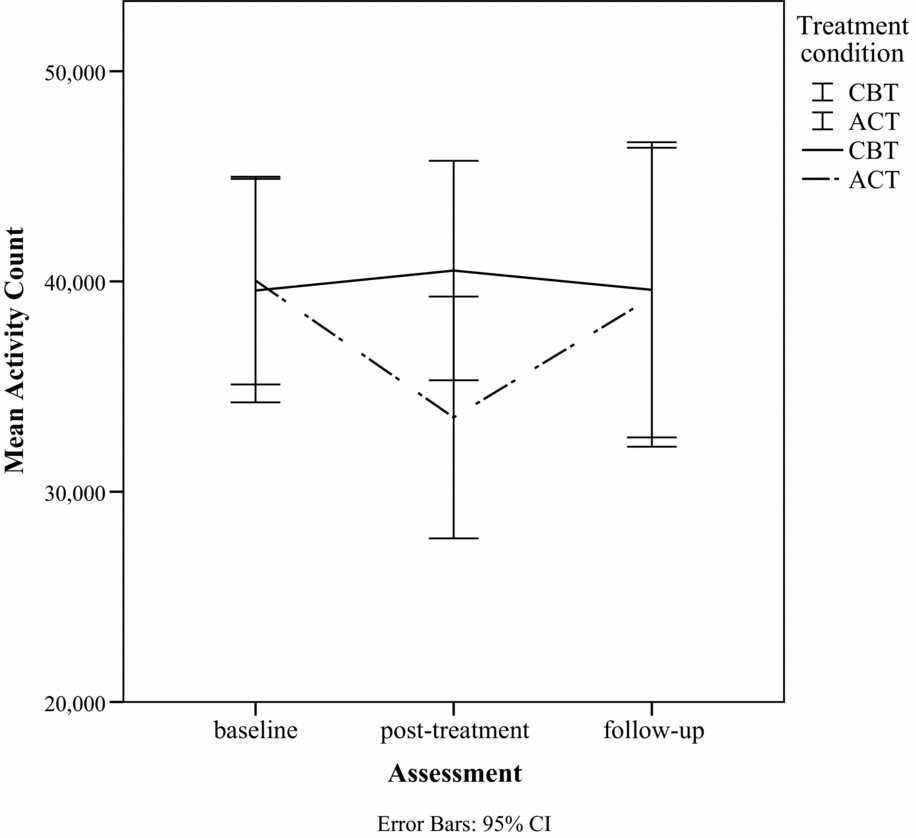
The amount of variability in the outcome accelerometer data between groups and across time is displayed in Figure 1. The intercept-only model revealed an intraclass correlation coefficient of .0502, indicating that only 5.02% of the variance in physical activity was between participants; the remainder (94.98%) was accounted for by time.
Physical activity by treatment condition over time.

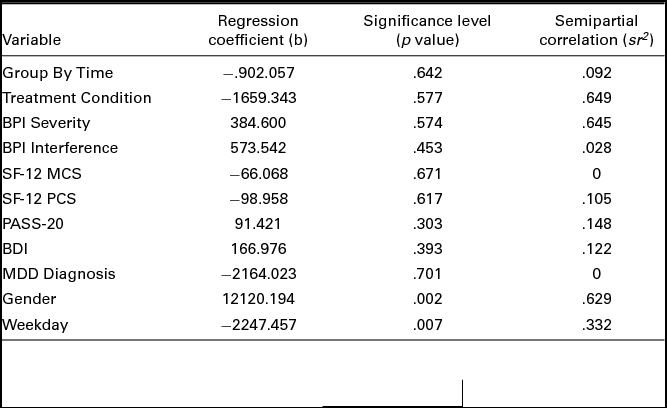
Results are presented in Table 1. We compared differences between the physical activity outcomes of those enrolled in ACT as compared to those enrolled in CBT; the regression coefficient relating treatment condition to physical activity was negative and not statistically significant (b = −1659.34, p = .57, sr 2 = .649). To assess for the group by time interaction, time was entered as a level 2 predictor and modality was entered as a level 3 predictor. The group by time interaction was not significant (b = −902.06, p = .64, sr 2 = .09).
Regression Coefficients From Hierarchical Linear Modelling Analysis
We also hypothesised that physical activity levels would be negatively correlated with indices of psychological impairment (e.g., depression, anxiety, lack of valued living, diagnosis of major depressive disorder). The regression coefficients relating the BPI severity and interference subscales to physical activity were positive but not statistically significant (b = 384.60, p = .57, sr 2 = .645) and (b = 573.54, p = .45, sr 2 = .028), respectively. The regression coefficients relating the SF-12 MCS and PCS to physical activity were negative but not significant (b = −66.07, p = .67, sr 2 = 0) and (b = −98.96, p = .62, sr 2 = .105), respectively. The regression coefficients relating the PASS-20 and BDI to physical activity were positive but not significant (b = 91.42, p = .30, sr 2 = .148) and (b = 166.98, p = .40, sr 2 = .122), respectively. The regression coefficient relating the presence of major depressive disorder was negative and not significant (b = −2164.02, p = .69, sr 2 = 0).
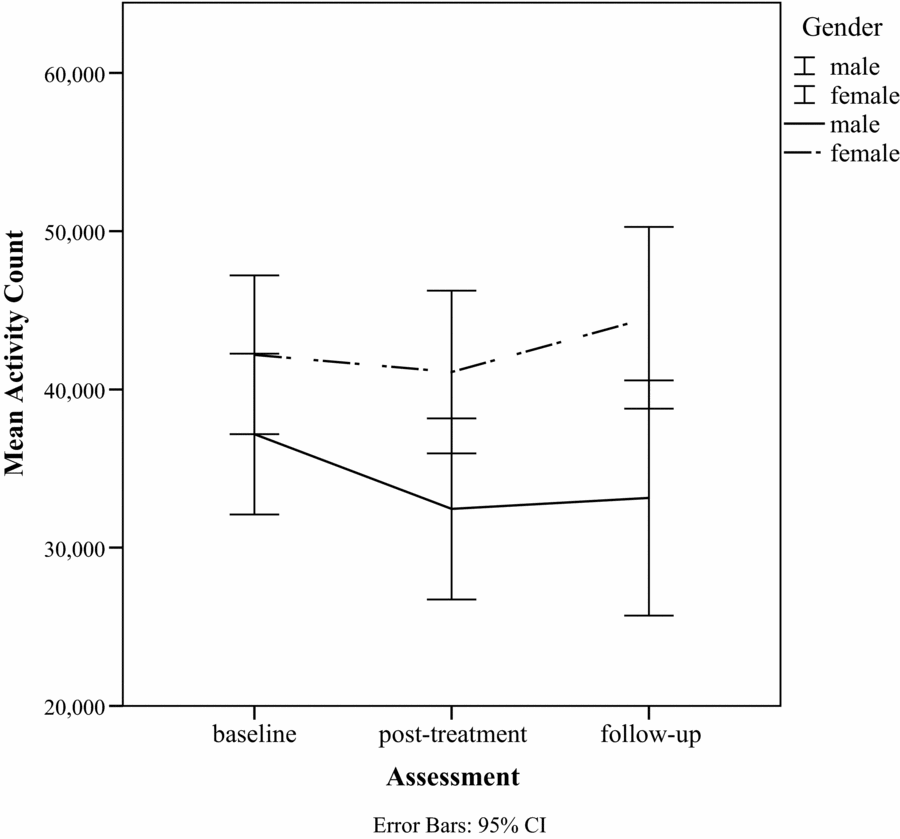
Because we found strong overall effects for individual differences but no effects for any of the hypothesised differences in pain or psychological symptoms, we performed exploratory analyses to examine other individual difference variables (e.g., gender). Exploratory analyses found that the regression coefficient relating gender to physical activity was positive and statistically significant (b = 6804.08, p = .02, sr 2 = .629). The variance in physical activity was significantly predicted by gender, such that women's physical activity levels were higher than were men's (Figure 2). The regression coefficient relating weekday to physical activity was negative and statistically significant (b = −2247.45, p = .002, sr 2 = .332). Study participants had higher levels of physical activity on weekdays, as compared to weekends.
Physical activity by gender over time.
With respect to our third hypothesis, that objectively measured physical activity would correlate modestly with self-reported physical activity, the proportion reduction in error variance method (Raudenbush & Bryk, Reference Raudenbush and Bryk2002) established that the MPI self-report data had a semipartial correlation of .395 with the objective physical activity data.
Discussion
In the current study, a randomised clinical trial of ACT and CBT for participants with chronic pain, we found evidence for a moderate to strong association between subjectively reported and objectively measured physical activity. We did not find statistically significant evidence that psychological treatment increased physical activity. We also did not find statistically significant evidence that physical activity levels were correlated with indices of mental health and wellness. Rather, physical activity and change in physical activity were related to gender and the day of the week the data were gathered.
It should be noted that some of the findings of the above analyses are limited by the possibility that the study was underpowered to detect an effect. Proportion reduction in error variance method identified two variables that had large partial correlations. For example, treatment condition and pain severity each had large partial correlations (sr 2 = .649 and sr 2 = .645, respectively). While it is possible that no statistically significant effect exists for these variables, the size of these partial correlations suggests that the sample may have been underpowered to detect an effect. The remainder of the discussion will discuss the implications of the present results; however, it is possible that replication with greater sample power would better elucidate the relationship between PA and psychotherapy in patients with chronic pain.
These results provide important information for pain management and the increasing realm of psychological treatment for chronic pain. As research has demonstrated, physical activity has been shown to decrease pain symptoms; however, two empirically supported psychological treatments for chronic pain, CBT and ACT, did not increase physical activity levels in the current study. Perhaps including an exercise component may help to supplement psychological treatments to obtain better treatment gains for physical activity. This exercise component may take a variety of forms, from water therapy to exercise classes held by a physical therapist, to at-home exercise instructions.
In addition, these results suggest that tailored interventions may be especially important. Women increased their physical activity over the course of the study. In contrast, men demonstrated decreased activity levels over the course of the study. Among the general population, gender differences in physical activity have been found to vary between studies. Women have been found to have significantly higher levels of non-work physical activity than men (Saffer, Dave, & Grossman, Reference Saffer, Dave and Grossman2011); however, other research has suggested men have greater levels of physical activity than do women (Colley et al., Reference Colley, Garriguet, Janssen, Craig, Clarke and Tremblay2011). Among the chronic pain population, men have been found to be significantly more impacted in physical activity levels than are women (Nielens & Plaghki, Reference Nielens and Plaghki2001). Given that women showed increased physical activity levels over the course of the study, they may not require a full exercise supplement to show treatment gains in physical activity levels. However, the size of this gender effect was limited; therefore, it is likely that both men and women would benefit from supplemental intervention to increase physical activity in the delivery of psychological treatments for chronic pain.
The correlation between the objective physical activity accelerometer data and the self-report WHYMPI data contrasts with other research that found little relationship between objective and subjective measures of physical activity (Prince et al., Reference Prince, Adamo, Hamel, Hardt, Gorber and Tremblay2008). However, the difference between self-report and objective measures of physical activity has been found to be significantly greater when measuring high levels of physical intensity (i.e., vigorous physical activity). Therefore, the degree of discrepancy between subjective and objective physical activity measurement may be less impactful among populations in which lower levels of activity are assessed (Prince et al., Reference Prince, Adamo, Hamel, Hardt, Gorber and Tremblay2008). Our study provides unique information in that we used a measure of activity that was specific to pain (WHYMPI) in a sample of individuals with chronic pain. These results suggest that in a chronic pain sample, a reasonably accurate measure of physical activity may be obtainable using a self-reported measure developed for and validated in individuals with chronic pain.
However, research assessing physical activity and physical disability measurement devices (e.g., self-report, clinical tests, accelerometers) in patients with chronic low back pain has suggested that the assessment of physical activity and physical abilities has greater complexity than typically constructed (Alschuler, Hoodin, Murphy, & Geisser, Reference Alschuler, Hoodin, Murphy and Geisser2011). It is possible that self-report and accelerometer data are assessing different constructs; such that self-report measures assess one's thoughts and beliefs towards pain whereas accelerometer devices measure physical activity levels (Alschuler et al., Reference Alschuler, Hoodin, Murphy and Geisser2011). Therefore, it is possible that using these measurement techniques in tandem has continued utility. Nevertheless, it is important to acknowledge that accelerometers are expensive devices to use for data collection. The reliability of self-report data of physical activity in this population as suggested by these results provide support for the use of less expensive self-report measures rather than more expensive accelerometer technology in similar areas of research. Further research to better elucidate the difference between the constructs tapped by self-report and objective measures of physical activity may help to solidify the best recommendation for assessment of physical activity in contexts where financial resources are limited.
The current study is characterised by certain limitations. A large amount of the actigraph data was missing, which is a particularly important problem in a relatively small clinical trial. Accelerometers are more commonly used in epidemiological studies with upwards of thousands of participants. These studies have greater statistical power and the capability to listwise delete cases in which missing data occur. Replicating this research with a larger sample will give greater power to detect significant effects, as well as increase the reliability of the data and research findings. Replicating these results with research participants with other chronic medical conditions, such as diabetes, would help to elucidate the effect of psychological treatment on physical activity in other populations. This research would also help to describe the relationship between physical activity and other facets of wellbeing such as mental health and quality of life.
To summarise, in the present study, physical activity levels were not found to be significantly affected by psychological treatment. Women did increase their physical activity levels over the course of treatment; however, men did not. Treatment of chronic pain will benefit from research investigating the utility of exercise components used in combination with psychotherapy for chronic pain, especially for those patients who are men. In addition, future research with chronic pain populations may find greater utility of the self-report WHYMPI data as compared to more expensive forms of physical activity measurement, when resources are limited.