Introduction
A contaminant is described as any substance not intentionally added to food which is present in such food as a result of the production process (Codex Alimentarius Commission, 2002). Trichloromethane may be described as such a contaminant. To ensure a high standard of hygiene, cleaning and disinfection of equipment is an essential part of dairy processing, both on-farm and during product manufacture. Chlorine is the most utilized, inexpensive and effective cleaning and disinfection agent and the dairy industry was the first food industry to exploit its germicidal properties (Chlorine Chemistry Division of the American Chemistry Council, Chlorine and Food Safety White Paper, 2002). If chlorine comes into contact with organic material, such as milk, cream or butter, it can form total organic chlorine (TOX; Tiefel & Guthy, Reference Tiefel and Guthy1997; Resch & Guthy, Reference Resch and Guthy2000). Total organic chlorine consists of volatile organic chlorine (VOX) and non volatile organic chlorine (NVOC). The most important of the VOX group is the contaminant TCM. This process occurs via the Haloform reaction. The classic haloform reaction is that which occurs between a halogen (chlorine, bromine, fluorine and iodine) and a methylketone to form a haloform (Fuson & Bull, Reference Fuson and Bull1934). Milk and milk products contain acetoin, diacetyl and other methylketones (Mick et al. Reference Mick, Mick and Schreier1982) that can react with chlorine to yield volatile organic chlorine in the form of TCM.
Chlorinated hydrocarbons, such as TCM, accumulate in the fat rich portions, in products like milk, butter and vegetable oil (Hubbert et al. Reference Hubbert, Hagstad, Spangler, Hinton and Hughes1996). As milk fat is concentrated and converted to cream and butter the TCM content increases proportionally (Resch & Guthy, Reference Resch and Guthy1999). The results of a study by Fleming-Jones & Smith (Reference Fleming-Jones and Smith2003) showed that, in the USA, dairy products contain the highest levels of TCM (>0·176 mg/kg). The International Agency for Research on Cancer (IARC) states that TCM is ‘possibly carcinogenic to humans’ and declared it as a Group 2B carcinogen. This categorization was reached based on ‘inadequate evidence in humans and sufficient evidence in experimental animals’ (IARC, 1999). However, the levels necessary to cause cancer are well above the level of 0·1 mg/kg that has been established by the European Union (EU Directive on Water Quality 98/83/EC, 1998) as the acceptable limit for all Trihalomethanes (including TCM) in drinking water supplies. The EU has not published regulations on the acceptable limits of TCM in foods. However, Germany has enacted strict regulations on the acceptable levels of TCM in foods using the legal limit of 0·1 mg/kg that has been set for water (Verordnung über Höchstmengen an Schadstoffen in Lebensmitteln, 2003). Even though the legal limit is 0·1 mg/kg, countries competing for market share for their dairy products in Germany are recommended to meet target levels of TCM set at <0·03 and <0·002 mg/kg in butter and milk, respectively. Thus, it is in the economic interest of individual countries to achieve these marketing standards/targets as well as the legal limit.
At an average concentration of 0·07 mg/kg in 2009, (personal communication, Irish Dairy Board), TCM in Irish butter was within the legal limit of 0·1 mg/kg. Since the value of exported Irish butter is very important to the economy, TCM levels in butter must be reduced to meet the recommended marketing target of <0·03 mg/kg. The factors affecting milk TCM levels during the milk production process (milking and milk storage) specifically, milking and milk storage equipment cleaning practises were identified by Gleeson & O'Brien (Reference Gleeson and O'Brien2010). It was concluded from that investigation that factors influencing chemical residues in milk may be due to single or multiple incorrect equipment cleaning practises. The main factors identified by Gleeson & O'Brien (Reference Gleeson and O'Brien2010) relating to the adequate rinsing of both milk and detergent chemicals from milking equipment were; insufficient rinse water volume, reusing rinse water, adequate plant drainage after each wash cycle, limiting the re-use of the detergent solution to just one occasion, avoidance of chlorine use for pre-milking disinfection, using correct type of chemicals and at the correct usage rates.
The span from milk production to dairy product comprises two stages. The first stage involves the on-farm milking of dairy herds. In Ireland, dairy herds are milked twice daily i.e. morning and evening. Milk from a number of milking events (normally 4–6) may be combined and stored in a static bulk tank on-farm. From there it is collected and transported (in milk tankers) to the dairy processing plant. The second stage involves processing the milk into various dairy products. TCM contamination of milk could occur at either stage. The processing sites were monitored initially for TCM. However, the processing stage was not found to be a contributing factor in TCM contamination of butter (Kelly et al., unpublished). Therefore, focus was placed on the first stage of the production process. The objective of this study was firstly, to identify a group of individual farms with high TCM (>0·002 mg/kg) milk supplies, apply the information, guidelines and recommendations learned from the study of Gleeson & O'Brien (Reference Gleeson and O'Brien2010) on these farms and re-measure the milk supplies. If that strategy was effective then it would be applied to the wider group of farms within 6 dairy processing plants associated with butter manufacture, in an attempt to reduce milk TCM on a large scale. Finally, the effectiveness of this corrective mechanism was measured in terms of change in TCM levels in the milk supplies.
Materials and methods
Milk sample collection and preparation for analysis
The milk samples (approximately 40 ml) were taken by trained dairy personnel in a plastic bottle, three quarters filled to limit TCM evaporation into the headspace of the sample bottle and to allow for expansion during storage at −22 °C. A preliminary study showed that neither the plastic bottles nor freezing the samples for up to 7 d influenced the TCM concentration (Ryan et al. unpublished). The frozen samples were delivered by courier to the Milk Testing Laboratory, Animal and Grassland Research and Innovation Centre, Teagasc, Moorepark, Fermoy, Co. Cork, Ireland, within 7 d of collection.
Within 7 d of sampling, the samples were thawed and analysed for TCM. In preparation for headspace gas chromatography (HS-GC) analysis, 4 g of thawed milk sample was decanted directly into 20 ml head-space vials, 10 μl 0·246 g/l internal standard was added and the vials were sealed with magnetic Teflon lined caps. The samples were placed in an ultrasound bath for 10 min, stored at 4 °C for 4–6 h and analysed by GC.
Headspace-gas chromatography
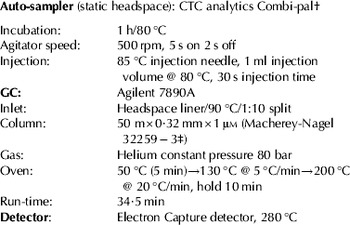
Static HS-GC with electron capture detector (ECD) was used as the analytical procedure (Resch & Guthy, Reference Resch and Guthy1999). Resch & Guthy (Reference Resch and Guthy1999) showed that the use of an internal standard method was beneficial when comparing samples and they also showed that inclusion of an external standard resulted in more accurate calculation of TCM in milk, when compared with the internal standard method alone. Both an internal (2-bromo-1-chloropropane) and external standard were used for analysis in this study. The GC settings used in milk TCM analysis are shown in Table 1.
Gas chromatography operating conditions for the analysis of Trichloromethane in milk

† CTC Analytics AG Industriestrasse 20 CH-4222 Zwingen Switzerland
‡ Macherey-Nagel GmbH & Co. KG Neumann Neander Str. 6-8D-52355 Düren Germany
Calibration curve
Milk was obtained directly from a cow by hand milking (as opposed to machine milking) and placed in two glass containers that had been thoroughly washed, rinsed with ethanol and distilled water, oven dried and cooled. Milk obtained in this manner had no contact with cleaning and disinfection agents and had non-detectable levels of TCM. Calibration curves were determined by adding five known concentrations of TCM to milk (0·0006, 0·0011, 0·002, 0·005 and 0·012 mg/kg). A control with no added TCM was used as the base for the calibration line. Each point in the calibration series was completed in triplicate. Control samples (0·0018 mg TCM/kg) were included with each set of analyses and results were directly compared with the calibration curve.
Preliminary study – proof of concept
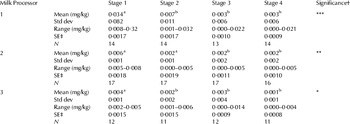
A preliminary study was carried out on a number of farms (n=43), identified as having a high milk TCM concentration, representing 3 milk processing companies. Milk from these suppliers was sampled at 4 stages during lactation. Stage 1 represented the initial milk sample, taken at the processing facility following screening of a number of milks which identified farms with milk TCM levels ⩾0·002 mg/kg. Stage 2 represented on-farm investigations and identified the likely major causes of the high TCM levels on these farms based on the study of Gleeson & O'Brien (Reference Gleeson and O'Brien2010). These major causes were conveyed to milk suppliers by Teagasc Technical personnel through a combination of farm visits and correspondence over a period of 3 months. Stage 3 represented milk samples taken approximately 2 months later than stage 2 sampling to test the efficacy of the advice given. Stage 4 represented samples taken approximately 6 months after the advice was given.
Application of concept to milk supplies within 6 dairy processor catchment areas
Six dairy processing companies with varying numbers of milk suppliers took part in this study. Processors 1, 2, 3, 4, 5 and 6 represented 1000, 850, 1700, 1000, 4200 and 3000 milk suppliers, respectively, i.e. approximately 65% of the total milk suppliers, from different geographical regions of Ireland. Each milk processor collects milk from the farm at a frequency of 2–3 d (depending on the volume of milk being produced on the farm) and combines the milks from 10–20 farms on a specific route into one tanker. Between March and July, 2010 the milk from each tanker route within each processor catchment area was sampled on three separate occasions (n=1039, minimum of 21 d apart). The samples were analysed and the five tankers consistently (on all 3 occasions) having the highest milk TCM levels in each processor catchment area were identified (30 tankers in total were identified as high TCM milks).
Subsequently, the individual farm milk supplies with TCM concentrations ⩾0·002 mg/kg, contributing to each of these tankers, were identified (Stage 1; n=393). The corrective on-farm recommendations and advice (based on Gleeson & O'Brien, Reference Gleeson and O'Brien2010) were then applied to these farms by respective milk processing company personnel, representing Stage 2. The delivery of this corrective action was an ongoing process over a period of 6 months. When all farms had received the advice/information/farm visit on at least 1 occasion, milk supplies of these farms were again sampled and analysed (Stage 3).
Statistical analysis
Preliminary study – Proof of Concept
Data were analysed using a repeated measures model in SAS 9.2, PROC MIXED (which allows for variation in numbers of measurements). A heterogeneous autoregressive (1) covariance structure was used. The model included terms for milk supplier, stage of sampling and their interaction. All available data was used with a minimum of three observations (across stage 1–4) per milk supplier. Pair-wise comparisons were performed employing a Bonferroni adjustment. Statistical significance was determined using P < 0·05.
High TCM milk supplies within 6 dairy processor catchment areas
Results were analysed using a repeated measures model in SAS 9.2, PROC MIXED (which allows for variation in numbers of measurements). A heterogeneous autoregressive (1) covariance structure was implemented. The model included terms for processor, stage of sampling, their interaction and milk supplier nested within processor. Processor and stage of sampling were treated as fixed effects and milk supplier nested within processor was treated as the random effect. All available data was used, with a minimum of two observations (across stage 1–3) per milk supplier. Statistical significance was determined using P < 0·05. Pair-wise comparisons were performed employing a Bonferroni adjustment.
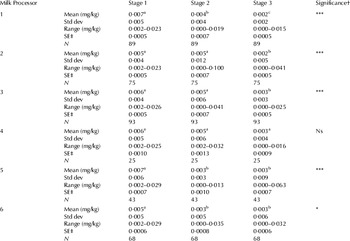
Raw data and least square means data is presented in Tables 2 & 3.
Effect of corrective action on-farm on levels of Trichloromethane (TCM) in bulk milk from 43 farms supplied to three Irish milk processing companies

Raw Means with common superscript are not significantly different within rows
† ***=P < 0·001, **=P < 0·01, *=P < 0·05
‡ Standard error of the mean
N=number of farms
Effect of corrective action on-farm on levels of Trichloromethane in bulk milk supplied to six Irish milk processing companies

Raw Means with common superscript are not significantly different within rows
† ***=P < 0·001,**=P < 0·01, *=P < 0·05
‡ Standard error of the mean
N=number of farms
Results
Preliminary study – proof of concept
The effect of corrective on-farm recommendations and advice on TCM levels in milk from suppliers (n=43) is shown in Table 2. The results indicate that the recommended corrective action taken on the farms resulted in a reduction in average TCM levels in milk. At Stage 1, 100% of milk supplier samples were categorised as high with TCM levels ⩾0·002 mg/kg (average values of 0·034, 0·006 and 0·004 mg/kg for processors 1, 2 and 3, respectively). At stage 2, 57% of the milk samples were high (average values of 0·007, 0·002 and 0·002 mg/kg), with significant reductions (compared with Stage 1) in the milk TCM levels observed in processors 1 and 3 (P < 0·001, P < 0·01, respectively), and a numerical reduction observed in processor 2. At stage 3, 47% of the milk samples were high (average values of 0·003, 0·002 and 0·003 mg/kg), with significant reductions in the milk TCM levels observed in all 3 milk processing companies (P < 0·001, P < 0·001, P < 0·01) compared with stage 1, and in milk processor 2 (P < 0·01) compared with stage 2. At stage 4, the number of high milk samples were reduced further to 35% with average values of the different milk processing companies (0·003, 0·002 and 0·001 mg/kg) remaining similar (P>0·05) to those in stage 3.
Wider application of proved concept of corrective action in reducing milk TCM
The effect of corrective on-farm recommendations and advice on TCM levels in milk from suppliers (n=393) identified (from within the catchment area of 6 dairy processors) as having milk TCM levels ⩾0·002 mg/kg is shown in Table 3. The results indicate that the recommended corrective action implemented on the farms resulted in reduced TCM levels in milk. The overall percentage of milk samples with high TCM levels was reduced from 100% at stage 1 to 74% at stage 2 to 47% at stage 3. TCM levels in milks from identified high suppliers to Processors 1, 5 and 6 were significantly reduced (P < 0·001, P < 0·001, P < 0·05, respectively) at stage 2 compared with stage 1. While a further reduction (P < 0·01) in TCM levels were observed in Processor 1 milks at stage 3 compared with stage 2, Processor 5 and 6 milks remained unchanged (P>0·05). TCM levels in milks from identified high suppliers to Processors 2 and 3 remained unchanged at stage 2 compared with stage 1 but were significantly reduced (P < 0·001, P < 0·001, respectively) at stage 3 compared with stage 2. Meanwhile, TCM levels in milks from Processor 4 were reduced numerically between the different stages.
Discussion
A pilot strategy was developed which demonstrated that TCM in milk may be reduced by implementing corrective action to the milk production process on-farm, i.e. milking equipment and milking management practices. The success of this strategy meant that it was subsequently applied to an even larger group of farms and again was successful in reducing the overall TCM levels in milk. The critical parameters involved included the correct identification of the causes of high milk TCM on farms (insufficient rinse water volumes, incorrect detergents and usage thereof-), the effective transfer of the information for corrective action on farm, continued milk sampling and analysis and finally, prompt feedback of results to the farmer.
Farm management practices in relation to equipment cleaning have previously been associated with an increase in the bacterial count (Elmoslemany et al. Reference Elmoslemany, Keefe, Dohoo, Wichtel, Stryhn and Dingwell2010) and TCM in bulk milk (Gleeson & O'Brien, Reference Gleeson and O'Brien2010; Resch & Guthy Reference Resch and Guthy2000). It was shown that re-use of the detergent solution which contained chlorine also contributed to TCM residues. The importance of adequate pre and post rinsing of organic and detergent residues from the plant were shown to minimize TCM residues (Ryan et al. Reference Ryan, Gleeson, Jordan, Furey and O'Brien2012). On many farms, inadequate rinsing and re-use of detergent on more than one occasion was reported by Gleeson & O'Brien (Reference Gleeson and O'Brien2010) and was found to be one of the main reasons for the high TCM residue levels observed on farms in this study also. Chlorine is added to alkaline detergent cleaning agents as a peptizing agent to aid in protein removal and to improve the rinse-ability of machines (Reinemann et al. Reference Reinemann, Wolters and Rasmussen2000; Cleaning in place: Dairy, Food and Beverage Operations, 2008). Ryan et al. (Reference Ryan, Gleeson, Jordan, Furey and O'Brien2012) demonstrated that chlorine, when used according to manufacturers recommendations, was not found to have an adverse effect on milk TCM. When properly used as part of the milking equipment cleaning procedure, chlorine is an effective antimicrobial and does not effect milk TCM concentrations. However, many cleaning products have chlorine concentrations much greater than that recommended (200 ppm) by Reinemann et al. (Reference Reinemann, Wolters, Billon, Lind and Rasmussen2003). As part of the advisory element, farmers were advised to choose detergent products with chlorine concentrations within the recommended range. The chemical composition of products is available on the Teagasc website (http://www.agresearch.teagasc.ie/moorepark/Articles/Chemicalanalysisofdetergentsterilizerproducts.pdf).
The transfer of the above information to both the pilot group and the wider group of dairy farmers in the current study took a number of different forms. In the pilot study Teagasc technical personnel visited and advised all 43 farms on the reduction of TCM in milk. A total reduction in high TCM farms of 65% was observed between Stages 1 and 4. However, individual visits to all farms was not feasible with the wider study (393 farms) therefore, these farms were advised by milk quality personnel from the specific dairy processing companies. Newsletters, Teagasc guidelines (O'Brien, Reference O'Brien2009), written communications from the milk processor to individual dairy farmers and newspaper campaigns, represented the most popular methods of information transfer although, farm visits were also carried out on farms with difficult TCM issues.. In addressing the issue of high TCM in milk, a farm visit may be important as there was only a 53% reduction in high TCM milk in the large study compared to a 65% in the pilot study. However, a farm visit is not feasible for every farm and the processor may need to assess each farm with regard to TCM and arrange a visit for the farms with the highest milk TCM values.
Consistent communication with the dairy farmer in terms of advice and milk TCM results, i.e. continuous monitoring of milk TCM and feedback of sample results to the farmer, were considered crucial in allowing the positive effect on TCM to be evident to producers following the implementation of recommendations. During the wider study, the conveyance of advice and recommendations on farms was a ‘work in progress’ and the recommendations were implemented at different times on different farms. Several farms required a number of attempts as there where multiple incorrect practices employed. Thus, TCM reductions in milk did not occur simultaneously on all farms. However, at approximately 3–6 months after identification as high milk TCM farms, milk TCM levels of these farms were significantly reduced with the average TCM of the overall milk pool reduced to 0·0026 mg/kg milk (Table 3).
On the individual farms that did not show improvement in milk TCM levels, further and repeated advice will need to be delivered together with consistent testing and retesting of milk supplies. Continued testing is also necessary where a reduction was observed, in order to ensure that the poor practices observed are not reverted to. This will require increased time investment and/ or monitory incentives by the dairy processors. It is crucial for the processor to reduce milk TCM in as great a proportion of milk supplies as possible to as low a level as possible since a direct correlation exists between the proportion of high TCM milk and the TCM concentration of the combined milks (Ryan et al. Reference Ryan, Gleeson, Jordan, Furey and O'Brien2012). TCM concentration of a milk pool is dependent on the TCM levels of the individual component milks and the volume of such milks. This is of particular significance to milk processors as it shows that a small number of high TCM milks can influence the final TCM concentration of the combined milk load.
In conclusion, this study (i) proved the concept that a specific milk quality problem may be resolved on a relatively small number of farms by the implementation of corrective action on-farm and the dissemination of information accompanied by repeated sampling and analysis of milk samples together with continuous feedback of the results to the milk supplier, and (ii) that this strategy can be applied successfully to a relatively large group of farms. However, regular farm visits are considered essential and it may be worthwhile investing time in the form of farm visits to ensure fast immediate resolution of milk quality issues. This strategy has potential to be used to address other milk quality issues on-farm.
This work was supported by the Irish Dairy Industry.