In 2010, the healthcare spending was estimated to reach CAD192 billion (USD185 billion) in Canada, representing 11.7 percent of the country's gross domestic product (1). Although a large portion of expenditures is related to pharmaceuticals, home care, new technologies, and health human resources, the Conference Board of Canada labeled technological change as a cost escalator because it accounts for approximately 25 percent of health expenditure growth (2).
Disinvestment is defined commonly as the complete or partial withdrawal of resources from healthcare services and technologies that are regarded as unsafe, ineffective or inefficient, with those resources shifted to health services and technologies with greater clinical- or cost-effectiveness (Reference Elshaug, Watt, Moss and Hiller3). For this review, we defined healthcare technologies as drug therapies, medical devices, diagnostic and screening tests, vaccines, and surgical and non-surgical procedures.
Multiple barriers exist that render the development of disinvestment methods a challenge. Elshaug et al. highlighted several obstacles related to a dearth of published evidence and policy mechanisms to support the advancement of disinvestment, as well as political, clinical and social challenges. Moreover, there is a lack of incentives for clinicians to disinvest from ineffective technologies, and the removal of technologies and procedures may cause concern for health professionals and patients who will view the exercise as a reduction of available health services (Reference Elshaug, Watt, Moss and Hiller3). To date, limited research has been published on case studies of frameworks and tools used for disinvestment and resource allocation decision making in health care.
OBJECTIVES
Our research objective was to systematically identify case studies in the published and gray literature that describe disinvestment and resource allocation processes for real-world decisions in health care. This analysis helps to identify the gaps that exist with current methods used for disinvestment and resource allocation and will inform directions for future research on priority healthcare setting.
METHODS
Literature Search Strategy
Published literature was identified by searching the following bibliographic databases: MEDLINE with in-process records and daily updates via Ovid; Embase via Ovid; The Cochrane Library (2011, Issue 2) via Wiley; PubMed; and the Health Economic Evaluations Database (HEED). The main search concepts include disinvestment, obsolete and ineffective technologies, and priority healthcare setting. Retrieval was limited to documents published between January 1990 and January 2012. The search timeframe extended to 1990 because disinvestment activities occurred in the 1990s within Canadian provincial health insurance plans (Reference Elshaug, Watt, Moss and Hiller3). It should be noted that these reports did not present any specifics about the frameworks used, implementation strategies, and, although candidates were nominated, outcomes were not provided of health services and technologies that were actually delisted. In addition, disinvestment activities occurred in the 1970s with the Blue Cross Blue Shields Medical necessity program in the United States but has been excluded here to retrieve more recent studies on disinvestment (Reference Elshaug, Watt, Moss and Hiller3). No language restrictions were applied, and gray literature (literature that is not commercially published) was identified. Details are reported in Supplementary Table 1, which can be viewed online at www.journals.cambridge.org/thc2013090.
Selection Criteria
The selection criteria included articles that provided a case scenario for the application of a framework or tool that support decisions on disinvestment in a real-world health context. Eligible articles included those that presented information on the framework or tool used; health technologies and service assessed; the criteria considered for disinvestment decisions, including resource allocation; and the rationale behind and impact of disinvestment decisions; and strengths and limitations of framework or tools based on individuals who participated in the process. Reports that did not present a list or categories of candidate health services or technologies for disinvestment or the criteria considered during the decision-making process or were published in a language not spoken by any of the co-authors were excluded from our review. Two reviewers (J.P. and E.R.) selected the final articles for inclusion based on examination of the full-text publications. Any disagreements between the reviewers were discussed until a consensus was reached.
Data Extraction
One reviewer (J.P.) conducted the data abstraction for all selected studies using a pre-specified extraction form that included the study characteristics and the suggested criteria to inform the prioritization of disinvestment opportunities published by Elshaug et al. (Reference Elshaug, Moss and Littlejohns4). Another reviewer (E.R.) verified the accuracy of the data extracted. Any disagreements were discussed until a consensus was reached.
Quality Assessment
Because the selected articles are descriptive, a formal quality assessment using validated critical appraisal instruments was not conducted. Also, the intent of our systematic review was to present examples of the disinvestment decision-making process across various healthcare contexts rather than to test a hypothesis.
Data Analysis and Synthesis
Published studies that illustrated the use of frameworks and tools for disinvestment processes were described narratively. Also their strengths and limitations, based on stakeholder feedback, were discussed. All dollar amounts were converted to 2012 U.S. dollars.
RESULTS
Quantity of Research Available
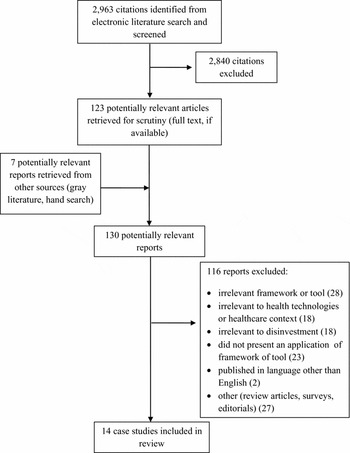
The electronic literature search and alerts yielded 2,963 citations. Upon screening titles and abstracts, 123 potentially relevant articles were retrieved for full-text review. An additional seven potentially relevant reports were identified through the gray literature. Of the 130 potentially relevant reports, 116 reports did not meet the selection criteria. The study selection process is presented in a Preferred Reporting Items for Systematic Reviews and Meta-Analyses (PRISMA) flowchart (Figure 1).
Selection of included studies.

Study Characteristics
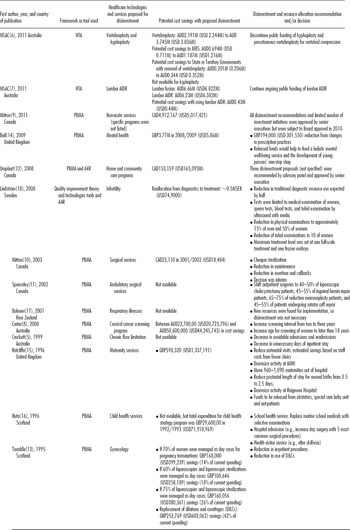
Four studies were conducted in Australia (Reference Crockett, Cranston and Moss5–Reference Carter, Stone and Vos8), four in Canada (Reference Mitton, Dionne, Damji, Campbell and Bryan9–Reference Urquhart, Mitton and Peacock12), another four in the United Kingdom (UK) (Reference Twaddle and Walker13–Reference Ruta, Donaldson and Gilray16), one each in New Zealand (Reference Bohmer, Pain, Watt, Abernethy and Sceats17) and Sweden (Reference Lindström and Waldau18). The publication years ranged from 1995 (Reference Twaddle and Walker13) to 2011 (6;7;Reference Mitton, Dionne, Damji, Campbell and Bryan9). Table 1 highlights the key findings in the selected case studies, and a summary of characteristics, criteria used for decision making and potential impact of decisions are presented in Supplementary Table 2, which can be viewed online at www.journals.cambridge.org/thc2013090.
Case Studies on Disinvestment Decision Making

A4R, Accountability for reasonableness; AIDR, Artificial intervertebral disc replacement; AUD, Australian dollar; CAD, Canadian dollar; GBP, British pound; HTA, Health technology assessment; M, million; MBS, medical benefits schedule; MSAC, Medical services advisory committee; PBMA, Program budgeting and marginal analysis; USD, US dollar.
Healthcare System Level
In three reports, proposals related to disinvestment opportunities occurred at the national level (6–Reference Carter, Stone and Vos8), seven studies assessed resource allocation at the health authority or regional level (Reference Mitton, Dionne, Damji, Campbell and Bryan9;Reference Urquhart, Mitton and Peacock12;Reference Twaddle and Walker13;Reference Ratcliffe, Donaldson and Macphee15–Reference Lindström and Waldau18), and four studies reviewed services and technologies provided in institutions (Reference Crockett, Cranston and Moss5;Reference Mitton, Donaldson, Shellian and Pagenkopf10;Reference Spenceley and Halma11;Reference Ball, Kemp and Fordham14).
Framework and Tool Used
Eleven studies used program budget and marginal analysis (PBMA) to make decision related to the investment and disinvestment of healthcare technologies or services (Reference Crockett, Cranston and Moss5;Reference Carter, Stone and Vos8–Reference Bohmer, Pain, Watt, Abernethy and Sceats17). Two studies used the health technology assessment (HTA) approach for their disinvestment recommendations (6;7). Health technology assessment is defined by the International Network of Agencies for Health Technology Assessment as a multidisciplinary field of policy analysis. It involves a systematic evaluation of the medical, social, ethical, and economic implications of development, diffusion, and use of health technology (19). One study from Sweden applied the Accountability for Reasonableness (A4R) Model and quality improvement theory and technologies, which addressed concepts on rationing, rationalization, ranking priority setting, and structured quality improvement (Reference Lindström and Waldau18). Two studies also described the specific application of the accountability for reasonableness framework, an approach based on justice theories and ethics for a fair priority setting process (Reference Urquhart, Mitton and Peacock12;Reference Lindström and Waldau18).
Healthcare Technologies and Services Assessed for Disinvestment
An array of healthcare technologies and services were covered across the studies. Health services and programs related to non-acute services, home and community, mental health, gynecology, maternity, and child health services were discussed in several studies (Reference Mitton, Dionne, Damji, Campbell and Bryan9;Reference Urquhart, Mitton and Peacock12). One hospital examined the provision of surgical services, and another hospital wanted to shift resources from inpatient to outpatient surgeries (Reference Mitton, Donaldson, Shellian and Pagenkopf10;Reference Spenceley and Halma11). Health technologies and services for chronic airflow limitation were proposed for disinvestment in a teaching hospital in Australia (Reference Crockett, Cranston and Moss5). The prioritization of reproductive technologies were assessed by the Swedish Parliament (Reference Lindström and Waldau18). Two health regions in New Zealand reviewed the allocation of health services and technologies for respiratory illnesses (Reference Twaddle and Walker13;Reference Bohmer, Pain, Watt, Abernethy and Sceats17). In 2011, the Medical Services Advisory Committee (MSAC) reviewed artificial intervertebral disc replacement (AIDR) lumbar and vertebroplasty, along with kyphoplasty, for a coverage recommendations (6;7). Finally, cervical cancer screening to inform the National Cancer Strategy was reviewed in Australia (Reference Kapiriri, Norheim and Martin20).
Potential Cost Savings with Disinvestment Opportunities
Four studies did not report the reduced dollar amounts associated with the proposed disinvestment opportunities in healthcare technologies and services (Reference Crockett, Cranston and Moss5;Reference Spenceley and Halma11;Reference Ruta, Donaldson and Gilray16;Reference Bohmer, Pain, Watt, Abernethy and Sceats17). The potential savings with the reduction or removal of health technologies or services ranged from approximately CAD23,110 in 2003 (USD18,484 in 2012) (Reference Mitton, Donaldson, Shellian and Pagenkopf10) to AUD50,600,000 in 2000 (USD44,245,743 in 2012) (Reference Carter, Stone and Vos8).
Criteria Considered in the Case Studies
A brief description of the criteria considered in each case study is outlined below, with specific details provided in Supplementary Table 3, which can be viewed online at www.journals.cambridge.org/thc2013090.
Disease Burden
Most case studies considered disease burden as a criterion (Reference Crockett, Cranston and Moss5–Reference Spenceley and Halma11;Reference Ball, Kemp and Fordham14–Reference Lindström and Waldau18). One study estimated the disease burden with the annual number of hospitalizations for chronic airway limitation (Reference Crockett, Cranston and Moss5), another study considered the prevalence and severity of respiratory diseases and the annual number of respiratory-related hospitalizations and mortality (Reference Bohmer, Pain, Watt, Abernethy and Sceats17), the incidence of infertility was accounted for in another study (Reference Lindström and Waldau18), and the incidence of vertebroplasties and number of procedures done in the lumbar was examined by the MSAC (6;7). Mitton et al. did not estimate the potential number of patients who would be impacted by the changes in surgical services in Canmore but stated that approximately 700 procedures were performed in 2000/2001. Spenceley and Halma indicated the number of surgical procedures performed in 1999/2000 (Reference Mitton, Donaldson, Shellian and Pagenkopf10;Reference Spenceley and Halma11). Carter et al. reported the population affected by cervical cancer screening and another study presented an approximate number of normal births in one health region (Reference Carter, Stone and Vos8;Reference Ratcliffe, Donaldson and Macphee15).
Clinical Effectiveness and Patient Safety
The clinical-effectiveness or health gains of the healthcare technologies and services that would be potentially impacted by disinvestment decisions was factored explicitly in three reports (Reference Mitton, Donaldson, Shellian and Pagenkopf10;Reference Urquhart, Mitton and Peacock12;Reference Ruta, Donaldson and Gilray16;Reference Lindström and Waldau18). One case study included impact on safety, adverse events, or harm reduction as criteria for disinvestment decision making (Reference Twaddle and Walker13). Another case study reviewed the literature on potential clinical benefits for various birth delivery strategies (Reference Ratcliffe, Donaldson and Macphee15). Five reports examined both the clinical-effectiveness and impact on safety and adverse events (6;7;Reference Mitton, Dionne, Damji, Campbell and Bryan9;Reference Ball, Kemp and Fordham14;Reference Bohmer, Pain, Watt, Abernethy and Sceats17). One report measured the incidence, mortality, disability adjusted life-year, years lived with a disability, and years of life lost for proposed changes to cervical cancer screening strategies (Reference Carter, Stone and Vos8).
Cost-Effectiveness and Opportunity Cost
The cost-effectiveness of infertility treatments (Reference Lindström and Waldau18), vertebroplasty versus conservative management (6), AIDR versus other lumbar procedures (7), and cervical cancer screening strategies (Reference Carter, Stone and Vos8) were measured in four reports. Ruta et al. conducted a literature search on the cost-effectiveness of otitis media, respite care, and school nurse and health visiting, and identified one economic evaluation on health visiting (Reference Ruta, Donaldson and Gilray16). Two case studies incorporated the optimal use of resources required for maximum benefit in patients receiving home and/or community services (Reference Mitton, Dionne, Damji, Campbell and Bryan9;Reference Urquhart, Mitton and Peacock12). Other studies reviewed the costs associated with the technologies, services, and care program that would be impacted by the decision (Reference Mitton, Donaldson, Shellian and Pagenkopf10;Reference Spenceley and Halma11;Reference Twaddle and Walker13;Reference Ratcliffe, Donaldson and Macphee15–Reference Bohmer, Pain, Watt, Abernethy and Sceats17), and cost-effectiveness of interventions and opportunity costs of resource reallocation were not mentioned in two studies (Reference Crockett, Cranston and Moss5;Reference Ball, Kemp and Fordham14). It should be noted that, in cases where the technology is deemed to be clinically ineffective and/or unsafe compared with the comparator, an economic evaluation will unlikely be conducted, although costing analyses may be performed.
Health Services Impact (Ethical, Legal, and Psychosocial)
Health services impact was discussed in seven studies (Reference Carter, Stone and Vos8;Reference Mitton, Dionne, Damji, Campbell and Bryan9;Reference Spenceley and Halma11;Reference Urquhart, Mitton and Peacock12;Reference Ball, Kemp and Fordham14;Reference Bohmer, Pain, Watt, Abernethy and Sceats17;Reference Lindström and Waldau18). Ball et al. accounted for the impact on legislation with changes to the mental health services in Norfolk Primary Care Trust (Reference Ball, Kemp and Fordham14), Spenceley et al. reviewed operational considerations (Reference Spenceley and Halma11), and Lindström and Waldau applied an ethical framework to their decision process using accountability for reasonableness (Reference Lindström and Waldau18). The impact on workplace environment, application of new information or initiatives, and future health services usage based on proposed changes in community services provided in a metropolitan area were part of the criteria for discussion in one study (Reference Mitton, Dionne, Damji, Campbell and Bryan9). Three case studies considered access, equity, acceptability, feasibility, and/or impact of implementation for the PBMA exercises (Reference Carter, Stone and Vos8;Reference Urquhart, Mitton and Peacock12;Reference Bohmer, Pain, Watt, Abernethy and Sceats17).
Stakeholder and Public Engagement
All studies incorporated an interdisciplinary advisory panel in the decision process. Panel members may have included executives, directors, managers, clinical leads, physicians, specialists, radiologists, surgeons, nurses, researchers and academics, health economists, and social therapists. Ruta et al. surveyed health professionals in Tayside, Scotland, working with children to provide their ranking on service expansions and reductions based on a list derived from another working group (Reference Ruta, Donaldson and Gilray16). In several instances, patient or community representatives partook in the panel discussions and decision process (Reference Crockett, Cranston and Moss5–Reference Carter, Stone and Vos8;Reference Ball, Kemp and Fordham14;Reference Bohmer, Pain, Watt, Abernethy and Sceats17;Reference Lindström and Waldau18).
Sources of Data
The clinical- or cost-effectiveness of an intervention or service was obtained from the published literature and clinical practice guidelines in eleven reports (Reference Crockett, Cranston and Moss5–Reference Carter, Stone and Vos8;Reference Mitton, Donaldson, Shellian and Pagenkopf10;Reference Spenceley and Halma11;Reference Ratcliffe, Donaldson and Macphee15–Reference Lindström and Waldau18). Clinical expert opinions were sought if there were evidence gaps (Reference Carter, Stone and Vos8;Reference Ball, Kemp and Fordham14;Reference Lindström and Waldau18). Cost data were obtained from local agencies, stakeholders, programs, regional health authorities, governments, and pharmaceutical subsidy costs in several studies (6–Reference Carter, Stone and Vos8;Reference Ball, Kemp and Fordham14–Reference Bohmer, Pain, Watt, Abernethy and Sceats17). If cost data were unavailable, health services usage or prescription data were obtained to calculate the related costs in one study (Reference Twaddle and Walker13). Two case studies did not specify any data sources used (Reference Mitton, Dionne, Damji, Campbell and Bryan9;Reference Urquhart, Mitton and Peacock12), and the source of cost data was not available in one study (Reference Lindström and Waldau18).
Disinvestment and Resource Allocation Decision and Rationale
In most studies, the stakeholders agreed to the proposed changes on the reduction or discontinued use of specific health technologies and interventions (Reference Crockett, Cranston and Moss5;6;Reference Mitton, Dionne, Damji, Campbell and Bryan9;Reference Mitton, Donaldson, Shellian and Pagenkopf10;Reference Urquhart, Mitton and Peacock12–Reference Ball, Kemp and Fordham14;Reference Ruta, Donaldson and Gilray16;Reference Lindström and Waldau18). Bohmer et al. reported that adequate funds were found for investment opportunities in one health authority, so disinvestment was not necessary (Reference Bohmer, Pain, Watt, Abernethy and Sceats17), and the MSAC recommended that AIDR continue to receive public funding because the clinical-effectiveness and safety were comparable to that of lumbar fusions, but the cost-effectiveness results were mixed (7). The same committee recommended against further funding for vertebroplasty and kyphoplasty because the evidence indicated that it was no more clinically effective but presented greater costs and risk for harms versus conservative management (6;7). In the remaining case studies, decisions regarding disinvestment recommendations were unclear. The primary reasons for a disinvestment or reduction in use of a technology or service were to release resources for their reallocation to other services or programs deemed more beneficial by the stakeholders (Reference Crockett, Cranston and Moss5;Reference Mitton, Donaldson, Shellian and Pagenkopf10;Reference Ball, Kemp and Fordham14;Reference Ruta, Donaldson and Gilray16;Reference Mortimer21). In addition to clinical- and cost-effectiveness of infertility treatments, the decision makers also reviewed the evidence on social and cultural-specific criteria (Reference Lindström and Waldau18). Details on the disinvestment decision and rationale are outlined in Supplementary Table 4, which can be viewed online at www.journals.cambridge.org/thc2013090.
Impact of Decision
Ten reports did not indicate the impact of the disinvestment decision (6–Reference Mitton, Dionne, Damji, Campbell and Bryan9;Reference Spenceley and Halma11;Reference Urquhart, Mitton and Peacock12;Reference Ball, Kemp and Fordham14;Reference Ratcliffe, Donaldson and Macphee15;Reference Bohmer, Pain, Watt, Abernethy and Sceats17;Reference Mitton and Donaldson22). At the time of the publications, the recommendations had not been implemented yet, so information on their impact in health care was not available. In one instance, the recommendations for disinvestment were implemented, but details were not available (Reference Urquhart, Mitton and Peacock12). Twaddle and Walker noted that fewer in-patient gynecological procedures would contribute up to GBP400,000 of potential savings based on 1992 prices (USD950,570 in 2012). Furthermore, resource reallocation from dilations and curettes to endometrial sampling or outpatient hysteroscopy would reduce costs by 50 percent (Reference Twaddle and Walker13). Changes to the resource allocation for surgical services in a community hospital would result in additional days for minor surgery without increased costs (Reference Mitton, Donaldson, Shellian and Pagenkopf10). Lindström and Waldau reported no adverse events associated with the implementation of their resource reallocation recommendation for infertility treatments (Reference Lindström and Waldau18). Also, health services usage was reduced, such as the number of visits or consultations with a physician, and contact between patients and healthcare provider was maintained through a designated Web site (Reference Lindström and Waldau18). One case study indicated that preliminary findings of an increase in day surgeries pointed to minimal cost impact (Reference Ruta, Donaldson and Gilray16).
Strengths and Limitations of Frameworks and Tools Based on Stakeholder Feedback
In some instances, participants provided their feedback on the strengths and limitations of the disinvestment process mainly through surveys or interviews once the recommendations and decisions were set forth. Overall, the stakeholders found PBMA to be a transparent and structured framework for resource allocation decision making (Reference Carter, Stone and Vos8–Reference Mitton, Donaldson, Shellian and Pagenkopf10;Reference Ball, Kemp and Fordham14;Reference Bohmer, Pain, Watt, Abernethy and Sceats17). Furthermore, the development of a set of criteria and identification of a program budget clarified the opportunity costs associated with a disinvestment proposal and helped to ensure that the health program's objectives were met. The stakeholders also complimented the inclusivity of diverse perspectives involved in the discussions, followed by the development of recommendations (Reference Crockett, Cranston and Moss5;Reference Mitton, Dionne, Damji, Campbell and Bryan9;Reference Spenceley and Halma11;Reference Twaddle and Walker13;Reference Ball, Kemp and Fordham14).
Several limitations with the application of PBMA were noted. These limitations would be applicable to other frameworks and tools for disinvestment decision making. First, the identification of appropriate disinvestment opportunities was a great challenge for some stakeholders, and there was uncertainty on whether the correct decisions were made (Reference Crockett, Cranston and Moss5;Reference Mitton, Dionne, Damji, Campbell and Bryan9;Reference Mitton, Donaldson, Shellian and Pagenkopf10). Second, individuals, who are involved in the decision process, require training and sufficient time to ensure that the framework is executed as intended (Reference Carter, Stone and Vos8;Reference Ball, Kemp and Fordham14;Reference Bohmer, Pain, Watt, Abernethy and Sceats17). Insufficient clinical-effectiveness, safety studies, or cost data were sometimes an impediment for evidence-based recommendations (Reference Crockett, Cranston and Moss5;Reference Mitton, Donaldson, Shellian and Pagenkopf10;Reference Twaddle and Walker13;Reference Ratcliffe, Donaldson and Macphee15;Reference Ruta, Donaldson and Gilray16). In some instances, decisions were based on assumptions or clinical experience due to insufficient available data or evidence identified. Finally, a structured approach for the implementation of and follow-up on the recommendations would ensure their credibility and uptake (Reference Mitton, Dionne, Damji, Campbell and Bryan9;Reference Mitton, Donaldson, Shellian and Pagenkopf10;Reference Bohmer, Pain, Watt, Abernethy and Sceats17). The strengths and limitations on the use of HTA processes used by the MSAC to formulate recommendations for vertebroplasty, kyphoplasty, and AIDR were not available, although disinvestment recommendations on the former were subsequently implemented, suggesting program effectiveness (6;7). A complete list of strengths and limitations extracted from each case study are presented in Supplementary Table 5, which can be viewed online at www.journals.cambridge.org/thc2013090.
DISCUSSION
Summary of Results
Fourteen case studies from the published literature that provided examples of disinvestment and resource allocation processes in the health context were included in this review (Reference Crockett, Cranston and Moss5–Reference Spenceley and Halma11;Reference Twaddle and Walker13–Reference Lindström and Waldau18). Most described the application of PBMA at the regional (Reference Mitton, Dionne, Damji, Campbell and Bryan9;Reference Urquhart, Mitton and Peacock12;Reference Twaddle and Walker13;Reference Ratcliffe, Donaldson and Macphee15–Reference Lindström and Waldau18) or institutional level (Reference Crockett, Cranston and Moss5;Reference Mitton, Donaldson, Shellian and Pagenkopf10;Reference Spenceley and Halma11;Reference Ball, Kemp and Fordham14) and two reports used the HTA process (6;7). Our results indicate a potential publication bias toward PBMA papers, so our Discussion will reflect this occurrence.
The appropriateness of a framework or tool would depend on the number of interventions to be included and the healthcare system context. The MSAC used the HTA process to review the interim funding of vertebroplasty and AIDR. These reviews focused on specific technologies and comparators within a national fee-for-service system, while the other studies that used PBMA examined the resource allocation for programs of care or a consortium of interventions for a broader population. PBMA is adaptable to a regional or institution context with one program budget and to a decentralized healthcare system with multiple budgets. Most case studies did not discuss the impact of their recommendations because they had not yet been implemented (6;7;Reference Mitton, Dionne, Damji, Campbell and Bryan9;Reference Ball, Kemp and Fordham14;Reference Bohmer, Pain, Watt, Abernethy and Sceats17;Reference Mitton and Donaldson22).
The specific application of A4R was illustrated in two case studies (Reference Urquhart, Mitton and Peacock12;Reference Lindström and Waldau18). This framework was applied to ensure the fairness of Sweden's prioritization healthcare setting process in the review of infertility diagnostics and treatments (Reference Lindström and Waldau18). In addition to the four conditions distinct to A4R (publicity, relevance, appeals mechanism, and enforcement), the disease burden, clinical- and cost-effectiveness, and opportunity costs of the technologies and services were also examined. The authors did not mention any limitations to the process, and the disinvestment decisions were well-received in the healthcare field and at the political level (Reference Lindström and Waldau18). Urquhart et al. acknowledged that not all A4R conditions, such as public involvement, were met during their priority setting exercise (Reference Urquhart, Mitton and Peacock12).
Dionne et al. interviewed stakeholders who used PBMA for reallocation decisions in the Vancouver Island Health Authority (Reference Dionne, Mitton, Smith and Donaldson23). Some issues faced by the stakeholders were the establishment on the basis for which allocation decisions are made, the comparisons of requests from distinct departments, how decisions can be evidence-based, and how to ensure that the decision process is fair (Reference Dionne, Mitton, Smith and Donaldson23). These concerns are consistent with several limitations pointed to by the stakeholders in the case studies. Some recommendation strategies to improve the process are to train the panel advisory group on economic and ethical principles, the application of weights to decision criteria to reduce the subjectivity of the recommendations, and the review of investment and disinvestment opportunities with an external mandate by senior management (Reference Dionne, Mitton, Smith and Donaldson23).
The identification of disinvestment opportunities was a challenge for some stakeholders. Reasons may include reluctance to remove any interventions or an inclination to increase the provision of health services (Reference Tsourapas and Frew24). To reduce barriers to disinvestment and resource release with PBMA, Mortimer suggested that the identification of disinvestment candidates be compiled before the identification of investment opportunities and the risk of any oversight on disinvestment would be reduced. Furthermore, advisory groups with appropriate representation and members can provide suggestions on investment and disinvestment options for a defined program budget, subsequently these options would be ranked according to input from healthcare providers or a tool for identification of priorities for disinvestment (Reference Mortimer21). Mortimer recommended that the program budget incorporate all health services that would potentially be impacted and present an explicit budget constraint (Reference Mortimer21). The proposed approach, along with other methods to facilitate disinvestment decisions, will be piloted in a Melbourne metropolitan hospital network in Australia (Reference Mortimer21).
LIMITATIONS
Our systematic review identified 14 case studies in the published literature. Although the gray literature was searched to improve the comprehensiveness of case studies on disinvestment and resource allocation identified, the published literature may present an overrepresentation of PBMA studies. We suggest that these case studies are a paltry representation of actual applications of the frameworks and tools in the health context. The scope for this systematic review was limited to illustrations of disinvestment and resource allocation processes using specific frameworks or tools in the healthcare system in the published and gray literature. Numerous HTA agencies, including organizations in the United Kingdom, Australia, and Spain, have been active in disinvestment initiatives, but in all likelihood do not have a strong mandate to publish their activities. Although the current sample is not representative of all disinvestment activities undertaken by HTA agencies, this study intended to review case studies that illustrated different disinvestment examples in context. To ensure the comprehensiveness of the literature identified, the search timeframe spanned over 20 years, no language restriction was applied and the gray literature, including HTA agency Web sites, was included. Although HTA agencies may follow up on the decisions based on their analyses, as mentioned previously they typically do not publish this information. Possible explanations may stem from the political sensitivities surrounding resource reallocation decisions (Reference Tsourapas and Frew24), as well as a low priority viewpoint and few incentives by decision makers to publish in peer-reviewed journals, which is in contrast to PBMA, which appears to be led by academics. Finally, it is unknown if the recommendations were implemented in most case studies and if so, their impact on patient care, health services delivery, and cost to the healthcare system.
DIRECTIONS FOR FUTURE RESEARCH
One limitation with the frameworks and tools relates to the availability of data used to support an informed decision. Future research can examine the data requirements to support disinvestment decisions and address the development of data collection frameworks to fill the evidence gaps. The availability of this information would reduce the need for assumptions and resultant uncertainty with the decision process. Future studies also can measure the impact and potential unintended consequences with the implementation of disinvestment decisions and identify factors that contributed to the success and failures of the framework or tool.
A challenge with disinvestment is the identification and prioritization of candidate health technologies (Reference Elshaug, Watt, Mundy and Willis25). The reduction or removal of ineffective technologies can be passive or occur through natural attrition, where the use of existing technologies or procedures decreases in clinical practice over time with the introduction of new services. Triggers to initiate discussions on disinvestment remain vague and barriers to disinvestment processes merit further exploration. An opportunity to initiate discussions on disinvestment may coincide with the introduction of a new technology in the same class and, hence, would result in the existence of multiple technologies for the same indication. Signals from post-marketing surveillance data sources on adverse events associated with the use of a healthcare technology may serve as another catalyst for similar discussions. The support for data collection, once a health technology has been approved for clinical practice, is low. Coverage with evidence development, where provisional access is provided to new and emerging technologies while evidence is generated to inform decisions on the future use of the technologies, as a disinvestment framework, warrants some investigation.
CONCLUSIONS
Fourteen case studies illustrated the application of frameworks and tools for disinvestment and resource allocation decisions in various healthcare systems for an array of healthcare services and technologies. They suggest that PBMA and HTA methods are amenable to the healthcare context. Despite the availability of these frameworks and tools, the scarcity of evidence and local health service usage, and cost data in some instances precluded the development of evidence-based recommendations for disinvestment. Future studies can review the data requirements, develop data collection frameworks to increase the evidence-base and assess the relevance of post-marketing surveillance studies as a trigger to initiate disinvestment and resource reallocation processes.
SUPPLEMENTARY MATERIAL
Supplementary Table 1: www.journals.cambridge.org/thc2013090
Supplementary Table 2: www.journals.cambridge.org/thc2013090
Supplementary Table 3: www.journals.cambridge.org/thc2013090
Supplementary Table 4: www.journals.cambridge.org/thc2013090
Supplementary Table 5: www.journals.cambridge.org/thc2013090
CONTACT INFORMATION
Julie Polisena, MSc, (Juliep@cadth.ca), Tammy Clifford, PhD, Canadian Agency for Drugs and Technologies in Health, Department of Epidemiology and Community Medicine, Faculty of Medicine, University of Ottawa, Ottawa, Ontario, Canada
Adam G. Elshaug, MPH, PhD, Department of Health Care Policy, Harvard Medical School, Boston, Massachusetts, School of Population Health, The University of Adelaide
Craig Mitton, PhD, School of Population & Public Health, University of British Columbia, Centre for Clinical Epidemiology and Evaluation, Vancouver Coastal Health Research Institute, Vancouver, British Columbia, Canada
Erin Russell, MSc, Canadian Agency for Drugs and Technologies in Health, Ottawa, Ontario, Canada
Becky Skidmore, MLS, Independent Researcher and Information Specialist, Ottawa, Ontario, Canada
CONFLICTS OF INTEREST
Julie Polisena has received a scholarship from University of Ottawa. Adam Elshaug is a Sidney Sax Fellow; his institution receives consultancy fees from the Australian Government and the Canadian Agency for Drugs and Technologies in Health (CADTH). Becky Skidmore was hired by CADTH (Canadian Agency for Drugs and Technologies in Health) as consultant for this project. The other authors report they have no potential conflicts of interest.