Introduction
Pelagic fishes of the genus Trachurus are important commercial fish resources, exploited by a number of countries from the Atlantic and the Mediterranean (FAO Fisheries Department, Reference FAO1994). The blue jack mackerel, Trachurus picturatus (Bowdich, 1825), is a pelagic to benthopelagic, schooling species, which occurs not only on the continental shelf and upper slope, but also around offshore islands and over seamounts (Fischer et al., Reference Fischer, Bianchi and Scott1981; Menezes et al., Reference Menezes, Sigler, Silva and Pinho2006), from about 100 m to 550 m (Menezes et al., Reference Menezes, Sigler, Silva and Pinho2006; Menezes & Giacomello, Reference Menezes and Giacomello2013). Its distribution is restricted to the north-eastern Atlantic and the Mediterranean, and it is an important fishery resource, especially in the archipelagos of the Azores and Madeira (Garcia et al., Reference Garcia, Pereira, Canha, Reis and Diogo2015). In Portuguese mainland waters, both the Atlantic horse mackerel, Trachurus trachurus, and the blue jack mackerel, T. picturatus, are present, although the former is more abundant. The two species have few morphological differences and are often caught together (Gonçalves et al., Reference Gonçalves, Henriques and Angélico2013).
The blue jack mackerel grows quickly in the first 3 years of life, after which growth slows down (Vasconcelos et al., Reference Vasconcelos, Alves, Gouveia and Faria2006). In the Azores, it reaches sexual maturity at 4–5 years, and may live to 18 years of age (Garcia et al., Reference Garcia, Pereira, Canha, Reis and Diogo2015); whereas in Madeira and the Canary Islands maturity is reached earlier and longevity seems to be curtailed, with no specimens older than 9 years occurring in Madeira (Vasconcelos et al., Reference Vasconcelos, Alves, Gouveia and Faria2006; Jurado-Ruzafa & Santamaría, Reference Jurado-Ruzafa and Santamaría2013). It feeds mainly on crustaceans and small fish, especially snipefish, Macroramphosus spp. (Hirch & Christiansen, Reference Hirch and Christiansen2010).
Several studies have been carried out on the parasite fauna of the Atlantic horse mackerel in European waters (MacKenzie et al., Reference MacKenzie, Campbell, Mattiucci, Ramos, Pereira and Abaunza2004, Reference MacKenzie, Campbell, Mattiucci, Ramos, Pinto and Abaunza2008), including a number of works where parasites were used as biological tags for stock identification of T. trachurus in Atlantic and Mediterranean waters (reviewed recently in MacKenzie & Hemmingsen, Reference MacKenzie and Hemmingsen2015). In comparison, few studies have focused on the parasites of the blue jack mackerel. Parasite community studies of this fish species were carried out off the coast of the Western Sahara and over seamounts south of the Azores (Gaevskaya & Kovaleva, Reference Gaevskaya and Kovaleva1985), and off the coast of Madeira (Costa et al., Reference Costa, Melo-Moreira and de Carvalho2012); another study attempted to identify endoparasites of T. picturatus from waters off Madeira and the Canary Islands which could be useful as biological tags (Costa et al., Reference Costa, Santamaria, Vasconcelos, Perera and Melo-Moreira2013). In addition, there are a few studies on particular parasites infecting several fish hosts, including blue jack mackerel caught off the Madeira archipelago, namely the acanthocephalan Bolbosoma vasculosum (Costa et al., Reference Costa, Chubb and Veltkamp2000), anisakid nematodes (Costa et al., Reference Costa, Pontes, Mattiucci and D'Amélio2003a; Pontes et al., Reference Pontes, D'Amélio, Costa and Paggi2005), and trypanorhynch cestodes (Costa et al., Reference Costa, Veltkamp and Chubb2003b). The parasite community of T. picturatus from Portuguese mainland waters is currently unknown.
In this study, the parasite community of the blue jack mackerel, T. picturatus, from the north-east Atlantic coast of Portugal, was investigated and compared with parasite communities of this commercially important fish from the Western African shelf and oceanic regions in the eastern Atlantic.
Materials and methods
Between October of 2012 and April of 2013, a total of 58 blue jack mackerel, T. picturatus, were obtained from a local fish market in the northern area of the Portuguese mainland coast (Matosinhos). Specimens were weighed and measured, and a first macroscopic examination was carried out with the purpose of detecting ectoparasites. The buccal cavity and gill chamber were also observed. Gill arches were placed in separate Petri dishes and observed under a stereomicroscope. The fish were then dissected and the internal organs removed and observed individually.
All parasites were isolated, counted and preserved in 70% ethanol (v/v) for subsequent identification. Living parasites were fixed in warm 70% ethanol (v/v) prior to storing. Digenean trematodes were stained in carmine following routine laboratory procedures, to facilitate observation of morphological structures. All other parasite groups were cleared and observed in glycerine semi-permanent slides. Morphological identification of parasites was conducted using an optical microscope, consulting the relevant literature for each parasite group. Prevalence, mean intensity and mean abundance of infection were determined according to Bush et al. (Reference Bush, Lafferty, Lotz and Shostak1997). Seasonal differences in fish biological parameters were analysed using the Kruskall–Wallis test; for prevalence, the chi-square test was used; for intensity, the Kruskall–Wallis test (three samples) or Mann–Whitney test (two samples); for abundance, the extension of the Median test. Pairwise comparisons were made whenever statistically significant differences were found. Correlations between fish size and parasite abundance were analysed by Spearman rank correlation. All statistical analyses were performed using IBM SPSS statistics software (SPSS Inc., Chicago, Illinois, USA). For all tests, statistical significance was accepted when P < 0.05.
Results
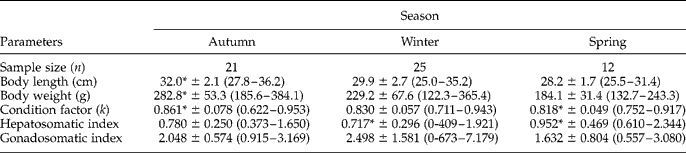
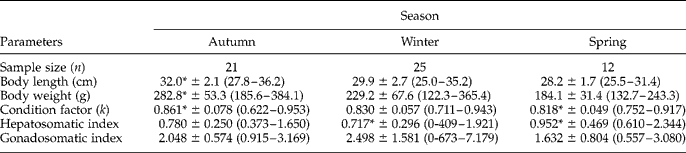
In this study, significant differences were detected in fish size between seasons, with jack mackerel captured in autumn being significantly larger than in other seasons, both in length and weight (table 1). The condition factor was also higher in autumn, although not significantly different from the winter sample. The hepatosomatic index, on the other hand, was higher in spring, although not significantly different from the autumn sample. There were no significant differences in the gonadosomatic index between seasons.
Mean values (± SD) of body length, weight, condition factor, hepatosomatic and gonadosomatic indices of Trachurus picturatus from Portuguese mainland waters during October 2012 to April 2013; ranges are given in parentheses.
* Level of significance with P < 0.05.
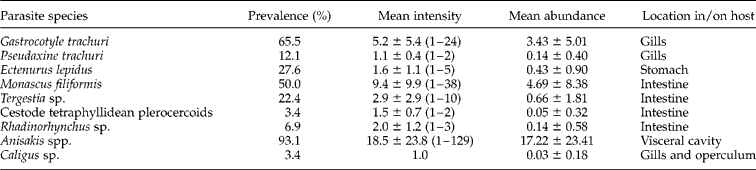
With regard to the parasite community, nine different parasite taxa were detected in T. picturatus from mainland Portuguese waters: the monogenean species Gastrocotyle trachuri Van Beneden & Hesse, 1863 and Pseudaxine trachuri Parona & Perugia, 1889; the digenean trematodes Ectenurus lepidus Looss, 1907, Monascus filiformis (Rudolphi, 1819) and Tergestia sp.; cestode tetraphyllidean plerocercoids; the acanthocephalan Rhadinorhynchus sp.; L3 larval stages of Anisakis spp. nematodes; and the copepod Caligus sp. (table 2).
Mean infection levels (± SD) of metazoan parasite species in Trachurus picturatus from Portuguese mainland waters; ranges given in brackets.
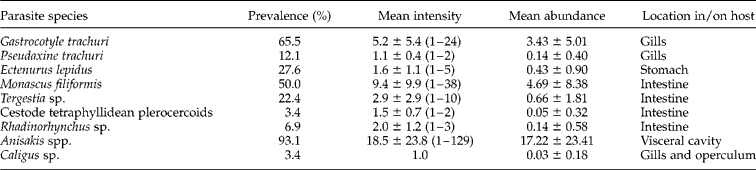
All fish were parasitized. The average number of parasite species per host was 2.9 ( ± 1.2), and each host carried an average load of 26.8 ( ± 25.3) parasites. The most prevalent parasite was Anisakis spp., which presented high infection levels in all seasons, reaching 100% prevalence in autumn. Within the ectoparasites, the dominant species was the monogenean G. trachuri, with prevalences above 50% in all seasons.
There were significant seasonal differences in infection levels, in particular in prevalence and abundance of the trematodes E. lepidus and M. filiformis, and in intensity and abundance of the nematode Anisakis spp. (table 3). Infection levels were always higher in autumn. Tetraphyllidean plerocercoids occurred only in winter and spring, Rhadinorhynchus sp. in autumn and winter, and Caligus sp. only in winter.
Seasonal levels of prevalence (%), mean intensity (I) and mean abundance (A) of dominant parasite species in Trachurus picturatus from Portuguese mainland waters during October 2012 to April 2013; mean values (± SD); ranges given in brackets.

* Level of significance with P < 0.05.
Parasite abundance was positively correlated with fish size whether using total length or weight (values are shown for correlation with total length) for M. filiformis (r= 0.296, P= 0.024), Rhadinorhynchus sp. (r= 0.267, P= 0.042) and Anisakis spp. (r= 0.550, P= 0.000).
Discussion
Seasonal changes in fish condition
Blue jack mackerel examined in this study had significantly higher length and weight in autumn (table 1). The condition factor was also higher in autumn and, to an extent, winter. This could reflect annual changes in growth and condition of this species, which, especially in the Portuguese continental shelf, is likely to benefit from an increase in food availability in spring/summer due to the occurrence of upwelling and consequent increase in primary production and plankton availability (Arístegui et al., Reference Arístegui, Barton, Álvarez-Salgado, Santos, Francisco, Figueiras, Kifani, Hernández-León, Mason, Machú and Demarcq2009). Blue jack mackerel reproduces in winter (Jurado-Ruzafa & Santamaría, Reference Jurado-Ruzafa and Santamaría2013; Garcia et al., Reference Garcia, Pereira, Canha, Reis and Diogo2015). Many fish species follow annual cycles with distinct periods of feeding and reproduction, and successful reproduction is often heavily dependent on adequate energy reserves, which need to be acquired prior to the start of the reproductive season (Lloret et al., Reference Lloret, Shulman and Lowe2014); in contrast, during the reproductive season there is often a reduction in feeding intensity, as seen for example in the horse mackerel, T. trachurus (Jardas et al., Reference Jardas, Šantić and Pallaoro2004). Seasonal differences, especially in condition factor (higher in spring, probably due to food availability) and gonadosomatic index (although without significant differences, this index was higher in winter) in this study seem to reflect this biological cycle.
Composition of parasite fauna
The parasite community of blue jack mackerel is broadly similar to the parasite community of Atlantic horse mackerel, T. trachurus, from the same region (MacKenzie et al., Reference MacKenzie, Campbell, Mattiucci, Ramos, Pinto and Abaunza2008), suggesting that the two species, which share a similar life style, are probably exposed to the same opportunities for acquiring parasites, despite the somewhat more oceanic nature of T. picturatus.
The monogenean G. trachuri has been observed previously in T. picturatus from off the coast of the Western Sahara and from the Meteor Seamount, south of the Azores (Gaevskaya & Kovaleva, Reference Gaevskaya and Kovaleva1979, Reference Gaevskaya and Kovaleva1985). It also occurs in T. trachurus from European waters (Llewellyn, Reference Llewellyn1962; MacKenzie et al., Reference MacKenzie, Campbell, Mattiucci, Ramos, Pinto and Abaunza2008), so its presence in T. picturatus from Portuguese mainland waters is not surprising. This parasite exhibits very high prevalences in young mackerel, especially in the first 3 years of life, and diminishing afterwards (Llewellyn, Reference Llewellyn1962). The minimum size of fish observed in the present study, 25.0 cm TL (total length), corresponds, on average, to 3-year-old fish (Vasconcelos et al., Reference Vasconcelos, Alves, Gouveia and Faria2006; Garcia et al., Reference Garcia, Pereira, Canha, Reis and Diogo2015), which may explain the moderately high prevalence of G. trachuri observed in this study, which is similar to that observed around the Meteor Seamount (Gaevskaya & Kovaleva, Reference Gaevskaya and Kovaleva1985).
The monogenean P. trachuri has often been detected in Trachurus spp., including T. picturatus (Gaevskaya & Kovaleva, Reference Gaevskaya and Kovaleva1979, Reference Gaevskaya and Kovaleva1985); Costa et al., Reference Costa, Melo-Moreira and de Carvalho2012), T. trachurus (Llewellyn, Reference Llewellyn1962; MacKenzie et al., Reference MacKenzie, Campbell, Mattiucci, Ramos, Pinto and Abaunza2008) and T. mediterraneus (Akmirza, Reference Akmirza2013), as well as in another small pelagic to benthopelagic species, the bogue Boops boops (Pérez-del Olmo et al., Reference Pérez-del Olmo, Fernández, Raga, Kostadinova and Poulin2008). This parasite is transmitted directly, and its transmission, even across species, is probably facilitated by the schooling behaviour of the hosts, often found in mixed schools.
The digeneans M. filiformis, E. lepidus and Tergestia sp. have all been observed previously in T. picturatus (Gaevskaya & Kovaleva, Reference Gaevskaya and Kovaleva1985; Bartoli et al., Reference Bartoli, Gibson and Bray2005). The most prevalent digenean in this study was the fellodistomid M. filiformis, with a prevalence of 50%. This species was detected in T. picturatus from the Western Saharan coast (Gaevskaya & Kovaleva, Reference Gaevskaya and Kovaleva1985), although no prevalence value is given, and also off Corsica, France, with a slightly lower prevalence, 41.7 % (Bartoli et al., Reference Bartoli, Gibson and Bray2005). Interestingly, it was absent from T. trachurus from Portuguese waters (MacKenzie et al., Reference MacKenzie, Campbell, Mattiucci, Ramos, Pinto and Abaunza2008) even though it also infects that species, for example in the Mediterranean (Bartoli et al., Reference Bartoli, Gibson and Bray2005). It is mainly a parasite of carangids, although other fish species may also be infected (Bray & Gibson, Reference Bray and Gibson1980).
Monascus filiformis has chaetognaths and medusae as second intermediate hosts (Martorelli & Cremonte, Reference Martorelli and Cremonte1998; Daponte et al., Reference Daponte, de Pertierra, Palmieri and de Nunez2006) and, although evidence as to whether Trachurus spp. feed on medusae is inconclusive (Cardona et al., Reference Cardona, De Quevedo, Borrell and Aguilar2012), both T. trachurus and T. mediterraneus are known to include chaetognaths in their diets (Bayhan & Sever, Reference Bayhan and Sever2009; Bayhan et al., Reference Bayhan, Sever and Kara2013), and it is likely that T. picturatus does too. Alternatively, M. filiformis could also be acquired by T. picturatus feeding on small fish that had consumed cercariae, and which constitute facultative intermediate hosts, as suggested by Køie (Reference Køie1979). Unfortunately, the feeding habits of T. picturatus are still poorly known. In Madeira, the stomach contents of T. picturatus were found to consist mainly of fish and euphausiid crustaceans, whereas in the Canary Islands, they were composed of isopods and fish (Costa et al., Reference Costa, Santamaria, Vasconcelos, Perera and Melo-Moreira2013). Around the Seine Seamount, near Madeira, blue jack mackerel were found to feed mainly on juvenile snipefish Macroramphosus sp. (Hirch & Christiansen, Reference Hirch and Christiansen2010). However, no M. filiformis were detected in Madeiran waters (Costa et al., Reference Costa, Melo-Moreira and de Carvalho2012), nor in the area of the seamounts studied by Gaevskaya & Kovaleva (Reference Gaevskaya and Kovaleva1985), suggesting that this parasite is restricted to continental-shelf regions, presumably where its intermediate hosts occur.
The hemiuroid E. lepidus occurred with a relatively high prevalence (46%) in blue jack mackerel from the continental shelf off the Western Sahara (Gaevskaya & Kovaleva, Reference Gaevskaya and Kovaleva1985), and with a much lower prevalence in the area of the Meteor Seamount (6.7%) (Gaevskaya & Kovaleva, Reference Gaevskaya and Kovaleva1985, as Ectenurus virgulus) and off the French Mediterranean coast (8.3%) (Bartoli et al., Reference Bartoli, Gibson and Bray2005). In the present study it was found to have an intermediate prevalence, 27.6%. This is a somewhat generalist parasite that occurs in a number of different hosts, but its definitive hosts are mainly carangids (Carreras-Aubets et al., Reference Carreras-Aubets, Montero, Kostadinova, Gibson and Carrassón2012). Metacercariae of Ectenurus sp. have also been detected in chaetognaths, Sagitta spp. (Gibson & Bray, Reference Gibson and Bray1986; Daponte et al., Reference Daponte, de Pertierra, Palmieri and de Nunez2006), suggesting that this hemiuroid could also have been transmitted through jack mackerel feeding on them.
The third digenean trematode, Tergestia sp., another fellodistomid, could not be identified with absolute certainty, but it is most likely to be Tergestia laticollis, a species known to infect several Trachurus species, including T. picturatus from the Mediterranean (Bartoli et al., Reference Bartoli, Gibson and Bray2005). This trematode was absent from previous studies of parasites of blue jack mackerel from the Atlantic (Gaevskaya & Kovaleva, Reference Gaevskaya and Kovaleva1985; Costa et al., Reference Costa, Melo-Moreira and de Carvalho2012), and was also absent from T. trachurus from Portuguese waters (MacKenzie et al., Reference MacKenzie, Campbell, Mattiucci, Ramos, Pinto and Abaunza2008). It is, however, present in T. trachurus from elsewhere in the north-eastern Atlantic (Bray & Gibson, Reference Bray and Gibson1980), and its free-floating cercariae may have been observed from off Portugal (Kent, 1871, cited by Bray & Gibson, Reference Bray and Gibson1980). The life cycle of this species is not yet fully elucidated.
Digenean species richness and infection levels were higher in blue jack mackerel from continental shelf areas (Gaevskaya & Kovaleva, Reference Gaevskaya and Kovaleva1985, Bartoli et al., Reference Bartoli, Gibson and Bray2005, and the present study) than in oceanic areas (Gaevskaya & Kovaleva, Reference Gaevskaya and Kovaleva1985; Costa et al., Reference Costa, Melo-Moreira and de Carvalho2012). This tendency has also been observed in other fish hosts, e.g. in Pagellus bogaraveo (Hermida et al., Reference Hermida, Cruz and Saraiva2014), and is likely related to differences between continental and oceanic regions in the occurrence of intermediate hosts of these parasites.
Cestode tetraphyllidean plerocercoids are very common marine parasites found in a variety of fish species; they were also found in T. picturatus from seamounts south of the Azores (Gaevskaya & Kovaleva, Reference Gaevskaya and Kovaleva1985), but were absent from the coasts of Madeira and the Western Sahara (Gaevskaya & Kovaleva, Reference Gaevskaya and Kovaleva1985; Costa et al., Reference Costa, Melo-Moreira and de Carvalho2012). In contrast, trypanorhynch cestodes, such as Nybelinia lingualis, found with moderate to high prevalences around Madeira, the Canary Islands and oceanic seamounts (Gaevskaya & Kovaleva, Reference Gaevskaya and Kovaleva1985; Costa et al., Reference Costa, Melo-Moreira and de Carvalho2012, Reference Costa, Santamaria, Vasconcelos, Perera and Melo-Moreira2013), are conspicuously absent in this study. These parasites were also rarely detected in a large number of T. trachurus samples from European continental waters (MacKenzie et al., Reference MacKenzie, Campbell, Mattiucci, Ramos, Pinto and Abaunza2008). This pattern is similar to that observed in Aphanopus carbo, which was found to be infected with N. lingualis in the sea around the archipelagos of Madeira and Azores, but not off mainland Portugal (Santos et al., Reference Santos, Saraiva, Cruz, Eiras, Hermida, Ventura and Soares2009). This may reflect differences either in availability of appropriate definitive hosts of these parasites (elasmobranch fishes) and/or intermediate and paratenic hosts that are consumed by blue jack mackerel. In Madeira, this transmission was hypothesized to originate in cephalopod prey, such as young oceanic flying squid of the genus Ommastrephes (Costa et al., Reference Costa, Veltkamp and Chubb2003b), which tend to be offshore species.
The acanthocephalan Rhadinorhynchus sp. could not be identified with certainty to species level because none of the specimens presented a fully everted proboscis. Nevertheless, it is likely to be the species R. cadenati, which was found in blue jack mackerel caught off Madeira, the Canary Islands and the Western Sahara (Gaevskaya & Kovaleva, Reference Gaevskaya and Kovaleva1985; Costa et al., Reference Costa, Santamaria, Vasconcelos, Perera and Melo-Moreira2013). It was found in the present study with a relatively low prevalence (6.9%), similar to that detected off the African West coast (6.7%). Blue jack mackerel may become infected with this parasite by feeding on isopod crustaceans (Costa et al., Reference Costa, Santamaria, Vasconcelos, Perera and Melo-Moreira2013).
The most prevalent parasite was the larval anisakid Anisakis spp., with an overall prevalence of 93.1% and reaching 100% prevalence in autumn. Anisakids have marine mammals as their definitive hosts, and use a variety of teleost fishes as paratenic hosts. They have often been observed in T. picturatus (Gaevskaya & Kovaleva, Reference Gaevskaya and Kovaleva1985; Costa et al., Reference Costa, Pontes, Mattiucci and D'Amélio2003a, Reference Costa, Melo-Moreira and de Carvalho2012, Reference Costa, Santamaria, Vasconcelos, Perera and Melo-Moreira2013; Pontes et al., Reference Pontes, D'Amélio, Costa and Paggi2005). The Anisakis spp. prevalence observed in this study was higher than those detected previously in this species in the Atlantic – 86.7% around the Irving Seamount (Gaevskaya & Kovaleva, Reference Gaevskaya and Kovaleva1985) – but anisakid prevalences of 100% have been detected in T. picturatus from the Mediterranean (Manfredi et al., Reference Manfredi, Crosa, Galli and Ganduglia2000). Very high prevalences of Anisakis spp. have also been detected in T. trachurus from Galicia and the north-western coast of Portugal (Silva & Eiras, Reference Silva and Eiras2003; MacKenzie et al., Reference MacKenzie, Campbell, Mattiucci, Ramos, Pinto and Abaunza2008). Off the Portuguese mainland, anisakid prevalences of 100% have also been reported previously in other fishes, such as blackspot seabream Pagellus bogaraveo (Hermida et al., Reference Hermida, Mota, Pacheco, Santos, Cruz, Saraiva and Tamagnini2012) and black scabbardfish Aphanopus carbo (Cruz et al., Reference Cruz, Saraiva, Santos, Eiras, Ventura, Soares and Hermida2009). Although specimens were not identified molecularly, it is likely that Anisakis spp. detected in this study correspond to the species Anisakis simplex and/or A. pegreffii, as these were the species identified in fish from the same region, including T. trachurus (Mattiucci et al., Reference Mattiucci, Farina, Campbell, MacKenzie, Ramos, Pinto, Abaunza and Nascetti2008), P. bogaraveo (Hermida et al., Reference Hermida, Mota, Pacheco, Santos, Cruz, Saraiva and Tamagnini2012) and Pleuronectiformes (Marques et al., Reference Marques, Cabral, Busi and D'Amelio2006).
Finally, the copepod Caligus sp. has not been detected previously in blue jack mackerel, but it is a generalist ectoparasite which also occurs accidentally in T. trachurus (MacKenzie et al., Reference MacKenzie, Campbell, Mattiucci, Ramos, Pinto and Abaunza2008).
Parasite community
Seasonal differences detected in parasite infection levels point to significantly higher infection levels in autumn; however, the sample size is too small to permit sound conclusions regarding the effect of season on parasite infection levels. In addition, it was not possible to distinguish seasonal effects from the effect of fish size, since fish from the autumn sample were significantly larger. This is all the more problematic when considering that the same parasites that evidenced seasonal differences in infection levels – Monascus filiformis and Anisakis spp. – also presented a positive correlation with fish size. The hemiuroid E. lepidus is a partial exception, since it also exhibited greater prevalence and abundance in autumn, but no correlation with fish size. This could be related to seasonal differences either in abundance of its intermediate hosts, or of T. picturatus feeding habits.
A positive correlation between abundance of the acanthocephalan Rhadinorhynchus sp. and the nematode Anisakis spp. with fish size is to be expected, since larger fish consume more and larger prey, thus increasing their potential exposure to trophically acquired parasites. Furthermore, for long-lived parasites such as anisakid nematodes, which are able to remain encysted in their paratenic hosts for long periods of time, their accumulation in the host is a function of the total amount of prey consumed by the fish (Gibson & Jones, Reference Gibson and Jones1993). A positive correlation of anisakid nematode abundance with fish length has also been detected, for example, in P. bogaraveo from Portuguese waters (Hermida et al., Reference Hermida, Mota, Pacheco, Santos, Cruz, Saraiva and Tamagnini2012).
In conclusion, the parasite community detected in T. picturatus from the Portuguese waters was broadly similar to that of the closely related T. trachurus from the same region (MacKenzie et al., Reference MacKenzie, Campbell, Mattiucci, Ramos, Pinto and Abaunza2008), which makes sense considering that these are similar species which may even school together. However, there are some differences, especially the infection of T. picturatus by the digeneans M. filiformis and Tergestia sp., which did not occur in T. trachurus from the same region, possibly reflecting subtle differences in habitat use and feeding regimes on the part of the two carangid species.
When comparing the present study with the two other studies of parasite fauna of T. picturatus (Gaevskaya & Kovaleva, Reference Gaevskaya and Kovaleva1985; Costa et al., Reference Costa, Melo-Moreira and de Carvalho2012), two broad differences separate continental-shelf localities (off Western Sahara and mainland Portugal) from oceanic localities (around Madeira and seamounts): higher infection levels of digenean trematodes in the shelf areas, and the absence of trypanorhynch cestodes in those areas. This is likely due to differences in abundance of intermediate hosts of those parasites, which, in turn, reflect differences in habitat between continental shelf and oceanic areas.
Acknowledgements
The authors would like to thank Fernando Alexandre for proof-reading the manuscript. Furthermore, the authors are grateful for valuable comments and suggestions from the editor and two anonymous referees, which greatly improved the manuscript.
Financial support
This research was partially supported by the European Regional Development Fund (ERDF) through COMPETE (Operational Competitiveness Program), and national funds through FCT (Foundation for Science and Technology) (project Pest-C/MAR/LA0015/2013) and by ARDITI (Regional Agency for Development of Research, Technology and Innovation of Madeira) (M.H.; grant no. 002243/2013/13).
Conflict of interest
None.