Introduction
Cochlear implantation is an effective intervention to restore hearing in patients with severe-to-profound sensorineural hearing loss (SNHL).Reference Andries, Lorens, Skarżyński, Skarżyński, Calvino and Gavilán1 Currently, there are more than one million patients with cochlear implants (CI).Reference Zeng2 With advances in technology and the success of cochlear implantation, candidacy criteria have expanded. The use of bilateral stimulation is becoming common for CI recipients with either a CI in one ear and a hearing aid (HA) in the contralateral ear (bimodal), or CIs in both ears (bilateral cochlear implants [BCIs]).Reference Angermeier, Hemmert and Zirn3 As of 2010, approximately 5 per cent of CI recipients worldwide have received bilateral implants.Reference Peters, Wyss and Manrique4 It is estimated that approximately 60 per cent of adult CI recipients have assistive low-frequency hearing in the non-implanted ear (hearing threshold at 250 Hz ≤85 dB HLReference Dorman and Gifford5). For these patients, a HA for the opposite ear is recommended to improve speech recognition and spatial hearing.Reference Zaleski-King, Goupell, Barac-Cikoja and Bakke6
Sound source localisation is an important skill that helps people perceive their surroundings. It helps people identify sources of danger in traffic environments and enhance communication in noisy environments by selectively directing attention to the locations of speakers of interest. Sound source localisation mainly relies on three cues: interaural time differences (ITD) and interaural level differences (ILD) for horizontal localisation, and spectral cues for vertical and front/back localisation.Reference Risoud, Hanson, Gauvrit, Renard, Lemesre and Bonne7 BCI or bimodal hearing conditions often help patients achieve better hearing ability compared with unilateral CI use. However, the two conditions differ in their approaches to improving binaural hearing. In BCI recipients, the benefits of binaural hearing are strongly associated with spatial hearing. Both ears can overcome the head-shadow effect to improve speech recognition in noisy environments and obtain good binaural loudness differences to improve sound source localisation. The benefit of binaural hearing gained by bimodal recipients has little to do with spatial hearing but rather with the complementarity of the sound information provided by bilateral devices. HAs can provide low-frequency spatio-temporal information to improve pitch discrimination and speech recognition. However, when spatial hearing is well utilised, the benefit of adding a CI is much greater than that of adding an HA in the opposite ear because the head-shadow effect is more pronounced at higher frequencies, and the symmetry of binaural cues is improved. With the upgradation of HA equipment, more high-frequency sound information can be used by the HA side ear, and spatial hearing benefits may also increase for these patients. This requires sophisticated approaches to compensate for the differences in the manner in which auditory information is transmitted in both ears.Reference Van Hoesel8
Presently, there are only a few studies that focus on the comparison of the sound localisation ability of BCI and bimodal CI users. Potts et al.Reference Potts and Litovsky9 compared the sound localisation ability of four participants under bimodal conditions before the second cochlear implantation with that under the BCI condition. They found that the sound localisation ability of all the participants using the BCI was better than that under the bimodal condition. Sparreboom et al.Reference Sparreboom, Ausili, Agterberg and Mylanus10 compared the sound localisation abilities of nine bimodal CI users and seven BCI users. They found that the BCI users performed significantly better than the bimodal CI users in locating high-frequency sounds. Choi et al.Reference Choi, Moon, Kim, Park, Kim and Chung11 compared the sound localisation abilities of 19 children with bimodal CIs and 13 children with BCIs and found no significant differences between the 2 groups. This might be due to the fact that both groups of participants were preverbal hearing-impaired and did not have effective auditory input to establish good spatial hearing ability early in life. Further, instead of the root mean square error (RMSE), the mean angle difference was used to evaluate the difference of the response and stimulus angle. The RMSE is always greater than or equal to the mean angle difference because it weighs large errors more than small errors, whereas the mean angle difference weighs all errors equally. Therefore, the mean angle difference does not reflect the potential difference in sound source discrimination.Reference Hartmann, Rakerd and Gaalaas12 The differences in the results of the above studies make it impossible to reach a consistent conclusion about whether bimodal hearing can help patients with bilateral SNHL acquire sound source localisation abilities as good as BCIs do. In this study, we conducted a horizontal-plane sound source localisation task with a large sample of BCI and bimodal CI users and attempted to answer this question.
Materials and methods
Study design and participants
Forty-four bimodal CI and 20 BCI users were included in this study. The average age of bimodal CI users was 36.29 ± 18.30 (7.61–79.82) years, and the average duration of deafness and bimodal CI use were 15.86 ± 9.78 (0.33–32.00) and 1.22 ± 1.46 (0.25–5.82) years, respectively. The average hearing threshold of the CIs and HAs were 39.38 ± 11.40 and 56.59 ± 14.47 dB HL, respectively. Twenty-two bimodal CI users had an average hearing threshold at 0.25–1 kHz less than or equal to 80 dB HL for the non-implanted ear, which was defined as the group with good low-frequency hearing. The remaining 22 bimodal CI users with an average hearing threshold at 0.25–1 kHz greater than 80 dB HL for the non-implanted ear were defined as the group with poor low-frequency hearing. Participants were enrolled when they visited our hospital for CI mapping, and their HAs were fitted at other institutions. The participants used the procedures that they used daily for both the CIs and HAs for the sound localisation task. The participants were able to balance the loudness of both ears as much as possible by adjusting the volume switches of the HAs and CIs. The average age of BCI users was 24.00 ± 14.87 (6.20–57.5) years. The mean duration of hearing loss in both ears was 13.00 ± 13.30 years. For all BCI users, the average hearing threshold at 0.5–2 kHz for the implanted ears was greater than 80 dB HL, and the auditory brainstem response threshold was greater than 90 dB nHL. Bilateral CIs were implanted simultaneously in 8 participants and sequentially in 12 participants. The average duration of the first and the second CI use were 4.68 ± 3.79 and 2.09 ± 2.02 years, respectively. The interval between sequential implantations was 6.47 ± 4.15 years. Participants with BCIs were enrolled during CI mapping at our hospital.
The authors assert that all procedures contributing to this work comply with the ethical standards of the relevant national and institutional guidelines on human experimentation (Ethics Committee of Beijing Friendship Hospital, Capital Medical University) and with the Helsinki Declaration of 1975, as revised in 2008. Written informed consent was obtained from the participants before recruitment after an adequate explanation of the purpose and procedures of the study.
Sound source discrimination task
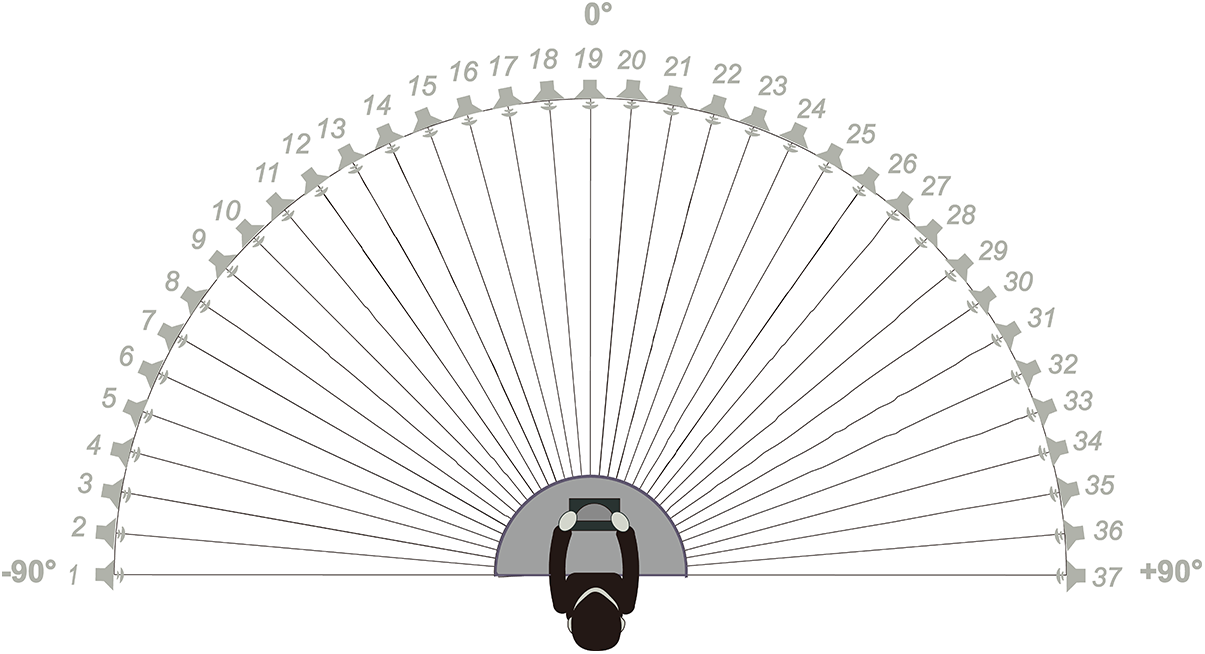
The sound source discrimination task was performed in a standard sound isolation chamber. The test equipment comprised 37 speakers spaced 5° apart, which were 1.2 m away from the participants and at the same height as the external ear canal. Speakers were coded 1–37 from left to right, with Speaker 19 located directly in front of the participants (Figure 1).
Schematic diagram of loudspeaker placement.

During the test, the participants sat in the centre of a circle, with a touch screen placed in front of them. The positions and numbers of speakers were displayed on the touchscreen. The stimulating signal was the speech sound ‘Song,’ with an intensity of 60 dB SPL. During the test, the participants were asked to hold their heads in a fixed forward-facing position until the stimuli ended and then turn their heads to look for the loudspeakers after the stimuli stopped. No feedback was provided after each response.
Pre-test
The participants underwent a pre-test to familiarise themselves with the experimental process. Speakers 1, 10, 19, 28 and 37 played 10 stimuli at random, twice per speaker. The participants were tested under binaural hearing conditions.
Formal test
During the formal test, the speakers emitted 37 sounds once, and the order was randomly generated. The test included two conditions: (1) use of one CI (participants with BCIs used the ear with the better aided hearing threshold) and (2) use of bilateral devices. The test order was randomly generated.
The RMSE was used to evaluate the sound source discrimination ability of the participants.
 \begin{equation}RMSE = \sqrt {\frac{{\mathop \sum \nolimits_{i = 1}^n {{\left( {\alpha _{RESP}^i - \alpha _{STIM}^i} \right)}^2}}}{n}} \end{equation}
In the above formula, n is the total number of stimuli, i is the number of stimuli, αRESP is the response degree, αSTIM is the stimulus degree. The lower the RMSE score, the better is the localisation ability.
Statistical analysis
In order to determine the chance level, a Monte Carlo simulation based on equation 1 was conducted to simulate the responses of one thousand completely deaf listeners with purely random response behaviour, each responding 37 times in a localisation test (using MATLAB’s Random Number Generator (Mathworks, Natick, Massachusetts, USA)).Reference Zirn, Angermeier, Arndt, Aschendorff and Wesarg13 The score obtained at chance level was 74.26 ± 6.66°.
SPSS software (Version 25.0, IBM SPSS, Armonk, New York, USA) was used to establish and analyse the data. Statistical analysis of the RMSE scores included pairwise comparisons using paired t-tests for paired data, two-sample t-tests for unpaired data, and a one-sample t-test to compare the RMSE scores of the test participants and those at the chance level. A two-sample t-test was used to compare the hearing threshold differences between the bimodal and BCI groups.
Results and analysis
Sound localisation behaviour
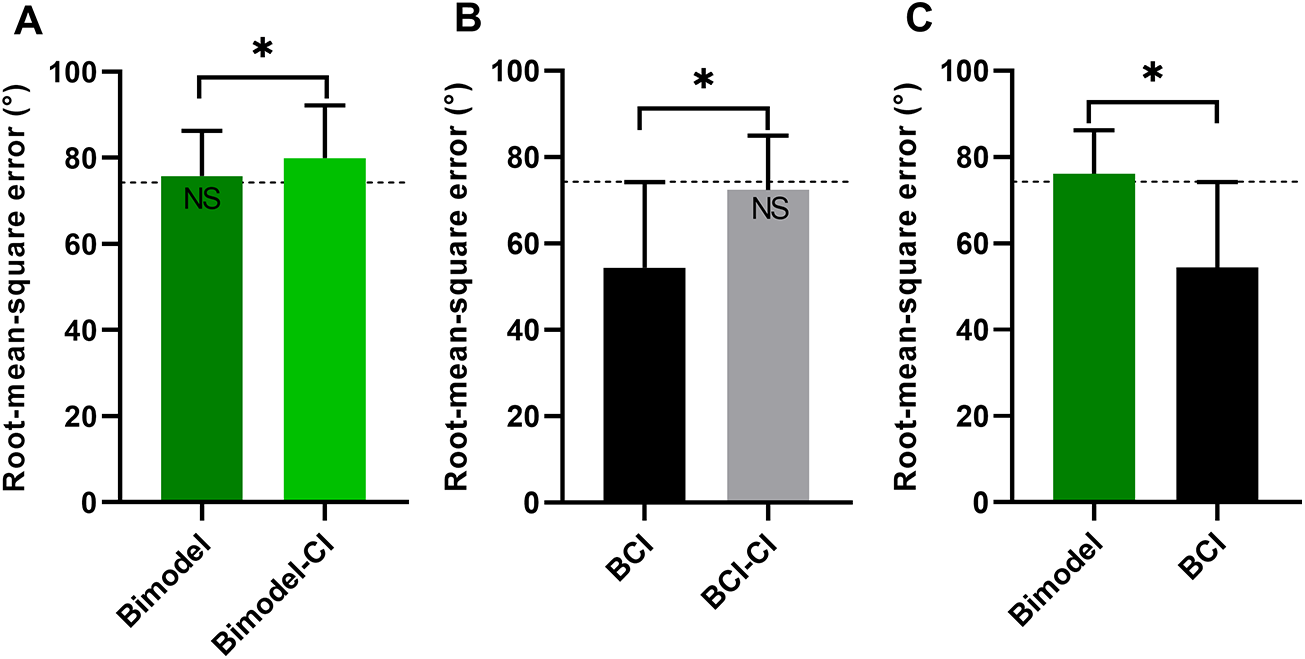
The RMSE scores of the participants under unilateral CI and bimodal hearing conditions were 79.98 ± 1.84° and 75.77 ± 10.49°, respectively. The RMSE score for the bimodal condition was significantly lower than that for the CI condition (t = 2.34, p = 0.024). There was no significant difference between the RMSE scores of the bimodal CI users using bilateral devices and those at the chance level (t = 0.96, p = 0.344). Although the RMSE score of bimodal CI users using CI + HA was significantly different from that using CI alone, the RMSE score for CI + HA was only at the chance level. Therefore, it could not be considered that HA use in the opposite ear could help patients with unilateral CIs to obtain better sound localisation ability. The RMSE scores of participants with BCIs using unilateral and bilateral CIs were 72.37 ± 12.62° and 54.39 ± 19.82°, respectively. For the same participants, the sound localisation ability with bilateral CI use was significantly better than with unilateral CI use (t = 16.13, p < 0.001). The RMSE scores of BCI users were significantly better than those at the chance level when using bilateral CIs (t = 4.48, p < 0.001), whereas there was no such difference when using unilateral CIs (t = 0.67, p = 0.511). The sound localisation ability of the BCI users was significantly better than that of the bimodal CI users (t = 5.65, p < 0.001) (Figure 2).
RMSE scores of bimodal CI and BCI users. (A) RMSE scores of bimodal CI users with CIs and CI + HA, Bimodal CI, participants only wear Cis. (B) RMSE scores of BCI users with unilateral and bilateral CIs, BCI-CI, participants wear unilateral CI. (C) Comparison of the RMSE scores between bimodal CI and BCI users. The ordinate represents the localisation ability, and the higher the value, the worse is the localisation ability. The dotted line represents the chance level; asterisk represents p < 0.05; ns represents no statistical difference compared with the chance level.

Binaural hearing threshold difference of the two groups
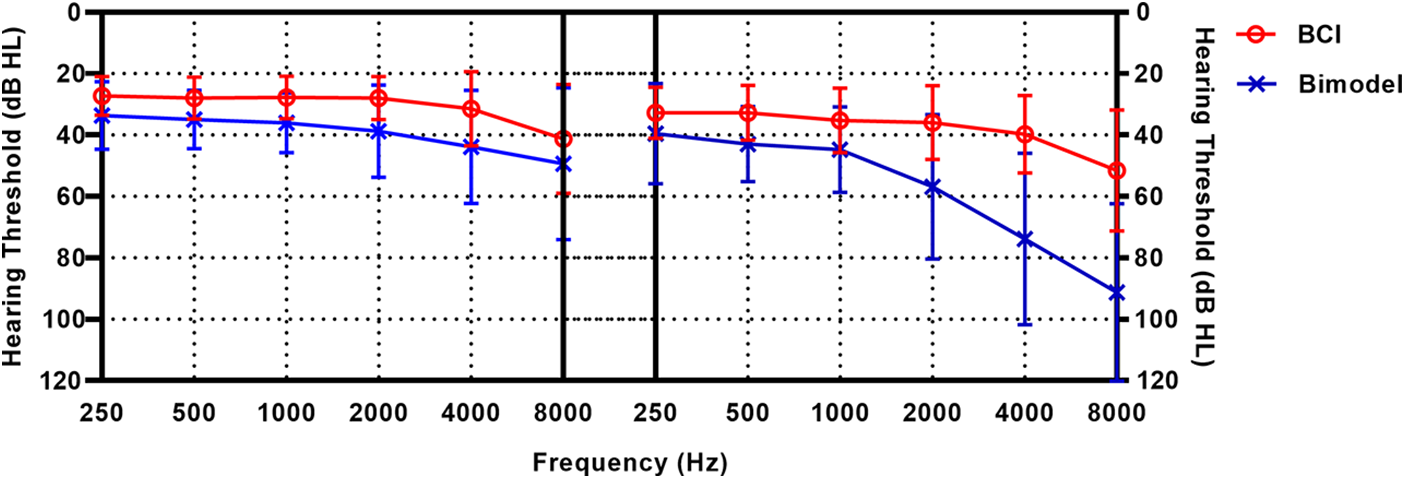
The average difference of binaural hearing threshold of BCI and bimodal CI users were 7.25 ± 7.06 and 21.45 ± 12.75 dB HL, respectively. The binaural hearing threshold difference of the BCI users was significantly smaller than that of the bimodal CI users (t = 4.66, p < 0.001). The average aided hearing thresholds of the BCI and bimodal CI users are shown in Figure 3.
Average aided hearing threshold of BCI and bimodal CI users. The red and blue lines represent the average aided hearing thresholds of the BCI and bimodal CI users, respectively. The pictures on the left and right show the good and poor hearing thresholds, respectively.

Effect of low-frequency hearing threshold of the non-implanted ear on the sound localisation ability of bimodal CI users
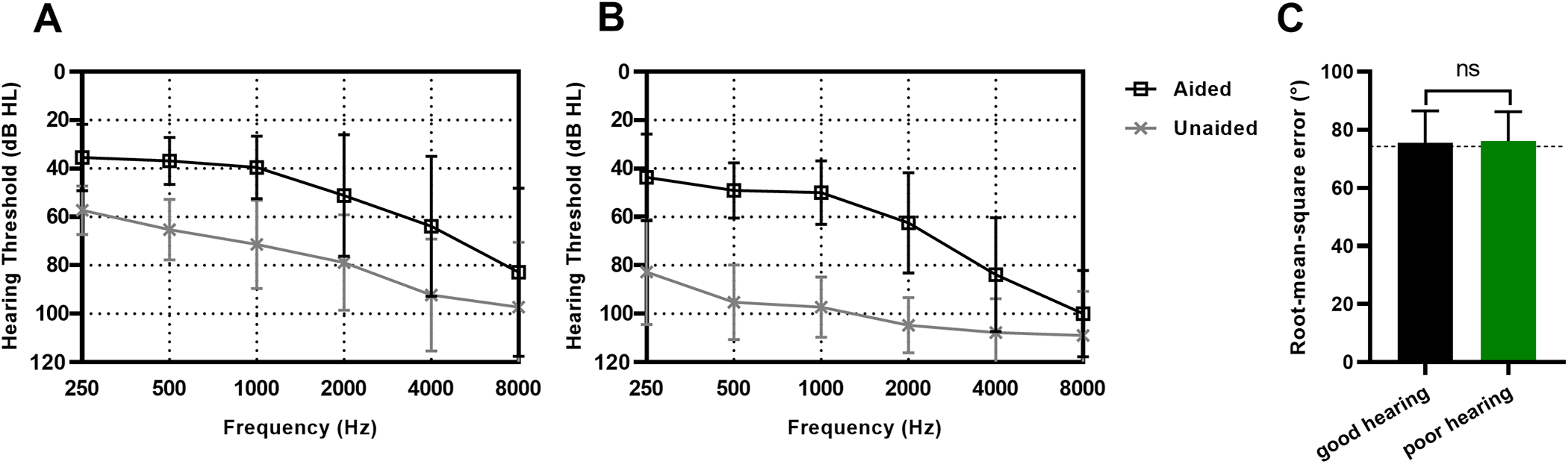
The RMSE sores of bimodal CI users with good and poor low-frequency hearing were 75.45 ± 11.07° and 76.10 ± 10.14°, respectively. There was no significant difference between the two groups (t = 0.20, p = 0.84). Better low-frequency hearing did not help the bimodal participants achieve more accurate sound source localisation (Figure 4).
Comparison of the sound localisation ability between bimodal CI users with good and poor low-frequency hearing in the non-implanted ears. (A) Hearing thresholds of the bimodal users with good low-frequency hearing. (B) Hearing thresholds of the bimodal users with poor low-frequency hearing. The black and the grey lines represent the aided and unaided hearing thresholds, respectively. (C) Comparison of the sound localisation ability of the two groups. The ordinate represents the localisation ability, and the higher the value, the worse is the localisation ability; the dotted line represents the chance level; ns represents no statistical difference.

Discussion
Our study showed that the sound localisation ability of the BCI users was significantly better than that of the bimodal CI users. Horizontal sound localisation requires that both ears provide well-matched information on the ITD and ILD. This matching is difficult in bimodal CI users because the acoustic propagation paths, signal processing and available frequency ranges of the CIs and HAs are fairly different. The ITD and ILD information of the two ears are more similar in BCI users, although differences in aetiology and listening experience may still exist.
Device performance might be an important factor that led to the sound localisation ability of bimodal CI users being worse than that of BCI users. Owing to the limited gain of HAs, as well as the generally severe hearing loss in the non-implanted ear compared with BCI users, bimodal CI users were less likely to acquire ILD cues for localisation. Francart et al.Reference Francart, Lenssen and Wouters14 reported that HAs with the algorithm present enhanced ILD cues that could help bimodal CI users improve localisation performance by 4°–10° absolute error, compared with the traditional algorithm, in a horizontal-plane sound localisation task. In contrast, our participants with BCIs used the same type of device bilaterally; thus, the time at which the bilateral spiral ganglion cells experienced stimulation might be consistent. The bimodal users used a CI in one ear and an HA in the other, and the two devices transmitted sounds in different ways. On the CI side, sounds are first processed by speech processors, decoded by implanted chips, and finally, the spiral ganglion cells are directly electrically stimulated.Reference Francart and McDermott15 Previous studies reported a delay of the CI ear relative to a normal-hearing ear of 10.5–12.5 ms for Cochlear Ltd. Devices (Cochlear Ltd., Sydney, Australia) and 9–11 ms for Advanced Bionics devices (Advanced Bionics, Great Shelford, UK),Reference Wess, Brungart and Bernstein16 and the delay with the use of the MED-EL CI system (MED-EL Elektromedizinische Geräte GmbH, Innsbruck, Austria) turned out to be reasonably similar to that of the unaided ear.Reference Zirn, Arndt, Aschendorff and Wesarg17 HAs process sound signals to produce a certain delay, after which the sound passes through the middle and inner ears to stimulate the auditory nerve. The sound delay is the sum of the device processing delay and the frequency-dependent travelling wave delay.Reference Stone and Moore18 In most cases, the delay of sounds heard through CIs and HAs is different. The difference can be up to tens of milliseconds, and nerve stimulation occurs first on the side with a shorter time delay. Therefore, the bimodal CI users were less likely to obtain ITD clues for localisation compared with the BCI users. The following are some recommendations to improve hearing by combined HAs and CIs, particularly binaural cue perception, leading to improved sound localisation. First, the dependence of the device sound processing delay on the frequency and hearing loss must be investigated, and the personalised device delay time for each bimodal CI user must be determined so that acoustic and electrical stimulation produce synchronous neural activation. Second, the gain compensation of the HAs must be optimised to enable similar loudness perception in both ears. Finally, the fidelity of the envelope timing cues in CIs must be improved in a way that could co-operate with the acoustic stimulus.
In this study, the binaural hearing threshold difference of the BCI users was significantly smaller than that of the bimodal CI users, which might be another reason for the poor performance of the latter group of participants. When the noise location is spatially separated from the target speech, the improvement in speech perception is called a spatial release from masking, which is thought to be related to the head-shadow effect and binaural hearing.Reference Akeroyd19 A previous study showed that poor localisation skills are associated with large left-right asymmetry in the spatial release of masking,Reference Sparreboom, Ausili, Agterberg and Mylanus10 suggesting that binaural functional symmetry is crucial for achieving good sound localisation ability. For bimodal CI users with a good low-frequency hearing threshold in the non-implanted ear, the HAs were more likely to achieve the target gain at a low frequency. Some researchers have suggested that such individuals might obtain more temporal fine structure cues of sound from the HAs to supplement the temporal envelope cues from the CIs to improve sound localisation ability.Reference Potts and Litovsky9 Our results showed that, although the RMSE score of the group with good low-frequency hearing in the non-implanted ear was lower than that of the group with poor low-frequency hearing, there was no significant intergroup difference in the results, which did not indicate that better low-frequency hearing could help bimodal CI users obtain better sound localisation ability.
This study has some limitations. First, we only conducted a sound localisation task on the participants and did not analyse its correlation of their performance on the task with their speech recognition abilities. The results of bimodal CI users in sound localisation demonstrated in this study should be interpreted with caution; it might be that hearing loss on the HA side had exceeded the compensation range of the HA, or the fitting effect of the HA had not been verified. These results do not deny that contralateral HAs aid in speech recognition among unilateral CI users. Second, the inconsistency in the CI and HA types used by the participants in this study might have also introduced confounding factors. In addition, the energy of the stimulus, ‘Song,’ was mainly concentrated in the middle and high frequency, however, the hearing threshold of the bimodal CI users in these frequency ranges was close to or lower than the volume of the stimulus. Therefore, in future studies, low-frequency stimuli should be used to verify the results obtained in this study regarding bimodal CI users.
Conclusion
This study demonstrated that the sound localisation ability of BCI users was significantly better than that of bimodal CI users. The better low-frequency hearing threshold of the non-implanted ears did not help the bimodal CI users obtain better sound localisation ability. These results suggest that bilateral cochlear implantation might be more helpful for sound source localisation in patients with bilateral severe-to-profound SNHL.
Acknowledgements
We thank all participants for participating in our study.
Financial support
This work was supported by the National Key Scientific Research Project of China (grant number 2020YFC2005201).
Competing interests
The authors declare none.
Ethical statement and informed consent
The study was conducted in accordance with the Declaration of Helsinki and was approved by the Ethics Committee of Beijing Friendship Hospital, Capital Medical University. Written informed consent was obtained from the participants before recruitment after an adequate explanation of the purpose and procedures of the study.