

Amphibian and reptile remains from Quaternary faunal assemblages are rare in Canada compared to similar assemblages known from the United States, and detailed information on known Canadian herpetofaunas is sparse (see Holman Reference Holman1995 and Holman et al. Reference Holman, Harington and Mott1997 for previous summaries). Despite the paucity of data, Quaternary amphibians and reptiles of Canada remain understudied, and known fossil remains have significant potential for examining biogeographic response to major ecosystem disturbance (e.g. glacial advance and recession). Comparison of the taxonomic composition of herpetofaunas from the pre-Late Glacial Maximum (LGM; preglacial) and post-Late Glacial Maximum (postglacial) is particularly important and may allow for interpretation of biogeographic change in northern-dwelling amphibians and reptiles. Here, we describe the taxonomic composition of eight late Quaternary herpetofaunas from British Columbia (n=1) and Alberta (n=7) and summarise published data concerning the chronologic and geographic distribution of Quaternary amphibians and reptiles from throughout Canada. We use data presented and summarised here to discuss both the Quaternary record of amphibians and reptiles in western Canada, and the implications of our findings for interpreting biogeographic patterns in amphibians and reptiles occurring in northern latitudes.
Institutional abbreviations. RAM, Royal Alberta Museum, Edmonton, Alberta, Canada; RBCM, Royal British Columbia Museum, Victoria, British Columbia, Canada.
1. Geologic and chronologic context
The late Quaternary geologic history of northern North America is characterised by the advance and retreat of glacial ice across large portions of the continent. There is little disagreement that most of Canada, excluding Beringia, was covered by ice sheets during the coalescence of Laurentide and Cordilleran ice at some point during the late Pleistocene, but the exact timing of coalescence and subsequent deglaciation remains a matter of some debate, particularly as it pertains to the geologic history of Alberta (e.g. Young et al. Reference Young, Burns, Smith, Arnold and Rains1994; Burns Reference Burns1996; Munyikwa et al. Reference Munyikwa, Feathers, Rittenour and Shrimpton2011). Regardless, the presence of glacial ice across most of Canada during the late Pleistocene serves as a distinct boundary for the separation of preglacial and postglacial vertebrate faunas. That boundary is meaningful for understanding broad biogeographic patterns in animal populations, despite the fact that the boundary is diachronous with respect to different regions of Canada.
Recent summary configurations of late Pleistocene ice sheets indicate that portions of western Canada (British Columbia, Alberta, Saskatchewan) were almost completely covered by ice sheets 18,000 yr B.P., with the exception of some coastal and extremely southern areas (summary in Dyke Reference Dyke2005). Significant decoupling of Cordilleran and Laurentide ice began by at least 14,000 yr B.P. (summary in Dyke Reference Dyke2005), although a recent study suggests the possibility that large deglaciated areas appeared by 15,000 yr B.P. in Alberta (Munyikwa et al. Reference Munyikwa, Feathers, Rittenour and Shrimpton2011). In central and eastern Canada, Laurentide ice covered significant portions of the landscape until the early Holocene (ca. 10,000 yr B.P. to 9000 yr B.P.; summary in Dyke Reference Dyke2005).
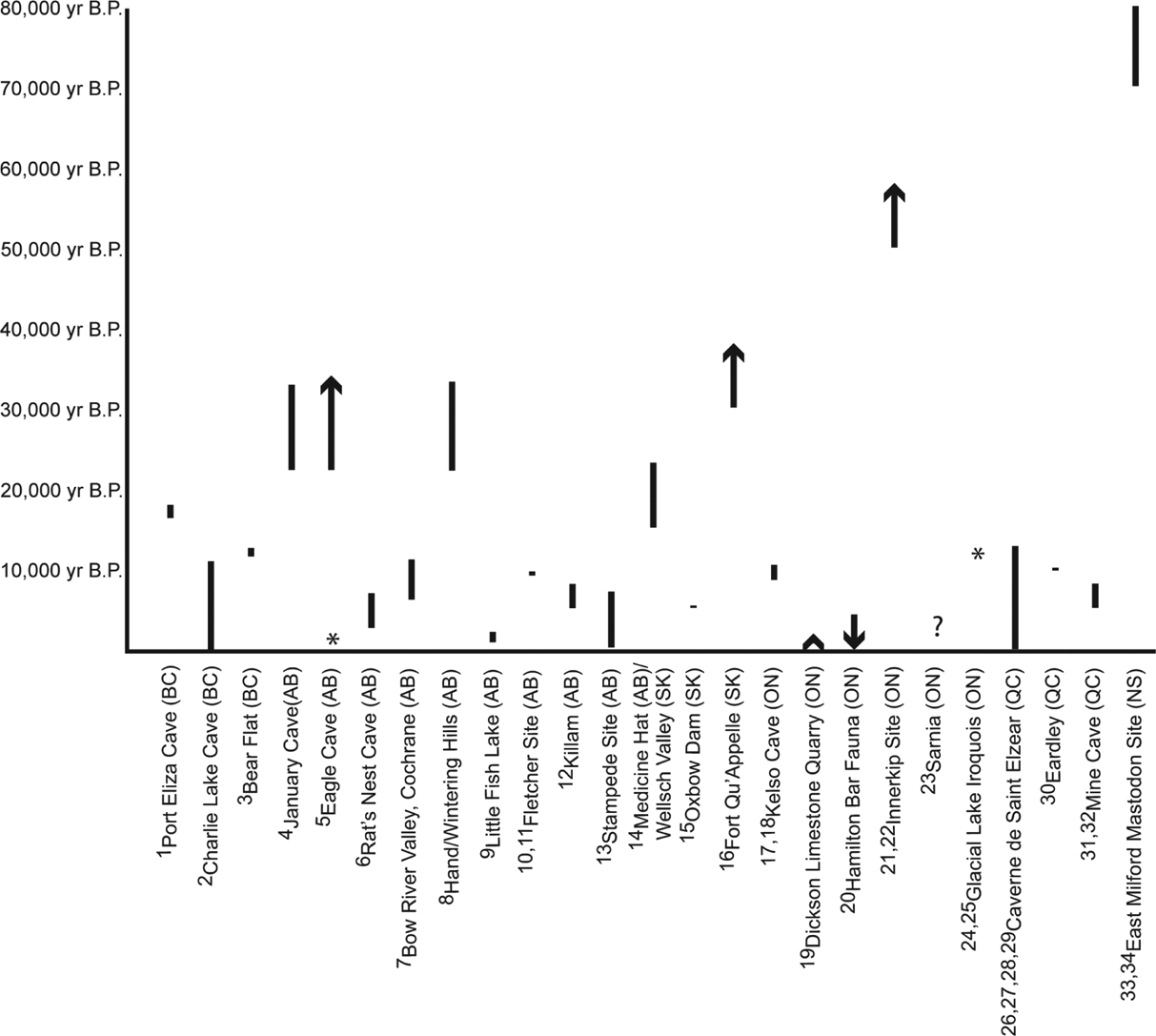
The chronologic distribution of sites containing remains of amphibians and reptiles likely reflects regional gaps that are related to the advance and recession of glacial ice (Fig. 1). This does not necessarily indicate the presence of glacial ice during those gaps, but may reflect uninhabitable conditions brought about by the proximity of glacial ice (Burns Reference Burns1996; Shapiro et al. Reference Shapiro, Drummond, Rambaut, Wilson, Matheus, Sher, Pybus, Gilbert, Barnes, Binladen, Willerslev, Hansen, Baryshnikov, Burns, Davydov, Driver, Froese, Harington, Keddie, Kosintsev, Kunz, Martin, Stephenson, Storer, Tedford, Zimov and Cooper2004). We acknowledge the possibility that other factors (e.g. lack of deposition) might also explain chronologic gaps in the Quaternary palaeontological record of Canada, but for the purposes of this paper, it is the recognition of the existence of those chronologic gaps that is important. Therefore, in regions where multiple preglacial and postglacial deposits occur (e.g. British Columbia and Alberta), comparisons between chronologically distinct faunas allow for the development of a framework that provides insight into the establishment of the extant amphibian and reptile biota of western Canada.
Age data for Canadian Quaternary herpetofaunas discussed in this paper. Arrows indicate uncertainty in maximum or minimum ages represented at localities. Asterisks (*) indicate single radiocarbon data points. Question mark (?) indicates an uncertain age assessment. Plotted age ranges for localities are based on the following citations: 1Al-Suwaidi et al. (Reference Al-Suwaidi, Ward, Wilson, Hebda, Nagorsen, Marshall, Ghaleb, Wigen and Enkin2006); 2Driver (Reference Driver1988); 3Hebda et al. (Reference Hebda, Burns, Geertsema and Jull2008); 4Burns (Reference Burns1991); 5Burns (Reference Burns1984); 6Burns (Reference Burns1989); 7Harris (Reference Harris1985); 8Young et al. (Reference Young, Burns, Rains and Schowalter1999); 9Ralrick (Reference Ralrick2007); 10A. Beaudoin pers. comm. 2011; 11Beaudoin & Lemmen (Reference Beaudoin and Lemmen2000); 12Bayrock (Reference Bayrock1964); 13Meyer et al. (Reference Meyer, Blakey and Roe2009); 14Stalker et al. (Reference Stalker, Churcher and Hill1982); 15Nero & McCorquodale (Reference Nero and McCorquodale1958); 16Khan (Reference Khan1970); 17Churcher & Dods (Reference Churcher and Dods1979); 18Mead & Grady (Reference Mead and Grady1996); 19Churcher & Fenton (Reference Churcher and Fenton1968); 20Churcher & Karrow (Reference Churcher and Karrow2008); 21Pilny & Morgan (Reference Pilny and Morgan1987); 22Churcher et al. (Reference Churcher, Pilny and Morgan1990); 23Carlton (Reference Carlton1982; not seen, cited by Harington [Reference Harington2003a]); 24Churcher & Peterson (Reference Churcher and Peterson1982); 25Holman (Reference Holman1995); 26LaSalle & Guilday (Reference LaSalle and Guilday1980); 27LaSalle (Reference LaSalle, Genoways and Dawson1984); 28Fay (Reference Fay, Genoways and Dawson1984); 29Pearce et al. (Reference Pearce, Olori and Kemezis2010); 30Holman et al. (Reference Holman, Harington and Mott1997); 31Harington (Reference Harington2003b); 32Lauriol et al. (Reference Lauriol, Deschamps, Carrier, Grimm, Morlan and Talon2003); 33Grantham & Kozera-Gillis (Reference Grantham and Kozera-Gillis1992; not seen, cited by Holman & Clouthier [Reference Holman and Clouthier1995]); 34Holman & Clouthier (Reference Holman and Clouthier1995). An older amphibian occurrence from the Yukon (Storer Reference Storer2006) is discussed in the text but is not plotted here.

2. Localities
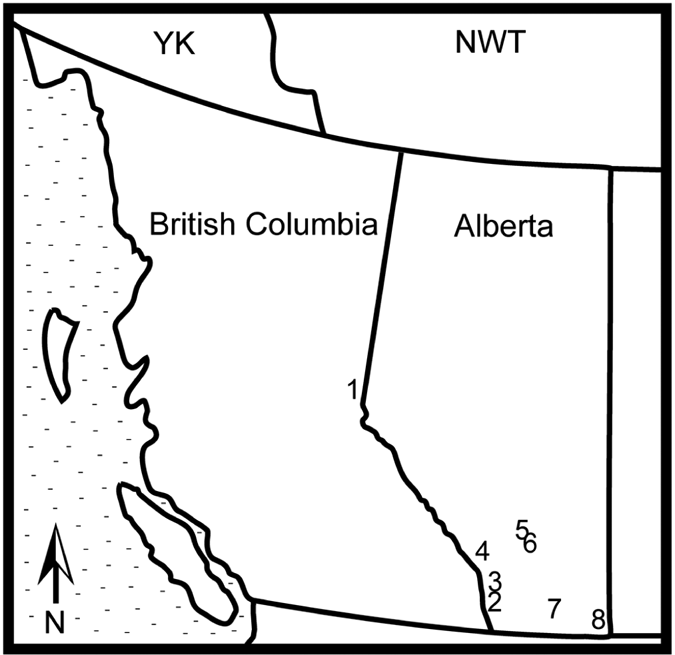
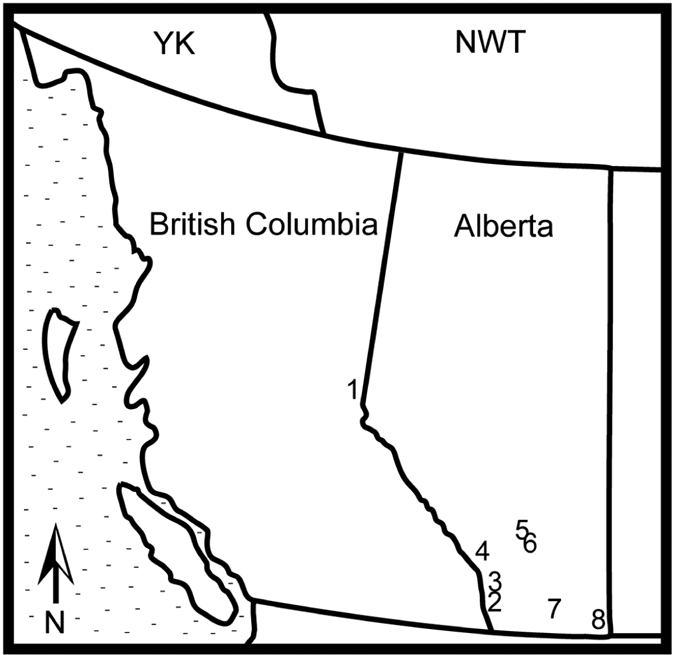
Specimens described in the Systematic Palaeontology section of this paper come from eight localities in western Canada (Fig. 2; British Columbia: Bear Flat; Alberta: Eagle Cave, January Cave, Rat's Nest Cave, Hand/Wintering Hills, Fletcher Site, Stampede Site and Little Fish Lake). Although there is previous mention of the occurrence of amphibians and reptiles at some of the individual localities (e.g. Burns Reference Burns1989), this report provides the first systematic descriptions for amphibian and reptile remains from those localities. Detailed excavation methods and site descriptions for specimens reported here are provided in original literature on those localities. To facilitate discussion, primary citations and brief summaries of the chronologic context for specimens described in the Systematic Palaeontology section are provided (ca. from oldest to youngest) as follows.
Geographic locations of western Canadian herpetofaunas described in this paper: 1=Bear Flat; 2=Eagle Cave; 3=January Cave; 4=Rat's Nest Cave; 5=Hand/Wintering Hills; 6=Little Fish Lake; 7=Fletcher Site; 8=Stampede Site. Abbreviations: NWT=Northwest Territories; YK=Yukon Territory.
2.1. Eagle Cave, Alberta
Locality information and age data were presented by Burns (Reference Burns1984). Based on two radiocarbon dates (>33,000 yr B.P. and 22,700±1000 yr B.P.), the majority of the deposit predates the LGM (Burns Reference Burns1984). Some near-surface deposits are more recent in age (Burns Reference Burns1984). Most of the amphibian and reptile remains reported here from Eagle Cave are from portions of the deposit interpreted as being of preglacial age, but according to collections records at the RAM, one of the specimens (an ilium of Bufo) is probably Holocene in age.
2.2. January Cave, Alberta
Locality information and age data were presented by Burns (Reference Burns1991). Radiocarbon age data indicate a preglacial age (ca. 33,000 yr B.P. to ca. 23,000 yr B.P.; Burns Reference Burns1991) for specimens reported from January Cave. Amphibian and reptile remains from the site are inferred to fall within that preglacial age range.
2.3. Hand/Wintering Hills, Alberta
An extensive series of Pleistocene-age prairie dog burrow fills occur at various localities in the Hand Hills and Wintering Hills of Alberta (Burns & McGillivray Reference Burns and McGillivray1989; Young et al. Reference Young, Burns, Rains and Schowalter1999). Because individual sites are thought to be nearly equivalent in terms of chronology and depositional context, we treat them as a single large-scale locality, even though the Hand Hills and Wintering Hills are separated by approximately 25 km. Vertebrate fossils from these deposits predominantly represent an extinct form of prairie dog (Cynomys niobrarius churcherii), but some associated remains of other taxa are known (Burns & McGillivray Reference Burns and McGillivray1989; Young et al. Reference Young, Burns, Rains and Schowalter1999). Direct AMS radiocarbon ages derived from bones of C. n. churcherii indicate an age range from 33,650±340 to 22,200±320 yr B.P. from the Winter 1 site (Young et al. Reference Young, Burns, Rains and Schowalter1999). Amphibians and reptiles are known from two localities (Sieppert Site, Winter 1 Site), and we infer that these remains are contemporaneous with the aforementioned prairie dog remains and radiocarbon data and, thus, predate the LGM.
2.4. Bear Flat, British Columbia
Locality information and age data for associated remains were presented by Hebda et al. (Reference Hebda, Burns, Geertsema and Jull2008). All reptile specimens are from sediments associated with fossils of taiga vole (Microtus xanthognathus) and other small mammal remains (Hebda et al. Reference Hebda, Burns, Geertsema and Jull2008). Bones of taiga vole were directly radiocarbon dated to ages of 11,507±52 yr B.P. and 12,567±49 yr B.P. (Hebda et al. Reference Hebda, Burns, Geertsema and Jull2008). Reptile remains are interpreted as being of comparable age, based on their association with taiga vole remains. Material from Bear Flat and the remaining sites in Alberta post-date the LGM.
2.5. Fletcher Site, Alberta
The Fletcher Site is an early Holocene archaeological site in southwestern Alberta. Locality information and age data were discussed by Forbis (Reference Forbis1968), Quigg (Reference Quigg1976), Vickers & Beaudoin (Reference Vickers and Beaudoin1989) and Beaudoin & Lemmen (Reference Beaudoin and Lemmen2000). Amphibian and reptile remains are from stratigraphic levels bracketed by radiocarbon ages from 9540±110 yr B.P. to 9380±110 yr B.P. (A. Beaudoin, pers. comm. 2011).
2.6. Rat's Nest Cave, Alberta
Rat's Nest Cave is situated in the eastern foothills of the Rocky Mountains. Locality information and age data were presented in Burns (Reference Burns1989) and Yonge (Reference Yonge1991). Radiocarbon data indicate that fossil-bearing sediments are mixed, but constrained to the postglacial, with a range from 7060±110 yr B.P. to 2480±80 yr B.P. (Burns Reference Burns1989). Amphibian and reptile remains from the site are inferred to fall within that postglacial age range.
2.7. Stampede Site, Alberta
The Stampede Site is a Holocene archaeological locality in southeastern Alberta. Most information concerning the locality is only available in unpublished reports (Gryba Reference Gryba1975; Meyer et al. Reference Meyer, Blakey and Roe2009). Excavated materials are maximally ca. 7200 yr B.P., as indicated by radiocarbon data and recovered projectile points (Meyer et al. Reference Meyer, Blakey and Roe2009). The single amphibian vertebra known from the site was recovered from a stratigraphic level constrained by radiocarbon ages from below (6870±60 yr B.P.) and above (6730±40 yr B.P.; A. Beaudoin, pers. comm. 2011).
2.8. Little Fish Lake, Alberta
Geologic history and context for specimens from Little Fish Lake were provided by Ralrick (Reference Ralrick2007). Radiocarbon age ranges indicate that vertebrate remains from the site are from the late Holocene (Ralrick Reference Ralrick2007). A radiocarbon date (1240±50 yr B.P.) derived from a skull of Rana represents a rare, direct radiocarbon record of a Quaternary amphibian from Canada (data from Ralrick Reference Ralrick2007). Other amphibian and reptile remains are interpreted as being contemporaneous with the radiocarbon age range (1950±90 yr B.P. to 790±50 yr B.P.) provided by Ralrick (Reference Ralrick2007).
3. Materials and methods
Specimens reported here (Figs 3, 4) are isolated and rarely articulated, three-dimensionally preserved bones of anurans (frogs and toads), salamanders and snakes that range in degree of completeness from pristine to fragmentary. No lizard or turtle specimens were identified amongst our samples. Depending on their locality of origin, specimens were recovered by surface collecting, quarrying, sieving or a combination of those techniques.
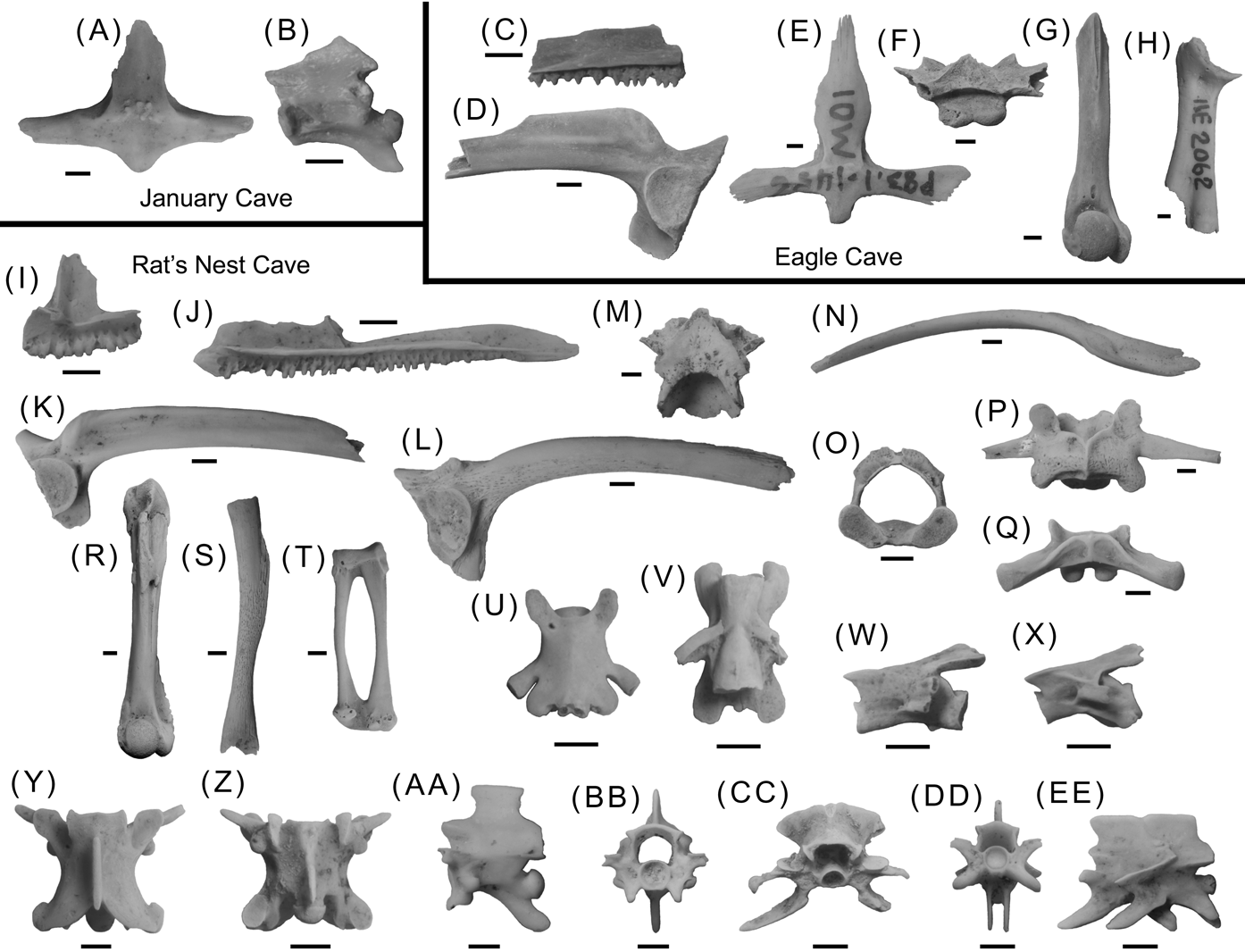
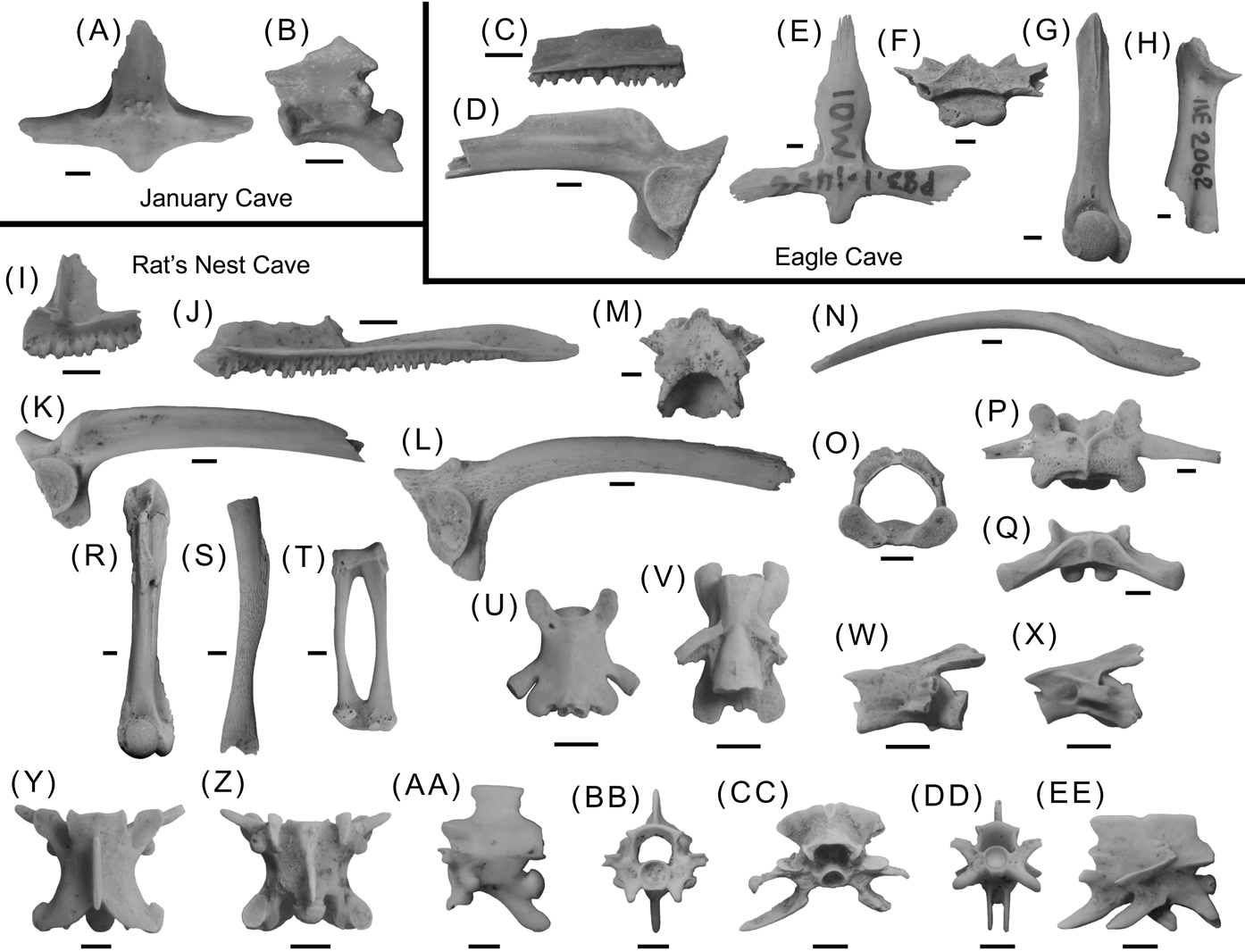
Amphibian and snake fossils from cave deposits in Rocky Mountains, western Alberta, Canada. (A–B) January Cave: (A) Anura indet., parasphenoid (RAM P80.1.9425), ventral view; (B) cf. Thamnophis sp., trunk vertebra (RAM P80.1.9426), left lateral view. (C–H) Eagle Cave: (C, D) Rana sp.: (C) fragment of left maxilla (RAM P95.7.1629), lingual view; (D) left ilium (RAM P95.7.1630), lateral view; (E–H) Anura indet.: (E) parasphenoid (RAM P83.1.1456), ventral view; (F) sacral vertebra (RAM P95.7.1631), oblique dorsal and posterior view; (G) right humerus (RAM P83.1.1266), ventral view; (H) left radioulna (RAM P83.1.1444), ventral view. (I–EE) Rat's Nest Cave: (I–K) Rana sp.: (I) right premaxilla (RAM P88.11.3907), lingual view; (J) right maxilla (RAM P88.11.3908), lingual view; (K) right ilium (RAM P88.11.3909), lateral view; (L) Bufo sp., right ilium (RAM P88.11.3910), lateral view; (M–T) Anura indet.: (M) sphenethmoid (RAM P89.18.3450), dorsal view; (N) right angulosplenial (RAM P88.11.3911), dorsal view; (O) atlas (RAM P89.18.3451), anterior view; (P) trunk vertebra (RAM P88.11.3912), dorsal view; (Q) sacral vertebra (RAM P88.11.3913), dorsal view; (R) right humerus (RAM P88.11.3914), ventral view; (S) right femur (RAM P88.11.3915), medial view; (T) right tibiale-fibulare (RAM P89.18.3452), ventral view; (U–X) cf. Ambystoma sp.: (U) trunk vertebra (RAM P89.18.3453), dorsal view; (V) trunk vertebra (RAM P88.11.3916), ventral view; (W) trunk vertebra (RAM P89.18.3454), left lateral view; (X) caudosacral vertebra (RAM P88.11.3917), left lateral view; (Y–EE) cf. Thamophis sp.: (Y) trunk vertebra (RAM P89.18.3455), dorsal view; (Z) trunk vertebra (RAM P89.18.3456), ventral view; (AA) trunk vertebra (RAM P88.11.3918), left lateral view; (BB) trunk vertebra (RAM P88.11.3919), anterior view; (CC) cloacal vertebra (RAM P89.18.3457), oblique anterior and dorsal view; (DD) isolated caudal vertebra (RAM P88.11.3920), oblique anterior and slightly ventral view; (EE) two articulated and partially fused caudal vertebrae (RAM P88.11.3921), left lateral view. Images at different magnifications; all scale bars=1 mm.
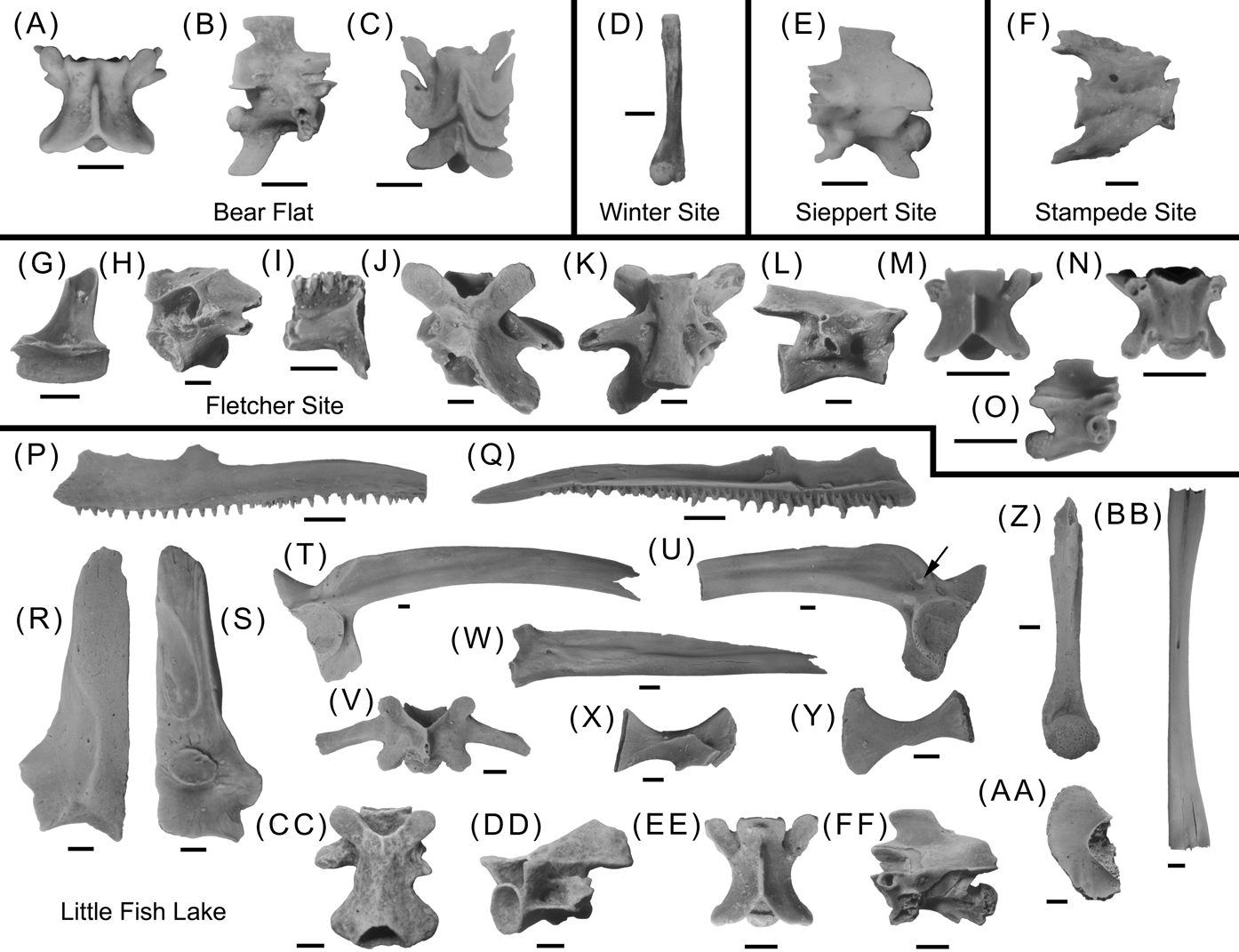
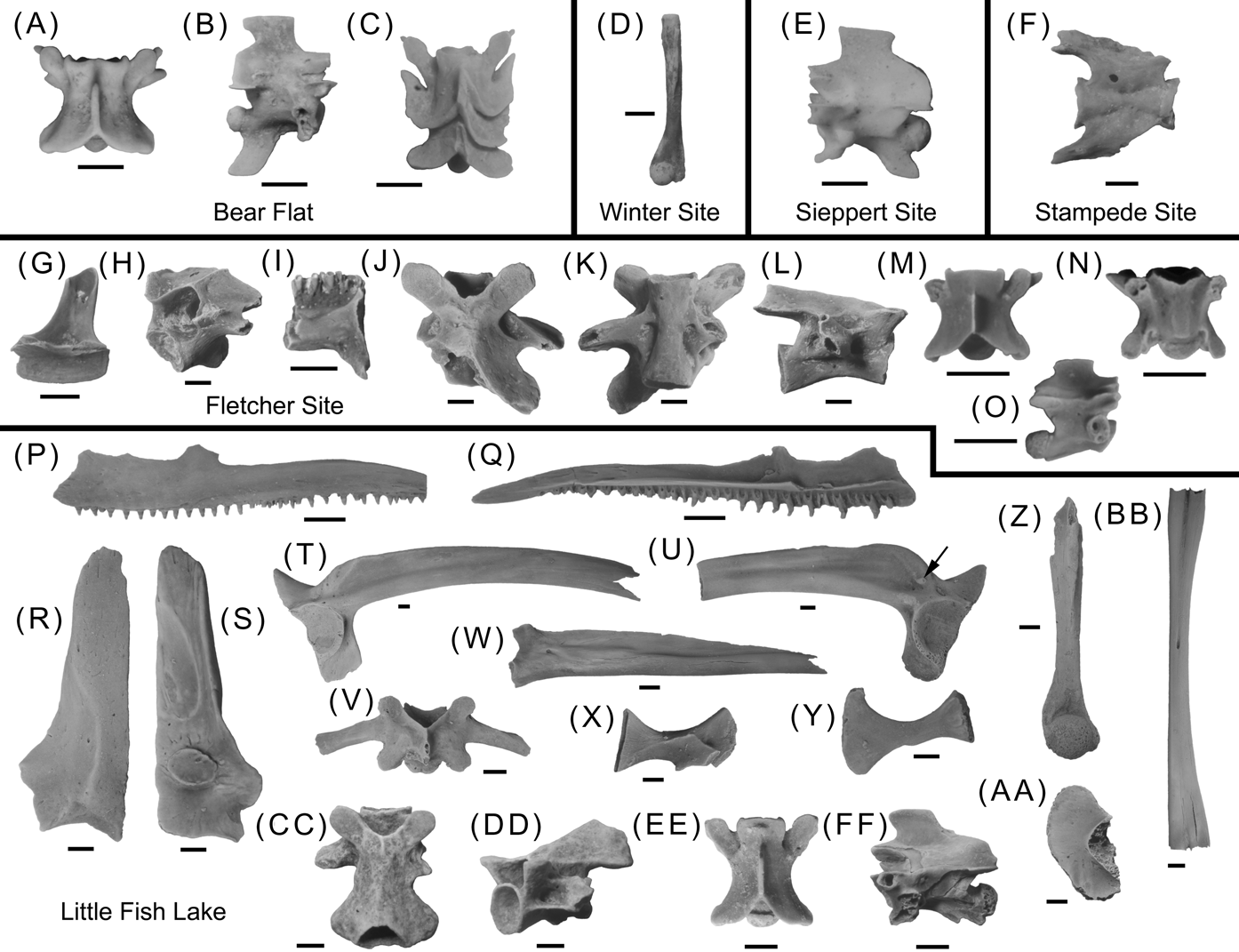
Amphibian and snake fossils from non-cave deposits in eastern central British Columbia and southwestern Alberta, Canada. (A–C) Bear Flat, British Columbia: cf. Thamnophis sp.: (A) trunk vertebra (RBCM EH2011.024.0001.001), dorsal view; (B) trunk vertebra (RBCM EH2011.024.0002.001), right lateral view; (C) two or three articulated and partially fused caudal vertebrae (RBCM EH2011.024.0003.001.A–C), dorsal view. (D) Hand/Wintering Hills (Winter 1 Site), Alberta: Anura indet., left humerus (RAM P86.3.281), ventral view. (E) Hand/Wintering Hills (Sieppert Site), Alberta: cf. Thamnophis sp., trunk vertebra (RAM P86.10.3), left lateral view. (F) Stampede Site, Alberta: cf. Ambystoma sp., caudal vertebra (DjOn-26 sample no. 584), right lateral view. (G–O) Fletcher Site, Alberta: (G) Bufo sp., left premaxilla (DjOw-1 sample no. 146), lingual view; (H) Anura indet., trunk vertebra (DjOw-1 sample no. 165), oblique left lateral, anterior, and dorsal view; (I–L) cf. Ambystoma sp.: (I) anterior end of left dentary (DjOw-1 sample no. 175), lingual view; (J–L) trunk vertebra (DjOw-1 sample no. 200), dorsal (J), ventral (K) and left lateral (L) views; (M–O) cf. Pituophis sp., trunk vertebra (DjOw-1 sample no.128), dorsal (M), ventral (N) and right lateral (O) views. (P–FF) Little Fish Lake, Alberta: (P–U) Rana sp.: (P) left maxilla (RAM P07.7.411A), labial view; (Q) left maxilla (RAM P07.7.227G), lingual view; (R) left frontoparietal (RAM P07.7.245A), dorsal view; (S) left frontoparietal (RAM P07.7.1004), ventral view; (T) right ilium (RAM P07.7.206A), lateral view; (U) left ilium (RAM P07.7.1005), bearing anomalous tubercle on lateral surface below dorsal prominence (arrow), lateral view; (V–BB) Anura indet.: (V) trunk vertebra (RAM P07.7.1006), dorsal view; (W) urostyle (RAM P07.7.1007), left lateral view; (X) left scapula (RAM P07.7.1008), dorsal view; (Y) right coracoid (RAM P07.7.200B), dorsal view; (Z) right humerus (RAM P07.7.1009), ventral view; (AA) fused ischia (RAM P07.7.236A), right lateral view; (BB) left tibiafibula (RAM P07.7.200E), dorsal view; (CC, DD) cf. Ambystoma sp., trunk vertebra (RAM P07.7.223), dorsal (CC) and oblique left lateral and anterior views (DD); (EE, FF) cf. Thamnophis sp.: (EE) trunk vertebra (RAM P07.7.1010), dorsal view; (FF) trunk vertebra (RAM P07.7.259), left lateral view. Images at different magnifications; all scale bars=1 mm.
Because our primary interest in the faunas is at a broad chronologic and geographic level, the specimens reported here represent a complete taxonomic inventory for each locality but do not necessarily represent a complete account of all individual specimens recovered from each locality. For localities in which only one (Hand/Wintering Hills and Stampede sites) or two (January Cave) specimens are known, we document all the available specimens. The remaining localities have produced more specimens – from seven specimens for the Fletcher Site to many hundreds for Little Fish Lake – and from each of those localities, we have selected voucher specimens that document the taxonomic composition and kinds of elements known from each locality.
Our identifications of elements and taxa relied on two lines of evidence or reasoning. First and foremost, identifications are based on morphological features taken from the relevant literature and direct comparisons with the limited collections of extant amphibian and reptile skeletons housed at our respective institutions. We have taken a conservative approach to identifying taxa (i.e. no lower than genus) for the following reasons: (1) we are not convinced than many of the features previously proposed in the literature for identifying Quaternary amphibian and reptile species are reliable (for detailed critiques, see Bever Reference Bever2005; Bell et al. Reference Bell, Gauthier and Bever2010); (2) the osteology of certain species that are potentially represented at some localities (e.g. Ambystoma macrodactylum at Rat's Nest Cave) has never been documented and we have not been able to examine skeletons of those species; and (3) meaningful comparisons of pre- and postglacial faunas can be made at higher taxonomic levels. Detailed information on identifications for individual specimens is presented in the Systematic Palaeontology accounts in this paper (see next section). We are aware of, and generally agree with, concerns raised by Bell et al. (Reference Bell, Gauthier and Bever2010) about the undesirable influence that an unacknowledged reliance on geographic ranges has had in influencing many previous identifications of Quaternary amphibian and reptile specimens. Nevertheless, we recognise there may be some merit in considering geographic ranges as a secondary line of evidence or reasoning for identifying taxa, especially when fossil and extant members are, in terms of geological time, relatively close in age and, presumably, have similar ecological requirements that influence their geographic distributions. For that reason, we considered geographic ranges of extant taxa within Alberta, British Columbia, and nearby portions of the continent only in the context of suggesting which taxon might be represented by a particular specimen or at a particular locality. Taxonomic identifications for other localities discussed in the summary (see also entries in Table 1) of Quaternary herpetofaunas of Canada were taken from the literature; none of the specimens upon which those identifications were based have been examined by either of us.
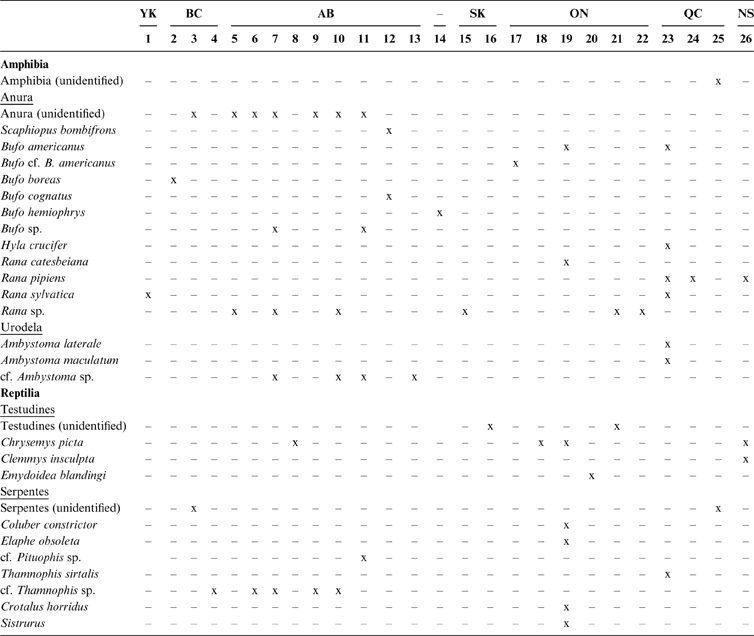
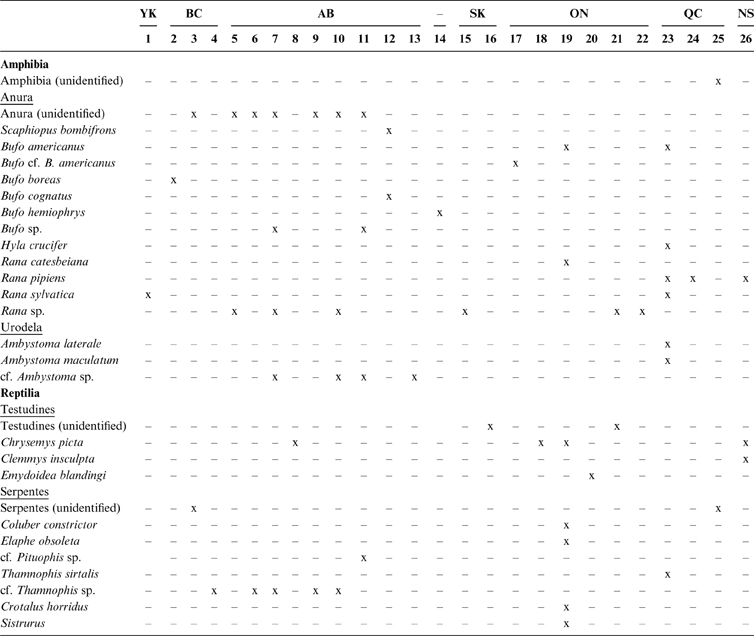
Summary of known occurrences of Quaternary amphibians and reptiles in Canada, by taxon and locality. Abbreviations and symbols (first row) are as follows: YK=Yukon; BC=British Columbia; AB=Alberta; SK=Saskatchewan; ON=Ontario; QC=Quebec; NS=Nova Scotia; and horizontal dash (–) indicates localities that extend across the border between Alberta and Saskatchewan. Localities (second row) are numbered as follows: 1=Thistle Creek Organic 2 (Storer Reference Storer2006); 2=Port Eliza Cave (Al-Suwaidi et al. Reference Al-Suwaidi, Ward, Wilson, Hebda, Nagorsen, Marshall, Ghaleb, Wigen and Enkin2006); 3=Charlie Lake Cave (Driver Reference Driver1988); 4=Bear Flat (this report); 5=Eagle Cave (this report); 6=January Cave (this report); 7=Rat's Nest Cave (this report); 8=Bow River Valley (Harris Reference Harris1985); 9=Hand/Wintering Hills (this report); 10=Little Fish Lake (Ralrick Reference Ralrick2007; this report); 11=Fletcher Site (Beaudoin Reference Beaudoin1998; this report); 12=Killam (Bayrock Reference Bayrock1964); 13=Stampede Site (this report); 14=Medicine Hat/Wellsch Valley (Stalker et al. Reference Stalker, Churcher and Hill1982); 15=Oxbow Dam (Nero & McCorquodale Reference Nero and McCorquodale1958); 16=Fort Qu'Appelle (Lammers & Wrigley Reference Lammers, Wrigley and Teller1984); 17=Kelso Cave (Churcher & Dods Reference Churcher and Dods1979; Holman Reference Holman1995); 18=Dickson Limestone Quarry (Churcher & Fenton Reference Churcher and Fenton1968); 19=Hamilton Bar Fauna (Churcher & Karrow Reference Churcher and Karrow2008); 20=Innerkip Site (Churcher et al. Reference Churcher, Pilny and Morgan1990); 21=Sarnia (Carlton Reference Carlton1982, not seen, cited by Harington Reference Harington2003a); 22=Glacial Lake Iroqouis (Holman Reference Holman1995); 23=Caverne de Saint Elzear (Fay Reference Fay, Genoways and Dawson1984); 24=Eardley (Holman et al. Reference Holman, Harington and Mott1997); 25=Mine Cave (Harington Reference Harington2003b); 26=East Milford Mastodon Site (Holman & Clouthier Reference Holman and Clouthier1995).
Specimens reported here are housed in three institutional collections: specimens from Bear Flat are housed at the RBCM; specimens from January Cave, Eagle Cave, Hand/Wintering Hills, Little Fish Lake, and Rat's Nest Cave are housed in the collections of the Quaternary Palaeontology Program at the RAM; and specimens from the Fletcher and Stampede sites are housed in the collections of the Quaternary Environments Program at the RAM. Unique institutional specimen numbers are assigned to specimens from the RBCM and from the Quaternary Palaeontology Program at the RAM, and those numbers are preceded by their respective institutional abbreviation. Specimens from the Quaternary Environments Program at the RAM are not assigned unique numbers, as per the policy of that program, but instead are identified by a unique archaeological site and sample number (e.g. “DjOw-1 sample no. 146” designates the Bufo premaxilla from the Fletcher Site).
4. Systematic palaeontology
Class Amphibia Linnaeus, Reference Linnaeus1758
Subclass Lissamphibia Haeckel, Reference Haeckel1866
Order Salientia Laurenti, Reference Laurenti1768
Crown-order Anura Rafinesque, Reference Rafinesque1815
Family Ranidae Gray, Reference Gray1825
Rana Linnaeus, Reference Linnaeus1758 (sensu Sanchiz, Reference Sanchiz and Wellnhofer1998)
Rana sp.
Localities and material. Eagle Cave, AB: maxilla (RAM P95.7.1629; Fig. 3C); ilium (RAM P95.7.1630; Fig. 3D). Rat's Nest Cave, AB: premaxilla (RAM P88.11.3907; Fig. 3I); maxilla (RAM P88.11.3908; Fig. 3J); ilium (RAM P88.11.3909; Fig. 3K). Little Fish Lake, AB: two maxillae (RAM P07.7.411A and RAM P07.7.227G; Fig. 4P, Q); two front oparietals (RAM P07.7.245A and RAM P07.7.1004; Fig. 4R, S); two ilia (RAM P07.7.206A and RAM P07.7.1005; Fig. 4T, U).
Remarks. Skull bones (upper jaws and frontoparietals) and ilia referable to one or more species of Rana are present in samples from Eagle Cave, Rat's Nest Cave, and Little Fish Lake. The upper jaw bones consist of a premaxilla from Rat's Nest Cave and maxillae from all three localities. The right premaxilla (RAM P88.11.3907; Fig. 3I) from Rat's Nest Cave is virtually complete and its structure is typical for anurans in being a small, triradiate bone (comprising a dorsally projecting pars dorsalis or nasal process, a ventral pars dentalis bearing teeth, and a lingually-projecting, shelf-like pars palatinum) in which the lower portion is relatively broad, the pars dorsalis is only moderately high, and the smooth edges indicate that it was not tightly sutured with adjacent bones. Maxillae are represented by three nearly complete specimens – two left maxillae (RAM P07.7.411A and RAM P07.7.227G; Fig. 4P, Q) from Little Fish Lake and one right maxilla (RAM P88.11.3908; Fig. 3J) from Rat's Nest Cave – and fragmentary specimens (e.g. RAM P95.7.1629; Fig. 3C) from Eagle Cave. The more nearly complete maxillary specimens (Figs 3J, 4P, Q) are typical for anurans in being triradiate bones that are low and anteroposteriorly elongate, are highest anteriorly and become shallower posteriorly, have a shelf-like pars palatinum extending along most of the lingual surface, dorsally bear a short and somewhat triangular nasal process, and are developed in the anteriormost end into a labiolingually compressed flange that in life overlapped the adjacent premaxilla. The fragmentary maxillary specimens (e.g. Fig. 3C) are from along the tooth-bearing portion of the bone. In each of the maxillary specimens, the labial surface is smooth (i.e. lacks ornament characteristic of some anurans) and the lingual surface of the pars dentalis has a row of teeth that are small, short, closely spaced, highly pleurodont, and pedicellate. Where preserved, the tooth crowns are labiolingually bicuspid and both cusps are conical in form. These upper jaws can be assigned to Rana and differentiated from other extant anurans known from western Canada (Bufo, Hyla, Spea, and Ascaphus) or which might be reasonably expected to have occurred in the region. This is based on a combination of moderate size and presence of teeth in both bones and, for the maxillae, also the absence of labial ornament and the elongate and low shape of the bone.
Frontoparietals (RAM P07.7.245A and RAM P07.7.1004; Fig. 4R, S) are known only from Little Fish Lake. These bones are isolated (i.e. not solidly fused across the midline as in some anurans) and the medial edge is smooth, which indicates that in life the left and right frontoparietals were not tightly sutured across the midline. The bones are dorsoventrally thin and anteroposteriorly elongate. They are somewhat wedge-shaped in dorsal or ventral outline, being broadest posteriorly and tapering anteriorly, and have a relatively straight medial edge and the anterior three-quarters of the lateral edge is formed by the shallowly concave orbital margin. The dorsal surface is smooth and unremarkable, but the ventral surface has two raised patches, called the “frontoparietal incrassations.” The more anterior incrassation is elongate and extends to the medial edge of the bone, whereas the more posterior incrassation is smaller, subcircular and lies midway between the medial and lateral edges of the bone. A combination of features of these frontoparietals (moderate size; elongate outline; paired and, at best, weakly sutured across midline; smooth dorsal surface; and configuration of the incrassations on the ventral surface) supports assignment to Rana.
Ilia preserving most or the entire acetabular region and varying portions of the shaft are known from Eagle Cave (RAM P95.7.1630; Fig. 3D), Rat's Nest Cave (e.g. RAM P88.11.3909; Fig. 3K), and Little Fish Lake (e.g. RAM P07.7.206A and RAM P07.7.1005; Fig. 4T, U). These specimens exhibit a suite of features that are diagnostic for anuran ilia (see Gardner et al. Reference Gardner, Roček, Přikryl, Eaton, Blob and Sankey2010), including: an expanded acetabular region bearing a bowl-shaped acetabulum on its medial surface and a small triangular scar on its medial surface for sutured contact with the adjacent ilium, and having the posterior edge thickened and solid for sutured contact with the ischium; an anteriorly elongate and tapered iliac shaft; and two features that are typical for many but not all anurans, namely a dorsal prominence and an iliac crest. Features consistent with assigning these ilia to Rana include: blade-like iliac crest present; dorsal prominence present and in the form of a low, ovoid structure that is confluent with the posterior end of the iliac crest; spiral groove absent; build relatively robust; and size moderate.
Based on the geographic ranges of extant species of Rana within Alberta (e.g. Cook Reference Cook1984; Russell & Bauer Reference Russell and Bauer2000; Fisher et al. Reference Fisher, Joynt and Brooks2007), it seems likely that different species are represented in the cave and short-grass prairie deposits. However, in our opinion, none of the above-listed specimens can be identified below genus level. Identifications of fossil and sub-fossil Rana bones historically have relied almost exclusively on iliac features (e.g. Holman Reference Holman1995, Reference Holman2003, and references therein). Species-level differences among North American Rana based on features of the premaxillae, maxillae and frontoparietals either do not exist or are not presently known and, based on limited comparative samples available to us, we have not seen any obvious differences among those bones. The current ranges of R. sylvatica and R. pretiosa overlap with both Eagle Cave and Rat's Nest Cave. According to Holman (Reference Holman2003, p. 184), ilia of R. sylvatica are characterised by having a rounded tubercle on the dorsal prominence, yet on the same page of that publication it noted that this tubercle is not universally present. None of the available specimens from either cave deposit have such a tubercle. Diagnostic features for the ilia of R. pretiosa are not presently known and, based on two skeletons available to us, ilia of that species are not obviously distinctive. As for Little Fish Lake, the only extant ranid known from the region is R. pipiens. The sizes of the largest ilia from Little Fish Lake and the general structure of the specimens are consistent with R. pipiens, but considering that iliac structure is not adequately documented for North American Rana species, we have conservatively refrained from identifying the Little Fish Lake specimens to species. One of the figured ilia (RAM P07.7.1005; Fig. 4U) bears a tubercle on its lateral surface, at the junction between the acetabular region and base of the dorsal prominence. We interpret that tubercle as an anomaly rather than a taxonomically significant feature, as might have been done in the past when fossil anuran species routinely were erected for subtle differences in one isolated bone (see examples in Sanchiz Reference Sanchiz and Wellnhofer1998; Holman Reference Holman2003).
Family Bufonidae Gray, Reference Gray1825
Bufo Laurenti, Reference Laurenti1768 (sensu Sanchiz, Reference Sanchiz and Wellnhofer1998)
Bufo sp.
Localities and material. Eagle Cave, AB (Holocene): ilium (RAM P83.1.1153; not figured). Rat's Nest Cave, AB: ilium (RAM P88.11.3910; Fig. 3L). Fletcher Site, AB: premaxilla (DjOw-1 sample no. 146; Fig. 4G).
Remarks. The left premaxilla (DjOw-1 sample no. 146; Fig. 4G) from the Fletcher Site is virtually complete and is similar in its general structure to the premaxilla of Rana sp. reported in the previous account. The most obvious and diagnostically significant differences are that in the Fletcher premaxilla, the lingual surface of the pars palatinum is smooth and there is no evidence that teeth were present in life (e.g. broken tooth bases). Lack of teeth in the upper jaws is a derived feature that occurs in a minority of anurans (e.g. Trueb Reference Trueb and Vial1973), most notably bufonids. By contrast, teeth are present in upper jaws of all other anurans known from western Canada. Two extant species of Bufo (B. cognatus and B. hemiophrys) have geographic ranges today that encompass the Fletcher Site (Cook Reference Cook1984; Russell & Bauer Reference Russell and Bauer2000; Fisher et al. Reference Fisher, Joynt and Brooks2007), but because premaxillae appear to be relatively invariant among species of Bufo, the specimen cannot be identified more precisely.
Several ilia are known from Rat's Nest Cave. The most nearly complete example is a right ilium (RAM P88.11.3910; Fig. 3L) that preserves an intact acetabular region and all but the anteriormost end of the shaft. This specimen can be assigned to Bufo based on the following combination of features that differentiate it from other anurans known from western Canada: dorsal prominence present and tubercle-like; iliac crest and spiral groove both absent; build relatively robust; and size moderate. A Holocene ilium (RAM P83.1.1153) also is available from Eagle Cave but it lacks all but the base of the iliac shaft. Even so, the Eagle Cave specimen can be assigned to Bufo using most of the features listed above for the Rat's Nest Cave specimen. Two extant species of Bufo (B. boreas and B. hemiophrys) have geographic ranges today that encompass or closely approach both cave deposits (Cook Reference Cook1984; Russell & Bauer Reference Russell and Bauer2000; Fisher et al. Reference Fisher, Joynt and Brooks2007) and attain body sizes consistent with RAM P88.11.3910 and P83.1.1153. Although criteria for identifying isolated fossil ilia of both species are published (e.g. Holman Reference Holman2003), given cautionary comments concerning the reliability of iliac features for differentiating species of Bufo (Bever Reference Bever2005) and our own cursory examination of limited samples of extant skeletons of Bufo, we refrained from trying to identify these ilia to species level.
Anura indet.
(Figs 3A, E–H, M–T, 4D, H, V–BB)
Localities and material. January Cave, AB: parasphenoid (RAM P80.1.9425; Fig. 3A). Eagle Cave, AB: parasphenoid (RAM 83.1.1456; Fig. 3E); sacral vertebra (RAM P95.7.1631; Fig. 3F); humerus (RAM 83.1.1266; Fig. 3G); radioulna (RAM 83.1.1444; Fig. 3H). Rat's Nest Cave, AB: sphenethmoid (RAM P89.18.3450; Fig. 3M); angulosplenial (RAM P88.11.3911; Fig. 3N); atlas (RAM P89.18.3451; Fig. 3O); trunk vertebra (RAM P88.11.3912; Fig. 3P); sacral vertebra (RAM P88.11.3913; Fig. 3Q); humerus (RAM P88.11.3914; Fig. 3R); femur (RAM P88.11.3915; Fig. 3S); tibiale-fibulare (RAM P89.18.3452; Fig. 3T). Hand/Wintering Hills–Winter 1 Site, AB: humerus (RAM 86.3.281; Fig. 4D). Fletcher Site, AB: vertebra (DjOw-1 sample no. 165; Fig. 4H). Little Fish Lake, AB: trunk vertebra (RAM P07.7.1006; Fig. 4V); urostyle (RAM P07.7.1007; Fig. 4W); scapula (RAM P07.7.1008; Fig. 4X); coracoid (RAM P07.7.200B; Fig. 4Y); humerus (RAM P07.7.1009; Fig. 4Z); fused ischia (RAM P07.7.236A; Fig. 4AA); tibiafibula (RAM P07.7.200E; Fig. 4BB).
Remarks. Most of the anuran material from the sampled localities consists of isolated skull, girdle, limb bones, vertebrae and urostyles that are not readily identifiable to family or genus. Many of the specimens are too large to be from Hyla or Ascaphus. Additionally, none of the trunk or sacral vertebrae has the amphicoelous centrum characteristic of Ascaphus. For Eagle Cave (Fig. 3E–H), Rat's Nest Cave (Fig. 3M–T), the Fletcher Site (Fig. 4H) and Little Fish Lake (e.g. Fig. 4V–BB), it is reasonable to expect that most, if not all, of the specimens belong to the same genera (Rana and/or Bufo) reported above from those localities. For two localities, the presence of anurans is founded on a single element, namely a parasphenoid (Fig. 3A) at January Cave and a humerus (Fig. 4D) from the Hand/Wintering Hills (Winter 1 Site).
Order Caudata Scopoli, Reference Scopoli1777 (sensu Evans & Milner, Reference Evans and Milner1996)
Crown-order Urodela Duméril, Reference Duméril1806 (sensu Evans & Milner, Reference Evans and Milner1996)
Suborder Ambystomatoidea (Noble Reference Noble1931; sensu Estes, Reference Estes and Wellnhofer1981)
cf. Family Ambystomatidae Gray, Reference Gray1850
cf. Ambystoma Tschudi, Reference Tschudi1838
cf. Ambystoma sp.
Localities and material. Rat's Nest Cave, AB: 3 trunk vertebrae (RAM P89.18.3453, RAM P88.11.3916, and RAM P89.18.3454; Fig. 3U, V, W); caudosacral vertebra (RAM P88.11.3917; Fig. 3X). Stampede Site, AB: caudal vertebra (DjOn-26 sample no. 584; Fig. 4F). Fletcher Site, AB: anterior end of dentary (DjOw-1 sample no. 175; Fig. 4I); trunk vertebra (DjOw-1 sample no. 200; Fig. 4J–L). Little Fish Lake, AB: trunk vertebra (RAM P07.7.223; Fig. 4CC, DD).
Remarks. Most of the salamander specimens are trunk vertebrae; the largest sample is from Rat's Nest Cave (e.g. Fig. 3U–W), but rare examples are also available from the Fletcher Site and Little Fish Lake (Fig. 4J–L, CC, DD). Trunk vertebrae of salamanders are characterised by a suite of features including: amphicoelous or opisthocoelous centra; the presence of rod-like transverse processes that may be paired or single, arise midway along the neural arch wall and project posterolaterally; the presence on the neural arch roof of a keel-like median crest that terminates posteriorly in a low spine; the variable presence of spinal foramina; and the lack of zygosphene–zygantrum articular facets and of prezygapophysial processes. Compared to other salamanders, trunk vertebrae from all three Alberta localities are typical for Ambystomatoidea in the following combination of features: centrum amphicoelous; paired transverse processes moderately elongate and weakly divergent; subcentral keel absent; basapophyses absent or, at best, developed only as weak ridges; spinal foramina present; neural crest low and grades posteriorly in a short neural spine that may be paired and terminates in a facet for a cartilaginous tip; and no other crests or ridges present on neural arch. Combinations of those features were used to characterise isolated vertebrae of Ambystoma (e.g. Naylor Reference Naylor1978; Holman Reference Holman2006; Boardman & Schubert Reference Boardman and Schubert2011). However, based on our examination of relevant specimens and the literature (see especially Tihen Reference Tihen1958), isolated vertebrae of Ambystoma and Dicamptodon appear indistinguishable. Consequently, based on morphological criteria alone, we can only reliably identify the Albertan trunk vertebrae to the more inclusive Ambystomatoidea. Several examples of caudosacral (Fig. 3X) and caudal (Fig. 4F) vertebrae are also present. These differ from the trunk vertebrae in having a pair of haemal arches arising from the ventral surface of the centrum. The caudosacral vertebra also has a single and stouter transverse process, but otherwise it is similar to the trunk vertebrae. The caudal vertebra is further modified by being laterally compressed, having reduced zygapophyseal processes lacking transverse processes and the haemal arch being elongated with its two halves being fused distally. Trunk vertebrae from Rat's Nest Cave differ from those from the Fletcher Site and Little Fish Lake in being approximately two thirds as long, and differing further from the Fletcher specimen in being relatively narrower. The Little Fish Lake specimen is also relatively elongate but, unlike any of the other specimens, it has an open notochordal canal extending through its centrum, and the distal end of its neural spine is indented by a broad cavity that in life would have been finished with a prominent cartilaginous cap. The presence of an open notochordal canal is widely regarded as a larval feature (e.g. Tihen Reference Tihen1942; Holman Reference Holman, Wendorf and Hester1975; Naylor Reference Naylor1978; Rogers Reference Rogers1985) and, coupled with the large size of the specimen and its distally unossified neural spine, suggests that this vertebra is from a neotenic individual. All other vertebral specimens have closed notochordal canals and more ossified neural spines and, accordingly, are interpreted as being from metamorphosed individuals.
Geographic distributions of extant Dicamptodon and Ambystoma favour the latter as the genus represented by the Alberta fossils. Extant Dicamptodon species are mainly limited to the Pacific Northwest, with the most northern occurrences being in southwestern British Columbia, in north-central Idaho and extreme western Montana (Petranka Reference Petranka1998). Ambystoma is more broadly distributed across much of the central portion of the continent, including southern Alberta. Ranges of two extant species of Ambystoma overlap in the southern portion of the Rocky Mountains; although A. macrodactylum is limited to the Rocky Mountains, A. tigrinum is widespread throughout the southern third of Alberta (Cook Reference Cook1984; Russell & Bauer Reference Russell and Bauer2000; Fisher et al. Reference Fisher, Joynt and Brooks2007). The smaller size and narrower form of the vertebrae from Rat's Nest Cave – which are consistent with Tihen's (Reference Tihen1958, table 1) “A. maculatum group” – suggests these more likely pertain to A. macrodactylum than A. tigrinum, but we were not able to verify this because vertebrae of A. macrodactylum are not adequately described or figured in the literature, and we were not able to examine comparative material of that species. Based on the above cited features and modern geographic occurrences, we hypothesise that the trunk vertebrae from the Fletcher Site and from Little Fish Lake likely represent A. tigrinum. However, we emphasise that a definitive species-level identification will require more information than is currently available to us (e.g. identification of discrete characters unique to the trunk vertebrae of A. tigrinum; ancient DNA). In the absence of such data, we restrict further discussion of these vertebral specimens to cf. Ambystoma sp.
The only non-vertebral salamander specimen identified among our samples is the anteriormost end of a left dentary (DjOw-1 sample no. 175; Fig. 4I) that preserves the first eight tooth positions, including three intact tooth pedicels. Although no tooth crowns are preserved, the teeth were small, closely spaced, moderately pleurodont, and, judging by the smooth rims of the intact pedicels, they were pedicellate. The symphysis is expanded ventrally and on the lingual surface, the ledge-like subdental shelf extends below the tooth row. The subdental shelf (or “splenial shelf”) is typical of transformed individuals (Tihen Reference Tihen1958, fig. 10 caption), which is consistent with how we interpret the trunk vertebra from the same locality (see above).
Class Reptilia Linnaeus, Reference Linnaeus1758
Order Serpentes Linnaeus, Reference Linnaeus1758
Suborder Alethinophidia Nopsca, Reference Nopsca1923
Superfamily Colubroidea Oppell, Reference Oppel1811
Family Colubridae Oppell, Reference Oppel1811
Subfamily Natricinae Bonaparte, Reference Bonaparte1840
cf. Thamnophis Fitzinger, Reference Fitzinger1843
cf. Thamnophis sp.
Localities and material. January Cave, AB: trunk vertebra (RAM P80.1.9426; Fig. 3B). Rat's Nest Cave, AB: four trunk vertebrae (RAM P89.18.3455, RAM P89.18.3456, RAM P88.11.3918 and RAM P88.11.3919; Fig. 3Y–BB); cloacal vertebra (RAM P89.18.3457; Fig. 3CC); caudal vertebra (RAM P88.11.3920; Fig. 3DD); two fused caudal vertebrae (RAM P88.11.3921; Fig. 3EE). Bear Flat, BC: two trunk vertebrae (RBCM EH2011.024.0001.001, RBCM EH2011.024.0002.001; Fig. 4A, B); two or three fused caudal vertebrae (RBCM EH2011.024.0003.001A–C; Fig. 4C). Hand/Wintering Hills–Sieppert Site, AB: trunk vertebra (RAM P86.10.3; Fig. 4E). Little Fish Lake, AB: 2 trunk vertebrae (RAM P07.7.1010 and RAM P07.7.259; Fig. 4EE, FF).
Remarks. Snake vertebrae are present in all but two of the Alberta localities (Eagle Cave and Stampede Site) and are the only reptile specimens recovered from Bear Flat. Most of the vertebral specimens are from the trunk region. These are slightly longer than wide, bear relatively short prezygapophyseal accessory processes and a moderately elongate and tall neural spine. Furthermore, the hypopophysis is moderately deep, directed posteroventrally, laterally compressed, slightly tapered, and terminates in a moderately blunt tip (Figs 3B, Y–BB, 4A, B, E, EE, FF). Also present are several examples of post-trunk vertebrae, which can be identified by the presence of a pair of thin hemapophyses extending from the ventral surface. One such specimen clearly is a cloacal vertebra, based on the characteristic pair of thin, ventrolaterally projecting elongate lymphapophyses rising from either side of the centrum (Fig. 3CC). Caudal (i.e. post-cloacal) vertebrae in snakes lack lymphapophyses and, instead, have a single, anteroventrally projecting pleurapophysis on either side. Most of the caudals identified from our samples are isolated (e.g. Fig. 3DD), but Rat's Nest Cave and Bear Flat each produced an articulated and partially fused series of caudals (Figs 3EE, 4C).
These vertebrae can be assigned to the Natricinae based on the presence and structure of their hypapophyses (Holman Reference Holman2000). Among natricines, vertebrae of Thamnophis and Nerodia are so similar to one another that they can be difficult to tell apart. Differences in the relative length and width of vertebrae (longer and narrower in Thamnophis) and relative height of the neural spine (lower in Thamnophis) were previously used to separate the two genera (Auffenberg Reference Auffenberg1963; Brattstrom Reference Brattstrom1967; Parmley Reference Parmley1986; Holman Reference Holman2000), but because the reliability of those features is not clear to us and we lacked comparative material of Nerodia, we assigned the above-listed specimens to cf. Thamnophis. This taxonomic assignment reflects our uncertainty with respect to morphological differentiation in isolated vertebrae of Thamnophis and Nerodia. We hypothesise that the specimens represent Thamnophis because Nerodia is restricted to the eastern portion of North America (Conant Reference Conant1975; Cook Reference Cook1984) and three species of Thamnophis occur in Alberta and easternmost British Columbia (Cook Reference Cook1984; Russell & Bauer Reference Russell and Bauer2000; Matsuda et al. Reference Matsuda, Green and Gregory2006; Fisher et al. Reference Fisher, Joynt and Brooks2007). Species of Thamnophis are notoriously difficult to differentiate based on vertebral characters (e.g. Brattstrom Reference Brattstrom1953; LaDuke Reference LaDuke1991; Holman Reference Holman2000), and we did not attempt to assign any of the specimens to species given the uncertainty in our generic assignment.
Subfamily Colubrinae Cope, Reference Cope1895
cf. Pituophis Holbrook, Reference Holbrook1842
cf. Pituophis sp.
Locality and material. Fletcher Site, AB: trunk vertebra (DjOw-1 sample no. 128; Fig. 4M–O).
Remarks. The Fletcher Site yielded a single snake trunk vertebra (DjOw-1 sample no. 128; Fig. 4M–O) that is small and has a partially broken neural spine. This specimen differs from the trunk vertebrae of cf. Thamnophis reported above in having the length and width of the neural arch roof more nearly equal in dorsal outline and in lacking a prominent hypapophysis. Instead, the ventral surface of the centrum bears a shallow and moderately broad keel. Based on our examination of the relevant literature as well as skeletons of non-natricine snakes, the vertebra appears most similar to genera such as Pituophis and Lampropeltis, but this is uncertain owing to the damaged neural spine and small size (suggesting it is not from a mature individual) of the specimen. Assignment of this specimen to Pituophis seems more likely, because the Fletcher Site occurs within the known range of P. melanoleucus throughout much of the short-grass prairie region in southern Alberta (e.g. Cook Reference Cook1984; Russell & Bauer Reference Russell and Bauer2000; Fisher et al. Reference Fisher, Joynt and Brooks2007). By contrast, the most northern occurrences for extant and fossil Lampropeltis are limited to central Montana (Stebbins Reference Stebbins1985).
5. Quaternary herpetofaunas of Canada
With the addition of fossils described here, there are now at least 26 localities known to contain Quaternary amphibian and reptile remains in Canada. The majority of Quaternary herpetofaunas occur in the west (Table 1), but prior to this report, herpetofaunas from the east were better known. The oldest Quaternary records of amphibians and reptiles in Canada come from Thistle Creek Organic 2 in the Yukon (Storer Reference Storer2006) and from the East Milford Mastodon Site in Nova Scotia (Holman & Clouthier Reference Holman and Clouthier1995). The majority of localities either immediately precede (n=18; Fig. 1) or are subsequent to (n=6; Fig. 1) the LGM.
A total of 29 amphibian and reptile taxa are now reported from Quaternary deposits in Canada (Table 1). Although certain localities may have potential for more detailed descriptions of their herpetofauna (e.g. Charlie Lake Cave), that number is still likely a high estimate for actual richness in the past. The summary taxonomic data presented here represent an amalgamation of data from different researchers operating under different methodological approaches to taxonomic identification. Recent work has called into question the robustness of taxonomic identification of several amphibian and reptile taxa (Bell et al. Reference Bell, Head, Mead and Barnosky2004; Bever Reference Bever2005), and we are not overly confident in certain species-level identifications that appear in the literature concerning Quaternary herpetofaunas of Canada (e.g. species identifications of Bufo). Our intent is not to disparage the work of other researchers but simply to point out that taxonomic richness and subsequent studies utilising such data can be strongly influenced by the paradigm under which a researcher operates.
Maximum taxonomic richness of amphibians and reptiles (n=7) occurs in the Hamilton Bar Fauna and at Caverne de Saint Elzear (Fay Reference Fay, Genoways and Dawson1984; Churcher & Karrow Reference Churcher and Karrow2008). At those and all other Quaternary herpetofauna localities now reported in Canada, there is little to suggest dramatic differences in the taxonomic composition of preglacial and postglacial herpetofaunas. For records presented here from Alberta and British Columbia, taxonomic similarity is expressed at higher levels than in other reports, given our conservative approach to specimen identification (e.g. Rana and at least one colubrid snake occur both pre- and postglacially). Regardless, there are few clear geographic range extensions represented in any of the herpetofaunas presented in Table 1, and even the most diverse assemblages consist of taxa that do not differ significantly from what would be expected locally today.
Prior to our study, reports of Quaternary amphibians and reptiles in western Canada were limited to faunal lists and review papers dealing with occurrences in coastal and northeastern British Columbia and in southern Alberta and Saskatchewan. Although none of those reports include any information that can be used to independently confirm the published taxonomic identifications, some of those identifications may well be correct because they involve taxa that occur in the same regions today. To cite two examples: (1) identification of Bufo boreas at Port Eliza Cave on Vancouver Island (Al-Suwaidi et al. Reference Al-Suwaidi, Ward, Wilson, Hebda, Nagorsen, Marshall, Ghaleb, Wigen and Enkin2006) is reasonable because that species occurs today on Vancouver Island (Matsuda et al. Reference Matsuda, Green and Gregory2006); and (2) a report of indeterminate turtle material at Fort Qu'Appelle in southern Saskatchewan (Lammers & Wrigley Reference Lammers, Wrigley and Teller1984) is reasonable because two turtle species, Chrysemys picta and Chelydra serpentine, occur today in the Qu'Appelle River system (Cook Reference Cook1977).
Two other published records from western Canada, however, are more suspect. If correct, a report of Chrysemys picta from the Bow River Valley near Cochrane, Alberta (Harris Reference Harris1985), would be notable because modern records of that species outside of the Milk River drainage in southernmost Alberta are thought to represent introduced populations or individuals (Lewin Reference Lewin1963; Russell & Bauer Reference Russell and Bauer2000). The anurans Scaphiopus bombifrons and Bufo cognatus were reported at Killam, Alberta, as extralimital records of postglacial age (Bayrock Reference Bayrock1964). The presence of those anurans well north of their current ranges in the southeastern part of Alberta (Russell & Bauer Reference Russell and Bauer2000) was thought to indicate warmer and drier conditions relative to the present day (Bayrock Reference Bayrock1964). Unfortunately, neither the Bow Valley nor the Killam occurrences can be verified because no specimens were described or figured in either case. Furthermore, there was no indication that the specimens were placed in an institutional collection where they could be examined.
6. Discussion
Quaternary herpetofaunas of Canada are relatively depauperate with respect to others known from regions to the south. This is perhaps unsurprising, given that the same pattern occurs in the extant biota (Gregory & Gregory Reference Gregory, Gregory, Smith and Scudder1998). Because of that sparse Quaternary record, any new data is potentially informative for understanding the Quaternary history of northern-dwelling species of amphibians and reptiles in North America. Prior to this report, research on Canadian herpetofaunas predominantly emphasised faunas from eastern provinces. Records reported here increase the known number of herpetofaunas from western Canada and provide an opportunity to explore the biological response of amphibians and reptiles to the advance and recession of glacial ice. We focus our discussion on the sites reported here for two reasons.
Firstly, all taxonomic records reported in the Systematic Palaeontology section are constrained by radiocarbon chronology that permits categorisation as preglacial (n=3) or postglacial (n=6, because the ilium of Bufo from Eagle Cave may represent a postglacial component from a predominantly preglacial site), and preglacial faunas that closely bracket the onset of glaciation are more abundant in the west. Sites known from eastern Canada are all postglacial in age, with the exception of the East Milford Mastodon Site from Nova Scotia (Holman & Clouthier Reference Holman and Clouthier1995). While those sites provide some indication of postglacial patterns of dispersal and biogeography, they do not permit regional comparisons of pre- and postglacial faunas because of the geographic spread of the localities and the occurrence of only a single preglacial herpetofauna. Furthermore, there are known taxonomic and abundance differences in pre- and postglacial mammalian faunas in the west (e.g. Burns Reference Burns1991; Jass et al. Reference Jass, Burns and Milot2011), and the chronologic distribution of sites from the west allows for similar evaluation of amphibians and reptiles.
Secondly, meaningful comparisons of taxonomic treatments of fossils are dependent on similarity of the methodological approach to identification amongst different researchers. The conservative approach utilised for specimen identification here likely differs from those in other publications summarised in Table 1. Therefore, comparisons of our taxonomic dataset with published, species-level identifications from other localities would not be meaningful. In most cases, specimens reported in earlier studies are not figured and voucher specimens are not listed, further contributing to the difficulty of making meaningful comparisons or even verifying published identifications.
Taxa occurring in preglacial faunas reported here include Rana sp. (Eagle Cave), Anura indet. (Eagle Cave, January Cave, Hand/Wintering Hills) and cf. Thamnophis sp. (January Cave, Hand/Wintering Hills). Taxa occurring in postglacial faunas reported here include Rana sp. (Rat's Nest Cave, Little Fish Lake); Bufo sp. (Eagle Cave [Holocene], Rat's Nest Cave, Fletcher Site); Anura indet. (Fletcher Site, Rat's Nest Cave, Little Fish Lake); cf. Ambystoma sp. (Fletcher Site, Rat's Nest Cave, Stampede Site, Little Fish Lake); cf. Thamnophis sp. (Bear Flat, Rat's Nest Cave, Little Fish Lake); and cf. Pituophis sp. (Fletcher Site). The presence of these taxa in the Quaternary record of western Canada is unsurprising, given their similarity to taxa known to occur in the same regions today (Russell & Bauer Reference Russell and Bauer2000). Nevertheless, some novel observations can be made.
The absence of salamanders and Bufo from preglacial deposits in the Rocky Mountains (i.e. Eagle Cave, January Cave) is notable. Both Eagle Cave and January Cave represent accumulations in which the remains of salamanders and Bufo might be expected given the taphonomic character of those sites and their proximity to the occurrence of extant populations of Ambystoma macrodactylum, A. tigrinum, and Bufo boreas. While it is tempting to infer that the absence of those taxa from Eagle Cave and January Cave is meaningful in an ecologic sense, it would be premature to do so with such small sample sizes of amphibian and reptile remains (e.g. n=2 for January Cave) and without data from additional localities.
Overall, there is similarity between taxa occurring during the preglacial in western Canada and those that occur either in the postglacial record or in the extant biota. Rana and at least one colubrid snake (cf. Thamnophis sp.) occur preglacially and reappear in the postglacial. In fact, the record of cf. Thamnophis sp. from Bear Flat may represent the earliest known herpetological occurrence in the postglacial of western Canada, assuming that the remains are contemporaneous with radiocarbon data derived from associated mammalian remains. The record of a colubrid snake from Bear Flat suggests that the return of reptiles to a deglaciating landscape was perhaps contemporaneous with the return of mammal populations. Additionally, that record is of special importance because Bear Flat and the other localities reported here are situated in an area that served as a faunal corridor between Beringia and more southern portions of North America as the Laurentide and Cordilleran ice sheets decoupled. Considerable attention was, and continues to be, directed towards understanding the interaction of Beringian and North American faunas during the late Quaternary (e.g. Shapiro et al. Reference Shapiro, Drummond, Rambaut, Wilson, Matheus, Sher, Pybus, Gilbert, Barnes, Binladen, Willerslev, Hansen, Baryshnikov, Burns, Davydov, Driver, Froese, Harington, Keddie, Kosintsev, Kunz, Martin, Stephenson, Storer, Tedford, Zimov and Cooper2004).
All of the taxa reported here potentially represent cold-tolerant species and are taxa that occur in Alberta and British Columbia today (e.g. Cook Reference Cook1984; Russell & Bauer Reference Russell and Bauer2000; Matsuda et al. Reference Matsuda, Green and Gregory2006), and some even extend farther north into the Northwest Territories, the Yukon and Alaska (Hodge Reference Hodge1976). Nearly all are consistent with genera or higher-level taxa thought to represent primary colonisers of postglacial landscapes (see Holman Reference Holman1995, p. 185, for summary), the record of cf. Pituophis from the Fletcher Site being a possible exception to this generalisation. Overall, our data are consistent with the prevailing hypothesis that herpetofaunas in North America show a greater degree of biogeographic stability relative to other groups (e.g. mammals). Given the similarity of preglacial and postglacial faunas with the extant amphibian and reptile biota, we suggest that particular evolutionary constraints (e.g. cold-tolerance) in certain amphibians and reptiles may have played a much larger role in maintaining relatively stable, late Quaternary geographic distributions than in other groups, such as mammals.
Finally, we emphasise that our observations are not diminished by the fact that we were not able to attain species-level resolution. At higher taxonomic levels, the data presented here remain useful for discussions of regional biogeographic patterns for the late Quaternary and suggest that meaningful biogeographic data may be generated above the species level. We emphasise that the taxonomic hypotheses that we present for some specimens (e.g. cf. Thamnophis, cf. Ambystoma) are testable either through further morphologic evaluation and/or analyses of ancient DNA. Such studies may further elucidate the Quaternary record of reptiles and amphibians in western Canada. Until that time, the data presented here establish a preliminary framework for evaluating biogeographic change and stasis in Quaternary amphibians and reptiles in the western regions of northern North America.
7. Acknowledgements
Wann Langston is probably wondering why in hell there is a paper concerning the Quaternary in a volume celebrating his work. Although one of the authors (CNJ) works primarily on Quaternary mammals, Dr Langston had a profound influence on him while he was a graduate student at The University of Texas at Austin. Despite his protests to the contrary, Dr Langston knows quite a bit about Quaternary palaeontology, and he's pretty good at teaching graduate students how to park trailers.
Jim Burns originally collected vertebrate materials from January Cave, Eagle Cave, Rat's Nest Cave, and the Hand/Wintering Hills and provided insight into the stratigraphy of Eagle Cave. Alwynne Beaudoin provided information on the fossils and context for specimens from the Fletcher Site and Stampede Site. Richard Hebda graciously permitted us to include the specimens from Bear Flat, and Marji Jones provided formal RBCM catalogue numbers for those specimens. Patty Ralrick provided information on Little Fish Lake and permitted us to include materials originally collected as part of her MSc project. Dick Harington answered inquiries regarding specimens housed at the Canadian Museum of Nature. Jack Brink, Karen Giering, Ian Kriston and Mark Steinhilber provided access to comparative specimens at the RAM, and Tom Courtenay, Graeme Housego, Rhian Russell, Brandon Strilisky and Jackie Wilke did the same at the Royal Tyrrell Museum. Mike Newbrey allowed use of his macrophotography equipment. Peter Milot provided assistance with curation of specimens. Chris Bell, John Storer and François Therrien provided copies of papers that assisted with this project. Chris Bell and Jim Mead provided constructive reviews of the manuscript, and Renata Brunner Jass made many helpful suggestions that improved the manuscript.