Introduction
Research among childhood cancer-bereaved siblings showed that 54% still grieve two to nine years after the loss (Sveen et al., Reference Sveen, Eilegård and Steineck2014). Grief, the emotional, cognitive, functional, and behavioral responses to loss, can have several consequences for adolescents and young adults (AYA). Examples include hiding their feelings of sorrow from their parents, engaging in risk behaviors such as drinking (Barrera et al., Reference Barrera, Alam and D'Agostino2013), and negative effects on scholastic achievement and socioeconomic outcomes in adulthood (Fletcher et al., Reference Fletcher, Mailick and Song2013). Siblings are often called “the forgotten grievers” based on the idea that they are not the focus of family, friends, and healthcare professionals, who often primarily focus on the ill child and the parents (Jenholt Nolbris, et al., Reference Jenholt Nolbris, Enskär and Hellström2015).
Qualitative data describe how childhood cancer-bereaved siblings go in and out of grieving (Nolbris & Hellström, Reference Nolbris and Hellström2005), an observation that is in harmony with the Dual Process Model of coping with bereavement. According to this model, coping refers to “processes, strategies, or styles of managing […] the situation in which bereavement places the individual. If coping is effective, then not only the suffering, but also the mental and physical ill health difficulties that are associated with bereavement […] should be reduced” (Stroebe & Schut, Reference Stroebe and Schut2010; p. 274). The Dual Process Model of coping with bereavement involves two types of coping, both of which are necessary to coming to terms with loss (Stroebe & Schut, Reference Stroebe and Schut1999). Loss-orientation refers to the bereaved person's concentration on the loss experiences per se, and as such incorporates grief work. Restoration-orientation, on the other hand, refers to the focus on secondary stressors that are also consequences of bereavement (e.g., reorienting one's life), which can also be an essential part of grieving. An individual oscillates between these two ways of coping and needs a balanced combination of both. Without this balance, several consequences may appear, such as complicated grief or other mental and/or physical health symptoms (Stroebe & Schut, Reference Stroebe and Schut2010). Grief can thus be seen as a more specific phenomenon than bereavement (Christ et al., Reference Christ, Bonanno, Malkinson, Field and Behrman2003) and one of several symptoms that arise as a consequence of loss, for instance anxiety and depression (Stroebe & Schut, Reference Stroebe and Schut1999, Reference Stroebe and Schut2010).
Qualitative data show that childhood cancer-bereaved siblings perceive a need for timeout periods from their grief; for example, they must take time to do something completely different, such as being with friends (Nolbris & Hellström, Reference Nolbris and Hellström2005). Later on, when more time has passed, they have described that they try to find words to express and communicate their grief (Jenholt Nolbris et al., Reference Jenholt Nolbris, Enskär and Hellström2014). About half of all childhood cancer-bereaved siblings report that they avoid talking to their parents about their deceased brother/sister out of respect for their parents’ feelings two to nine years following the loss. Their risk of anxiety is also higher compared with the risk for those who talk with their parents (Wallin et al., Reference Wallin, Steineck and Nyberg2015).
Large-scale studies on grief among siblings, as well as studies designed to examine factors that can facilitate the grieving process, are rare, despite the fact that grief among siblings is a significant problem. The aims of this nationwide study were therefore to identify childhood cancer-bereaved AYA siblings’ ways of coping with grief and examine whether these ways of coping were related to their experience of having worked through their grief.
Methods
This study derives from a nationwide Swedish survey of cancer-bereaved AYA siblings (Eilegård et al., Reference Eilegård, Steineck and Nyberg2013a, Reference Eilegård, Steineck and Nyberg2013b). In 2009, all eligible siblings who had a brother or sister diagnosed with childhood cancer before the age of 17 and who died before the age of 25 between 2000 and 2007 were identified (N = 240). Eligible siblings were contacted, informed about the study, and invited to participate; 174 siblings agreed and were included (participation rate: 73%). They were mailed an anonymous study-specific questionnaire (for additional information about the data collection, see earlier publications: Eilegård et al., Reference Eilegård, Steineck and Nyberg2013a, Reference Eilegård, Steineck and Nyberg2013b). The Regional Ethics Committee of Karolinska Institute in Stockholm, Sweden, approved the study (ethical approval number: 2007:862-31).
The study-specific questionnaire was developed as described by Steineck and others (Eilegård et al., Reference Eilegård, Steineck and Nyberg2013b; Grenklo et al., Reference Grenklo, Kreicbergs and Valdimarsdottir2013; Kreicbergs et al., Reference Kreicbergs, Valdimarsdóttir and Onelöv2004; Rådestad et al., Reference Rådestad, Steineck and Nordin1996; Valdimarsdóttir et al., Reference Valdimarsdóttir, Kreicbergs and Hauksdóttir2007), similar to a method put forward by Charlton (Reference Charlton2000). It consists of around 200 questions about siblings’ current life situation and health and their experiences of bereavement. This particular paper is based on one open-ended question about coping with grief (“What has helped you to cope with your grief after your sibling's death?”) and one closed-ended question about the siblings’ long-term grief (“Do you think you have worked through your grief over your sibling's death?”). The response alternatives for the closed-ended question were: “No, not at all,” “Yes, to some extent,” “Yes, a lot,” “Yes, completely,” and “Not applicable, I was too young.” This question has been used before (Kreicbergs et al, Reference Kreicbergs, Lannen and Onelöv2007; Lövgren et al, Reference Lövgren, Sveen and Nyberg2017) and was intended to measure normative grief. The closed-ended question has also previously been validated; Sveen and colleagues (Reference Sveen, Eilegård and Steineck2014) examined the correlation between responses to this question and questions from the Inventory of Complicated Grief (ICG) (Prigerson et al., Reference Prigerson, Maciejewski and Reynolds1995) and found that higher scores on the ICG questions (i.e., more symptoms of complicated grief) significantly correlated with lower scores on our study-specific question (that the respondents to a lesser extent had worked through their grief). Because we dichotomized the grief question in this study and Sveen et al. (Reference Sveen, Eilegård and Steineck2014) did not, we further examined the correlation between ICG and the grief question, and found that our results were similar to those of Sveen et al. (Reference Sveen, Eilegård and Steineck2014) (r = –0.46, p < 0.001).
Data analysis
To explore how siblings cope with grief, the open-ended question was analyzed with conventional content analysis (Hsieh & Shannon, Reference Hsieh and Shannon2005). Siblings’ comments varied from a few words to a couple of sentences. First, all responses were read to obtain a sense of the whole (ML, JS, UK). Thereafter, the responses were read word by word to derive codes that were sorted into categories based on similarity of content (ML). To validate the analysis, JS and UK critically reviewed ML's analysis documentation, which illustrated raw data and each step in the analysis process. Changes were made and discussions continued within the research team until consensus was reached. The closed-ended question about grief was dichotomized; the response alternatives “No, not at all,” and “Yes, to some extent” were taken to indicate that the siblings had not worked through their grief, whereas “Yes, a lot,” “Yes, completely” indicated that they had worked through their grief. To examine the association between the way siblings cope with their grief and their experience of having worked through their grief, Fisher's exact test was used (p < 0.05 was set to show differences). Because the bereaved siblings’ age at time of death might affect the way the siblings cope with grief, we also examined this potential relation with Mann-Whitney U test.
After we had categorized siblings’ ways of coping with grief and started to compare our study results with previous studies, we observed that our categories (i.e., siblings’ ways of coping) could be interpreted as loss-oriented and/or restoration-oriented coping according to the Dual Process Model of coping with bereavement (Stroebe & Schut, Reference Stroebe and Schut2010). The research group therefore discussed different interpretations, based on the free comments from siblings, until consensus was reached.
Results
Sibling characteristics
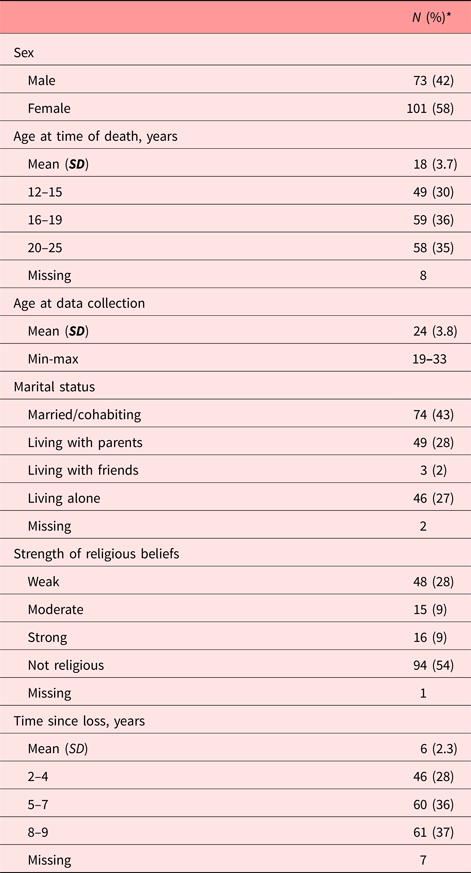
Fifty-eight percent of the participating siblings were women and the average time since loss was six years. Mean age was 18 years (standard deviation [SD] = 3.7) at time of death and 24 (SD = 3.8) at the time of data collection. The majority of the participants were married/cohabiting or living with their parents and were nonreligious (Table 1).
Characteristics of the 174 cancer-bereaved siblings

*Sum of percentages may not equal 100 due to rounding.
Siblings’ ways of coping with grief
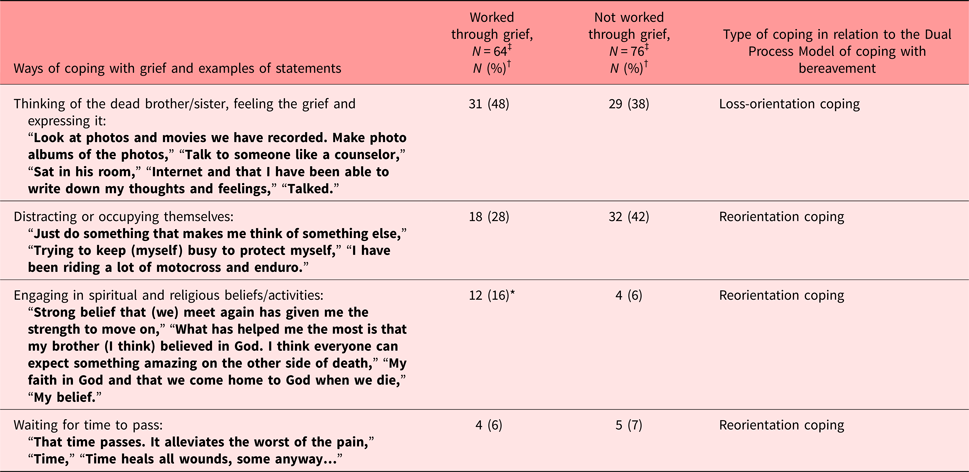
One hundred forty-three of the 174 siblings (82%) answered the question about coping with grief. Four different ways of coping were identified: (1) thinking of their dead brother/sister, feeling the grief and expressing it (N = 60); (2) distracting or occupying themselves (N = 50); (3) engaging in spiritual and religious beliefs and activities (N = 16); and (4) waiting for time to pass (N = 9) (Table 2). Category 1 “was related to evoked memories, for example looking at photos, talking about the brother/sister, crying, and letting themselves feel the pain of loss. Category 2 involved having a normal life with friends and hobbies to rest from their painful feelings. Category 3 involved coping related to their beliefs, for example having faith that they will meet again or that the brother/sister was in a safe place/with God. Siblings also described “that category 4 was one way to handle the most painful grief. Many siblings (N = 87, 61%) described that their immediate family and extended family and friends were a part of their coping, for example talking about the brother/sister or participating in activities that distracted them. Ten siblings reported that nobody helped them in their grief and/or that they were their own best helpers (not shown in Table 2). The bereaved siblings’ age at time of death did not affect the way the siblings cope with grief.
Siblings’ ways of coping with grief after the loss of a brother or sister to cancer in relation to whether they perceived they have worked through their grief or not, and the relation to the Dual Process Model of coping with bereavement

†More than one way of coping with grief can be reported per sibling. *p = 0.016 (“Engaging in spiritual and religious beliefs and activities” was associated with the siblings’ experience of having worked through their grief 2–9 years after the loss). ‡Three siblings did not respond to the closed-ended question about grief and have therefore been excluded.
Ways of coping with grief in relation to the siblings’ experience of having worked through their grief
One of the four categories of coping with grief, Engaging in spiritual and religious beliefs and activities, was associated with the siblings’ experience of having worked through their grief 2–9 years after the loss (p = 0.016). Siblings who used this way of coping with grief were significantly more likely to report being religious than nonreligious (p < 0.001). Five of the 16 who used this way to cope with grief stated that they did not have strong religious beliefs or were not religious at all.
There was no statistically significant difference in having worked through grief between the siblings who provided comments on their coping (N = 143) and those (N = 31) who did not respond to the open-ended question concerning coping.
The siblings’ ways of coping with grief in relation to the dual process model of coping with bereavement
Category 1 was interpreted as loss-oriented coping, whereas categories 2–4 were related to restoration-oriented coping (Table 2). Twenty-five siblings (17%) used both loss- and restoration-oriented processes in combination to cope with grief (not shown in Table).
No differences between those who combined use of category 1 versus categories 2–4 and those who did not combine them in terms of having worked through their grief (p > 0.05).
Discussion
This nationwide study described how cancer-bereaved AYA siblings cope with grief – a topic that has previously only been explored qualitatively and in smaller samples. This study therefore contributes knowledge about four commonly used ways of coping with grief, providing information that may prove valuable for healthcare professionals and families in their efforts to support these individuals. This study also adds to the literature in that the only way of coping that showed a statistically significant association with siblings experiencing that they had worked through their grief, was spirituality and religious beliefs and activities, such as believing they would meet their brother/sister again or that he/she was in a safe place, for example with God.
Religion includes congregational aspects and formal ways to express one's beliefs, whereas spiritualty is about personal authenticity, for example connecting with oneself, nature, or God/life sources. An individual may be spiritual without having a specific religion or very religious without having a developed spirituality (Surbone & Baider, Reference Surbone and Baider2010). It is possible that Jenholt Nolbris et al. (Reference Jenholt Nolbris, Enskär and Hellström2014) were touching on siblings’ spiritual and religious beliefs when they described how siblings express the bond they have with their deceased brother/sister through the sky, the stars, the siblings’ minds, or through a more concrete thing such as a football. The siblings in this study did not specifically mention that kind of sibling bond as a way of coping with grief, but described a strong belief that they will meet again, for example in heaven. In this study, making a distinction between spirituality and religion has been hard because of the brevity of the comments from the siblings. For example, the short statement “my belief” might be related to a specific religion but could also be interpreted as another form of belief that not is related to a special community or church. Apart from spirituality and religious beliefs and activities, all the other three ways of coping with grief used by cancer-bereaved siblings had previously been described in qualitative studies (Barrera et al., Reference Barrera, Alam and D'Agostino2013; Jenholt Nolbris et al., Reference Jenholt Nolbris, Enskär and Hellström2014).
Only 16 siblings were engaged in spiritual and/or religious beliefs/activities, which was associated with having worked through grief. The small number of siblings who used this way of coping might be explained by the fact that most siblings in this study were nonreligious. Still, individuals may be involved in spiritual beliefs/activities regardless of whether they are religious or not. If siblings are displaying this type of coping it could be reinforced or validated.
There is little research about spirituality and religious beliefs among siblings; however, research on parents who lost a child show that parents’ greater use of spiritual activities was associated with milder symptoms of grief and depression (Hawthorne et al., Reference Hawthorne, Youngblut and Brooten2016). Another qualitative study (Ganzevoort & Falkenburg, Reference Ganzevoort and Falkenburg2012) found that bereaved parents were painfully aware that their child was not “here” (on Earth or with them), but felt that their child was “somewhere.” Parents’ expression of “somewhere” was dependent on their beliefs or worldview. Lichtenthal and colleagues (Reference Lichtenthal, Currier and Neimeyer2010) showed that bereaved parents found meaning related to their child's death in their spiritual and religious beliefs. Parents who did not find meaning in the loss of their child had higher levels of grief. Our finding of a correlation between spiritual and religious coping and working through grief supports the results of Lichtenthal and colleagues (Reference Lichtenthal, Currier and Neimeyer2010). Meaning-making and spiritual and religious coping are therefore important components for further exploration among siblings.
The grief literature highlights that bereaved individuals, including siblings, alternate between thinking of how they felt and what happened to their brother/sister and doing something completely different as a way to cope with their loss (Jenholt Nolbris et al., Reference Jenholt Nolbris, Enskär and Hellström2014; Stroebe & Schut, Reference Stroebe and Schut1999, Reference Stroebe and Schut2010). This dynamic process, denoted oscillation in the Dual Process Model of coping with bereavement, involves confrontation and avoidance. Nevertheless, in this sample, few siblings reported combining loss-oriented and restoration-oriented coping. Moreover, no effect on grief was found among siblings who combined Thinking of the dead brother or sister, feeling the grief and expressing it and Distracting or occupying themselves/Engaging in spiritual and religious beliefs and activities/Waiting for time to pass. However, one reason for this might be that we measured siblings’ ways of coping using free text, and that not all types of coping were covered; in other words, the siblings might only have reported the most significant ones.
Although this nationwide study is, to our knowledge, the largest study that has examined correlations between ways of coping with grief among cancer-bereaved siblings and working through grief, it has limitations. One may be that our single question about grief was not sensitive enough to detect nuances of working through grief, even if it correlated with the ICG. Our categorization of siblings’ ways of coping with grief in relation to loss-oriented and restoration-oriented coping is based on our interpretation of the siblings’ free comments, which were often short and might have been interpreted differently by others. The results should be read in light of this knowledge.
The correlation between spiritual and religious coping and working through grief is the one of the most significant results in this study. Future research about the meaning of spiritual and religious coping for bereaved siblings, especially in secularized countries such as Sweden, would therefore help us understand more about how health care staff and family members, friends, and others can support siblings through their grief work. Longitudinal studies about siblings’ grieving trajectory, which are lacking in the literature, would also add to the understanding about normative and prolonged grief among this group in relation to different ways of coping with grief.
Acknowledgments
We would like to thank all the siblings who made this study possible. Funding for this project has been provided by the Swedish Childhood Cancer Foundation, the Swedish Cancer Society, the Swedish Research Council, and Gålö Foundation.
Disclosures
No conflicts of interest to declare.