Introduction
Coral reefs occur throughout much of the tropical and subtropical regions of the world, but their species composition, diversity, and ecological characteristics vary through this range and have changed over geological time (Perrin, Reference Perrin2002; Baron-Szabo, Reference Baron-Szabo2006; Kiessling et al., Reference Kiessling, Simpson and Foote2010). Reef-building corals thrived in the western Tethys (European region) during the Eocene to early Miocene, before their loss from the Mediterranean, and their record can be seen in the mountains and sea walls of many European countries close to, or fringing, eastern Atlantic waters (Bosellini and Russo, Reference Bosellini and Russo1992; Perrin and Bosellini, Reference Perrin and Bosellini2012; Budd and Bosellini, Reference Budd and Bosellini2016). At the opposite boundary of the Atlantic, western Atlantic reef corals are a legacy of historical events, initially including elements of the eastern Atlantic fauna and being largely cosmopolitan up to the end-Eocene (Vaughan, Reference Vaughan1919; Berggren and Hollister, Reference Berggren and Hollister1974; Frost and Langenheim, Reference Frost and Langenheim1974; Budd, Reference Budd2000; Stemann, Reference Stemann and Donovan2004). During the late Oligocene/early Miocene, this composition was transformed by loss of genera into a more endemic Caribbean fauna (Edinger and Risk, Reference Edinger and Risk1994; Johnson and Kirby, Reference Johnson and Kirby2006; Johnson et al., Reference Johnson, Sanchez-Villagra and Aguilera2009), followed by gradual species generation and turnover within certain surviving genera to achieve the present-day distinct Caribbean fauna (Budd et al., Reference Budd, Stemann and Johnson1994; Gardner et al., Reference Gardner, Côte, Gill, Grant and Watkinson2003; Cramer et al., Reference Cramer, Jackson, Donovan, Greenstein, Korpanty, Cook and Pandolfi2020). As some authors have pointed out, the western Atlantic was open to the Pacific Ocean for most of this time, complete closure of the Isthmus of Panama being achieved only in the Pliocene (Berggren and Hollister, Reference Berggren and Hollister1974; Edinger and Risk, Reference Edinger and Risk1994). The affinities of the modern Caribbean fauna with extant, as well as historical, scleractinian faunas elsewhere in the world are being explored to this day (Budd and Stolarski, Reference Budd and Stolarski2009; Budd and Bosellini, Reference Budd and Bosellini2016; Stolarski et al., Reference Stolarski2016).
The reef coral genus Acropora is solely represented on modern western Atlantic reefs by two important reef-front species, A. cervicornis (Lamarck, Reference Lamarck1816) and A. palmata (Lamarck, Reference Lamarck1816) (the cervicornis group), as well as their persistent F1 hybrid, which is currently recognized as a third species, A. prolifera (Lamarck, Reference Lamarck1816) (Aronson et al., Reference Aronson, Bruckner, Moore, Precht and Weil2008a, Reference Aronson, Bruckner, Moore, Precht and Weilb; Japaud et al., Reference Japaud, Bouchon and Fauvelot2014; Anguila-Perera and Hernández-Landa, Reference Anguilar-Perera and Hernández-Landa2018; Nylander-Asplin, Reference Nylander-Asplin2018; Precht et al., Reference Precht, Vollmer, Modys and Kaufman2019; Hoeksema and Cairns, Reference Hoeksema and Cairns2020). Acropora is furthermore represented in the fossil record of the western Atlantic, including three named and several still to be described species from the Caribbean and North, Central, and South America (Vaughan, Reference Vaughan1919; Weisbord, Reference Weisbord1973; Budd et al., Reference Budd, Stemann and Johnson1994; Wallace, Reference Wallace2012). Its earlier history and biogeography elsewhere include diversification into possibly 11 lineage groups in the Eocene to early Miocene of the western Tethys (Europe or eastern Atlantic) (Wallace and Rosen, Reference Wallace and Rosen2006; Wallace, Reference Wallace2008; Wallace and Bosellini, Reference Wallace and Bosellini2014). In contrast to its reduced modern Atlantic Ocean presence, Acropora is the most diverse modern reef coral genus in the Indo-Pacific, with more than 150 species and 18 morphological species group lineages (Wallace, Reference Wallace1999; Veron, Reference Veron2000; Renema et al., Reference Renema2016; DeVantier and Turak, Reference DeVantier and Turak2017).
While the fossil history of corals from the general Caribbean region is extensively documented, including in the references cited in the preceding, records of Acropora in mainland territories such as the United States and Mexico are less well documented, and indications are that these have much to contribute to understanding change processes in the western Atlantic (Wallace et al., Reference Wallace, Portell and Muir2020). One such carbonate paleoenvironment is the Suwannee Limestone of Florida and Georgia, USA, which has a rich diversity of marine invertebrate and vertebrate fossils that record the presence of coral- and seagrass-bearing communities from the Eocene/Oligocene boundary to the mid Oligocene (e.g., Dall, Reference Dall1916; Mansfield, Reference Mansfield1937; Scott, Reference Scott2001, Reference Scott, Buster and Holmes2011; Herbert and Portell, Reference Herbert and Portell2002; Smith, Reference Smith2015; Upchurch et al., Reference Upchurch, Scott, Alfieri, Fratesi and Dobecki2019). Along with younger fossils from the Tampa Member of the Arcadia Formation (mid Oligocene to early Miocene; Brewster-Wingard et al., Reference Brewster-Wingard, Scott, Edwards, Weedman and Simmons1997), these deposits offer a unique insight into the evolution and paleogeography of Atlantic lineages of many marine animal groups, including corals.
In a recent study of Acropora presence in the fossil record of mainland America at a lineage level (morphological species groups), using fossils from the Suwannee Limestone and the Tampa Member of the Arcadia Formation, evidence was found of 10 unnamed species plus the known species A. tampaensis Weisbord, Reference Weisbord1973, from seven extant and up to three unknown species groups (Wallace et al., Reference Wallace, Portell and Muir2020). Here we describe two of the unnamed species, collected in the oldest of these localities, a Suwannee Limestone site in Polk County, Florida, and discuss their significance in terms of lineage age, paleobiogeography, and paleoecology.
Geological setting
Geological time units
Cenozoic, Paleogene, Eocene (Priabonian) to Oligocene (Rupelian) (International Commission on Stratigraphy, 2021).
Stratigraphic information
The name Suwannee Limestone was originally proposed by Cooke and Mansfield (Reference Cooke and Mansfield1936) for exposures along the Suwannee River near the town of Ellaville, Florida. Its areal extent is from the eastern Florida panhandle south to the central peninsula (as intermittent exposures) and as far south as Key West in the subsurface (Bryan, Reference Bryan1991). It also continues northward into Georgia, where it is extensively exposed in the southern portion of the state and extends in the subsurface as far as the Savannah River at the Georgia–South Carolina border (Bryan, Reference Bryan1991). The unit is typically a white to pale orange, soft, and porous wackestone, packstone, or grainstone with loosely cemented foraminifera, abundant tests of the irregular echinoid Rhyncholampas gouldii (Bouvé, Reference Bouvé1846), and uncommon to abundant mollusks (Herbert and Portell, Reference Herbert and Portell2002). Its lithology is variable from incompletely to well cemented, silicified, or dolomitized (Upchurch et al., Reference Upchurch, Strom, Nuckels, Scott and Upchurch1980; Huddlestun, Reference Huddlestun1993). Jones et al. (Reference Jones, Mueller, Hodell, Stanley, Zullo, Harris, Scott and Portell1993), on the basis of Sr isotope analysis of sea star marginal ossicles from the site, estimated the age of the Suwannee Limestone exposed here at 33.6 to 34.1 Ma (±0.5–1.0 Myr). The two holotypes were derived ex situ from the quarry described in the following.
Location information
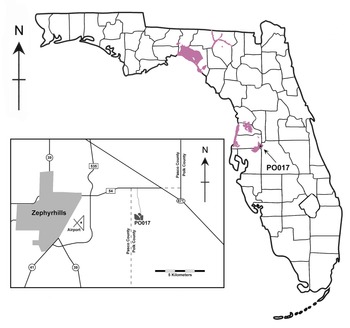
Terramar 01 (West Coast Mine) (Florida Museum of Natural History [FLMNH], Invertebrate Paleontology [IP] locality PO017), located at 28.232729°, –82.098447° WGS84, approximately 9.7 km northwest of Socrum, Florida (Fig. 1). This quarry was described in detail by Herbert and Portell (Reference Herbert and Portell2002), and it has been the source of numerous studies (Bryan, Reference Bryan1991; Jones et al., Reference Jones, Mueller, Hodell, Stanley, Zullo, Harris, Scott and Portell1993; Petuch, Reference Petuch1997, Reference Petuch2004; Smith, Reference Smith2015).
Location of Suwannee Limestone exposures in Florida (purple) and location of Terramar 01 (West Coast Mine) (FLMNH-IP locality PO017).

Materials and methods
The fossil corals were examined using a binocular microscope with eyepiece graticule for the presence of diagnostic Acropora features, including branching type, axial and radial corallite structure, and coenosteal structure (see Wallace, Reference Wallace1999, Reference Wallace2008; Wallace and Bosellini, Reference Wallace and Bosellini2014; Santodomingo et al., Reference Santodomingo, Wallace and Johnson2015 for terminology and discussion of skeletal characters in fossil Acropora).
Repositories and institutional abbreviations
Types, figured, and other specimens examined in this study are deposited in the following institutions: The Florida Museum of Natural History, Invertebrate Paleontology (FLMNH-IP), University of Florida (UF), Gainesville, Florida, USA; the Smithsonian National Museum of Natural History (NMNH), Washington D.C., USA, and the Museum of Tropical Queensland (MTQ), Townsville, Australia, a campus of Queensland Museum.
Systematic paleontology
Phylum Cnidaria Hatschek, Reference Hatschek1888
Class Anthozoa Ehrenberg, Reference Ehrenberg1834
Subclass Hexacorallia Haeckel, Reference Haeckel1896
Order Scleractinia Bourne, Reference Bourne and Lankester1900
Family Acroporidae Verrill, Reference Verrill1902
Diagnosis
Massive, ramose, encrusting, columnar, or laminar colonies by extratentacular budding; corallites small, synapticulothecate, slightly differentiated from coenosteum. Septa non-exert, in two cycles, formed by simple spiniform rods projecting inward and upward from the corallite wall, commonly fusing to form laminae. Columella absent or trabecular and weak. Dissepiments thin and tabular when developed. Coenosteum absent or (more commonly) extensive, light reticulate, flaky, generally spinose or striate on surface (after Wallace and Bosellini, Reference Wallace and Bosellini2014; Richards et al., Reference Richards, Carvajal, Wallace and Wilson2020).
Occurrence
Late Cretaceous to Recent.
Genus Acropora Oken, Reference Oken1815
Acropora Oken, Reference Oken1815, p. 66 [Validated ICZN 1963 (Boschma, Reference Boschma1961; China, Reference China1963)]
Type species
Acropora muricata (Linnaeus, Reference Linnaeus1758). Recent. Neotype: Museum of Tropical Queensland (MTQ) G49167, Gunung Api Island, Banda Islands, Indonesia (see Wallace, Reference Wallace1999, p. 2–6).
Diagnosis
Acroporidae that are ramose, rarely massive or encrusting, branching with a single axial corallite that forms the axis of a branch and opens at its tip; more numerous radial corallites are budded from the branch tip; radial corallites connected by light, reticulate, spinose, costate, or pseudocostate coenosteum that is also the wall of the axial corallite; columella and dissepiments absent.
Occurrence
Paleocene to Recent.
Acropora elegans group
Diagnosis
Species with lightly structured corallum, mostly with horizontal branching, sparsely arranged and sometimes anastomosed. Radial corallites tubular or appressed tubular, evenly sized, sparsely distributed, sometimes alternate-sympodially arranged on the branch; coenosteum throughout formed of elaborated spinules, moderately to densely arranged, axial; radial domination of branch diameter various. Extant species of this group occur mostly below 20 m depth (Wallace, Reference Wallace1999; Wallace et al., Reference Wallace, Done and Muir2012; Muir and Wallace, Reference Muir and Wallace2015; Santodomingo et al., Reference Santodomingo, Wallace and Johnson2015).
Holotype
UF 32479, Terramar 01 (West Coast Mine) (FLMNH-IP locality PO017) USA, Florida, Polk County, GPS coordinates 28.232729°, –82.098447°, datum WGS84. Lower Oligocene (Rupelian), Suwannee Limestone. Collector: Roger W. Portell; date collected: 11 March 1990. Collected ex situ.
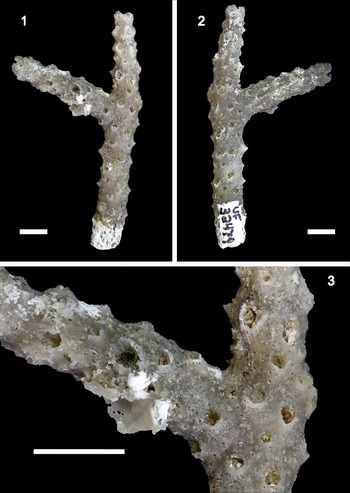
Acropora suwanneensis n. sp., holotype UF 32479, lower Oligocene, Suwannee Limestone, Polk County, Florida, USA. (1, 2) Whole specimen from both sides. (3) Detail of branch showing radial corallites of similar size, not touching, tubular with wide round openings and sometimes an extended lip, coenosteum costate or anastomosed on radial corallites, anastomosed between radial corallites. Scale bars = 5 mm.

Diagnosis
Colony form probably arborescent with slender, open branches up to at least 30 mm long and 4.5 mm in diameter and tapering slightly toward tip; radial corallites all approximately same size, well separated and not touching, tubular with round wide opening 1.9 to 2.4 mm in diameter, and a basal lip, projecting outward from the branch or partly appressed; coenosteum costate on radial corallites, between radial corallites dense reticulo-costate to anastomosed.
Occurrence
Lower Oligocene (Rupelian), Suwannee Limestone (Florida). Known only from the type locality.
Description
Holotype UF 32479: silicified, single fragment, total length 46 mm, consisting of a branch tapering to a tip and giving off a second complete branch, 16.5 mm from this tip: secondary branch 20 mm long; main branch diameter 4.5 mm at base, 3 mm at tip; secondary branch 5.4 mm at base, 3 mm at tip. An axial corallite can be seen opening at the tip of each branch, both axial corallites somewhat damaged, diameter 2–2.5 mm. Radial corallites all approximately same size, not touching, tubular with openings 1.0–1.4 mm in diameter, round to slightly lipped; these are partially appressed, then extending outward from branch; septa difficult to see, but some primary septa present in most corallites. Coenosteum costate or anastomosed on radial corallites, anastomosed between radial corallites.
Etymology
Named for the Suwannee River and the lithostratigraphic unit, Suwannee Limestone, which occurs throughout central and northern Florida and north to west Georgia.
Remarks
This species shares the following morphological similarities with the extant Pacific and central Indo-Pacific species Acropora torihalimeda Wallace, Reference Wallace1994: very slender branches (less than 6 mm wide), radial corallites that are tubular, evenly sized, and arranged on the branch and not touching, coenosteum between corallites consolidated (anastomosed) with flattened spinules (this feature can be seen only in small patches on the A. suwanneensis holotype). Radial corallites of A. torihalimeda have a distinct oblique opening, but the silicified and abraded nature of the fossil specimen makes it difficult to compare for this character in A. suwanneensis.
Acropora horrida group
Diagnosis
Radial corallites simple tubular with round openings, evenly sized. Coenosteum throughout with simple to moderately elaborated spinules, parts of coenosteum fused. Colonies arborescent to hispidose, branch diameter 50/50 axial; radial.
Holotype
UF 27217, Terramar 01 (West Coast Mine) (FLMNH-IP locality PO017) USA, Florida, Polk County, GPS coordinates 28.232729°, –82.098447°, datum WGS84. Lower Oligocene (Rupelian), Suwannee Limestone. Collector: Roger W. Portell; date collected: 16 May 1989. Collected ex situ.
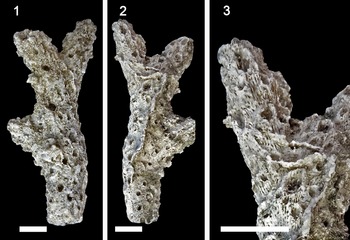
Acropora upchurchi n. sp., holotype UF 27217, lower Oligocene, Suwannee Limestone, Polk County, Florida, USA. (1, 2) Whole specimen from both sides; (2) shows the two visible surface zones mentioned in the text. (3) Detail showing one axial corallite tip on the left; another axial corallite, surrounded by small radial corallites, indicates an incipient branch (lower center). The edge of the “fresher” surface zone can be seen clearly to the right of this. Radial corallites are all approximately same size, touching at the branch tips but elsewhere not touching, tubular appressed with round openings. Scale bars = 5 mm.

Diagnosis
Colony form probably caespitose with terete branches up to at least 9.2 mm in diameter with a slight taper at the tip. Axial corallite up to 3.5 mm outer diameter and 2.5 mm inner diameter. Radial corallites all approximately same size, touching at the branch tips but elsewhere not touching, tubular appressed with round openings and a slight lip. Coenosteum open costate on radial corallites, reticulate between radial corallites.
Occurrence
Lower Oligocene (Rupelian), Suwannee Limestone, Florida. Known only from the type locality.
Description
Holotype UF 27217 silicified, single fragment, total length 36 mm, consisting of a main branch giving off two complete branches, one at 11 mm from its tip and another at approximately 14 mm below this. Main branch diameter 7.5 mm at base, 9.5 mm below the upper branch, and 2.5 mm at tip, other branches both 7 mm diameter at base, 4.5 mm at tip. The specimen presents two visible surface zones, best seen in Figure 3.2, where the top and right side appear to have died or been smothered for a time, and the left side appears to be growing over it in repair, showing a raised edge. An axial corallite can be seen opening at the tip of each branch, and at least two incipient branches, formed by an axial corallite surrounded by small radials, can also be seen. Radial corallites are all approximately same size, touching at the branch tips but elsewhere not touching, tubular appressed with round openings 1.9–2.4 mm in diameter. Most radial corallites are abraded, some very seriously so, making measurements of diameters difficult, but some near-intact ones occur around tips of branches. Coenosteum is somewhat worn and fragile, open costate on radials, and reticulate between radials.
Etymology
Named in honor of Dr. Sam Upchurch for his extensive work on silicification of Oligocene and Miocene limestones of Florida.
Remarks
Acropora upchurchi bears some similarity to the Pacific species A. tortuosa (Dana, Reference Dana and Wilkes1846), in the horrida species group (see Wallace, Reference Wallace1999, p. 287, pl. 76), in the dimensions and general appearance of branches and the tubular radial corallites with round openings, mostly not touching. The details of coenosteum between radial corallites cannot be seen in detail, but A. tortuosa can be considered its most similar extant species. Despite the irregularity in the holotype specimen, its skeletal characteristics should be sufficient to be compared with other material, when such becomes available.
Results and discussion
Morphology, habitat, and biogeography
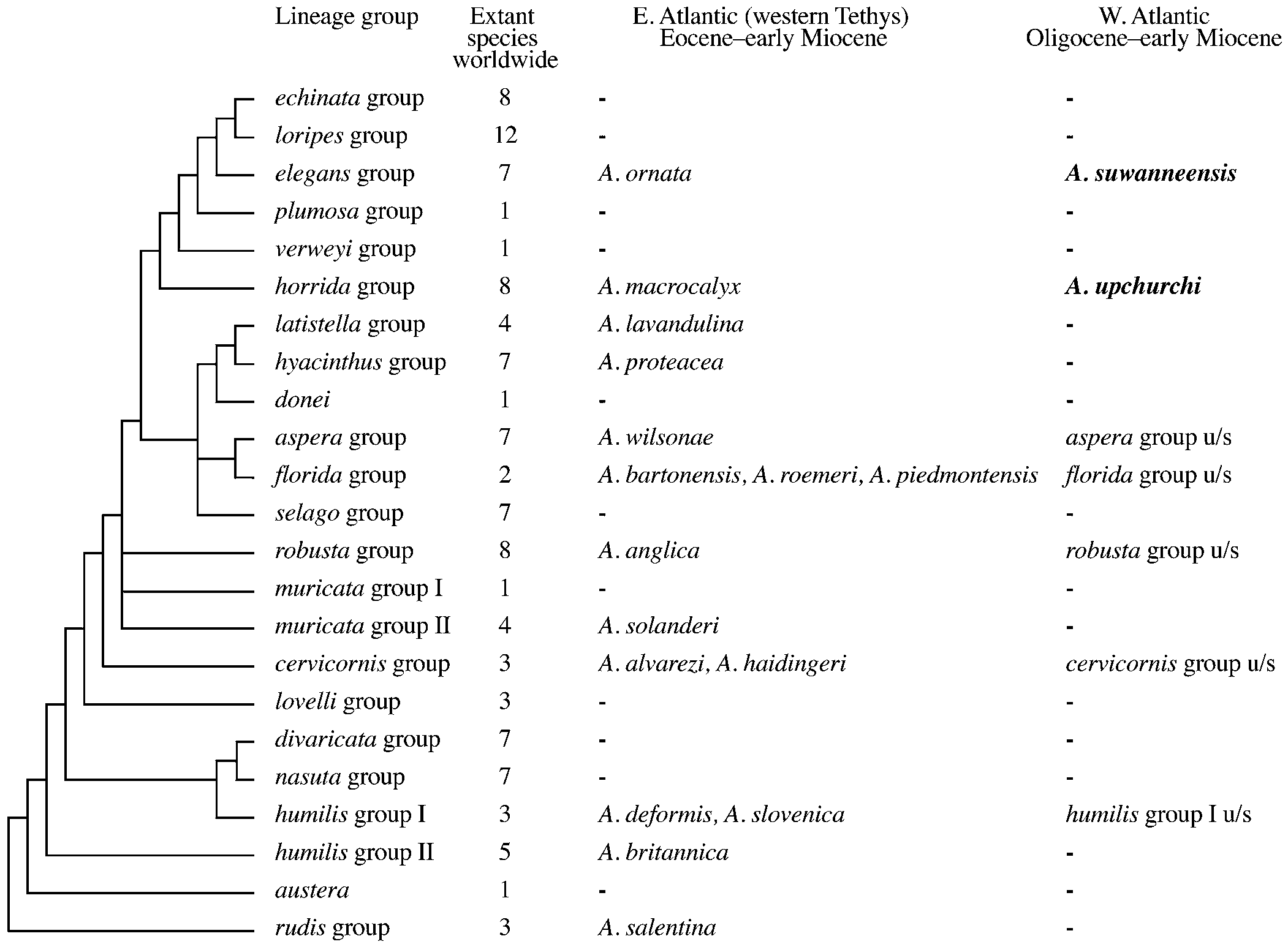
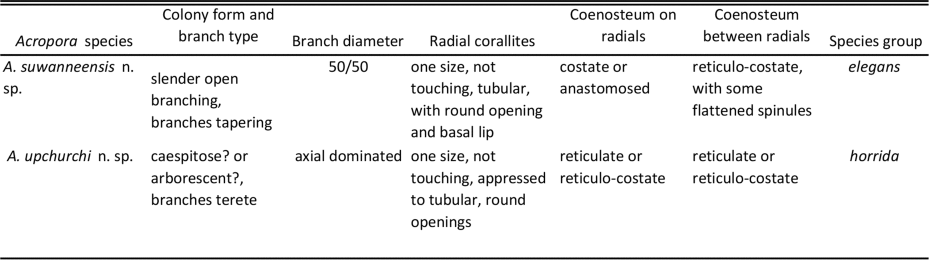
Skeletal morphology and the species group lineage to which each species is attributed are shown in Table 1. Both new species have slender, delicate skeletal structure and are interpreted as belonging to species groups that occur entirely subtidally on modern reefs of the Indo-Pacific: most other Acropora species and species groups include the intertidal in their distribution (Wallace, Reference Wallace1999). Similar samples of diminutive species of Acropora have not been reported to date from anywhere else in the western Atlantic, although representatives of both lineages are seen in the fossil record of the eastern Atlantic (western Tethys): A. ornata (Defrance, Reference Defrance1828), elegans group (Wallace, Reference Wallace2008, fig. 13), and A. macrocalyx Wallace and Bosellini, Reference Wallace and Bosellini2014, horrida group (Fig. 4; Wallace and Bosellini, Reference Wallace and Bosellini2014, fig. 13).
Eastern and western Atlantic fossil species of Acropora displayed against the lineages (as species groups) to which they have been attributed in a morphological phylogeny from Wallace (Reference Wallace1999). The new species from this paper are in bold. Only species that have been attributed to species groups have been included. u/s = undescribed species. Data from Wallace (Reference Wallace2008), Wallace and Bosellini (Reference Wallace and Bosellini2014), and Wallace et al. (Reference Wallace, Portell and Muir2020).

Summary of main skeletal characters of new Acropora fossil species found in the Suwannee Limestone, together with the species group to which each species is attributed. Question marks denote uncertainty. Characters are described in detail in Wallace (Reference Wallace1999, Reference Wallace2008), Wallace and Bosellini (Reference Wallace and Bosellini2014), and Santodomingo et al. (Reference Santodomingo, Wallace and Johnson2015).

Extant species of the elegans group lineage, of which A. suwanneensis n. sp. and its most similar extant species, A. torihalimeda, are members (Fig. 4), are usually found below 20 m, often in mesophotic depths (below 30 m) and in some cases down to 110 m or deeper (Muir et al., Reference Muir, Wallace, Done and Aguirre2015, Reference Muir, Pichon, Squire and Wallace2018a, Reference Muir, Wallace, Pichon and Bongaertsb; Turak and Devantier, Reference Turak, DeVantier, Loya, Puglise and Bridge2019). Occasionally, they may occur at more shallow depths in extremely calm and dark or turbid water (e.g., Muir and Wallace, Reference Muir and Wallace2015; Turak and DeVantier, Reference Turak, DeVantier, Loya, Puglise and Bridge2019). Most species in this lineage (e.g., A. tenella (Brook, Reference Brook1892); A. cardenae Wells, Reference Wells1985; A. torihalimeda) were regarded as rare until very recently because they were found only in occasional deep-water samples. The new emphasis on mesophotic reefs as a significant habitat for reef-building corals (Kahng et al., Reference Kahng, Copus, Wagner and Rossi2016; Loya et al., Reference Loya, Puglise and Bridge2019) has shown all three species to be common in mesophotic locations, particularly in tropical low latitudes (Bridge et al., Reference Bridge, Fabricius, Bongaerts, Wallace, Muir, Done and Webster2012; Muir et al., Reference Muir, Wallace, Done and Aguirre2015, Reference Muir, Pichon, Squire and Wallace2018a; Prasetia et al., Reference Prasetia, Sinniger and Harii2016).
The second species, Acropora upchurchi n. sp., is interpreted as a member of the horrida species group (Fig. 4). Its age of 33.6–34.1 Ma extends the first recorded occurrence of this lineage back from the 16.0–20.4 Ma (Miocene, Burdigalian) recorded for A. macrocalyx Wallace and Bosellini, Reference Wallace and Bosellini2014 from the Miocene of Italy. Another, as yet unnamed, horrida group species was reported from the Aquitanian (20.4–23.0 Ma) Tampa Member of the Arcadia Formation in Florida (Wallace et al., Reference Wallace, Portell and Muir2020): this also predates the Burdigalian first record of the species group from Europe (Wallace and Bosellini, Reference Wallace and Bosellini2014) and supports A. upchurchi as a member of the horrida group.
Longevity—Many extant Indo-Pacific Acropora species, assessed in terms of morphology, are extremely old, up to 20+ million years (Santodomingo et al., Reference Santodomingo, Wallace and Johnson2015). In addition to these extant species, at least three extinct Acropora species existed in western Tethys (eastern Atlantic) waters for long periods of 17, 20, and 28 million years as indicated from the fossil record (Wallace and Bosellini, Reference Wallace and Bosellini2014). The elegans lineage is first recorded from the Eocene (Lutetian, 41.7–42.8 Ma) of France as A. ornata, which is illustrated by Michelin (Reference Michelin1840–1847, p. 164) and Wallace (Reference Wallace2008, fig. 13). The most similar extant species to A. suwanneensis n. sp., A. torihalimeda (see Wallace et al., Reference Wallace, Done and Muir2012, p. 217), does not have a fossil record; however, three other extant Indo-Pacific species of the elegans group, A. elegans (Milne Edwards and Haime, Reference Milne Edwards and Haime1860), A. pichoni Wallace, Reference Wallace1999, and A. tenella, are among 12 Acropora species that have existed without detectable morphological change and in overlapping geographic distribution for 17 million years, as demonstrated by in situ fossils from Kalimantan, Indonesia, by Santodomingo et al. (Reference Santodomingo, Wallace and Johnson2015).
As with the elegans group, the horrida group includes some extremely long-lived species. A. tortuosa, the extant species most similar to A. upchurchi n. sp., is shown to date from 9.4–9.8 Ma (from Miocene, Tortonian), and three other extant morphological species in the A. horrida lineage have the following ages: A. kirstyae Veron and Wallace, Reference Veron and Wallace1984, 17 Ma; A. halmaherae Wallace and Wolstenholme, Reference Wallace and Wolstenholme1998, 12 Ma; and A. horrida (Dana, Reference Dana and Wilkes1846), 10 Ma (Santodomingo et al., Reference Santodomingo, Wallace and Johnson2015).
These extreme ages might be expected to be accompanied by genetic changes over time, but this is not visible from the skeleton. It might manifest itself by genomic differences seen in extant species, as suggested by the results of Richards et al. (Reference Richards, Miller and Wallace2013), Rosser (Reference Rosser2015), Suzuki et al. (Reference Suzuki, Keshavmurthy, Hayashibara, Wallace, Shirayama, Chen and Fukami2016), and Rosser et al. (Reference Rosser, Thomas, Stankowski, Richards, Kennington and Johnson2017). In the skeletal morphology available to paleontologists, it is presently assumed that “species” with the same skeletal structure but unknown genomes would nevertheless be closely related. However, while cryptic genetic differentiation, particularly associated with marginal environments, might be proposed as possible within populations of any of these species, as seen in some extant Acropora species (e.g., Richards et al., Reference Richards, Miller and Wallace2013; Rosser, Reference Rosser2015; Suzuki et al., Reference Suzuki, Keshavmurthy, Hayashibara, Wallace, Shirayama, Chen and Fukami2016), it was concluded by Santodomingo et al. (2015, p. 693) that “[o]n present evidence, it is […] more parsimonious to suggest that populations of the same species were able to persist through the Neogene because the habitat required for […] survival remained available, probably expanding and shrinking in small refugia over crisis periods for reef development in the [Indonesian] region.”
Acropora suwanneensis n. sp. and A. upchurchi n. sp., members of the Suwannee Limestone fossil assemblage, each have an estimated age of 33.6 to 34.1 Ma [±0.5–1.0 Myr], based on analysis of sea star marginal ossicles from the site by Jones et al. (Reference Jones, Mueller, Hodell, Stanley, Zullo, Harris, Scott and Portell1993). Although these species were collected ex situ after the quarry was dewatered, the paleoenvironment of the marine invertebrates at Terramar 01 (West Coast Mine) and the presence of dugong and other marine vertebrate fossils have been considered and discussed by various authors. The consensus to date is that the environment of deposition of the Suwannee Limestone at this site was “essentially like that found today off the Florida Keys, with a shallow water, marine environment floored with carbonate sands and mud and inhabited by a wide range of invertebrates including corals” and “coral thickets with sea grass beds, not true reef tracts” (Herbert and Portell, Reference Herbert and Portell2002, p. 303 and references therein) and also “a back-reef lagoonal environment” (Petuch, Reference Petuch1997, p. 123). We are interested in pursuing, in the future, the possibility that western Atlantic species of Acropora may have entered and survived in the Indo-Pacific, but this will require some more data.
Paleobiogeography
The presence of the two new species in the Suwannee Limestone of central Florida makes an important contribution to the known lineage-level diversity of Acropora in the western Atlantic since the species groups have not been recorded there previously, other than another as yet unnamed horrida group species reported from the younger Tampa Member of the Arcadia Formation by Wallace et al. (Reference Wallace, Portell and Muir2020). With an age of 33.6–34.1 Ma, the two new species predate all other Acropora species thus far described from the Americas and the Caribbean by at least 10 million years, with A. tampaensis from the Tampa Member of the Arcadia Formation being 20.4–23.0 Ma and A. panamensis Vaughan, Reference Vaughan1919 and A. saludensis Vaughan, Reference Vaughan1919 from the Emperador Limestone of Panama both being 20.62–21.24 Ma, based on the revision of that location by Johnson and Kirby (Reference Johnson and Kirby2006) (Wallace, Reference Wallace2012).
Paleogeography
For both species, the most similar extant species occurs in the Pacific Ocean to central Indo-Pacific (Wallace, Reference Wallace1999; Veron, Reference Veron2000; Wallace et al., Reference Wallace, Done and Muir2012), but not in the Indian Ocean. This leaves open a suggestion that the western Atlantic Acropora fauna, represented here by the two new species, may have played a role in the distribution of Acropora lineages into the Pacific Ocean. During the late Eocene to early Oligocene, when the new species occurred, an Atlantic–Pacific connection was maintained through Central America, likely via a “strong westward flowing equatorial current” (Berggren and Hollister, Reference Berggren and Hollister1974, p. 172). This was part of a long period in which the two major oceanic areas, Atlantic and Pacific, were connected by the Tethys seaway, which only began to close during the Burdigalian age in the Miocene (Smith et al., Reference Smith, Smith and Funnell1994, maps 4 and 5; Rögl, Reference Rögl1998; Harzhauser et al., Reference Harzhauser, Kroh, Mandie, Piller, Göhlicht, Reuter and Berning2007, fig.1). There are some records of extant Pacific invertebrate genera and sometimes species that occur as fossils in the western Atlantic region; for example, whole body fossils of the extant Pacific sea star Heliaster microbrachius (Xantus, Reference Xantus1860) have been found in a Neogene deposit in Florida (Jones and Portell, Reference Jones and Portell1988). For the present, we can say that the two new species described herein may have contributed to a cosmopolitan Tethys Sea fauna while occupying available subtidal coral habitats in the Paleogene of the western Atlantic and possibly contributed to the presence and future success of two Acropora species lineages in the modern Indo-Pacific.
Acknowledgments
For donating specimens to the FLMNH or helping during sample collecting at Terramar 01 (West Coast Mine) (FLMNH locality PO017), R.W.P. thanks R. Carter, F. Garcia, R. Hulbert, L. Ivany, E. Kendrew, S. Manchester, G. Morgan, C. Oyen, K. Schindler, T. Stemann, D. Turley, S. Upchurch, and J. Waldrop. Assistance with digital images and figures provided by S. Roberts and P. Muir. Literature and discussion on the Suwannee Limestone silicification mechanisms made available by S. Upchurch. C.C.W. thanks S. Cairns and T. Coffer of USNM for advice and access to type and reference collections at NMNH and K. Spring and A. Rozefelds of Queensland Museum for assistance and advice.
Competing interests
The authors declare none.