


Parenting beliefs, intentions and actions have powerful influences on children's wellbeing (Baumrind, Reference Baumrind1965, Reference Baumrind1991), and differing child-rearing practices have been shown to be associated with different wellbeing outcomes for children and adolescents (Buri, Louiselle, Misukanis, & Mueller, Reference Buri, Louiselle, Misukanis and Mueller1988; Milevski, Schlecter, Netter, & Keehn, Reference Milevski, Schlechter, Netter and Keehn2007). Parenting approaches that provide higher levels of commitment and investment in children result in higher levels of efficacy and self-esteem in their offspring (Baumrind, Reference Baumrind1993). Much of the research on the positive outcomes of high levels of parental effort has focused on parental involvement with their children's education (Hoover-Dempsey et al., Reference Hoover-Dempsey, Walker, Sandler, Whetsal, Green, Wilkins and Closson2005) and parental effort has been positively linked to a range of positive academic outcomes in students, including high scholastic motivation, achievement, and time spent on homework (Keith & Keith, Reference Keith and Keith1993).
Parental involvement in a child's school experience is considered an important factor in a child's or adolescent's academic success, with homework being a key aspect (Walker & Hoover-Dempsey, Reference Walker, Hoover-Dempsey and Good2008). There has been much research undertaken on parental involvement with their offspring's homework (e.g., Epstein & Van Voorhis, Reference Epstein and Van Voorhis2001; Moorman & Pomerantz, Reference Moorman and Pomerantz2010; Steinberg, Elmen, & Mounts, Reference Steinberg, Elmen and Mounts1989), with high levels of parental involvement long considered to be beneficial to a child (e.g., Brooks, Reference Brooks1916). Research on parental involvement with a child's schooling experience and their homework has posited that high parental involvement influences positive student outcomes through modelling, reinforcement and instruction (Hoover-Dempsey et al., Reference Hoover-Dempsey, Battianto, Walker, Reed, DeJong and Jones2001). Because of assumed positive effects, teachers are encouraged to promote parental involvement in children's and adolescents’ schooling (Walker & Hoover-Dempsey, Reference Walker, Hoover-Dempsey and Good2008). Teachers believe parents need to be more involved in homework, and specific programs have been created to encourage parents to interact more with their children when they are completing homework (e.g., Epstein & Voorhis, Reference Epstein and Van Voorhis2001).
While high levels of parental effort in encouraging their offspring's academic success are considered important in areas such as schoolwork, recently it has been suggested that there may be a point where parental assistance ceases to be beneficial to offspring. Overparenting (also known as helicopter parenting) has been described as a parent providing developmentally inappropriate or extreme assistance to their child in an attempt to improve their academic and personal success (LeMoyne & Buchanen, Reference LeMoyne and Buchanan2011). Research has associated this parenting approach with poor adolescent and young adult wellbeing outcomes, including dependence on adults (Montgomery, Reference Montgomery2010), a sense of entitlement (Segrin Woszidlo, Givertz, Bauer, & Taylor Murphy, Reference Segrin, Woszidlo, Givertz, Bauer and Taylor Murphy2012), and social anxiety (Spokas & Heimberg, Reference Spokas and Heimberg2009).
Overparenting remains somewhat loosely defined and appears to include a wide range of behaviours and attitudes that may not cohere closely and which may vary across different observers (Locke, Kavanagh, & Campbell, Reference Locke, Kavanagh and Campbell2015; Ungar, Reference Ungar2009). Much of the research on overparenting has been undertaken with young adults studying at university. In this research, overparenting has been defined as high levels of parental monitoring, advice and communication with their university-aged child about their coursework (e.g., Segrin, Woszidlo, Givertz, Bauer, & Taylor Murphy, Reference Segrin, Woszidlo, Givertz, Bauer and Taylor Murphy2012; Segrin, Woszidlo, Givertz, & Montgomery, Reference Segrin, Woszidlo, Givertz and Montgomery2013). Parental overinvolvement in a student's university life has been reported to include a parent choosing their child's subjects, editing or completing their university assignments, and insisting lecturers improve their child's grades, with one author recommending university faculties develop policies about how to deal with increasing extreme parental interference in their child's university education (Vinson, Reference Vinson2013). When parents are making decisions about their child's class choices or providing academic pressure, it has been found that the adult student has reduced school engagement (Padilla-Walker & Nelson, Reference Padilla-Walker and Nelson2012), increased depression, and decreased satisfaction with life (Schiffrin et al., Reference Schiffrin, Liss, Miles-McLean, Geary, Erchull and Tashner2014).
The idea of parents being overinvolved in their child's or adolescent's schooling has also been discussed in many recent opinion pieces about helicopter parenting in mainstream media (e.g., Lahey, Reference Lahey2013; Levine, Reference Levine2012). Some of the literature on homework has defined inappropriate parental involvement with a child's homework as being more to do with the type of support given by parents. This research has shown that parental involvement can be more or less effective depending on the motivation and the sense of responsibility taken by parents and students in the task of the student completing their homework (e.g., Katz, Kaplan, & Buzakashvily, Reference Katz, Kaplan and Buzakashvily2011; Wingard & Forsberg, Reference Wingard and Forsberg2009). Parental help has been shown to be constructive or unconstructive, with constructive assistance posited to be assisting the child to master core principles of the tasks set, and providing opportunities for students to complete tasks on their own, while unconstructive assistance has been found to include actions such as telling the child the right answer, pressuring them through authoritarian methods, and taking over from the child when they are completing school tasks (Moorman & Pomerantz, Reference Moorman and Pomerantz2010). Parental assistance with homework has been expected to reduce over a child's years at school, and daily parental involvement in an adolescent's homework has been posited as developmentally inappropriate (Hoover-Dempsey & Sandler, Reference Hoover-Dempsey and Sandler1997).
Despite this apparent interest in excessive parental assistance with the homework of school pupils, there is currently little research on the topic. Most research in the area focuses on the positive elements of parents being a part of their child's or adolescent's schooling experience (e.g., Epstein & Van Voorhis, Reference Epstein and Van Voorhis2001; Hoover-Dempsey & Sandler, Reference Hoover-Dempsey and Sandler1997). A challenge in this area is that more parental supervision and support is likely to be both developmentally appropriate and normative at younger ages, while overinvolvement by parents is more obvious at senior school and tertiary levels, where self-management of academic tasks is increasingly expected. However, some suggestions of overinvolvement in a child's or adolescent's schooling and homework have begun to emerge in the research literature. One recent example involved first-person descriptions of teaching experiences showing parental overinvolvement in a child's academic work (e.g., Lahey, Reference Lahey2013). In another, parenting professionals described parental actions that were considered to constitute overparenting, including attempted interference with school processes and consequences for homework, constantly contacting the school or teachers about their child's academic experience, and doing homework for their child (Locke, Campbell, & Kavanagh, Reference Locke, Campbell and Kavanagh2012). The informants reported that this level of involvement tended to impair the development of emotion regulation and resilience in children and adolescents (Locke et al., Reference Locke, Campbell and Kavanagh2012).
In an effort to begin to understand the relationship between high effort parenting approaches and parent assistance in academic tasks, the present study aimed to explicitly assess the relationship between overparenting, as measured by a new scale of overparenting, and the expectations of ideal and actual responsibility taken by parents and teachers for students completing their homework in the primary and high school years. We expected that higher overparenting scores would be associated with parental reports of greater responsibility by both parents and teachers for a student's completion of homework.
Method
Participants
Eight hundred and sixty-six parents were recruited from three inner-city Brisbane Catholic/independent schools (a boys’ Prep–Year 12 school, a girls’ Prep–Year 12 school, and a girls’ Year 8–12 school). Parents from the first two schools participating in this study (N = 638) had previously participated in research on the development of the LPS (Locke et al., Reference Locke, Kavanagh and Campbell2015). A further 228 parents were recruited from a Catholic girls’ high school. These numbers represent 20–40% of the invited families at each school. Only one parent per family was a participant. Where both parents provided responses, shown by the child's student number appearing twice in the data, only those of the father were used, in order to maximise paternal response rates.
Measures
Overparenting
The Locke Parenting Scale (LPS; Locke et al., Reference Locke, Kavanagh and Campbell2015) was used to assess a parent's tendency to overparent. The LPS assesses beliefs, attitudes and behaviours that may contribute to overparenting and was designed to be used with parents of school-aged children. Items were informed by beliefs reportedly associated with overparenting in existing commentaries, and by expert opinions on beliefs and behaviours that potentially reflected overparenting. Exploratory and confirmatory factor analyses resulted in the development of an eight-item scale that comprised two factors: Ensuring Constant Happiness (five items, such as ‘I try hard to make sure my child is always happy’) and Befriending (three items, including ‘I would consider my child to be like a friend now’). Parents respond on a Likert scale, from 1, strongly agree, to 5, strongly disagree. Items are reverse scored so that high numbers indicate strong agreement. The LPS has high stability over a 16–19 month interval (r = .77; p < .001). The coefficient alpha for the total LPS scale is acceptable at .73 (Locke et al., Reference Locke, Kavanagh and Campbell2015).
Responsibility for homework
Parents rated the extent to which they believed they, their child, and their child's teachers had responsibility for their child or adolescent in completing their homework; these items were developed for this study. The first set of these items asked about the ideal responsibility taken for homework completion: ‘How much responsibility should [you/your child/your child's teacher] have, to ensure [their/your child's] homework is completed?’ The second set asked about current responsibility: ‘How much responsibility [do/does] [you/your oldest child/your oldest child's teacher] take . . .’ Responses were on a Likert scale from 1, a lot, to 6, a little. These scores were reversed to make high numbers indicate greater responsibility.
Demographic information
Parents were also asked about their gender, age, education, marital status, and number of children. Parents were not asked about their cultural identification or income. However, school fees at the three schools ranged from AUD3,000–17,000 per student, indicating that families attending these schools would be in a middle- to high-income bracket. Most students were likely to be born in Australia and have English as their first language.
Procedure
Approval was obtained from the relevant university's human ethics committee. Parents were advised of the study in each school's electronic newsletter and also in direct emails to the parents from a member of the school leadership team. They were informed the research was on modern parenting trends and child wellbeing. Parents were given a hyperlink to the survey and invited to participate. When answering questions on their parenting beliefs and actions, they based their responses on their oldest child at school.
Analysis
Correlations between the LPS factors and homework variables were similar for the two factors of the scale. Given the acceptable internal consistency of the total scale of eight items (.740) and for simplicity of presentation, the presented results below focus on the total LPS score rather than on the two factors. As we were unsure whether the relationship of LPS and homework variables was linear and to avoid making assumptions, for the primary analyses, the LPS scores were split into quartiles (8–22; 23–25; 26–28; 29–40), with Pearson correlations with the continuous total LPS score also presented in Table 3. Analyses for grade level divided the sample into five cohorts, selected on the basis of potentially differential demands on the student (Preparatory and initial primary years: Prep–Year 3; Upper primary: Years 4–6; Middle school: Years 7–9; a critical transitional year: Year 10; and the most senior years: 11–12). A combination from the Preparatory year to Year 3 was needed to achieve a minimum sample size for reliable analyses on this important youngest group. Discrepancies between ideal and actual responsibility were analysed by taking the difference between the two ratings for a given responsibility target. Participants were not required to answer every question, so the total number of respondents differs across survey items.
Results
Participant Characteristics
Out of a potential pool of 2,983 families at the three schools, 1,136 (representing 38% of the families) responded to the online survey on parenting, with 866 providing data for the current analyses. The return rates of online surveys are typically lower than for paper surveys, and a return rate of 38% is higher than previous averages reported (previously shown to reflect an average of 33%; Nulty, Reference Nulty2008). Of those who reported their gender, 83% were female (N = 694) and 17% (N = 139) were male. The median age category was 41–50 (N = 573, 70%). Most participants said their highest level of education was a university degree: 41% (331) had an undergraduate degree, and 36% (293) had a postgraduate degree. Half of the parents had two children (407, 49%), with 15% (125) having one child, and 36% (299) having three or more. Most parents were married to or living with the other parent of the child (714, 88%). The gender of the student they were reporting on represented 48% boys (N = 400) and 52% girls (N = 433). Middle and high school student cohorts were most strongly represented (Prep–Year 3: 68, 8%; Years 4–6: 116, 13%; Years 7–9: 402, 41%; Year 10: 118, 14%; Years 11–12: 208, 24%), reflecting the instruction to respond in relation to the oldest child at school.
While fathers (M = 25.82, SD = 4.88) reported slightly higher LPS scores than mothers, M = 24.89, SD = 4.67, F(1, 819) = 7.53, p = .006, η2 = .009, an apparent trend for LPS scores to be lower after primary school, F(4, 819) = 2.10, p = .080, η2 = .010, did not reach statistical significance. Nor was there a Parental Gender by Grade interaction, F(4, 819) = 1.22, p = .301, η2 = .006.
Correlations Between Homework Responsibility of Parents, Teachers and Children
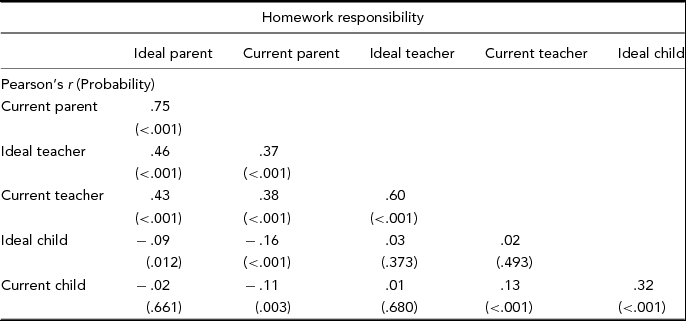
Results are displayed in Table 1. As was expected, ideal and current responsibility for homework correlated highly for both parents (56% of the variance) and teachers (36%). However, the ideal and current responsibility of the child or adolescent were only moderately related (10% of the variance) — presumably reflecting differential perceptions across the sample about the degree of correspondence between the child's ideal and actual commitment to homework.
Correlations Between Perceived Ideal and Current Homework Responsibility for Parents, Teachers, and students across the total sample
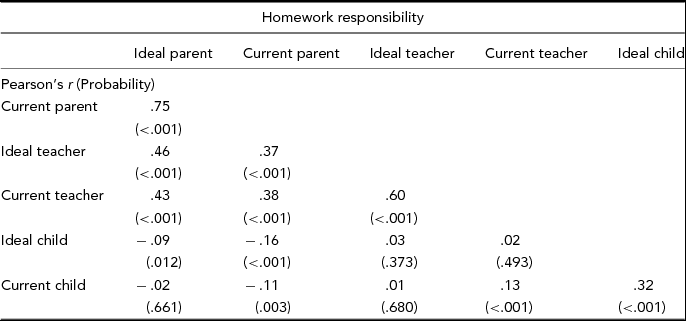
Correlations between perceived responsibility of teachers and parents accounted for 14–21% of the variance, with the correlations of parent or teacher responsibility and that of the student being modest (-.16 to .12). Relationships between perceived student and parental responsibility tended to be negative, albeit small in size. The only significant student/teacher relationship involved the current responsibility of each, which was modestly positive.
Perceived Homework Responsibility Across Year Levels
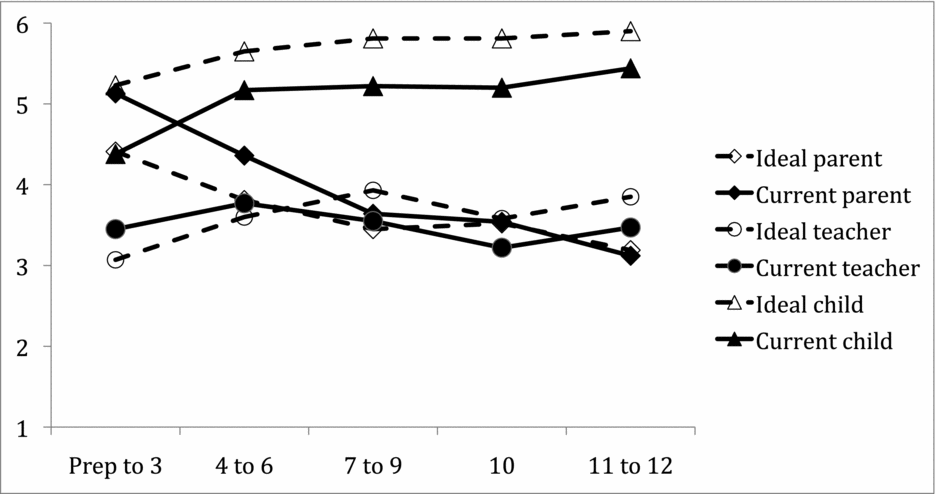
As Figure 1 and Table 2 show, the ideal and actual responsibility of the child for homework increased over the grade cohorts, and there were reductions in the perceived responsibility of parents. The ideal responsibility of teachers was higher in middle and high school grades than in initial school grades, but there was no change in perceptions of the actual responsibility that was taken by teachers over the course of schooling.
Homework responsibility by grade.

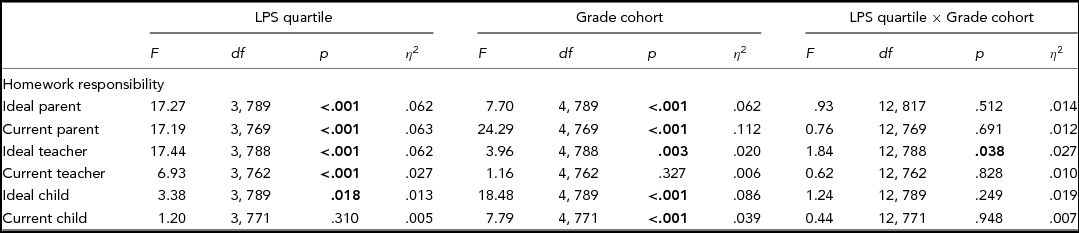
Effects of LPS Quartile and Grade Cohort on Perceived Homework Responsibility
Note: Results in bold type are significant (i.e., less than .05).
Relationship Between LPS Scores and Perceived Homework Responsibility
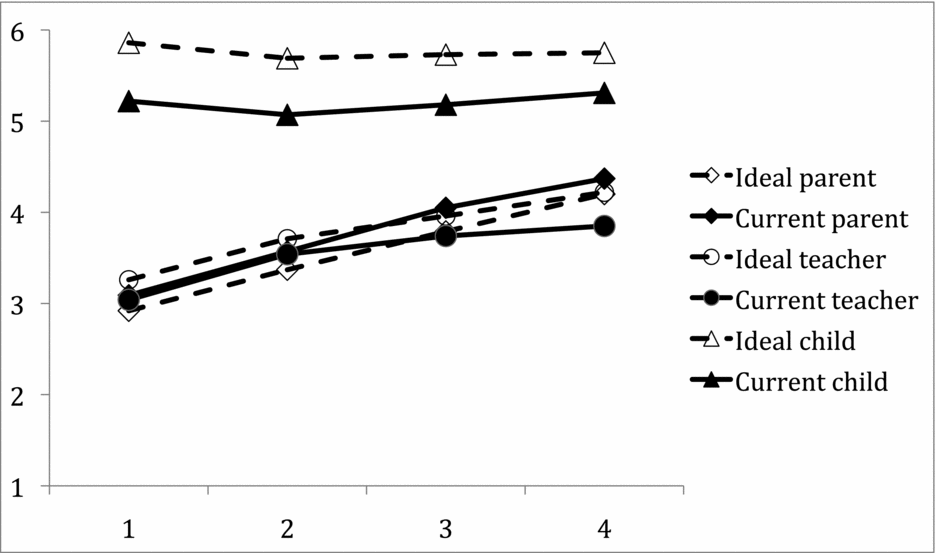
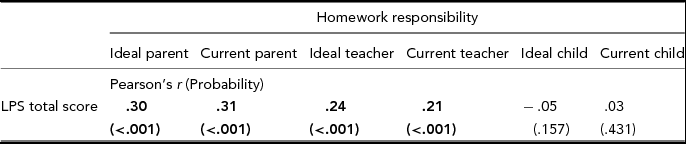
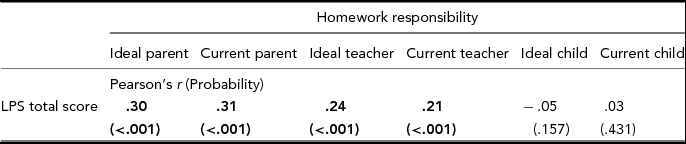
The key focus of the study was on any differences in perceived responsibility for homework as LPS scores rose, indicating overparenting. As Figure 2 and Table 2 show, there was a highly significant increase in the perceived responsibility of both parents and teachers with increasing LPS scores. Correlations between the total LPS scores and homework responsibility, reflecting the continuous linear trend, were small to medium in size (see Table 3).
Homework responsibility by LPS quartile.
Correlations Between Perceived Ideal and Current Homework Responsibility for Parents, Teachers, and Students and Continuous LPS Scores
Note: Results in bold type are significant (i.e., less than .05).
There was a statistically significant but small tendency for the ideal child scores to differ across LPS quartiles, with the means suggesting greater responsibility in the lowest quartile. However, the Pearson correlation between LPS scores and ideal responsibility of the child was not significant (r = -.05, p = .134), indicating the absence of a continuous relationship across the whole range of LPS scores. Nor was there any effect of LPS scores on the responsibility that the child was currently taking (see Table 3).
Only the ideal teacher scores showed an interaction between LPS quartile and grade cohort (Table 2). This primarily reflected a large increase, with rising LPS scores in the Prep to Year 3 cohort (on continuous scores, r = .54, p < .001), and the lack of an effect in Years 4–6 (on continuous scores, r = .13, p = .175).
Discrepancy Between Ideal and Actual Responsibility
Parents saw the ideal responsibility of the child for homework as exceeding the responsibility they actually showed (Figures 1 and 2), F(1, 799) = 147.40, p < .001, η2 = .156, with this difference being unmodified by either grade or LPS score. Teachers were perceived to fall short of the ideal more substantially in higher grade cohorts, F(4, 789) = 6.06, p < .001, η2 = .030, and in higher LPS quartiles, F(3, 789) = 2.64, p = .048, η2 = .010.
As Figure 1 shows, results for parents were more complex. Parents saw their actual responsibility as exceeding the ideal in preparatory and lower primary grades, but thereafter they approximated each other; Effect for Grade cohort: F(4, 797) = 5.56, p < .001, η2 = .027. An interaction between LPS category and grade, F(12, 797) = 1.89, p = .032, η2 = .028, primarily reflected the fact that this effect was slightly more evident in Prep to Year 3 and in the highest LPS quartile.
Discussion
Consistent with previous work on the rate and appropriateness of homework assistance in older adolescents (Hoover-Dempsey et al., Reference Hoover-Dempsey, Battianto, Walker, Reed, DeJong and Jones2001), our study found that parents’ perceptions of average levels of child responsibility rose over increasing grade cohorts, while maintaining a similar discrepancy between ideal and actual responsibility. In contrast, perceived parental responsibility for homework fell, especially for actual responsibility, so that a perception that their actual support exceeded the ideal disappeared in middle and high school. Interestingly, there was no significant change in perceptions of the responsibility parents thought teachers actually took at different grade levels, but their ideal responsibility for teachers was higher when the child was in middle or high school. As a result, teachers were seen as falling short in their actual responsibility in the higher grades.
Parents who endorsed beliefs associated with overparenting, as measured by their scores on the LPS, saw both themselves and the child's teacher as having greater ideal and actual responsibility for their child completing homework. In addition, high scores on the LPS were associated with a greater tendency to see teachers as falling short of their ideal responsibility for homework. This result provides some early validation of the LPS as a measure of beliefs associated with overparenting actions.
Some specific effects for higher LPS scores were seen in the youngest cohort: notably, an increased tendency for parents to see their actual homework responsibility as exceeding the ideal, and for ideal teacher responsibility to be higher. However, these results need to be viewed with caution, given the small sample size in that cohort, and replication is needed to have confidence in them.
In contrast to the results on parental and teacher responsibility, we did not find that parents’ overparenting beliefs were associated with the level of ideal or actual responsibility they saw their child as taking for homework. This lack of compensatory reductions in responsibility (given the rise in the perceived responsibility of parents and teachers with higher LPS scores) may be positive, in that parents are building independent responsibility, even when they attempt to provide — and ensure that the school provides — a highly supportive environment. Alternatively, the lack of a zero-sum effect for homework responsibility may reflect an overinvestment in academic achievement by high LPS scorers, which may result in excessive emotional responses reactions if the academic expectations are not fulfilled. Whether there is a relationship between LPS scores and the level and strength of academic expectations merits exploration.
Implications
Overinvolvement with children's homework has previously been reported by parenting experts (e.g., Locke et al., Reference Locke, Campbell and Kavanagh2012; Padilla-Walker & Nelson, Reference Padilla-Walker and Nelson2012). However, to our knowledge, this is the first study to report a quantitative relationship between overparenting beliefs and perceived homework responsibility in relation to school-aged children and adolescents.
There has been some research indicating that older children (aged 9 and 10) perceive high levels of parental help when completing homework as well intended, but as also implying that they are incompetent (Pomerantz & Eaton, Reference Pomerantz and Eaton2000). Parental assistance with homework sometimes takes the form of a parent simply checking if the adolescent is right or wrong according to the parent's terms, which can be a cause of stress for both parties (Solomon, Warin, & Lewis, Reference Solomon, Warin and Lewis2002).
Higher levels of parent assistance in homework may also impact on a child's sense of autonomy and motivation in their academic tasks. A high level of parent assistance for a child undertaking tasks has been shown to impact on a child's sense of autonomy (e.g., Gilmore, Cuskelly, Jobling, & Hayes, Reference Gilmore, Cuskelly, Jobling and Hayes2009). When parents fail to support autonomy in their children, then the child may fail to develop autonomous motivation in academic settings (Grolnick, Reference Grolnick2009). It may be that more parent help for homework may impact on the child's persistence and motivation in completing their homework, potentially setting off a cycle of high parental help reducing a child's motivation to complete their homework, necessitating more parent help to complete homework, which further reduces a child's academic motivation.
The assistance and support offered by parents and teachers may not only impact on a child's sense of competence and autonomy but also their academic experience and expectations in school and university. High levels of parental help reduce student opportunities to learn personal responsibility for their academic achievements (Hoover-Dempsey et al., Reference Hoover-Dempsey, Walker, Sandler, Whetsal, Green, Wilkins and Closson2005). Academic entitlement — the sense that a student should get high grades and that university personnel are primarily responsible for their grades — has been found to be common in U.S. universities (Greenberger, Lessard, Chen, & Farruggia, Reference Greenberger, Lessard, Chen and Farruggia2008). Many tertiary students with high entitlement scores also report high levels of parental pressure about grades, and it has been assumed that parenting factors contribute to a student developing a sense of academic entitlement (Greenburger et al., Reference Greenberger, Lessard, Chen and Farruggia2008). The high levels of parent involvement and interference previously reported at universities (e.g., Vinson, Reference Vinson2013), and the perception of a greater tendency for current students to see their lecturers as responsible for their grades (Greenberger et al., Reference Greenberger, Lessard, Chen and Farruggia2008) may at least partly be the result of the kind of parental beliefs and actions described in the current study concerning academic work during the student's school years.
Schools use homework as a means of developing student responsibility for their academic work (Hoover-Dempsey et al., Reference Hoover-Dempsey, Walker, Sandler, Whetsal, Green, Wilkins and Closson2005). Parents who expect their child's teachers or themselves to take responsibility for their child's homework could adversely impact on the efficacy of schools’ policies and practices aimed at developing this responsibility. Over-involved parents may also be seen by schools as an intrusive presence in ensuring their child achieves constant success (Hoover-Dempsey et al., Reference Hoover-Dempsey, Walker, Sandler, Whetsal, Green, Wilkins and Closson2005; Locke et al., Reference Locke, Campbell and Kavanagh2012).
Limitations
The current sample, while large, was subject to a relatively low response rate, and the instructions to relate answers to the oldest child resulted in relatively low numbers in junior grades. The sample was restricted to three independent schools, where parents pay for their child's education, resulting in a sample of parents likely to be over-representing parents who were born in Australia and of mid to high socioeconomic status. There was also an under-representation of fathers in the sample, limiting conclusions that can be made about their results (including their higher average LPS scores). As a result of these factors, the generalisability of our results to the Australian population requires further substantiation. Replication of our findings in large samples from government-funded schools with a mix of cultural and socioeconomic backgrounds and larger numbers of fathers would confer greater confidence in our results, especially if response rates were high.
High LPS scorers who were more involved with homework and expected more of the teacher may have been reacting to greater academic difficulties of their child. Without an objective measures of the child's academic skills, it is impossible to rule out this explanation, although the extreme nature of responses that are required to obtain these high LPS scores suggest a reaction that would remain excessive.
Associations between the LPS and perceived homework responsibility may also be inflated by shared method variance, since both were self-reports. While the focus of the current article was on relationships between different parental perceptions rather than prediction of objectively assessed behaviour, it would be interesting to see whether the effects do carry over to parental behaviour. In particular, it would be important to test whether any such behavioural changes primarily involve an increased frequency of the same behaviour as less involved parents (e.g., more frequent reminders to do homework), more extreme versions of the behaviour (e.g. more insistence when they do remind them), or qualitatively different behaviour (e.g., giving them an answer vs. cueing skill use). Exploration of such differences is important for a richer articulation of the precise nature of overparenting practices in general.
Conclusion
Our results suggest that a parent who endorses overparenting beliefs may have more of a propensity to take responsibility for their child doing their homework, and may expect their child's teachers to take more responsibility for homework as well. While we found no effect of the overparenting measure on parents’ perceptions of the responsibility of their child, if the differences in perceived parental responsibility result in a greater parental involvement in ensuring homework completion, this may avert the child's exposure to negative consequences from failure to take responsibility for homework themselves. Ironically, extreme efforts by parents to promote academic achievement could be undermining the development of independent and resilient performance in their children.