


Introduction
Depressive disorders make up a significant subset of the mental health disorders that afflict children and adolescents. Almost 13% of adolescents (12–17 years old) report a diagnosis of major depressive disorder (Perou et al., Reference Perou2013), with adolescents suffering from major depressive disorder at a rate comparable to its prevalence in adults (Rohde et al., Reference Rohde, Lewinsohn, Klein, Seeley and Gau2012). The presence of depression in childhood and adolescence is a strong predictor of a future diagnosis in adulthood, higher lifetime prevalence rates, and higher rates of relapse (Treutiger and Lindberg, Reference Treutiger, Lindberg and Andershed2013). As such, effective assessment and treatment of depression during childhood is essential to promote positive outcomes in childhood and throughout the lifespan.
A critical component to effective assessment of child and adolescent psychological disorders is reliance upon multiple sources of information. Parents, teachers, other caregivers, peers, and children themselves are all useful sources of information, with parents reportedly providing the majority of information in clinical practice (De Los Reyes and Kazdin, Reference De Los Reyes and Kazdin2005). Despite this wealth of information, no one source is considered the ‘gold standard’ informant for diagnosing depression (Achenbach et al., Reference Achenbach, McConaughy and Howell1987). Multiple sources allow clinicians to collect various perspectives that may provide a more well-rounded description of the child's behaviour across contexts with less reliance on a single source. However, multiple information sources can also provide discordant information that clinicians must sort through and subjectively weigh to arrive at a diagnosis (Achenbach et al., Reference Achenbach, McConaughy and Howell1987; De Los Reyes and Kazdin, Reference De Los Reyes and Kazdin2005).
In the past, clinicians relied heavily on parent reports due to concerns about childrens’ cognitive abilities to understand diagnostic questions (Edelbrock and Costello, Reference Edelbrock, Costello, Goldstein and Hersen1990). Further research has identified discrepancies in reporting based on the age of the child. Younger children may not be able to fully understand or verbalize descriptions of their symptoms, they may not understand the assessment process, or disorders they are seeking assessment for may actually hinder communication and understanding (e.g. autism spectrum disorder; Bennett et al., Reference Bennett, Boyle, Georgiades, Georgiades, Thompson and Duku2012). Some researchers have shown that older children and adolescents provide more consistent agreement (Edelbrock et al., Reference Edelbrock, Costello, Dulcan, Conover and Kalas1986; Grills and Ollendick, Reference Grills and Ollendick2003), while others find no agreement or even less consistent agreement among reporters (Choudhury et al., Reference Choudhury, Pimentel and Kendall2003). This decrease in agreement may be due to adolescents’ increased independence as increasingly time is spent away from parents in different contexts. Adolescents also may not view their own behaviours as problems. Similar to adults, adolescents are less likely to see their own behaviours as problematic, are less likely to attribute their problems to internal causes, and are less likely to have a desire to change problem behaviours with increasing disorder severity (Allen et al., Reference Allen, Manning and Meyer2010).
The discrepancy between reporters can be attributed to numerous factors. Parents may be unreliable reporters because they lack insight into their children's symptoms that are not visible (i.e. internalizing behaviors), they may be biased by situational factors (e.g. only seeing the child in the home), and reports about their child may be overshadowed by the parents’ own problems and experiences (Allen et al., Reference Allen, Manning and Meyer2010; Penney and Skilling, Reference Penney and Skilling2012). A number of studies have shown that depressed mothers report more externalizing problems in their child and may over-report child symptoms like anxiety, depression (Allen et al., Reference Allen, Manning and Meyer2010; Berg-Nielson et al., Reference Berg-Nielson, Vika and Dahl2003; De Los Reyes and Kazdin, Reference De Los Reyes and Kazdin2005; Hinshaw, Reference Hinshaw2004; Quitmann et al., Reference Quitmann, Kriston, Romer and Ramsauer2012), and autism (Bennett et al., Reference Bennett, Boyle, Georgiades, Georgiades, Thompson and Duku2012). Another possibility for these discrepancies is that parents suffering from depression actually cause an increase in externalizing behaviour in their children (Allen et al., Reference Allen, Manning and Meyer2010). Other informants, such as teachers and health care personnel, may only interact with the child in limited situations that do not allow for a full understanding or insight into symptomatology, making these third-party informants potentially unreliable. Informant reports may vary based on other characteristics of the child and/or informant, including age, gender, ethnicity, socioeconomic status, IQ and self-esteem (Berg-Nielson et al., Reference Berg-Nielson, Vika and Dahl2003; Harvey et al., Reference Harvey, Fischer, Weieneth, Hurwitz and Sayer2013; Penney and Skilling, Reference Penney and Skilling2012).
Maternal depression/anxiety has the most robust support of the variables influencing maternal reporting of child psychopathology (Boyle and Pickles, Reference Boyle and Pickles1997; Chi and Hinshaw, Reference Chi and Hinshaw2002; Gartstein et al., Reference Gartstein, Bridgett, Dishion and Kaufman2009; Najman et al., Reference Najman, Williams, Nikles, Spence, Bor and O'Callaghan2000; Richters, Reference Richters1992; Youngstrom et al., Reference Youngstrom, Izard and Ackerman1999). A meta-analytic review of 193 studies (Goodman et al., Reference Goodman, Rouse, Connell, Broth, Hall and Heyward2011) reported that there is a strong relationship between mothers’ depressive symptoms and maternal-reported child psychopathology, across a number of child assessments. More specifically, maternal depressive symptoms were related to higher levels of maternal-reported child internalizing, externalizing, and general psychopathology (Allen et al., Reference Allen, Manning and Meyer2010; Ge et al., Reference Ge, Conger, Lorenz, Shanahan and Elder1995). These associations were moderated by a number of demographic variables such as the child's age, gender and ethnicity. Given the strong relationship between maternal stress/depressive symptoms and maternal impression management (Copeland and Harbaugh, Reference Copeland and Harbaugh2005; MacCallum et al., Reference MacCallum, Golombok and Brinsden2007; McMahon et al., Reference McMahon, Gibson, Leslie, Cohen and Tennant2003), impression management and/or maternal stress may be additional variables that moderate the relationship between maternal-reported child depressive symptoms and child-reported depressive symptoms.
Impression management is a goal-directed response in which the individual attempts to represent him/herself in a socially desirable way to the observer, and was first studied by utilizing personality inventories (Strickland, Reference Strickland and Blass1977). Also known as ‘faking good’ or in some circumstances ‘faking bad’ or defensive responding, this pattern of responding tends to minimize or over-emphasize psychopathology or stressful experiences as well as the interference caused by these events. In clinical settings, a number of motivational factors have been associated with this behavior, including a desire for financial gain, improved living conditions, medication-seeking, or prolonging/reducing treatment (Rogers et al., Reference Rogers, Sewell, Morey and Ustad1996). For example, parents being investigated for child abuse and/or child custody evaluations may have a high motivation to ‘fake good’ in order to appear as competent parents and thus retain custody of their child (Costello and McNeil, Reference Costello and McNeil2014; Lenny and Dear, Reference Lenny and Dear2009). An alternative explanation could be drawn from the consistent literature linking parenting stress and impression management (Copeland and Harbaugh, Reference Copeland and Harbaugh2005; MacCallum et al., Reference MacCallum, Golombok and Brinsden2007; McMahon et al., Reference McMahon, Gibson, Leslie, Cohen and Tennant2003). In sum, these studies specifically explored the effect impression management has on maternal self-reporting, where elevated levels of impression management, within families that have experienced a stressful event, was associated with a reduction in self-reported psychopathology. Taken with findings that parenting a child with a mental illness increases maternal stress (Donenberg and Baker, Reference Donenberg and Baker1993), it would be reasonable to hypothesize that impression management may play a role in maternally reported child psychopathology.
In other cases, individuals may ‘fake bad’ or report more symptoms in order to receive treatment. For instance, moderately depressed adults may actually present themselves as symptomatic to ensure they receive treatment, resulting in moderately depressed individuals reporting higher depressive ratings on self-report questionnaires than severely depressed individuals (Kelly, Reference Kelly2000). Although the negative stigmas and discrimination associated with mental health disorders have decreased dramatically in the past century, these disorders still carry a negative connotation (Alonso et al., Reference Alonso, Buron, Bruffaerts, He, Posada-Villa and Lepine2008; Corrigan, Reference Corrigan2004; Hinshaw, Reference Hinshaw2004; Kelly and Jorm, Reference Kelly and Jorm2007; Munson et al., Reference Munson, Floersch and Townsend2009; O'Driscoll et al., Reference O'Driscoll, Heary, Hennessy and McKeague2012). Parents and children may be influenced by their desire to avoid this negative stigma by downplaying psychological symptoms, even at the expense of receiving proper treatment (Penney and Skilling, Reference Penney and Skilling2012). This misrepresentation extends beyond the individual and has been reported in parental reports of their child's behaviour (Skilling et al., Reference Skilling, Doiron and Seto2011). For instance, parents may under-report their child's symptoms for fear of being viewed as incompetent in their parental role or as being judged as the cause of the problems. High rates of impression management on assessments have necessitated the inclusion of indices of social desirability and impression management on many common self-report assessments (e.g. Conners 3 Parent-Rating Scale-short version; Conners, Reference Conners2008; Multidimensional Anxiety Scale for Children-Parent Report; March et al., Reference March, Parker, Sullivan, Stallings and Conners1997); however, to date, there is scant literature as to the relationship of these reports to childhood symptomatology. As a result, the current study examined the impact of maternal symptomatology and impression management on child depressive symptoms.
The purpose of this study is to examine the effect impression management has on measures that are commonly used to assess child and adolescent depressive symptoms. The aim was to assess whether maternal impression management accounted for a portion of the variance between parent-reported and child-reported measures of depressive symptoms. Results of this study should inform future assessment and diagnosis of child and adolescent depression, and provide much-needed information that may help clinicians properly interpret discrepant reports in the assessment of childhood depression. It was hypothesized that (a) mothers who engaged in impression management would report less depressive symptomatology in their children, (b) mothers who scored higher on a measure of parental stress would report higher levels of depressive symptomatology in their children, consistent with literature linking parenting stress and impression management (Copeland and Harbaugh, Reference Copeland and Harbaugh2005; MacCallum et al., Reference MacCallum, Golombok and Brinsden2007; McMahon et al., Reference McMahon, Gibson, Leslie, Cohen and Tennant2003), and (c) child and adolescent ratings of depressive symptoms would be negatively influenced by maternal impression management ratings. We also hypothesized that (d) impression management would moderate the relationship between maternal-reported depressive symptoms and child-reported depressive symptoms on the anxiety/depression subscale of the Child-Behavior Checklist and (e) on the withdrawn subscale of the Child-Behavior Checklist.
Methods
Participants
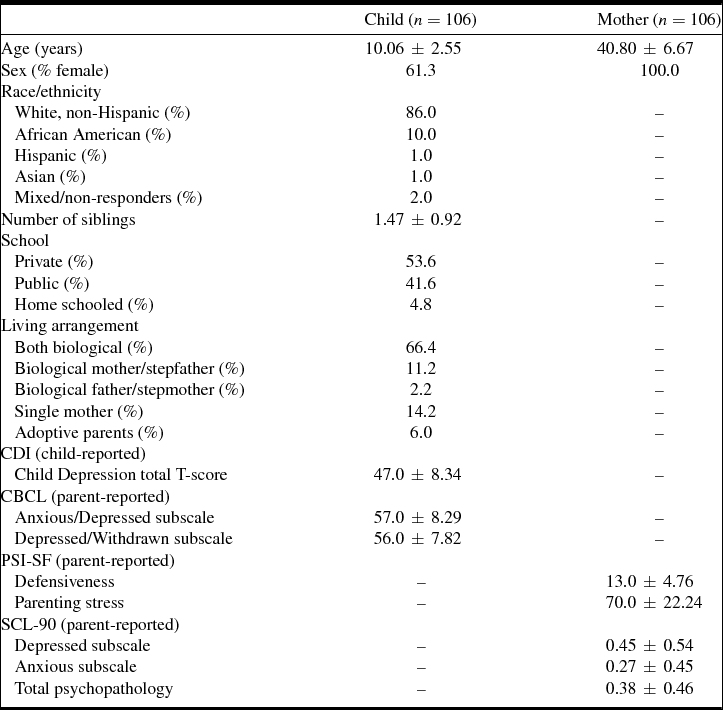
Participants in this study were 106 mother–child dyads. Children and at least one parent or primary caregiver presented to a university-based training clinic for psychological assessment and/or treatment (n = 319). Of the 319 families seeking psychological assessment, 106 mother–child dyads completed all study assessments and were included in analyses. Children ranged in age from 7 to 16 years (mean = 10.06, SD = 2.55), were 58.7% male, and were mostly White (86.0% White, 10.0% African American, 4.0% mixed/non-responders; see Table 1). Mothers ranged in age from 27 to 57 years (mean = 40.80, SD = 6.67). Children were predominantly referred by their parents for concerns regarding academic functioning, inattention/hyperactivity, mood difficulties, and/or behavioural problems.
Descriptive characteristics of study sample

Variables are presented as means ± SD unless otherwise specified.
Measures
The Children's Depression Inventory (CDI) is a 27-item self-report questionnaire used to assess depressive symptoms in children and adolescents (Kovacs, Reference Kovacs1992). The CDI may be completed by children and adolescents between the ages of 7 and 17 years and administration takes approximately 15 minutes. Items on the CDI address a number of factors, including negative mood, interpersonal problems, ineffectiveness, anhedonia and negative self-esteem. The reliability and validity of the CDI has been measured extensively and found to be adequate in clinical and non-clinical samples of children and adolescents (e.g. Saylor et al., Reference Saylor, Finch, Spirito and Bennett1984). Reliability for the total score used in the current study was acceptable (Cronbach's α = 0.86). The CDI identifies potentially clinically depressed children and adolescents by those who meet or exceed a T-score of 65 overall (Kovacs, Reference Kovacs1992). Only two children met the clinical cut-off for depression on the CDI, with an additional 14 reporting slightly above average depressive symptoms.
The Child Behavior Checklist (CBCL) is a 113-item self-report questionnaire administered to parents to assess a broad range of childhood disorders (Achenbach and Rescorla, Reference Achenbach and Rescorla2001). This questionnaire is meant for use by parents of 6- to 18-year-old children and takes approximately 20 minutes to complete. Items on the CBCL are scored and converted to T-scores based on normative data. T-scores ⩾ 60 indicate sub-clinical levels of disorder and ≥ 70 indicate clinical levels of disorder for the Anxious/Depressed and Withdrawn/Depressed subscales. The CBCL exhibits excellent reliability and validity with coefficients ranging from .71 to .89 in large samples (Nakamura et al., Reference Nakamura, Ebesutani, Bernstein and Chorpita2009). Reliability for Anxious/Depressed and Withdrawn/Depressed subscales in the current study was high (Cronbach's α = 0.95, α = .93, respectively). The CBCL utilizes normative T-scores for the emotional/behavioural problems subscales, with scores of 70 and above representing the clinical significance range (Achenbach and Rescorla, Reference Achenbach and Rescorla2001). Parent-reported child depressive symptoms on the CBCL were slightly higher, with seven children meeting clinical cut-off on the Anxious/Depressed scale and six children meeting clinical cut-off on the Withdrawn/Depressed scale. In addition, 27 children scored in the sub-clinical depression range on the Anxious/Depressed scale and 20 children scored in the sub-clinical depression range on the Withdrawn/Depressed scale based on parent-reports.
The Parenting Stress Index-Short Form (PSI-SF) is a 36-item self-report questionnaire used to assess stress in parent–child relationships (Abidin, Reference Abidin1990). This measure is meant to be completed by the parent and is used to identify families in need of intervention due to a high-stress parent–child situation. Included in the PSI-SF is a measure of parental defensive responding meant to detect parental bias, or impression management, where parents may attempt to present themselves more favourably to the clinician (Castaldi, Reference Castaldi1988; LaFiosca and Lloyd, Reference LaFiosca and Lloyd1986). The PSI/SF defensive responding scale is based on the widely used Marlowe–Crowne Social Desirability Scale (Crowne and Marlowe, Reference Crowne and Marlowe1960). The defensive responding scale is indicated by low scores on seven items from the parental distress scale and indicates the degree to which parents may deny or minimize problems. The rate of defensive responding in the general population is estimated at 5–8% (Parkes et al., Reference Parkes, Caravale, Marcelli, Franco and Colver2011). Test–retest and alpha reliabilities for the PSI/SF total score are .84 and .91, respectively (Abidin, Reference Abidin1995). Normative data were derived for each PSI scale from the raw score frequency distribution of scores (n = 800) from the mothers in the normative sample (Abidin, Reference Abidin1990). This index is scored such that lower scores indicate more defensive responding. The total stress measurement has been shown to yield an alpha of .84 and the measures exhibit adequate reliability and validity (Haskett et al., Reference Haskett, Scott, Grant, Ward and Robinson2003). The PSI-SF manual states that a raw score less than 10 on the defensive responding scale is clinically significant (Abidin, Reference Abidin1990). Reliability for the defensive responding and maternal stress subscales in the current study was acceptable (Cronbach's α = 0.84, α = 0.90, respectively). Maternal defensiveness scores ranged from 7 to 25 (mean = 13, SD = 4.76) and maternal stress scores ranged from 35 to 121 (mean = 70.0, SD = 22.24) on the PSI-SF.
The Symptom Checklist-90-Revised (SCL-90-R) is a 90-item self-report measure used to evaluate a wide range of psychological symptoms in adults (Derogatis, Reference Derogatis1992). The measure can be administered in 15 minutes and provides nine primary symptom dimensions. On a five-point scale, ranging from ‘not at all’ to ‘extremely’, mothers rated the severity of psychopathological symptoms they experienced over the past 7 days. Endorsement patterns provided information on the following scales: depression, obsessive-compulsive disorder, anxiety, phobias, psychoticism, interpersonal sensitivity, somatization, and paranoia. Reliability for this measure is high (Cronbach's α: 0.75–0.91; Reuterskiöld et al., Reference Reuterskiöld, Öst and Ollendick2008). This measure has been found to have satisfactory internal consistency and appropriate test–retest reliability (Derogatis et al., Reference Derogatis, Rickels and Rock1976; Horowitz et al., Reference Horowitz, Rosenberg, Baer, Ureno and Villasenor1988). Reliability for the Depression subscale used in the current study was high (Cronbach's α = 0.97). Parent-reported psychopathological symptoms on the SCL-90-R and other descriptive characteristics are listed in Table 1.
Procedures
Families were referred to a university outpatient training clinic for psychological assessment by teachers, school psychologists or guidance counsellors, medical or mental health professionals, or self-referral. Families seeking services completed individual semi-structured diagnostic interviews as well as a number of self- and caregiver-report questionnaires to assess their child's symptomatology. Data collection was completed by trained doctoral student clinicians practising under the supervision of a licensed clinical psychologist. Assessments typically lasted for three, 2- to 3-hour sessions, beginning with semi-structured diagnostic interview (i.e. Anxiety Disorders Interview Schedule for DSM-IV, Parent and Child Report). Mothers completed the assessments either within the university clinic or at home, whereas youths completed the CDI within the university clinic. Only parent–child dyads who completed all study assessments, including the PSI-SF, CDI, CBCL and SCL-90-R, were included in analyses. Listwise deletion was utilized because participants with missing data did not significantly differ from the sample. Based on age limits for these assessments, only children between 7 and 17 years were included in the study. Institutional review board approval was obtained prior to study onset, and parent informed consent and child assent for both services and research were obtained before assessment.
Results
Primary outcomes
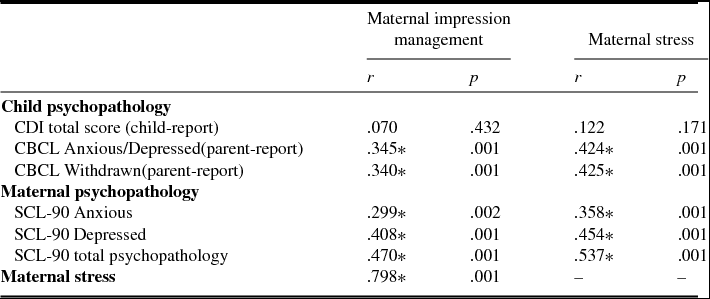
Overall, 26 mothers out of 106 mother–child dyads scored defensively (i.e. engaged in impression management) on the PSI-SF (i.e. a raw score less than 10 on the defensive responding subscale; Abidin, Reference Abidin1990); a similar distribution of defensive responding scores and standard deviations has been reported in other samples (i.e. 30%; Frühauf et al., Reference Frühauf, Figlioli, Oehler and Caspar2015). Pearson correlations were conducted to examine hypotheses (a) to (d). An a priori decision was made to adjust alpha to p < .01 to control for multiple tests and possible inflation of type I error, but also to reflect the exploratory nature of the analyses given the dearth of literature in this area (e.g. instead of Bonferroni, which would probably be too restrictive in this case). Scores on the PSI-SF indicated a strong association between impression management and stress (r (104) = .798, p < .001), such that high levels of impression management (i.e. low scores, see ‘Measures’ section) were associated with lower reports of total stress, mirroring previous literature (e.g. Copeland and Harbaugh, Reference Copeland and Harbaugh2005; MacCallum et al., Reference MacCallum, Golombok and Brinsden2007; McMahon et al., Reference McMahon, Gibson, Leslie, Cohen and Tennant2003).
In support of hypothesis (a), high levels of maternal impression management (i.e. low scores) were associated with decreased parent reports of child depression and anxiety on both the Anxious/Depressed subscale (r (104) = .345, p < .001) and the Withdrawn subscale (r (104) = .340, p < .001) of the CBCL. In congruence with hypothesis (b), high levels of maternal stress were associated with increased parent reports of child depression and anxiety on both the Anxious/Depressed subscale (r (104) = .424, p < .001) and the Withdrawn subscale (r (104) = .425, p < .001) of the CBCL. High reports of maternal stress were not related to child reports of depression symptomatology on the CDI (r (104) = .122, p = .171; Table 2). In contrast to hypothesis (c), maternal impression management was not related to child reports of depression symptomatology on the CDI (r (104) = .070, p = .432).
Associations between psychopathology, maternal impression management and stress

*p < .01.
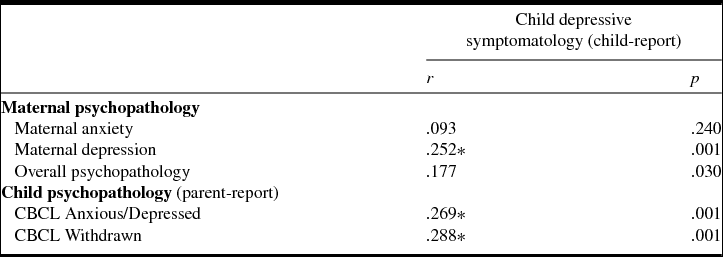
High levels of maternal impression management were also associated with decreased reports of the mother's self-reported anxiety (r (104) = .299, p < .002), depression (r (104) = .408, p < .001), and overall psychopathology (r (104) = .470, p < .001), as reported on the SCL-90-R (Table 2). High levels of maternal stress were associated with increased reports of the mother's own anxiety (r (104) = .358, p < .001), depression (r (104) = .454, p < .001), and overall psychopathology (r (104) = .537, p < .001). Child-reported depression on the CDI was also associated with maternal depression (r (104) = .252, p < .001), but not with overall psychopathology (r (104) = .177, p = .03) or maternal reports of anxiety (r (104) = .093, p = .240). Child- and maternal-reports of child depression were also positively correlated (r (104)(Anxious/Depressed subscale) = .269, p < .001 and r (104)(Withdrawn subscale) = .288, p < .001; see Table 3).
Associations between child and maternal psychopathology

*p < .01
Interaction analyses
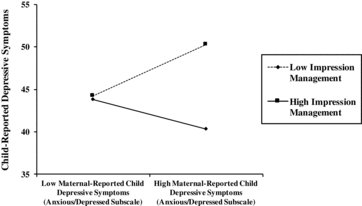
To test hypothesis (d), that maternal impression management moderates the relationship between maternal-reported child depressive symptoms, as measured by the Anxious/Depressed subscale of the CBCL, and child self-reported depressive symptoms (i.e. total T-score of the CDI), a hierarchical multiple regression analysis was conducted. In the first step, two variables were included as covariates: child age, gender, and maternal stress, given previous literature (e.g. Goodman et al., Reference Goodman, Rouse, Connell, Broth, Hall and Heyward2011). Maternal-reported child depressive symptoms and maternal impression management were entered into the second block, and the interaction term was entered into the third block, predicting child-reported depressive symptoms. The overall model was significant: R 2 = .29, F (1,100) = 5.14, p < .001. Within the first block, age [t (100) = –2.23, p < .05], gender [t (100) = 4.22, p < .05], and maternal stress [t (100) = 1.94, p < .05], significantly contributed to the model. Next, maternal impression management [t (100) = –2.08, p < .05], and maternal-reported child depressive symptoms [t (100) = –1.99, p =.05], significantly contributed to the model. Finally, within the third block, the interaction term between maternal-reported child depressive symptoms and maternal impression management accounted for a significant proportion of the variance in child self-reported depressive symptoms: ΔR 2 = .05, ΔF (1,100) = 5.36, p < .05, β = .06, t (100) = 2.31, p < .05. Given the reverse scoring of the defensive responding subscale, an examination of the interaction plot showed an enhancing effect that maternal impression management has on the relationship between maternal-reported depressive symptoms and child self-reported depressive symptoms (see Fig. 1).
Maternal impression management moderates the relationship between maternal-reported child depressive symptoms and child-reported depressive symptoms; maternal-reported child depressive symptoms measured by anxious/depressed subscale of the CBCL; child-reported depressive symptoms measured by the total T-score of the CDI. High/low impression management refers to high or low engagement in impression management.

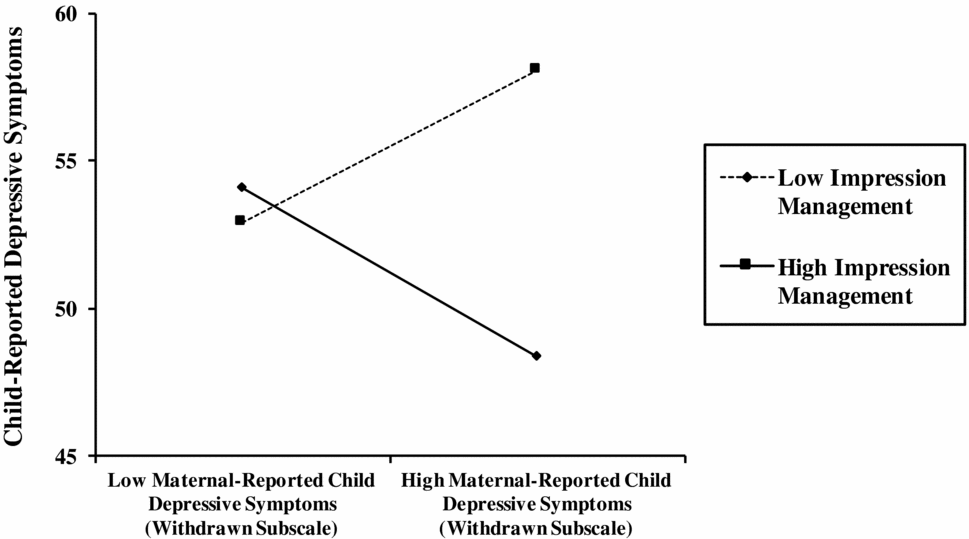
To test hypothesis (c), that maternal impression management moderates the relationship between maternal-reported child depressive symptoms, as measured by the withdrawn subscale of the CBCL, and child self-reported depressive symptoms (i.e. total T-score of the CDI), a hierarchical multiple regression analysis was conducted in the same manner outlined above. The overall model was significant: R 2 = .33, F (1,100) = 6.24, p < .001. Within the first block, gender [t (100) = 4.59, p < .05], but not maternal stress [t (100) = 1.11, p > .05], nor child age [t (100) = –.44, p > .05] significantly contributed to the model. Next, maternal impression management [t (100) = –2.46, p < .05], and maternal-reported child depressive symptoms [t (100) = –2.00, p < .05] significantly contributed to the model. Within the third block, the interaction term between maternal-reported child depressive symptoms (i.e. withdrawn subscale of the CBCL) and maternal impression management accounted for a significant proportion of the variance in child self-reported depressive symptoms: ΔR 2 = .06, ΔF (1,100) = 6.85, p < .05, β = .09, t (100) = 2.62, p < .05. Given the reverse scoring of the defensive responding subscale, an examination of the interaction plot demonstrated a similar trend outlined above (see Fig. 2).
Maternal impression management moderates the relationship between maternal-reported child depressive symptoms and child-reported depressive symptoms; maternal-reported child depressive symptoms measured by withdrawn subscale of the CBCL; child-reported depressive symptoms measured by the total T-score of the CDI. High/low impression management refers to high or low engagement in impression management.

Discussion
The purpose of the current study was to examine the effects impression management has on measures that are commonly used to assess child and adolescent depressive symptoms. More specifically, we assessed whether maternal impression management accounted for a portion of the variance between maternal-report and child-report measures of depressive symptoms. Overall, we hypothesized that mothers who engaged in impression management would report less depressive symptomatology in their child, but that stressed mothers would over-report depressive symptoms in their child. In addition, it was theorized that impression management would significantly moderate the relationship between maternal-reported depressive symptoms and child-reported depressive symptoms on two negative affect subscales (i.e. anxious/depressed and withdrawn subscales) of the Child-Behavior Checklist (CBCL).
As predicted, mothers who engaged in impression management reported significantly less child depressive symptoms than comparison mothers; however, our exploratory moderation analyses indicated that these results may be more nuanced. The tendency by individuals to ‘fake good’ on psychological assessments is potentially detrimental to the assessment and treatment process (Achenbach et al., Reference Achenbach, McConaughy and Howell1987; De Los Reyes and Kazdin, Reference De Los Reyes and Kazdin2005; Penney and Skilling, Reference Penney and Skilling2012). These findings support evidence that even parents who have reached the point of seeking out psychological assessment for their children may have a tendency to downplay psychological symptoms in order to make their child appear more socially acceptable and avoid potentially stigmatizing mental illness labels (Alonso et al., Reference Alonso, Buron, Bruffaerts, He, Posada-Villa and Lepine2008; Corrigan, Reference Corrigan2004; Hinshaw, Reference Hinshaw2004; Kelly and Jorm, Reference Kelly and Jorm2007; O'Driscoll et al., Reference O'Driscoll, Heary, Hennessy and McKeague2012). However, alternative interpretations for these findings do exist; it is still also possible that these parents are less aware of their child's symptoms. Furthermore, a parent who engages in impression management of themselves, may be less likely to notice depressive symptoms in their child. Finally, our findings also suggest that the PSI-SF is likely to be a useful tool in accurately identify mothers who are engaging in response bias and are likely to under-report depressive symptoms in their child.
Maternal reports of child depressive symptoms were also influenced by maternal stress and maternal psychopathology, with highly stressed mothers, mothers with greater overall psychopathology, and mothers with more self-reported depressive symptoms reporting greater depressive symptoms in their children. Unfortunately, the more complex relationship among maternal reports of child depressive symptoms, maternal stress, maternal psychopathology and impression management was beyond the scope of the current manuscript. The current study utilized stress only included as a covariate, due to the relationship with parents reports of child depressive symptoms; however, our findings do replicate the results of an extensive body of literature linking maternal psychopathology and depression to child depression development (e.g. Goodman, Reference Goodman2007; Hammen and Brennan, Reference Hammen and Brennan2003). In a recent meta-analysis by Goodman and colleagues (Reference Goodman, Rouse, Connell, Broth, Hall and Heyward2011) which relied on mother-reports of child depression symptoms (internalizing and externalizing), they found significantly larger effect sizes for mothers than reports completed by the child, a teacher, or combined mother–child reports, supporting our findings that depressed mothers are likely to report more depressive symptoms in their child. Unfortunately, these findings are correlational and thus do not directly answer the question of whether exposure to maternal psychopathology and depression influence depressive symptom development in children, or whether maternal symptoms merely skew maternal reports of child behaviour.
Even though the causal direction of this relationship cannot be inferred, impression management significantly moderated the relationship between maternal-reported child depressive symptoms and child-reported depressive symptoms on two negative affect subscales of the CBCL. Notably, these moderations were robust to the effects of significant covariates: child age, gender and maternal stress. Both subscales (i.e. anxious/depressed and withdrawn subscales) demonstrated similar trends, and therefore will be discussed in conjunction. Overall, mothers who engaged in high-level impression management (i.e. lower scores on the defensive responding subscale) tended to report less child depressive symptoms than their child self-reports. Although it cannot be inferred given the statistical analysis used, it may be hypothesized that mothers engaging in impression management may be under-reporting their child's depressive symptomatology. However, this was only the case when mothers reported high levels of withdrawn and anxiety/depression, respectively. Put differently, looking just at mothers who engaged in high levels of impression management, there is a strong negative relationship with child-reported depressive symptoms. Specifically, when mothers who engaged in impression management reported high levels of withdrawn or depressed/anxious symptoms in their children, their children tend to report less depressive symptoms. The opposite pattern of results was observed for mothers who engage in low-levels of impression management (i.e. higher scores on the defensive responding subscale); when they reported high levels of withdrawn or depressed symptoms in their child, their child also tended to report more depressive symptoms. This pattern of results suggests that some of the discrepancy between maternal-reported child depressive symptoms and child-reported depressive symptoms may be explained by mothers who engage in impression management. This is the first study to demonstrate that impression management may be one factor that partially influences the disconcordance between maternal-reported and self-reported child depressive symptoms.
Future research is needed to replicate our results, as well as examine whether these results translate to other internalizing (e.g. anxiety disorders) and/or externalizing disorders (e.g. attention-deficit/hyperactivity disorder). However, there are some alternative explanations for our moderation results. First, previous research suggests that depressed mothers may cause increased depressive symptoms in their children (Allen et al., Reference Allen, Manning and Meyer2010); although maternal stress was entered as a covariate, it may be that impression management is influencing maternal-reported child depressive symptoms and child-reported depressive symptoms through its relationship to maternal depression. Unfortunately, given the high multicollinearity between maternal stress and maternal depression, it would not have been appropriate to include both as covariates. We utilized maternal stress, as opposed to maternal depressive symptoms, as a covariate because previous literature supports maternal stress as having a stronger relationship to impression management. Nevertheless, future research should further examine the role maternal depressive symptoms have on these relationships.
Contrary to the other predictions of this study, child-reports of depressive symptoms were unrelated to maternal impression management and maternal stress. This suggests that child-reports of symptomatology may be less influenced by maternal issues like impression management behaviours and high levels of stress, while maternal reports may be significantly and detrimentally impacted by these factors. Therefore, in cases where mothers have high defensive scores on psychometric lie scales and/or report high levels of stress, children may be more reliable reporters of their own psychological symptoms. Even so, this study must be viewed in light of its limitations. First, measures of psychological symptoms included in this study were self- or parent-reported and therefore subject to response bias (although examining this type of reporting was the goal of the study). In addition, due to the cross-sectional design of this study, causal associations between maternal psychopathology, stress, impression management and child psychopathology could not be determined, and the direction of these causal relationships needs to be examined in the future. Moreover, our sample included a wide age range, which was not explored as a moderator in our analyses. Future research should examine the role child's age has on the relationship between maternal impression management and childhood depressive symptoms.
Mothers who engaged in impression management on psychological assessments reported lower scores of their child's depressive symptomatology, while mothers who responded highly on a measure of parental stress or self-reported high levels of their own symptomatology reported higher depression scores. In contrast, children's reports of their own depressive symptoms were not associated by maternal impression management or stress. In addition, our interaction analyses indicated that when mothers engaged in high levels of impression management, and reported high levels of withdrawn or depressed/anxious symptoms in their child, their child tends to report less depressive symptoms. Conversely, when mothers engage in low-level impression management, and reported high levels of withdrawn or depressed/anxious symptoms in their child, their child tends to report higher levels of depressive symptoms. This pattern of results suggests that mothers engaging in impression management may be under-reporting their child's depressive symptoms. In sum, clinicians should pay close attention to levels of maternal impression management, stress and psychopathology during psychological assessments for children. In the case of discrepant child depression symptom reports, the findings described here suggest giving preferential deference to child self-report measures when mothers endorse significant impression management.
Acknowledgements
Ethical approval: All procedures performed in studies involving human participants were in accordance with the ethical standards of the institutional and/or national research committee and with the 1964 Helsinki declaration and its later amendments or comparable ethical standards.
Informed consent: Informed consent was obtained from all individual participants included in the study.
Funding: There is no funding to report.
Conflicts of interest: On behalf of all authors, the corresponding author states that there are no conflicts of interest.



Comments
No Comments have been published for this article.