Introduction
This paper considers the interplay of text and image in the treatment of certain prophets in a copy, now in the Edinburgh University Library, of part of the Jāmiʿ al-Tawārīkh or World History of Rashīd al-Dīn.Footnote 1 Probably produced in the Ilkhanid capital, Tabriz, and identified by Sheila Blair as part of the same manuscript as the fragment in the Khalili collection, which is dated 714/1314, this is the largest surviving Arabic fragment, 150 folios long, of the vast four-volume original text.Footnote 2 The manuscript perhaps began, like other universal histories produced in the Islamic world, such as those of al-Tabarī, Ibn al-Athīr and al-Nuwayrī,Footnote 3 with the creation of Adam, before moving on to discuss other early prophets venerated either in the Hebrew or the Arabian tradition, or both, like Abraham and Moses. But these opening folios are lost,Footnote 4 and the current folio 1 begins with a description of the fabulous city of Iram.Footnote 5
The first twenty-three folios of this truncated text contain both a summary account of the legendary monarchs of Iran—itself a topic worthy of further investigation—and a chronicle of salvation history drawn from a mixture of Jewish, Christian and Muslim traditions. That is a somewhat uneasy juxtaposition.Footnote 6 The text, an unadorned narrative, moves easily from the secular matter concerning the ancient Iranian kings to the spiritual matter embedded in the accounts of the great prophets and religious leaders of the distant past. This juxtaposition of two different kinds of content serves notice that, in the medieval Islamic as in the medieval Christian world, people had an integrated view of history sub specie aeternitatis.
In order to give some idea of the flavor of this latter, spiritual section, it will be helpful first to look briefly at the accounts of Sālih, an ancient Arabian religious leader, one of a long line of monotheistic prophets belonging to an indigenous, broadly Abrahamic tradition, and of the Jewish leader Samson. The discussion will then turn to the figure of Moses,Footnote 7 who in this portion of the manuscript takes pride of place among prophets and spiritual leaders alike. This is true both of the text itself, which devotes 202 lines to his life—as distinct, say, from Abraham, whose life is covered in fifty-three lines—and of the illustrations, which number five, whereas Abraham rates only a single one. Moses is therefore allotted by far the fullest billing of any holy person who figures in the Edinburgh fragment, with the significant exception of the Prophet Muhammad himself, who is depicted in six images in the Edinburgh manuscript, with a further four devoted to events in his lifetime.Footnote 8 The only other person who appears repeatedly in the illustrative cycle is Mahmūd of Ghazna,Footnote 9 with fifteen depictions covering his reign, among which eleven appear to depict him personally,Footnote 10 a fact that deserves much more attention than it has yet received. The present paper will pay special attention to the account of Moses and will end by seeking an explanation for the unusually full treatment of his career in this text. In the context of preparing a two-volume publication of this fragmentary manuscript under our joint authorship, my wife Carole has translated and made a careful analysis of Rashīd al-Dīn’s hitherto unpublished, unedited and untranslated Arabic text dealing with the prophets. I have been privileged to draw upon this, and it has revealed some surprises.
It is appropriate to remember here, although this is not the place to explore the matter in the necessary detail, that, in the fragment of a different portion of Rashīd al-Dīn’s work in the collection of Professor David Khalili, other aspects of the career of Moses are covered in the illustrations, namely the sequel to the making of the golden calf which shows the Levite Phineas slaughtering the rebel Israelites when Moses commanded him to do so, and the death of Moses himself.Footnote 11 But these are not continuous from the images illustrating the Edinburgh fragment, nor are they excerpted from its text; they accompany a text that, while cognate with the Edinburgh one, is simply different. It also has a more summary character. The same Khalili fragment contains three further images from the life of Muhammad, again both discontinuous and absent from the Edinburgh portion, which cover episodes in the earliest military engagements in which Muhammad participated.Footnote 12 And the story of Jonah also figures in both fragments.Footnote 13 Thus the Khalili manuscript reflects, on a smaller scale, some of the same preoccupations as the Edinburgh one.
The exact correlation between the Edinburgh and Khalili fragments in the treatment of the lives of Moses, JonahFootnote 14 and Muhammad, however, in both text and illustration, remains a subject for future research. That research must be rigorously text-based. As Rachel Milstein has noted, the Khalili text is configured very differently from the Edinburgh one in its treatment of the Hebrew prophets, in that it follows the Bible very closely and does not feature extensive Qurʾānic quotations, whereas the Edinburgh text dealing with that material is clearly derived from the account of al-Tabarī and has numerous Qurʾānic quotations.Footnote 15 One may also note the uneven length at which they cover the same ground and the element of repetition in the two texts, and even in their illustrations.Footnote 16 Such major contrasts may well have significant implications for the interrelationship of the two fragments, but this again is a matter for future research. The main point to remember is that these are not two different versions of the same text but two different texts whose contents intersect in some places. The Khalili text includes the history of the Jews, a separate section of the Jāmiʿ al-Tawārīkh that is not found in the Edinburgh manuscript, where episodes from the history of the Jews appear in the pre-Islamic section of Rashīd al-Dīn’s text. In this context it is worth noting that the Persian version of part of Rashīd al-Dīn’s text found in the Topkapı Sarayı Müzesi Library in Istanbul and catalogued as H.1653 has no material on Jewish history at all, whereas the other fragment of Rashīd al-Dīn’s Persian text preserved in the same library and catalogued as H.1654 covers much the same ground in the Moses story as the Edinburgh fragment.
Perhaps there was a principal text—an Ur-text—which served as the basis for those versions of it that were dispatched to the various cities of the Mongol realm,Footnote 17 and those versions could differ quite radically from each other in length and content while still having much in common. So it may be that the familiar assertion that the text was regularly copied in Arabic or Persian, with the unspoken assumption that this text was identical from one copy to the next, may very well need to be refined. This possibility will be raised in another context later in this paper. The life of Moses in the contemporary Persian version of Rashīd al-Dīn’s text preserved in Istanbul, H.1654,Footnote 18 though its illustrations were painted later,Footnote 19 would also need to be considered in this context. In any event, there is no doubt that both the fragments written in Arabic are broadly contemporaneous, as their multiple similarities—of scale, paper, script, layout and painting style—indicate.Footnote 20 The implications of these findings are far-reaching, but cannot be explored here.Footnote 21
The present paper has two purposes. One is to look carefully at the way that the stories of Sālih and Samson, as given in Rashīd al-Dīn’s text, are reflected in the accompanying illustrations before turning to what might be termed “the Moses cycle” and exploring the interplay of text and image in those paintings as well. These latter pictures have a particular interest in that they inaugurate the long line of images of this prophet in Islamic painting, though it will become plain that some of them draw for inspiration on earlier images of Moses in other, non-Islamic, painting traditions.Footnote 22 Iconography aside, they also incorporate other foreign elements, and these have both eastern and western origins.
The other purpose of this paper is to switch the focus from the micro to the macro and to consider the motivation for the unusual emphasis on Moses in the Edinburgh fragment. After all, Rashīd al-Dīn’s text typically allocates no more than one or maybe two images to each figure of importance. Some degree of speculation is therefore necessary; and one must also remember the innovative nature of Rashīd al-Dīn’s grand enterprise, to which the Edinburgh and Khalili fragments bear witness. After all, this was not just a standard universal history, of which al-Tabarī’s early tenth-century text is only one of several earlier examples in Islamic literature. Instead, it is a universal history with a very particular agenda. To recapitulate familiar information, it was commissioned by the Ilkhan himself, Ghāzān Khān, the Mongol ruler of Iran, a recent convert to Islam, with the apparent aim of propelling Mongol history—a brand new element in this genre of literature—to the forefront of attention. In part, at least, it was therefore of plainly propagandist intent.Footnote 23 Only in Mongol eyes would the brief period of Mongol dominance—no more than the blink of an eye in the broad sweep of world history—merit such prominence. So far as surviving evidence indicates, this was also the first universal history in the Islamic world to be furnished with illustrations.Footnote 24 One must reckon here with the impact of the earlier “world” histories produced in western Europe,Footnote 25 although the world known to almost all western Europeans was a much smaller one than that known to Rashīd al-Dīn.
Moreover, the person tasked to produce this official history, and the person who (rightly or wrongly) took the credit for its composition,Footnote 26 was not an impecunious scholar, a jobbing writer or a professional historian, but the chief servant of the Ilkhanid state, the vizier Rashīd al-Dīn. He too was a convert to Islam, in his case from Judaism. While the text (which he probably wrote only in part but which he certainly oversaw) naturally draws on many diverse sources, its frequently summary nature and its particular emphases are very much its own. It therefore seems reasonable to see Rashīd al-Dīn’s own hand in this even if he did not pen every single word himself. The variations in style are clearly too significant to allow one to postulate a single author. The program of illustrations also went far beyond the limited existing Islamic repertoire of relevant images. It incorporated many outright inventions as well as borrowings from alien pictorial traditions. Besides, this illustrated manuscript, which was produced in multiple versions (perhaps a better word than “copies”) over the years, was intended to have a public role. Indeed, it was intended for display in mosques and educational establishments throughout the Ilkhanid realm. Thus it had teaching and propaganda functions, and here its illustrations were of key importance, for they made the work accessible to people who were illiterate or inadequately literate. The famous description of Christian images as the Bible of the illiterate quickly comes to mind. It is therefore plausible that many of the paintings that accompanied Rashīd al-Dīn’s text were carefully selected to transmit certain messages. This, then, is the general context for what now follows.
The Treatment of Sālih
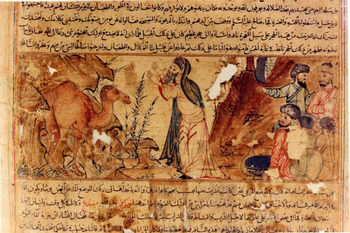
The first theme tackled in this paper is the interplay of text and image in what might be termed salvation history. One may begin with the case of Sālih (Figure 1), an ancient Arabian prophet who lived, says Rashīd al-Dīn, after Hūd and before Abraham;Footnote 27 he is mentioned nine times in the Qurʾān,Footnote 28 though these largely allusive references add up to nothing like a complete account of him.Footnote 29 He belonged to the people of Thamūd, who were wealthy unbelievers. Rashīd al-Dīn’s text suggests that their wealth was linked to their unbelief.Footnote 30 God sent Sālih to warn them and to teach them about his Oneness. On a day when they were celebrating one of their festivals at the foot of a mountain Sālih preached to them. They replied “We will believe in your prophethood and we will be guided by what you say … if you bring a camel out of this rock as a miracle,”Footnote 31 pointing to a huge rock on the mountain. The text continues: “When he saw that nothing could be done with those rebels, he prayed to God Most High. He answered his prayer and a camel of extreme beauty appeared from that rock. So they believed”—but it was only for a few days, whereupon “They sent Sālih the prophet away from them and they hamstrung the camel.”Footnote 32 Not surprisingly, after still further warnings, which they again disregarded, they all perished by earthquake and thunderbolt, but for one man, Abū Righālat, who settled near Mecca and founded a tribe of his own there.Footnote 33 This, then, is an exemplary tale of the mortal danger of stubborn unbelief and trusting in riches.
Sālih and the she-camel.
Source: Rashīd al-Dīn, Jāmiʿ al- Tawārīkh, Edinburgh University Library (Arab ms. 20), fol. 1v. Reproduced by permission of the Edinburgh University Library.
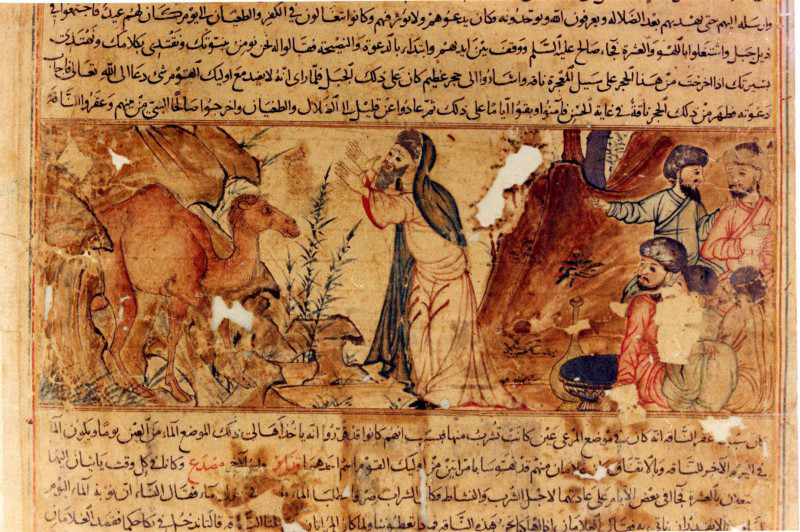
The accompanying image uses the extended oblong horizontal format that is standard for illustrations in this manuscript.Footnote 34 It shows Sālih, dramatically spotlighted at centre stage and clad in the cowl (tarha) and mantle of a prophet, with upturned face and raised hands outstretched in prayer as a camel emerges out of the rock with stately gait, its eyes fixed on him. He turns his back on a cluster of five men from the tribe of Thamūd at the far right of the picture, who veer round from their celebrations, which plainly include a lot of wine, to watch him. The body language both of Sālih and of the men of Thamūd tells its own story of belief and unbelief. He has separated himself from them to turn to God, while they form their own tightly bunched little group, with their backs pointedly turned to him, the very image of solidarity, though one of them grabs the shoulder of his neighbor and gesticulates towards the prophet. The landscape details draw on Chinese prototypes of rocks, trees and grass. These are expertly combined with minimum strokes and sepia washes to evoke a credible setting for a narrative that unfolds in simple linear progression along the frontal plane, from the men of Thamūd to Sālih to the camel. Each section is clearly distinguished from the next, thereby creating a trio of compartments. Such triple layouts are a frequent device in the paintings of this manuscript. This particular image, packed with expressive power, pared down to its essentials and delivering maximum impact with minimum means, is typical of the simplified storytelling technique of Rashīd al-Dīn’s painters. Above all, though, everything is subordinated to the overriding theme of the entire Sālih story, namely God sending a prophet to warn wealthy unbelievers to mend their ways and to follow the right path. Moreover, the painter has carefully followed the details given in the text, and has not allowed his imagination free rein to embroider the painting with redundant detail. The focus is on the centrality of the prophet and the authority of his message, nicely balanced by references to belief (the camel) and unbelief (the carousing men of Thamūd).
The Treatment of Samson
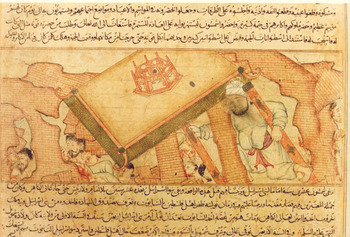
What of Samson (Shamsūn)? He appears occasionally in Jewish mosaics,Footnote 35 and also in Byzantine art, both in mosaicFootnote 36 and manuscriptFootnote 37 form, and in the latter case Terry Allen has pointed to a possible source for the image in the Edinburgh fragment.Footnote 38 The Byzantine versions of his death emphasize the chaos of collapsing masonry, but Samson himself is reduced to a puny figure,Footnote 39 dwarfed by the downfall of the temple itself. The Samson scene in the Edinburgh Rashīd al-Dīn, by contrast, exalts his preternatural strength by deliberately exaggerating his sheer bulk (Figure 2).
Samson destroys the temple of the Philistines.
Source: Rashīd al-Dīn, Jāmiʿ al-Tawārīkh, Edinburgh University Library (Arab ms. 20), fol. 11r. Reproduced by permission of the Edinburgh University Library.
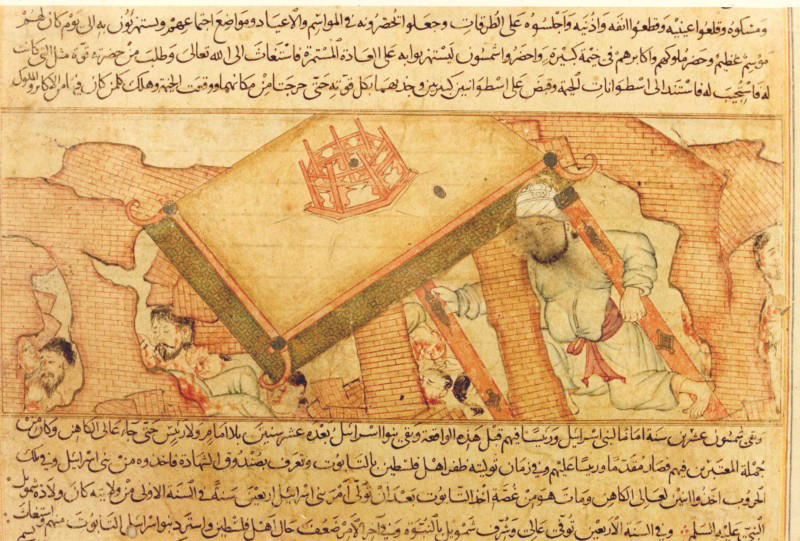
Samson does not appear in the Qurʾān, but he is mentioned in various Muslim exegetical and historical sources.Footnote 40 The story as told by Rashīd al-Dīn has much in common with the biblical narrative of Judges 16:17‒30. Delilah is not mentioned by name but she lulls him, says the text of Rashīd al-Dīn,
until he fell asleep and she tied his hands tightly and she asked the groupFootnote 41 to come, and they came. They grabbed him and pulled out his eyes and cut off his nose and ears and sat him down on the roads and they began taking him to celebrations and festivals and their meeting places, and mocking him, until one day when they had a great celebration. Their kings and princes were present in a big tentFootnote 42 and they brought out Samson to mock him continuously. He beseeched God Most High for help, and he asked His Presence for such strength as he had previously had. It was granted to him. So he leant on the columns (ustuwānāt) of the tent and grabbed two big columns and pulled them with all his might until they were forced out of their place and the tent fell down and all the nobles and kings in it perished.Footnote 43 Samson had remained for twenty years as an imam to the Children of Israel and as a chief over them before this event and the Children of Israel remained twenty years without an imam or chief until ‘Alī al-Kāhin came.
While the core elements of the story as told by Rashīd al-Dīn are present in the painting, one major inconsistency is unmissable. The text describes a big tent, whereas the painting depicts a building largely constructed of brick in the fashion of contemporary Persian architecture—but with wooden elements, namely the painted red columns, both with a vegetal cartouche in silver,Footnote 44 and the canted roof, whose hipped eaves with curled terminations are derived from wooden Chinese buildings. The open skylight also seems to be of red painted wood, though its arch forms again echo Ilkhanid Persian forms in brick;Footnote 45 and the geometric decoration of its cornice is also of wood. This combination of brick and wood is not encountered in any surviving Ilkhanid buildings, though there is no reason to doubt that it existed. But above all, the main structure is obviously of brick rather than canvas, and thus flatly contradicts the text. It is hard to imagine that a collapsed tent, however big, would be able to wreak the kind of destruction depicted here. Other Muslim versions of this story describe the building as a minaret supported on two columns,Footnote 46 a structure that really taxes the imagination. There is still more to come. Despite later damage to his face, it is clear that Samson himself has recovered his sight, his nose and at least one ear. In this respect the painter is following the fuller details given in other Muslim versions of this story, which recount—as Rashīd al-Dīn does not—that God restored his eyes, nose and ears.Footnote 47 To those familiar with the biblical story and Milton, then, this is not Samson eyeless in Gaza, at the mill with slaves. Moreover, one detail crucial to the meaning of the biblical account is missing: namely, Samson’s hair, the very feature that marks him out as a Nazarite dedicated to God. There is no mention in Rashīd al-Dīn’s account of his hair being cut by the woman while he is asleep; instead, he mentions that she tied Samson’s hands to his neck with his very long hair. Judges 16:22 notes that Samson’s hair, the source of his strength, had begun to grow again while he was a captive. But here Samson wears a turban—after all, he is a Muslim avant la lettre, and the Islamic sources specifically identify him as a Muslim —and so his hair is hidden. Thus a detail that is absolutely crucial to the entire story in the Jewish and Christian traditions is simply omitted in the Muslim version. These details apart, one must salute the artist for the gusto with which he has tackled his subject. The temple of the Philistine god Dagon has disintegrated most convincingly and the result is a shambles, with bloodstained heads, gore and limbs everywhere. Attention focuses on the gigantic figure of Samson, who clenches one column with his right hand and with bent knee braces himself as he heaves upwards with all his might. Even in his crouching position he takes up almost the full height of the picture space. This marked emphasis on his huge size and strength adds credibility to his feat. The main composition resolves itself into a triangle whose sides are the falling diagonal of the roof and the rising diagonal of Samson’s body. Collapse and carnage frame this on both sides.
So much for Sālih, where urgent warning is delivered, and Samson, where condign punishment is inflicted. Both these men of God beseech God for help and their prayer is answered on the spot. These messages could not be clearer, and it is noticeable that the stories and the images that accompany them support and thereby strengthen each other. This suggests that the illustrative program was carefully planned in at least some parts of the text. In both these accounts, too, the narrative is markedly more condensed than the versions of these stories found in other Muslim sources, such as the works of al-ThaʿlabīFootnote 48 and al-Kisāʾī.Footnote 49 That has the effect of emphasizing the exemplary power of these tales. It is worth noting that the theme of God intervening in human affairs to save His chosen ones—Daniel in the lions’ den, the Hebrews in the fiery furnace, Jonah in the belly of the great fish, the drowning of the Egyptians who threatened Moses, and so on—has a long history which goes back all the way to the earliest centuries of Christian art.Footnote 50 It is telling that well over a millennium later some of the very stories that brought comfort and hope to the nascent Christian community were re-used at the behest of the Mongols newly converted to Islam. And Rashīd al-Dīn was able to draw on the riches of Judaic sacred lore for further scenes of a similar nature, such as Abraham in the fire or Moses killing Og.
The Finding of Moses
Now to the five paintings which constitute the Moses cycle in the Edinburgh fragment.Footnote 51 Given the plethora of episodes in his full and long life that presented themselves as possible candidates for illustration, which were by no means limited to those alluded to in the Qurʾān,Footnote 52 the choices that were actually made for the Edinburgh fragment are significant: Moses as a baby, Moses destroying the Egyptians in the Red Sea, Moses on Mount Sinai, Moses destroying Korah, and Moses killing the king of the giants, Og.Footnote 53 In three out of the five cases, then, Moses deals out death to his enemies—and in all three cases the odds were against him. To put it mildly, that is an interesting take on what was seen at the time as important about him. And given the wealth of lore about Moses in the three Abrahamic religions, this choice of images is quirky. One could argue that other episodes might have been chosen, say, in place of the downfall of Korah, which simply recycles the drowning of the Egyptians—the burning bush, for instance, or the plagues of Egypt, or the golden calf, or the striking of the rock to provide water in the wilderness. Such significant omissions cast a long shadow over this cycle of images, raising serious questions as to its purpose.
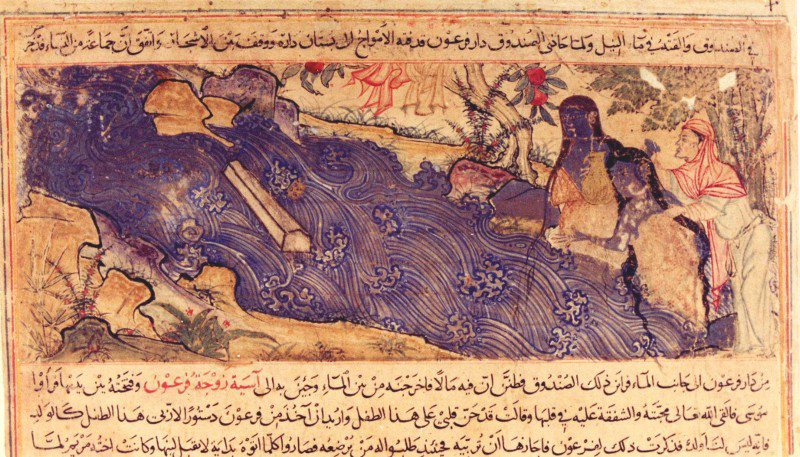
The Moses story begins, as indeed it does in the Bible (Exodus 2:2), with his babyhood. In the Qurʾān (sūra 20:39‒40 and sūra 28:7‒13), God tells Moses’ mother that she should place him in a chest (tābūt) and cast it into the sea.Footnote 54 She does this, and the sea casts it up on the shore where Pharaoh’s family finds him, and Pharaoh’s wife protects him. Moses’ sister, unobserved, watches from afar. When Moses refuses the milk of the wet-nurses,Footnote 55 she directs Pharaoh’s people to the baby’s natural mother, who suckles him. This shows that God’s promise is true. The narrative of Rashīd al-Dīn broadly follows this outline, though it differs in key respects from the biblical version, which tells of a reed cradle found by Pharaoh’s daughter while she was bathing. He writes: “Āsiya, Pharaoh’s wife, had an inclination towards faith.” The text is damaged here and resumes:
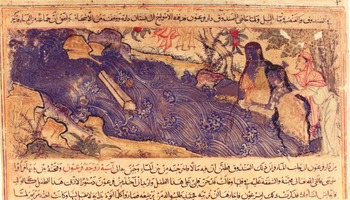
in the box (sandūq) and threw it into the waters of the Nile. When the box was opposite Pharaoh’s house, the waves threw it in pieces into the garden of his house and it came to rest among the trees. And it so happened that a group of women had gone out ofFootnote 56 Pharaoh’s house to the water’s edge and they saw that box. They thought that there was money in it, so they took it out of the water and brought it to Āsiya, the wife of Pharaoh. She opened it up herself and they saw Moses. And God Most High placed love and pity for him (Moses) in her heart and she said “My heart feels tenderness towards this child and I want to obtain permission from Pharaoh to raise this child as a son, for I have no children.” So she mentioned that to Pharaoh and he allowed her to bring him up.
It will be seen that the text gives two versions of what happened to the box: the first that it was cast up in the garden, and the second that it was rescued from the river by the women of Pharaoh’s household. In neither case is Āsiya present. Obviously the artist has opted for the second version as much more dramatic (Figure 3). But he has also introduced a third woman in hijāb gesticulating anxiously at the furthest edge of the painting. She is different in dress, color and facial features—note her lantern jaw—from the other women, and so she cannot readily be explained as one of Pharaoh’s women. Presumably, then, this is Moses’ sister Maryam, who by rights should be depicted as further off (though neither of the other women seems to have noticed her). The artist may also have remembered the Qurʾānic reference to the box being in the sea. At all events, the famously placid Nile has turned into Niagara Falls. A raging torrent propels the box (certainly no cradle) downstream at dizzying speed and it will be touch and go whether the outstretched arm of the servant girl will catch it in time. Thus the artist has boldly dramatized the event and introduced the idea of a clear and present danger that threatens the very life of Moses. The message here is that God protects His own, however defenseless His chosen one may seem. In a bold stroke of the imagination, the artist has capitalized on the Chinese convention of introducing a diagonal emphasis into a painting by the use of a part of some natural feature like a tree, a branch or a rock, and in this case has made the river the principal actor in the scene. It takes up almost the full length of an already long picture, irrupting into the scene at the top left corner, and every swirl and eddy of its spume-flecked course is carefully charted. The depiction of water, whether still or in motion, was a particular specialty of Chinese painters, as shown by the Nine Dragon(s) scroll, painted by Chen Rong, dated 1244 and now in Boston,Footnote 57 and the artist here is at pains to replicate their conventions. This is evident not only in his treatment of the river but also of the rocks with their expressively uneven thickness of outline, the grassy horizon, the tree with a split trunk, the sprays of flowers, and the clothing hanging from the tree and cut short by the upper frame. All this is learned rather than observed at first-hand. But it is a huge step forward from its Jewish,Footnote 58 ByzantineFootnote 59 and western EuropeanFootnote 60 predecessors and parallels, and it dramatically opens a window on a very different pictorial world. Nothing could better illustrate the seismic change wrought in Persian painting by the sudden irruption of Far Eastern modes into its long-established pictorial repertoire.
The baby Moses in the Nile.
Source: Rashīd al-Dīn, Jāmiʿ al- Tawārīkh, Edinburgh University Library (Arab ms. 20), fol. 7v. Reproduced by permission of the Edinburgh University Library.
Moses on Mount Sinai
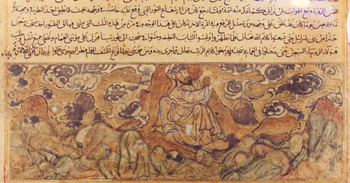
The next scene is placed out of the biblical sequence, since it shows Moses on Mount Sinai praying to God with the elders of Israel (seventy according to Exodus 24:1 and 14) stretched out below him (Figure 4). In the Bible this happens long after the crossing of the Red Sea. The text of Rashīd al-Dīn elides this chronology, simply mentioning that he made six journeys to Mount Sinai, “so that he might plead on behalf of his people”;Footnote 61 during two of them he stayed there for forty days. But the main point to stress is that a foliation error has occurred here in the Edinburgh manuscript, in that folio 8v and 8r are currently in the wrong order, and should be in the reverse order. Once the correct order is accepted, the scene of Moses on Mount Sinai falls into the correct place. The text recounts how he received a replacement for the broken tablets containing the Ten Commandments. Several medieval Byzantine manuscripts depict this scene, showing Moses with outstretched arms and muffled hands (the latter detail expresses his reverence for what he is about to hold) reaching out to receive the stone tablets that a hand from heaven gives to him.Footnote 62 Such a directly anthropomorphic notion was not calculated to appeal to Muslim taste, though curiously enough a related idea can be found in another scene in this very manuscript.Footnote 63 Yet the pose of the prophet, with those same outstretched arms, might be seen as an echo of standard Byzantine iconography for Moses receiving the law, suitably modified with Muslim sensibilities in mind. Rashīd al-Dīn’s text recounts how his countenance shone so brightly on his return that “nobody could look at his face and for a period of forty days he had attached to his face a silk like a burqa‘.”Footnote 64 It continues
And one time of these three when he walked to the mountain, he took as his companions seventy rabbis from the Children of Israel so that they could hear the word of God Most High.…clouds came down on Moses and covered the whole mountain and he asked those seventy leaders to enter the clouds and they prostrated themselves and heard the word of God Most High about what had happened between Him and Moses. And when he had finished Moses came down to them and they said “We want to see God.”Footnote 65
At this point the picture is inserted. The text unfortunately has a lacuna, but it was probably similar to the account given by al-Kisāʾī, who states that when God sent down the angels in their finery, they were thunderstruck and died.Footnote 66
Moses on Mount Sinai with the elders of Israel.
Source: Rashīd al-Dīn, Jāmiʿ al-Tawārīkh, Edinburgh University Library (Arab ms. 20), fol. 8r. Reproduced by permission of the Edinburgh University Library.
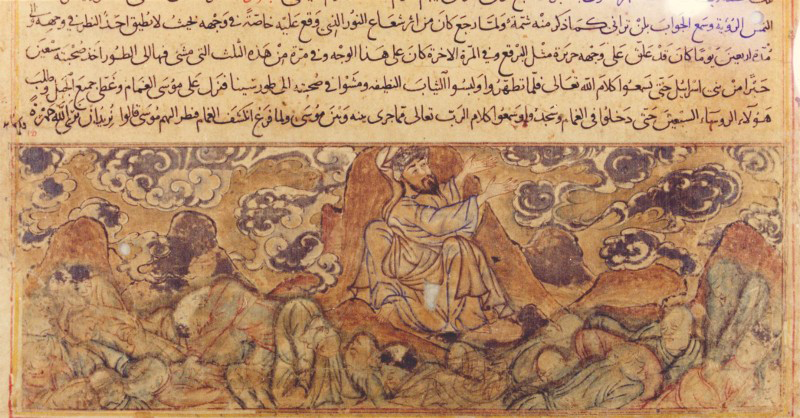
The accompanying picture is undeniably atmospheric in its evocation of Sinai as a mountain of fire and smoke with the voice of God thundering from it, to the abject terror of the Children of Israel. The artist makes free use of the Chinese convention for depicting clouds and the rocky landscape is wreathed in them. Big with meaning, they roll ominously across the picture. Their silver tint, now oxidized, would have reflected light rather effectively. Perhaps this was a reference to the radiant light that so singled him out after his sojourn on Sinai. Moses is at dead centre, his open hands outstretched as he communes with God. His feet are bare, for he is on holy ground. All around and below him, and stretching the full length of the painting, are scattered about a dozen elders of Israel. Their abandoned poses, closed eyes and curled-up bodies suggest that they are deep asleep or—more probably—dead, as in the account by al-Kisāʾī.Footnote 67 They are depicted in such sketchy fashion that it is almost as if they were not entirely present in the flesh. More than one source for this remarkable scene might be proposed. Such groupings are characteristic of Chinese depictions of lohans, enlightened followers of the Buddha, usually depicted with shaven heads. The inappropriate and misunderstood re-use of Chinese themes is typical of earlier Ilkhanid painting.Footnote 68 But another option to be considered is that this scene is a reworking of an image of Christ in the Garden of Gethsemane, praying on a high rock with his disciples asleep below him. The treatment of this theme in Byzantine mosaics,Footnote 69 in Serbian frescoesFootnote 70 and in the Italian Trecento master DuccioFootnote 71 all provide parallels for Moses on Sinai as depicted here. Another possibility, perhaps rather more remote, suggested by Rachel Milstein,Footnote 72 is that this scene is derived from an image of the Transfiguration. Whatever the ultimate source or sources of this painting, its main purpose is plain: to stress that Moses communicated directly with God and served as His messenger. Moreover, when Moses descended from the mountain after forty days in the presence of God, he brought the Ten Commandments with him. So the idea of Moses as lawgiver is implicit in this picture. Perhaps there is even a hint of the rebellious nature of his people, even the elders, for they plainly have no part in his communion with God.
The Drowning of the Egyptian Army
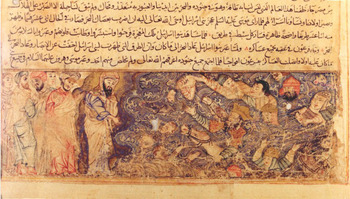
Now to the principal miracle performed by Moses: how at God’s command he struck the waters of the Red Sea so that they parted to let his people through and then rushed back to drown Pharaoh and his army (Figure 5). The Qurʾān makes many references to this event,Footnote 73 and Rashīd al-Dīn’s text describes it at length, as do other Muslim sources.Footnote 74 It can be interpreted as a topos for how God helps the Muslims to triumph over their enemies. Rashīd al-Dīn’s narrative contains many of the details found in Exodus 13:17 to 14:31, but adds that Pharaoh was accompanied by his vizier Haman (this is also the name of the evil vizier of King Ahasuerus in the Book of Esther); that God, instead of telling him to stretch out his hand over the sea, ordered him to strike it with his staff, and (current folio 8v) “there appeared from it 12 clear, visible paths, so each tribe went in a path.” So
the troops of Pharaoh [described by Rashīd al-Dīn as a “world-conqueror”] assembled in contingents and when all his armies had assembled God Most High drowned them and not one of them survived and Moses and Aaron (peace be upon them both) with [current folio 8r] the Children of Israel crossed in safety. No harm or fear came to any of them.
Here again, then, the current foliation is wrong; folios 8v and 8r should be in reverse order.
The drowning of the Egyptians in the Red Sea.
Source: Rashīd al-Dīn, Jāmiʿ al-Tawārīkh, Edinburgh University Library (Arab ms. 20), fol. 8v. Reproduced by permission of the Edinburgh University Library.
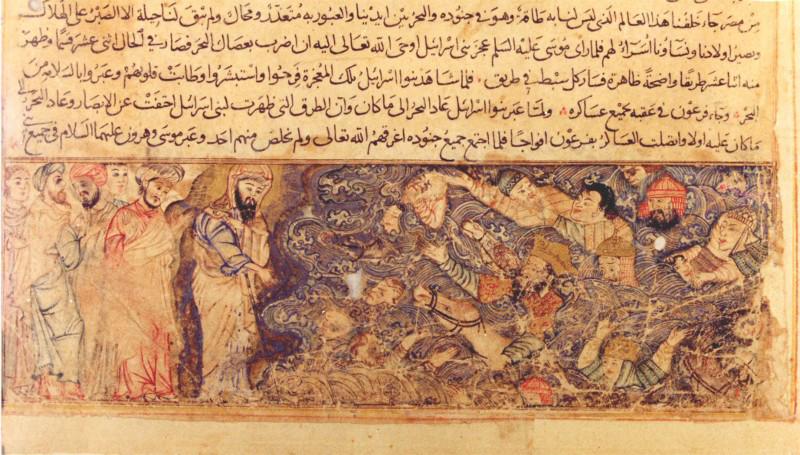
This event is a staple of Old Testament iconography, and indeed it is perhaps first found in the Jewish synagogue of Dura Europos in Syria, datable to no later than 244‒45 AD.Footnote 75 The theme occurs in Rome as early as the catacombs and in the mosaics of Santa Maria Maggiore, and it generated some celebrated post-Iconoclastic interpretations,Footnote 76 for example in the Chludov and Paris Psalters and in the Octateuchs. It is therefore no surprise to recognize a familiar Byzantine model in this image, though of course the Muslim artists had no time for the learned classical personifications, such as Night and Dawn, that the Byzantines favored.Footnote 77 The narrative virtually imposes a composition divided between the Children of Israel and the Egyptians. Sometimes this was done by a two-tier layout, with the Israelites above and the Egyptians below;Footnote 78 but the alternative of a divided oblong format was also known,Footnote 79 and that is the one followed here.Footnote 80 The difference lies in the graphic, even ferocious power of the image; it pumps frenzied action into a confined space. Once again, the impact of the Far East can be recognized in the treatment of water, as in the image of the box containing the baby Moses, with the difference that while that scene depicts a rip tide, this one takes us into a maelstrom, with water spurting and surging in all directions. Several of the Egyptians, moreover, have Far Eastern features and wear Mongol armor, though it is doubtful whether some anti-Mongol connotation is intended. Some Egyptians are already dead; others struggle desperately and one even grabs the beard of a fellow-soldier in an attempt to keep afloat. Chaos reigns, and panic-struck expressions and flailing arms intensify it. The rolling eyes of the horses evoke their terror. The closely packed group of Israelites forms a deliberate contrast with the disorder of the drowning Egyptians. The crowned figure of Pharaoh in a red surcoat, the very emblem of tyranny and pride overthrown, is prominent in their midst, flinging out his arm as he glares despairingly at Moses.Footnote 81 The prophet, wearing his cowl of office and a rayed halo of western European type—the only one in the entire manuscriptFootnote 82—plunges his wonder-working dragon-headed rod into the sea which boils around him. He is a picture of calm authority. Behind him, Aaron raises his hands in astonishment. The narrative is divided into three compartments, depicting respectively the drowning Egyptians, as seen from above in bird’s-eye view, while Moses, separated from them and his people by a brown body-length aureole,Footnote 83 is, like the Israelites themselves, seen from the side. Such spatial contradictions are found elsewhere in Ilkhanid painting.Footnote 84
The Punishment of Korah
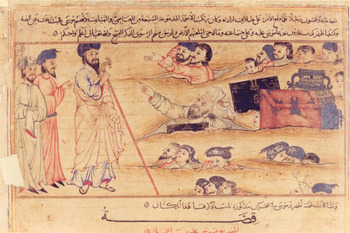
In the current pagination of the manuscript the picture of the drowning of the Egyptians is followed almost at once by an image clearly derived from it, which illustrates the death of Qārūn (the biblical Korah) and his supporters (Figure 6). Once again, a foliation error has occurred here, and this is conclusively borne out by the continuity of the text from one side to the next. So the correct sequence is that the current folio 9v, which deals with Moses and Og and the beginning of the story of Moses and Qārūn, should precede, not follow, the current folio 9r, which deals with the death of Qārūn and his followers and then goes on to the story of Moses and Khidr. As it happens, the Arabic text dealing with Qārūn is somewhat shorter than the Persian text of H.1654. A tentative translation of this part of the Edinburgh fragment—for some passages still resist easy decipherment—runs as follows (current folio 9v, line 34):
As for Qārūn, who was famous and celebrated because of his abundance of wealth and riches, he was the son of Moses’ paternal uncle. His name in Hebrew was F.wr.h, son of Yishar son of Quhath. Quhath was his grandfather and Moses’ grandfather…[folio 9v, line 35] … He had [folio 9r, line 1] with him 250 men. When the situation developed contrary to his will…He wanted to have for himself the rank of Aaron in the priesthood and leadership of the Children of Israel. He…[folio 9r, line 2]…the deceit of Qārūn appeared. So Moses invoked God against him and his group and his wealth until the earth covered them and nothing remained of them except disgraceful memory. Almighty God is most knowing and most wise.
At this point the picture of Qārūn is inserted. Thus ends the story of Qārūn; the next section deals with the prophet Khidr.
Moses watching Korah and his supporters being swallowed up by the earth.
Source: Rashīd al-Dīn, Jāmiʿ al-Tawārīkh, Edinburgh University Library (Arab ms. 20), fol. 9r. Reproduced by permission of the Edinburgh University Library.
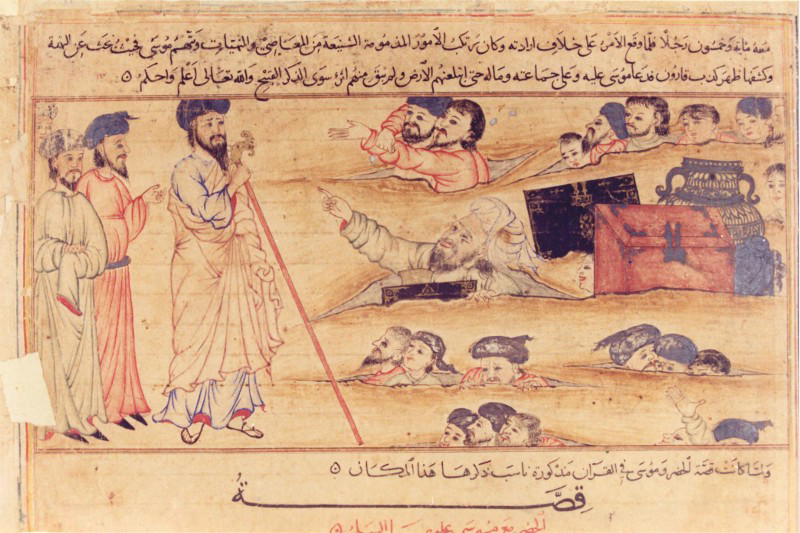
Happily the broad content of this rather exiguous version of the Qārūn story can be supplemented from several sources: the Bible (Numbers 16:1‒35), the Qurʾān, especially 28:76‒82,Footnote 85 the History of al-Tabarī, and the relevant sections in the tales of the prophets by al-Thaʿlabī and al-Kisāʾī.Footnote 86 The latter two sources place the Qārūn story just before that of al-Khidr, as in Rashīd al-Dīn’s Arabic text. Dr. Natif cites an additional Jewish source.Footnote 87 But perhaps the best source to flesh out what the Edinburgh fragment omits is the Persian version of Rashīd al-Dīn’s own text.Footnote 88
This painting displays a powerful sense of theatre in its stark juxtaposition between Moses and his supporters, standing tall on safely solid ground, and Qārūn together with those with him, who are being swallowed up in multiple fissures. A distinct caesura separates the saved from the damned. Here and there a despairing hand is raised as the miscreants go down into the pit; others claw desperately at the edge of a crevasse; Qārūn alone, defiant to the last, his teeth gritted, stretches out his arm and points a minatory finger at Moses as he sinks to his doom.Footnote 89 It is surely no accident that he replicates the pose of Pharaoh in the preceding image; indeed, the Qurʾān identifies him as a minister of Pharaoh. He too is the centre of attention; behind him loom his disappearing possessions, now of no earthly use to him: black and red lacquered chests, jar, goblet and an exotic silver Chinese urn. Moses, totally in command, clutches his dragon-headed rod as he sternly surveys the scene. The close visual parallel between this and the previous scene could be interpreted as a short-cut opportunistically taken by the painter. But is this really no more than a ruthlessly recycled image? When seen in the context of the whole Moses cycle it works rather differently. Moses triumphs first over an external enemy and then over a rebel from among his own people who challenges his religious credentials. In both cases God intervenes miraculously to destroy both of His prophet’s enemies. So the parallelism is distinct and deliberate. Moreover, the repetitive nature of these two paintings, which follow each other in quick succession, speaks eloquently of pride as a besetting sin. They constitute a double warning against it, both textually and visually.
The Killing of Og
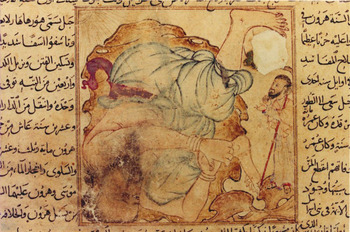
Finally we come, in a very literal sense, to the downfall of the giant Og, King of Bashān (Figure 7).Footnote 90 While there are frequent references to him in the Bible, the incident depicted here is not to be found there, though the Jewish commentaries treat it in extensive detail;Footnote 91 the Babylonian Talmud tells how Moses killed him, as do some of the Islamic sources.Footnote 92 Thus for example al-Kisāʾī recounts that Og saw how large the Israelite army was, so he went to a nearby mountain and cut out a rock of comparable size to cast it at them.
But God sent the hoopoe-bird, which began to peck at the stone that was on Og’s head. When it had made a hole in it, it fell down around Og’s neck and he was unable to throw it off … then Moses…struck him on the knee and Og fell dead.
Rashīd al-Dīn’s text is much more succinct:
Moses came to ʿAuj son of ʿAnaq after a while. He attacked the Children of Israel and Moses was busy fending him off. The length of the stature of Moses was ten cubits [fifteen feet] and the length of his staff was ten cubits. He leapt in the air ten [cubits]. The staff came to his [Og’s] ankle and Og perished with that blow and God drove away his wickedness from the Children of Israel.
The text continues on either side of the picture with information about the deaths of Maryam and Aaron, Moses’ siblings, and the death of Moses himself. So the text of Rashīd al-Dīn does not give sufficient warrant for the content of the painting, which shows that the cause of Og’s death was the fall that broke his neck, not the blow on the ankle. This suggests that the painter was drawing on other sources, whether these were written or visual. It is noticeable that Moses himself is described as being of preternatural size, even though he in turn is dwarfed by Og.
Moses kills the giant Og.
Source: Rashīd al-Dīn, Jāmiʿ al-Tawārīkh, Edinburgh University Library (Arab ms. 20), fol. 9v. Reproduced by permission of the Edinburgh University Library.
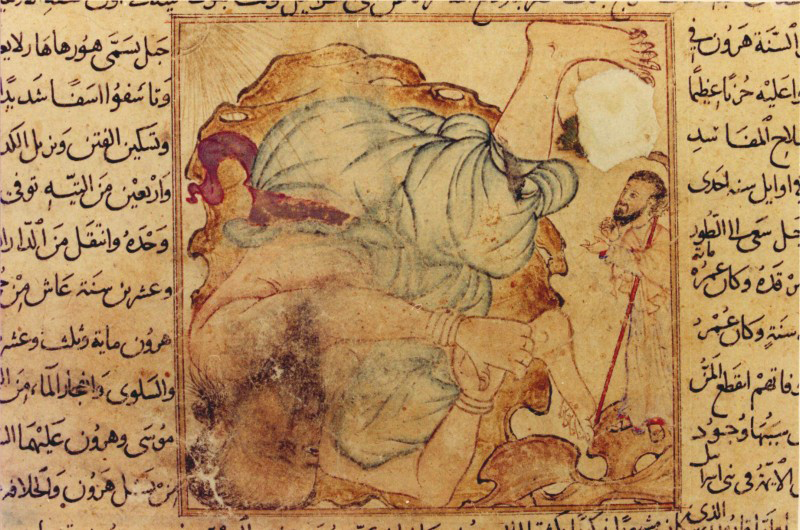
This is an exceptional painting. It is the smallest in the Edinburgh fragment, yet it depicts the largest person in the entire illustrative program.Footnote 93 And for all that, Moses still stands taller than the fallen giant. Moreover, this image is unique among both earlier and later Islamic images of this event, which have as their principal focus the sheer size of Og, thereby severely diminishing Moses. This tendency is already marked in the earliest surviving Islamic depiction of this event, which is found in a Persian translation of al-Tabarī’s History datable around 1300.Footnote 94 The standard solution, then—and it long continuedFootnote 95—was to use a vertical format to underline Og’s colossal height, which is stressed even further when his head bursts out of the upper frame. Not here. And there is a moral here too. Og is literally cut down to size. There is no attribute to indicate his kingly rank. He is merely an enormous half-naked man in baggy pantaloons. His height and strength avail him nothing before God and His messenger. It is enough for Moses to leap up—fifteen feet in the air, no less—and, reaching up, to strike him on the ankle and thus bring him crashing down. This is a tale that loses nothing in the telling. How are the mighty fallen. And by a further stroke of wit, Og takes up virtually the whole of the picture space within which he is imprisoned, with his head squeezed into the bottom left corner and his foot into the top right one. He is further confined by the text that relates his defeat and is placed on either side of the vertical frame. The rock with which he planned to kill the Israelites and which causes his death instead, by fatally unbalancing him, has somehow fallen off his neck and encircles his body as he clutches his injured ankle. There is room for little else but a leafy branch that pokes redundantly out of the frame above the head of Moses, and a quadrant of the sun in the top left-hand corner with rays streaming from it. Moses himself stands beside the fallen Og on a curvilinear perforated rock of Chinese inspiration, his hands outstretched in wonder, with his trusty dragon-headed staff leaning against his shoulder.
So much for the Moses cycle in the Edinburgh fragment. Certain key themes stand out in this selection of images, and it is worth recalling them here, in the order of the images themselves, before moving on to ask other questions of this cycle. The paintings signpost certain events in the life of Moses. First, he is singled out from birth for God’s special protection. Second, on Mount Sinai, God reveals Himself to Moses, an unprecedented mark of divine favor, and entrusts him with transmitting His law to the Children of Israel. Third, God uses Moses to intervene miraculously to rescue His people from the pursuing Egyptians, who all perish. Fourth, God makes Moses His instrument to punish the internal rebellion led by Korah. And fifth, God grants Moses a miraculous victory over his gigantic enemy Og, the king of Bashān. It might be argued that the last three scenes harp on an identical theme, namely the defeat of enemies without and within, which suggests that the person charged with the pictorial program missed some opportunities, such as key events in the forty years that the Jews spent in the desert, or their many lapses into idolatry and false religion. And this choice of scenes may also suggest that this was an early and immature attempt to devise a coherent iconographical program for Moses. On the other hand, the heartening emphasis on divine deliverance from imminent death, and the fact that the latter three images all depict highly dramatic miracles, do help to explain this choice of subjects for illustration.
Explaining the Special Emphasis on Moses
Now to the second major theme of this paper, namely the issue of why Moses plays such a prominent part in both the text and the images of the World History. Several possibilities suggest themselves, and they need not be mutually exclusive; indeed, it is quite plausible that multiple motives dictated that the manuscript, text and illustrations alike, should highlight the story of Moses. It will be useful to look at three of these in some detail, while accepting the likelihood that still others could be proposed. After all, ambiguity and multivalency are part of the way that symbolism operates. That is why it can be so effective.
Rashīd al-Dīn as Moses
A first and radical motive has been proposed by Dr. Mika Natif, namely that Rashīd al-Dīn somewhat arrogantly saw himself as a latter-day Moses and did what he could to make the World History transmit this message.Footnote 96 Her detailed study, with its impressive wealth of documentation, is of particular importance because of her lavish use of Jewish sources, and some of this material has not hitherto been used in studies of these images. Moreover, there is much in her interpretation that is plausible. She treats the theme in such exhaustive detail that there is no need to do more than deal with it in summary fashion here, while drawing attention to some hitherto neglected aspects of the theme. Rashīd al-Dīn was of Jewish birth and background,Footnote 97 and the Old Testament, and perhaps especially the Pentateuch, was an essential part of his religious and intellectual heritage, as was the body of sacred Jewish lore that grew up around it. That remained true even when he later converted to Islam—a conversion, by the way, whose sincerity was questioned by his enemies.Footnote 98 By this reckoning he abused his privileged position as compiler, overseer and general editor of the World History, if not its actual author, to give this portion of his illustrated history a very particular and personal meaning which not only redounded to his own credit but also elevated him above the normal run of humanity. The key ingredient in this bold association is that, like Moses, he was the leader of the Jewish community—if only in the Ilkhanid realm—and that, again like Moses, he shouldered responsibility for the welfare of his people. One might even add that Rashīd al-Dīn’s early training as a doctorFootnote 99 chimed with the concern for public health that runs through Mosaic law, while his repeated attempts to integrate the Mongol customary law, the so-called yasa, with the Islamic sharīʿa Footnote 100 could perhaps qualify him in some sense as a lawgiver. Such aspects of his career could have served to flesh out still further a connection between him and Moses. Moreover, there can be no doubt that Rashīd al-Dīn wielded formidable power in political and financial terms, though he was no military man; he argued vehemently against aggressive jihād.Footnote 101
But that is not enough to make an irrefutable case for Rashīd al-Dīn as the Moses of his time. For neither under Sultan Ghāzān Khān nor even under his brother Sultan Öljeitü could Rashīd al-Dīn be termed the ruler of the country. Instead, he was the perpetual second in command. His authority depended not on God—he was emphatically no prophet—but on the support of the reigning Ilkhan. In all seriousness, then, there would have been more than a suspicion of hubris, not to say megalomania and even blasphemy, in any attempt on his part to forge (and that may be the mot juste) a connection between himself and that prophet to whom God spoke directly and whose face radiated blinding lightFootnote 102 because he had long been in the presence of God. And it is worth adding that there is a miraculous element in the five paintings of the Moses story in the Edinburgh fragment. Rashīd al-Dīn was an outstanding figure on many counts, but even his most enthusiastic partisan would not have claimed that he performed miracles.
So the attempt to interpret Moses as an antetype of Rashīd al-Dīn quickly runs into serious difficulties. It would certainly not have pleased his Mongol masters. That said, one need not insist on a pedantically accurate set of parallels between Moses and Rashīd al-Dīn in order to propose some degree of connection between them. Such a comparison could well operate subliminally on the basis of just a few elements that these two towering figures of past and present had in common. These might have sufficed to plant the seed of a link between them, leading readers and viewers to make whatever connections they pleased. Rashīd al-Dīn’s motto in all this might have been the Chinese aphorism: “seek to suggest rather than to display.” On balance, however, the idea of Rashīd al-Dīn as an alter ego of Moses does not recommend itself as the principal subliminal message of these illustrations.
The Qurʾānic Emphasis on Moses
The second and least controversial reason for this marked emphasis on Moses is the importance that the Qurʾān itself accords to him. He is mentioned in the sacred text no fewer than 136 times—more than any other pre-Islamic prophet.Footnote 103 Only Muhammad is mentioned more often than this, and Muhammad is also the sole holy figure whose narrative has more illustrations accorded to it than the Moses story. These numerous references presented the compiler of the text and the illustrator with a potential embarras de richesses, in both cases further expanded by what the compiler or the workshop master (or whoever would have overseen the choice of illustrations) knew of the material from the Qurʾānic commentaries and the accounts in various exegetical works already mentioned, not to mention the very rich Jewish sources. The overriding need for brevity must have imposed some constraints on the compiler, while the workshop master would necessarily have been guided by the content of Rashīd al-Dīn’s actual text. At the very least, one may safely state that the Qurʾānic text opened up a wide range of subject matter for the painter’s consideration. Some of these Qurʾānic reports or allusions are only passing references, for example when he is mentioned alongside other prophets. But they do, when taken together, confer huge authority on him as a central figure in the Muslim faith.
And this makes him of cardinal importance in the context of the teaching role of the World History.Footnote 104 That in turn explains why he figures so largely in the illustrative program. For the many people who could not read the Arabic text—probably the majority of those who would see it on display in Iran, in mosques and madrasas—their experience of the manuscript would be visual, not literary. Thus it was up to the pictures to transmit a clear message about Moses that stuck close to the most important aspects of his exemplary life. So we see him in turn delivered from danger as a baby and singled out for special treatment; communing with God while the elders of his people, the religious elite of Israel, are fast asleep below him; performing spectacular miracles first to save his people from destruction and then to stamp out an internal rebellion; and killing a giant. In all of this the sense of God’s ever-present help and guidance is unmistakable, so that Moses becomes a pattern of the leader with unshakable faith in God, one who is obedient to God and whom God repeatedly honors with His special favor. If the public that encountered the World History absorbed all this, these five images would have served their purpose.
Does Moses Prefigure Muhammad?
But a third reason for the special emphasis on Moses might be proposed, for in several key respects he can be seen to prefigure Muhammad himself. That connection obviously had the potential to interest any Muslim who read the text and saw the paintings. And it could continue to resonate as long as the manuscript survived, centuries after Rashīd al-Dīn himself had been forgotten. The idea that certain Old Testament events and people prefigured those of the New Testament is fundamental to Christian iconography, so there was nothing intrinsically new here. It is therefore not surprising that the allusions to Moses in the Qurʾān, most of which seem to date to the Medinan period when Muhammad was in constant contact with the local Jews, could occasionally be interpreted in a typological sense. To some, then, the biography of Moses would lend itself to being seen in the light of the biography of Muhammad, which would of course be much better known to the Muslims who read the text of the World History. This is not to deny that some Muslim theologians understandably thought Moses to be distinctly inferior to Muhammad; after all, Muhammad in the Islamic tradition is seen as the seal of the prophets.
The points of contact between the careers of these two larger-than-life personalities are at once many and varied, and Rashīd al-Dīn’s text consistently exploits them. Both were singled out by God while still young. Both were lawgivers for their communities. Both preached an uncompromising monotheism and obedience to God’s commands. Both were notably humble. Both led their communities through thick and thin, in peace and war. Both destroyed the enemies of those communities—in other words, both were warrior prophets. Both were frequently entrusted with messages from God that they transmitted to their people. More than that, both were privileged to be with God in a dimension beyond time, for Moses saw God and Muhammad ascended to Heaven. The two relevant paintings in the Edinburgh fragment approach these very sensitive topics as closely as their painters dared.
While there are of course differences between these two men—for example, the miraculous element featured much more in the life of Moses than of Muhammad—these major resemblances between the greatest of the pre-Islamic prophets and Muhammad, God’s final prophet, are more than sufficient to explain the preeminence of Moses in both text and image in the early part of the World History. Naturally the connections between them can be highlighted in far more detail in text than in image; but the images, both in their sheer quantity, which gives them a cumulative impact, and in their content, stay rooted in the mind and the imagination. And the connection between them is further driven home by the relatively close proximity of the cycle of paintings devoted to each of them in the Edinburgh fragment. In that text the Moses story ends on folio 10v; the story of Muhammad begins on folio 41r. So the images of Moses would be relatively fresh in the mind of the reader embarking on the story of Muhammad. One might go so far as to suggest that this closeness was deliberately planned, for of course in real time the two prophets lived a millennium and a half apart. It is possible, indeed, that the Edinburgh fragment was a custom-made text designed with a particular destination in mind—perhaps, for example, a city with a substantial Jewish population, such as Isfahan or Hamadān.Footnote 105
Conclusion
The seven images studied in detail in this paper, both in their content and in their accompanying text, have revealed a consistent desire on the part of those responsible for this manuscript to do more than make the images a decorative accessory to the text. T. S. Eliot famously wrote “Poetic drama is more than drama in verse,” and one might adapt that pronouncement to the present case: “an illustrated book is more than a book with illustrations.” The illustrations can have a life, an energy and an agenda of their own. They can re-contextualize a story, they can bring it up to date, they can bring out a significance that is not there in the text or only latent in it. Moreover, their multiple meanings can coexist without any one interpretation elbowing the others out of the way. Those meanings enrich rather than exclude each other. So these seven images have an exemplary and teaching function appropriate to holy writ; and without diminishing that function in the least, the images of Moses in particular may also serve to underline his importance in the Qurʾān, to allude gracefully to the patron of this enterprise, Rashīd al-Dīn, and to give those who saw the manuscript a fuller concept of Muhammad’s prophetic mission in the context of salvation history—of God’s long-term plan for His people—as revealed in the life of Moses, the greatest forerunner of the Prophet of Islam.