Introduction
Digenetic trematodes of the genus Austrodiplostomum Szidat & Nani, 1951 have been reported infecting several vertebrate species (Yamaguti, Reference Yamaguti1971; Kohn et al., Reference Kohn, Fernandes and Baptista-Farias1995; Ramos-Ramos, Reference Ramos-Ramos1995). The metacercariae of these parasites can infect the vitreous humour (Scholtz et al., Reference Scholtz, Vargas-Vázquez, Moravec, Vivas-Rodríguez and Mendonza-Franco1995; Silva-Souza, Reference Silva-Souza1998; Amato et al., Reference Amato, Amato and Albrecht2001) and, more rarely, the brains of the fish (intermediate hosts) (Ostrowski-Nunez, Reference Ostrowski-Nunez1982; Silva-Souza, Reference Silva-Souza1998; Amato et al., Reference Amato, Amato and Albrecht2001). The life cycle of this diplostomid is completed in the intestines of birds, such as ‘biguá’ Phalacrocorax olivaceus (Humboldt, 1805) (definitive host) (Rietschel & Werding, Reference Rietschel and Werding1978) (Ostrowski-Nunez, Reference Ostrowski-Nunez1982; Ramos-Ramos, Reference Ramos-Ramos1995; Flowers et al., Reference Flowers, Poore, Mullen and Levy2004; Machado et al., Reference Machado, Takemoto and Pavanelli2005). The genus Austrodiplostomum comprises 40 digenetic helminth species, including adults and metacercariae, and can be found in 125 host species (Eiras, Reference Eiras1994; Niewiadomska, Reference Niewiadomska1996) distributed across all continents, but most commonly in Eurasia and North America, and occasionally in South America (Niewiadomska, Reference Niewiadomska1996; Niewiadomska & Laskowski, Reference Niewiadomska and Laskowski2002).
Austrodiplostomum compactum (Lutz, 1928) Dubois, 1970, is widely distributed in the Neotropical region, where several fish species from Brazilian freshwater rivers are parasitized by metacercariae, including: Cichla ocellaris Bloch & Schneider, 1801 (‘tucunaré’ or ‘tucunaré açu’); Cichla monoculus Spix & Agassiz, 1831 (tucunaré or tucunaré açu); Crenicichla britskii Kullander, 1982 (‘joaninha’); Hoplias malabaricus (Bloch, 1794) (‘traíra’ or ‘lobó’); Plagioscion squamosissimus (Heckel, 1840) (‘corvina’ or ‘pescada branca’); and Satanoperca pappaterra (Heckel, 1840) (‘cará’, ‘acará’ or ‘porquinho’) from the Itaipu reservoir and the Upper Paraná River floodplain, State of Paraná (Kohn et al., Reference Kohn, Fernandes and Baptista-Farias1995; Silva-Souza, Reference Silva-Souza1998; Pavanelli et al., Reference Pavanelli, Takemoto, Machado, Lizama, Tanaka, Guidelli, Issac, Carvalho and França2000; Santos et al., Reference Santos, Pimenta, Martins, Takahashi and Marengoni2002; Machado et al., Reference Machado, Takemoto and Pavanelli2005; Yamada et al., Reference Yamada, Takemoto and Pavanelli2007); Geophagus brasiliensis Quoy & Gaimard, 1824 (cará or acará) from Barra Bonita (middle Tietê River, State of São Paulo) (Novaes et al., Reference Novaes, Ramos, Carvalho and Silva2006); and P. squamosissimus from Nova Avanhandava, lower Tietê River, State of São Paulo (Paes et al., Reference Paes, Santos, Carvalho and Silva2003) and from the Volta Grande reservoir, State of Minas Gerais (Martins et al., Reference Martins, Fujimoto, Nascimento and Moraes1999, Reference Martins, Paiva, Fujimoto, Schalch and Colombano2002). In Venezuela, Cuba, Colombia and Mexico, other metacercariae of the genus Diplostomum have also been recorded infecting Rhamdia quelen (Quoy & Gaimard, 1824) (‘bagre’ or ‘jundiá’), Oreochromis aureus (Steindachner, 1864) (‘tilapia’ or ‘tilapia azul’) and Oreochromis mossambicus (Peters, 1852) (tilapia or ‘tilapia de mozambique’) (Pérez-Ponce de Leon et al., Reference Pérez-Ponce de Leon, Osório-Saraiba and Garcia-Prieto1992; Garcia et al., Reference Garcia, Osório-Sarabia and Constantino1993; Aragort et al., Reference Aragort, Leon, Guillén, Silva and Balestrini1997; Aguirre-Macedo et al., Reference Aguirre-Macedo, Scholz, González-Solís, Vidal-Martinez, Posel, Arjona-Torres, Siu-Estrada and Dumailo2001).
Plagioscion squamosissimus is a widespread fish species from the Amazonian basin. Because of its economical importance, it was introduced in the Paraná basin, mainly in great reservoirs such as Itaipu, Promissão and Marimbondo (Torloni et al., Reference Torloni, Corrêa, Carvalho, Santos, Gonçalves, Gereto, Cruz, Moreira, Silva, Deus and Ferreira1993; Moretto et al., Reference Moretto, Marciano, Velludo, Fenerich-Verani, Espindola and Rocha2008), where it is now the major fish product in the south-east of Brazil (Graça & Pavanelli, Reference Graça and Pavanelli2007; Vidotto & Carvalho, Reference Vidotto and Carvalho2007).
Considering the previous occurrence of A. compactum metacercariae in the Tietê River (Paes et al., Reference Paes, Santos, Carvalho and Silva2003), the aim of this study was to determine the prevalence, intensity of infection, abundance, seasonality and host status of A. compactum metacercariae infection. In addition, the existence of possible correlations between biotic factors (populational and parasitic) and some abiotic variables were assessed.
Materials and methods
Study area and parasitological procedures
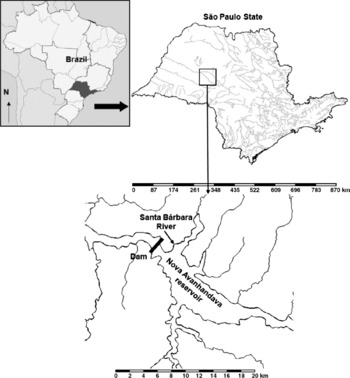
This study was conducted in the Santa Bárbara River (municipality of Buritama, São Paulo State, Brazil), a major tributary of the Nova Avanhandava reservoir (21°07′S and 50°17′W), and the penultimate of the middle Tietê River cascade of reservoirs (fig. 1). Nova Avanhandava is the second largest hydroelectric plant in operation on the Tietê River, with an installed power capacity of 347.40 MW. The reservoir has an area of 210 km2, total water volume of 2720 × 106 m3, mean discharge rate of 688 m3/s, mean depth of 13 m and water permanence time of 46 days (Torloni et al., Reference Torloni, Corrêa, Carvalho, Santos, Gonçalves, Gereto, Cruz, Moreira, Silva, Deus and Ferreira1993; CESP, 1998; Rodgher et al., Reference Rodgher, Espíndola, Fracácio, Rodrigues, Pereira and Rocha2002).
Map of Brazil highlighting São Paulo State and the study area at the mouth of the Santa Bárbara River, in the Nova Avanhandava reservoir (lower Tietê River).

Plagioscion squamosissimus specimens were collected using nylon monofilament gill nets with mesh sizes of 3–14 cm (not opposite knot lengths) from six sites on the Santa Bárbara River. Nets were placed at 17.00 h and removed by 07.00 h the following day, total exposure 14 h, during the months of July, September, October and December of 2003 and February, March, April and June of 2004. All samples were collected from the same sites with the same network area (standardized effort = 1200 m2 of nets per month). The total weight (in grams) and standard length (distance from the anterior extremity of the head to the end of the hipural bone, in centimetres) of each specimen were recorded.
Three to six hours after collection, the eyes of all individuals were analysed under a stereomicroscope. Prevalence (number of hosts infected with one or more individuals of a particular parasite species), mean intensity of infection (mean number of parasites of a particular species found in the infected hosts of a particular species) and mean abundance (total number of individuals of a particular parasite species in a sample of a particular host divided by the total number of examined hosts of that species) were calculated according to Bush et al. (Reference Bush, Lafferty, Lotz and Shostak1997). Voucher helminths were deposited in the Coleção Helmintológica do Departamento de Parasitologia, Instituto de Biociências (CHIBB), Universidade Estadual Paulista, municipality of Botucatu, São Paulo State, Brazil.
Data analysis
The relative condition factor (Kn) was employed to determine the status of P. squamosissimus infected by A. compactum (Andrade-Talmelli et al., Reference Andrade-Talmelli, Fenerich-Verani and Verani1999; Dias et al., Reference Dias, Furuya, Pavanelli, Machado and Takemoto2004; Yamada et al., Reference Yamada, Moreira, Ceschini, Takemoto and Pavanelli2008). Data on the weight and length of P. squamosissimus specimens were pooled to establish the species weight–length relationship (LeCren, Reference LeCren1951). A total of 377 specimens (non-parasitized = 20; parasitized = 357) were used to determine the parameters of the equation:

where W exp is the expected weight; L is the fish length; a is the intercept; b is the slope.
Host status was assessed using the ‘relative condition factor’ (Kn), estimated by dividing the observed weight of an individual by the expected weight for a given length (Kn = W/W exp). The non-parametric Mann–Whitney statistical test was used to compare Kn between parasitized and non-parasitized fish. Intensity of infection in all samples was compared by the Kruskal–Wallis test, and multiple comparisons were performed by Dunn's method. Significance level was set at 5% in all statistical analyses.
Spearman's rank correlation coefficient (r s) was used to test the relationship between host length and intensity of infection (Abdallah et al., Reference Abdallah, Azevedo and Luque2005) in order to check whether the infection process is cumulative (Takemoto et al., Reference Takemoto, Lizama, Guidelli, Pavanelli, Moreira, Ito, Lacerda, Bellay, Rodrigues, Thomaz, Agostinho and Gomes2005). The distribution of mean intensity of infection according to host length in parasitized specimens was also evaluated (Sturges, Reference Sturges1926).
Concomitantly, Spearman's correlation test was used to check the existence of correlations between parasitic infection levels and some abiotic variables, such as accumulated monthly precipitation (data provided by the AES Tietê Company), water transparency (measured with a Secchi disk) and pH, electrical conductivity, water temperature and dissolved oxygen, measured with Horiba U-22 (Paes, Reference Paes2006).
Results
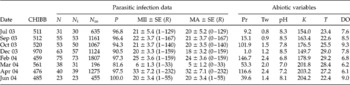
A total of 378 P. squamosissimus specimens were analysed. The mean prevalence observed was 94.3 ± 2.1%. The number of metacercariae collected ranged from 1 to 232 parasites. Mean intensity of infection and mean abundance were 21.6 ± 1.5 and 20.2 ± 1.6, respectively (table 1).
Parasitic infection data and abiotic variables monitored by collection during the study period.

CHIBB, Coleção Helmintológica of the Departamento de Parasitologia, Instituto de Biociências, Universidade Estadual Paulista; N, number of collected specimens; N i, number of parasitized specimens; N m, total number of metacercariae; P, prevalence (%); MII, mean infection intensity; R, range; SE, standard error; MA, mean abundance; Pr, precipitation (mm); Tw, water transparency (m); K, conductivity (μS/cm); T, water temperature (°C); DO, dissolved oxygen (mg/l).
During the study period, the prevalence of A. compactum metacercariae infection remained above 90%, except in March 2004, when it was 81.6%. Mean intensity of infection and mean abundance also showed low variation, except in March 2004, when a significant reduction in these parameters was observed (P ≤ 0.001) (table 1).
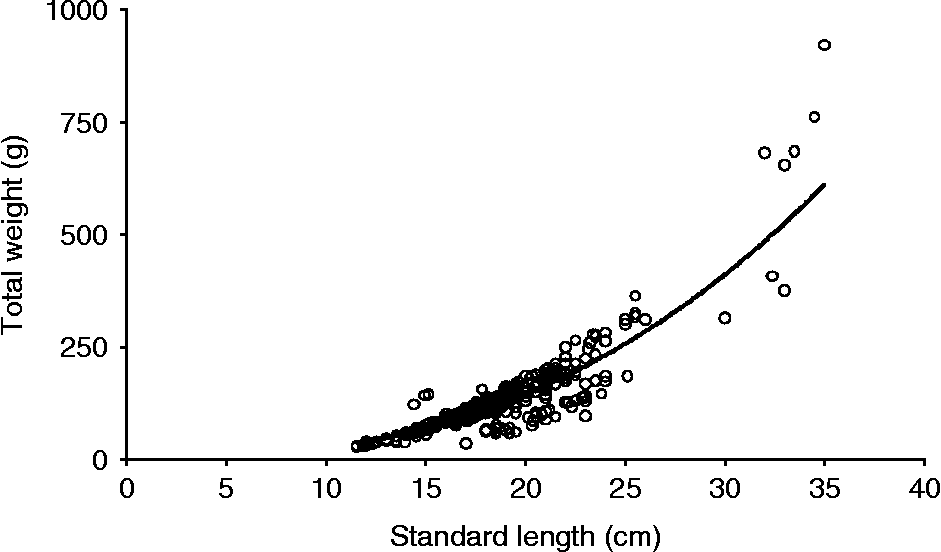
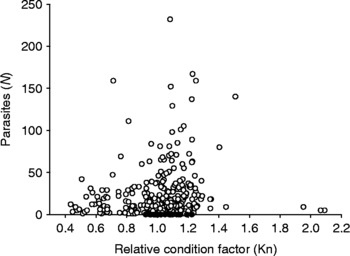
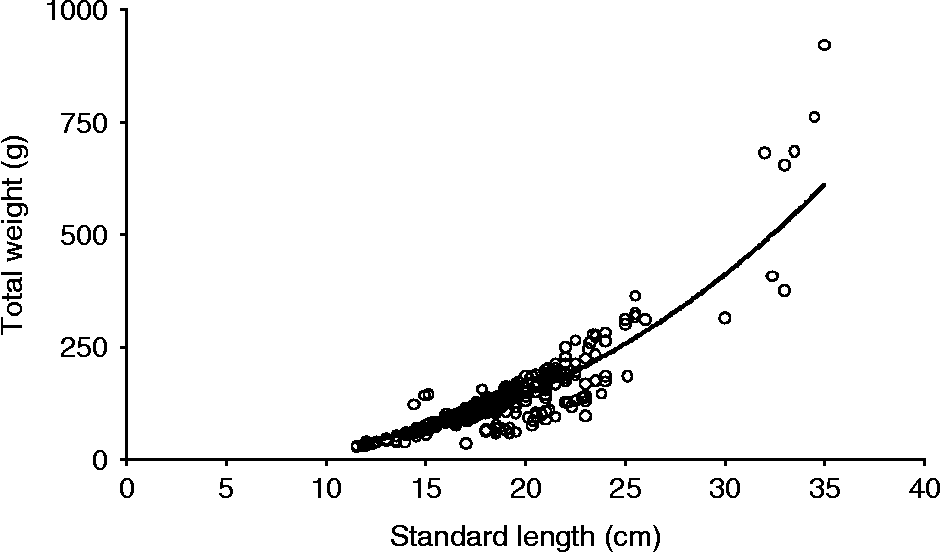
Host fish length and weight were 18.5 ± 3.5 (11.5–35) cm and 131.4 ± 91.8 (27.7–920.6) g, respectively. The weight–length relationship (fig. 2) was established and Kn was calculated for parasitized and non-parasitized specimens (fig. 3). No significant difference in Kn was observed between parasitized fish (1.03 ± 0.2; 0.44–2.1) and non-parasitized fish (1.0 ± 0.1; 0.86–1.09; T = 2913; P = 0.068).
Weight–length relationship in Plagioscion squamosissimus specimens (n = 377) captured in the study area during the study period. Equation y = 0.0649x 2.5732; R 2 = 0.8171.
Change in condition factor values (Kn) in Plagioscion squamosissimus around the 1.0 default, according to the total weight of parasitized (white circle; n = 357) and non-parasitized (black circle; n = 20) specimens.

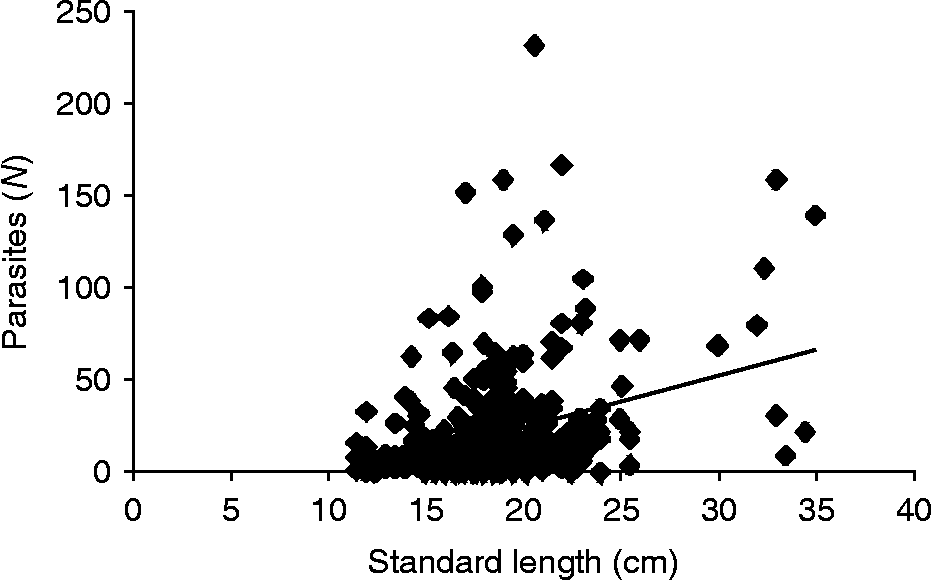
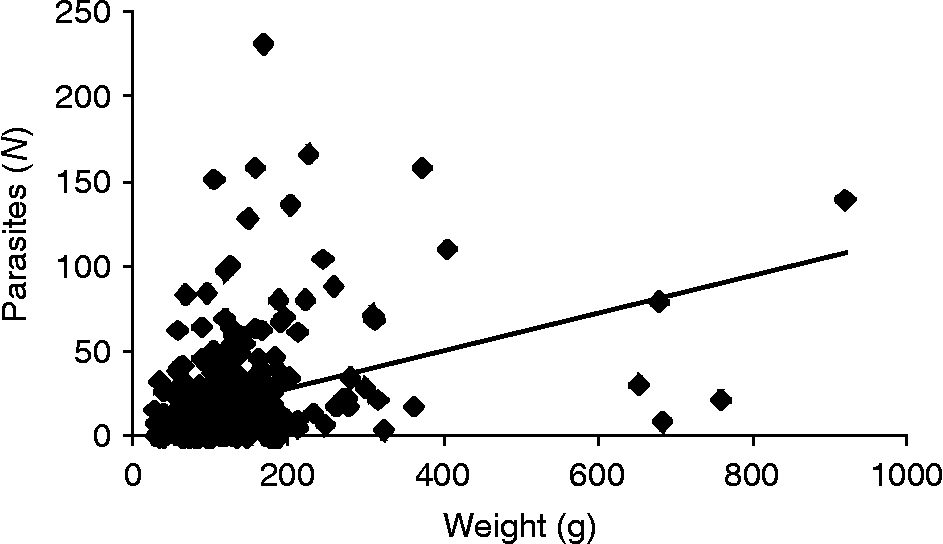
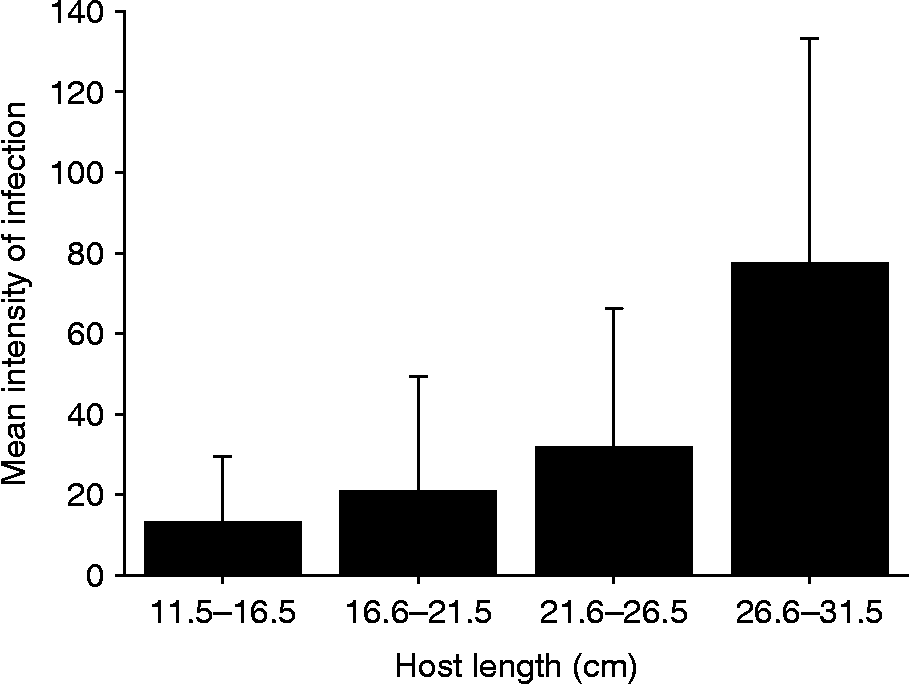
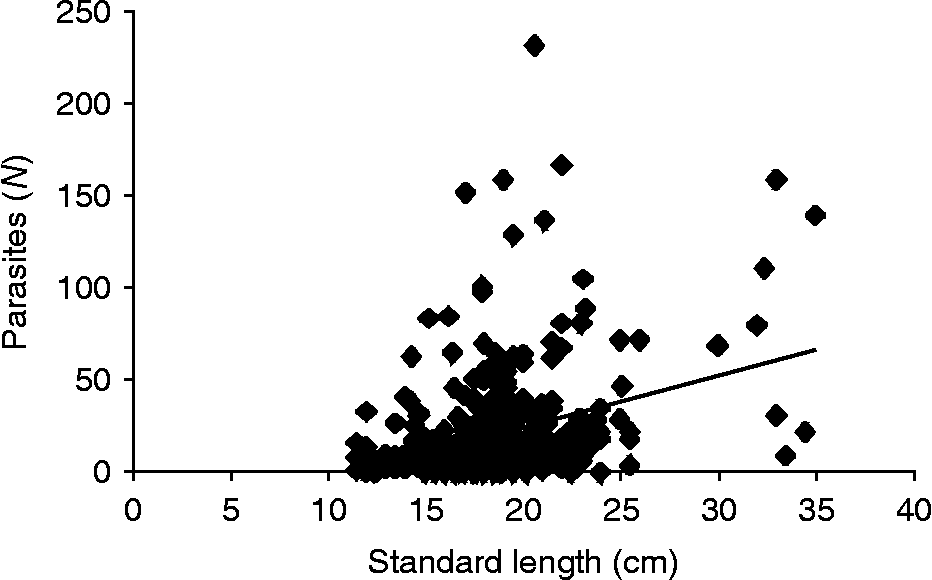
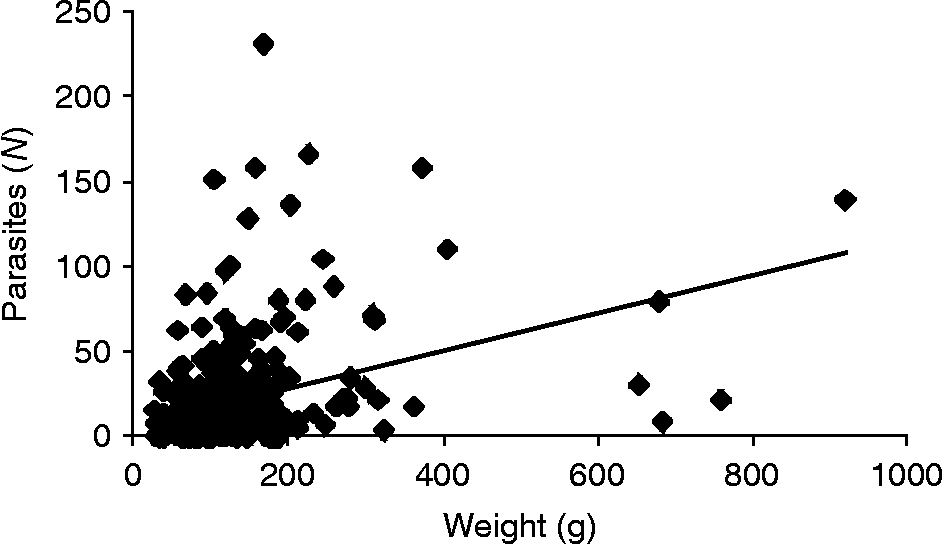
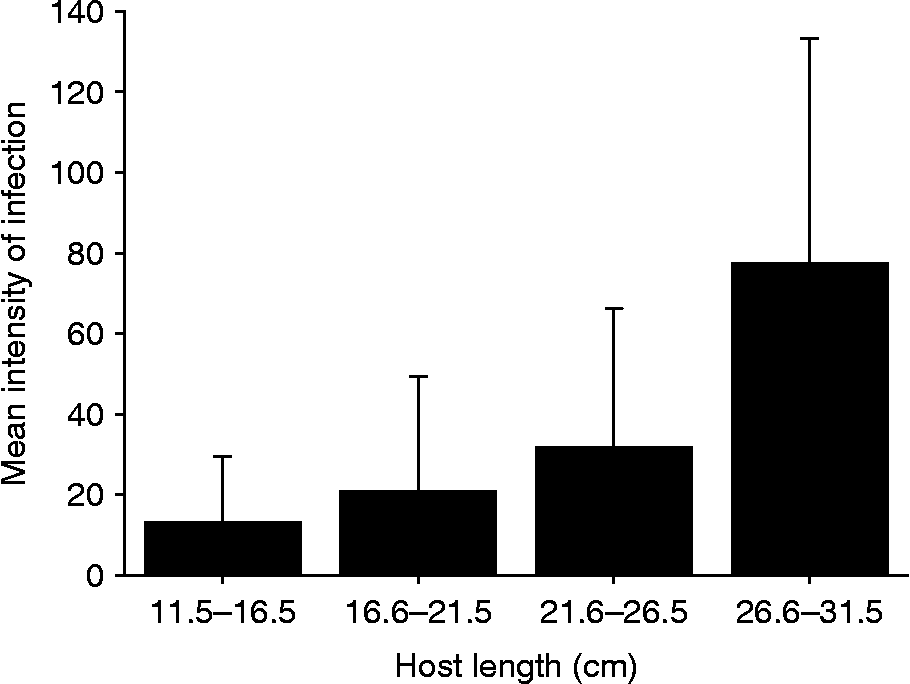
The number of parasites significantly correlated with host length (r s = 0.32, P < 0.001) and host weight (r s = 0.36, P < 0.001) (figs 4 and 5). Therefore, a greater intensity of infection (78 parasites/individual) was observed in the larger specimens (L s = 26.6–31.5 cm) (fig. 6).
Correlation between standard length and abundance of Austrodiplostomum compactum from the Nova Avanhandava reservoir, between July 2003 and June 2004. Linear regression y = 2.8292x − 32.004; R 2 = 0.1201.
Correlation between standard length and abundance of Austrodiplostomum compactum from the Nova Avanhandava reservoir, between July 2003 and June 2004. Linear regression y = 0.1114x+5.8046; R 2 = 0.1264.
Mean Austrodiplostomum compactum infection intensity and standard deviation in Plagioscion squamosissimus according to host length.
The analysis of biotic and abiotic variables (table 1) revealed that no abiotic variable correlated with parasitic infection level (P>0.05).
Discussion
In this study, a high prevalence of A. compactum metacercariae infection in P. squamosissimus was observed. This fish species from the Amazon Basin was introduced in São Paulo Power Company (CESP) reservoirs between 1966 and 1973 (Torloni et al., Reference Torloni, Corrêa, Carvalho, Santos, Gonçalves, Gereto, Cruz, Moreira, Silva, Deus and Ferreira1993). According to Pojmanska & Chabros (Reference Pojmanska and Chabros1993), the prevalence of diplostomids in allochthonous fish (species from other Neotropical basins) is higher than that of autochthonous fish (species from the Upper Paraná). This was also observed by Machado et al. (Reference Machado, Takemoto and Pavanelli2005), who found higher rates of infection in the fish introduced into the floodplain of the upper Paraná River, where P. squamosissimus species showed the highest prevalence and intensity of infection. Thus, it is possible that A. compactum metacercariae utilize native fish as intermediate hosts, and that their adaptation to these native hosts is the explanation for the low prevalence and intensity of infection in these fish (Machado et al., Reference Machado, Takemoto and Pavanelli2005).
According to Pavanelli et al. (Reference Pavanelli, Takemoto, Machado, Lizama, Tanaka, Guidelli, Issac, Carvalho and França2000), the occurrence of A. compactum metacercariae in several fish species and in different aquatic ecosystems (rivers, lakes and dams) shows that while this trematode may have been introduced with P. squamosissimus, it appears to have found appropriate ecological conditions for its parasitic cycle because, in addition to fish (second intermediate hosts), it also found snails (first intermediate hosts) (Machado et al., Reference Machado, Takemoto and Pavanelli2005; Ruiz & Aguilar, Reference Ruiz and Aguilar2005) and birds (definitive host) (Silva-Souza, Reference Silva-Souza1998; Machado et al., Reference Machado, Takemoto and Pavanelli2005) in many of these ecosystems. Moreover, the low level of specificity of the metacercariae associated with the presence of intermediate hosts allows metacercariae to spread and infect other species of autochthonous fish. Specifically, in the Nova Avanhandava reservoir, the intermediate hosts, i.e. gastropod molluscs Biomphalaria glabrata (Say, 1818) and Biomphalaria intermedia (Paraense & Deslandes, 1962) (França et al., Reference França, Suriani and Rocha2007), as well as birds Phalacrocorax brasilianus (Gmelin, 1789) (Branco, Reference Branco2003) and those of the genus Casmerodius (J.V.K. Paes, pers. obs.) were also observed.
The analysis of A. compactum infection in P. squamosissimus showed that infection levels (prevalence, mean intensity of infection and abundance) were high during most parts of the study period, with the exception of March 2004. Dörücü & Íspir (Reference Dörücü and Íspir2001), studying Diplostomum sp. metacercariae infection in Acanthobrama marmid Heckel, 1843, also noted a seasonal variation in the intensity of infection. Silva-Souza (Reference Silva-Souza1998) observed variation in monthly prevalence. However, rather than a clear seasonal pattern, the author found only a trend to higher A. compactum prevalence in P. squamosissimus in the driest months. These findings differ from those reported by Santos et al. (Reference Santos, Pimenta, Martins, Takahashi and Marengoni2002), who found a trend towards an increase in infection levels with the increase in precipitation and temperature.
The relative condition factor, however, did not differ significantly between parasitized and non-parasitized fish, indicating a good general fish status, irrespective of the presence of the parasite. In support of this hypothesis, studies on fish composition have shown that P. squamosissimus is dominant in number and biomass among the species recorded in Nova Avanhandava (Paes, Reference Paes2006; Vidotto & Carvalho, Reference Vidotto and Carvalho2007). This indicates that A. compactum metacercariae parasitism does not exert a substantially negative influence on the host population. Nonetheless, lower condition factors in P. squamosissimus individuals parasitized by A. compactum metacercariae as compared to non-parasitized fish were observed in the Tibagi River, Paraná State by Silva-Souza (Reference Silva-Souza1998).
An increase in food supply might be a compensatory factor that minimizes the negative effect of parasitism. Indeed, this may have occurred in Nova Avanhandava, where P. squamosissimus preferably consumed aquatic insects, especially Odonata and Ephemeroptera (Vidotto, Reference Vidotto2005) and Libelulidae and Gomphidae (Ramos et al., Reference Ramos, Vidotto-Magnoni and Carvalho2008), and shrimps (Macrobrachium sp.) (Vidotto, Reference Vidotto2005; Ramos et al., Reference Ramos, Vidotto-Magnoni and Carvalho2008), which are very abundant in the reservoirs located on the middle and lower Tietê River (Pereira et al., Reference Pereira, Smith, Espíndola and Rocha2002). In the Tibagi River, however, the main food item for this species was fish (Astyanax altiparanae Garutti & Britski, 2000 and P. squamosissimus young) (Bennemann & Shibatta, Reference Bennemann, Shibatta, Medri, Bianchini, Shibatta and Pimenta2002), which require a greater effort (and tactics) to catch in comparison with shrimps and aquatic insects.
Differences in the period of introduction and establishment in ecological aquatic ecosystems, as well as different limnological features may also explain the discrepancy between P. squamosissimus data obtained in the Tibagi River (Silva-Souza, Reference Silva-Souza1998) and those found in the present study in Nova Avanhandava (Bittencourt-Oliveira, Reference Bittencourt-Oliveira, Medri, Bianchini, Shibatta and Pimenta2002; Shibatta et al., Reference Shibatta, Orsi, Bennemann, Silva-Souza, Medri, Bianchini, Shibatta and Pimenta2002; Yabe & Gimenez, Reference Yabe, Gimenez, Medri, Bianchini, Shibatta and Pimenta2002; Paes, Reference Paes2006; Vidotto & Carvalho, Reference Vidotto and Carvalho2007). According to some reports, P. squamosissimus was equivocally introduced in the Tietê River during the 1960s (Torloni et al., Reference Torloni, Corrêa, Carvalho, Santos, Gonçalves, Gereto, Cruz, Moreira, Silva, Deus and Ferreira1993), while in the Tibagi River, Paraná State, it was introduced more recently, in the early 1990s (Bennemann & Shibatta, Reference Bennemann, Shibatta, Medri, Bianchini, Shibatta and Pimenta2002). This information suggests that the longer the time of A. compactum metacercariae interaction with P. squamosissimus, the smaller the negative effects on the host.
In this study, the significant correlation found between the length of parasitized specimens and mean intensity of infection indicates that A. compactum metacercariae infection is a cumulative process. Aragort et al. (Reference Aragort, Leon, Guillén, Silva and Balestrini1997) also found a positive correlation between length and intensity of infection in a study of the parasitic fauna in tilapia (O. mossambicus and O. aureus) of the Valencia Lake (Venezuela). They observed that intensity of infection was higher in the larger fish (in weight), and suggested that the relationship between intensity of infection and length might be due to the fact that larger specimens have a greater body surface for infection. The present study and that of Aragort et al. (Reference Aragort, Leon, Guillén, Silva and Balestrini1997) corroborate the island biogeography theory (Kuris et al., Reference Kuris, Blaustein and Alió1980).
Austrodiplostomum compactum metacercariae most commonly parasitize the vitreous humour, but some metacercariae can also be found in the aqueous humour (Garcia et al., Reference Garcia, Osório-Sarabia and Constantino1993) and the brain of their hosts (Ostrowski-Nunez, Reference Ostrowski-Nunez1982; Conroy et al., Reference Conroy, Conroy, Santacana and Perdomo1985; Pineda-López, Reference Pineda-López1985; Osorio-Sarabia et al., Reference Osorio-Sarabia, Pineda-López and Salgado-Maldonado1987; Silva-Souza, Reference Silva-Souza1998). In this study, however, although the brains or other organs of the specimens were not examined, only free metacercariae were found in the vitreous humour, and no eye lesions were observed macroscopically.
According to Martins (Reference Martins1998), digenetic trematodes are more pathogenic when a fish is acting as an intermediate host because the parasite is more aggressive to the host at this metacercaria stage than in its adult forms. Migration to the host tissues in order to reach other infection sites (eyes, brain, among others) can cause injury and, if encysted, tissue changes. The fact that metacercariae cause diseases and weaken hosts is an important ecological characteristic. Weakened fish can be easily preyed and, as a consequence, the parasite cycle can be completed in the predator (bird), the definitive host (Pavanelli et al., Reference Pavanelli, Takemoto, Lizama, Guidelli, Lacerda, Yamada, Tavernari, Moreira, Ceschini, Bellay and Fernandes2006).
Evans et al. (Reference Evans, Heckmann and Palmieri1976) and Eiras (Reference Eiras1994) showed that, depending on host size, 40 metacercariae/eye may cause blindness, cataracts or undermined vision. Garcia et al. (Reference Garcia, Osório-Sarabia and Constantino1993) found that the presence of A. compactum metacercariae in the eyes (aqueous and vitreous humour) and brain of tilapia O. aureus and O. mossambicus from the Amela Lake in Colima (Mexico) caused injuries in the cornea and conjunctiva. Silva-Souza (Reference Silva-Souza1998) did not find any injury or inflammatory reaction resulting from infection in P. squamosissimus. The same (no damage, cataracts or blindness) was observed in this study despite the record of up to 136 metacercariae in a single eyeball. It is noteworthy that metacercariae of other species of the Diplostomidae family have caused mortality and decreases in condition factors in catfish Ictalurus punctatus (Rafinesque, 1818) at fish farms in the USA (Overstreet & Curran, Reference Overstreet and Curran2004).
Acknowledgements
The authors are thankful to Laboratório de Biologia e Ecologia de Peixes and Laboratório de Parasitologia de Animais Silvestres (Universidade Estadual Paulista, UNESP – Instituto de Biociências – IB, Campus de Botucatu, São Paulo, Brazil), for the use of their facilities during the conduction of this research; the Post-Graduate Course in Biological Sciences (Zoology) for their support during every stage of this work; Dr Ana Paula Vidotto and Dr José Luís Costa Novaes (Departamento de Morfologia, IB, UNESP) for their help in the critical reading of the manuscript; Ricardo A. S. Teixeira, Renato Devidé (Departamento de Morfologia, IB, UNESP) and Dr Karina Rodrigues dos Santos (Departamento de Parasitologia, IB, UNESP, Botucatu) for their help in the field and laboratory work; Conselho Nacional de Desenvolvimento Científico e Tecnológico – CNPq (process n. 133203/2004-2 and 140838/2007-4), Fundação Paulista de Amparo a Pesquisa – FAPESP (process n. 03/11 239-2) and Fundação para o Desenvolvimento da Unesp – FUNDUNESP (process n. 00 329/04) for their financial support. This work complies with current Brazilian laws.