Research on gene × environment interaction has sought to determine not just whether individuals vary in their susceptibility to environmental influences for genetic reasons, but whether such variation reflects the classic and pathology-oriented diathesis–stress model of person × environment interaction or the evolutionary-inspired differential–susceptibility model. Whereas the former stipulates that some individuals are disproportionately vulnerable to the negative effects of contextual adversity, the latter contends that the very individuals whose functioning is most likely to be compromised under negative environmental conditions are also disproportionately likely to benefit from supportive, enriched, or even benign ones (Belsky, Reference Belsky1997; Belsky, Bakermans-Kranenburg, & van Ijzendoorn, Reference Belsky, Bakermans-Kranenburg and van Ijzendoorn2007; Belsky et al., Reference Belsky, Jonassaint, Pluess, Stanton, Brummett and Williams2009; Belsky & van Ijzendoorn, Reference Belsky and van Ijzendoorn2017; Ellis, Boyce, Belsky, Bakermans-Kranenburg, & van Ijzendoorn, Reference Ellis, Boyce, Belsky, Bakermans-Kranenburg and van Ijzendoorn2011). Notably, Widaman et al. (Reference Widaman, Helm, Castro-Schilo, Pluess, Stallings and Belsky2012; Belsky, Pluess, & Widaman, Reference Belsky, Pluess and Widaman2013; Belsky & Widaman, Reference Belsky and Widaman2018) and Roisman and colleagues (Reference Roisman, Newman, Fraley, Haltigan, Groh and Haydon2012) have proposed analytic strategies for distinguishing between these alternative conceptual frameworks.
Recently in this journal, Silveira et al. (Reference Silveira, Pokhvisneva, Parent, Cai, Rema, Broekman, Rifkin-Graboi, Pluess, O'Donnell and Meaney2017) sought to determine whether, in the Maternal Adversity, Vulnerability and Neurodevelopment (MAVAN) cohort, prenatal adversity, operationalized using a composite measure of multiple indicators (e.g., maternal health during pregnancy, socioeconomic status), interacted with a biologically informed polygenic index, based on genes coexpressed with the serotonin transporter gene in the hippocampus, in predicting a diverse set of neurodevelopmental outcomes measured at 48 and 60 months. Importantly, functional polymorphisms in the promoter region of the SLC6A4 gene moderate the influence of stressful life events and of positive environmental exposures on the development of and resilience to psychopathology at different ages (Bukh et al., Reference Bukh, Bock, Vinberg, Werge, Gether and Vedel Kessing2009; Caspi et al., Reference Caspi, Sugden, Moffitt, Taylor, Craig, Harrington, McClay, Mill, Martin, Braithwaite and Poulton2003; Eley et al., Reference Eley, Sugden, Corsico, Gregory, Sham, McGuffin, Plomin and Craig2004; Kendler, Kuhn, Vittum, Prescott, & Riley, Reference Kendler, Kuhn, Vittum, Prescott and Riley2005). The approach used was based on the assumption that genes operate in networks that reflect patterns of coexpression; therefore, existing genomic databases and a novel bioinformatic approach was used to create a coexpression polygenic score (ePRS) based on functional genetic variants in genes coexpressed with the SLC6A4 gene in the hippocampus. It was hypothesized that such a polygenic approach could provide stronger evidence for genetic moderation than one focusing on a single candidate polymorphism only (Silveira et al., Reference Silveira, Pokhvisneva, Parent, Cai, Rema, Broekman, Rifkin-Graboi, Pluess, O'Donnell and Meaney2017).
Although Silveira et al. (Reference Silveira, Pokhvisneva, Parent, Cai, Rema, Broekman, Rifkin-Graboi, Pluess, O'Donnell and Meaney2017) detected several gene × environment interaction effects involving the cumulative prenatal adversity score and the ePRS/SLC6A4 polygenic score on different behavior-problem outcomes, the investigators did not illuminate the form that these interactions took, something we thus do here for the Child Behavior Checklist (CBCL) outcomes of anxious/depressed, anxiety problems, and pervasive developmental problems at 48 months, as well as withdrawal, pervasive developmental problems, and internalizing problems at 60 months. Toward this end, we implemented the approach of Roisman et al. (Reference Roisman, Newman, Fraley, Haltigan, Groh and Haydon2012; Belsky et al., Reference Belsky, Newman, Widaman, Rodkin, Pluess, Fraley, Berry, Helm and Roisman2015) to determine whether the detected interactions proved consistent with diathesis–stress or differential–susceptibility theorizing. The decision to implement this approach to distinguish diathesis–stress form differential–susceptibility rather than that of Widaman et al. (Reference Widaman, Helm, Castro-Schilo, Pluess, Stallings and Belsky2012) was determined because the latter involves a confirmatory/a priori model testing strategy rather than an exploratory one (see Belsky & Widaman, Reference Belsky and Widaman2018); in addition, Silveira et al. (Reference Silveira, Pokhvisneva, Parent, Cai, Rema, Broekman, Rifkin-Graboi, Pluess, O'Donnell and Meaney2017) had already carried out (and reported) the results of their exploratory regression analyses.
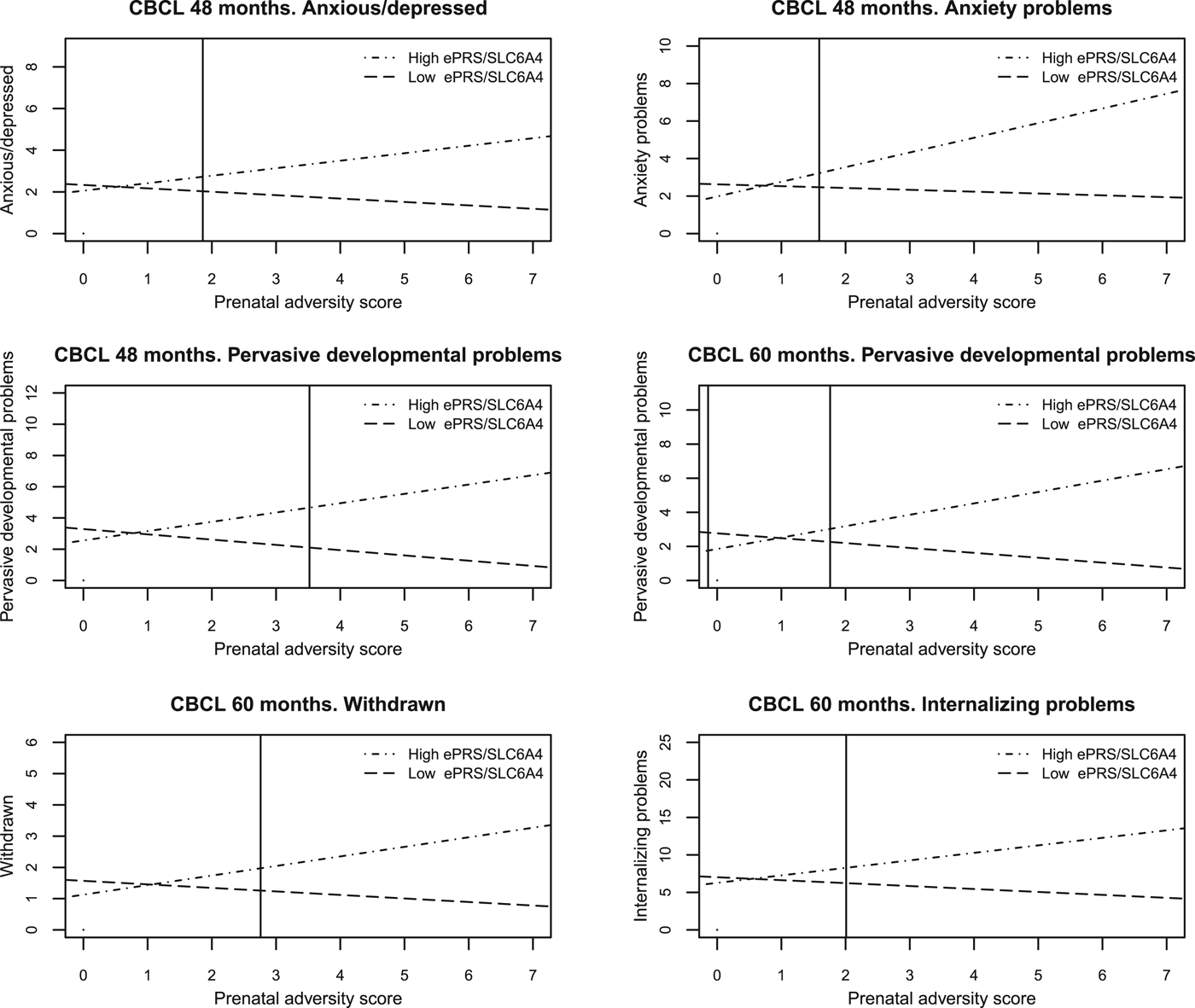
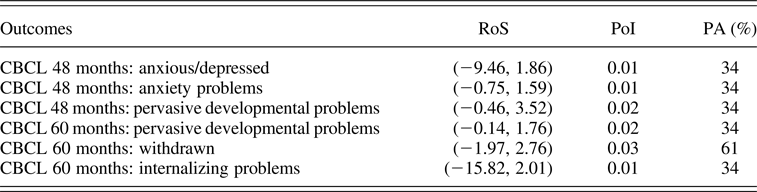
As detailed in Table 1, regions of significance analysis revealed only upper bounds of regions of significance to be within the observed range of predictor variable (prenatal adversity score), though the left (and lower) bound is very close to the lower limit of the score for some outcomes; in addition, the proportion of interaction values are consistent with the diathesis–stress model, again probably because of the truncated nature of the adversity score, which does not capture enriched or supportive prenatal contextual conditions. Notably, however, Roisman et al.’s (Reference Roisman, Newman, Fraley, Haltigan, Groh and Haydon2012) proportion (of cases) affected index meets criteria for the differential–susceptibility model (Figure 1).
Plots of the interactions between the polygenic score ePRS/SLC6A4 and the cumulative prenatal adversity score described in Silveira et al. (Reference Silveira, Pokhvisneva, Parent, Cai, Rema, Broekman, Rifkin-Graboi, Pluess, O'Donnell and Meaney2017). The vertical lines depict the regions of significance. Note: CBCL = Child Behavior Checklist; ePRS/SLC6A4 = coexpression polygenic score of gene SLC6A4.

Analysis of the interactions for six outcomes reported in Silveira et al. (Reference Silveira, Pokhvisneva, Parent, Cai, Rema, Broekman, Rifkin-Graboi, Pluess, O'Donnell and Meaney2017)

Note: PA = percentage affected (because the x-axis is reversed, with values ranging from “optimal” to “nonoptimal,” PoI and PA indices were mirrored); PoI = proportion of interaction; RoS = regions of significance are outside the reported interval.
In sum, building on the strength of a biologically informed candidate gene, notably SLC6A4, as well as that of a multiloci, network-based approach, this follow-up analysis suggests that our polygenic score could distinguish a subgroup of children that was more vulnerable to the anticipated adverse effects of higher levels of prenatal adversity. Intriguingly, some evidence also suggested that these same putatively “vulnerable” children benefited more than others from low levels of adversity. Considered together, these results raise the possibility that if our index of prenatal exposure had ranged from highly adverse to highly supportive, stronger evidence consistent with differential susceptibility might have emerged. This speculation suggests that future research should focus not on the degree of prenatal adversity only, but also the degree to which pregnant women feel supported, cared for, and psychologically well off when investigating effects of prenatal exposures.