For the last 15 years, much investigation has focused on the relationship between comprehension (making meaning from the propositional content of input) and input processing (making connections between the meaning and the forms that encode it) (Lee, 1987, 1998, 1999, 2002a, 2002b; Lee, Cadierno, Glass, & VanPatten, 1997; Lee & Rodríguez, 1997; Leeser, 2004; Leow, 1993, 1995, 1997; among others). Although the exact nature of the relationship between comprehension and input processing has yet to be established, the research has supported the notion that making meaning is a necessary prerequisite for the making of form-meaning connections; that is, a second language (L2) learner must comprehend the message before mapping its meaning to the specific forms that convey it.
Research on L2 reading has shown that when learners engage input in the form of a written text, they are able to develop their linguistic systems incidentally; that is, as learners process a text for the primary function of comprehending it (or understanding its propositional content), their linguistic competence might be enhanced. This language development is termed incidental because it occurs as a result of reading when the primary focus of the learner is on creating meaning from the text rather than on learning new words or other formal aspects of the language. This phenomenon has been referred to as the “power of reading” (Krashen, 1993) and, for the most part, it has been demonstrated with respect to the acquisition of new L2 vocabulary (for an excellent review of incidental acquisition of L2 vocabulary, see Huckin & Coady, 1999). A more recent line of inquiry in L2 reading has investigated the extent to which learners are able to acquire previously unfamiliar verbal morphology through reading. Specifically, this research has focused on the conditions under which learners acquire the Spanish future tense incidentally (Lee, 2002a, 2002b; Leeser, 2004).
What factors, then, affect learners' abilities to make meaning (comprehension) and form-meaning connections (input processing) while processing a written text containing previously unfamiliar forms for meaning? Do characteristics of the input that facilitate comprehension also facilitate acquisition of forms? The present study addresses these questions using VanPatten's (1996, 2003, 2004, and elsewhere) model of input processing as a general framework. It is important to note that this model attempts to describe or explain only one of the many processes involved in SLA. VanPatten (2004) stated that this model “attempts to capture under what conditions learners may or may not make connections between a form and its meaning and the processes they initially bring to the task of acquisition” (p. 6). This framework, although not suitable for investigating all processes involved in SLA, is appropriate for investigating incidental acquisition by very early-stage learners.
Employing VanPatten's model of input processing, the purpose of the present study is to further examine the incidental acquisition of an unknown morphological form as beginning learners process a text for meaning.1
For the purpose of the present study, incidental acquisition is defined as any enhancement of the learner's linguistic system that is a byproduct of reading a text for meaning. Several anonymous SSLA reviewers commented on the controlled nature of the reading passages employed, and I agree that incidental acquisition is operationalized in such a way here that it does not provide direct understanding about what happens when a student simply picks up a text and starts reading. At the same time, if learners are not able to enhance their linguistic systems through reading in controlled settings with passages that contain numerous target forms, it is not likely that such linguistic development would take place in less controlled conditions.
BACKGROUND AND MOTIVATION FOR THE STUDY
The Lexical Preference Principle
VanPatten (1996, 2003, 2004) proposed a series of principles and their corollaries that explain how learners go about making form-meaning connections in order to begin constructing a L2 linguistic system. The present discussion focuses on the lexical preference principle (LPP): “Learners will tend to rely on lexical items as opposed to grammatical form to get meaning when both encode the same semantic information” (VanPatten, 2004, p. 9). In (1), for example, futurity is marked twice—once by the lexical item mañana “tomorrow” and again by the morphological future tense ending -á.
(1) Mañana el hombre hablará con su jefe. “Tomorrow the man will speak with his boss.”
According to the LPP, a learner will tend to comprehend the future nature of the event by processing the lexical item mañana “tomorrow” before processing the future verb morphology contained in hablará “will speak.” Learners who do not have lexical cues must search for other ways to assign temporality; that is, they must rely on form. Without lexical cues to meaning, learners, in theory, will be more likely to detect forms in the input and begin input processing. A logical extension of this theory is that learners exposed to lexical cues to the time frame will not need to attend to the grammatical form that encodes the same information. However, the research to date has not demonstrated that exposure to lexical cues to meaning inhibits learners' noticing of the forms in the input. Neither has it supported the idea that learners who are not exposed to such lexical cues more successfully detect the forms in the input, a step that is obligatory for making form-meaning connections. In the present study, these lexical cues to the time frame of a given phrase or excerpt of discourse are referred to as lexical temporal indicators (LTIs). They can appear in the form of temporal adverbs (such as yesterday or tomorrow), in the form of a date (e.g., in the year 1972), or in the form of nouns or adjectives in the input (such as medieval or future). By focusing on the variable of the presence or absence of LTIs, this study seeks to explore the extent to which the data support VanPatten's LPP when the target form is unfamiliar.
Research on LTIs
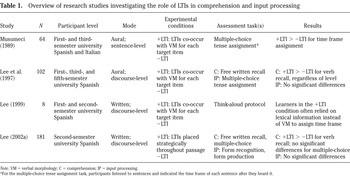
Several studies (Lee, 1999, 2002a; Lee et al., 1997; Musumeci, 1989) focused explicitly on how learners of Spanish utilize LTIs for comprehension (i.e., making meaning) and input processing (i.e., making form-meaning connections); these studies are summarized in Table 1. Methodological considerations that inform the present study, such as the mode of input, text interaction format, means of measurement, and treatment of the LTIs in these previous studies will be examined in this subsection.
Overview of research studies investigating the role of LTIs in comprehension and input processing

Mode of Input and Text Interaction Format.
In two of the studies that investigated the role of LTIs in the comprehension and input processing of tense in a foreign language (Lee et al., 1997; Musumeci, 1989), the mode of the input was aural; that is, the learners heard rather than read the stimulus sentences (Musumeci) or the passage (Lee et al.). In Lee (1999), with an adapted version of the passage employed in Lee et al., the mode of the input was written rather than aural, and the learners were asked to think aloud as they read. Although the content of the passages and the target morphological form (third-person preterit) were parallel, strong comparisons between the studies are difficult to make due to the contrasts in the mode of the input (as well as the means of measurement, discussed in the next subsection). Factors such as the acoustical saliency of the grammatical items in question (Barcroft & VanPatten, 1997; Rosa & O'Neill, 1998) and lexical cues contribute to the learners' ability to process the input for form. Research on the effects of the mode of input demonstrated that learners perform significantly better on measures of both comprehension and input processing when the input is written rather than aural (Greenslade, Bouden, & Sanz, 1999; Leeser, 2004; Leow, 1995).
Both Lee (1999) and Lee (2002a) used reading passages, but in the former study the learners conducted think-aloud protocols, and in the latter the learners read silently. Think-aloud protocols—concurrent verbal reports in which learners are asked to externalize their mental processes as they complete a task—have been employed in SLA research as a means of exploring learners' cognitive processes (for excellent reviews of studies that utilized think-aloud protocols, see Bowles & Leow, 2005, and Leow & Morgan-Short, 2004). Ericsson and Simon (1993), in their review of the use of verbal protocols to study cognitive processes, suggested that studies employ concurrent (online as the task is being completed) rather than retrospective (after completing the task) protocols whenever possible to ensure that the verbalizations reflect mental processes rather than the recollection of mental processes. In Lee (1999), the think-aloud protocols were concurrent (or introspective); that is, the learners thought aloud while reading the text. However, the researcher also prompted the learners to externalize their thoughts by asking probing questions as they conducted the protocols, which served to shift the nature of the verbal reports from nonmetalinguistic to metalinguistic. Nonmetalinguistic verbal reports are those in which learners are asked to think aloud as they complete a task, without offering justifications or reasoning for their thoughts; that is, they are not asked to reflect on what processes they think they are using to complete the task. In contrast, metalinguistic verbal reports require learners to offer rationales for their thought processes as they conduct a task. The distinction between nonmetalinguistic verbal reports and metalinguistic verbal reports has been described as “self-revelational” versus “self-observational” (Cohen, 2000).
However, concerns have been raised as to the validity of employing think-aloud protocols as a means of data collection because of the possibility that the act of thinking aloud actually adds an additional task that might affect processing (the use of metalinguistic verbalizations, specifically, were critiqued as a form of data collection by Ellis, 2001, and Jourdenais, 2001, among others). The term reactivity has been used to describe the phenomenon of a concurrent verbal report resulting in different processing than the completion of the same task without thinking aloud (Bowles & Leow, 2005; Leow, 2001; Leow & Morgan-Short, 2004). Two recent studies, one that investigated beginning learners (Leow & Morgan-Short) and another that investigated more advanced learners (Bowles & Leow), explored the issue of reactivity when concurrent think-aloud protocols were employed while learners read an L2 text. Neither study reported significant differences on measures of comprehension and form processing between learners who thought aloud and those who read the text silently. However, Bowles and Leow pointed out that more investigation into the validity of verbal protocols is needed in order to explore whether reactivity in think-alouds varies “according to a number of factors including task type, text length and type, text difficulty, and linguistic structure and individual differences” (p. 435).
The present study seeks to add to this growing body of literature by using written input—a reading passage—to investigate the role of LTIs in the comprehension and input processing of tense in a foreign language. Both silent reading and think-aloud protocols are used to explore whether the text interaction format has an effect on learner comprehension and input processing as learners confront previously unfamiliar verb forms both with and without the benefit of lexical cues to the time frame.
Means of Measurement.
Another difference in the studies reviewed relates to the means of measuring comprehension and input processing. Musumeci (1989) utilized a multiple-choice tense identification task that directed learners to indicate if the target sentence referred to the past, present, or future. Lee et al. (1997) used two tasks, a free written recall in the learners' native language (to measure comprehension) and a multiple-choice tense identification task that provided the infinitive of the target verb and asked the learners to determine if the verb they heard in the passage referred to the past, present, or future (to measure input processing). It is noteworthy that the task that Lee et al. employed to measure input processing (the tense identification task) is very similar to the task that Musumeci employed to measure comprehension. In fact, it is difficult to see a clear relationship between Lee et al.'s tense identification task and Lee and VanPatten's (1995) conceptualization of input processing, defined as making form-meaning connections. Because the target verbs appeared in their infinitival form in the tense identification task, it seems that the learners were asked to indicate that they understood the verbs' meanings, or time frame, in the passage without necessarily noticing the forms that encoded this meaning.
Finally, Lee (2002a) made use of various means of measuring comprehension and input processing. To measure comprehension, he employed both a free written recall and a multiple-choice comprehension task in the learners' native language. Each multiple-choice item consisted of a target sentence from the passage translated into English with a blank in place of the target verb, and below each item were four choices that included the target verb (again in English) conjugated in the past, present, present perfect, and future tense. To measure input processing, Lee again utilized two tasks: a forms-production task (completed by one half of the participants) and a forms-recognition task (completed by the other half). The production task consisted of a cloze passage in Spanish with the infinitives of the target verbs provided in parentheses; participants were instructed to conjugate each verb in the same form that was given in the passage that they had just read. The recognition task included the same sentences as the production task but provided the learners with target verbs conjugated in the past, present, present perfect, and future (with their order varying from item to item). Participants were to select “the form of the word that appeared in the passage” they read (p. 79). Unlike the tasks used in Lee et al. (1997), successful completion of both the form-recognition task and the form-production task required the learners to detect (Tomlin & Villa, 1994) or notice (Schmidt, 1990, 1995) the form of the target verbs in the passage; detection of a form is a necessary step for making form-meaning connections. Due to the requirements of Lee's tasks—because they were more carefully focused on the detection or recognition of the novel verb form by the participants—his study provides more robust evidence for the role of LTIs in input processing than the other studies. To advance this line of inquiry, the present study also employs tasks that require participants to demonstrate that they have detected the novel forms in the input.
Treatment of LTIs.
Another methodological consideration in the previous research on the role of LTIs is the treatment of these lexical cues in the input. Because Musumeci (1989) studied the effect of LTIs at the sentence level, each target sentence read aloud under the +lexical cue condition included a temporal adverb. She found that learners in the +LTI conditions (one with a gesture component, one without) scored significantly higher than the learners in the −LTI conditions (both with and without the gesture component) on a task that required them to assign temporality. Lee et al. (1997) investigated the same phenomenon at the discourse (rather than sentence) level, also employing a temporal adverb in every sentence that included a target verb. In contrast to Musumeci's results, learners in the +LTI condition in Lee et al.'s study did not score significantly higher on a task that required them to assign a time frame to the verbs that they heard in the passage. Lee (1999) used materials adapted from Lee et al. and also included a temporal adverb as a lexical cue in each sentence that contained a morphologically marked target verb. In this study participants thought aloud as they read the passage. Lee found that learners who read the passages with adverbial lexical clues would often rely on these clues and not on the verb forms in order to assign past tense, and in some cases the learners would rely on these clues to create a temporal framework for the whole text (which in one instance was overextended to present tense verbs in the passage). Even in the texts with only morphological clues, the learners often relied on context or comprehension strategies instead of morphological rule use to circumvent processing the text for forms (especially in the case of participants with low comprehension scores). These observations led Lee to conclude that while readers are engaged in processing a text for meaning, they sometimes (but not always) also process it for form. Any difficulty they have with processing for meaning might impede their ability to process for form.
Because Lee (2002a) also investigated the frequency of exposure to the target form, with one exposure condition that contained 16 target forms, he concluded that a passage with co-occurring adverbs in every passage “read in a most unauthentic way” (p. 62). Instead, following the finding of Lee (1999) that learners create a general temporal framework, he elected to “place adverbs strategically throughout the passages, in particular, at the beginning of paragraphs” (2002a, p. 62). Lee (2002a) found that those learners who read the version of the passage that included LTIs recalled a significantly greater number of the target verbs than those who did not, but even though the difference between the two groups reached a level of significance (p < .0001), the actual number of recalled target items was very low (for an average of 10 target items, the +LTI group recalled a mean of 1.169, whereas the mean score for the −LTI group was 0.719). On the second measure of comprehension, a multiple-choice comprehension task, Lee found no significant differences with respect to the presence or absence of LTIs. On measures of input processing, the presence or absence of LTIs was also not found to significantly affect the learners' recognition or production of the forms in the passage. In his discussion of the results, Lee speculated that the LTIs “may not have been sufficient in number nor specific enough in their placement to aid comprehension or detract from processing the form of the target verbs” (2002a, p. 73).
Summary of Previous Research.
Although the research reviewed in this section offers insight into the role of LTIs in the acquisition of Spanish, the methodologies employed by the various studies are disparate to the extent that it is difficult to draw firm conclusions with respect to both comprehension and input processing. According to VanPatten's model of input processing, the presence of these lexical cues should serve to enhance comprehension or learners' ability to make meaning from the input. Musumeci (1989) and Lee et al. (1997) provided evidence for this aspect of the model, whereas Lee (1999) demonstrated that, for the most part, the learners in his study who read the version of the passage that included temporal adverbs only made sporadic use of such lexical cues. Lee (2002a) offered conflicting evidence as to the role of LTIs in learner comprehension at the initial stage of acquisition, with lexical cues significantly enhancing the learners' performance on one measure of comprehension (free recall) but not the second (multiple-choice comprehension questions). Given these findings, the question arises: When confronted with a novel form, would very early-stage learners benefit from a verb-specific time frame that included LTIs that co-occur with each novel form, or at this stage are they as yet unable to make use of lexical cues to the time frame in the input?
With respect to input processing, or making form-meaning connections, VanPatten's model suggests that the presence of LTIs might actually impede the mapping of form and meaning because the learner can (and prefers to) rely on the semantic information relayed in the lexical cue to assign tense, without necessarily allocating attention to the morphological encoding of the verb. Lee (1999) offered evidence of this phenomenon, with two high comprehenders in the −LTI condition being the only learners to make consistent use of the verb morphology to assign tense. However, because Lee was conducting an exploratory study with a limited subject pool and because he made “no claims as to [the learners'] depth of knowledge of the target forms” (p. 2), it seems that these learners had already acquired the form in question; that is, their data do not speak to the process of acquisition of the form but rather the end point. Only Lee (2002a) included a research design that makes it possible to make claims about the relationship between comprehension and input processing of a novel form. However, as discussed previously, the study's treatment of the LTIs (limited number and strategic placement) precludes firm conclusions as to the role of these lexical clues in the acquisition of an unfamiliar morphological form. The expected finding would be that learners who read the passage without LTIs would recall and produce more target forms on the measures of input processing due to the fact that they were forced to rely on the forms alone as they made meaning from the text.
PRESENT STUDY: GOALS AND RESEARCH QUESTIONS
The present study seeks to build on previous research on the role of LTIs by addressing several methodological considerations. First, in this study, comprehension and input processing are measured in the same design in order to confirm that LTIs indeed facilitate comprehension and to further investigate their role in input processing. Second, the measures of input processing require that the learners demonstrate that they have detected the form in the input, a prerequisite of processing. All of the LTIs co-occur with each target form in the input, although care was taken to make the passage sound as natural as possible. This study also investigates the role of LTIs in the comprehension and input processing of an unknown morphological form in order to focus on the initial stages of acquisition. Finally, the present study investigates the effects that the text interaction format—silent reading and think-aloud reading protocols (concurrent and nonmetalinguistic)—might have on learner comprehension and input processing.
Based on these considerations, the following research questions will guide the present study:
- Does the presence or absence of LTIs as a cue to meaning affect comprehension of an unfamiliar morphological form in a passage during a silent reading or a think-aloud protocol?
- Does the presence or absence of LTIs as a cue to meaning affect input processing of an unfamiliar morphological form in a passage (in terms of form recognition and form production) during a silent reading or a think-aloud protocol?
- What is the role of the text interaction format on learner comprehension and input processing?
METHODS
Design
To investigate the effect of the presence or absence of LTIs, an experiment was conducted to examine how these cues to meaning affect comprehension and input processing of an unfamiliar morphological form in two text interaction formats: silent reading and a think-aloud protocol. The participants in the study were assigned to one of four groups based on text interaction format: silent reading +LTI, silent reading −LTI, think-aloud +LTI, or think-aloud −LTI. The +LTI groups in each condition read a version of the passage that included lexical clues to meaning in addition to the verb morphology, whereas the −LTI groups read a version of the passage with the verb morphology only. After reading the passage, all participants completed the same multiple-choice comprehension task. To measure input processing, participants then completed one of two production tasks: Half of the participants in each condition completed a multiple-choice form-recognition task and the other half completed a cloze passage production task. A detailed description of the two versions of the text and the three tasks are presented in the Materials and Scoring subsection.
Participants
The participants in this study were learners of Spanish from 15 intact classes of a one-semester accelerated elementary Spanish course at a large American university. For a participant's data to be included, all of the following criteria had to be met: (a) English was the participant's reported native language, (b) the participant completed all tasks in the study packet, (c) the participant followed all of the task instructions, (d) the participant did not already know the target form (as established by a screening pretest of verb form knowledge), and (e) the participant had not completed more than 2 years of high-school Spanish.
Of the original 257 learners to whom materials for the silent reading condition were distributed, 140 met all of the criteria. Only the data of these 140 learners were included in the statistical analyses. For the think-aloud condition, of the 37 participants to whom materials were distributed, 21 met all of the criteria. Only the data of these 21 participants were included in the statistical analyses.
All of the participants were enrolled in a semester-long accelerated elementary Spanish class that covers the same material as a regular two-semester sequence of elementary Spanish. The course is designed for learners who have taken Spanish in high school but who do not score well enough on a placement test to be placed in a higher level. The course is based on a communicative, task-based approach; participants were accustomed to performing tasks in all four language skills (reading, writing, listening, and speaking) both during class activities and for homework. All instructors of the course used the same text, syllabus, and exams. Classes met 4 days per week, for 50 min each day. During these classes, the learners completed task-based activities that required the use of targeted vocabulary and grammatical structures presented in the textbook. Participants were chosen from this level for two reasons: (a) The target form had not been presented to the learners at the time of data collection and (b) there were a sufficient number of sections of this level to assure a robust participant pool.
Target Form
The third-person singular form of the Spanish synthetic future tense (see Appendix A) was the target form chosen for this study for the following reasons: (a) It is a consistent form that is built from the infinitive and uses the same paradigm for all verb classes (-ar, -er, and -ir verbs); (b) it is perceptually salient in written mode because of the written accent on the final vowel; (c) it is a form that the participants had not previously encountered. This third reason was especially vital because the purpose of this study was to investigate how learners attach meaning to an unfamiliar form encountered in the input. The synthetic future tense is not formally presented to L2 Spanish learners until the very end of the accelerated elementary Spanish course from which participants were taken for this study. The data were collected prior to this point in the semester. Additionally, it is more common in classroom settings to convey futurity by using the periphrastic construction ir a + infinitive. This practice diminished the possibility that the participants were exposed to the targeted future form in classroom discourse (Leeser, 2003). In spite of this, in order to verify that the participants had no prior knowledge of the Spanish future, a test of verb form knowledge was administered prior to the treatment in the experiment.
Materials and Scoring
The materials used in the silent reading condition included a packet that consisted of an informed consent statement, a screening test of verb form knowledge, a language experience background questionnaire, a reading passage in one of two conditions (+LTI or −LTI), a multiple-choice comprehension test, and either a form-recognition test or a form-production test. The materials for the think-aloud condition were identical but also included instructions for conducting a think-aloud protocol as well as a model think-aloud protocol. Each of these materials is described in the following subsections.
Test of Verb Form Knowledge.
The purpose of the test of verb form knowledge was to identify those participants who already possessed some knowledge of the future tense, in order to exclude their data from analysis. Because this study investigated learners' ability to process a new morphological form, it was imperative that no participant knew the future tense forms. The test of verb form knowledge, following Lee (2002a), was a brief 24-item verb conjugation task. Participants were asked to conjugate six verbs (two -ar, two -er, and two -ir) in the first-person singular form of the present indicative, preterit, present perfect, and future tense. They were provided the infinitive of each of the six verbs with its English translation. Below each infinitive, the verb was conjugated in English in the present indicative, preterit, present perfect, and future tense, with blanks next to each item. The participants were asked to provide the Spanish equivalent of each of the verb forms and to try to not leave any blanks. The equivalent forms in English rather than tense labels (e.g., present indicative, preterit) were used as a prompt in order to focus the pretest on meaning rather than merely testing knowledge of the labels themselves; that is, a learner might be able to produce the Spanish equivalent of “I have called” but not know that this form is called the present perfect. Following Lee, the test of verb form knowledge purposefully did not include a form-recognition test, to ensure that the participants' initial exposure to the future tense did in fact take place when he or she completed the experimental portion of the packet.
Any participant who indicated even partial knowledge of the future tense was excluded from the experiment. Any form that included an accent mark or any infinitive-based form (such as llamaría, llamara, or *llamá) resulted in the participant's exclusion from the study. Only the data from those participants who demonstrated absolutely no prior knowledge of the future tense on this test were included.2
An anonymous SSLA reviewer suggested that because the test of verb form knowledge required learners to produce future verb forms, it cannot validly claim to demonstrate that a learner had no knowledge of the future tense. Whereas I acknowledge the limitation of this screening measure (i.e., it does not elicit whether the learners could recognize the future), employing a verb-form-recognition task would have exposed the learners to the target form prior to treatment.
Language Experience Background Questionnaire.
This questionnaire was included to ensure that all participants' native language was English. The participants were also asked to disclose the number of years of high-school Spanish they had taken as well as any other languages they had studied. Any participant who indicated that he or she did not speak English with his or her parents or who had taken more than 2 years of high-school Spanish was excluded from the participant pool.
Examples of Think-Aloud Protocol and Warm-up Passage.
The materials in the think-aloud condition included an example of a concurrent, nonmetalinguistic think-aloud protocol in order to clearly demonstrate what the participants were expected to do. On the left side of the page was a brief paragraph that corresponded to the text being processed during the example think-aloud protocol. On the right side of the page was an actual transcription of a student performing a think-aloud protocol using the text on the left side of the page. The participants listened to an audio-recording of the example think-aloud protocol as they read the transcription. The audio-recording was performed by a volunteer with a proficiency level similar to that of the participants in the study. The model was provided to avoid any misunderstandings about the researcher's expectations. If participants did not understand that their thoughts were precisely what the researcher wanted to elicit, they might have felt silly or embarrassed about externalizing their thoughts while reading. The model also demonstrated that the think-aloud protocol was not expected to be perfect; in the recording, the learner stumbles over words, misinterprets phrases, repeats himself, and paraphrases. Additionally, the sample think-aloud demonstrated that learners were not expected to give specific rationales or rules.
To provide the participants with an opportunity to familiarize themselves with performing a think-aloud protocol, a warm-up passage was included in the study packet. However, the participants were not informed that this think-aloud protocol was being conducted as a warm-up and would not be included as data for the present experiment. This was to ensure that the participants took the warm-up seriously. The warm-up passage, entitled Catarina: Una estudiante “Catarina: A student,” was a very brief passage created for the purpose of the activity. It was brief due to the time constraints of the data collection session. The participants were asked to perform a think-aloud protocol on this warm-up passage, which was audio-recorded.
Treatment Passages.
The treatment passages were versions of a short narrative modified from Lee's (2002a) adaptation of the authentic text El hogar electrónico “The electronic home.” Each passage included 13 target forms, with approximately 1 target form per sentence. The number of target forms included in the passage attempted to balance the conflicting requirements of providing not only sufficient but optimal exposure to the target forms (Lee, 2002a) and ensuring natural-sounding discourse in a brief passage. One version of the narrative began with the title En el futuro “In the future” and contained one LTI in each sentence in which a target form appeared (see Appendix B). The LTIs included dates (para el año 2012 “in the year 2012”) and temporal adverbs (algún día “some day”) as well as noun phrases (la casa del futuro “the house of the future”). The decision to include a LTI in each sentence that contained a target form was based on Lee's (2002a) findings that a passage that included LTIs only at the beginning of paragraphs (creating a general rather than a verb-specific time frame) did not significantly improve learner comprehension or detract from input processing. He suggested that future research consider creating a verb-specific time frame by having the LTIs co-occur with each target form, following Lee et al. (1997). In the second version of the passage, the LTIs were deleted; the passage was identical in every other respect (see Appendix C).3
All materials adapted from Lee (2002a) were used with permission from the author.
Task Measuring Comprehension.
After reading one of the two versions of the passage silently to themselves or conducting the think-aloud protocol, the participants were asked to complete a 13-item multiple-choice comprehension test in English. The purpose of the multiple-choice test was to determine comprehension of the future actions in the passage. This task was adapted from Lee (2002a) and included one item for each target verb that appeared in the passage, in the order in which they originally appeared. The items were made up of sentences from the −LTI version of the passage translated into English, with a blank in place of each target verb (see Appendix D).4
Due to space limitations, sample items of the tasks are provided in Appendixes D–F. The complete version of the tasks can be obtained by contacting the author. An anonymous SSLA reviewer also suggested that the multiple-choice comprehension task might better be named a receptive test of grammatical meaning because it does not measure the learners' understanding of the prepositional content of the text. I chose to maintain the multiple-choice comprehension test label because the aim of the task was to determine if the learners were able to extract the future meaning of the verbs in the passage. This label has also been used by Lee (2002a), Leeser (2004), and others for such tasks.
Form-Recognition Task.
Immediately after the multiple-choice comprehension test, half of the packets contained a multiple-choice form-recognition task adapted from Lee (2002a) (see Appendix E). The instructions indicated that the participant was to select the form of the word that appeared in the passage that he or she had read. The task included 13 items in Spanish (without LTIs) that corresponded with the target sentences in the passage, in the order in which they had originally appeared. In place of the verb in each sentence was a blank, and below each item were four choices in random order: (a) the target verb conjugated in the present tense, (b) the target verb conjugated in the preterit tense, (c) the target verb conjugated in the present perfect, and (d) the target verb conjugated in the future tense, which was the correct answer for each item.
The purpose of the form-recognition task was to ascertain if the participants had noticed the new (target) forms in the passage as they read silently to themselves. According to VanPatten's model of input processing, learners must notice (Schmidt, 1990, 1995) or detect (Tomlin & Villa, 1994) the forms in the input. By demonstrating that they had recognized the forms, and hence indicating that some type of cognitive registration had occurred, the participants could be said to have at least begun processing the new forms to which they had been exposed in the passage. Each correct answer on the multiple-choice form-recognition task was assigned 1 point, yielding a possible score of 13 points.
Form-Production Task.
Immediately after the multiple-choice comprehension test, half of the packets contained a form-production task (see Appendix F). This task was also adapted from Lee (2002a) and consisted of a modified cloze passage in Spanish that included the target sentences from the passage, again without LTIs. In each sentence, the conjugated target verb was replaced by a blank space followed by the infinitive of the target verb in parentheses. The participants were instructed to conjugate the verb in parentheses in the same form as it was given in the passage.
The purpose of this task was to determine whether the participants were able to process the new forms to which they were exposed in the passage to the extent that they were able to produce these forms exactly or produce at least some aspects of the forms. Because Lee (2002a) reported extremely low mean scores for his form-production task following an exact scoring criteria, he suggested including “approximative forms” (p. 74) in future analyses, as evidence that participants indeed registered elements of the target structure. Therefore, a less rigid scoring procedure was decided upon for the present study in order to determine if the participants processed any elements of the forms in the input. Forms that met the following criteria were counted as correct: (a) any form with an accented terminal vowel, such as *dependá or *dependé, and (b) any form that was built from the infinitive rather than verb stem, such as *dependere or *dependera.5
An anonymous SSLA reviewer noted that other Spanish verb forms share characteristics similar to those accepted as approximative forms in this study. The Spanish preterit tense is formed by adding an accented terminal -é in the first-person singular and an accented terminal -ó in the third-person singular. The Spanish conditional tense (to which the learners in this study had not been formally exposed) is constructed from the infinitive rather than the root of the verb.
Procedure
The silent reading data were collected by the researcher on one class day in the participants' regular classroom during their regularly scheduled classes. The think-aloud data were collected by the researcher on one class day in a language laboratory with audio-recording equipment during the participants' regularly scheduled classes. The data collection sessions for both text interaction formats lasted no longer than 40 min.
RESULTS
To determine the effect of the presence or absence of LTIs on learner comprehension and input processing of previously unfamiliar verb forms, mean scores were calculated for both text interaction formats from the raw scores of data collected from each of the three tasks. The data were then submitted to separate ANOVAs. The α level was set at .05. To compare the effects of text interaction format, the mean scores on the tasks from the silent reading condition and the think-aloud condition were compared by means of one-way ANOVAs. Again, the α level was .05.
Effect of LTIs on the Multiple-Choice Task
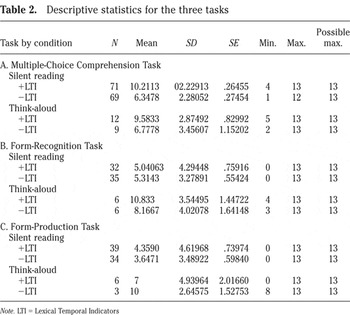
Learner comprehension was measured via the number of correct (future tense) responses on the multiple-choice comprehension task. The descriptive statistics for the silent reading and think-aloud conditions are presented in Table 2A. The mean multiple-choice task scores illustrate greater comprehension in both text interaction formats for the participants who interacted with the version of the passage that included LTIs than for those participants who read the version of the passage without LTIs.
Descriptive statistics for the three tasks

The mean scores on the multiple-choice comprehension task were then submitted to a one-way ANOVA. In the silent reading condition, the learners who read the passage that included LTIs as cues to meaning performed significantly better than those learners who read the version of the passage without LTIs on the task that measured comprehension, F(1, 138) = 102.752, p < .0001. For the think-aloud condition, although the F value did not reach a level of significance, it did approach significance, F(1, 19) = 4.125, p = .056.
Effect of LTIs on the Form-Recognition Task
The first measure of input processing was the number of correct responses on the multiple-choice form-recognition task. The descriptive statistics are presented in Table 2B for both the silent reading condition and the think-aloud condition. A cursory glance at the mean scores for the silent reading condition indicates that they are almost identical regardless of the version of the passage (+LTI or −LTI). With respect to the think-aloud condition, examining the mean scores for both groups reveals that the group that read the version of the passage that included LTIs performed slightly better than the group who read the version of the passage without them.
The mean scores from each text interaction format on the multiple-choice form-recognition task were then submitted to separate one-way ANOVAs to determine if there were significant differences among the groups. There was no significant difference between the scores of the participants who read the version of the passage that included LTIs and those who read the version of the passage without LTIs in either the silent reading condition, F(1, 65) = .010, p = .921, or the think-aloud condition, F(1, 10) = 1.485, p = .251.
Effect of LTIs on the Form-Production Task
The second measure of input processing was the number of correct responses (following loose scoring criteria) on the cloze passage form-production task. The descriptive statistics are presented for both the silent reading condition and the think-aloud condition in Table 2C. In the silent reading condition, the mean scores for the group that read the passage that included LTIs was slightly higher than the mean scores for the group that read the version of the passage without lexical cues to meaning. For the think-aloud condition, the mean scores for the group that read a passage with LTIs were lower than the mean scores for the non-LTI group. The descriptive statistics also reveal that whereas the minimum score for the first group (+LTI) was zero, the minimum score for the second group (−LTI) was 8.
The mean scores for both the silent reading and the think-aloud groups on the form-production task were then submitted to separate one-way ANOVAs, the results of which demonstrate that there was no significant difference between the participants' scores on the form-production task regardless of the presence or absence of lexical cues to meaning for either the silent reading group, F(1, 71) = 0.539, p = .465, or the think-aloud group, F(1, 7) = 0.926, p = .368.
Role of Text Interaction Format on Learner Comprehension and Processing
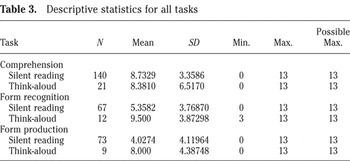
To determine whether the text interaction format—silent reading or think-aloud protocols—significantly affected learner comprehension, the mean scores on each task for both conditions were calculated and submitted to statistical analysis. Table 3 presents the descriptive statistics for scores on all tasks for both text interaction formats.
Descriptive statistics for all tasks

The mean scores were submitted to a one-way ANOVA. There was no significant difference based on text interaction format for the measure of comprehension, F(1, 159) = 0.078, p = .781. Regardless of whether the participant read the passage silently or conducted a think-aloud procedure on the passage, the scores on the multiple-choice comprehension task were very similar.
With respect to the measures of processing, the mean scores on the form-recognition task and the form-production task for both the silent reading group and the think-aloud group are also presented in Table 3. One notes right away the difference between the means for the form-recognition task: The think-aloud group clearly outperformed the silent reading group. To determine if this difference was statistically significant, the mean scores were submitted to a one-way ANOVA. There was a significant difference between the two text interaction formats with respect to form recognition, F(1, 77) = 12.194, p < .001. For the form-production task, the mean scores on the 13-item task are very different at first glance, with the scores of the think-aloud group plainly surpassing those of the silent reading group. For confirmation, the mean scores were submitted to a one-way ANOVA. Again, a significant difference was found between the text interaction formats, F(1, 80) = 7.352, p < .008. The learners who conducted a think-aloud procedure scored significantly higher on the verb form production task than those who read the same passage silently to themselves.
DISCUSSION
The results of the current study provide new insight into the role of LTIs in the incidental acquisition of an unfamiliar verb tense. For the silent reading condition, the results indicate that the presence of lexical cues to meaning in a passage enhances learner comprehension, because scores on the multiple-choice comprehension task were significantly higher for the learners who were exposed to these lexical cues. These results lend support to VanPatten's LPP, which states that learners tend to rely on lexical items rather than grammatical form to get meaning when the information is redundant. For the most part, research on the role of lexical cues in learner comprehension has supported this principle (Lee et al., 1997; Musumeci, 1989). However, Lee (2002a) found that the presence of LTIs aided comprehension as measured by a free recall task but not by a multiple-choice comprehension task. The significant positive effect of LTIs observed in this study serves to confirm Lee's suspicions that providing cues to meaning in the form of LTIs that co-occur with each target form would positively impact learner comprehension as measured by a multiple-choice task.
This finding contributes to the body of research on both incidental SLA and VanPatten's principles of input processing in several ways. First, it provides empirical evidence that beginning learners are able to make use of LTIs to create meaning from a text when they are confronted with new forms in the input. At the same time, it supports Lee's (1987, 1998) findings that L2 readers can comprehend a word's meaning without previous knowledge of the specific form. Although VanPatten's model of input processing was originally conceived to focus on aural input (Leeser, 2003)—as was the case in Musumeci (1989) and Lee et al. (1997)—this finding, in conjunction with those of Lee (2002a), offers empirical evidence that supports the LPP with respect to written input as well. Finally, it serves to resolve Lee's (2002a) contradictory findings with respect to comprehension (in that study, learners who read a version of the passage that included lexical cues recalled significantly more verbs correctly with future meaning but did not score significantly higher on the multiple-choice comprehension task) and furthers our understanding of how beginning learners make use of LTIs to aid comprehension; that is, beginning learners appear to benefit from a verb-specific time frame (i.e., LTIs that co-occur with each target verb) rather than a general time frame (i.e., occasional LTIs) as they comprehend new forms in the input.
Contrary to the observed positive effect of LTIs in the silent reading condition, no significant effect was observed for the role of LTIs in the think-aloud protocol. The learners who performed think-aloud protocols on the version of the text that included LTIs did not score significantly higher on the comprehension task than those learners who performed think-aloud protocols on the version of the passage without such lexical cues to meaning. Although the difference between the scores of the two groups did not reach a level of significance, the means (+LTI = 9.58, −LTI = 6.77) did line up in the expected order and approached significance (p = .056). The results are also very similar to the mean scores for the silent reading condition (+LTI = 10.21, −LTI = 6.3).
With respect to input processing, VanPatten's model posits that L2 learners can only attend to a limited amount of linguistic data at a time as they process input, and the LPP states specifically that “learners will tend to rely on lexical items as opposed to grammatical form to get meaning when both encode the same semantic information” (VanPatten, 2004, p. 9); that is, if learners can extract the same semantic information from a lexical cue, they will tend not to attend to the morphological form of the verb. For this reason, it was thought that if the learners did not have to attend to the forms to create meaning because of the presence of LTIs, they would be less likely to detect the form in the input. Conversely, it was thought that the learners who read passages without lexical cues to meaning (with only the form of the verb to rely on to determine meaning) would be pushed to allocate more attention to the forms in the input. Previous research has not supported this assumption about learners' noticing of forms. Lee (2002a) found that his group of learners that read a similar text with 10 target future tense forms did not demonstrate significant differences on the same type of form-recognition task (+LTI = 5.029, −LTI = 5.559). As discussed in the literature review, Lee suggested that increasing the number of LTIs to correspond with each target verb in the +LTI condition might serve to detract from learners' noticing of forms. However, the results of the form-recognition task in the silent reading condition of the present study (+LTI = 5.04, −LTI = 5.31) were very similar to Lee's (2002a) results even though the +LTI condition of the passage contained a lexical cue that co-occurred with each of the 13 target items; that is, the presence or absence of lexical cues to meaning did not affect the learners' noticing of the novel forms in the input. In fact, the learners recalled more or less the same number of future tense forms regardless of the input condition. These results indicate that learner recognition of novel forms encountered in a reading passage is not inhibited by redundant lexical markers.6
An anonymous SSLA reviewer pointed out quite rightly that these results indicate that form recognition is not enhanced by such lexical cues; that is, the LTIs did not serve a priming effect (as discussed in Mellow & Cumming, 1994), perhaps due to the fact that this was the learners' initial exposure to the target forms, and this study utilized discrete point tasks. My understanding of priming effects is that when sufficient resources are available, lexical markers can serve to remind learners to use certain redundant morphological markers.
Following the same reasoning, it was anticipated that the presence of LTIs in the passage would affect learner input processing during silent reading such that scores on a cloze passage production task would be significantly lower when learners are exposed to these lexical cues than when they are not. Furthermore, due to the fact that the task required that the learners produce the forms to which they were exposed in the input rather than merely recognize them, it was expected to require an even greater focus of attention on the forms. Although the mean scores for the form-recognition task (+LTI = 5.04, −LTI = 5.31) were slightly higher than the mean scores for the form-production task (+LTI = 4.35, −LTI = 3.64), they in no way approached the expected outcomes. Recall that loose scoring criteria were utilized when assigning points for correct responses on the form-production task. The learners produced a wide variety of forms for each verb. For example, for the verb abrirá “will open,” the approximative forms that received credit included *abrerá, *abrira, *abirira, and *abrá. Alhough not included in the statistical analysis in the previous section, the mean scores for learners who produced exact forms were calculated as well (+LTI = 1.4103, −LTI = 0.4706); these scores were again very similar to exact scores reported by Lee (2002a) on the same basic task after learners silently read a passage that only contained strategically placed lexical cues to time frame rather than cues that co-occurred with each target form (+LTI = 0.0821, −LTI = 1.433). These mean scores of approximative forms underscore that although learners are able to register certain aspects of novel forms in a written text read silently (accented terminal vowel, form built from the infinitive instead of the root), not all aspects of the novel form are registered. The results also indicate that factors other than the presence or absence of lexical cues to meaning contribute to a learner's ability to produce new forms in the input.
The research questions related to the processing of forms in the think-aloud condition must also be answered in the negative on the basis of the current findings. It was expected that the presence of LTIs in the passage would negatively impact learners' noticing of forms as measured by the form-recognition task and the form-production task. If learners are exposed to lexical cues to the time frame, the LPP could be extended to predict that these learners will not attend to the verb morphology because the lexical cues render this morphology redundant. In the silent reading condition, the difference between the scores of two groups was not significant and in fact did not even line up in the expected order (+LTI = 10.83, −LTI = 8.16). With respect to the form-production task, there was no significant difference between the scores of the learners who read the version of the passage with LTIs and the scores of the learners who read the version of the passage without such lexical cues to meaning (+LTI = 7, −LTI = 10).
In terms of the processing of forms and VanPatten's LPP, the results of the present study do not indicate that the presence of LTIs serves to detract from the learners' noticing of forms. Lee (2002a) reported similar findings, but suggested that perhaps the limited number of LTIs in his test passage might have been a confounding factor. The present study addressed this issue by investigating if the inclusion of LTIs in each target sentence would serve to further detract from the learners' ability to recognize and produce novel forms from a written text. The lack of significant differences between the scores of the learners exposed to each input condition in the present study confirms prior findings that LTIs do not detract from noticing of novel forms in the input (and allay suspicions that such findings were due to extraneous factors, such as passage characteristics). On the other hand, the fact that beginning learners were able to recognize the previously unfamiliar forms in the input and even produce approximative forms lends further empirical support to the claim that learners can enhance their linguistic systems through reading (Lee; Leow, 1997; Shook, 1994).
With regard to the comparison of text interaction formats—whether silent reading or thinking aloud affects comprehension and processing—the results of the present study indicate significant differences between the formats for the processing of forms but not for the comprehension of time frame. The lack of significant differences on the multiple-choice comprehension task corroborates the findings of Leow and Morgan-Short (2004) and Bowles and Leow (2005) that thinking aloud is not reactive; that is, thinking aloud did not add an additional attentional burden. In fact, on both measures of processing (recognition and production of targeted forms), the learners who conducted the think-aloud protocols scored significantly higher than the learners who read the text silently.
It is unclear exactly which aspect or aspects of conducting a think-aloud protocol facilitated learners' noticing of previously unfamiliar forms. The most obvious conjecture is that these learners spent more time on task. Unfortunately, this variable was not measured at the outset of the study. As reported, no participant spent longer than 40 min completing the materials, but there was a good deal of variation both between and within the groups. Many of the participants who read the passage silently used every minute to complete the materials, but there were also silent readers who worked through the tasks in as little as 20 min. On average, the think-aloud group used more time to complete the tasks, but one must consider that this group listened to a sample think-aloud protocol and conducted a brief practice think-aloud before beginning to read the treatment passage. Whereas time on task might have been a contributing factor, it is not likely that it was the only one. It is probable that thinking aloud encouraged the learners to allocate more attentional focus than reading silently, and thus they registered the forms more effectively and held them in working memory long enough to recognize or approximate them on the processing tasks.7
I am not referring to conscious learning, as one anonymous SSLA reviewer suggested. I suggest that having to think aloud (and knowing that the think-aloud protocol was recorded) caused the learners to focus their full attention on the task of understanding the passage, resulting in more effective noticing of the forms that encode the meaning; that is, I am not proposing that thinking aloud caused the learners to utilize different mental processes than the learners who read silently. Instead, I am asserting that, on the whole, the learners who thought aloud engaged the text more actively than the silent readers because they felt more accountable for their performance.
This statement is not intended to be interpreted as evidence invalidating the use of think-aloud protocols in SLA research. To the contrary, think-aloud protocols can likely offer unique insight into the acquisition process. For example, VanPatten's model of input processing specifically focuses on online processing; however, the tasks used to measure comprehension and input processing and the LPP in the empirical research to date (including the present study) have consisted of post hoc assessments; that is, the current practice has been to develop tasks that the learners complete after they are exposed to the input via the treatment, be it oral or written. Therefore, these tasks cannot tell us what learners were doing during comprehension, as pointed out by Leeser (2003) and Leow (2000). The use of audio-recorded think-aloud protocols as a means of data collection allows us to observe how the learner interacts with the input in real time. For example, the learners' think-aloud protocols were transcribed. Although reporting the analysis of these transcriptions is beyond the scope of the present study, it is worthwhile to mention the usefulness of such data. For instance, the difference between the mean scores of the multiple-choice comprehension task in the think-aloud condition (+LTI = 9.58, −LTI = 6.77) did not reach a level of significance. However, by analyzing these same learners' think-aloud protocols, it was possible to count the number of times each learner actually assigned future meaning to the verbs in the passage as they thought aloud. The mean score of a possible 13 registrations of future meaning for the group that read the version of the passage with LTIs was 7.333. Yet, the mean score of the group of learners that read the version of the passage without LTIs was 0.1111. These online processing results, when analyzed in a future study, will provide further insight into the role of lexical cues as learners confront novel forms in the input while reading.8
Other methods of measuring online processing, such as studies that measure reaction time and eye tracking, are promising lines of investigation within this framework.
LIMITATIONS AND DIRECTIONS FOR FUTURE RESEARCH
All empirical research is subject to limitations in the generalization of findings due to its controlled nature. The present study investigated the role of LTIs on the comprehension and input processing of the Spanish future tense. The Spanish synthetic future tense is a notably simple construct with a salient tense marker—that is, one form equated to one meaning in the context presented (although the future tense can also be used to express probability). This necessarily limits the generalization of the findings of the present study to verb forms that share these characteristics. Other research might include morphology that is more complex in meaning and less salient in form.
With respect to the think-aloud condition, the number of participants was admittedly small due to the nature of the data collection. Future research on larger participant pools is warranted in order to enhance the generalization of the findings related to this experiment.
Regarding the investigation of form recognition and form production, I have been very careful to limit any claims that resulted from learners' scores on these tasks to their noticing of the forms in the input. This is a prerequisite of input processing, which requires that learners connect the forms with their meanings. Before learners can make such connections, they must notice the form in the input. VanPatten (2004) explained that “processing implies that perception and noticing have occurred, but the latter two do not necessarily imply that a form has been processed (linked with meaning and/or function)” (p. 7). The tasks used in the present study do not demonstrate that forms have been connected to their meanings, only that these forms have been registered. Therefore, no claims can be made about whether these forms have been linked with their meanings. Future research should focus on the development of tasks that seek to measure the end point of input processing, such as the tasks employed in Leeser (2004).9
In Leeser's study, after reading or listening to a passage that contained 19 target third-person singular future tense forms, learners completed two tasks. In the first, the learners were asked to indicate the words that they recognized from the passage from a list of words that included the 19 target items. Learners then completed a tense-identification task in which they had to provide the best English equivalent for a list of words that included five future tense forms.
CONCLUSIONS
The findings of this study, which investigated the role of LTIs and text interaction formats in the incidental acquisition of Spanish future tense morphology, have led to several conclusions. First, LTIs in a reading passage enhance the comprehension of beginning learners as they confront new forms in written input, but these learners benefit from a verb-specific time frame (one in which LTIs co-occur with novel forms) rather than a general time frame when assigning temporality. In a sense, this finding leads one to conclude the more lexical cues to meaning, the better, which is especially noteworthy when considered in conjunction with the second conclusion, that LTIs do not detract from learners' noticing of forms in written input in terms of either recognition or production; that is, LTIs enhance comprehension without inhibiting the noticing of forms. Third, beginning learners do develop their L2 morphological systems through reading when their primary focus is text comprehension; that is, they are able to notice new forms in the input. Finally, based on measures of both recognition and production, this experiment has shown that the text interaction format of a think-aloud procedure can enhance the processing of novel forms by beginning learners.
APPENDIX A: THE SPANISH SYNTHETIC FUTURE TENSE

APPENDIX B: PASSAGE WITH LTIs
En el futuro
Para el año 2012, dicen que el 95% de la población de los países latinoamericanos dependerá de las telecomunicaciones y la tecnología. Por ejemplo, en 10 años, para entrar en lo que se llama la casa inteligente el propietario no necesitará ni llaves ni tarjeta magnética para abrir la puerta. En vez, la puerta de la casa del futuro se abrirá al reconocer su voz y compararla con un código grabado. También, dentro de 15 años, en la cocina la tostadora incluirá un mando a distancia por infrarrojos.
Muy pronto en el futuro se practicará el teletrabajo en latinoamérica tanto como en los Estados Unidos. El profesional liberal probablemente participará en videoconferencias sin salir de su casa o su oficina. Algún día, mandará el trabajo a cualquier parte del mundo instantáneamente con las tecnologías telemáticas (computadoras, la red, etc.).
Para el año 2020, cada persona recibirá toda transimisión que quiera a través de la pantalla de alta definición, alimentada por la televisión por cable y los satélites. Aún más allá en el futuro, asistirá a clases de piano o de cerámica a distancia, por ejemplo. Algún día, participará en juegos de aventura por todo el mundo electrónicamente.
¿Qué nos espera en el futuro? Según algunos sociólogos, todo esto generará aislamiento social y después influirá en las necesidades de contacto personal. Pronto, el hombre, Homo sapiens, se convertirá en el Homo electrónicus.
APPENDIX C: PASSAGE WITHOUT LTIs
Dicen que el 95% de la población de los países latinoamericanos dependerá de las telecomunicaciones y la tecnología. Por ejemplo, para entrar en lo que se llama la casa inteligente el propietario no necesitará ni llaves ni tarjeta magnética para abrir la puerta.
En vez, la puerta se abrirá al reconocer su voz y compararla con un código grabado. También, en la cocina la tostadora incluirá un mando a distancia por infrarrojos.
Se practicará el teletrabajo en latinoamérica tanto como en los Estados Unidos. El profesional liberal participará en videoconferencias sin salir de su casa o su oficina. Mandará el trabajo a cualquier parte del mundo instantáneamente con las tecnologías telemáticas (computadora, la red, etc.).
Cada persona recibirá toda transimisión que quiera a través de la pantalla de alta definición, alimentada por la televisión por cable y los satélites. Asistirá a clases de piano o de cerámica a distancia, por ejemplo. Participará en juegos de aventura por todo el mundo electrónicamente.
Según algunos sociólogos, todo esto generará aislamiento social e influirá en las necesidades de contacto personal. El hombre, Homo sapiens, se convertirá en el Homo electrónicus.
APPENDIX D: SAMPLE ITEMS: MULTIPLE-CHOICE COMPREHENSION TASK
Please answer all of the following comprehension questions by selecting the answer that was given in the passage you read.

APPENDIX E: SAMPLE ITEMS: FORM-RECOGNITION TASK
Select the form of the word that appeared in the passage you read.

APPENDIX F: SAMPLE ITEMS: FORM-PRODUCTION TASK
Conjugate the verb in parentheses in the same form as it was given in the passage.
Dicen que el 95% de la población de los países latinoamericanos _________________ (depender) de las telecomunicaciones y la tecnología. Por ejemplo, para entrar en lo que se llama la casa inteligente el propietario no ___________ (necesitar) ni llaves ni tarjeta magnética para abrir la puerta. En vez, la puerta se _____________ (abrir) al reconocer su voz y compararla con un código grabado.