Introduction
For some time now, social policy debates in Germany have been dominated by the so-called ‘Hartz IV’ legislation. Named after Peter Hartz, a former VW personnel manager and chairman of an influential welfare commission, the Hartz reforms were introduced between 2003 and 2005 and are widely regarded as having brought about the most far-reaching change in German labour market policy since the 1960s. The reforms introduced a large number of modifications to existing legislation, but it is the low level of benefits for people in receipt of the new unemployment assistance, the so-called unemployment benefit II (UBII), which continues to cause heated public debates and political disputes, not only between the government and opposition (and trade unions), but also within the ruling coalition between the Christian Democrats and their junior partner in government, the Free Democrats (FDP). In 2009, the Constitutional Court added to this debate, requiring the government to change the calculation procedure of UBII and thus increase benefit rates, particularly for children. In contrast, it is particularly the FDP which has called for lower rates and a wider gap between earnings and benefit income in order to strengthen work incentives.
German labour market policy since 2005 has been interpreted within Social Policy in two ways. For some, the creation of UBII signals the departure from an erstwhile defining policy characteristic in Germany. The fact that an overwhelming majority of workless people now receive assistance- rather than insurance-based support is regarded as a shift ‘from Bismarck to Beveridge’, that is a change from the traditionally dominant principle of ‘status protection’ (via earnings-related transfers and employment reintegration in accordance with qualification and work experience) to basic security and means-tested support only (Konle-Seidl et al., Reference Konle-Seidl, Eichhorst and Grienberger-Zingerle2007; Eichhorst et al., Reference Eichhorst, Grienberger-Zingerle, Konle-Seidl, Eichhorst, Kaufmann and Konle-Seidl2008; Mohr, Reference Mohr2008).
A second reading puts UBII in wider context of policy reforms which have contributed to an arguably dual social structure consisting of employees for whom little has changed (relatively secure jobs, good job protection, wages and benefits) and a disadvantaged group who have access to less secure and less well-paid jobs and who rely on basic social protection only. While such a division might have been developing for some time, recent social and labour market policies have arguably reinforced and institutionally cemented a structure of ‘insiders’ and ‘outsiders’ within the German welfare state (Palier and Thelen, Reference Palier and Thelen2010).
It could be argued that the two assessments appear to contradict each other. A replacement of an erstwhile dominant ‘Bismarckian’ approach in social protection generally (Hinrichs, Reference Hinrichs and Palier2010) and unemployment protection in particular (Eichhorst et al., Reference Eichhorst, Grienberger-Zingerle, Konle-Seidl, Eichhorst, Kaufmann and Konle-Seidl2008) with a basic security model seems to be at odds with a notion of dualism. The former assumes a trend towards greater equality, at a lower level, whereas the latter points to growing inequality. On the other hand, both might be compatible provided ‘dualism’ is regarded as a transitory phase. Trends of greater flexibility, deregulation and insecurity might ultimately affect also those workers who are currently better protected (Eichhorst and Marx, Reference Eichhorst and Marx2011).
In this article, we are not concerned with the contrasting or potentially complementary nature of the two assessments. Instead, we aim to demonstrate that both interpretations are questionable and, at best, only partially correct. Concretely, we make two claims. First, we argue that within German labour market policy, unemployment insurance remains highly relevant both as a source of support for individual job seekers and as a core principle within the landscape of contemporary labour market policy as a whole. Second, we contest the notion of ‘dualisation’, which suggests a situation which was (more) uniform in the past is now giving way to a polarised structure of labour market policy, that is rigid division of schemes for ‘insiders’ on the one hand and ‘outsiders’ on the other. Conceding that the institutional configuration of German labour market policy has indeed changed, we argue that the gulf between those with better protection and others who are less well protected has not widened. Instead, if anything, the Hartz reforms have led to a less pronounced scope of institutional inequality in both benefit provision as well as access to active labour market programmes.
Good-bye Bismarck? The administrative (re)construction of unemployment
Until recently, unemployed persons in Germany received benefit support and accessed training and other labour market programmes via three separate institutional routes. Funded by earmarked contributions, unemployment insurance (UI) provided earnings-related benefits and job search schemes for contributors. For job seekers no longer entitled to UI, unemployment assistance (UA; Arbeitslosenhilfe) applied until 2004. UA was paid out of general (federal) taxation and eligibility was subject to passing a means test. However, unusual in international context, the scheme granted benefits which were proportional to previous earnings. Finally, many of those not in receipt of either UI or UA claimed general flat-rate and means-tested social assistance (SA), administered and funded by municipalities and local authorities.Footnote 1 SA claimants rarely participated in federal labour market programmes, which were primarily geared towards UI (and to some extent UA) recipients. However, depending on local circumstances and priorities, municipalities and local authorities offered separate employment-oriented schemes for working-age recipients (Voges et al., Reference Voges, Jacobs, Trickey, Lødemel and Trickey2001).
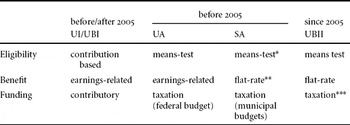
In 2005, this de-facto three-tier system was replaced by an actual two-tier scheme as a consequence of the Hartz reforms (Fleckenstein, Reference Fleckenstein2008). The latter are widely regarded as having brought about the most far-reaching change in German labour market policy since the 1960s (Seeleib-Kaiser and Fleckenstein, Reference Seeleib-Kaiser and Fleckenstein2007; Oschmiansky et al., Reference Oschmiansky, Mauer and Schulze Buschoff2007). The replacement of the second and third-tier of support with a single unemployment assistance scheme (unemployment benefit II; UBII) was a cornerstone of the reforms. This amalgamation was administratively cumbersome due to the need to create new funding and administrative structures within the multi-level German welfare state. However, as a single system of rights and obligations pertaining to benefit support and labour market programmes for persons outside of unemployment insurance (now called unemployment benefit I; UBI), the new UBII scheme has overcome previous divisions, although some administrative fragmentation has been allowed to remain (see table 1; for details see Clasen and Goerne, Reference Clasen, Goerne, Lødemel and Moreira2011).
Major characteristics of the old and new unemployment protection system

Notes:*stricter means test for SA than for UA applied; **plus additions depending on family situation and needs; ***largely federal budget plus municipal funding for accommodation.
As indicated in the introduction, the Hartz reforms have been interpreted by some as a paradigmatic change due to the arguable disappearance of the traditional dominance of so-called ‘Bismarckian’ (insurance) principles and their replacement with a Beveridgean basic security approach within German labour market policy. The major justification for such an assessment rests on three grounds. Perhaps least important is retrenchment inflicted on UI claimants, largely in terms of a shorter benefit entitlement period (see below). More relevant is the fact that the new unemployment assistance scheme no longer provides earnings-related benefits. Most crucial however is the overall composition of unemployment support in Germany today, with the vast majority of claimants in receipt of assistance rather than insurance-based benefits. This would suggest that social security in Germany has mutated to a predominately basic means-tested approach akin to the situation in the UK for example, in which the contributory Jobseekers Allowance plays a similarly marginal role with a coverage of around 20 per cent of all unemployed persons (DWP, 2010).
However, we consider the notion of a trend ‘from Bismarck to Beveridge’ inappropriate for two reasons. The first relates to the labels chosen. Although a proponent of flat-rate benefits provided at subsistence level, William Beveridge was fiercely opposed to means-testing and a strong supporter of the principle of social (National) insurance, albeit one which was encompassing and centrally administered rather than risk specific and co-directed by social partners (Timmins, Reference Timmins2001). Equally, although the term ‘Bismarckian’ is often associated with contribution funded programmes and earnings-related benefit provision (see also Palier and Martin, Reference Palier and Martin2007), it should be remembered that Bismarck was actually an ardent advocate of state-run, tax-funded and flat-rate social policy provision (Hennock, Reference Hennock2007).
Unfortunate labelling aside, there are substantive objections to the notion of the dominance of basic security at the expense of unemployment insurance. The Hartz reforms brought about significant institutional change as well as new rights and obligations in respect of transfer payments and active labour market provision for claimants within and outside of unemployment insurance.Footnote 2 As a result, the diminishing relevance of the contributory principle for unemployed job seekers has been deduced from the declining share of claimants in receipt of UBI or the growth of means-tested transfers. Indeed, while in the late 1990s a little more than half of all unemployed claimants received means-tested rather than insurance-based support, the ratio of UBI to UBII claimants was about one to four in 2008 (Bundesagentur, 2010a).
Nevertheless, for three reasons we argue that this decline cannot be interpreted as evidence for the fading importance of the insurance principle. The first has to do with changes in the administrative reconstruction of unemployment. The declining share of insurance-based support was partly the consequence of those aspects of the Hartz reforms which shortened the maximum entitlement of UBI and tightened eligibility criteria (and thus transferred some claimants from insurance to assistance support). However, the growth of means-testing within unemployment protection is largely due to other reasons. It is noticeable that immediately after the implementation of the new amalgamated system in January 2005, the number of UBII claimants was larger than the sum of UA recipients and SA recipients registered as unemployed in December 2004. The main reason for this is that a substantial proportion of working-age SA claimants had not registered as unemployed with the public employment service.Footnote 3 SA was a benefit of last resort and claimants were entitled to it irrespective of their labour market status. By contrast, the principal condition for eligibility to UBII is the ability to engage in paid work. In the wake of the reform, 90 per cent of previous working-age SA claimants became defined as ‘being able to work’ and thereby transferred to UBII (Eichhorst et al., Reference Eichhorst, Grienberger-Zingerle, Konle-Seidl, Eichhorst, Kaufmann and Konle-Seidl2008: 47). In addition, unlike the former SA system, under the UBII system each workless adult within the same household became counted as a claimant. In short, replacing SA and UA with a single scheme for working-age benefit claimants increased the number of benefit claimants considerably due to a major change in eligibility conditions (Konle-Seidl, Reference Konle-Seidl2009).
Somewhat confusingly, however, although deemed to be employable many UBII claimants are actually not counted as unemployed, such as persons who care for a child under the age of three, long-term claimants over the age of fifty-eight who look after relatives and those who participate in labour market programmes (see also Dingeldey, Reference Dingeldey, Clasen and Clegg2011). Most intriguingly, in 2009, between a quarter and a third of all UBII claimants actually had a paid job, and just under a third of this group worked for more than fifteen hours per week, which is the threshold above which they are no longer counted as unemployed. In total, these claimant groups represented more than half of all UBII claimants in December 2009 (Bundesagentur, 2010a).
In short, administrative redefinitions have made unemployment assistance in Germany a rather broad and encompassing benefit category and UBII a scheme which is not only for the unemployed (Konle-Seidl, Reference Konle-Seidl2009). This, then, is one reason why the apparent increase of means-testing within unemployment support as a whole after 2005 is an inappropriate indicator for the arguable relative decline of the relevance of unemployment insurance. More broadly, the case of UBII is a reminder of the need for caution when assessing beneficiary rates over time and across countries, taking account of differences in the institutional and administrative construction of unemployment as well as of functional equivalence between different types of benefits received by working-age persons (Erlinghagen and Knuth, Reference Erlinghagen and Knuth2010). As discussed, many recipients of unemployment assistance in Germany are actually in paid work, and most are registered as unemployed. In other countries, such as the United Kingdom for example, persons in the same labour market position, that is working in low-pay or part-time employment, would not be claiming unemployment benefit but receiving tax credits or other types of wage subsidies, and not be counted as unemployed but as employed.
The second reason why we do not regard the Hartz reforms as signalling a departure from the insurance-based principles within German labour market policy has to do with the relative stability of the scope of contributory-based support over time. In the early 1980s, unemployment insurance was received by around 40 per cent of all registered unemployed persons in West Germany, with the remainder resorting to unemployment assistance, social assistance or not entitled to any support. Throughout the 1990s, the ratio (in West Germany as well as Germany as a whole) remained below 50 per cent and was around 40 per cent in the early 2000s (Reissert, Reference Reissert2004). After the Hartz reforms, the ratio dropped to about a third of all registered unemployed (Bundesagentur, 2010a). In other words, the reforms have contributed to a relative decline of the scope of unemployment insurance, but contrasting the current situation with any period over the past thirty years shows that the degree of change has been far from radical.
Thirdly, looking at flows rather than stocks of unemployed persons in receipt of either UBI or UBII further questions the thesis of a hollowing-out of the insurance principle. In the mid 1990s, between 50 per cent and 60 per cent of West Germans who became unemployed were eligible for insurance benefits (Bundesanstalt für Arbeit, 2001). In 2009, the monthly number of persons entering UBI was about the same or even slightly higher than the number of those accessing UBII (Bundesagentur, 2010a), and many of the latter were not unemployed, as discussed above. Moreover, close to 90 per cent of all those who had entered UBI left the benefit receipt within twelve months, that is before their entitlement to insurance-based benefit ran out, while only about eight per cent actually transferred from UBI to UBII (Bundesagentur, 2010a). Thus, whether looking at the role of different unemployment protection schemes from a ‘claimant stock’ or from a ‘claimant flow’ perspective, we claim that the Hartz reforms have not radically affected the overall characteristics of supporting registered unemployment in Germany. In other words, while certainly not strengthening the contributory principle, the reforms have not dented its role much either.
Of course, rather than claimant ratios, other indicators might be employed in order to substantiate the claim of a radical shift from insurance to assistance, such as a decline in benefit levels or benefit entitlement, or changes in the nature of and access to active labour market programmes. As for benefit generosity, there has been remarkably little change for those in receipt of unemployment insurance. In the early 1980s, claimants with dependent children received unemployment benefit which was equivalent 68 per cent of previous net earnings. Today the replacement rate is 67 per cent. For those without children, the respective rate was 63 per cent and is now 60 per cent. The Hartz reforms did not alter these rates – but significantly changed maximum benefit entitlement. Depending on individual contribution records, prior to 2005 some unemployed people (over the age of forty-five) were able to receive more than the standard (twelve months) benefit support, with a maximum of thirty-two months for those older than fifty-seven. The Hartz reforms introduced a standard twelve month period for all under the age of fifty-five (and maximum of eighteen months for older claimants). This restriction is often referred to as a major indicator of paradigmatic change and departure from arguably traditional principles of benefit rights linked to contribution records. However, such a notion seems unfounded given that benefit entitlement for most of the post-war era had been twelve months and was extended only in 1985 (Clasen, Reference Clasen2005: 195). Claims that arguably traditional ‘Bismarckian’ principles applied only for the subsequent period of twenty years would thus seem rather bizarre. Moreover, in 2008, the government extended the maximum entitlement (for older persons) once again (to twenty-four months), a move which is likely to strengthen the relevance of contributory and earnings-related unemployment protection for an even larger proportion of jobless persons in Germany.
To sum up, the thesis of a departure from insurance principles and of the growing importance of means testing has been used for framing the analysis of recent reforms in German labour market policy. Notwithstanding its popularity, the discussion above demonstrates that such an assessment exaggerates the scope of actual change brought about by the Hartz reforms. A closer look at the administrative construction of unemployment, as well as claimant stock and flow data since the 1980s, shows that the insurance element within unemployment support has remained significant. Claims of the erosion and marginalisation of insurance principles inflate the impact of the Hartz reforms and ignore the persistence of reciprocity principles based on contributory social security in German labour market policy.
Towards dualisation within German labour market policy?
The notion of dual or segmented labour markets with privileges for ‘insiders’, while marginalising employment conditions and opportunities for ‘outsiders’, has a long theoretical and empirical tradition (see e.g. Doeringer and Piore, Reference Doeringer and Piore1975; Wilkinson, Reference Wilkinson1981). Recently, Palier and Thelen (Reference Palier and Thelen2010) have argued that a range of policies introduced in Germany and France since the 1990s have led to the institutionalisation of new forms of dualism, which are now entrenched and politically ‘underwritten’ by governments in both countries as the outcome of reforms in industrial relations and labour market policy.
Here we address arguments only in relation to Germany and only to labour market policy, where ‘institutionalised dualism’ would suggest a division between groups of unemployed with different benefit entitlement as well as unequal access to labour market programmes. A process towards more dualisation would imply a shrinking of the relative size of the privileged (or core) group with better benefits and access to better labour market measures, and a growth in the number of those who are disadvantaged in both respects. It could also refer to a deeper division between the two, that is growing inequality in terms of benefit rights and quality of labour market support.
In terms of German labour market policy, the above would suggest a decline in the relative size of the group in receipt of unemployment insurance and expansion of the number and share of claimants resorting to assistance benefits only. In addition, it would suggest more segmentation in the scope of privileges, that is a stricter division between ‘insiders’ and ‘outsiders’. In what follows, we address these aspects separately, first turning to the notion that within German labour market policy there might be more dualisation now than there was prior to the Hartz reforms. We then ask whether the division between the ‘insiders’ and ‘outsiders’ is now deeper that it was before.
Dualisation: more or less segmentation?
On the face of it, the Hartz reforms have indeed produced a growth of the relative size of ‘outsiders’, given the increase of the number of those who now receive UBII relative to unemployment insurance. However, as demonstrated above, much of this has been the result of administrative redefinition of the terms ‘ability to work’ and ‘unemployment’. Nevertheless, in one sense the argument of dualisation in German labour market policy is justified. As discussed, the Hartz reforms replaced a de-facto three-tier system of support (unemployment insurance, unemployment assistance, social assistance) with a two-tier model, separating claimants of insurance-based UBI from those with assistance-based UBII. In other words, there is now a dual structure of German labour market policy which represents less rather than more fragmentation. However, dualisation conventionally suggests exactly the opposite, that is more (and deeper) segmentation and it is this argument which we contest here. In essence, we argue that there is now less segmentation within the landscape of German labour market policy as a whole.
Prior to the Hartz reforms, claimants of unemployment assistance, but also those on social assistance, not only received means-tested support but also remained outside of core labour market programmes, such as training and retraining (largely reserved for insurance claimants), or participated at a scale which was much lower than their proportion of all unemployed persons registered with the federal employment agency (FEA) (Clasen et al., Reference Clasen, Gold and Vincent1998). Reasons for this include a lack of programmes for long-term unemployed, but also the effects of a multi-tiered welfare state. During the 1980s and 1990s, employment offices had a financial incentive to prioritise insurance over assistance claimants since the former were funded from the unemployment insurance budget and the latter by federal taxation. Thus, transferring claimants of UI (rather than UA) into work would have a direct cost-saving effect for the FEA. In order to counteract this bias, the government provided earmarked funds for some FEA administered programmes, such as wage subsidy schemes for long-term unemployed (Clasen et al., Reference Clasen, Gold and Vincent1998). Moreover, in 1996 the FEA became obliged to allocate measures to UA recipients in accordance with their share of all benefit claimants (Steffen, Reference Steffen2009). These policies indicated the government's acknowledgement of the counterproductive effects of the strong institutional division between groups of unemployed persons inside and outside of unemployment insurance.
A further division existed between recipients of unemployment assistance on the one hand and those who (exclusively) claimed social assistance. The latter received not only means-tested benefits administered and financed at municipal level, but were all but fully excluded from most active measures commissioned at federal (FEA) level (Konle-Seidl et al., Reference Konle-Seidl, Eichhorst and Grienberger-Zingerle2007).Footnote 4 As long as long-term unemployment remained low, this situation presented only limited financial difficulties. However, with unemployment becoming a more persistent problem in the 1980s and 1990s, many local authorities responded to the pressure of supporting workless people outside of federal programmes with local job creation programmes. In some cases, these schemes contained training and qualification components, but often programmes were used explicitly as a ‘work test’, that is to establish whether claimants were actually willing to take up employment, and to potentially move claimants off benefit. In addition, municipalities made use of labour market schemes in order to transfer the financial burden of supporting long-term unemployed persons to the federal level. Almost half of all programmes offered at municipal level consisted of employment opportunities subject to social security contributions, which, if sustained for at least twelve months, subsequently established entitlement to UI (Schmid et al., Reference Schmid, Hörrmann, Maier and Steffen2004). Moreover, as the finanancial and administrative responsibility for SA was entirely devolved to municipalities, discretionary decision making and diverse local management procedures led to a considerable variation of practices in the type and scale of local labour market schemes across the country (Voges et al., Reference Voges, Jacobs, Trickey, Lødemel and Trickey2001).
The creation of a single benefit regime (UBII) abolished this dual support structure for the long-term unemployed, and standardised what previously was a highly fragmented situation. For example, formerly UA but not SA claimants were permitted to reject job offers which paid wages not commensurate with earnings received prior to unemployment or, after six months, did pay less than the level of UA received. Within UBII, every job offer is considered suitable regardless of qualifications or previous earnings even at the start of a claim (Konle-Seidl et al., Reference Konle-Seidl, Eichhorst and Grienberger-Zingerle2007), and anyone who refuses to accept a job offer could be sanctioned by a benefit reduction of 25 per cent (Blien et al., Reference Blien, Walwei and Werner2002). This then constitutes a clear change for previous UA, but not for SA claimants. As discussed in more detail below, the introduction of UBII implied a downward adjustment of transfer income for the majority of UA claimants, but SA claimants generally benefited from switching to UBII (Arntz et al., Reference Arntz, Clauss, Kraus, Schnabel, Spermann and Wiemers2007).
In addition, former SA claimants have gained access to active labour market measures from within the FEA repertoire, notwithstanding that the overall profile of labour market programmes has changed over time (see below). They can now participate in a large array of active labour market policy schemes, ranging from short-term training and start-up subsidies to longer-term programmes, including vocational education. Interestingly, the integration has worked in both directions, as a version of the above-described local employment opportunity (job creation) programmes is now also included in the new arsenal of measures for UBII claimants. The programme offers temporary work experience in areas of ‘public interest’ for unemployed persons who are often difficult to place into unsubsidised jobs. Participants receive pay which is only slightly above their benefit level (so-called €1 jobs). Such provision is new to claimants of the previous UA benefit, and resulted in considerable criticism. By contrast, public debates have all but ignored that for SA claimants it is largely a continuation of existing practices.
In short, the creation of UBII has replaced a fairly entrenched institutional division with an integrated structure for all unemployed outside of unemployment insurance, albeit not with a fully uniform nationwide administrative structure (see Clasen and Goerne, Reference Clasen, Goerne, Lødemel and Moreira2011). While UBII claimants still receive financial housing related transfers from local authorities, the counterproductive cost-shifting incentives for municipalities who previously aimed at transferring claimants to the FEA were removed as benefits payments and active labour market programmes are now (largely) paid out of federal taxation. Moreover, unemployed former SA recipients no longer need to register with two different administrations (local authorities as well as local public employment offices). The local variation between municipalities and thus variability in which long-term unemployed persons receive financial benefits as well as support with labour market integration has not entirely disappeared (see Clasen and Goerne, Reference Clasen, Goerne, Lødemel and Moreira2011) but is much less pronounced than it once was. In other words, instead of more dualism, the amalgamation between former UA and SA has brought about more standardisation and integration within the landscape of German labour market policy as a whole.
Dualisation: a deeper division between insiders and outsiders?
Rather than to the structure of division, the notion of dualisation might refer to the distance or size of the gap between ‘insiders’ and ‘outsiders’. In labour market policy, this would refer to the relative position of those with insurance-based support (UBI) and those without. Is the division between these two groups deeper now than it was before the reforms?
As regards benefit rights, the Hartz reforms have not altered the level of insurance benefits but the maximum entitlement period, even though the latter has since been extended again (see above). By contrast, the creation of UBII implied a significant change for recipients of the previous UA, which, as indicated earlier, was means-tested but provided earnings-related benefits. Under UBII, benefits are no longer proportional to previous earnings and the means test itself is more strictly applied than under the previous UA scheme.
The introduction of UBII might thus be regarded as deterioration of the position of those who previously had been in receipt of UA and thus as having created a more pronounced degree of dualisation. However, given the actual level of benefits paid, this could be queried. In the early 1980s, UA granted 58 per cent of previous earnings. Subsequently, the level was reduced (for claimants with children) to 53 per cent. Moreover, in 1996 the benefit became subject to an annual deduction of 3 per cent for long-term recipients. Thus, for claimants who had been on average earnings prior to unemployment, it can be argued that UA provided a replacement income which was equal to or just above half average earnings, that is a level which is widely regarded as an indicator of income poverty. However, very few claimants in receipt of UA actually did have jobs with average or better earnings. Yet unpublished calculations indicate that only about 0.3 per cent of current recipients of UBII had previously been in employment which paid average wages or above (De Luca, Reference De Luca2010). It is unlikely that this proportion was substantially higher for claimants of the earlier UA scheme.
Of course, this does not mean that the introduction of UBII did not lead to reduced income. Survey data indicate that about 11 per cent of previous unemployment assistance recipients lost their entitlement entirely because of the operation of the stricter means test within UBII (Bruckmeier and Schnitzlein, Reference Bruckmeier and Schnitzlein2009) and slightly more than half of those who remained eligible were worse off than before (by about €150 per month on average). On the other hand, 44 per cent of those still eligible gained with the introduction of UBII (on average €220 per month) compared with previous UA. This latter group was particularly comprised of moderate and lower earners, single persons and also claimants with children.Footnote 5
In short, while there were those who lost out financially as a consequence of the Hartz reforms, the claim that the division between the ‘insiders’ (recipients of insurance benefits) and ‘outsiders’ (those in receipt of UBII) is now deeper than before seems questionable. In fact, if such an assessment is extended to all unemployed benefit claimants, that is does not only focus on former UA claimants but also on those who previously received social assistance, the average distance between claimant groups with and without receipt of insurance benefit is probably shorter now than prior to the reforms in terms of the level of support received.
As for participation in active labour market programmes, there have always been differences between claimants in receipt of unemployment insurance and others, which is partly due to institutional fragmentation but also related to differences in occupational backgrounds and qualifications. For example, two-thirds of UBI recipients have a vocational qualification compared with less than half of UBII claimants. This might explain why the number of persons participating in training, retraining or other programmes leading to a qualification was higher in UBI than in UBII. By contrast, the number of persons engaged in temporary public employment was ten times higher among UBII claimants (Bundesagentur, 2010a).
Recipients of unemployment insurance have always been more likely than other benefit claimants to participate in programmes with a higher content of ‘human capital’ building. Social divisions in the participation in labour market programmes are not a feature which has been brought about by the Hartz reforms. In fact, if anything we would argue that the Hartz reforms have led to less rather than more segmentation also in active labour market policy for three reasons. First, as discussed above, erstwhile divisions between previous UA and SA claimants have been abolished, and the latter are no longer excluded from participating in employment schemes at federal level. Second, while in the early years after the Hartz reforms the organisational division and administrative differences between UBI and UBII (and also within UBII) were rather pronounced, recent years have seen considerable efforts aimed at closer integration. The latest stage in this development is the introduction of a single profiling system which applies to both UBI and UBII claimants. It is unlikely that this will be enough to eradicate the discrimination of UBII recipients regarding their participation in labour market measures, but it signifies an important step to a more equal treatment of unemployed persons across the two claimant groups.
Third, while the division between claimants of UBI and others remain in place, the overall decline in spending and the changing profile of German labour market provision has made that division less dominant. Already before 2005, the ‘institutional repertoire’ (Ebbinghaus and Eichhorst, Reference Ebbinghaus and Eichhorst2007) of labour market programmes began to shift away from long-term programmes, such as lengthy training and qualification schemes, to short-term measures and subsidies for self-employment (Oschmiansky and Ebach, Reference Oschmiansky, Ebach, Bothfeld, Sesselmeier and Bogedan2009). The Hartz reforms led to a further decline of participant numbers in training and qualification measures and reinforced the trend towards a stronger ‘work first’ approach (for both UBI and UBII clients). Previously a core programme, the role of vocational qualification, for example, diminished and represented only 10 per cent of all measures in 2007 (Oschmiansky and Ebach, Reference Oschmiansky, Ebach, Bothfeld, Sesselmeier and Bogedan2009). By contrast, short-term provision, particularly in the area of job search support, now figures strongly within German labour market policy, as well as subsidies to low-wage jobs and a more prevalent use of third-party providers (Oschmiansky and Ebach, Reference Oschmiansky, Ebach, Bothfeld, Sesselmeier and Bogedan2009; Bundesagentur, 2010b).
In short, the profile of German labour market policy as a whole had already begun to change by the late 1990s. After 2005, this change continued and, as a whole, affected those in receipt of unemployment insurance at least as much as other unemployed benefit recipients. Differences between the two groups remain in terms of access to labour market programmes. However, if anything, these differences have become less rather than more prominent over time.
Conclusion
This article has reviewed trends in contemporary German labour market policy in the light of arguments which have claimed that its character has become less ‘Bismarckian’ and more dualistic in the wake of what were the most far-reaching reforms since the 1960s. We have contested both positions. As demonstrated, neither benefit generosity nor claimant data support the thesis of a hollowing out of the insurance principle. While the Hartz reforms did indeed change eligibility and coverage of contributory-based support, these changes cannot be interpreted as a radical departure, particularly if, as the ‘Bismarckian’ notion implies, a longer time period is applied as a reference point for such an assessment.
The claim that Germany is becoming more dualised has been linked to developments in three areas: industrial relations, employment structures and social protection (Palier and Thelen, Reference Palier and Thelen2010). Trends in some of these areas, and especially the scope and composition of jobs (e.g. a growing number of atypical employment, etc.) might well indicate more segmentation. In this article, we restricted ourselves to social protection and access to labour market programmes. Here we have identified trends towards greater standardisation and integration rather than segmentation, and shallower rather than deeper divisions within the unemployed population as a whole. This suggests some scepticism regarding the claim of an interdependent and possibly mutually reinforcing movement towards a more dualised structure across all three policy domains.
Finally, rather than indicating a trend towards greater dualisation or segmentation, we consider the recent reform in German labour market policy as a manifestation of a multiple process of integration within unemployment protection systems. Indeed, the developments in Germany discussed in this article reflect similar trends across many European countries, which, in response to the shift from industrial to post-industrial labour markets, have brought about a blurring of the boundaries between insurance and assistance provision, a tighter integration between transfer payment and active labour market programmes and a diminishing of differences between unemployment and other benefit programmes for persons of working age (see Clasen and Clegg, Reference Clasen and Clegg2011).