1. Introduction
Agnostoids range from the traditional upper lower Cambrian (uppermost part of Cambrian provisional Series 2) through the pre-Hirnantian Ordovician and occur in a wide range of lithofacies, representing a diversity of marine environments. The agnostoids reached a maximum diversity during the latter half of the Cambrian (provisional Cambrian Epoch 3 and the early Furongian) and are most common in open-shelf lithofacies. Because of their abundance and relatively rapid evolution, agnostoids are among the most significant elements in Cambrian biostratigraphy.
Westergård (Reference Westergård1946) monographed the agnostoids from the traditional middle Cambrian of Sweden and demonstrated their value for correlation and regional biostratigraphy. Although Westergård's biostratigraphy has been widely used as a reference standard, the zonal boundaries were not defined on the first appearance datum of eponymous species (Robison, Reference Robison1976; Peng & Robison, Reference Peng and Robison2000; Axheimer & Ahlberg, Reference Axheimer and Ahlberg2003). Since then, Cambrian agnostoids have been thoroughly studied, and it has become apparent that many genera and species have a nearly cosmopolitan distribution, hence providing the most precise tools available for intercontinental correlations in the upper half of the Cambrian System. The subdivision of this interval (Cambrian Series 3 through the Furongian Series) into stages will accordingly be largely based on the first appearance datums (FADs) of intercontinentally distributed agnostoids (e.g. Babcock et al. Reference Babcock, Peng, Geyer and Shergold2005; Babcock & Peng, Reference Babcock and Peng2007; Peng et al. Reference Peng, Babcock, Zuo, Lin, Zhu, Yang, Qi, Bagnoli and Wang2009a ; Babcock, Robison & Peng, Reference Babcock, Robison, Peng, Hollingsworth, Sundberg and Foster2011).
The International Subcommission on Cambrian Stratigraphy (ISCS) is working toward a global subdivision of the Furongian into three stages. The lowest of these, the Paibian Stage, is defined by a point in time coinciding with the FAD of Glyptagnostus reticulatus (Angelin, Reference Angelin1851) at a level 396 m above the base of the Huaqiao Formation in the Paibi section, northwestern Hunan Province, China (Peng et al. Reference Peng, Babcock, Robison, Lin, Rees and Saltzman2004). A proposal (Peng et al. Reference Peng, Babcock, Zuo, Lin, Zhu, Yang, Qi, Bagnoli and Wang2009a ) to define the base of the middle stage (Jiangshanian) on a point in time coinciding with the FAD of Agnostotes orientalis (Kobayashi, Reference Kobayashi1935) at 108.12 m above the base of the Huayansi Formation in the Duibian B section at Duibian village, western Zhejiang, China, was recently ratified by the International Union of Geological Sciences (IUGS). The base of the upper stage of the Furongian is expected to be drawn at the FAD of Lotagnostus americanus (Billings, Reference Billings1860) or at a closely comparable level.
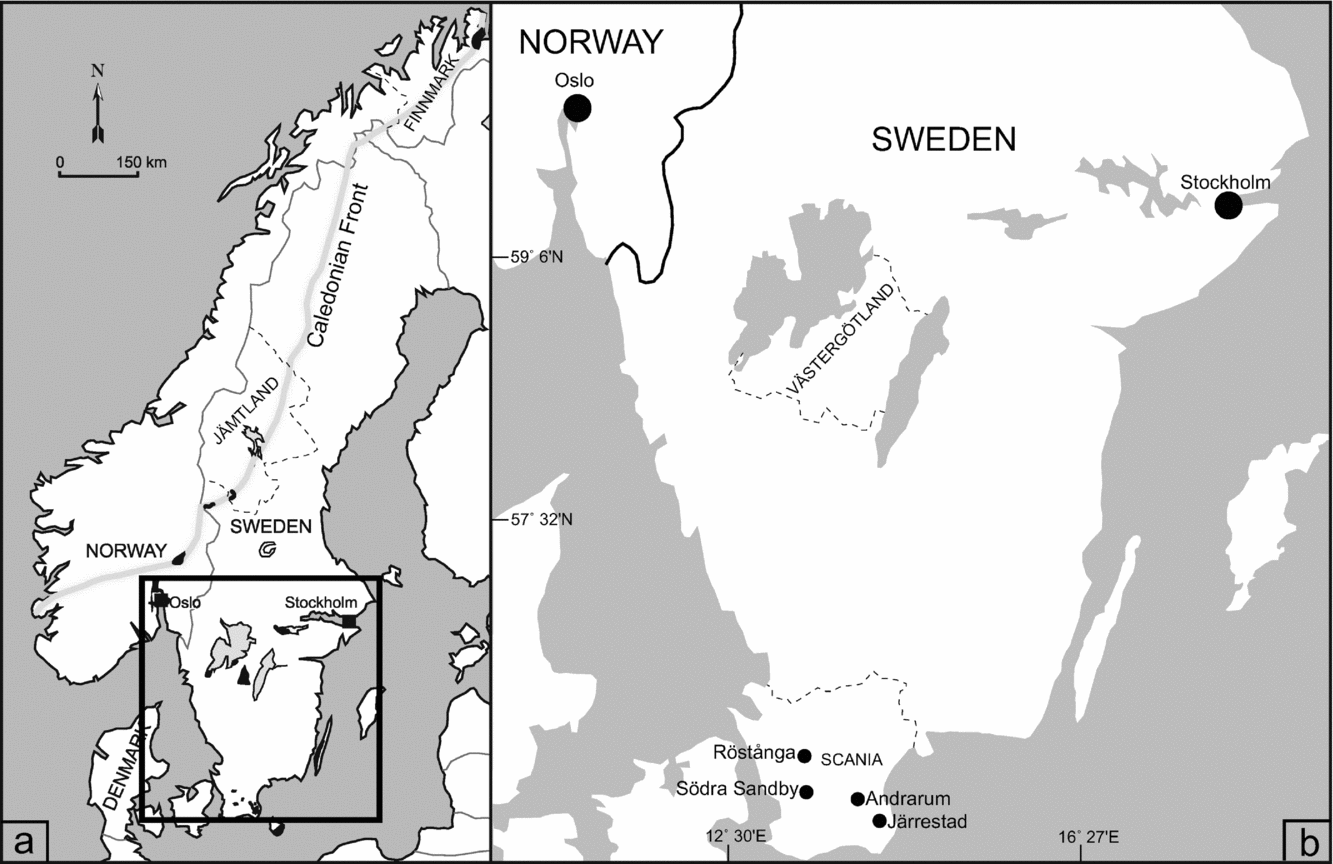
Fourteen agnostoid species/subspecies assigned to eight genera have been described from the Furongian of Scandinavia (Terfelt & Ahlberg, Reference Terfelt and Ahlberg2010; Terfelt, Ahlberg & Eriksson, Reference Terfelt, Ahlberg and Eriksson2011). The majority of these have been recovered from Scania (Skåne) and Västergötland, Sweden (Fig. 1). The aim of this paper is to review their temporal and spatial distribution, and their potential for intercontinental correlation.
(a) Map of Scandinavia showing Cambrian outcrop areas (in black), the extent of the Caledonian Front, and the location of Jämtland, central Sweden, and Finnmark, northern Norway. (b) Map of southern Sweden showing provinces and localities referred to in the text.

All illustrated specimens are housed at the Department of Geology, Lund University, Sweden (prefixed LO), and the Geological Survey of Sweden, Uppsala (SGU).
2. Geological setting and biostratigraphy
In Furongian times, Baltica was geographically inverted and situated at temperate to subtropical palaeolatitudes between 30 and 60° S (Torsvik & Rehnström, Reference Torsvik and Rehnström2001; Cocks & Torsvik, Reference Cocks and Torsvik2002, Reference Cocks and Torsvik2005). Scandinavia formed the northeastern part of Baltica and was to a large extent covered by an oxygen-depleted and sediment-starved epicontinental sea. The Scandinavian successions are dominated by dark grey to black mudstones and shales of the condensed Alum Shale Formation (Gee, Reference Gee1972; Buchardt, Nielsen & Schovsbo, Reference Buchardt, Nielsen and Schovsbo1997; Nielsen & Schovsbo, Reference Nielsen and Schovsbo2007), except in Finnmark, northern Norway, where the Furongian predominantly consists of thick arenaceous deposits (Reading, Reference Reading1965; Nikolaisen & Henningsmoen, Reference Nikolaisen and Henningsmoen1985).
The thickest and most complete Furongian successions are found in Scania, southernmost Sweden (Westergård, Reference Westergård1922, Reference Westergård1944; Buchardt, Nielsen & Schovsbo, Reference Buchardt, Nielsen and Schovsbo1997; Ahlberg et al. Reference Ahlberg, Axheimer, Babcock, Eriksson, Schmitz and Terfelt2009). In other parts of Scandinavia the Furongian alum shales are either tectonized (along the Caledonian Front, for instance in southern Norway) and/or interrupted by unconformities of various magnitudes. In Scania, Furongian deposits crop out in a number of areas scattered along the Colonus Shale Trough (Norling & Bergström, Reference Norling and Bergström1987; Erlström et al. Reference Erlström, Thomas, Deeks and Sivhed1997), notably at Andrarum, Järrestad, Södra Sandby and Röstånga.
The Furongian faunas of Scandinavia are generally dominated by low-diversity olenid trilobite assemblages (Westergård, Reference Westergård1922; Henningsmoen, Reference Henningsmoen1957; Terfelt, Ahlberg & Eriksson, Reference Terfelt, Ahlberg and Eriksson2011). In addition, agnostoids, brachiopods, conodonts sensu lato, phosphatocopines and tiny crustaceans may be common in certain stratigraphical levels, notably in interbedded limestone beds and early diagenetic carbonate lenses (anthraconite or orsten) (e.g. Westergård, Reference Westergård1922; Müller & Walossek, Reference Müller and Walossek1985; Müller & Hintz, Reference Müller and Hintz1991; Ahlberg & Ahlgren, Reference Ahlberg and Ahlgren1996; Szaniawski & Bengtson, Reference Szaniawski and Bengtson1998; Maas, Waloszek & Müller, Reference Maas, Waloszek and Müller2003; Terfelt & Ahlgren, Reference Terfelt and Ahlgren2007; Eriksson & Terfelt, Reference Eriksson and Terfelt2007).
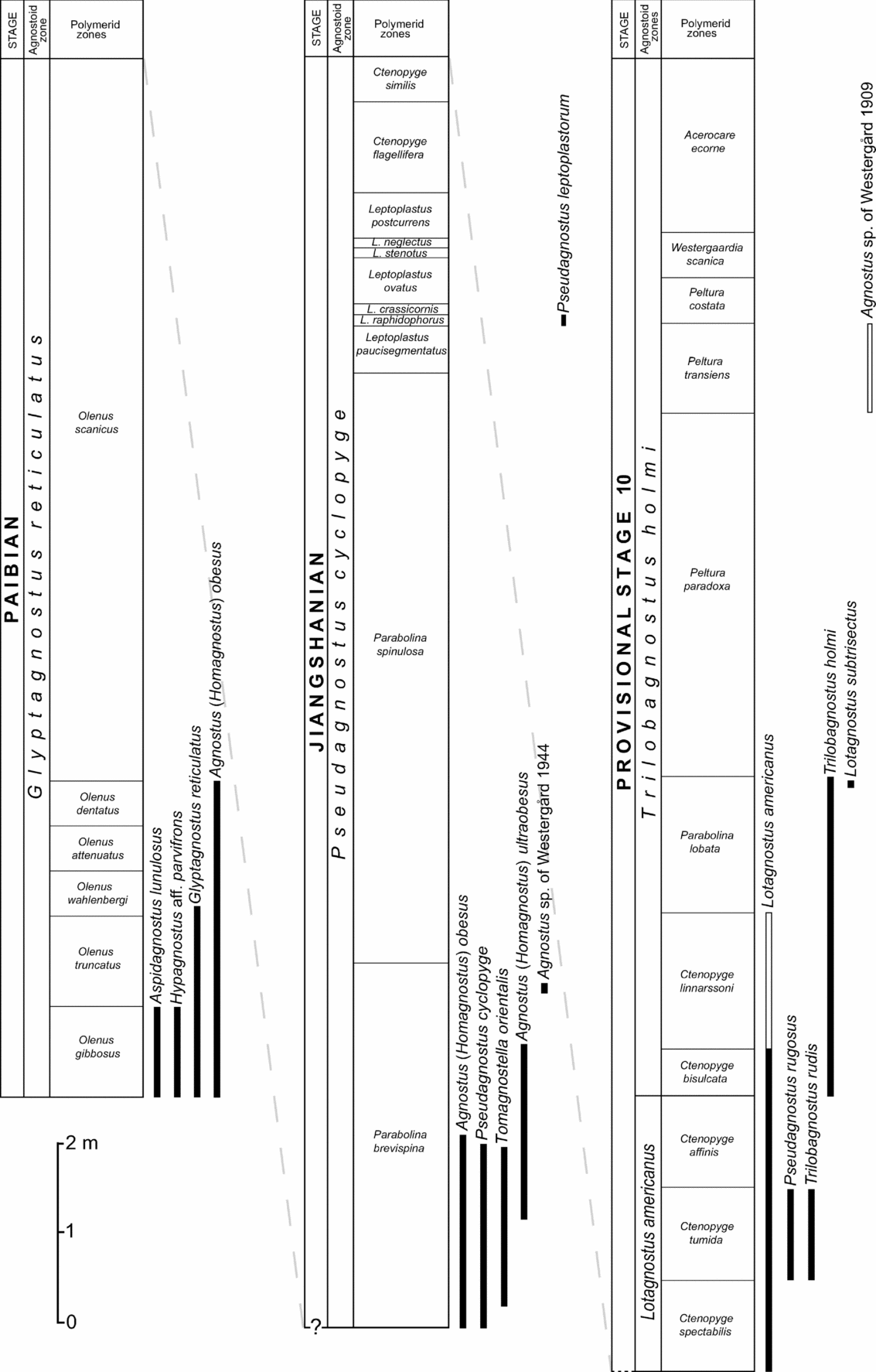
The Furongian biostratigraphy of Scandinavia is largely based on the succession of endemic olenid trilobites. Species turnover rate was high, which enabled Westergård (Reference Westergård1947) and Henningsmoen (Reference Henningsmoen1957) to establish a high-resolution biostratigraphy that has been applied also in Poland, England, Wales and East Maritime Canada. Terfelt et al. (Reference Terfelt, Eriksson, Ahlberg and Babcock2008) recently revised the biostratigraphy and established a two-fold interval zonation based on agnostoids and polymerids, respectively (Fig. 2). The zonation proposed was based on the succession in Scania (except for the Peltura costata Zone). Four agnostoid interval zones were distinguished: the Glyptagnostus reticulatus, Pseudagnostus cyclopyge, Lotagnostus americanus and Trilobagnostus holmi zones.
Biostratigraphical subdivision, relative thicknesses of the zones (as recorded in Scania) and ranges of agnostoids in the Furongian Series of Scandinavia. An open bar indicates presence in the zone, not the temporal distribution within the zone.

3. Paibian Stage
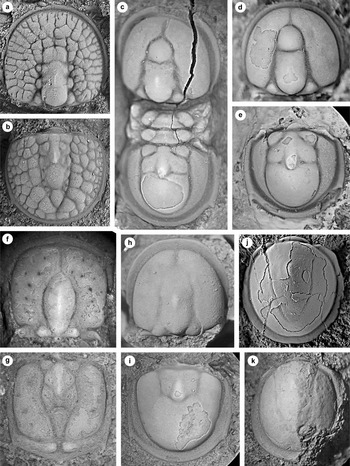
In Scandinavia, the base of the Glyptagnostus reticulatus Zone coincides with the base of the Paibian and the top of the zone corresponds to the top of the stage. In Scania, the stage has a thickness of approximately 11.5 m. The zonal index occurs in low to moderate numbers in the lower one-fifth of the zone, corresponding to the Olenus gibbosus through the lowermost O. wahlenbergi zones (Westergård, Reference Westergård1922; Clarkson, Ahlberg & Taylor, Reference Clarkson, Ahlberg and Taylor1998; Lauridsen & Nielsen, Reference Lauridsen and Nielsen2005; Eriksson & Terfelt, Reference Eriksson and Terfelt2007; Fig. 2). The FAD of the cosmopolitan species Glyptagnostus reticulatus (Fig. 3a, b) provides a globally recognized and correlatable horizon (e.g. Palmer, Reference Palmer1962; Rushton, Reference Rushton1983; Peng & Robison, Reference Peng and Robison2000; Geyer & Shergold, Reference Geyer and Shergold2000; Peng et al. Reference Peng, Babcock, Robison, Lin, Rees and Saltzman2004). Two other geographically widespread agnostoids are known from the lower Paibian of Baltica: Aspidagnostus lunulosus (Kryskov in Borovikov & Kryskov, Reference Borovikov and Kryskov1963) and Agnostus (Homagnostus) obesus (Belt, Reference Belt1867). Aspidagnostus lunulosus (Fig. 3f, g) is a distinctive species known from the Glyptagnostus stolidotus and/or G. reticulatus zones of southern Kazakhstan, northwestern Queensland, Australia, South Korea, Siberia and China (e.g. western Xinjiang, western Zhijiang and western Hunan; Peng & Robison, Reference Peng and Robison2000; Ergaliev & Ergaliev, Reference Ergaliev and Ergaliev2008; Lazarenko et al. Reference Lazarenko, Gogin, Pegel, Sukhov, Abaimova, Egorova, Fedorov, Raevskaya, Ushatinskaya, Rozanov and Varlamov2008). In Sweden, this species has been described from the Olenus gibbosus Zone of Västergötland (Ahlberg & Ahlgren, Reference Ahlberg and Ahlgren1996; described as A. cf. stictus Öpik, Reference Öpik1967; Fig. 2). A single specimen has been recorded from an erratic limestone boulder at Wismar in northern Germany (Weidner, Reference Weidner1997). The stratigraphical position is not known owing to the lack of an associated fauna.
(a, b) Glyptagnostus reticulatus from the Olenus gibbosus Zone at Krokagården, eastern Kinnekulle, Västergötland, south-central Sweden. (a) Cephalon, original of Ahlberg & Ahlgren (1996, fig. 4I), LO 7333t, × 11. (b) Pygidium, original of Ahlberg & Ahlgren (1996, fig. 4M), LO 7337t, × 13. (c–e) Agnostus (Homagnostus) obesus from the Olenus wahlenbergi Zone at Andrarum, southern Sweden. (c) Complete specimen, original of Westergård (Reference Westergård1922, pl. 1, fig. 4a, b) and Ahlberg & Ahlgren (1996, fig. 3G), SGU 122a, × 16. (d) Cephalon, original of Westergård (Reference Westergård1947, pl. 1, fig. 10a, b) and Ahlberg & Ahlgren (1996, fig 3E), SGU 6433, × 20. (e) Pygidium, original of Westergård (Reference Westergård1947, pl. 1, fig. 11a, b) and Ahlberg & Ahlgren (1996, fig 3F), SGU 6434, × 18. (f, g) Aspidagnostus lunulosus from the Olenus gibbosus Zone at Hällekis, Kinnekulle, Västergötland, south-central Sweden. (f) Cephalon, original of Ahlberg & Ahlgren (1996, fig. 5K), LO 7350t, × 17. (g) Pygidium, original of Ahlberg & Ahlgren (1996, fig. 5L), LO 7351t, × 18. (h, i) Pseudagnostus cyclopyge from the lower Parabolina brevispina Zone at Andrarum, Scania, southern Sweden. (h) Cephalon; original of Ahlberg (Reference Ahlberg2003, fig. 4C), LO 8308t, × 17. (i) Pygidium, original of Ahlberg (Reference Ahlberg2003, fig. 4D), LO 8309t, × 15. (j, k) Tomagnostella orientalis from the lower Parabolina brevispina Zone. (j) Pygidium from Andrarum (locality 5 of Westergård, Reference Westergård1922, fig. 3), Scania, southern Sweden, coll. F. Terfelt, LO 11305t, × 12. (k) Pygidium from Gum, Kinnekulle, Västergötland, south-central Sweden, original of Ahlberg & Ahlgren (1996, fig. 5F), LO 7345t, × 13.

A cephalon assigned to Hypagnostus aff. parvifrons (Linnarsson, Reference Linnarsson1869) (= H. aff. correctus Öpik, Reference Öpik1967 of Ahlberg & Ahlgren, Reference Ahlberg and Ahlgren1996) is known from the Olenus gibbosus Zone of Västergötland, Sweden. The overall morphology of the cephalon suggests that it represents a species of Hypagnostus. It compares most closely with cephala of the type species, H. parvifrons, a cosmopolitan and long-ranging species that is known from the Drumian and the Guzhangian stages. Hypagnostus parvifrons is a variable species, and, following Peng & Robison (2000) and Peng et al. (Reference Peng, Hughes, Heim, Sell, Zhu, Myrow and Parcha2009b ), we consider H. correctus to be a junior synonym of H. parvifrons.
Agnostus (Homagnostus) obesus (Fig. 3c–e) is a common species in the interval ranging from the base of the Olenus gibbosus Zone through the O. dentatus Zone (sensu Terfelt et al. Reference Terfelt, Eriksson, Ahlberg and Babcock2008) in Scandinavia (e.g. Westergård, Reference Westergård1944, Reference Westergård1947; Terfelt et al. Reference Terfelt, Eriksson, Ahlberg and Babcock2008). It has also been recorded from the lower half of the Parabolina brevispina Zone (Fig. 2). The concept and intraspecific variability of A. (H.) obesus were discussed by Pratt (Reference Pratt1992), who showed that a number of species, including Homagnostus tumidosus (Hall & Whitfield, Reference Hall, Whitfield and King1877), can be synonymized with A. (H.) obesus. Outside Scandinavia, A. (H.) obesus (sensu Pratt, Reference Pratt1992) has been recorded from England (Rushton, Reference Rushton1983), Newfoundland (Martin & Dean, Reference Martin and Dean1988), Siberia (e.g. Lazarenko et al. Reference Lazarenko, Gogin, Pegel, Sukhov, Abaimova, Egorova, Fedorov, Raevskaya, Ushatinskaya, Rozanov and Varlamov2008), Kazakhstan (Ergaliev & Ergaliev, Reference Ergaliev and Ergaliev2008), Korea (Choi, Lee & Sheen, Reference Choi, Lee and Sheen2004) and North America (Pratt, Reference Pratt1992; Stitt & Perfetta, Reference Stitt and Perfetta2000). It ranges from the base of the Paibian into the Jiangshanian and is valuable for broad correlations in the Paibian Stage.
4. Jiangshanian Stage
Pseudagnostus cyclopyge (Tullberg, Reference Tullberg1880) is fairly common in the lower half of the Parabolina brevispina Zone of Scania, southern Sweden (Figs 2, 3h, i). It has also been described from southern Mackenzie Mountains, Northwest Territories, Canada (Pratt, Reference Pratt1992) and Malyi Karatau, southern Kazakhstan (Ergaliev & Ergaliev, Reference Ergaliev and Ergaliev2008), facilitating a broad correlation between these areas.
A single pygidium of Tomagnostella orientalis (Lazarenko, Reference Lazarenko1966) (= Peratagnostus falanensis Westergård, Reference Westergård1947 of Ahlberg & Ahlgren, Reference Ahlberg and Ahlgren1996) is known from the lower P. brevispina Zone (Fig. 2) in Västergötland, south-central Sweden, where it is associated with A. (H.) obesus and Protopeltura aciculata. Two additional pygidia have recently been recovered from contemporaneous strata at Andrarum, Scania, southern Sweden. The Scanian specimens are associated with P. brevispina and P. aciculata. The pygidial axis is faintly outlined and has a clearly visible axial node, and the border is wide (Fig. 3j, k). The Swedish material agrees in all essential respects with that of T. orientalis, a geographically widespread species that has been described from the upper Paibian and the lower Jiangshanian in Siberia, China, Korea, Alaska and Australia (see Choi, Lee & Sheen, Reference Choi, Lee and Sheen2004 and references therein; Lazarenko et al. Reference Lazarenko, Gogin, Pegel, Sukhov, Abaimova, Egorova, Fedorov, Raevskaya, Ushatinskaya, Rozanov and Varlamov2008; Peng et al. Reference Peng, Hughes, Heim, Sell, Zhu, Myrow and Parcha2009a ).
Specimens tentatively assigned to Agnostus (Homagnostus) ultraobesus Lermontova, Reference Lermontova and Vologdin1940 are known from the middle P. brevispina Zone (Fig. 2) at Andrarum, southern Sweden (cf. Shergold & Webers, Reference Shergold, Webers, Webers, Craddock and Splettstoesser1992; Ahlberg & Ahlgren, Reference Ahlberg and Ahlgren1996). Pratt (Reference Pratt1992) considered this species name to be a junior synonym of A. (H.) obesus. The former differs, however, from the latter in completely lacking a median preglabellar furrow and in having less constricted acrolobes and wider cephalic and pygidial borders. A. (H.) ultraobesus and A. (H.) obesus are herein treated as two separate species.
A single indeterminate pygidium with a fairly short and distinctly tapered axis was recorded by Westergård (Reference Westergård1944) from the uppermost P. brevispina Zone (Fig. 2) at Andrarum, southern Sweden. It is herein referred to as Agnostus sp. of Westergård (Reference Westergård1944).
Pseudagnostus leptoplastorum Westergård, Reference Westergård1944, is based on a flattened pygidium from the Leptoplastus raphidophorus Zone (Fig. 2) at Andrarum, southern Sweden. It has subsequently been recorded from roughly contemporaneous strata in central and southern Kazakhstan (Ivshin, Reference Ivshin1962; Ergaliev & Ergaliev, Reference Ergaliev and Ergaliev2008), allowing a broad correlation between lower Leptoplastus-bearing strata and the Acutatagnostus acutatus–Erixanium Zone in southern Kazakhstan.
5. Provisional Stage 10
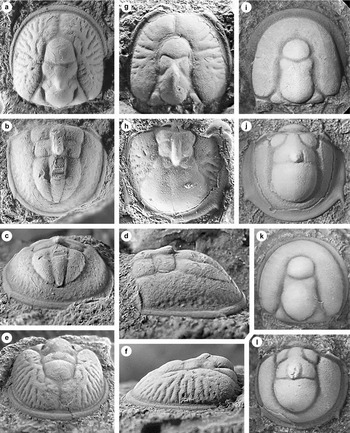
Lotagnostus americanus (Billings, Reference Billings1860) is a globally dispersed and easily recognizable species (Fig. 4a–f) that can be used for intercontinental correlations of upper Furongian strata (Peng & Babcock, Reference Peng and Babcock2005). Moreover, it is used as a zonal index in many areas, including Scandinavia (Terfelt et al. Reference Terfelt, Eriksson, Ahlberg and Babcock2008). The ISCS has recently proposed the FAD of L. americanus as the primary marker horizon for correlation of the base of Stage 10 (e.g. Babcock & Peng, Reference Babcock and Peng2007). In Sweden, L. americanus (= L. trisectus of Westergård, Reference Westergård1922, Reference Westergård1944, Reference Westergård1947; Ahlberg & Ahlgren, Reference Ahlberg and Ahlgren1996) ranges from the Ctenopyge spectabilis through the C. bisulcata zones, and possibly through the C. linnarssoni Zone (Westergård, Reference Westergård1947; Fig. 2).
(a–f) Lotagnostus americanus from locally derived boulders of the Ctenopyge bisulcata Zone along the shore at Gislövshammar, Scania, southern Sweden. Coll. P. Cederström. (a, e, f) Cephalon in dorsal (a), anterodorsal (e) and left lateral (f) views, LO 11306t, × 10. (b–d) Pygidium in dorsal (b), posterior (c) and left lateral (d) views, LO 11307t. (b) × 11. (c) × 12. (d) × 14. (g, h) Pseudagnostus rugosus from locally derived boulders of the Ctenopyge tumida Zone along the shore NNE of the hamlet of Gislövshammar, Scania, southern Sweden. Coll. P. Cederström. (g) Cephalon, LO 11308t, × 12. (h) Pygidium, LO 11309t, × 11. (i, j) Trilobagnostus rudis from the Ctenopyge tumida Zone at Hönsäter, Kinnekulle, Västergötland, south-central Sweden. (i) Cephalon, original of Ahlberg & Ahlgren (1996, fig. 3I), LO 7321t, × 15. (j) Pygidium, original of Ahlberg & Ahlgren (1996, fig. 3H), LO 7320t, × 15. (k, l) Trilobagnostus holmi from the Parabolina lobata Zone. (k) Cephalon from Blomberg, Kinnekulle, Västergötland, south-central Sweden, original of Westergård (Reference Westergård1922, pl. 1, fig. 13) and Ahlberg & Ahlgren (1996, fig. 3K), SGU 129, × 21. (l) Lectotype, pygidium from Råbäck, Kinnekulle, Västergötland, south-central Sweden, original of Westergård (Reference Westergård1922, pl. 1, fig. 15a–b) and Ahlberg & Ahlgren (1996, fig. 3O), SGU 131, × 20.

Pseudagnostus rugosus Ergaliev, Reference Ergaliev1980 is known from the Ctenopyge tumida Zone of Scania and Västergötland, Sweden (Figs 2, 4g, h). The species was recently discussed comprehensively by Terfelt & Ahlberg (2010). This distinctive agnostoid has a narrow stratigraphical range and provides a precise correlation between the C. tumida Zone of Baltica, the lower Eolotagnostus scrobicularis–Jegorovaia Zone of Kazakhstan and the lower Lotagnostus americanus Zone of South China.
Trilobagnostus rudis (Salter, Reference Salter1864) is based on material from the Dolgellau Formation at Gwynedd, North Wales (Morris, Reference Morris1988; Rushton, Reference Rushton2009). In Sweden, it has been recorded from the Ctenopyge tumida Zone of Scania and Västergötland (Westergård, Reference Westergård1947; Ahlberg & Ahlgren, Reference Ahlberg and Ahlgren1996; Figs 2, 4i, j). The species has subsequently been reported from the C. tumida Zone in the Holy Cross Mountains, Poland, and the middle Lotagnostus americanus Zone at the Khos-Nelege River, western Yakutia, Siberia (Żylińska, Reference Żylińska2001; Lazarenko et al. Reference Lazarenko, Gogin, Pegel, Sukhov, Abaimova, Egorova, Fedorov, Raevskaya, Ushatinskaya, Rozanov and Varlamov2008). Ergaliev & Ergaliev (2008) reported T. rudis from considerably older strata in the lower part of the Pseuadagnostus vastulus–Irvingella tropica Zone in Malyi Karatau, southern Kazakhstan. This is an anomalous occurrence and the species identification needs to be confirmed.
Trilobagnostus holmi (Westergård, Reference Westergård1922) is a distinctive species and zonal index in the agnostoid zonation of Scandinavia (Terfelt et al. Reference Terfelt, Eriksson, Ahlberg and Babcock2008; Figs 2, 4k, l). It ranges from the Ctenopyge bisulcata (Westergård, Reference Westergård1922, p. 69) through the Parabolina lobata zones and is most common in the lower P. lobata Zone (Henningsmoen, Reference Henningsmoen1958; Terfelt et al. Reference Terfelt, Ahlberg, Eriksson and Clarkson2005). The species has also been recorded from North Wales, where it is associated with L. americanus (Rushton, Reference Rushton, Bassett and Dean1982, text-fig. 2).
Lotagnostus subtrisectus Westergård, Reference Westergård1944 is a poorly known species based on a single flattened pygidium from the uppermost P. lobata Zone (Fig. 2) at Andrarum, southern Sweden.
The last occurring agnostoid hitherto recorded from the Furongian of Scandinavia is represented by an incomplete, flattened and poorly preserved pygidium from the Peltura transiens Zone (Fig. 2) at Järrestad, Scania, southern Sweden. It was briefly described by Westergård (Reference Westergård1909) and is herein referred to as Agnostus sp. of Westergård (Reference Westergård1909).
6. Discussion
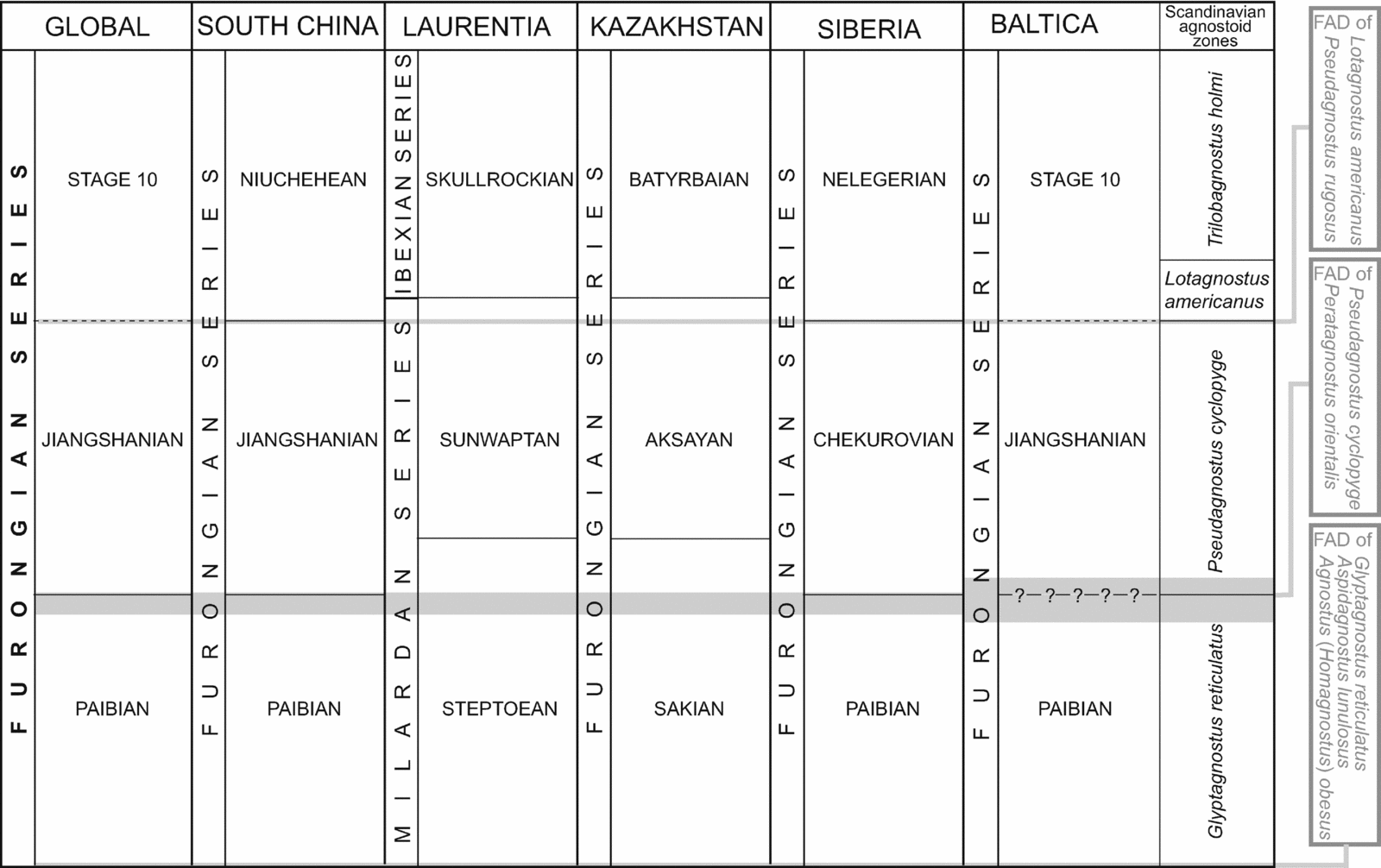
Out of the 14 agnostoid species/subspecies so far known from Scandinavia, seven are geographically widespread and important for intercontinental correlations. Glyptagnostus reticulatus, Aspidagnostus lunulosus and Agnostus (Homagnostus) obesus first appear at the base of the G. reticulatus Zone, allowing a precise correlation of the base of the Paibian Stage into Scandinavia (Fig. 5). The primary marker for the base of the Jiangshanian Stage, Agnostotes orientalis, has hitherto not been recorded in Scandinavia. Pseudagnostus cyclopyge and Tomagnostella orientalis are, however, valuable auxiliary markers for the Paibian–Jiangshanian transitional interval (Fig. 5). In South China, the FAD of T. orientalis defines the base of the zone below the A. orientalis Zone (Peng et al. Reference Peng, Hughes, Heim, Sell, Zhu, Myrow and Parcha2009a ). Tomagnostella orientalis is, however, a rather long-ranging species that has been recorded from the A. orientalis through the Eolotagnostus zones (Peng et al. Reference Peng, Hughes, Heim, Sell, Zhu, Myrow and Parcha2009a ). The pygidium from the Eugonocare borealis Zone in the Khos-Nelege River section, Siberia (Lazarenko et al. Reference Lazarenko, Gogin, Pegel, Sukhov, Abaimova, Egorova, Fedorov, Raevskaya, Ushatinskaya, Rozanov and Varlamov2008, pl. 16, fig. 13), is misidentified and should be transferred to another taxon. In Scandinavia, the first occurrence of T. orientalis and P. cyclopyge is in the lowermost Parabolina brevispina Zone, suggesting a correlation with the uppermost Paibian through the lowermost Jiangshanian stages. The record of the intercontinentally distributed polymerid Irvingella major in the P. brevispina Zone of Jämtland, central Sweden (Rushton & Weidner, Reference Rushton and Weidner2010), provides evidence for a broad correlation between the P. brevispina Zone and the Irvingella major Zone of the lower Jiangshanian. Lotagnostus americanus and Pseudagnostus rugosus have an intercontinental distribution and their first appearance in Scandinavia allows for a correlation with one of the most favourable levels for defining the base of provisional Stage 10 (Figs 2, 5).
Correlation chart of the Furongian Series showing the FADs of important agnostoid species and the agnostoid zonation of Baltica as compared to global stages as well as regional stages in major areas of the world.

The depositional environment of the Alum Shale Formation has been debated during the past two decades, but all evidence indicates poorly oxygenated conditions at the sediment/water interface and that deposition generally took place below storm wave base. The Furongian part of the formation is seemingly fairly homogeneous; however, recent studies have shown that it is a variable unit both in terms of lithology and fossil fauna (e.g. Clarkson, Ahlberg & Taylor, Reference Clarkson, Ahlberg and Taylor1998; Ahlberg et al. Reference Ahlberg, Månsson, Clarkson and Taylor2006; Eriksson & Terfelt, Reference Eriksson and Terfelt2007), reflecting environmental changes. The life style of agnostoids has been extensively discussed and different life strategies have been proposed, including, for instance, a pelagic (e.g. Öpik, Reference Öpik1961, Reference Öpik1979; Robison, Reference Robison1972; Jago, Reference Jago1973), benthic (Jaekel, Reference Jaekel1909), epifaunal (Pek, Reference Pek1977; Havlíček, Vaněk & Fatka, Reference Havlíček, Vaněk and Fatka1993) and a nektobenthic (Müller & Wallosek, Reference Müller and Walossek1987) life. There is, however, growing evidence for a benthic mode of life in adult agnostoids (e.g. Chatterton, Collins & Ludvigsen, Reference Chatterton, Collins and Ludvigsen2003; Fatka et al. Reference Fatka, Vokáč, Moravec, Šinágl and Valent2009; Fatka & Szabad, Reference Fatka and Szabad2011).
In the Furongian of Scandinavia, agnostoids are conspicuously assembled in three different intervals: the lower Glyptagnostus reticulatus Zone, the lower Pseudagnostus cyclopyge Zone and the Lotagnostus americanus through lower Trilobagnostus holmi zones (Fig. 2). If the assumption that the agnostoids had a benthic mode of life is correct, their distribution was strongly influenced by changes in sea-floor conditions, such as variations in temperature, oxygen levels, acidity/alkalinity, substrate composition/consistency, etc. The agnostoid-barren strata may represent time intervals during which the environment was inimical to agnostoids. A different interpretation is that the absence of agnostoids, or fossils altogether, is a result of taphonomy, notably subsequent dissolution of the calcareous fauna (Eriksson & Terfelt, Reference Eriksson and Terfelt2007).
The unfossiliferous succession separating the lower and middle agnostoid-bearing intervals can be explained by means of dissolution and/or a hostile environment. The base of the lower interval coincides with the onset of the Steptoean Positive Carbon Isotope Excursion (SPICE; Ahlberg et al. Reference Ahlberg, Axheimer, Babcock, Eriksson, Schmitz and Terfelt2009), which has recently been interpreted as reflecting transient increases in the burial of organic carbon and pyrite sulphur in sediments (Gill et al. Reference Gill, Lyons, Young, Kump, Knoll and Saltzman2011). According to Saltzman et al. (Reference Saltzman, Young, Kump, Gill, Lyons and Runnegar2011), massive amounts of oxygen were released as a side product of chemical reactions in the buried material. Following Schovsbo (Reference Schovsbo2001), the highly elevated oxygen levels in the sulphur-rich sediments produced corrosive pore waters during the reoxidation of sulphide compounds, resulting in an adverse, acidic environment effectively prohibiting fossilization. This model can be applied also to the unfossiliferous interval in the middle Trilobagnostus holmi Zone following the upper agnostoid-bearing interval. The middle agnostoid-bearing interval is succeeded by an anomalous succession dominated by the articulate brachiopod Orusia lenticularis, reflecting a regressive event coupled with increasing levels of oxygen at the sediment/water interface (Dworatzek, Reference Dworatzek1987). This shallowing obviously resulted in unfavourable conditions for agnostoids.
Acknowledgements
We thank Peter Cederström for collecting scientifically important agnostoids and for presenting and donating the specimens to the Division of Geology, Lund University. John Ahlgren also generously made specimens from his collection available. Linda Wickström kindly facilitated the loan of comparative material in the collections of the Geological Survey of Sweden (SGU), Uppsala. FT thanks the Swedish Research Council (VR) for funding the research. PA is indebted to the Royal Physiographic Society in Lund for financial support.