In the past two decades steles have become crucial, if not the most important, sources for historical research into north China in the Middle Period (roughly from the ninth to the fifteenth centuries).Footnote 1 But what is a stele? Is it a documentary source? A material object? A form of public communication made of stone? What do we achieve by leaving all these possibilities open rather than foreclosing any of them? I have thought about such questions while investigating existing steles in north China over the past decade. My fieldwork experiences have pushed me to see steles differently than I had from reading inscriptions in anthologized books. Whenever I encountered steles standing in either original or relocated sites, I began to consider the material, technological, and social conditions for producing, moving, erecting, and using these stones carved with texts and images. I could not help but imagine the stories behind the steles and the stories the steles had witnessed over the past centuries. Standing in local communities as a testament to time, the steles were not just a stone medium for documents. As material objects, they convey much more than the textual content they bear. To discover the full narratives that might emerge from and around steles, as I argue in this article, we need to pay attention to their material and visual forms, as well as to foreground the nature of steles as a medium that stores and transmits rich historical information carried by words, images, and the very physicality of the stones themselves.
China has a long history of using stone as a medium for writing. But the success of the medium was hardly instantaneous. The proliferation of steles instead developed over several centuries and alongside the emergence of specific genres of commemorative texts. As early as Eastern Zhou texts in the fifth century BCE, the term jinshi 金石 (metal and stone) appeared referring to ritual inscriptions inscribed on two specific kinds of materials: bronze and chime stone.Footnote 2 The practice of inscribing lengthy texts on stones seemed to start with the First Emperor of the Qin, who had his officials erect stones on the tops of various mountains and then inscribe these stones with texts eulogizing the virtuous power of the Qin. Around the first century CE, the practice of erecting bei 碑 (upright stone tablets) emerged to serve funerary and commemorative functions. We often use “stele” to translate references to this type of stone tablet. Yet in the Chinese tradition of “metal and stone,” there are many other categories of stone media—such as jie 碣 (high rock; stone tablet with a round top), chuang 幢 (stone pillar), moya 摩崖 (engraved mountain cliffs), and shijing 石經 (stone sutras or classics). These stone media and their texts became significant components in the formation and development of a Chinese memorial culture from the Han dynasty onward.Footnote 3 In addition, like many other durable material objects, steles often have a long history of their own, a history that outlives their original makers, owners, and users.
For the sake of convenience, this article uses the word “stele” both for the general category of stones carved with texts (and sometimes with images and symbols) and for slab stones categorized as bei, which have been the major medium of stone inscription since the Tang dynasty. Most of these steles had (and have) dual documentary or record-keeping and monumental/public communication natures. As documents, stele inscriptions preserve valuable historical sources that are otherwise unavailable in official records. For instance, many inscriptions contain the biographies of ordinary men and women and writings about local events and institutions. As monuments, steles are products of particular political, social, cultural, and even technological circumstances. Besides serving to store information, mostly in the forms of text and image, they served as a means for communicating information that went beyond text and image.Footnote 4 While the inscription often explicitly describes or comments on the monumental function of a stele, the material presentation of the stele as monument conveys implicit messages that can either correspond to or challenge claims expressed in the textual document. The documentary and monumental functions of steles are not separate but rather in constant conversation.
In advocating attention to both the documentary and monumental functions of stele, this article elucidates what I call an “epigraphic approach” to pre-modern Chinese history, based on recent scholarly efforts to employ epigraphic sources in the study of Middle-Period north China. It explains the foundation, development, and the new avenues for research this methodology creates. In accord with this methodology, I foreground steles as a form of public communication which functioned both to communicate information and to project authority. Emphasizing the public communication function of steles challenges us not only to think of historical sources in terms of the information they transmit but also to reflect on the modes of transmission and the power dynamics contained therein. It also helps us override a tendency to neglect the multiple kinds of users of steles who were not readers.
To demonstrate this methodology in the context of current research on pre-modern China, I have divided this article into three parts. The first section explains the foundation of the epigraphic approach, including the richness of the Chinese scholarly tradition of utilizing steles in historical research and the abundance of steles and inscriptional sources from north China. The second section reviews my own earlier work and that of scholars like Iiyama Tomoyasu, to show what the epigraphic approach has achieved in tracing long-term social transformations in north China after the Mongol conquest, an enterprise that two decades ago Middle-Period China historians had considered almost impossible. The third section looks at a new case study to explore the intricate relationships between steles as a vehicle for communication and their producers as well as receivers in the fifteenth-century rural world of north China. It teaches us a great deal about diverse ways in which educated readers and ordinary viewers engaged with steles, and what we can gain from attention to the materiality, visuality, and communicative nature of steles. Overall, I hope to achieve two broader goals. One is to engage other fields that have paid attention to the materiality of steles—such as archeology and art history—to advance a dynamic and interdisciplinary approach to steles. My second goal is to encourage other historians of imperial China to consider what else we can learn by paying attention to the various public communication functions of steles.
Epigraphic Studies and Collections of Stele Inscriptions
Employing stele sources in the study of Middle-Period north China has benefited from two important scholarly traditions: (1) the collection and publication of stele inscriptions in the form of manuscript or print and (2) the simultaneous methodological progress in epigraphic studies. Chinese scholars of the imperial period have long employed stele inscriptions in historical and textual studies. Their interest in collecting and examining stele inscriptions not only helped preserve many stele sources but also contributed to the development of systematic methods for epigraphic study. The boom in publishing stele inscriptions in print in the past fifty years has greatly enlarged the primary-source pool for historians, many of whom have also implemented new methodologies to understand steles. These developments laid important foundations for scholars to take an epigraphic approach to the history of Middle-Period north China in recent decades. As I will show, the reality of historical sources in the north determines that historians of Middle-Period China need to approach stele sources differently from their colleagues who focus on late imperial and modern China.
From the eleventh century onward, epigraphic studies developed in the tradition of Chinese antiquarian scholarship, known as the “the study of metal and stone” (jinshi xue 金石學).Footnote 5 This tradition combined the collection and connoisseurship of antiquities and studied steles for their historical, epigraphic, and calligraphic values. Song-dynasty antiquarians like Ouyang Xiu 歐陽修 (1007–72) often sought out inscribed texts in the form of rubbings and regarded inscriptions as unique historical sources because they were “immune to textual corruption caused by transmission, and were thus deemed essential in the authentic reconstruction of history.”Footnote 6 Epigraphic studies in this tradition peaked from the mid-Qing dynasty to the early Republic era. Unlike their Song-dynasty counterparts who had access to stele inscriptions mainly from markets, many Qing-dynasty antiquarians compiled epigraphical collections based also on extensive field research.Footnote 7 Numerous publications emerged in this period, ranging from reproductions of rubbings to catalogues, bibliographies, commentaries, and notes.Footnote 8
Antiquarian scholars’ compendia have preserved important historical records, especially when original inscriptions on the steles have become eroded and less legible or the steles no longer exist. Yet most scholarship in this tradition treated stele inscriptions as supplementary sources for textual analysis of classical texts and official historical records.Footnote 9 They rarely paid attention to the broader social, cultural, political, and technological conditions that enabled or demanded the appearance of specific genres of steles. A rare exception is Ye Changchi (1849–1917), a late imperial antiquarian and philologist. His innovative Words on Stones (Yushi 語石) provides the most comprehensive and empirical study on the history of stone carvings and engravings in China.Footnote 10 Ye pioneered the systematic study of Chinese steles based on extensive and in-depth textual and field investigations.Footnote 11 Many of his insightful views on popular genres and the geographical distribution of steles in each historical period still prove valuable to scholars today.
The publication of stele inscriptions in print has flourished throughout China in the past fifty years. We have seen increased availability of stele inscriptions in the twentieth and twenty-first centuries, beginning with compilations of modern compendiums in the 1970s and arriving at digital archives in the last decade. The first massive publication project of stele inscriptions occurred in Taiwan, with the publication of the Shike shiliao xinbian 石刻史料新編 (New collections of inscription sources, four series, 100 vols., 1977–2006). This modern publication includes most inscriptional collections composed by Qing-dynasty scholars and inscriptional texts included in local gazetteers. It has allowed scholars to use a wide scope of inscriptional sources with great convenience. The largest boom in publishing stele inscriptions occurred in mainland China over the last three decades. Some publishing projects are based in institutions, especially those like the Chinese National Library that own vast collections of rubbings.Footnote 12 Others are regionally coordinated or thematically oriented, and often include many extant stele inscriptions that have previously been unknown. Global efforts are also underway to digitalize stele inscriptions or publish rubbings online.Footnote 13 These recent publications of inscriptions in print and digital databases have greatly increased the availability of many stele sources that would have been difficult to access three decades ago. They are particularly important for historical studies on regions like north China for which transmitted historical records are not abundant.
In the past three decades, the publication of stele inscriptions from many provinces of north China has also been breathtaking. The most representative province-wide publication project is the Sanjin shike daquan 三晉石刻大全 (A complete collection of steles in Shanxi province), which now includes seventy-plus volumes with more on the way. Each volume includes collected inscriptions—of both extant and lost steles—from one county or city district from ancient times to the present.Footnote 14 In Shandong province, the Shandong shike fenlei quanji 山東石刻分類全集 (A complete collection of categorized steles in Shandong province) collects more than several thousand images of steles, stone and cliff carvings, and epitaphs from before the Tang dynasty.Footnote 15 The massive publication project of Shaanxi sheng jinshi wenxian huiji 陝西省金石文獻匯集 (Collections of metal and stone sources in Shaanxi province) has produced the Shaanxi shike wenxian mulu jicun 陝西石刻文獻目錄集存 (Catalog of stone sources in the Shaanxi province), which catalogs 3,610 individual stele sources. In addition, eighteen independent volumes of inscriptions from specific localities have also been published.Footnote 16 For Henan and Hebei provinces, there are no province-wide projects to publish all available steles sources yet. We do have publications of stele inscriptions of specific historical periods or from specific localities, however.Footnote 17
While the compendiums and recent publications are rich historical evidence, they also remove the steles from their material histories, by transposing inscribed texts onto the printed page. In addition, most compendia, whether historical or recent, present only partial documentation of the original steles, often neglecting information such as inscriptions about donors on the rear of steles and visual aspects of the stone carvings. Modern publication and digitization efforts collapse the material properties of steles even more.
Since the 1980s, these limitations have begun to be addressed, particularly by a group of scholars of the “South China School” (Huanan xuepai 華南學派) who have collected and studied steles through extensive fieldwork. Unlike earlier antiquarians, whose fieldwork investigations mainly aimed to collect rubbings of steles, these modern scholars, many of whom are historians of late imperial and modern China, adopt the fieldwork methods of historical anthropology. Heavily relying on a variety of local materials such as contracts, genealogies, steles, and ritual manuals, their historical research emphasizes the combination of textual analysis and fieldwork investigation.Footnote 18 The efforts of the “South China School” have not only yielded many publications of stele sources and epigraphic studies but have also inspired other historians to utilize stele sources in their research.Footnote 19 In addition to socioeconomic, cultural, and regional histories, the boom in using stele materials has now spread to many other fields of Chinese history, such as legal history.Footnote 20 In short, recent studies on steles among China historians have championed interdisciplinary historical research, with historical anthropology providing most theoretical and methodological support.
Influenced by historical anthropology, many scholars of Middle-Period Chinese history, including myself, have combined fieldwork with textual analysis as well. But we face a different reality from scholars of late imperial and modern China. We simply do not have the luxury of access to extensive local materials in most regions; thus we often are not able to use other local sources to contextualize and complement steles and inscriptions and vice versa.Footnote 21 Scholars who focus on south China are still able to supplement inscriptional sources with local gazetteers and the collected works of literati, which were particularly abundant in the south thanks to the flourishing of literati culture and printing in the Song dynasty.Footnote 22 Scholars who focus on north China, however, have to approach steles and inscriptions differently by looking at limited sources from as many perspectives as possible.
Epigraphic Genres Popular in Middle-Period North China
In addition to combining steles with other available historical sources, scholars of Middle-Period north China in the recent decade have developed a new approach worthy of reference. This approach, which foregrounds distinctive epigraphic genres of steles, develops out of Chinese and Japanese scholars’ extensive use of stele sources in studying the Liao, Jin, and Yuan dynasties.Footnote 23 Japanese scholars have pioneered the approach of extensively collecting stele materials on and from north China through fieldwork. For more than thirty years, under the leadership of Morita Kenji and Matsuda Koichi, a group of Japanese scholars based in Kyoto have not only made regular trips to China to investigate steles but also organized a monthly study group to read stele inscriptions. Professor Morita and his colleagues have also published more than twenty-four volumes of an internal journal that circulates information about newly published or discovered stele materials, especially those from the Yuan dynasty in the thirteenth and the fourteenth centuries.Footnote 24 In exploring stele inscriptions, their work has made great contributions to the political, military, and social histories of Jin-Yuan China.Footnote 25 Methodologically, these scholars have nonetheless still largely focused attention on the steles’ textual information.
Over the last decade, younger generations of Middle-Period north China historians have studied steles not just as providers of textual sources but as important historical materials in themselves. These scholars have refined the epigraphic approach to north China by focusing on different types of steles that emerged, flourished, and died out at specific times and in specific spaces.Footnote 26 Iiyama Tomoyasu, Iguro Shinobu, Funada Yoshiyuki, and I have explored multiple popular types of steles, such as genealogical steles, government-document steles, irrigation steles, and religious steles, in breadth and depth.Footnote 27 All these steles, as our studies show, had earlier origins but developed new characteristic features in the Mongol-Yuan era, attesting to sweeping changes in northern Chinese society under Mongol rule. We have paid scrupulous attention to the historical conditions and the local environments that contextualized the rise and fall of these steles as both distinctive texts and material objects. In doing so, we have demonstrated how the Mongol conquest in the early thirteenth century set in motion drastic and dramatic social change in north China, which was completely different from what we have learned from sources in the south. In the following pages, I use my own work and that by Iiyama as examples to sum up the historical and methodological insights we have gained from the “epigraphic genre” approach.
First, it is worth pointing out that our “epigraphic genre” approach builds upon but also differs from the thorough investigation of some stone inscriptions—especially epitaphs (muzhiming 墓志銘)—by other China historians. In the past three decades, historians of the Tang and Song, in particular, have proposed various methods for using epitaphs in historical research, but mainly in terms of the content of the texts.Footnote 28 In recent years, some scholars of early Chinese history have recognized the necessity of highlighting the materiality of commemorative stone/wood-based objects that bear texts or images or both, which is the common premise in art historical research. For instance, Jessey Choo and other scholars have examined epitaphs dating from the fifth to the ninth centuries in terms of their physicality, although their approach is still limited to the text itself. Nonetheless, they underline two aspects of materiality requiring further inquiry: the calligraphic styles or scripts chosen for inscription, and the object, including but not limited to the rubbing.Footnote 29 In comparison, our “epigraphic genre” approach foregrounds distinctive types of steles as documentary and monumental objects that stood in particular places and interacted with different people coming across them in diverse ways.
By focusing on the distinctive genres of steles, we have above all overcome the relative weakness of local materials—their scattered distribution and limited forms—to explore long-term social change in Middle-Period north China. Unlike stones containing epitaphs that were buried underground, most steles that Iiyama and I have discussed were installed aboveground. I highlight this feature to shed light on the dual nature of steles as public documents and monuments. Understandably, in a society where books and written documents were frequently destroyed in wars and social disorder from the late Tang to the Yuan, the durability of stones and the relatively easy access to them accounted for the common rationale of northerners in turning to steles as a primary medium for important documents and writings. More importantly, steles took hold in the north because they were socially and even politically appropriate to a particular time. Although individual steles erected in various villages, towns, and cities spoke to different local contexts, when considered together, they convey important historical information far beyond local scope.
The two distinctive genres of steles Iiyama and I studied are, respectively, genealogical steles and religious steles. Our studies are, in varying degrees, premised on three assumptions. First, the particular type of records people strived to preserve via steles attest to people's primary concerns in their time. Second, the people and institutions involved in the multiple processes of producing and utilizing steles reflected changes in the social and political order as well as in the elite stratum. Finally, how themes common to a specific era were expressed and interpreted in different inscriptions also reflects cultural concerns and solutions of the time.
Along these lines of thought, we asked the following sets of questions: Who installed and used a particular type of stele, in what ways, and for what reasons? How were steles and stele-related activities described in the inscriptions? What do people's practices and concerns as expressed through words in inscriptions and revealed by the material and visual forms of steles tell us about long-term social and cultural transformations?
As our studies show, both genealogical and religious steles were popular across north China in the Jin and Yuan periods, and both exhibited distinctive features under Mongol rule. The history of these two stele genres and subgenres illuminates significant trends in social and cultural practices among local elites in Middle-Period north China, particularly under the Mongols. More significantly, the genealogical and religious steles mutually influenced one another, attesting to profound interactions between monastery and family at the time.
Iiyama's study of genealogical steles, or xianying bei 先塋碑, which literally means “stele for the ancestral graveyard,” has revealed concurrent changes in the kinship system, funeral practices, and elite-state relations in north China in the twelfth to fourteenth centuries. Iiyama has shown that large stone steles installed at ancestral graveyards became a popular choice for recording genealogies in north China in the Jin-Yuan periods, and that the popularity of this practice was closely related to the Mongols’ favored recruiting principle of huǰa'ur/genjiao 根腳, which allowed hereditary transmissions of an officeholder's position and rank to his direct descendants. The preservation of a genealogy served a pressing purpose for the stele's owners: it transmitted their claims, or evidence, of a political privilege acquired from contact with the ruling Mongol elite. By engraving a genealogy on a stele these men sought to facilitate the transmission of not just a descent line but also of their privileged political status. The underlying political motivation explained a distinctive feature of genealogical charts that were often carved on the reverse of the genealogical steles: these charts, while recording the ancestors for three generations and their wives and children, often excluded collateral descent lines. In doing so, officeholders who erected their families’ genealogical steles aimed to prevent members of collateral descent lines from potentially snatching the hereditary political privilege from direct descendants.Footnote 30
In short, the history of genealogical steles in north China teaches us a great deal about how a new stratum of elite emerged under Mongol rule, and how they creatively exploited existing funerary and epigraphic practices to protect their interests in a new political world. As Iiyama suggests, the dissolution of the Northern Song elite and the subsequent Jurchen and Mongol rules in north China broke down hierarchical distinctions in funerary practices among different social groups.Footnote 31 The new elite in the Mongol era adopted the previously non-elite practice of installing genealogical steles, which was eventually legitimized and elevated by the Mongol court. The top-down state recognition in turn consolidated the new funerary culture centering around graveyards and genealogical steles in north China, a change that was likely unintended by the Mongol rulers. Moreover, the state recognition of the Chinese officeholding families’ epigraphic practices even affected the political tradition of the Mongol rulers. By the end of the thirteenth century, genealogical steles were so closely tied to elite status that Mongol emperors even started to grant genealogical steles and inscriptions to meritorious subjects as a symbol of imperial favor.
While Iiyama's study has demonstrated how northern political elites erected genealogical steles at their ancestral graveyards to skillfully protect their privileged status under Mongol rule, my own work has revealed that the religious clergy, as social elites, accomplished something similar by installing countless steles in monastic spaces across the country. In my book In the Wake of the Mongols and other publications, I explored various religious steles, particularly those of Quanzhen Daoism and Buddhism. Like officeholding families, Buddhist and Daoist clergy also actively and creatively used steles to protect their political privilege, promote their social power, and consolidate their cultural authority.Footnote 32 Yet compared to officeholding families, Buddhists and Daoists did so through more genres and a much larger number of steles and also adopted more strategic and systematic ways of utilizing steles as a medium of communication.Footnote 33
Among a variety of religious steles, imperial-edict steles and lineage steles prevailed as popular subgenres and characterized epigraphic practices in the Mongol-Yuan era. Imperial-edict steles marked the temple space of numerous Quanzhen Daoist abbeys and Buddhist monasteries (and later Confucian schools as well), first in north China and later spreading to the south.Footnote 34 Most imperial edicts that were carved on steles specified privileges that khans, princes, and other royal-family members had granted to a specific monastic order; the most important privileges concerned exemption from taxation and corvee duties. Recognized by the state, these steles served as monuments and as documentary records of imperial patronage. Like genealogical steles for direct descendants of officeholders, imperial-edict steles allowed members of monastic institutions to claim privileges granted by Mongol rulers and to highlight those who had the right to inherit the privileges. In addition, imperial-edict steles also justified the clergy's appropriation of resources that had belonged to other traditions or institutions.Footnote 35
While popular in many religious orders, lineage steles corresponded to the Quanzhen innovations in lineage making in particular and to the broader cultural environment under Mongol rule in general. Remarkably, Quanzhen Daoists at the time (and Buddhists too) shared with elite kinship groups an enthusiasm for making genealogies and erecting steles with inscriptions of “Chart of lineage” (zongpai zhi tu 宗派之圖). “Lineage” here of course refers to self-identified religious groups instead of kinship groups. Quanzhen Daoists were particularly active in producing religious-lineage steles in their monastic institutions in the Jin and Yuan periods. They built dense cross-regional monastic networks—each surrounding the main Quanzhen abbey of a specific religious lineage, where the ancestral tablet of the lineage's founder was honored and one or more steles about the founder were erected. Quanzhen Daoists often inscribed a biographical record of the lineage founder on the front of the stele and carved the reverse side with a chart of the lineage leader's disciples and a list of abbeys belonging to the lineage.Footnote 36 Lineage steles were not only popular in both Quanzhen Daoist and Buddhist communities but were even used by the clergy to advance their interests in both monastic and familial matters.Footnote 37
The “epigraphic genre” approach allows us to see how the genre of lineage steles operated across social groups, exposing the underlying cultural environment. The popularity of lineage steles in both kinship and religious groups, I argue, revealed a few deeply shared conceptions of authority among the laity and the clergy under Mongol rule. First, lineage—be it kinship or religious—was a critical source of identity, legitimacy, and power when it was recognized by the state and particularly when its members formed personal connections with the Mongol rulers. Second, genealogy, in the forms of both biography and chart, was an authoritative way to document lineages. Third, steles were the authoritative medium to preserve genealogy and assert lineage claims.
In sum, steles and stele inscriptions have served as a vital source for understanding people who were otherwise invisible to historians and for illuminating underlying social and cultural transformations at both national and local levels that were otherwise undetectable. By employing the “epigraphic approach” to Middle-Period north China, Iiyama's work on genealogical steles and my work on religious steles have revealed that these transformations in north China under Mongol rule revolved around two crucial social institutions at the time: family and monastery. People affiliated with both institutions actively responded to new political and social environments under Mongol conquest and rule. More remarkably, both institutions stretched steles as a medium to an extreme to claim, protect, and maximize familial or monastic interests.
Moreover, bringing scattered steles belonging to the same category together widened the scope of the questions we were able to ask about and through the steles. The popularity of steles for both kinship and monastic groups revealed the common anxiety shared by many northerners over record keeping at a time of persistent instability. Foreign invasions, emigrations, and fragmentation of kinship groups and local communities all fed enduring social instability in north China from the twelfth to fourteenth centuries, making paper and print less reliable substances than steles as media for writings.
These findings inspire us to explore how steles differed from other substances of sources, especially paper. In addition to perpetuating significant documentary claims, the durable and public materiality of steles also helped transmit their carefully configured information (including misinformation and disinformation) to audiences spanning generations. As a secondary medium for reproducing documents originally written on paper or silk, steles also provided an opportunity to manipulate the presentation of the original documents.Footnote 38 I have discussed elsewhere how the religious clergy sometimes used imperial-edict steles to intentionally create disinformation to serve their interests.Footnote 39 The durability of stones helped the disinformation outlive the original piece of information. The cultural practice of making rubbings relocated the inscription from stones to paper, which in turn consolidated the credibility of the disinformation. In other words, steles provided their installers a crucial space for flexible information control in changing environments. Thus, in addition to recording texts and commemorating people and events, steles also functioned to transmit authority and power through information control and projection.
The Public Communication Function of Steles in the Rural World
I have argued that thinking about the function of steles as a form of public communication enables us to advance the epigraphic approach to north China. My previous work has touched upon how monastic actors exerted the communicative function of certain types of steles to appeal to their intended audience, while imparting information favorable to the interests of the stele installers.Footnote 40 In this section I foreground how steles served to transmit authority and power. Specifically, I examine not just what power was projected through a stele's textual information but also how authority was transmitted through the visual rhetoric of the text's presentation. In other words, I regard the textuality, materiality, and visuality of a stele as inseparable parts that allow the stele to exert its communicative function at full capacity. As Marshall McLuhan's classic assertion goes, “the medium is the message.”Footnote 41 This was true not only when, as other scholars have shown, big institutions and cultural elites—such as state, religions, and literati—used steles to project power. It was also true in the rural world where resources, stakes, and concerns were different, as demonstrated in the following case study of fifteenth-century steles in a northern Chinese village.
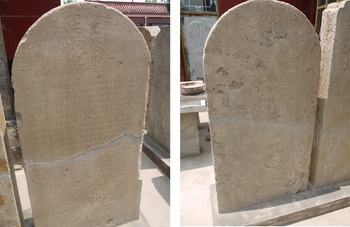
In July 2014 I conducted fieldwork at the Yong'an Buddhist Monastery (Yong'an si 永安寺) at Hengshan village 橫山村 of Dingxiang county 定襄縣; ten steles from the Yuan, Ming (1368–1644), and Qing (1644–1911) dynasties stood in the courtyard in the monastery.Footnote 42 During the field investigation of the temple, a stele installed in 1491 caught my attention. The stele lacks the imperial emblems of carved dragons at the top and a tortoise at the base, indicating that it was locally produced. It is currently installed on a concrete base side by side with another stele (see Figure 1), indicating that the 1491 stele was moved to the current location during a renovation project in recent years. While it originally impressed me as just an ordinary local stele like those I have seen everywhere in northern Chinese villages, a quick look at the content of the stele inscription confounded me.
The 1491 stele, front side (left) and back side (right).

The 1491 stele turns out to be a rarely seen case of a recycled stele. The front side of the stele bears the title “Chongxiu Yong'an yuan ji” 重修永安院記 (Record of rebuilding the Yong'an Monastery) (see Figure 1, left), yet the title on the back side is “Qinshi zongpai zhi tu” 秦氏宗派之圖 (Chart of the Qin's descent group and its branches) (Figure 1, right). On closer investigation, I quickly realized that the stele was originally a genealogical stele of a Qin family, likely installed in the Jin-Yuan period. However, it was recycled, in 1491, by monks of the Yong'an Buddhist Monastery. Clearly, when the inscriber erased the surface of the original genealogical stele of the Qins, he did not do a thorough job. Instead, many characters from the original stele were left on the surface of the 1491 stele. We can still identify the two obvious large characters gong 公 (master or Mr.) and ming 銘 (epitaph or inscription) between the stele title and body inscription on the front side. Judging from these two characters and the thinner vestiges of other old characters remaining on the stone, we can tell that the original inscription was likely “Gu Qingong muzhiming” 故秦公墓志銘, a tomb epitaph of a Qin man.
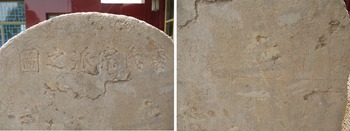
The 1491 stele exemplifies the local practice of redeploying steles of one popular epigraphic genre in pursuit of another. However, the process of redeployment was incomplete in this case, with some remaining old textual information coexisting alongside newly inscribed content on the same stone. In addition to carving new characters onto both the front and back sides of the stele, the inscriber in 1491 also carved images of clouds, flowers, and animals (see Figure 2, left). As a result, old and new characters and new images are entangled on the 1491 stele, creating a perplexing mix of textual and visual information from the old and new steles. This phenomenon is also observable on the back side of the stele, which originally charted kinship information of the Qins. It was later reinscribed with names of lay leaders and patrons of the temple-rebuilding project that was completed in 1490. Thus, below the original title “Qinshi zongpai zhi tu,” there is a new thinly-carved line “Jiushou du gongde ren” 糺首都功德人 (Chief patrons who led [the temple-building project]) (see Figure 2, right).
Inscription of “Qinshi zongpai zhi tu” 秦氏宗派之圖on the back side of the 1491 stele (left), and inscription of “Jiushou du gongde ren” 糺首都功德人and names of the Lis (right).
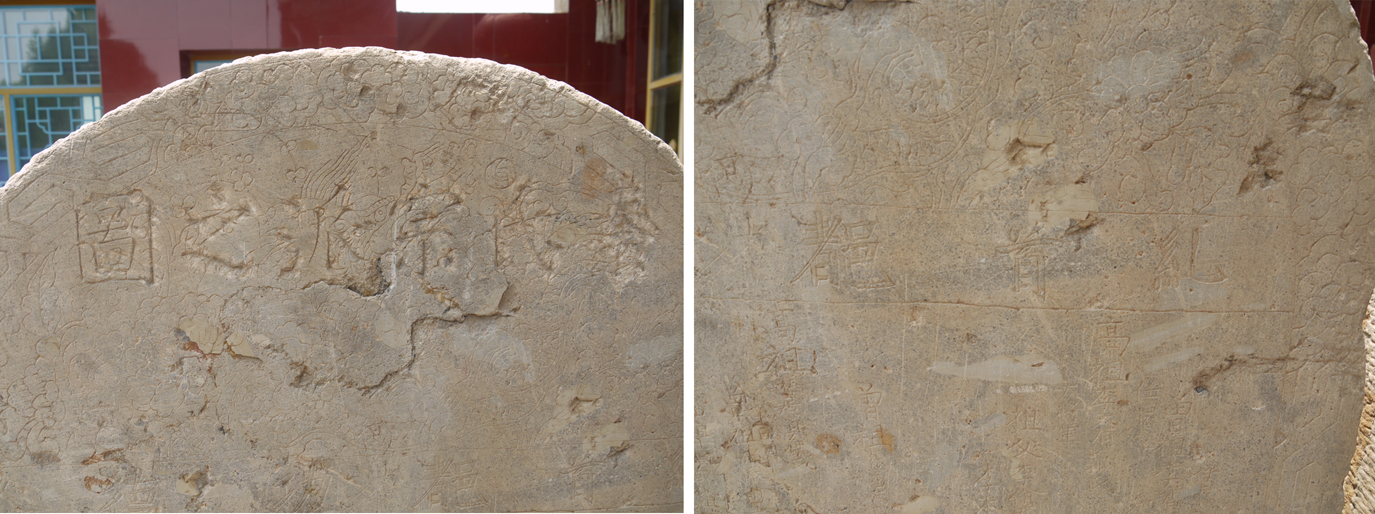
Right below this horizontally arranged line, we see several vertically arranged lines of names, which made the information on the stele further confusing for two reasons. First, these names appeared in the form of genealogical records for four families ranging from great-great-grandfathers to great-grandsons of several branches of the kinship groups. While names of donors commonly appeared on the back side of temple-building steles, it was rather rare to give a seven-generation genealogical record of a chief patron. Second, the first chief patron had the surname of Li 李, the character for which looked like that of Qin 秦. As a result, without a careful investigation, a reader could mistakenly regard the genealogical chart of the Lis as that of the Qins due to the strong first impression of the remaining old title “Qinshi zongpai zhi tu.” Even when examining the stele closely on the spot, it took some time for me to figure out whether the genealogical records came from the old or new stele.
The redeployment of the epigraphic genre consisted of recycling the material of an old stele that had fallen out of use in its original context. The process of recycling returned the stele to its original physical form as a piece of stone, which could be reused in a variety of ways—be it for building materials or for a new stele. The practice of recycling steles was common in imperial China, but existing steles with recognizable traces of recycling are few. The 1491 stele offers a rare chance for us to explore the reuse of steles in Middle-Period China by asking the following questions: How did different social actors come to engage with reused steles, including deciding what old and new texts to erase or inscribe and how to erase or inscribe them? How did various engagements with the steles reveal cultural concerns of people toward texts, monuments, and their projected authority? How did literacy affect the ways in which people engaged with the steles?
These questions situate my approach to the reuse of steles in Middle-Period north China differently from the substantial body of literature on the reuse and long lives of artifacts. This body of literature has been mainly developed by archaeologists and art historians, especially those who work on ancient and medieval Europe.Footnote 43 The past decade has also seen the expansion of this line of research into comparative studies on antiquarianism, including that of late imperial China.Footnote 44 These scholarly works have commonly contextualized the use and reuse of artifacts and architecture in elite settings. In contrast, my approach to the reuse of steles underscores their malleable material nature and public communication function in social and everyday life environments.
The baffling material and visual qualities of the 1491 stele complicate our understanding of the materiality of writing on steles. In recent years, scholars have been increasingly attentive to the nature of steles as medium as well as the meanings different media signify. Some tend to emphasize the irreducible materiality of writing, be it words carved on stone or handwritten on paper.Footnote 45 Yet as the 1491 stele shows, stele inscriptions could be erased and replaced by new carved words or images. In other words, for words on stones, their materiality is reducible. During the process of recycling, a stele first lost its nature as monument and recording medium. Only when it was recycled for the production of a new stele did the stone tablet become a stele once again and regain the same qualities of document and monument. This malleable feature significantly differentiates steles from paper as a medium for writing in imperial China.
The malleability of steles as a medium for writing offers us an entry point from which to explore further the unusual case of the 1491 stele. As the following paragraphs show, this case reveals sophisticated ways in which steles stored and transmitted information and projected power in the rural world where reading was not the default mode of engagement.
Above all, we might wonder why the Ming Dynasty inscriber did not erase the entire old inscription to make room for an unambiguous new one? Or why did monks of the temple and their sponsors not insist on it? Normally, the reason would be technological and economic. But neither factor seemed to be the case for the 1491 stele, making the recycling of this stele even more intriguing. On the old stele, as well as the new one in 1491, characters were carved intaglio, the most common stone-engraving technology used for Chinese steles. Judging from the current condition of the stele, the old title “Qinshi zongpai zhi tu” on the back side had been carved quite deeply, so deep that it was impossible to make the characters completely disappear without grinding away a few centimeters of the stone surface. In other words, recycling old steles might be a cost-saving solution in stele making, but recycling an intaglio-carved stele without leaving any traces required the hard work and possibly high cost in grinding the stone surface. However, according to the frontside inscription of the stele, the Yong'an Monastery's abbot, Monk Ruzheng 如整, had raised sufficient funds from local patrons to complete a large-scale monastic construction within a year.Footnote 46 In addition, the inscriber was the “chief stone carver” (dushijiang 都石匠) Liu Fuyou 劉福友 of Dingxiang county, suggesting that he was a seasoned carver. The available sources unfortunately do not provide a definitive account explaining the crude reuse of the old stele.
Nevertheless, the crudeness of the over-carving affected the textual, material, and visual qualities of the recycled stele. The two inscriptions overlapping on the same stone resulted in difficulty for even educated readers to recognize the content of either. The extra layer of images carved around the remaining old characters increased this difficulty. The mixing of text and images created visual messiness, which sheds light on the material and visual aspects of steles and inscriptions. As Antony Eastmond reminds us,
Inscriptions are not just disembodied words that can be studied in isolation. Instead they must be considered as material entities, whose meaning is determined as much by their physical qualities as by their content. … The visual qualities of inscriptions allow them to play with their onlookers, who can be manipulated to act as the viewer of an inscription rather than its reader.Footnote 47
This observation signals important questions regarding the formatting of inscriptions, the targeted readers, and the physical environment of a stele. These questions are crucial to understanding the value of the 1491 stele for Hengshan villagers, who were producers or receivers of information stored by the stele.
A thorough examination of the 1491 stele in its physical environment of the monastery reveals much about its value as a writing medium for people far beyond the monks of the Buddhist monastery. As a religious stele, the 1491 stele integrated the epigraphic practice of genealogical steles and transmitted crucial information about the power dynamics among kinship groups in the village. On the surface, the incomplete recycling of the old genealogical stele into a new religious stele resulted in the coexistence of both in layers on the same stone. At deeper levels, the 1491 stele functioned to project hierarchy among Hengshan village's kinship groups, including both interlineage and intralineage power dynamics.
At the first level, the 1491 stele underscored the distinction between families as chief donors and ancillary donors through listing them under different donor categories with differing numbers of generations of ancestors recorded. Families of chief donors were listed under the title of “Jiushou du gongde ren” 糺首都功德人 (Chief patrons who led [the temple-building project]) and their ancestors started from the generation of “great-great grandfather” (gaozu 高祖). Families of ancillary donors were described as “Zhuyuan xinggong ren ”助緣行功人 (People who did good and assisted [the temple-building project]) and their ancestors started only from the generation of “grandfather” (zufu 祖父) or “father” (fu 父). This distinction indicated that the greater the contribution a donor family could make to the temple-building project at the Yong'an Buddhist Monastery, the more detailed its genealogical record could be on the monastery's stele as a public monument and a greater number of ancestors who would be able to benefit from the “merit” of renovating the Buddhist monastery. In other words, the genealogical category of a donor family's founding ancestor was applied to suggest the family's position in the hierarchy among its fellow kinship groups.
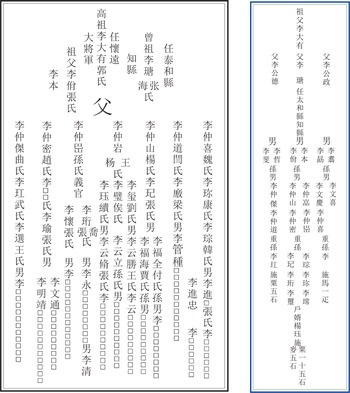
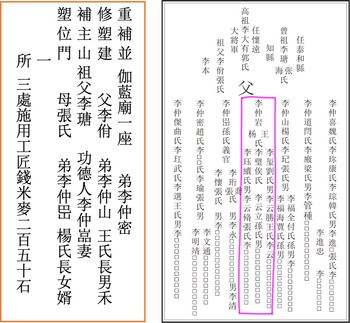
At the second level, the 1491 stele further treated donor-families hierarchically through a differentiated visual layout of the genealogical records inscribed on it. The Lis, as the primary chief-donor family, were given the largest space on the stone surface to lay out their seven-generation family members in a genealogical-chart-like form. The chart was made up of two layers separated with the largest character 父, meaning “father” (see Figure 3, left). The spatial arrangement of the chart created a visual image of a genealogical chart with both horizontal and vertical dimensions. The above layer included great-great-grandfather (Li Dayou 李大有) at the center, flanked by great-grandfather (Li Tang 李瑭) on the right and two grandfathers (Li Yi 佾 and Li Ben 李本) on the left. The hierarchy among these remote ancestors was suggested by having the line for each junior generation inscribed horizontally two characters lower than the previous senior generation. Below the character 父 were several horizontally parallel lines, beginning with seven men in the same generation of the father with the same character of 仲, meaning “the second,” in their given names. Their names were followed with a long list of men in the generations of sons, grandsons, and great-grandsons. Wives of most of these Li men were also mentioned with their natal surname followed by shi 氏. The genealogical chart of the Lis occupied thirteen vertical lines while most other families were given only one or two lines.Footnote 48 The discriminatory spatial arrangement created a recognizable visual contrast among genealogical records of donor families, making the Lis stand out just by viewing.
The original spatial arrangement of the Lis on the back side of the 1491 stele (left), and the original spatial arrangement of the Lis on the back side of the 1429 stele (right)

The third and further levels of power projection require a comparison of the 1491 stele with earlier temple-building steles that stood in the same monastic space. Some of these steles were inscribed with similar genealogical records of Hengshan village's large families like the Lis. The practice of inscribing an elaborate genealogical chart of chief-donor families was not an innovation in 1491. Instead, it was a longstanding tradition of Hengshan villagers, as seen on old steles installed by earlier ancestors from the Yuan and early Ming periods. These steles attested to the importance and authority of genealogy for the village's elite families in a long-term historical context. Indeed, as a way of claiming and securing their elite status, some chief-donor families in the Yuan dynasty, as I have discussed elsewhere, had already started to install genealogical steles or to use Buddhist steles as a preferred medium for kinship records.Footnote 49 Descendants of such village elite families in the Ming continued the practice of inscribing their genealogical records on steles installed in the Yong'an Buddhist Monastery. The 1491 stele was only one product of this village tradition; an earlier one was installed in 1429 and a later one in 1609.Footnote 50
Not only did the 1429 stele also feature the Lis as the primary chief-donor family but its spatial arrangement of the Lis (and other patron-families as well) was similar to that of the 1491 stele (see Figure 3, right, which is arranged next to Figure 3, left, for comparison). As the chief patrons of the monastic construction project, the Lis enjoyed the privilege of having their names visually arranged as a genealogical chart. While the Lis occupied the space of seven vertical lines, all other patron families had only one or two lines. In addition, both the 1429 and 1491 charts of the Lis featured Li Dayou as the founding ancestor, as grandfather in the former and as great-great-grandfather in the latter. These similarities point to a consistent pattern in the engagement of the Lis with temple-building steles of the Yong'an Buddhist Monastery.
In both cases, the Lis engaged with Buddhist steles not just by sponsoring their physical production but also by taking full advantage of them as a medium to keep records, make claims, and to project power. As the chief patrons of the Yong'an Buddhist Monastery, the Lis had considerable agency in deciding what steles to make and how their kinship information was represented in terms of content and format. That Li Yi 李佾—a man in the third-generation of the Lis—appeared on the front side of the 1429 stele as the “Patron-in-Chief” (Gongde du jiushou 功德都糾首) would seem to be related to the representation of the Lis on the back side of the stele as the only chief-donor family with a detailed genealogical chart. Similarly, some members of the Lis directly participated in the physical production of the 1491 stele. Li Yunsheng 李雲胜, a man in the sixth generation and a head of Hengshan village (benli jiu 本里纠), wrote the calligraphy of the inscriptions on both the front and back sides of the 1491 stele. The Lis turned the two religious steles into a medium for conveying their family genealogy.
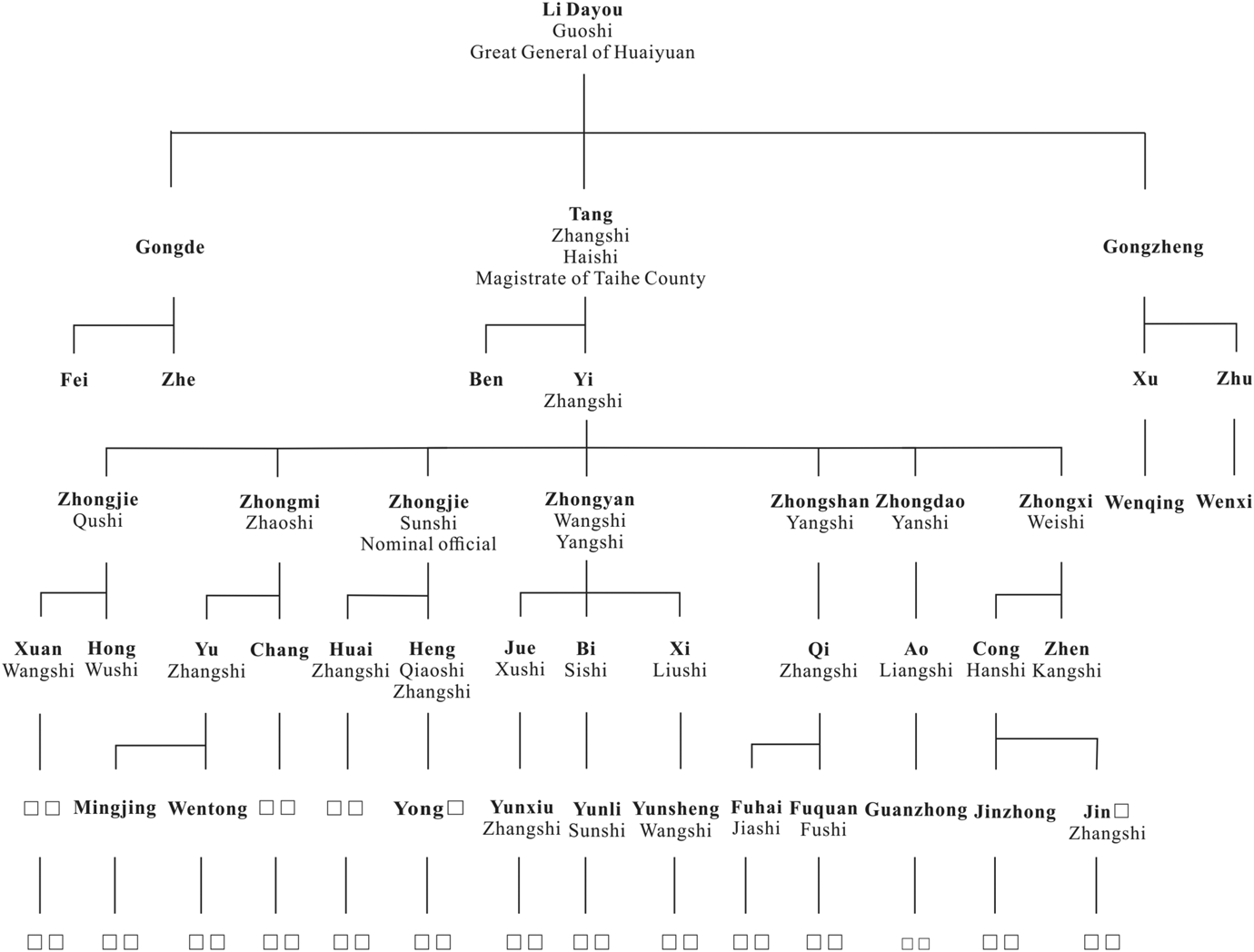
Additionally, by placing Li Dayou as the founder of their kinship group on both the 1429 and the 1491 steles, the Lis conveyed an unmistakable message to their fellow villagers: the Lis had had an honorable official background. The office-holding origin of their kinship group helped the Lis claim their elite status in Hengshan village. Li Dayou had held the military rank of Great General of Huaiyuan 懷遠大將軍, which ranked 3b in the Yuan. Although Li Dayou's identity is difficult to pinpoint due to insufficient available sources, he was most likely one of the local Dingxiang strongmen who surrendered to the Mongols in the early thirteenth century and subsequently made their families officeholding households.Footnote 51 Indeed, Li Dayou's son Li Tang held the position of magistrate of Taihe county 泰和縣知縣. Given Li Dayou's distinguished status in the Yuan era, it would not be surprising if the Lis erected a typical genealogical stele to transmit the claim and evidence of their political privilege acquired from Li Dayou's connection to the ruling Mongol elite. After all, the Yaos, who were the peers of the Lis in Hengshan village in the Mongol-Yuan era, did exactly that.Footnote 52 For the Lis in the early Ming, featuring Li Dayou as their founding ancestor would not bring the same political capital as it had in the Mongol-Yuan era. But doing so likely lent them some cultural capital in preserving and perpetuating their genealogy. Combining the two genealogical charts on the 1429 and 1491 steles, one can draw a relatively complete genealogy of the Lis (or at least the line of his second son) over seven generations across the Yuan and Ming dynasties (see Figure 4).
The genealogical chart of the Lis across the Yuan and the Ming dynasties.

The visualized genealogical chart exposes a hidden layer of information conveyed by the genealogical records of the Lis on the 1429 and 1491 steles. That is, some descent lines of the Lis exploited the two steles’ public communication function to make implicit claims that serve their subgroup's interest. The two records gave the prominence of a particular line of descent: Li Dayou–Li Tang–Li Yi–Li Zhongyan 李仲岩. In addition to Li Tang, Li Dayou had two other sons, Li Gongde and Li Gongzheng. Information about these two sons and their descendants appeared on the 1429 stele but disappeared on 1491 stele. In addition, on the back side of the 1429 stele, an additional inscription was added in 1430 to record extra monastic construction projects sponsored by two families, one of which was the Lis. The inscription of the Lis again appeared in the form of a simple genealogical chart with the single line of Li Tang–Li Yi–Li Zhongyan, accompanied by Li Zhongyan's three brothers (see Figure 5). As the main donor (gongde ren 功德人), Li Zhongyan contributed 250 shi 石of cash, rice, and wheat, which were used to hire craftsmen to polish the main statue of the monastery and to build a gate and a tutelary-deity shrine.
The original inscription about Li Zhongyan's contribution to the 1430 construction project (left). This inscription was inscribed on the back side of the 1429 stele. And, the central position of Li Zhongyan's branch in the genealogical chart of the Lis on the 1491 stele (right).

Notably, the 1491 stele further underlined the prominence of the Li Yi–Li Zhongyan line. That Li Yi's brother Li Ben had no wife indicates that most of the fourth-generation men and their descendants came from the line of Li Yi. Among Li Yi's seven sons, Li Zhongyan's name was put in the middle, resulting in the visual effect of Li Zhongyan's branch being positioned right in the center of the Lis’ genealogical chart (see Figure 5, right). This arrangement was deliberate, because it could not be explained by the rationale that the branches of Li Yi's seven sons were arranged following the order of seniority and Li Zhongyan was simply the fourth son and thus naturally in the middle. The 1430 inscription explicitly describes Li Zhongmi 李仲密, Li Zhongshan 李仲山, and Li Zhongjie 李仲岊 as Li Zhongyan's younger brothers. On the 1491 stele, Li Zhongshan was arranged on the left of Li Zhongyan, and Li Zhongjie and Li Zhongmi on the right. This arrangement indicates that seniority did not determine the order of the seven brothers’ lines; otherwise the three younger brothers should have all be arranged on the left of Li Zhongyan. The visual arrangement was likely meant to highlight Li Zhongyan and his descendant line. This deliberate choice was technically possible. Li Zhongyan's grandson Li Yunsheng wrote the calligraphy of the entire 1491 inscription, thus having agency in shaping the layout of the inscription. In a nutshell, from the 1429 stele to the 1491 stele, while continuing to display the Li kinship group's overall prominence, some members along the linear decent line of Li Tang–Li Yi–Li Zhongyan privileged themselves by excluding some collateral descent lines and by formatting the inscribed genealogical charts to center around Li Zhongyan's branch.
Thus far, I have discussed how some of the Li men curated information about their lineage and stored it on the 1491 stele in explicit and hidden layers to project authority and convey specific messages. The last question to consider is how such information was received or consumed by the stele's audience, especially local villagers who were likely unable to read the stele's inscription. For them, their personal engagement with the stele mainly came from viewing rather than reading. In viewing they could still extract some information from the material and visual aspects of steles: such as the quality of the stone, the engraved decorations, the size and letter style of inscribed characters, their clarity and legibility, and the location of the stele. With all these concerns in mind, without reading the inscription an onlooker could at least reach the conclusion that the 1491 stele was a crudely made local product, with no imperial endorsement. Yet ordinary villagers likely had access to much more textual information from the 1491 stele than we might have thought.
When considering how commoners in imperial China engaged with written texts, Charles Sanft's proposal to redefine “literacy” in early imperial China is inspiring. As he points out, our modern understanding of “literacy” as being able to read and write is not appropriate for premodern times. Instead of giving reading and writing equal space, he proposes to frame the terms of his discussion of literacy in two respects: 1) considering “the consumption of written information through reading and listening” and 2) conceiving of the matter “not in terms of individual capabilities but instead as a characteristic of a community.”Footnote 53 These two respects throw into relief the point that diverse modes of engaging with written texts, or text-bearing objects like steles, collectively contributed to the overall literacy of a community regardless of whether most its members were able to read or not.
This understanding allows us to imagine how ordinary villagers could acquire some of the 1491 stele's textual information without having the full capacity to read, let alone write. We can only imagine because the inscription leaves no records on this matter. Some village members such as the monastic abbot and Li Yunsheng were able to read and even write, so they could read some content for interested village fellows. As Sanft claims, recognizing graphs is an ability built into our brains and thus is not hard to acquire even without formal schooling.Footnote 54 With the initial help of local literate men, some Hengshan villagers might have been able to read their family name and recognize it on the list of donors. Once they located the position of their family in the complex web of characters that formed the donor list, a few illiterate individuals could likely pick up some unwritten messages through the size of characters, the assigned space for each family, and the visual layout for each family, as well as by comparison of all such categories among different donor families. More importantly, for the Hengshan village community as a whole, its members had access to the information stored and transmitted by the stele in the whole range of modes: writing (like Li Yunsheng), reading (with full or partial capacity), and oral transmission (listening and talking). These modes of interaction attested to steles’ unique communicative functions in the local community thanks to the stele's presence as a public text-bearing object and its durability in its stone materiality.
Thus, we see that leading families in Hengshan village turned Buddhist steles into spaces for public genealogy making and status claiming. This practice, which persisted across the Yuan and Ming dynasties, became a tactic through which the village's influential families enhanced their private interests. Later generations inherited not just the epigraphic practice but also conceptions of authority inherent in it. Within the village world, these conceptions included the importance to sustaining a prominent kinship group's identity and status of supporting the Yong'an Buddhist Monastery and producing a public genealogy. Familial and monastic interests were intertwined, but not limited to cooperating on monastic building projects. Kinship and monastic agents also negotiated what and how information—especially that salient to the involved parties—was displayed on steles and subsequently transmitted to various receivers.
To summarize, steles had a dynamic communicative function due to the diverse ways in which different social actors engaged with steles as providers or receivers of the information that was stored and transmitted by steles. This point is critical for understanding steles erected in northern Chinese villages. As villagers tended to economize the financial cost in stele making, they often had one stele—particularly one made under collective efforts—to take on a multitude of documentary claims. In this light, the final product of a stele's inscription—including its content and the way it was carved in the stone—spoke to the competition over the stele's nature and function among different interested parties vying to preserve and convey information. At the information-receivers’ end, the default mode of engagement with steles was viewing rather than reading. Thus, the material and visual dimensions of steles were equally crucial to the inscriptions for explicit and implicit information to successfully reach their targeted audience.
The scarce literacy, in terms of reading and writing, in rural society and the cultural authority of written words made steles important resources for villagers acting as both providers and receivers of information. Some (but not all) old steles served as a repository that stored knowledge and practices of villagers’ remote ancestors, including the practice of making distinctive steles and utilizing them to make claims. Although individual villagers might have trouble apprehending texts inscribed on steles, the texts were likely accessible to the village community as a whole and the information contained in them was diffused among villagers in diverse modes and scales. In this light, steles functioned as a crucial local communicative medium in the rural world.
Conclusion
Throughout this article, I have shown how steles, when examined as material objects and particularly through the lens of their public communication function, offer new historical and methodological insights into our understanding of Middle-Period north China, where transmitted historical records are far from abundant. Examining the communicative functions of steles is a powerful method for understanding the deeper social relations and power dynamics teeming beneath the surface documentary claims of steles in the vast rural world of north China.
Attending to the function of steles as a form of public communication, I argue, allows us to explore the relationship between the medium and its producers and receivers. It illuminates the ways in which explicit and implicit information was configured, transmitted, and negotiated. Exploring diverse modes of transmission points us to often-hidden power dynamics that determine not just the content of information but also the ways in which the information is represented. It allows us to interrogate the “unspoken” conversation between messages conveyed through reading and those conveyed through viewing.
In conclusion, I would like to propose three ways in which this public-communication approach to steles can make a meaningful intervention into the Middle-Period China studies specifically, and into the broader field of pre-modern Chinese history more generally. First, given that the materiality of steles as a medium for writing and image is malleable, we can also trace material journeys of steles from production to use and from original use to their afterlife—such as recycling, reuse, or disuse—in changing environments. Paying close attention to these processes offers a new slant on steles’ communicative functions of transmitting information and projecting authority by and for diverse historical agents who were not necessarily educated writers and readers. As new stories from and around steles start to appear, they will tell us a great deal concerning Middle-Period Chinese societies about which we have little knowledge, such as the vast rural world that left few extant written records. In short, we can use steles as a window into the everyday lived experiences of people whose voices formerly have rarely been “heard” by historians.
Second, foregrounding steles as a medium redirects our attention from texts alone to the triad of textual, material, and visual information stored by any communicative medium, including manuscript and print. It suggests that historians might understand other kinds of sources as media in which the text, the text-bearing object, and the information conveyed by both form an inseparable whole. This approach compels us to look at the relations among media, information, and power, and helps historians widen the scope of questions we ask. What written and unwritten information was stored by different types of textual media? How was the information transmitted? What do the information's content, format, and modes of transmission tell us about the power dynamics among the producing and receiving ends of the information?
Third, a comparison of different types of textual media opens a door to revisiting, from fresh angles, some received paradigms in interpreting Chinese history. A good example is the Tang–Song transition hypothesis, which is so far still the most influential interpretive paradigm accounting for the long-term political, social, and cultural transformations of Middle-Period China.Footnote 55 Scholars have long seen the proliferation of print, at the hands of the state and the market, as characterizing the Tang–Song transition. Yet a close comparison between stele and print could point us to new directions from which to explore the historical changes that occurred during this period. My claim in the following paragraphs is meant to provoke further scholarly discussion or even productive counterarguments from scholars of print and epigraphy to advance this comparative line of inquiry.
As textual media, both stele and print were deeply rooted in the Chinese obsession with the authority of written words. Both were used as a means of preserving and perpetuating written texts. Despite these shared characteristics, the two media differed in their general purposes. While printing texts and images on paper sought to replicate them, inscribing texts on stones aimed to solidify them. Replication perpetuated texts through quantity: using printing technology to make many copies of the same text. Solidification perpetuated texts through quality: using stone-engraving technology to create one enduring copy that in theory could survive water, light, and fire for hundreds, even thousands of years. Thus, print and stele exert the full affordances of paper and stone. Paper is fragile but light; it makes it easy to reproduce, disseminate, and collect texts. Stone is heavy but durable; it allows for publicizing, eternalizing, and even sanctifying texts. The difference between print and stele in replicating and solidifying texts is a subtle but important one.
From such a distinction arise important questions. What are the specific social, political, economic, and technological contexts that demanded either replication or solidification? Were printed and inscribed texts meant to be read or used? And what is the difference between these two modes of engagement?
Questions regarding reading and using printed texts in the Tang and Song dynasties have largely been resolved thanks to the rich scholarship on print in China. As scholars like Lucille Chia and Hilde de Weerdt have shown, the shift from the Tang to the Song dynasty also marked a shift in the uses of print media. Woodblock printing for religious purposes under Tang rule carried a largely talismanic function. Within this context, print was intended to be used more than explicitly read. That changed, however, in the tenth century when the Song state capitalized on the proliferation of commercial print in its sponsorship of the publication of a variety of works. These works largely included authorized, standardized editions of the many texts needed by men studying for the civil service examinations. The proliferation of print in Song China gradually led to the rise of reading culture, as a wide spectrum of the literate population employed printing technology in shaping and contesting political, religious, intellectual, and vocational authority.Footnote 56 Increasing demand for book reading, collection, and circulation consolidated a social environment for the large-scale replication of texts and images. Print now had a large and growing number of literate readers. The necessity of print thus went hand in hand with the growth of a wide spectrum of the literate population—especially Confucian literati—during the Tang–Song transition.Footnote 57
In contrast, the necessity for steles, as comparable textual media, must be understood in association with the needs of both the literate and illiterate population in exerting the authority of the written word. While literate audiences certainly had little trouble reading texts inscribed on steles, these texts were not meant to be read, at least not fully, by illiterate audiences. Instead, they were meant to be viewed and used. Illiterate people like most villagers used steles and their inscriptions in a variety of scenarios, such as when they needed written evidence in claiming rights or solving disputes in front of literate authority. In these circumstances, solidifying a particular set of knowledge or piece of information became especially crucial.
Notably, the Tang–Song transition saw the social practice of making and erecting many genres of steles spread widely from the elite stratum to ordinary people.Footnote 58 Answers to questions regarding the reading, viewing, and use of steles and inscriptions in the Tang and Song dynasties await additional scholarly work, for the sociopolitical shifts from the Tang to the Song world witnessed not just changes in the uses of print but also in the uses of steles. Recent scholarship has demonstrated how important steles became for storing data, transmitting ideas, and projecting power in north China, particularly after the twelfth century. It remains to be seen whether this was an exclusive feature of the social and cultural transformations of the north. The field may have much to learn by asking in what ways, for what purposes, and for whose interests steles were used elsewhere in China as well, in any dynastic period.
Competing interests
The author declares none.