


1. INTRODUCTION
Public perception of engineering recognizes its importance to national and international competitiveness, economy, quality of life, security, and other points of comparison used to measure global standing, but the general public lacks an understanding of “what engineers actually do on a day-to-day basis” (National Academy of Engineering, 2008). Federal funding trends for education underscore many of the concerns regarding teaching and learning in science, technology, engineering, and mathematics (STEM) subjects in primary through grade 12 (P-12) education, which have been voiced by the 2000 Glenn Commission Report and elaborated upon in a number of ensuing studies and white papers (National Commission on Mathematics and Science Teaching for the 21st Century, 2000). Providing more high-quality STEM preparation for preservice teachers and professional development for in-service teachers, along with more rigorous and relevant STEM learning experiences for students are emerging as priorities among funding agencies (Planning Committee for the Convocation on Rising Above the Gathering Storm: Two Years Later, 2009). The fact that National Science Foundation programs aimed at stimulating pure or applied STEM research are promoting outreach components or professional development opportunities for teachers is one example of the importance currently placed on improving P-12 STEM education. However, even with heightened emphasis on STEM reform, the role of engineering in P-12 education is not settled, and currently several approaches are competing, among these are outreach activities, curricula components, and engineering as a tool or context for math and science.
Perceptions of the scope and definitions of the knowledge and skills of engineering arise from various historic contexts and situations. Unlike the sciences, mathematics, social sciences, and language arts, engineering does not have the same well-established tradition and developed infrastructure in the P-12 curriculum. Consequentially, there are significant gaps in curricula, professional development, and other resources available to schools, as well as very little in the way of uniform standards for content, teacher certification, or assessment criteria for precollege engineering among the growing number of entities becoming involved in P-12 STEM education.
Among the available preengineering resources, many use the engineering design process as the defining characteristic of engineering. However, conflicting perspectives on the essential attributes that comprise the engineering design process results in a lack of coherent criteria against which teachers and administrators can measure the validity of a resource, or assess its strengths and weaknesses, or grasp incongruities among competing process models.
The literature suggests two basic approaches for representing engineering design: a phase-based, life cycle-oriented approach and an activity-based, cognitive approach. Although these approaches serve various teaching and functional goals in undergraduate and graduate engineering education, as well as in practice, they tend to exacerbate the gaps in P-12 engineering efforts, where appropriate learning objectives that connect meaningfully to engineering are poorly articulated or understood. This is not to suggest that the realms of higher education and industry are immune from conflicting perspectives and agendas regarding engineering education. However, epistemology provides a common lens with which the topographies of various stances can be brought into focus and examined, whereas no such context exists in P-12 engineering.
Through examining some fundamental problems that must be resolved if preengineering is to enter the P-12 curriculum with meaningful standards and is to connect through learning outcomes, shared understanding of engineering design, and other vestiges to vertically link P-12 engineering with higher education and the practice of engineering, we hope it will be possible to also examine historical aspects, various pedagogies, and current issues pertaining to undergraduate and graduate engineering programs. As a case study, we hope to shed light on various kinds of interventions, and outreach efforts to inform these efforts, or at least provide some insight to major factors that shape and define the environment and cultures of the two institutions. These include epistemic perspectives, institutional objectives, and political constraints, which are very different, and can compromise collaborative efforts between the institutions of P-12 and higher education.
Another consideration is that exposure to engineering disciplines or practice is rarely, if ever, part of the education or certification of teachers and administrators, leaving them inadequately prepared to help students make informed choices about engineering careers, much less introduce engineering into the classroom. There is also growing appreciation that engineering may be a positive vehicle to motivate a kindergarten through grade 12 (K-12) student to study of other STEM subjects (National Science Board, 2007; Committee on K 12 Engineering Education, 2009). Historically, engineering schools have not always recognized a direct relationship between P-12 and engineering education. As Busch-Vishnaic and Jarosz (Reference Busch-Vishniac and Jarosz2004) point out, “the message we send by emphasizing the exclusivity of engineering as a profession is not one of encouragement but rather one of discouragement.” However, funding trends aside, continuing trends of decreasing enrollments and poor retention provide reasons that are compelling in their own right for university engineering programs to become more proactive in P-12 engineering.
Section 2 of this paper describes perceptions of engineering among the general public, prospective engineering students, and engineering educators. It argues that current outreach approaches do not do an adequate job of representing the societal contributions of engineers nor present a balanced picture of what engineers do. Section 3 presents models of the engineering design process, and identifies characteristics that need to be considered in choosing a model of the engineering design process to teach. This section proposes an approach to design process model choice that is based on an engineering approach itself. Section 4 summarizes the literature on the transitions and differences between student, novice, experienced, and expert designers. Identifying the differences between expert and novice designers is necessary to establish objectives and constraints for teaching engineering using a design process. Figure 1 shows the flow of topics in Sections 2 to 4. Section 5 presents a case study of precollege education to demonstrate the use of this approach to choosing a design process model for teaching P-12 engineering. Section 6 presents conclusions.
The links between topics in Sections 2 to 4.

2. VIEWS OF ENGINEERING AMONG GENERAL PUBLIC, PROSPECTIVE ENGINEERING STUDENTS, AND ENGINEERING EDUCATORS
This section looks at perceptions of engineering among the general public, prospective engineering students, and engineering educators. It argues that current outreach approaches do not do an adequate job of representing the societal contributions of engineers nor present a balanced picture of what engineers do. This paper focuses on perceptions of engineering education in the United States.
2.1. The needs of future engineers
Many trends pose challenges for the future: globalization; energy demands and environmental impacts; social, cultural, political, and economic forces; knowledge of the human genome; micro/nano/quanto systems; human–machine interactions; new ways of distributing knowledge; the accelerating pace of technological innovation; the seamless, transparent presence of technology; and multidisciplinary individuals involved with technology (National Academy of Engineering, 2004a, 2004b; Hastings, Reference Hastings2005). As these challenges present themselves, the discipline of engineering and engineering educational efforts must adapt. To broaden participation in engineering, new pathways for recruiting and retaining engineering students are needed, such as flexible curricula that progress from high school to community colleges or universities and ultimately to graduate degrees with multiple entry and exit points (Tate, Maxwell, Flueckiger, et al., Reference Tate, Maxwell, Flueckiger, Park and Parten2008; Tate, Maxwell, Ham, et al., Reference Tate, Maxwell, Ham, Blair, Stewart, Patterson, Fontenot and Chandler2008).
A recent study highlighted the challenges faced in making engineering an attractive discipline for prospective students and improving public perceptions of the contributions of engineering. The commonly used approach of engineering outreach to emphasize science and math as well as the practical benefits of being an engineer in marketing engineering “may damage rather than increase the appeal of engineering” and overemphasizes their importance instead of placing these subjects “correctly, as just two of a number of skills and dispositions . . . necessary to a successful engineer.” The weakest of several tested messages for promoting engineering is the one that portrayed engineers as “connecting science to the real world.” The report instead recommended emphasizing “the inspirational, optimistic aspects of engineering” similar to the image of a “physician . . . who cures diseases and relieves human suffering.” As noted, “The medical profession does not market itself to young people by pointing out that they will have to study organic chemistry or by emphasizing the long, hard road to becoming a physician” (National Academy of Engineering, 2008).
2.2. Distinction among engineering, science, and math
In teaching engineering, especially in programs intended as outreach to prospective students and the general public, engineering should not be conflated with other STEM subjects, especially science or technology. The difference between science and engineering is captured in the statement by von Karman: “Scientists study the world as it is, engineers create the world that never has been.” Sohlenius (Reference Sohlenius2005) expanded on this thought by explaining that “The Engineering Scientist analyses what is, analyses what would be possible, imagines what would be desirable, creates what has never been, analyses the results of the creation, and generalizes the conclusion … all to the benefit of mankind.” According to Simon (Reference Simon1996),
Schools of engineering . . . are all centrally concerned with the process of design. . . . [yet] it is ironic that in [the twentieth] century the natural sciences almost drove the sciences of the artificial from professional school curricula, a development that peaked about two or three decades after the Second World War. Engineering schools gradually became schools of physics and mathematics. . . . The use of adjectives like “applied” concealed, but did not change, the fact. . . . It did not mean that design continued to be taught, as distinguished from analysis.
To explain the overemphasis on science in engineering education requires a historical analysis of the forces that shaped engineering curricula after World War II (Kline, Reference Kline2000). In particular, there was a shift toward “engineering science” subjects at the expense of design and manufacturing, even to the point of “the education system has treated engineering as synonymous with engineering science” (Suh, Reference Suh1990).
2.3. Engineering science versus engineering design
“Guided by the belief that scientists had outperformed engineers in wartime laboratories,” educators shifted research and teaching toward “engineering science” as part of a “Cold War reconfiguration of engineering education” (Kline, Reference Kline2000). Currently, however, there is a need for a reemphasis on the creative aspects of engineering to maintain competitiveness in the current globalizing context. The United States needs to prepare future engineers and researchers for a global engineering environment (Devon, Reference Devon2004).
With advances in computing power, the analytical and engineering science skills that contribute to innovation are becoming a commodity. Even the activities of research and development—and innovation—are being outsourced (Engardio & Einhorn, Reference Engardio and Einhorn2005). It is difficult for individual engineers to be conversant with the many technologies, social, and economic focuses bearing on new designs, and it is also difficult for engineers to understand their client, customer, or society's perspective on the needs of a new technology. One solution to the challenges is to broaden participation in innovative activity through “open” innovation approaches (von Hippel, Reference von Hippel2005; Chesbrough et al., Reference Chesbrough, Vanhaverbeke and West2006).
Other countries have strong motivations, are investing heavily in R&D, and are making rapid progress in increasing their scientific output and ability to innovate (Judson, Reference Judson2005/2006; Uchitelle, Reference Uchitelle2006; Leadbeater & Wilsdon, Reference Leadbeater and Wilsdon2007; Wilsdon & Keeley, Reference Wilsdon and Keeley2007). In order for the United States to remain competitive in the face of global competition, the country must greatly expand access to the tools of innovation.
In a recent article in the Chronicle of Higher Education, Grasso and Martinelli, addressing issues brought forth in Rising Above the Gathering Storm (Committee on Prospering in the Global Economy of the 21st Century, 2007), stated that the United States does not necessarily need more engineers but needs to maintain the quality of 21st century engineering graduates and to educate engineers in a more holistic manner. Engineers should “look beyond the fields of math and science, in search of solutions to entire problems” and “must at least attempt to understand the human condition in all its complexity—which requires the study of literature, history, philosophy, psychology, religion and economics, among other fields” (Grasso & Martinelli, Reference Grasso and Martinelli2007).
2.4. Summary
This section argues that current outreach approaches do not do an adequate job of representing the societal contributions of engineers nor present a balanced picture of what engineers do. As a result, the general public and prospective engineering students do not have a clear understanding of what engineers do or how their work benefits society. To recruit and maintain a large, diverse, and creative pool of engineers, the profession needs to do a better job of presenting the activities of engineering design, the context in which engineers work, and the creative skills needed to conceptualize and implement innovative products and systems.
3. MODELS OF THE DESIGN PROCESS
This section presents models of the engineering design process and identifies characteristics that need to be considered in choosing a model of the engineering design process to teach. In addition, this section proposes an approach to design process model choice that is based on an engineering approach itself. Other researchers have reviewed models of the design process, and the models have been generalized into different categories. For extensive references in the field of design theory, the reader is referred to references by Hubka and Eder (Reference Hubka and Eder1992), Cross (Reference Cross1993), Blessing (Reference Blessing1994, Reference Blessing1995), Dwarakanath et al. (Reference Dwarakanath, Blessing, Wallace and Mruthyunjaya1996), Evbuomwan et al. (Reference Evbuomwan, Sivaloganathan and Jebb1996), and Horváth (Reference Horváth2004).
Ross defines a model as “M is a model of A if M can be used to answer questions about A” (Ross, Reference Ross1977, Reference Ross1985). This paper presents a model of design process activities for the use of P-12 educators. The purpose of this model is to provide answers to questions such as the following:
• What is a design process model that is flexible enough to include instances of the engineering design process as actually practiced in different industries and disciplines and that is specific enough to provide a basis for pedagogy?
• What is the context of engineering efforts?
There are two purposes for having a model of the design process: introduce students to what engineers do and the cognitive processes they follow, and provide a structure for educators to initiate, manage, and assess students' engineering design activities.
3.1. Definition of engineering design
Design may be characterized “as the epitome of the goal of engineering [that] facilitates the creation of new products, processes, software, systems, and organizations through which engineering contributes to society by satisfying its needs and aspirations” (Suh, Reference Suh1990). Design can be a challenging subject to teach because “design thinking” is characterized by a set of skills that include tolerating ambiguity, viewing from a systems perspective, dealing with uncertainty, and using estimates, simulations, and experiments to make effective decisions (Dym et al., Reference Dym, Agogino, Eris, Frey and Leifer2005; Dorst, Reference Dorst2007). This distinct “designerly” form of activity is fundamentally different than approaches used by experts in other fields (Cross, Reference Cross2004). In contrast with undergraduate design education, the goals and objectives of P-12 and graduate engineering design education have received little attention. For one graduate engineering design course on transdisciplinary design, see Tate and Lu (Reference Tate and Lu2004), as well as recent National Science Foundation sponsored workshops on interdisciplinary graduate design education (National Science Foundation, 2008).
3.2. Scope of design process
The first issue to be considered in choosing a design process model is its scope: what is the intended breadth of activity to be explained? Using the model of the product design and development process presented by Ulrich and Eppinger (Reference Ulrich and Eppinger2004) as a starting point (shown in Fig. 2a), the scope of several, commonly encountered models of the design process can be contrasted (Tate & Nordlund, Reference Tate and Nordlund1995). Ulrich and Eppinger's view of the design process starts with understanding the customer and society's needs and proceeds through the manufacturing or implementation of a solution.
Clausing's (1994) model, which is shown in Figure 2b, includes the same scope and shows how the design process can be integrated with technology development to produce a stream of product technologies that can be drawn upon during conceptual design. The scope of design activity as viewed by Clausing (Reference Clausing1994) is very broad: “Total quality development is the modern way of developing new products that will be competitive in the global economy. It combines the best engineering, the best management, the best strategy, and especially, the best teamwork.”
The contrasting scopes of engineering design process models: (a) the product design and development process, (b) the product design and development process with technology development, (c) product design and manufacturing, (d) product design, and (e) concept development with technical conflict resolution.

A slightly narrower approach to modeling the engineering design process, which is shown in Figure 2c, is to include design and manufacturing, but to assume that the design specifications given to the engineers is sufficient without involving the engineers in directly assessing the customers' needs and environment and formulating a business strategy to meet these. This approach can be seen in Suh's (1990) work on axiomatic design. Suh does not describe how to connect design activities to the company's general activities, but focuses on decision making for product design and manufacturing.
In contrast to these models of the design process, European schools of engineering design tend to separate out a portion of product development activity. The design process is restricted to certain stages of the product development process: after specification of needs, but before manufacturing as shown in Figure 2d. An engineering design team begins its design task when it receives a set of requirements from a customer or sponsor. “This document is the start of the design sequence, the engineering design team accepts the assignment of the problem” (Hubka & Eder, Reference Hubka and Eder1992). The end point of the design process is a description of a technical system, specifically a “full and complete description of an optimal product (i.e., a technical system) is considered the aim of an engineering design process, its output.” (Hubka & Eder, Reference Hubka and Eder1992).
The motivating objective for Altshuller is to make creativity (the activity of generating new designs) become a controlled process. As shown in Figure 2e, it does not include the selection from among existing designs; rather, it is concerned with the statement of problems, an analysis that identifies a key area of conflict, the identification of general principles for resolving the conflict, and the application of solution guidelines to the specific situation at hand (Altshuller, Reference Altshuller1984). Applying this method in the context of a design project should provide benefits in the form of a reduced number of iterations and better solutions, based on Altshuller's definition of a good product.
3.3. Prescriptive versus descriptive models of the design process
The second question to be answered about a design process model is its intention. Is the model intended to describe what engineering designers do in practice, or is it intended to prescribe what engineers—or students—should do? Prominent reviews of design research have classified models of the design process according to whether they are descriptive, prescriptive, or computer based (Dixon, Reference Dixon1987; Finger & Dixon, Reference Finger and Dixon1989; Blessing, Reference Blessing1994, Reference Blessing1995; Cross, Reference Cross1994).
The distinction between prescription and description is said to be the following: “Some . . . models [of the design process] simply describe the sequences of activities that typically occur in designing; other models attempt to prescribe a better or more appropriate pattern of activities” (Cross, Reference Cross1994). According to Blessing (Reference Blessing1995), “Descriptive models result from studies into how design actually takes place. In particular, the studies that focus on successful processes and products are relevant for the aim to improve design. They can be used to develop prescriptive models. Prescriptive literature suggests models of design that are considered to represent effective and efficient design processes. Apart from a few exceptions, prescriptive models typically give a systematic or methodical sequence of stages or activities, and recommend or even demand certain methods for specific steps in the design process” (Blessing, Reference Blessing1995). Blessing et al. (Reference Blessing, Chakrabarti, Wallace, Frankenberger, Badke-Schaub and Birkhofer1998) argue that descriptive studies of design can be combined with prescriptive studies in a generic design research methodology that links and addresses research questions in a systematic way.
3.4. Phase-based versus activity-based (cognitive) models of design processes
In this section the effectiveness of existing design process models in matching reality is discussed. In this analysis, design process models may be grouped into two classifications (Evbuomwan et al., Reference Evbuomwan, Sivaloganathan and Jebb1996): those that are based on cognitive activities, and those based on the phases of design object evolution.
3.4.1. Activity-based models
One view is that the design process consists of repeated iterations of three cognitive activities. According to Blessing (Reference Blessing1994), “A design activity is defined as a subdivision of the design process related to the individual's problem solving process. It is a much finer division than the stage, covering a shorter period of time. A typical characteristic of an activity is that it reoccurs several times in any one process.”
The names ascribed to these activities may vary, but sometimes they are analysis, synthesis, and evaluation. Additional activities observed by Evbuomwan et al. (Reference Evbuomwan, Sivaloganathan and Jebb1996) include “optimization, revision, data collection, documentation, communication, selection, decision making, modeling, etc.”; nevertheless, the three key activities predominate. Sim and Duffy (Reference Sim and Duffy2003) define 27 “generic design activities” and then break them into three similar groups. These three may be defined as the following (Jones, Reference Jones, Jones and Thornley1962):
1. Analysis deals with understanding the design problem and generating the requirements and the specifications.
2. Synthesis deals with generating ideas and solutions by exploring the design space.
3. Evaluation deals with the appraisal of design solutions against the requirements, specifications, and “set corporate criteria” (Evbuomwan et al., Reference Evbuomwan, Sivaloganathan and Jebb1996).
3.4.2. Phase-based models
Phase-based, sequential models of the design process tend to emphasize the progression of the design in terms of the amount known about the details of its implementation. The phases may be augmented with more specific activities or steps as in the activity-based models (Pahl & Beitz, Reference Pahl and Beitz1988; Evbuomwan et al., Reference Evbuomwan, Sivaloganathan and Jebb1996). Blessing (Reference Blessing1994) defines a stage as “a subdivision of the design process based on the state of the product under development. . . . The transformation from problem into a full product description involves several product stages. The problem statement or design brief can be regarded as a first description or the initial state of the desired product. Gradually this state is transformed into a state in which a full description the product exists, containing the information needed to realize the final materialized state: the product.” In the model of Pahl and Beitz (Reference Pahl and Beitz1988), these phases of the design process are described by the following:
1. In planning and clarifying the task, the market, the company, and the economy are accounted to create and select suitable product ideas. Then, requirements and constraints are formed into a requirements list.
2. During the conceptual design phase, the principle solution is specified. To do this, the essential problems are abstracted, function structures are established, suitable working principles are sought, a working structure is synthesized, and finally solution concepts are evaluated against technical and economic criteria.
3. In the embodiment design phase, a working principle is elaborated in the form of preliminary layouts that are then evaluated, rejected, and/or combined to produce a definitive layout.
4. During the detail design phase, all production documents are produced.
These phases must be qualified with two disclaimers. First, a clear border cannot always be drawn between these phases, and second, it is not possible to avoid backtracking (Pahl & Beitz, Reference Pahl and Beitz1988).
3.4.3. Relationship or interaction between phases and activities
Blessing discusses the relationship between the stages and activities in the design process models (Blessing, Reference Blessing1994, Reference Blessing1995): “A strategy is defined as the sequence in which design stages and activities are planned or executed.” In her view, the activities can be represented in several ways in the phases: hidden, recurring, or independent. This leads to multiple strategies for traversing the stages in the design process models: stepwise, cyclic, decomposing, iterative, and abstracting or concretizing.
The two types of models for viewing the design process may be compared against the desired characteristics of a design process model (Tate & Nordlund, Reference Tate and Nordlund1998). The strengths of the activity-centered models are that they acknowledge the primacy of making decisions within the design process. Furthermore, an evaluation of the performance of each activity may be made in terms of the resources expended to complete the activity. Iteration in design is clearly indicated in some of these models, such as Cross (Reference Cross1994) and Wilson (Reference Wilson1980); however, the models tend to emphasize repeated evaluations of multiple concepts for the same problem. Thus, they do not acknowledge the repetition of activities at multiple levels of the same design. Finally, information management consists of producing information such as lists of factors, interaction matrices, partial solutions, and combined solutions. Phase-based models emphasize two things concerning the information produced: first, its progression from abstract to detailed, and second, its increasing quantity. Understanding of the design problem is weighted to the front end of the process, and the solution of this problem may become divorced from the production of solution details. The documents that are produced tend to evolve as the design progresses; thus, because they lack a clear endpoint, it is difficult to measure the resources expended to perform each task. Furthermore, although revisiting of a phase is undesirable because it tends to change design details produced, it is acknowledged to occur frequently in practice.
Often neither approach may be used to trace the progression of a design in an effective manner, and the progress of the design process does not match its description in the model. Thus, these models function as ideal cases only, and do not describe what was actually done (Bucciarelli, Reference Bucciarelli1994; Tate & Nordlund, Reference Tate and Nordlund1998).
3.5. Problem-based versus project-based models
The literature on design process models indicates that two types of prescriptive models can be characterized based on the level of abstraction considered and the flow of cognitive focus from problem to product. According to Blessing (Reference Blessing1995), the two types of models “distinguish themselves in the transformation from problem into product description:
• problem-oriented models: problem → abstraction → concept → product
• product-oriented models: problem → concept → product
The problem-oriented models concentrate on analyzing the problem and are characterized by abstraction steps. Product-oriented models put more emphasis on analyzing the product idea and are characterized by analysis and evaluation steps.” Blessing (Reference Blessing1995).
This has also been observed by Dym et al. (Reference Dym, Agogino, Eris, Frey and Leifer2005), who recognize a distinction between projects that are oriented on “design” or “problem”:
design-oriented project-organized education deals with know how, the practical problems of constructing and designing on the basis of a synthesis of knowledge from many disciplines; and problem-oriented project-organized education deals with know why, the solution of theoretical problems through the use of any relevant knowledge, whatever discipline the knowledge derives from.
These distinctions mirror those encountered in the educational literature. Two pedagogical approaches to dealing with open-ended problems and tasks are problem-based learning and project-based learning.
3.5.1. Problem-based learning
This type of learning is focused, experiential learning organized around the investigation and resolution of messy, real-world problems. It is intended to provide authentic experiences that foster active learning, support knowledge construction, and naturally integrate school learning and real life. Students are provided a carefully selected scenario and are tasked with identifying the root problem and the conditions needed for a good solution while acting as self-directed learners working with teachers as problem-solving colleagues (Torp & Sage, Reference Torp and Sage2002).
3.5.2. Project-based learning
In project-based learning the students undertake projects that consist of and extended inquiry into various aspects of a real-world topic. The real-world nature of the project is intended to motivate the students and lead to greater student autonomy and ownership of the work. The projects consist of two components: a driving question or problem to organize and drive student activities, and resulting artifacts or communications that address the driving question (Frank et al., Reference Frank, Lavy and Elata2003).
3.6. Summary
In choosing a model of the design process to teach, it is important for teachers to consider the intention and scope of the process model: how far the process goes, whether the model is intended to be prescriptive or descriptive, and whether the focus of the model should be on the phases through which the design process progresses or the cognitive activities undertaken by the engineering designers.
4. KNOWLEDGE AREAS IN DESIGN AND THE DEVELOPMENT OF DESIGN EXPERTISE
Knowledge in design can be abstracted into fundamental areas. When knowledge is related between or within these fundamental areas, a theory of design is generated. The areas of fundamental knowledge that are covered within design theory can be abstracted as follows: the design process, the design object (the product of the design process), designers, specific field knowledge, resources (such as time, money), and the organizational environment (Dixon, Reference Dixon1987; Tate & Nordlund, Reference Tate and Nordlund2001).
4.1. Expertise in design from descriptive models of design
Surveys of descriptive studies of design processes by Cross and Blessing have shown contrasts between expert and novice behavior throughout the product development process (Blessing, Reference Blessing1994; Cross, Reference Cross2004, Reference Cross2006). One approach to improving education in engineering design is to provide support for “novice” designers. In particular, this means that the behaviors of novice designers are compared with more experienced or “expert” designers to identify areas of weakness or needed improvement; see, for example, Dorst (Reference Dorst2007). Lloyd et al. (Reference Lloyd, McDonnell and Cross2007) give an overview of research approaches for empirical studies of design activity. In general, these studies yield information about differences in external activities, such as the relative time spent gathering information versus problem solving (Ahmed et al., Reference Ahmed, Wallace and Blessing2003).
4.1.1. Problem scoping
There is a trade-off between time and attention in defining a design problem. Over concentration on problem definition can lead to unsuccessful outcomes, such as getting stuck and never coming up with a solution. Yet, at least an adequate amount of problem scoping needs to be carried out in gathering information and prioritizing criteria because structuring and framing a problem are key features of design success. Precise analysis of requirements relates to the quality of the solution, and changes to design specifications outside the planned period increase project effort and cost (Blessing, Reference Blessing1994). Experienced designers have been found to be proactive in problem framing by imposing their view of the problem and directing the search for solution concepts (Cross, Reference Cross2006). Less experienced designers take requirements at face value without argument, whereas experienced designers use their experience to interpret the specifications (Blessing, Reference Blessing1994).
Designers tend to be solution focused, rather than problem focused. Experience with a specific domain (or discipline) leads to rapid identification of a problem frame and a proposed solution conjecture (Cross, Reference Cross2006). Initial problems and goals are rarely formulated explicitly and are often misunderstood. Instead, they become “solidified during the design process” (Blessing, Reference Blessing1994). Designers' attention alternates between the problem and the solution (the concept of the “coevolution of problem and solution”). Designers develop both “spaces” together in conceptual design and “appositionally” seek a “matching problem–solution” pair, rather than arguing propositionally from problem to solution (Cross, Reference Cross2006).
4.1.2. Solution generation
Designers become attached to early solution concepts and are reluctant to abandon them, even in the face of difficulties encountered. Engineering educational programs may lead engineers to fixate on prior design solutions in comparison with industrial designers and architects. Yet, trying to change this behavior may work against “effective and productive features of intuitive design cognition.” Generating a wide range of alternative solution concepts is not normal design practice. A relatively limited amount of alternatives may be the most appropriate strategy. A key tool to assist design cognition is sketching because it can support and facilitate exploration in conceptual design (Cross, Reference Cross2004, Reference Cross2006). In comparison with the prescriptive literature, the conceptual design stage in industry ignores the abstract–logical (function structure) approach, insufficiently analyzes the technical process and cost assessment, and thereby hinders the optimization of manufacturing (Blessing, Reference Blessing1994).
4.1.3. Breadth versus depth in conceptual design
“Decomposition is a strategy observed to be applied in almost all cases” on either project or personal levels. Designers deal with complex problems by breaking them into subproblems and defining subgoals. This is attributable to the limitations of short-term memory combined with the size and complexity of design problems (Blessing, Reference Blessing1994). Caldenfors (Reference Caldenfors1998) found significant benefit from structured top-down approaches to conceptual design in terms of originality, practicality (level of consideration of design goal and requirement), and usefulness (improvement in system performance).
4.1.4. Process strategy
Successful products depend on the quality and completeness of the process, and the quality and execution at each stage is critical to product success (Blessing, Reference Blessing1994). A “reasonably structured” process leads to greater design success, but “rigid, overstructured” approaches are not successful. Creative, productive design behavior is associated with frequent switching of cognitive activity, perhaps related to exploring problem and solution together. Models of behavior from other fields may not apply to design (Cross, Reference Cross2004, Reference Cross2006).
Designers make qualitative plans that are short range and near term to evaluate whether proposed tasks are worth pursuing. Yet, plans are not followed exactly: global plans are hierarchically structured, whereas activities are opportunistically organized. Examples of opportunistic behavior include abandonment of components before completion, suspension of activities on one aspect of the design to gather information or work on another aspect of the design, working on small units or issues for a few minutes at a time, periodically focusing on the degree of success of the process to date and setting of new goals, reconsidering of requirements after each decision to find the most important ones to focus on next, developing solutions to new constraints inferred during solution development, and a tendency to drift (Blessing, Reference Blessing1994).
The clear demarcation between stages in the engineering design process that is proposed in prescriptive literature has been hard to locate in laboratory studies and industry. This observation is explained because the design process moves freely among the stages, the same activities are repeatedly executed to achieve the same types of goals throughout the design process, not all stages have to be carried out for a particular design problem, and different elements of a product can be at different stages of development at the same time (Blessing, Reference Blessing1994).
4.2. Summary
The needs for undergraduate engineering students learning about design have been articulated well. The needs for graduate and P-12 engineering design education have been less well defined. Nevertheless, considerations about the progression from novice to expert provide insight into the needs of students who are being introduced to the engineering design process for the first time.
5. ENGINEERING DESIGN PROCESS MODELS FOR P-12 EDUCATION
5.1. Texas Tech University T-STEM experience
The Texas Tech University T-STEM Initiative is a key component of the Texas High School Project (THSP), a $180 million public–private initiative intended to promote STEM education reform in Texas. Some of the goals and outcomes established for the initiative are as follows:
• Establish 35 Texas STEM academies in areas of high need across the state, each year producing 3500 Texas high school graduates from diverse backgrounds prepared to pursue careers in STEM related fields.
• Create five to seven Texas STEM Centers that will support the transformation of teaching methods, teacher preparation, and instruction in STEM fields.
• Establish a statewide best practices network for STEM education to promote broad dissemination and adoption of promising practices to improve math and science performance of all Texas students.
Each of the seven funded centers develops research-driven curriculum resources, professional development grounded in best-practice approaches, and innovative education services. Resources and services offered by the centers are available to all Texas schools, but their primary mandate is to support a network of T-STEM academies located across different geographic regions of the state.
The T-STEM academies are charged with incorporating team-teaching, project-based learning, innovative curricula, and to emphasize relevance and rigor in STEM teaching and learning. Students are selected using a lottery system to ensure academy student populations reflect a demographic cross-section of the school district. The academies are organized and operate according to various schemas, but all are required to operate within the THSP Blueprint for Academies (Texas Education Agency, 2009).
The Texas Tech University T-STEM Center builds on the proven models, resources, and experience of three existing centers at Texas Tech University, all of which already have strong track records in developing innovative P-12 STEM resources: the Center for the Integration of Science and Education Research (CISER), located in the College of Education; the Outdoor School, located at the Texas Tech University Junction campus; and the Center for Engineering Outreach in the Dean's Office of the College of Engineering. The impetus for this collaboration is to develop a high-profile, university-level vehicle for faculty and staff from the various colleges and academic units at Texas Tech University to pool experience, seek funding, and share resources.
The THSP expects each center to develop an area of specialized research or resource development. Since its inception, the Texas Tech University T-STEM Center has focused on engineering design as an area of specialization and works to integrate engineering design projects into grade 6–12 classrooms using a multidisciplinary approach in which problems capture students' interest and provoke serious thinking as the students acquire and apply new knowledge in a problem-solving context.
Currently, center staff and instructors conduct approximately 18 different 2- to 5-day workshops during a Summer Professional Development Institute. The workshops emphasize standards-based STEM content in a project-based context that integrates concepts and skills from all of the academic disciplines in the P-12 curriculum: math, science, language arts, and social sciences. However, the engineering design process provides a relevant framework in which science, mathematics, and technology are applied as tools to predict the viability of solutions with mathematical models, experiments, simulations, and other proofs.
Engineering projects are used to engage students in learning, reinforce STEM concepts learned in their academic classes, and also give teachers tools to teach STEM content in a context that provides the “why” to learning. The previously indicated shift after World War II toward emphasis on engineering sciences and away from design processes and engineering in applied contexts seems to have percolated down into the P-12 curriculum having similar affect to perceptions attributed to university engineering programs with engineering becoming conflated with other STEM disciplines, rather than as a body of knowledge and skills used by engineers to address problems lying outside, or different from those within the purview of natural science and mathematics.
Mathematics and the sciences have empirical traditions and rely upon objective inquiry that students often have difficulty connecting to practical skills that have relevance in their daily lives. In contrast, engineering provides a practical context for applying STEM concepts creatively: as empowering means to address relevant human problems. However, although various partners comprising the T-STEM Center previously had produced significant resources for P-12 education emphasizing science, technology, and mathematics, such as professional development for teachers and learning activities for students, providing a meaningful engineering context required the faculty and staff working under the auspices of the center to reexamine much of our previous experience with P-12 education.
5.2. Evaluating existing resources
The Texas Tech University T-STEM Center is a multidisciplinary collaboration of faculty and staff from various Texas Tech University colleges, including education, engineering, arts and sciences, as well as P-12 teachers and administrators and industry partners. Faculty and staff associated with the three founding centers and those pulled from pools of excellence from across campus brought a significant range of expertise to the table, along with existing partnerships, programs, and other affiliations. The initial plan was to evaluate what kinds of outreach were underway at Tech and then to find existing resources that could be used as is or could be adapted for middle schools and high schools.
5.2.1. Outreach activities
Competitions are a common approach to outreach in engineering. There are existing competitions emphasizing virtually all disciplinary areas of engineering, or they can be developed from scratch and provided locally. They allow bringing students, teachers, and parents to campus and provide opportunities for university faculty and students to mentor, or otherwise make connections with stakeholders in local P-12 entities.
The College of Engineering at Texas Tech University sponsors a number of P-12 student competitions, or hosts a range of existing competitions including Boosting Engineering Science and Technology Robotics, FIRST Robotics, GEAR and FIRST LEGO League LEGO robotics competitions, EcoCAR Challenge, the Texas Tech University chapter of SWE Pink Engineering Day engineering challenge for middle school girls, Team America Rocketry Challenge, and NASA Student Launch Initiative. The T-STEM Center cosponsors most of these, as well as additional competitions like the Texas Alliance for Minorities in Engineering South Plains Math and Science Competition.
Some positive aspects of competitions are that they are engaging for P-12 students and teachers, often requiring hands-on engagement such as designing and constructing an artifact like a robot or new product; and existing competitions usually are structured so that very little in the way of creating the activities needs doing. Many of the competitions listed have reasonably well articulated engineering conventions as part of the competition, including evidence of the design process employed by the competing teams, technical documentation requirements, and product presentations. A primary weakness of many competitions; however, is that they often lead to the students focusing on iteratively building devices by trial and error, rather than thinking through their designs beforehand and using analytical approaches to predict their expected outcomes. Because teachers do not have training in project management or the design process, the knowledge and skills that can be identified with engineering are lost on the participants, or worse, teachers and students develop misconceptions about engineering and the roles of engineers. In addition, there is no guarantee that any STEM content emphasized or incorporated into the competition aligns with state-mandated curriculum standards for the grades competing.
Demonstrations, mentoring, and site visits are another common type of outreach, and at the very least can provide opportunities to help students, teachers, and parents learn about engineering careers, or these can be longer term interactions, providing much higher level learning experiences. Often student chapters of engineering professional organizations make good ambassadors in these contexts. Over time, these approaches can turn into long-term relationships between the entities and people involved. Because the Texas Tech University Center for Engineering Outreach and other partners had been actively working with area schools, informal science providers, civic and education organizations, and other stakeholder entities for over 9 years, these kinds of outreach activities were abundant. In retrospect, they provide opportunities to increase the involvement of engineering faculty and students in P-12 education, and have served as a key strategy in making initial overtures to schools and teachers 9 years ago.
In 2008 the Texas Tech University T-STEM Center either sponsored or cosponsored over 35 events in partnership with over 28 outside entities to provide engineering-oriented events at schools, museums, and other venues with a total participation of over 4500 P-12 students. Some of these types of outreach can offer P-12 teachers and students significant learning experiences incorporating engineering knowledge and skills. For example, a mentoring program places Texas Tech University engineering students and faculty in P-12 classrooms to support teaching and learning resources we have developed using engineering design projects. Mentors also support many of the competitions discussed previously to help underscore the connection between the competitive activities and engineering. Most of these outreach events, however, are more superficial learning experiences but provide excellent venues to promote and inform students, teachers, parents, and others about engineering careers.
5.2.2. Curricular components
The staff of the Center for Engineering Outreach spent more than 8 years working with teachers and other stakeholders to develop P-12 engineering curriculum for our Precollege Engineering Academy at Estacado High School and feeder programs at Dunbar Middle School and several elementary schools. However, developing new curriculum requires significant resources and expertise in academic content, various mandated requirements for P-12 curriculum, teaching and assessment methods, document and curriculum design, classroom management, and classroom technologies. As a result, the elements of a curriculum existed, especially in the collective experiences of the participants, but were by no means in any form that could be disseminated to other schools.
One lesson that we learned early and repeatedly is that most P-12 teachers do not have the training or experience to develop curricula. Although most are more than capable of creating engaging activities for their students and teaching course content to state and national standards, these are a far cry from developing fully articulated curriculum with rubrics for learning outcomes and assessment, validated content delivered using best practice strategies for teaching and learning and underpinned with prevailing educational theory, and incorporating constructs familiar enough to be adopted by other teachers. The working relationship that developed between the CISER staff and faculty from the College of Education and their counterparts in the Center of Engineering Outreach has been a valuable learning experience for all concerned. Currently, there are no standards-based, vertically aligned engineering curricula available. There are a wide range of engineering-oriented activities and resources available to teachers willing to seek them out on the Internet. The American Society of Engineering Education and other engineering organizations, as well as a significant number of institutions of higher education have collected extremely useful repositories of engineering-based activities and lesson plans. Project Lead the Way (2009), developed by a consortium of universities, and the Infinity Project (2009), developed by Texas Instruments and Southern Methodist University, are possibly the most widely adopted curricula. However, both of these require schools to make a significant initial investment in equipment. This core reliance on proprietary technology can be extremely intimidating for teachers, and teacher turnover often renders the equipment useless until new teachers can be trained. The Texas Tech University T-STEM Center had this experience in partnering with the regional chapter of IEEE to purchase the Infinity Project curriculum and equipment for the Precollege Engineering Academy at Estacado High School. A teacher was trained during the summer, but she was uncomfortable with her grasp of the technology and the electrical engineering content when school began. Even with support from faculty and practitioner engineers, she only managed to incorporate a few lessons; when she took another job in the district, the equipment went unused until another teacher was trained.
Because these curricula are not directly tied to the Texas Essential Knowledge and Skills, these courses could only be offered as Innovative Courses in Texas (which is no longer allowed under the newly revised Texas Education Agency course inventory) or for local transcript credit, with no guarantee they will be accepted for transfer to another high school or for enrollment by postsecondary institutions.
This discussion is not intended to level undue criticism toward either curriculum. As previously indicated, both Project Lead the Way and the Infinity Project are widely adopted and provide powerful learning experiences for thousands of preengineering students across the nation. However, problems with implementing these preengineering curricula in Texas point to a more pervasive problem with P-12 engineering: a lack of P-12 standards for engineering.
Another lesson that we learned early in establishing the Precollege Engineering Academy is that simply providing training to teachers does little to ensure that the material will be implemented in the classroom, unless there is some sort of ongoing or classroom support provided. The underlying issues that contribute to this dynamic involve the standards for the content the teacher is responsible for covering in a particular course. In Texas, the Texas Essential Knowledge and Skills determines the concepts and skills that must be covered in each course in the state inventory. Test scores from the Texas Assessment of Knowledge and Skills test are used to establish the performance ranking for Texas schools, which affects, among other things, funding a school receives. The test is structured to indicate which concepts students do or do not understand, which reflects badly on teachers that have too many students missing questions from their courses. This dynamic also underscores another lesson learned: no matter how engaging or innovative the curriculum, if there is no clear and direct linkage to the standards, it stands little chance of being adopted. In this vein, if an activity requires significantly more time than a teacher normally would take to cover a concept or skill, teachers are less willing to adopt it.
5.2.3. Engineering design models
Because the T-STEM initiative requires project-based curriculum, faculty and staff at the Texas Tech University T-STEM Center spent considerable time evaluating available design process models, many of which were discussed previously, to assess their suitability as a pedagogical framework for the P-12 classroom. None that we found met the requirements established by the curriculum development team. For example, the Colorado School of Mines model (Fig. 3) depicts the design process ending with a finalized design, which is congruent with many perspectives that identify design as a core engineering competency. Although it is not unusual for the engineer's role to end or significantly diminish in a project when the client signs off on the finalized design, our main requirement was that the model provide a framework for project-based learning that would be useful to teachers. The potential to implement their design to produce an artifact is a key activity the design team viewed as a “hook” to engaged students in learning, perhaps even giving students impetus to exceed expectations for an assignment. Exceeding expectations was an element that the design team established as a transformative benchmark, suggesting that students are beginning to take responsibility for their own learning.
The Adventure Engineering (2004) model.

The team also felt that executing the design was crucial to allowing students to verify performance predictions that would be established in the project requirements specification of a project. The curriculum design team felt that the relevancy of the experience would be diminished, if the design were not executed, because ultimately engineers design products intending that they be built and verified in operation as a matter of practice.
An interesting feature of this model is the fact that it overlays the engineering design process with the BSCS 5E model, which is well known among teachers as a constructivist approach for inquiry learning. This was an approach that the design team was considering as a strategy for making engineering design more accessible and familiar to teachers. However, because the design process can easily be subsumed by the more familiar 5E construct in the perceptions of teachers, the correlation this model attempts to make seems somewhat artificial and risks presenting an obstacle to teachers recognizing features of the engineering design process that ultimately distinguish engineering design from the scientific method. It is interesting that the Texas Tech University T-STEM Center had contracted with BSCS to help build our capacity for curriculum development, which resulted in many discussions about this representation, and how such a correlation might be illustrated. The consensus was that any connections would be tenuous at best, primarily because the 5E model describes an inquiry approach to learning, whereas the engineering design process plots a deliberate path: moving from poorly defined and open ended toward increasingly sharper detail and agreement.
Another model the design team considered (depicted in Fig. 4) is the one adopted by the Massachusetts Department of Education (2006). Although the model reflects a phase-based, life cycle approach to engineering, the design committee was concerned that it did not necessarily reflect steps that would be appropriate, or even logical, in every context. For example, Step 5: Construct a Prototype seems to elevate prototyping (albeit a tool that can be used very effectively in some situations, but perhaps not contribute much in other projects) to a project phase invariably part of every engineering design project. The design team also felt that Step 1: Identify the Need of Problem was more consistent with entrepreneurial enterprises and did not especially reflect a more common way design projects are initiated, with a client seeking a proposal, based on a set of initial requirements. The team was also not sure if the relative time frame for Step 8: Redesign was meant to fit the context of an individual design project or to represent something somewhat more metaphysical—perhaps milestones on technologic progress.
The steps of the engineering design process according to the Massachusetts Department of Education (2006). Reprinted with permission of the Massachusetts Department of Education. Copyright 2006 Massachusetts Department of Education. This excerpt from the Massachusetts Science and Technology/Engineering Curriculum Framework is reproduced by permission of the Massachusetts Department of Elementary and Secondary Education. All of the Massachusetts curriculum frameworks are revised periodically. The complete and current version of each of the Massachusetts curriculum frameworks is available on the Internet at http://www.doe.mass.edu/frameworks/current.html

The design team liked a number of things about the Massachusetts model in concept, notably the recognition of multiple possibilities for solutions, and Step 7: Acknowledging the Importance of Communicating the Solutions. However, as with the previous model, the Massachusetts approach to engineering design does not seem to fit every design situation, and sacrifices relevance to include steps that are not uniformly considered as integral to engineering design.
5.3. Developing the engineering design FRAME model
The two examples of design models discussed here are intended to indicate the kinds of concerns that the design team had about adopting a model from the literature. An underlying concern was that the models were being considered to provide a framework for teaching and learning, and both audiences (teachers and students) basically had little or no experience with the process depicted by the model. Note that these models were examined at face value without any curriculum used in conjunction with them in the classroom. Many more design models than these two were examined by the team. After an exhaustive search of the literature without finding a model that met our criteria for P-12 teaching and learning, the design team decided to develop a model specifically aimed at providing teachers with classroom tools to manage project-based learning with engineering design projects, while also providing students with engaging and rigorous learning experiences and a structured approach to problem solving. Figure 5 shows the phases of the engineering design FRAME model.
The engineering design FRAME model. Adapted with permission of Texas Tech University T-STEM Center. Copyright 2009 Texas Tech University T-STEM Center. [A color version of this figure can be viewed online at journals.cambridge.org/aie]

The process took significantly more effort and time than anticipated because different epistemic perspectives and understandings between various disciplines represented on the design team presented barriers to progress and significant frustration among team members. It is interesting that the basic elements and activities depicted by the model were rarely under contention, and most of the problems arose from differences over word choices for labeling phases of the process. It was difficult to try to keep the model relatively simple to make key activities and phases of engineering design projects accessible to teachers while also making various elements of the design process (which in practice promote innovation by consideration of emerging technologies, new materials, and processes) available in a pedagogical framework that would encourage rigor in the classroom.
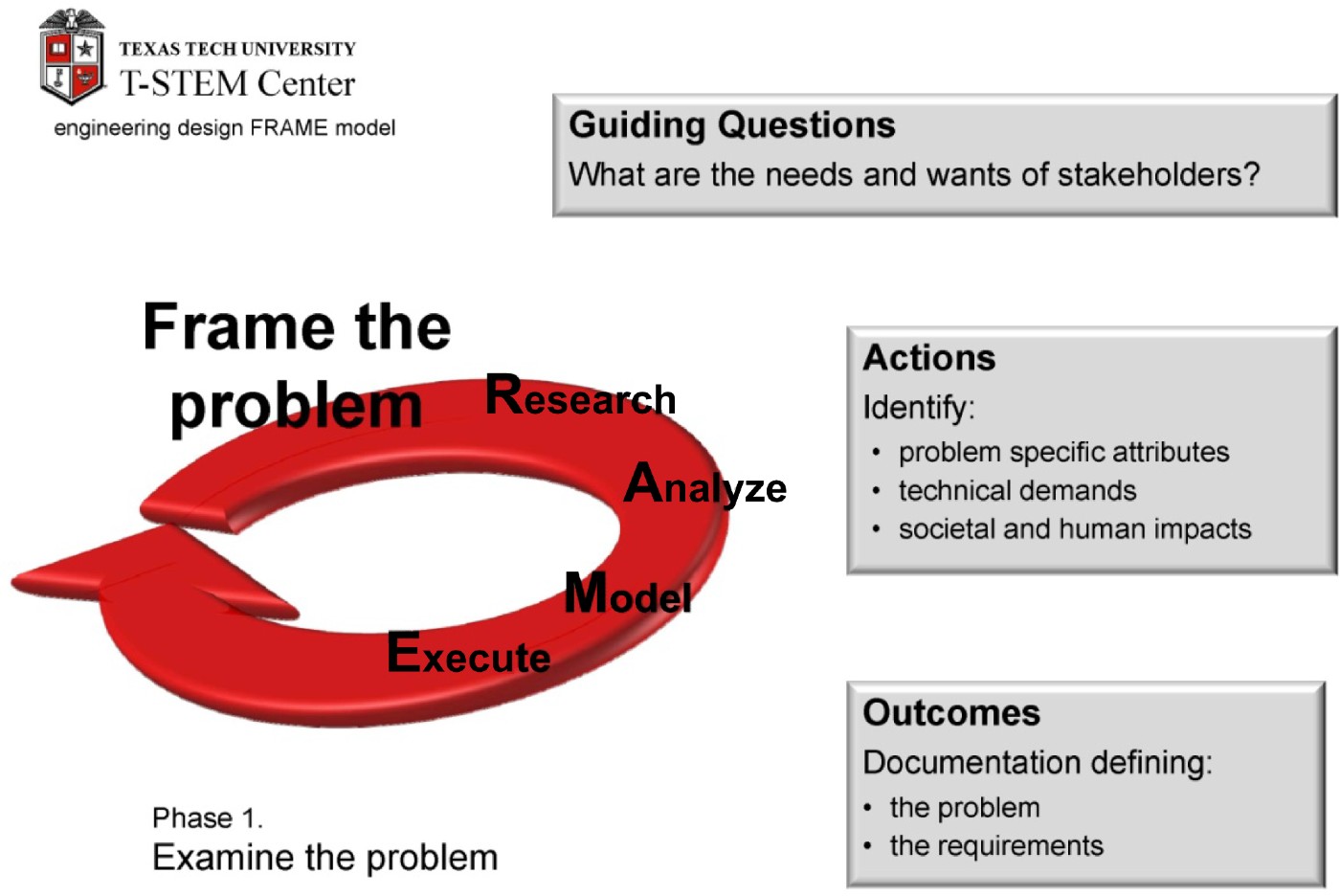
The model was designed to contain elements of both phase-based and activity models. The thinking was that this approach would make elements of the curriculum aimed at helping teachers understand and manage a project life-cycle approach to teaching and learning in the classroom. At the same time, the elements that reflect activity, or cognitive models, would give students tools for developing justifiable solutions to open-ended problems. Figure 6 shows a breakdown of the activities that comprise phase 1.
FRAME model project phase 1. Adapted with permission of Texas Tech University T-STEM Center. Copyright 2009 Texas Tech University T-STEM Center. [A color version of this figure can be viewed online at journals.cambridge.org/aie]
A unique feature of the model is that it employs a heuristic guide to help teachers and students engage in a more complete consideration of constraints and issues that must be addressed during each phase of the project. An example is shown in Figure 7. The heuristic guide also helps develop project documentation and presentations that reflect conventions appropriate for each phase of the project life cycle. The documentation not only helps students articulate and justify their design decisions, but by allowing them to submit project documents for feedback from Texas Tech University faculty and staff, it also provides a mechanism for the center to offer ongoing support to classroom teachers.
An example of the FRAME model heuristic. Reprinted with permission of Texas Tech University T-STEM Center. Copyright 2009 Texas Tech University T-STEM Center. [A color version of this figure can be viewed online at journals.cambridge.org/aie]

5.4. Conclusions to the T-STEM experience
By legislative mandate in 2001, Massachusetts schools were required to provide engineering in the K-12 curriculum for all grade levels. Efforts to meet this requirement have underscored the lack of available research-based curriculum, professional development, and other components necessary to establish preengineering in K-12 education. In Texas, both the legislature approval of the new science 4 × 4 high school graduation plan and the Texas Education Agency plan for revising the state course inventory in 2009 identify engineering as a new science category for graduation. The State Board of Education nominated a committee to write Essential Knowledge and Skills Standards for a capstone engineering course. The committee chose to focus on the design process as the defining characteristic of engineering that comprises an essential knowledge and skills set that would best serve Texas students and the educational goals of the state. These standards were approved by the Texas State Board of Education in the summer of 2009. These changes should increase demand for preengineering curriculum, professional development, and other resources in a market where little is currently available.
6. CONCLUSIONS
Public perception of engineering recognizes its importance to national and international competitiveness, economy, quality of life, and security, but uncertainty about engineering among the general public remains. Conflicting perspectives on what essential attributes the engineering design process comprises results in a lack of coherent criteria against which teachers and administrators can measure the validity of a resource, or assess its strengths and weaknesses, or grasp incongruities among competing process models. This article has shed light on various kinds of interventions and outreach efforts to inform these efforts or at least provideed some insight into major factors that shape and define the environment and cultures of the two institutions, including epistemic perspectives, institutional objectives, and political constraints, which are very different and can compromise collaborative efforts between the institutions of P-12 and higher education. This article described perceptions of engineering among the general public, prospective engineering students, and engineering educators, and argued that current outreach approaches do not do an adequate job of representing the societal contributions of engineers nor present a balanced picture of what engineers do. Models of the engineering design process were presented, and characteristics were identified that need to be considered in choosing a model of the engineering design process to teach. The literature on the transitions and differences between student, novice, experienced, and expert designers was summarized. Finally, a case study of precollege engineering was used to demonstrate the approach to choosing a design process model for teaching P-12 engineering.
Derrick Tate is an Assistant Professor of mechanical engineering at Texas Tech University, where he seeks to impact society through bringing design thinking to areas of strategic importance: developing sustainable approaches for building systems, transportation, and manufacturing; facilitating mass innovation; and enabling innovation in enterprises. His current projects include development of sustainable wall systems funded by West Texas entrepreneurs and an NSF US–Tanzania Workshop, entitled “Advancing the Structural Use of Earth-Based Bricks.” He has been a member of international committees for several conference series: Integrated Design and Process Technology (IDPT), Concurrent Engineering (CE), Axiomatic Design (ICAD), and Design Education Conference (ConnectED).
John Chandler is Co-Director of the Texas Tech University Center for Engineering Outreach with A. Dean Fontenot. Chandler and Fontenot are currently developing curriculum, teacher training, and academic resources to help K-14 institutions and educators engage students in learning about engineering. Chandler and Fontenot developed the Texas Tech University Precollege Engineering Academy Program and Applied Math and Engineering Magnet Programs, which serve Title 1 schools with majority populations of children from low-income African American and Hispanic families. Dr. Chandler also directs the Summer Training Institute for Teachers to provide professional development opportunities in engineering, science, technology, and mathematics for K-12 teachers.
A. Dean Fontenot is a Professional Communications for Engineers Adjunct Professor, the Senior Director of the Texas Tech University T-STEM Center, and the Senior Director of the Center for Engineering Outreach. She has 25 years of experience in teaching written and oral communication and 12 years of experience working with K-12 institutions to educate teachers and students about engineering. Dr. Fontenot works with the THSP to reform K-12 education and concentrates on integrating engineering design into K-12 classrooms. She sits on numerous councils and boards including the Texas Alliance for Minorities in Engineering board of directors; the NASA RASC-AL steering committee; and the secondary-level, engineering-oriented professional development symposium.
Susan Talkmitt is the Director of Curriculum for the Texas Tech University T-STEM Center and a codeveloper of the Engineering Design FRAME Model. She is also the Associate Director of the Outreach Program for the Texas Tech University Howard Hughes Medical Institute Science Education Program at CISER. She leads a traveling lab program and a professional development program for K-12 teachers that provides curriculum, content, and classroom resources that support teaching and learning of STEM subjects. She has developed nationally and state funded curricula for teachers that emphasizes science and STEM content.



