

Researchers seeking to collect data through “intervention or interaction” with living human beings, through the use of their “identifiable private information,”1 or as part of “clinical investigations”2 will typically find their work subject to oversight by one or more Institutional Review Boards (IRBs). IRBs are responsible under various federal regulations, and often under institutional policies, to oversee research with human participants funded by U.S. government dollars or for submission to U.S. regulatory authorities; many other countries have similar systems. IRBs review and have authority to approve, require modifications to, or disapprove research activities.3 They are charged with ensuring that risks to research participants are minimized and reasonable in relation to anticipated benefits, selection of participants is equitable, informed consent is appropriately obtained, data is appropriately monitored to protect participants' safety, and adequate provisions are in place to protect participant privacy and confidentiality, among other criteria.4
Despite this hefty responsibility and its potential impact on researchers, participants, and the public,Reference Florczak and Lockie5 IRB processes are largely ensconced in a black box — conducted, as one author explained, “behind closed doors.”Reference Stark6 Meetings are often closed, sometimes even to the researcher whose protocol is under review, and minutes are typically not disclosed other than to regulators and accreditors.7 Decisions are provided to the researcher and maintained in institutional records, but are usually not published or otherwise shared;8 IRB members themselves may even find it difficult to review prior board determinations and materials relevant to their current decisions because the records that are kept generally are not curated, indexed, or easily-searchable by topic or type of issue raised. There are few parameters demanding robust explanation of IRB decisions, whether favorable or unfavorable, and recent evidence suggests that IRBs frequently fail to justify the stipulations they impose on research as a condition of approval, often leaving ethical and regulatory concerns implicit.Reference Clapp, Gleason and Joffe9 This opacity makes it difficult to assess how well reasoned (or not) board determinations may be. While there have been studies of IRB processes, including decision times, approval rates, and other generalized statistics,Reference Abbott and Grady10 nothing in the regulations requires that IRBs transparently provide such data, or conduct such analysis themselves.
Against this backdrop, there have been calls for greater IRB transparency in the research ethics literature. However, they have been short on analysis and often embedded in calls to establish a system of IRB precedent to address inconsistency in IRB approaches and outcomes.Reference Bozeman, Slade and Hirsch11 While transparency and precedent are important and related concepts, they are distinct: transparency will not automatically result in a system of decision-making-by-precedent among IRBs or a commitment to consistency, nor is transparency a necessary prerequisite. Boards, or even individual members, could share their decisions with no one else, but still bind themselves (by policy or informally) to their own prior determinations — and vice versa. That said, as will be discussed below, transparency can facilitate consistency by exposing the rationales behind IRB decisions, both strong and weak, and promoting learning from the experiences of others.
Transparency itself has received little direct attention in the IRB context, although its virtues have been extolled in many other settings, from court decisions12 to allocation of health resourcesReference Daniels13 to clinical trial data14 to the FDA approval process.15 Is transparency an independent good that we ought to demand of IRBs? In this article, I argue that the answer is yes.
In what follows, I provide the first comprehensive taxonomy of what transparency means (or could mean) for IRBs; this descriptive enterprise is essential to assessing the ethical sufficiency of the status quo and the proper scope of needed change. With that conceptual foundation in place, I then describe current regulatory requirements and practices, and provide arguments in favor of greater IRB transparency, from the perspective of several different stakeholders. In closing, I offer recommendations for improvement.
In what follows, I provide the first comprehensive taxonomy of what transparency means (or could mean) for IRBs; this descriptive enterprise is essential to assessing the ethical sufficiency of the status quo and the proper scope of needed change. With that conceptual foundation in place, I then describe current regulatory requirements and practices, and provide arguments in favor of greater IRB transparency, from the perspective of several different stakeholders. In closing, I offer recommendations for improvement.
What Do We Mean By Transparency?
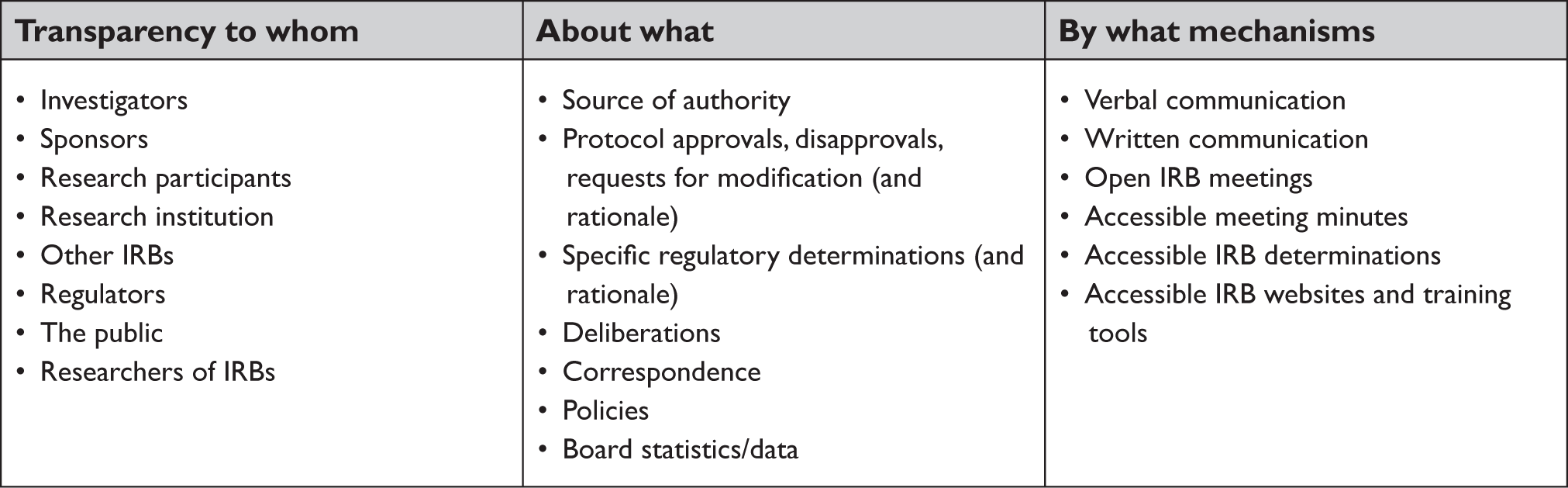
When thinking about IRB transparency, it is important to be specific: transparency to whom, about what, and by what mechanisms? Recognizing what it is not — namely, a mandate to use or do anything with the information obtained — is also helpful. In this regard, transparency is best viewed as a means to other ends, such as trust, efficiency, and quality, as explored below.
To Whom?
The most obvious type of transparency in the IRB context refers to accessibility to and openness with investigators whose research protocols are under review, as they are the individuals in closest contact with IRBs, and whose work hangs in the balance. The same is generally true of research sponsors, particularly those with a financial interest in the research. Other stake-holders also have a clear interest in IRB decisions and decision-making, including the research participants whose interests IRBs are charged with protecting and the institutions hosting research studies who will bear the legal brunt of any IRB shortcomings. IRBs at other institutions may also have an interest in transparency among their peer boards, because they are engaged in collaborative research or because they are interested in benchmarking behavior of other IRBs as a learning exercise. Regulators, of course, need to know what IRBs are doing and how well they are doing it for compliance purposes, and the same is true for voluntary IRB accreditors, such as the Association for the Accreditation of Human Research Protection Programs (AAHRPP).
The public in general also has a claim to transparency on a variety of grounds. IRBs are often deciding whether and how publicly-funded research may proceed, they are overseeing compliance with public laws and regulations, and they may play an important role in promoting public trust in the research enterprise (to the extent the public knows they exist). Sometimes, they are situated within public institutions (e.g., public universities) subject to government transparency requirements. And they may be approving research that the public will be affected by, and may even consider participating in, a potentially distinct role from protecting individuals who are already enrolled as participants.
A final stakeholder group is comprised of researchers who wish to study IRBs, analyzing for example how they are composed, how members engage with one another, how they make decisions and set policy, what hurdles they face, how they might be affected by certain types of reform, and a variety of other important questions. As others have recognized, the transparency needed to conduct such research has traditionally been lacking,16 but is sorely needed.Reference Nicholls17
About What?
Each of these stakeholders may have a desire (or need) for transparency regarding different aspects of IRB operations and outcomes. At a foundational level, transparency as to the source of IRB authority, whether regulations, agency guidance, or institutional policy, as well as transparency — or education — about the historical ethical rationale for IRBs, can help enhance the perceived legitimacy of board actions, while minimizing perceptions of arbitrary or senseless imposition of burden.18 Indeed, at least some complaints that get leveled at IRBs seem upon closer examination to be complaints about the regulations they are charged with administering.
Beyond this, investigators need transparency about IRB determinations regarding their protocols, which they receive via approvals, disapprovals, and requests for modifications. In addition to bare determinations as to whether or not research can proceed, however, it is helpful to have transparency about various underlying determinations as well, for example, the IRB's assessment regarding a protocol's risk level and its ratio of benefit to risk, on what grounds it agreed to waive informed consent, which exemption category a study was deemed to fall under, and why certain payment amounts were accepted or rejected. Knowing how and why decisions were reached can be important for compliance purposes, crafting amendments, and designing future research such that it will be approved as expeditiously as possible. This may come in the form of conversations with the IRB chair or administrative staff, for example, or in written form such as a determination letter, although the level of detail provided can vary substantially — and in some cases, no detail is provided at all.19
Investigators, institutions, and regulators are not the only ones with an interest in this information, as noted above, but at present, it is typically not accessible to others. Indeed, the more extensive details regarding rationale may be inaccessible beyond the IRB itself. It is important to note here that information about IRB approvals and deferrals (outright disapprovals are exceedingly rare) can be equally valuable. Both provide insight into the IRB's overarching philosophy, its interpretation of relevant regulations, how it is likely to behave in the future, what should be emulated or avoided, and potentially what should be protested and changed. In fact, shedding light on IRB deferrals can be particularly important since, unlike protocols that are approved and proceed, deferred proposals will not be available as a teaching tool unless active steps are taken. In this regard, there are strong analogies to arguments for transparency of all clinical trial results, both positive and negative.Reference Hudson and Collins20
In addition to the outcome and basis for IRB determinations regarding specific protocols, transparency regarding IRB procedures and policies is also important. Investigators need to know what to submit, to whom, about what, and by when. They also need to understand how IRBs are interpreting various regulatory requirements that leave them with substantial discretion, as well as any institutional policies that may exceed what regulations require. It is in no one's interest to hide the ball on these matters — IRBs want and need investigators to comply. That said, IRBs vary in the extent to which they facilitate investigators' protocol development and submissions, with the best (and typically most well-funded and institutionally-supported) boards providing easy-to-navigate websites, training sessions, and the like. While some IRBs have a robust library of formal policies covering a wide range of circumstances, it is also often the case that there will be informal policies that have developed over time,Reference Dickert, Emanuel and Grady21 which can be difficult to track, circulate, and understand. In some contexts, decisions may be “driven by tacit, unwritten practices that are neither standardized nor subjected to adequate critical scrutiny.”Reference Henry, Romano and Yarborough22 There is also wide variability as to whether written IRB policies and procedures are available on an institution's public website — thereby available for all to see, learn from, and analyze — or whether they are made available only via password within an institution or available only to IRB members and staff (and those responsible for institutional or regulatory oversight). IRB policies provide an important mechanism for institutions to learn from one another and potentially avoid unnecessarily reinventing the wheel,23 and may also be of interest to research participants and others.
Finally, IRBs may have and maintain a variety of information about their own work, for example how many protocols they review, on what timeline, and of what nature. They may have built search functions and other data analysis components into their protocol submission templates and review software. And they may generally have mechanisms in place for self-assessment, quality improvement, and the like. Ideally, IRBs will analyze the data across these various parameters on a systematic basis, use it to adjust their own approaches, and publish it for the benefit of others. This is not technically within the IRB's regulatory purview, however, and many boards may simply lack adequate resources to conduct these additional activities. Nonetheless, transparency about these details — whether the analysis is done by IRBs themselves or the data is simply shared for analysis by others — is critically important to permit ongoing assessment of the current IRB system and evidence-based policymaking.
By What Mechanisms?
In terms of the mechanisms of IRB transparency, this can be achieved in a variety of ways depending on the goal to be achieved and stakeholder of interest. Some information may be provided verbally, for example through informal conversation between investigators and IRB staff or responses to questions raised by research participants via phone call to the contact person listed on research consent forms. While better than nothing, in general, written communication is preferable for transparency purposes, creating a record that can be referred to later and shared with others. Another mechanism might be to open IRB meetings, either a little bit — at least to the team of investigators whose protocol is under review (as some IRBs already do) — or a lot — to any investigator at the institution, to other IRBs, to researchers interested in studying IRBs, to potential or current participants, or to members of the public more generally. Alternatively or in addition, IRBs might share their meeting minutes with any of these stakeholders (ideally, with sufficient detail to understand what actually transpired at the IRB meeting),24 perhaps upon request or even as a matter of course. And similarly, IRBs could choose to make their determinations available beyond the affected investigator, ideally including robust rationales. As with IRB policies, this information could be shared only within an institution or via an open-access public website, with a range of options in between. Of course, in any of these scenarios, appropriate confidentiality requirements would need to be established, as discussed below.
Current Regulatory Requirements
So far, we can see that IRB transparency is a broad concept, encompassing a range of stakeholders, types of information, and mechanisms of disclosure. But what must IRBs actually do when it comes to transparency? At present, not very much.
The Declaration of Helsinki provides that IRBs (“research ethics committees”) “must be transparent in [their] functioning,”25 and the Council for International Organizations of Medical Sciences (CIOMS) International Ethical Guidelines for Health-related Research Involving Humans states that IRBs must conduct reviews “according to clear and transparent procedures.”26 Both of these sources offer aspirational principles, rather than regulatory requirements, and not much specificity regarding the transparency particulars described above.
With regard to U.S. regulatory requirements, the Federal Policy for the Protection of Human Subjects (the “Common Rule”), which governs most research conducted or supported by federal agencies, and regulations for research under the purview of the Food and Drug Administration (FDA) do offer a bit more specificity, although still leaving wide latitude for IRBs. IRBs are required to have (but not necessarily publish or share) a variety of written procedures for review and oversight of research, including policies for “reporting its findings and actions to the investigator and the institution.”27 Beyond policies, the regulations require IRBs to “notify investigators and the institution in writing of its decision to approve or disapprove the proposed research activity, or of modifications required to secure IRB approval of the research activity. If the IRB decides to disapprove a research activity, it shall include in its written notification a statement of the reasons for its decision and give the investigator an opportunity to respond in person or in writing.”28 Similarly, in the event an IRB suspends or terminates a protocol's approval, it must provide the “investigator, appropriate institutional officials, and the department or agency head” with a statement of reasons.29
Defining IRB Transparency Parameters

There are a few important points to distill from these regulations. First, the regulations require that IRBs provide a statement of reasons — a rationale — for their decisions only when they are disapproving research or suspending or terminating their prior approval. When IRBs approve a protocol, however, they must simply report the decision, without reference to reasons. As between the two, it certainly makes sense to provide a justification when IRBs preclude a study from proceeding, so that investigators can make appropriate changes to strengthen the protocol or clarify and resolve elements of misunderstanding or concern. But importantly, IRBs rarely flat out disapprove a protocol, and instead frequently defer a decision until amendments are made. The regulations do not appear to account for this possibility. Moreover, providing clear reasons need not be a zero sum game. Explaining a rationale for disapproving a protocol in no way impedes an IRB's ability to provide a similar explanation in the context of protocol approvals; reasons are not a scarce resource to be allocated judiciously. Even when the IRB's decision is favorable, investigators and others can learn from the IRB's reasons; what did it find convincing and why did it deem the relevant criteria to be satisfied? As noted above, both sides of the coin are important.
A second point is that the regulations provide no hint as to what might count as an adequate statement of reasons, when one is required. Is it necessary or sufficient to simply point to the regulatory provisions not satisfied by a protocol, or must the statement of reasons be more fleshed out to explain why those regulatory sections or institutional policies preclude approval? Unfortunately, examination of regulatory guidance and agency enforcement letters sheds no light on the parameters of this requirement. Third, and related, although IRB determinations must be provided in writing, the regulations do not specify their scope or content more precisely. Ultimately, the regulations require transparency about the bare outcome of the IRB's deliberation in all cases and transparency about the IRB's rationale in some cases. However, even that required transparency is limited at most to the investigator, institution, and regulators.
By comparison, sharing IRB meeting minutes could generate more substantial transparency. By regulation, minutes must be “in sufficient detail to show… actions taken by the IRB; the vote on these actions including the number of members voting for, against, and abstaining; the basis for requiring changes in or disapproving research; and a written summary of the discussion of controverted issues and their resolution.”30 Regulatory guidance further specifies that meeting minutes include documentation of findings, “including protocol-specific information justifying each IRB finding,” regarding specific regulatory provisions governing consent waiver and documentation and research with special populations.31 Although regulatory guidance acknowledges that IRB minutes are intended to “provide information to persons not present at the meeting (e.g., investigators, institutional officials, regulators, IRB members who could not attend),”32 meeting minutes are not required to be shared with anyone, including the investigator. Instead, they must simply be maintained with IRB records and made available for review by regulators.
To summarize, the bottom line is that “IRBs are rarely required to explain or justify their decisions.”Reference Coleman33 Investigators must be given some information, institutions and regulators have full access (to the extent that IRBs record their rationales), but everyone else can be left in the dark.
To summarize, the bottom line is that “IRBs are rarely required to explain or justify their decisions.” Investigators must be given some information, institutions and regulators have full access (to the extent that IRBs record their rationales), but everyone else can be left in the dark.
Current IRB Practice
In terms of what happens in practice, there is wide variety in what IRBs communicate to whom and how, with some IRBs much more open and transparent (beyond the regulatory requirements) than others. At the front end, some IRBs provide substantial outreach and education to help investigators understand what IRBs are looking for and how to avoid common mistakes, both in general and as to specific protocols.Reference Fiske34 This requires resources, however — personnel, time, and money. As Professor Robert Klitzman has explained in his work on IRBs, the “time demands of such enhanced IRB availability can necessitate difficult tradeoffs, and cause tensions. IRB chairs and administrators can become overwhelmed, and need to weigh the advantages of open doors vs. limited resources.”Reference Klitzman35
In many cases, IRB “deliberations are conducted behind closed doors, and minutes of meetings are made available to outsiders only under limited circumstances…the process is both insular and secretive.”36 Little is known about the issues that IRBs “consider important to their decisions or about the substance of IRB deliberations.”37 Specific reviewers of any given protocol may not be identified (even if board rosters are available), which can have the salutary effects of reducing conflicts and protecting reviewers from institutional retaliation by investigators, but can also make reviewers less accountable. On the other hand, some IRBs invite investigators and others to attend their meetings. Typically, however, they are asked to provide information and answer questions, and then to leave before deliberation and discussion begin.38
Ultimately, we lack empirical data about actual levels of IRB transparency across different parameters, which would itself be informative. But what we know is that the regulations are permissive of relative nontransparency, which is also common in practice. Typically, IRBs are not writing opinions justifying their actions, meeting minutes cover little of substance (especially when a protocol is approved), and entire swaths of stakeholders may be unable to access key information.
Beyond deliberations, decisions themselves are generally kept private, shared only with the particular investigators whose research is affected. How IRBs communicate their decisions to investigators is also variable. Some IRBs write “lengthy memos to [principal investigators] in response to submitted protocols, assisting these PIs in rewriting studies,” and some try to point out the specific regulations and ethical principles behind their decisions.39 But again, this is resource-intensive, and not all IRBs choose (or can choose) to take this approach. Indeed, many do not.40
While there are no systematic mechanisms in place for IRBs to learn laterally from one another's processes, deliberations, and determinations, some information is shared at conferences, through trainings, and in journals aimed at IRB professionals.41 Networks have also developed for sharing resources through email listservs and other informal approaches that are often used to crowdsource responses to IRB challenges, including policy development, how to approach unusual studies, and the like. As new requirements for single IRB review of multisite studies take effect,42 increased sharing will be necessary between boards (or at least between the institutional human research protection programs of which boards are a part), and novel approaches are currently being developed. For example, IRBShare is a collaborative review model and electronic sharing resource that allows institutions to share documents and data used in review decisions, including minutes, protocols, and approved consent documents.43
Ultimately, we lack empirical data about actual levels of IRB transparency across different parameters, which would itself be informative. But what we know is that the regulations are permissive of relative nontransparency, which is also common in practice. Typically, IRBs are not writing opinions justifying their actions, meeting minutes cover little of substance (especially when a protocol is approved),44 and entire swaths of stakeholders may be unable to access key information.
A Push for IRB Transparency
Is this status quo ideal — or even minimally acceptable? I think not. For some reason, despite their similarities to judicial and administrative decision-makers (i.e., making binding decisions about specific cases and policies for general application, both of which impact not only particular parties but a wide range of stakeholders), IRBs have developed in such a way that nontransparency has become the default rule, even while at least some substantive level of transparency is expected in these other contexts. But I suggest that rather than having to justify why IRB transparency is the preferable approach, nontransparency ought to be permitted only with good, explicit reason. Given the benefits of transparency described below, and the protections that can be put in place to avoid potential negative consequences, the present level of IRB nontransparency is unacceptable — and good reasons for nontransparency in particular contexts are likely to be few and far between.
General Benefits of Transparency
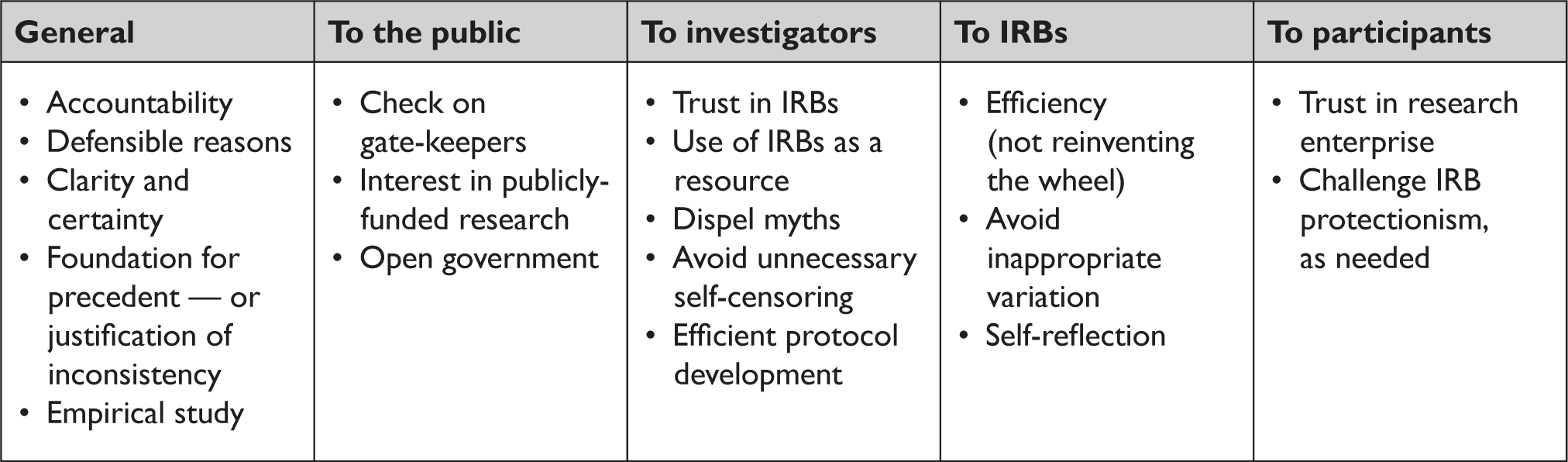
Consider, for example, the litigation system and court decisions, agency rule-making through notice-and-comment processes, and agency review decisions, such as those made by FDA in approving new medical products. All entail processes that are more transparent than IRB oversight of research, and have in common not only analysis of applicable issues and arguments, but also detailed written evaluations that are made available to the public beyond the immediate parties at issue to explain the outcome and rationale. This forces development of articulable and defensible reasons, helps to provide a foundation for future analyses (and potentially for a system of precedent), and facilitates external oversight.45 These are each important generalized benefits of a transparent system of decision-making, which the current IRB system fails to capitalize on. By contrast, when decisions are not made transparently, there is not only a lack of accountability, but also the possibility of confusion and uncertainty for affected parties, inconsistency between decision makers, ad hoc decision-making and poor reasoning, and even abuse of power (or at least not much to prevent it).Reference Swenson46 These are each risks facing IRBs. There are also more specific justifications for transparency to particular stakeholders.
Benefits of Transparency to the Public
Beyond these baseline considerations in favor of transparency, it is important to recognize the impact of IRB decisions on the public. As noted above, IRBs have the power to allow research to proceed on the basis of their determination of compliance with federal regulations, or to withhold approval when — in their estimation — applicable requirements are not met. Given this gatekeeping authority, IRBs can play a critical role in promoting scientific advancement, for example facilitating and speeding the approval of useful research. Conversely, however, they can stand in the way and slow things down, beyond the appropriate impediment of scientifically or ethically unsound projects. Both approaches have real implications for the public, such that it is appropriate for the public to demand to be given access to understand the how and why of IRB determinations — just as they have an interest in understanding the behavior of other gatekeepers, from FDA and the Patent and Trademark Office to government research funders and others. This allows the public to gauge whether the gatekeeper is striking the right balance and promoting the right priorities, and to call for change where needed. Relatedly, given that much of what IRBs review is government-funded research, the public has an interest in understanding the impact of IRB review on their tax dollars, and is aggrieved by being shut out of the process.
There is also one more way in which the public has an interest in IRB transparency, and that has to do with the public's interest in the transparency of government entities. The Department of Health and Human Services has never taken the position that IRBs are themselves arms of the government, absent some other factor, even though their existence is mandated by regulation and despite their role in overseeing research according to regulatory terms.47 Nonetheless, some IRBs are located within government agencies or are part of public universities, and as such could be subject to a full slate of transparency responsibilities under federal and state laws.48 These might include open meeting requirements,49 records requests under freedom of information acts,50 notice-and-comment rulemaking under various administrative laws,51 ethics and conflict of interest rules, and the like.52 In light of the quasi-governmental impact of IRBs as regulatory gatekeepers, it may be reasonable to extend these public transparency features often expected of government agencies to IRBs more generally.
Benefits of Transparency to Investigators
Investigators have a more direct interest in IRB transparency, on at least two grounds. First, there is some indication that the present lack of transparency, real or perceived, can lead investigators to distrust IRBs, or even to “demonize” them.53 This can result in a variety of problems, ranging from failure to engage IRBs about research questions early on to rejection of the resources that IRBs may make available to facilitate research compliance to dismissal of the IRB process as illegitimate, which in the extreme may spur disrespect of ethical rules. If investigators are helped to understand the goals of IRBs, why certain questions are asked, on what grounds modifications are requested, the ways in which IRBs can help support research, timelines for review, IRB processes, and the like, this can avoid misunderstandings, assuage feelings of arbitrariness and powerlessness, and improve investigator trust in IRBs.54 This is even more likely if IRBs can transparently demonstrate to investigators that they are being treated fairly and consistently in relation to other investigators and projects. There are numerous “horror stories” about IRBs, but transparency on all these fronts can help separate fact from myth, and with regard to fact, can offer explanation of why certain IRB actions have been taken. Ultimately, transparency should improve the essential relationship between IRBs and investigators, and facilitate weeding out IRB activities that are irrational or overly conservative.
The second basis for investigator interest in IRB transparency is simple efficiency. When investigators are uncertain why the IRB is imposing various requirements or reaching particular outcomes, they are obviously in a poor position to submit approvable protocols from the start or to make appropriate adjustments, particularly in light of IRB discretion in interpreting and implementing the relevant regulations. Similarly, when investigators are unclear as to how previous protocols have fared (and why), they may undertake unnecessarily duplicative work, for example justifying methods that the IRB may already be familiar or comfortable with, tracking down new approaches that the IRB might have already decided to be problematic, or developing mechanisms for things like recruitment, informed consent, results return, or confidentiality protection that the IRB might be able to offer guidance on given prior experience, saving investigators valuable time and effort. In short, “[w]ell-considered, thoughtful reviews could… serve as exemplars and educational tools.”55
Relatedly, to the extent that investigators fear that IRBs will slow down their research or behave conservatively,Reference Whitney56 likely rooted in the “horror stories” noted above, they may self-censor what they submit for review in hopes of getting approval as quickly and painlessly as possible. While substantial empirical evidence of such behavior is lacking, anecdotal evidence is abundant.Reference Kempner, Merz and Bosk57 In so doing, investigators may sometimes make unnecessary sacrifices via wrong guesses about how their IRB is likely to behave. For example, investigators may fail to adopt a more scientifically appropriate study design, a speedier mechanism of recruitment, a fairer approach to paying participants out of concern that their IRB would not approve. If, rather than guessing, investigators had a better sense of what really would impede IRB approval, and what would not, such detrimental self-censoring could be minimized or avoided.
Benefits of Transparency to IRBs
These efficiency concerns are also relevant in support of IRB transparency in relation to other IRBs, as well as systems to promote transparency within IRBs over time, i.e., preservation of institutional memory via easily accessible and searchable records of prior decisions. As Professor Carl Coleman has explained, failure to work together to share information and insight results in a scenario in which “IRBs are regularly challenged by issues of first impression — not necessarily issues that are new to the world of research, but issues that have never previously come before the particular IRB.”58 When IRBs are unable to learn from each other (and themselves), at the very least in terms of identifying relevant considerations and offering guideposts for their own decisions, the research enterprise suffers; resources may be wasted and research slowed.
A related concern is that a lack of transparency between IRBs, including failure to share policies, determination letters, and meeting minutes, for example, can contribute to variability between them. Sharing these materials and rationales will not automatically lead to consistency — courts do not necessarily reach the same outcome simply because they have access to the decisions rendered in other jurisdictions (to which they are not bound by precedent) — but it can help minimize thoughtless or ill-conceived variation.59 This is not to suggest that IRBs should blindly “go with the crowd” once it becomes apparent what others are doing.60 Sometimes, independent judgment will be needed, and just as there may be majority and minority rules in different legal jurisdictions, it may be that there is no obvious “right” answer when it comes to certain issues raised before IRBs, even with transparency. The key is to have sufficient grounding to know whether differences are considered and purposeful, and to avoid accidental difference simply out of ignorance to the behavior and decisions of peers. In this way, transparency can help lay the foundation for a system of IRB precedent, formally or informally,61 or at the very least generation of best practices.
The self-reflection that is likely to arise from transparency between IRBs may also help IRBs overcome unnecessary conservatism and fears that may be associated with risking “first mover” status in approving something unfamiliar.62 On the other hand, transparency might cause IRBs to discover that they have been more progressive than their peers, potentially resulting in increased conservativism in some instances.
Benefits of Transparency to Research Participants
When considering the benefits of IRB transparency, we cannot overlook a primary beneficiary: research participants. While participants would indirectly benefit from the various advantages already described, transparency regarding IRB processes and standards could have a more direct impact on participant trust. Given that participants may not be aware that IRBs even exist at present, or that they exist to help protect participant interests, or that the entire research enterprise is heavily regulated in a way that is skewed dramatically toward participant protection, disclosure of these features and education regarding the IRB's role may be an untapped resource to promote participant recruitment and retention. IRBs are sometimes concerned about language being included in informed consent materials indicating explicitly that a study has been IRB approved, on the grounds that this could appear to be an endorsement or encouragement to participate.63 But helping participants understand why an IRB found the regulatory criteria to be satisfied could reasonably be relevant to the decision whether to participate.64 And in the event that an IRB determines the regulatory criteria have not been satisfied, this may be relevant to patient communities who stand to benefit from research, who may help provide the IRB with additional information or help researchers address IRB concerns, for example.Reference Stark65 Other than potential information overload, which can be addressed and avoided, there seems to be little downside to greater transparency with research participants regarding the IRB process and outcomes. Empirical study of this question would be valuable.
Additional Benefits
There are at least two additional benefits to IRB transparency that span a variety of stakeholders. First, under the status quo of nontransparency, it is difficult to hold IRBs accountable for their decisions. This is most obviously because many stakeholders may simply not know what IRBs are doing, and therefore may not know to object, appeal, or push for change. But at a more subtle level, when IRB materials are not shared or available, and in particular, when IRB decisions are not presented in written form with analysis, IRBs can more easily fall back on “gut feelings” or intuition.66 In an alternate scenario in which IRB activities are made accessible to others, IRBs are more likely to be compelled to articulate reasons and provide precise (or any) justifications for their decisions. And when reasons are provided, they can be assessed, analyzed, critiqued, praised, adjusted, and the like.67 Moreover, the process of articulating reasons may cause IRBs to reassess their own views; perhaps they are less well-supported than initially “felt,” and alternative approaches are warranted.Reference Reynolds and Richman68 Ultimately, IRB transparency should improve the quality of IRB decisions, just as publication of judicial decisions has been correlated with higher quality.69
A second benefit of IRB transparency is that transparent decisions, policies, and practices can be studied empirically. Empirical evaluation of IRBs is essential, given the resources devoted and impact on scientific advancement, and important work has been done already.70 But this sort of work can be challenging, with important limitations, for example relying on IRBs to voluntarily provide information, which some may deny, or relying on investigators to pass along their correspondence, which maybe incomplete. More robust analysis via greater IRB transparency will provide important insights into the bases for IRB decisions (e.g., regulations, institutional policy, ethical principles, etc.); areas of focus (e.g., informed consent, trial design issues, privacy, etc.); goals (e.g., participant protection, institutional liability avoidance, etc.); consistency (e.g., within and between IRBs); and overall approaches (e.g., helpful or detached). It will allow assessment of whether IRBs are being too conservative, too permissive, too bureaucratic, too conflicted, too resource-intensive — and what they are doing well, adding value to the research enterprise and participant protection. Evidence-based policymaking, in turn, will allow the IRB system to focus its energies on areas where it can be most effective.
Objections and Responses
In light of all these benefits of IRB transparency, why has greater transparency not yet been adopted — what are the downsides? One key concern has to do with confidentiality.Reference Ashcroft and Pfeffer71 IRBs are reviewing protocols that may contain sensitive information, including commercially valuable information about new products or even the investigator's trial design and study description. In a world of lucrative drugs and devices, in which even a few months difference can result in significant market advantage, and in the realm of academic research, in which investigators' careers hinge on publications and funding awards, the inclination to wall-off commercial and intellectual competitors is understandable.72
Benefits of IRB Transparency

While this rationale may suggest caution with regard to who is allowed to attend IRB meetings (which could at least partially be addressed via confidentiality agreements), there is a relatively simple solution when it comes to IRB minutes and decisions: redact them. This is precisely what FDA does when releasing the materials supporting its decisions to approve new drug applications. Any member of the public is able to download robust portfolios from the Drugs@ FDA website, including correspondence between sponsors and the agency, scientific analyses, and decision memos; certain information may be redacted, but enough remains to allow stakeholders to better understand the agency's rationale, the issues at stake, and how they were resolved. Granted, this comparison may not be apples to apples with the IRB context — for example, once FDA grants approval, the sponsor may be protected by various marketing exclusivities, rendering competition less worrisome, and FDA does not publish the same information about applications that were denied (although perhaps it should).Reference Gottlieb73 Nevertheless, court decisions often deal with various types of sensitive information, and redaction or selective inclusion is possible in those contexts. Similarly, IRB decisions can be written in such a way to focus on rationales and outcomes without necessarily sharing information that is best kept confidential.74 Moreover, this sort of confidentiality concern is no reason not to be more transparent about IRB policies, rather than protocol-specific decisions, nor is it a reason not to be entirely forthcoming and direct with investigators themselves about the IRB's decision and rationale related to their own submissions.
Probably the most important argument against IRB transparency is not that transparency itself is undesirable, but rather that it is costly. Many IRBs are already woefully under-resourced, so asking them to write out and share robust determinations and policies is an added burden, which could ultimately result in delay. Nonetheless, if this is the argument against transparency, there are even greater concerns — namely that IRBs are inadequately resourced to even render justifiable determinations in the first place. Clearly, this cannot stand.
There are other potential confidentiality concerns, for example when IRBs are reviewing politically sensitive research, such as that involving abortion, but those special cases should not be allowed to wag the dog, nor is it necessarily the case that fear of backlash is adequate reason to avoid transparency. And there may be another type of free-rider concern beyond issues related to competition between sponsors or investigators, which is that if some IRBs are more transparent than others, they will bear the burdens while others learn from them without reciprocal benefits.75 The answer to that concern, though, is not to avoid transparency, but rather to make it more universal.
It is possible that greater IRB transparency could have a range of unintended consequences. As noted above, perhaps IRBs would become even more conservative if they fear that their activities will be subject to outside scrutiny or if they discover that their board is not as conservative as others, or perhaps the candor of IRB deliberations would be negatively affected on a more transparent approach.76 IRBs may actually be inclined to document and disclose less if they fear opening themselves up to litigation.77 And it is also possible that increased transparency will result in more “IRB shopping” by sponsors and investigators seeking the most lenient boards.
These are reasonable worries, but they need not be insurmountable. First, given the general benefits of IRB transparency described above, possible bad outcomes seem inadequate to support the status quo. In particular, with regard to litigation, there have been relatively few lawsuits stemming from research studies,78 and there is so much discretion in the applicable regulations that IRBs likely need not worry so long as they are behaving reasonably. Moreover, transparency can even help build an IRB “standard of care” based on what others are and have been doing in similar contexts. Second, these are empirical questions: we could pilot test different approaches to transparency to see how they work and what impact they have, before accepting the status quo of nontransparency. And third, it is also possible that IRB transparency will have the salutary effect of facilitating more liberal approaches as IRBs see others adopting creative solutions to facilitate research. Most likely, transparency would facilitate some “regression to the mean,” with comparably conservative IRBs becoming less so as they gain insight into the approaches taken by other boards, and vice versa for some comparably liberal IRBs, which would minimize any concerns about IRB shopping. Since transparency is distinct from precedent, however, justifiable differences in approach could stand, so long as adequate care is taken to avoid inflexible “groupthink.”
Probably the most important argument against IRB transparency is not that transparency itself is undesirable, but rather that it is costly. Many IRBs are already woefully under-resourced,Reference Grady79 so asking them to write out and share robust determinations and policies is an added burden, which could ultimately result in delay. Nonetheless, if this is the argument against transparency, there are even greater concerns — namely that IRBs are inadequately resourced to even render justifiable determinations in the first place. Clearly, this cannot stand.
Resolving the IRB resource problem is beyond the scope of this article, but one possibility is to include IRB costs in grant awards and contracts as a line item akin to a user fee, rather than as generalized “overhead” or “indirects,” to help ensure that funds are directed to this specific purpose. User fees raise ethical concerns of their own,Reference Avorn80 but IRB services are not costless and the fee-for-service model is precisely that utilized by external IRBs not affiliated with any research institution and run as for-profit businesses. These IRBs pride themselves on customer service and efficiency, and being adequately resourced is part of how they are able to deliver. With appropriate protection against conflict of interest, IRB user fees may be a part of the solution, as some institutions have recognized, at least for industry-sponsored research.81 It is also possible that new requirements for single-IRB review of multi-site research will lead to certain efficiency gains and more resources for reviewing IRBs. Finally, note that some types of IRB transparency will be less costly than others, such as making existing policies more freely available, such that cost cannot be an unqualified defense of nontransparency in all cases.
To the extent that time is itself a resource, a related worry is that if one goal of transparency is to allow IRBs to learn from each other, IRBs need to have time to review the cases that came before, as well as some mechanism for sorting and searching them. The technological issues associated with developing a repository of decisions or policies need not be insurmountable, but adding more work to reviewers' plates is indeed a challenge. This might be addressed by relying more heavily on IRB staff and administrators to help find and summarize relevant materials. Bioethics researchers interested in IRB issues can also help distill key points of learning from their own empirical analyses, which can be provided to IRBs through various training and continuing education opportunities.
Recommendations and Conclusions
While it is certainly not the case across the board, the default rule — permitted by the regulations governing IRBs and demonstrated by the practices of many — has been for IRBs to be closed-door, relatively secretive bodies, making determinations with substantial impact on a wide variety of stakeholders without robust explanation, justification, or transparency. This default ought to change, in line with other trends in favor of transparency in the research enterprise, such as sharing clinical trial data, posting results to clinicaltrials.gov, and under the revised Common Rule, sharing clinical trial consent forms. Importantly, IRB transparency would be complementary — but not redundant — to these other approaches because it can provide key insight about IRB standards and rationales, distinct from information about the scientific validity and reliability of research findings and the quality of information provided to research participants. Given the clear benefits of IRB transparency in terms of accountability, consistency, trust, and efficiency, the question is not whether to push for improved transparency or why, but rather how and along which parameters.
One option is regulatory change. The regulations could, for example, impose more specificity with regard to IRB minutes, set expectations in favor of open meetings, flesh out the requirements for the content of determination letters (both approvals and rejections, perhaps offering templates or checklists to encourage reason-giving and covering the regulatory criteria for IRB approval), and specify that these materials be shared beyond institutional and regulatory audits. Regulatory change is procedurally difficult, but regulatory agencies could nonetheless offer guidance to this effect. Regulators could also make selected real-world cases available for training and guidance, facilitate research on IRB decision-making, and conduct their own analyses of trends and approaches demonstrated by the records they have exclusive access to in order to develop best practices.
IRBs (including board members and staff of institutional human research protection programs) can also voluntarily accept the responsibility to promote transparency, and in many ways have begun to so, as noted above, through investigator-oriented websites to help facilitate understanding of goals and processes, as well as listservs, conferences, journals, and other venues to share information between themselves.Reference Schrag82 Note, however, that individuals likely face institutional restrictions and confidentiality requirements, such that they may not be able to promote transparency without institutional support and permission.
Even if IRBs fail to embrace transparency, however, investigators could drive a movement themselves. Although they cannot force IRBs to be more transparent in the materials shared with them, investigators can commit to sharing the materials they do have access to, for example publishing decision letters, sharing protocols as they looked before and after the IRB process, and the like. Indeed, one such initiative has already launched in New Zealand, where “The Ethics Application Repository” (TEAR) serves as a voluntary digital archive of IRB applications and related materials in which researchers from any institution around the world can post their IRB's requested changes and ultimate decisions.Reference Feeley83 The hope is that both researchers and IRBs will learn from what came before. As Professor Laura Stark explains, this approach gives investigators “the opportunity to participate in creating a solution to the problem they rightly criticize.”84 Journals may also have a role to play, perhaps by demanding that approved study protocols and IRB correspondence be made publicly accessible as a condition of publication.85
No one ought to prefer a black box system in which the relevant stakeholders lack access to information that can improve efficiency, quality, and accountability. The nontransparent IRB system we have at present is likely not the one that we would have selected by conscious design, and so we ought to design a new one — one that supports transparency about a wide range of IRB activity to the wide range of stakeholders who stand to be affected. Clearly transparency is not all-or-nothing, but rather exists on a spectrum — and the same is true for solutions to nontransparency. We can begin with stepwise progress, first addressing low-hanging fruit like thin explanation of IRB actions to investigators and closed-door IRB meetings, while working steadily toward the goal of full transparency in this endeavor with such high stakes.
Acknowledgements
The views reflected in this article are only my own, and should not be attributed to any organization with which I am affiliated. Thank you to Mark Satta (Harvard Law School) for excellent research assistance, and to Laura Odwazny, Emily Largent, and I. Glenn Cohen for insightful comments. A version of this article will be published as a chapter in Transparency in Health and Health Care, Holly Fernandez Lynch, I. Glenn Cohen, Carmel Shachar, and Barbara Evans, eds. (Cambridge University Press 2018, forthcoming).