Men and women in eighteenth-century America could scarcely avoid the tune “God Save the King.” Nor did they want to. The song circulated widely, frequently set with new lyrics that changed the focus from the original “God save great George our King” to topical themes. In the period during and after the Revolution, new lyrics were often explicitly political and politicized. The first item in American soldier Joseph Kendal's manuscript collection of song lyrics from 1783 was a setting of “God Save the King” that began “God save America, / Free from Despotic Sway, / Till Time shall cease.” A year earlier the eleven-year-old Albany native Elizabeth Van Rensselaer transcribed a keyboard arrangement of “God Save the King” titled “God save great Washington” not once, but twice, in two different keys.Footnote 1 The political uses of the song continued after the Revolution. On 17 October 1795, readers of the Philadelphia Minerva found “[God Save the] Rights of Woman” by an anonymous lady.Footnote 2 In short, “God Save the King” was ubiquitous in the colonial and early national period. Appropriations of the tune were not necessarily respectful of the British anthem, and the multiple sets of lyrics often represented disagreeing points of view, but the tune was certainly popular.
“God Save the King” is an illuminating case study of the relationship between political songs and the historical events surrounding the American Revolution—a case study that calls into question just how important the Revolution was as a marker of cultural change and invites a reconsideration of what “American” music signified in this period.Footnote 3 By tracing “God Save the King” contrafacta through six decades, from its composition in the 1740s to its embrace by English colonists in the 1750s and 60s through its widespread use by rival political factions the 1790s, I am able to advance two claims. First, that contrafacta show how slowly cultural change occurred after the Revolution. Men and women with the urge to promote cultural independence from Britain faced stiff headwinds because the very materials out of which their political culture was forged—the tunes, lyrics, and formats—all served to maintain ties of continuity with the colonial period. Second, the extent to which political songs did manage to articulate a national vision for the United States in the 1780s was curtailed by the almost immediate fracturing into partisanship in the 1790s, a breakdown in which contrafacta were complicit.Footnote 4 Together, these two claims put pressure on the idea that the Revolution was a decisive turning point in American music history. If anything, the true lessons of the Revolution were learned a decade after its conclusion: that music could just as easily divide a nation as unite it; and that, in any event, the music itself was still British.
The United States’ lack of cultural independence following the Revolution bears further attention, for it touches on deeper questions about country's position as a postcolonial nation. Whether the United States is postcolonial remains a subject of debate.Footnote 5 For white Americans, many (but not all) of whom were of English descent, the ideological transformation of “British colonial subject” to “U.S. citizen” required a profound conceptual shift from identifying as a colonizer to identifying as one of the colonized. That white colonists niftily claimed for themselves the role of marginalized colonial subjects without relinquishing the privileges of racial dominance is ironic, and historians continue to unpack the ongoing reverberations of settler colonialism.Footnote 6 After all, to Native Americans and enslaved Africans, the United States was not a land of liberty.
Yet the privileged white Americans who claimed the status of U.S. citizens could not easily shed the feeling of cultural indebtedness to Britain.Footnote 7 Indeed, the high degree of cultural emulation that pervaded U.S. culture in general, and music in particular, calls to mind twentieth-century theories about postcolonial mimicry, understood as the process by which the colonized imitate the colonizers only to find that indelible differences distort the reflection.Footnote 8 This distortion, replete with unpredictable supplemental meanings, contributes to the intractable ambivalence of postcolonial conditions. We can recognize a form of mimicry, and the attendant ambivalence, in contrafacta lyrics that refer intertextually but subversively to the original “God Save the King.” The eighteenth-century Americans who participated in political song culture both before and after the Revolution were a far cry from the racialized, violent, insurgent mimicry analyzed by contemporary theorists. Nevertheless, it is important to keep the potential for postcolonial ambivalence—that is, simultaneous desire to emulate and reject hegemonic culture—in mind when reviewing early political songs, in part because ambivalent copying of British culture was so ubiquitous in the early United States.
In many ways the early United States itself was a contrafactum of Britain. The structures of the U.S. government and the central bank were based on British models, and American consumers avidly followed British fashions and tastes as imports flooded U.S. markets—just as they had done before the Revolution.Footnote 9 In fact, many of the economic and cultural patterns from before the war resumed in the 1780s. Bevies of ships transported people, goods, and ideas back and forth across the ocean; the Atlantic Ocean was as much a highway as a barrier. Britain monopolized American cultural life in the fields of music, art, and literature as well. Singers, actors, and instrumentalists flocked across the ocean, recruited by English-born managers like Lewis Hallam, whose American Company (later known as the Old American Company) was in 1752 the first opera troupe in the British colonies. By the 1760s colonial audiences could expect to hear English operas within a few years of their London premieres, and by the 1780s and 1790s, they could buy the sheet music as well: music publishers in Philadelphia, Boston, New York, and Baltimore, many of whom were British immigrants, reprinted concert and theater repertory from London and Edinburgh.Footnote 10 The close ties connecting American musical life to Britain were not indelible—the Revolution disrupted musical activity, particularly when the Continental Congress passed a resolution banning public performances in October 1774, a ban that was not lifted until well after the war's end. Moreover, during the war patriotic sentiment elevated domestic creativity of all sorts, from the manufacture of locally made crockery and homespun cloth to the “unscientific” hymnody of self-taught composers such as William Billings. However, such nativism was anomalous and quickly abated after the war: British imports from porcelain and furniture to books and maps were quickly back in vogue. So too with music: the transatlantic musical links proved sufficiently sturdy to withstand the rupture of the Revolutionary War.Footnote 11
British musical tastes dominated post-Revolutionary America in part because music circulated in multiple formats. Versions of “God Save the King” appeared in manuscripts, broadsides, songsters (pocket-sized volumes of song lyrics), almanacs, newspapers, and other periodicals, and were performed in public parades, at civic events, and in taverns, coffee houses, and homes. These various formats, which enabled contrafacta to reach a broad and diverse audience, have much to teach us about the political culture of eighteenth-century America. The production of each format, whether a manuscript collection or a newspaper, was subject to economic and political factors that influenced both the musical content and its reception. For instance, publishers of partisan newspapers, supported politically and monetarily by members of a political party, counted on that infrastructure when disseminating each issue. Such was the case with James Fenno's unabashedly Federalist newspaper, the Gazette of the United States (est. 1789), and Philip Freneau's oppositional National Gazette (est. 1791), both in Philadelphia.Footnote 12 In these and many other publications we find songs that reflect the imperatives of the infrastructure that gave rise to their creation. Close attention to the materiality of political songs, coupled with an understanding of their production and dissemination, produces new insights into how men and women engaged with political songs in the Revolutionary period.
In what follows I foreground format as an analytic category that can help us understand popular and political song in the eighteenth century. According to traditional bibliographical analysis, format pertains to how a book came to be in its current state—how it was constructed, especially in terms of the number of pages per sheet of paper and how many times the pages were folded before sewn into the spines of books.Footnote 13 My use of “format” expands this definition: I attend to both the physical attributes of the formats and the protocols for how each format was meant to be used by readers.Footnote 14 I do so because attentiveness to format reveals that the material properties of musical texts contributed to the significance of political songs—musicality, materiality, and message were intertwined.Footnote 15 In many ways, a format-focused bibliographical investigation of “God Save the King” goes to the roots of Americanist scholarship—the field-defining works by Oscar Sonneck, Irving Lowens, Kate Van Winkle Keller, and Richard Crawford were bibliographies.Footnote 16 But I move away from an approach to bibliography that reinforces national boundaries and silos materials by format. Instead, this article tracks materials transatlantically and compares repertory across formats. Such an intervention helps us comprehend the complex dynamics of international influences in Revolutionary America.
Combining the familiar with the new, fixed content and form with novel messages and uses, both contrafacta and formats can be seen as doubly coded: they sutured the nation together and provided continuity with the pre-Revolutionary period, but they also signposted the eventual fracturing of the national political culture. We can envision the Janus-faced double meaning of contrafacta by focusing on the lyrics set to the tune, formats in which they circulated, and the people who encountered the many versions of “God Save the King” on both sides of the Atlantic from the 1740s through the 1790s.
A Proliferating Anthem
“God Save the King” is a simple song made famous by the political circumstances of Britain in the 1740s. It was composed sometime before 1744 and became widely known as an emblem of patriotic support for King George II, whose claim to the throne was contested by the Jacobite supporters of the Catholic prince Charles Stuart.Footnote 17 In the face of an armed rebellion mounted in Scotland in 1745, “God Save the King” served to rally Britons to George II's cause. The lyrics called for George's “victorious, happy and glorious” reign, and also demanded that the monarch be protected by God: “O Lord our God arise, / Scatter his enemies, / And make them fall; / Confound their Politicks, / Frustrate their knavish Tricks, / On Thee our hopes we fix. / God save us all.” (God save us all from the threat of a Catholic ruler, that is.) Reports of the song's performances were politicized as well: when “God Save the King” was premiered at the Theatre Royal on Drury Lane on 28 September 1745, London's Daily Advertiser claimed it reflected the “abhorrence” with which the audience viewed “the arbitrary Schemes of our invidious Enemies, and detest the despotick Attempts of Papal Power.”Footnote 18 The cultural nationalism that “God Save the King” came to symbolize was forged out of detestation for the Catholic “other” and the need to defend a vulnerable king.
Circulating orally and in print, “God Save the King” quickly became well known in England. It was performed at Drury Lane and Covent Garden, belted in the streets of London by broadside ballad hawkers, and could be heard pealing from the bell tower of the official church for the House of Commons at Westminster, the chimes of which were reset to play the tune in 1748.Footnote 19 Published versions appeared regularly. The Gentleman's Magazine printed it in both the October and December issues in 1745, and it appeared in the London Magazine and the Scots Magazine in November of that year. The anthology Thesaurus Musicus (published in late 1745) also included the song, as did anthologies published at regular intervals through the rest of the century. It appeared in various arrangements: for two voices and obbligato; for orchestra, soloists, and chorus; as an instrumental minuet in a collection of dances.Footnote 20 Ubiquitous in performance and print, the tune became familiar enough that it quickly could circulate without notated music and be identified by title alone—which was how it most often appeared in the American colonies.
Perhaps because of its close association with a historical moment of crisis, “God Save the King” emblematized a political ideology that prioritized stability and eschewed reform or revolution, and in the 1760s, as colonial resentment of metropolitan policies intensified, the tune's reference to a seemingly implacable imperial power made it a convenient symbol of oppression. Because the anthem glorified the consolidated power of the British empire, “God Save the King” was vulnerable to anti-British appropriation and subversion, and Revolutionary versions gained traction precisely because they used the hymn-like melody to take advantage of the allure of anointed monarchical power.Footnote 21 Indeed, the familiar tune was far more effective for expressing Revolutionary ideals than a newly composed song would have been—were such a song available. By layering meanings via new lyrics, “God Save the King” contrafacta created a discourse that challenged the dominance of the monarchy, critiqued imperial policy, and helped to create the very idea of an alternative governing authority.Footnote 22
“God Save the King” was not the only tune that circulated transatlantically. “Rule Britannia,” “Yankee Doodle,” “The Vicar of Bray,” and many others traveled widely in print, manuscript, and oral transmission. Often these tunes carried new lyrics that expressed political ideas, the melodies serving as staging grounds for ideological sparring. A conspicuous example is the many permutations of “Heart of Oak,” a patriotic ballad celebrating Britain's naval prowess, which the Pennsylvania lawyer John Dickinson transformed into “The Liberty Song” in 1768. Dickinson parodied themes from the original song in order to foreground what he and others perceived as the injustices of the British regime. A line about the inherent freedom of Britons in the original was converted into a trenchant critique of tyranny in Dickinson's version: “To honour we call you, as freemen not slaves, / For who are so free as the sons of the waves?” in the original became “No tyrannous Acts shall suppress your just Claim, / Or stain with Dishonour America's Name.”Footnote 23 Like “God Save the King” contrafacta, “Heart of Oak” parodies were powerful because of the tune's association with a cornerstone of British identity, the navy. The success of “Heart of Oak” as a form of insurgent political expression lay precisely in its combination of the new and the old: the familiar tune and familiar themes (liberty, slavery, pride) applied to an emerging political body—America.
“God Save the King” shared with other effective political songs several features. First, the tune was well known. New versions of “God Save the King” could circulate without notated music, and given the inconvenience of printing notation, publishers preferred to distribute a familiar tune that they could identify by name only to customers who might not be musically literate.Footnote 24 Furthermore, the musical features of the tune helped make it memorable. The melody was easy to sing: short, repetitive, and very narrow in range. As with other beloved songs of the era, its tune carried symbolic weight due to its association with a core emblem of British national identity—in this case, the monarchy. This last factor, audible in the anthem's solemn tempo and reserved melodic profile, was especially important, for it suggests that the tune appealed to lyricists keen on either harnessing that grandeur to promote American patriotism or subverting it to critique the figures of established power. For example, the satirical effect of a version known as “God save the Guillotine,” which advocated the beheading of British royalty and was speciously attributed to the American poet and French Revolution sympathizer Joel Barlow, was boosted considerably by the subversive contrast between the text and the melody.Footnote 25
The materiality of musical formats encouraged political singing. Inexpensive and easily shared formats such as newspapers, as well as more durable objects such as hymnals and songsters, helped distribute contrafacta widely. For example, a version titled “Hail godlike Washington” first appeared on the back page of the weekly newspaper The New-York Journal on 15 March 1787, then was immediately reprinted in other newspapers, and became popular again as a partisan song a decade later.Footnote 26 A birthday tribute to George Washington, the contrafactum was written by an anonymous Virginian and set to “God Save the King.” Certainly the lyrics were partly responsible for the version's popularity. Touching on patriotic topics, the verses (which are, conspicuously, thirteen in number) celebrate American victories in Revolutionary war battles against the British, express gratitude to the French for their stalwart aid during the war, praise national icon Benjamin Franklin, and sanctify the “godlike” George Washington.Footnote 27 Particularly appealing to patriots was the way it compared Washington to the king: unlike the song's original subject, George II, Washington needs no saving or protecting from politicking knaves; rather, it is he who is the savior and the protector set temporarily on earth to lead America to freedom. Initially appearing in timely newsprint, it eventually was integrated into the less responsive but more durable bookish format of the songster.
In addition to newsprint, other formats that could be manufactured quickly and passed through informal modes of circulation helped disseminate new versions of the song in the Revolutionary period. Hastily prepared manuscript books did not rely on the bulky technology of printing and thus publicized new versions of “God Save the King” wherever Continental Army troops travelled. Soldiers would hear their company fifers perform the tune regularly, and several men copied the melody into their personal music books. Thomas Nixon, Jr. of Danbury, Connecticut copied the tune as “God Save America” sometime between 1776 and 1778, while at least two other men copied it as “God Save the Congress.”Footnote 28 American Revolutionaries also printed propagandistic broadside ballads—like manuscripts, an easily produced, ephemeral format. Because broadsides were printed on a single piece of paper, they required from printers minimal materials and technological savvy and thus could be churned out rapidly. Ballads were posted in public spaces where they goaded Loyalists and encouraged Patriots (or vice versa).Footnote 29 John Henry Miller printed a passionate song on a broadside in 1775 aimed at Pennsylvania's German-speaking population. Titled “Ein Lied gegen das unrechte Verfahren des Königs, gegen America” (A Song about the King's Unjust Dealings with America) and set to a German tune, the twenty-one stanzas of the ballad inveigh against abusive British troops, who are accused of dastardly acts of violence. George III, addressed with shocking informality by the pronoun as “du,” is warned that he is about to lose the loyalty of all Americans.Footnote 30 Broadsides used humor to provoke the public as well. Francis Hopkinson published a broadside featuring a “Tory Medley,” setting the tune “God save the King” to lyrics mocking a Loyalist printer who is aghast at General John Burgoyne's defeat at Saratoga in 1777. In the voice of the petulant Loyalist condemning “the Rebel's all” for having “undone us quite, / . . .in spite / Of all the strength and might, / Of George our King,” Hopkinson reminded his audience that while the 1745 Jacobite rebellion had been justly vanquished, now it was the rebels who fought for a righteous cause.Footnote 31 Through mockery and mimicry, broadside printers were able to react swiftly to the fast changing political climate of the Revolutionary period.
In addition to being easy to produce and disseminate, broadsides were visually gripping, as they often included illustrations, which themselves were a kind of contrafacta, recycling images that had appeared on previous posters. When Britain evacuated Boston of its troops on 17 March 1776, the Fleet publishing family produced an illustrated broadside featuring two songs recounting the American triumph. The illustration depicts a city, but the city is not Boston: it is Louisbourg, the French fort in Canada that British colonial troops had captured in 1745—in a conflict that stemmed from the very contestation over George II's throne that inspired “God Save the King”—and that the British then returned to France in 1748 as part of peace negotiations. The woodcut illustration of Louisbourg had been used on a 1745 broadside ballad, printed in Boston by Thomas Fleet, celebrating British victory. Although many printers used stock images when creating broadsides, their choice of image could still have been intentional.Footnote 32 In this case, the printers selected an image that communicated iconographical meaning to readers, who shared a common knowledge about the references in it. When the same illustration appeared in the 1776 broadside (printed by Fleet's sons), it functioned allusively to remind patriot and loyalist New Englanders alike of the feeling of outrage and betrayal in 1748.Footnote 33
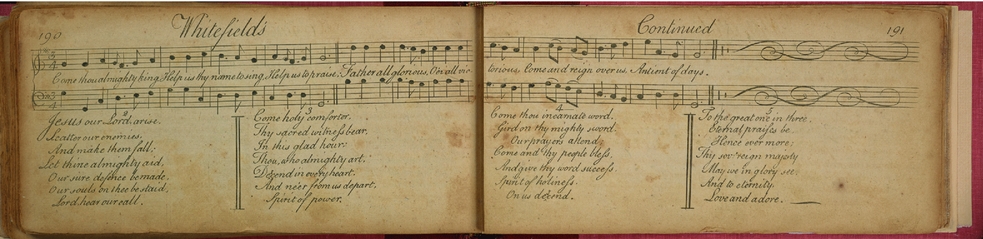
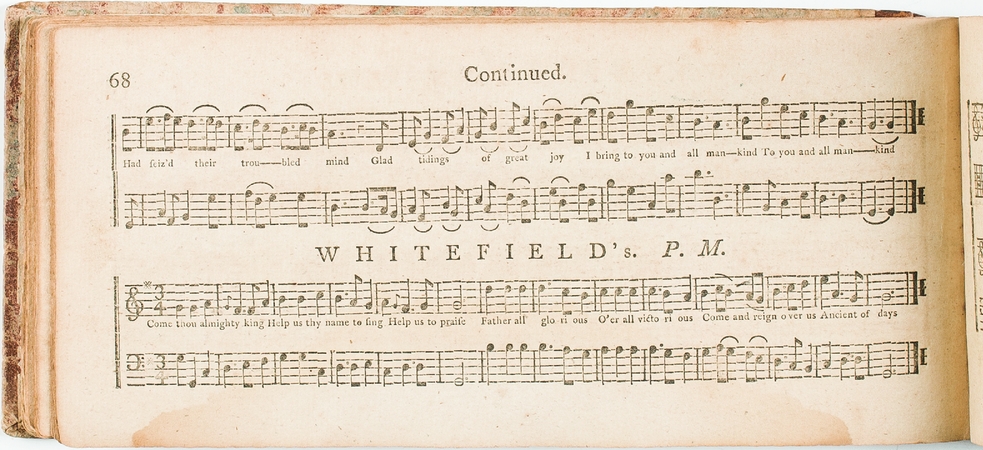
The quick-responding yet fragile formats that typify Revolution-era political song culture stand in contrast to the other key mode by which the tune “God Save the King” circulated in the mid-eighteenth century, for in addition to the newspapers, manuscripts, and broadsides that were used in public arenas, early contrafacta of “God Save the King” also appeared in hymnals, thereby infiltrating religious spaces. The melody was adopted by London's Methodists as a hymn in the 1750s and then dispersed to transatlantic ecumenical congregations in the 1760s. At first the hymn circulated in a humble format: pocket hymnals that, because of their small size and absence of music notation, were inexpensive.Footnote 34 A more costly (but still small format) version of the hymn appeared in The Psalm Singers Help, being a Collection of Tunes (London, 1760). This upright duodecimo format hymnal included engraved music notation (with thorough bass for keyboard) and was popular enough to go through at least four editions before 1775.Footnote 35 In the same period, the hymn was published in America, also with music notation, by the Philadelphia compiler James Lyon.Footnote 36 Lyon's publication, Urania: or A Choice Collection of Psalm-Tunes, Anthems, and Hymns, in the oblong format more typical of hymnals, included the hymn under the title “Whitefield's” in honor of the famed evangelist George Whitefield, who was still remembered for the massive crowds he drew when touring the American colonies, from Georgia to Maine, in 1740–41. (However, Lyon specifically aimed his publication at an ecumenical audience, addressing the preface “to the Clergy of every Denomination in America.”)Footnote 37 While the London hymnals in which the “God Save the King” sacred contrafactum appeared were modest in size and inexpensively manufactured, Urania was lavish. At more than two hundred pages, Urania was far longer than any previous colonial sacred imprint. It surpassed previous versions in terms of the aesthetics of its print technology as well, for Urania featured elegantly hand-engraved music by the English immigrant Henry Dawkins.Footnote 38 Thus Lyon's Urania represents a substantial refinement in the contrafactum's presentation. The hymn lyrics remained the same from the English to American publications, however. And with lines such as “Jesus our Lord arise, / Scatter our enemies, / And make them fall,” the hymn did not shy away from evoking the original lyrics. Regardless of the refinement or crudeness of the particular hymnal in which this version appeared, the format overtly sacralized the tune (Figure 1).
“Whitefield’s“ in James Lyon, Urania. Image of copy held at the University of Pennsylvania.
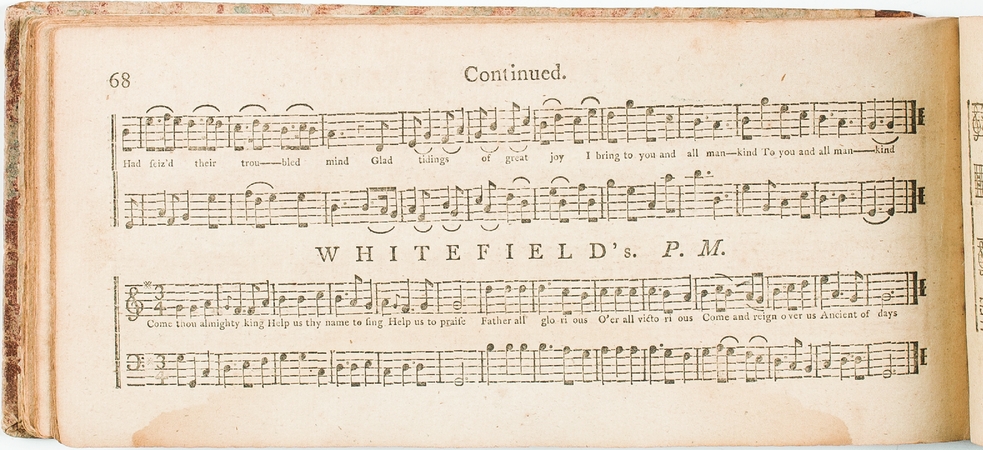
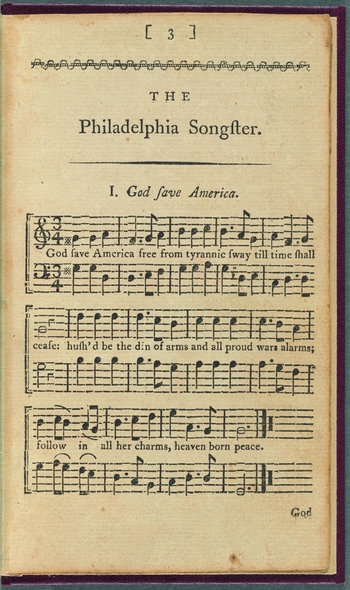
As “God Save the King” contrafacta continued to appear in durable formats such as songsters and hymnals, the tune was coded as both patriotic and sacred. For instance, it appeared as both a hymn in A Selection of Sacred Harmony (1788) and as a patriotic song in The Philadelphia Songster (1789). Both volumes were printed in Philadelphia in the same time period and both were the work of one man, Andrew Adgate, who employed the conventions of sacred and secular publication to reach a wide audience.Footnote 39 In A Selection of Sacred Harmony, Adgate copied the two-part setting of “Whitefield's” directly from the ever-popular Urania (Figure 2).Footnote 40 The next year Adgate aimed at a different segment of the music market when he published The Philadelphia Songster, a small collection of popular songs with printed music that featured a patriotic version, “God Save America,” as its opening piece.Footnote 41
“Whitefield’s“ in Andrew Adgate, A Selection of Sacred Harmony (Philadelphia, 1788). This version is an exact copy of the same hymn in Urania (Figure 1). The hymnal was relatively successful, and was enlarged and reprinted three more times by the end of the century (in 1790, 1794, and 1797). Image from copy held at the American Antiquarian Society.
Adgate's songster was something of an experiment, an attempt to capitalize on a growing publishing trend and harness the patriotic energy of the late 1780s. Songsters were increasing in popularity. Many were imported or reprinted from Britain, and their small size and entertaining repertoire helped readers attain a pinch of cosmopolitanism.Footnote 42 Like other songsters, The Philadelphia Songster contained mostly the sentimental British songs that were very popular in the early Republic. Adgate's songster defies many of the format's conventions, however. As a rule, songsters did not contain printed music, but Adgate's did. Songsters were often around two hundred pages, but Adgate's was only sixteen. Songsters were usually published independent of any particular musical event, such as an opera or concert, but Adgate's stemmed from a performance: on 8 July 1788, he put together a “music exhibition” that featured the contrafactum “God Save America” on its program, the same song that readers found on opening The Philadelphia Songster when it was published six months later.Footnote 43
The similarities and differences between Adgate's sacred and patriotic versions of “God Save the King” pertain to musical arrangement and printing technology as well. Indeed, Adgate's songster demonstrates the importance of format for determining the use of a contrafactum, for the arrangement in The Philadelphia Songster is not the same as that which appeared in Urania and A Selection of Sacred Harmony. The bass line has fewer leaps, the melody progresses smoothly with no graces. Apparently Adgate copied “Whitefield's” from Urania for his hymnal but devised a new arrangement of the tune for his songster. Yet in terms of printing technology, the hymnal and songster are analogous. For both publications Adgate collaborated with William Young and John M'Culloch, two printers who set music in type (rather than engraving). The transition from engraving to the more affordable typography marked Adgate's publications as au courant in the late 1780s, when letter-press was becoming popular, while the inclusion of the colonial-era hymn marked the volume's continuity with pre-Revolutionary transatlantic religious culture (Figure 3).
“God Save America” in Andrew Adgate, The Philadelphia Songster, 3. Image from copy held at the New York Public Library.

From the 1740s to the 1780s, “God Save the King” accumulated layered meanings as a royal anthem, a sacred hymn, and a generic patriotic song on both sides of the Atlantic, and formats supported these various meanings. In this accretion, the song was not unlike other well-known tunes, which were snatched up and reused incessantly. With the end of the War of Independence, however, Americans found themselves with no enemy against whom to define their cause. Yet songs like “God Save the King” remained a useful tool: its contrafacta facilitated the gradual consolidation of two separate political parties, whose disagreements would consume the final decades of the century. Beginning with the lead-up to the ratification of the Constitution, the dominant Federalist party sought to harness the symbolic power of the song to support its cause by projecting a vision of national unity. This tactic resulted in the tune's close association with George Washington, an association asserted in print and confirmed through performances at festive events. Yet eventually even a powerful unifying figure like Washington could not prevent the partisan squabbling from pulling the political fabric to shreds, a disintegration made audible in competing contrafacta.
From Festive Federal Unity to Partisan Fragmentation
On 23 April 1789, a week before his inauguration as the first president of the United States, George Washington travelled by barge from New Jersey to New York City. As Washington and his retinue crossed the Hudson River, they were hailed by a large sloop carrying some twenty men and women, all of whom rose and sang a new contrafactum of “God Save the King” that heralded Washington as a semi-sacred ruler as well as a laurel-crowned warrior. Before he could step on firm ground, Washington was honored by (or perhaps subjected to) a gun salute, which was repeated when he landed. Clanging bells and the clamor of masses of onlookers crowding the streets added to the celebratory hubbub. The day's events were recounted in newspapers across the nation. The “God Save the King” contrafactum reached a national audience as well, printed on broadsides and in newspapers. “Hail thou auspicious day! / Far let America / Thy praise resound,” the song ebulliently began, and resound it did.Footnote 44
Washington's reception exemplifies the importance of public spectacle and festive culture in early American politics.Footnote 45 Such events provided a forum for political participation outside the realm of government. By joining in parades and other civic festivities men and women could give voice, literally, to their opinions. Indeed, for those who could not vote—non-propertied white men, women, and people of color—the vernacular expression of political song(s) was an expedient way to exercise the democratic mandate of popular sovereignty.Footnote 46 Importantly, however, festive performances also reveal the fissures in the political bedrock: when people whose access to representative politics was dramatically foreclosed sang in protest rather than approval, or when approving performances were coerced out of the public, then the uneven relation of power between the government and the people was exposed.Footnote 47 By the 1790s, questions about whether the people were being adequately represented created fractures in the social and political terrain that no amount of parading could mend—or even mask.
For a time, however, the figure of George Washington seemed to be one thing everyone agreed on if we are to believe the numerous reports of instances where he was the focal point of festive singing. For example, a contrafactum titled “God Save Washington” was performed at the City Tavern in New York in 1784 to celebrate the first anniversary of the Revolutionary War's end. As a newspaper reported, the city commemorated its recovery from British occupation with tolling bells and burning effigies of traitors, while “all the officers in the town” were invited to the tavern for patriotic toasts and other festivities.Footnote 48 In another instance, when the Boston Artillery Company, a 150-year-old volunteer militia organization, gathered for an elaborate and toast-filled dinner in June 1788, one member sang “God Save George Washington.”Footnote 49 Washington himself was often greeted with versions of the song. In Portsmouth, New Hampshire, he listened politely to a contrafactum sung in the state Senate. This legislative performance came on the heels of a parade, which Washington dutifully documented in his diary.Footnote 50 (One detects a bit of fatigue from the much-fêted president as he described the crowded streets and rather predictable series of odes and honors. “The same happened yesterday at my entrance into New-Buryport—Being stopped at my entrance to hear it,” he drily observed.)Footnote 51
The enthusiastic reports about such festive performances implied that there were never any political disagreements, but rare was the public celebration of Washington that actually avoided politicization. Indeed, in the examples given above we need only note that each one featured well-established men of power—officers, members of a long-standing militia, legislators in state government—who, in deploying versions of “God Save the King” that praised Washington, confirmed the political status quo. They were not neutral. Indeed, the popular contrafacta celebrating Washington in the 1780s walked a careful line, drawing on the gravitas of the tune's association with the British monarchy while keeping the president distinct from the king. In many ways, Washington was depicted as a surrogate for King George III. This surrogacy was evident in the very way contrafacta were identified: increasingly in the late 1780s the tune was labeled “God Save Great Washington.”Footnote 52 Several popular “God Save the King” contrafacta played with the coincidence of George Washington sharing a name with Kings George II and III: “God Save George Washington” and “God Save Great Washington” was an easy substitute for “God Save Great George Our King.” Some contrafacta pitched the president and the monarch in dramatic symbolic battles, out of which Washington emerged the triumphant victor. These versions remained popular long after the Revolution was past. As one published in 1797 put it, “The bloody George in vain / May forge a stronger chain, / The deed is done! / A greater George than he, / Hath set Columbia free; / Immortaliz'd shall be, / George WASHINGTON.”Footnote 53 With the familiar tune as a battleground, Americans could visit a past victory—a memory that only grew more appealing as the distance of time dulled recollections of the war's hardships. But in doing so, such versions also extolled the established political order, an order against which a growing oppositional party chaffed.
Partisanship was not supposed to exist. The republican ideals on which the United States was founded, ideals of a moral and educated populace electing virtuous and selfless white gentlemen to government, and the unanimous expression of patriotic devotion those ideals inspired, were meant to obviate political parties. Yet two parties emerged, and the intractable differences between them, although nominally deplored by all involved, increased in the first two decades of the republic. The partisan divide between Federalists and Republicans can be conveniently couched as “court” versus “country,” with Federalists arguing for a central locus of power and Republicans (also known as Jeffersonians or Democratic-Republicans) staking a claim to greater authority for individual states. Numerous stereotypes stemmed from this binary. Federalists were cast as defenders of social hierarchies who desired a central bank and a standing army, who cherished their ties to Britain, and who were monarchists at heart. Republicans were depicted as democratic and populist, militating against centralization in all forms (particularly when it came to potentially coercive bodies of power such as an army) while sympathizing with the ideals of the French Revolutionaries. Federalist icons included George Washington, John Adams, and Alexander Hamilton; Republicans included Thomas Jefferson and James Madison.Footnote 54
To Republicans, the construction of unity in patriotic versions of “God Save the King,” along with other songs that praised Washington, was only a thin cover for the political aims of Federalists. Indeed, the very formats through which news of festive occasions circulated were themselves political—newspapers, broadsides, and even songsters betrayed the agendas of their publishers (some of whom were linked to the government). Federalists used Washington's popularity to project the hopeful (if hypothetical) image of a nation prospering under a strong central government. Thus, seemingly patriotic contrafacta advanced a Federalist agenda, especially as they sought to ratify the Constitution. A deeply divisive topic, the ratification occurred slowly through a piecemeal, state-by-state procedure, and its success was not at all certain. Federalists attempted to rally the people to their cause through numerous parades and festive events, and then arranged for so-called Grand Federal Processions in each state upon ratification.Footnote 55 With this context in mind, contrafacta that praise George Washington and national unity take on an additional valence, one of partisanship. For example, “Hail godlike Washington,” mentioned above, declares that “Now Albion's sons are fled,” there are particular tasks to attend to: “Next in our theme shall be” lofty goals (the pursuit of knowledge and the promotion of virtue over ambition), but also more concrete objectives, such as commerce and “civil laws.” Under the guise of celebrating Washington's birthday, the “God Save the King” contrafactum promoted a Federalist vision of confederated unity under the Constitution.
In the 1790s contrafacta took partisanship into an echo chamber. Setting the tune “God Save the King” with new lyrics celebrating George Washington permitted Federalists to build enthusiasm for the federal government. But substituting George Washington for King George in contrafacta confirmed Republicans’ suspicion that Federalists entertained aristocratic fantasies that endangered the liberties promised by the Revolution. Federalists were accused of mimicking British trappings of monarchy, of which the contrafacta of “God Save the King” were damning proof. Grumblings about Federalist elitism reached a distinctly audible pitch and focused on the “courtly forms, etiquettes and manners” of the ruling party. “The mimicry of . . . [this] absurd pomp by the citizens of a free commonwealth” was distinctly undemocratic, according to the newly formed Democratic Society of Pennsylvania.Footnote 56 A celebration that greeted George Washington “savors too much of Monarchy to be used by Republicans,” declared a correspondent in the extremely partisan newspaper Philadelphia Aurora.Footnote 57 Where did the Revolutionary ideals of “God save America, free from tyrannic sway” go, Republicans queried? Buoyed by contrafacta like “God Save Great Washington,” the cult surrounding the first president—no matter how much Federalists tried to control it—emulated the treatment of monarchs too exactly, according to Republicans.
Format played an important role in both espousing the idea of federal unity and in the partisan breakdown of the 1790s. Newspapers in particular amplified political messages by transforming local events into national news to be shared in coffee houses and taverns from New Hampshire to the Carolinas. The singing on 23 April 1789 commemorated Washington's inauguration, but it was the distribution of song lyrics in newsprint that made it a national civic event. Newspapers were not wholly the mouthpiece of the established Federalist party, however, and increasingly in the 1790s they were a format used by Republicans to espouse contrary political points of view. Most notably, this is evident in responses to the French Revolution, as the French Revolution became a proxy for political sparring. Republicans generally supported the Revolutionaries’ cause and Federalists condemned it. Newspapers fanned the flames by providing reports on developing events in Europe. “God Save the King” contrafacta were common features of these reports. Newspaper printers found that breathless accounts of military victories captivated readers, and included anecdotes about French rebuffs to foreign aggressors—some of which featured competitive singing. The Worcester Intelligencer reported that French and British troops facing off at Conticq in July 1794 engaged in friendly competitions after the fighting ceased. The soldiers sat “on the opposite banks of the river, trying who could beat each other at singing—the one party in a high tone singing la Carmagnole, &c. While the other was vociferously employed in endeavoring to drown their voices by singing God save the King—Rule Britannia—and hearts of Oak.”Footnote 58 A similar report appeared in the Philadelphia Gazette, recounting how as British and French troops faced off across a river near the Flemish city of Malines, the French sang “la Carmagnole” and the English, “God Save the King.”Footnote 59
But whereas these examples solidified the connection of “God Save the King” with the British as an anti-French symbol, in the United States it was a more flexible vehicle for political messages, for Republicans were able to use the same tune to proclaim their support for the French Revolutionaries. For example, at a massive all-day festival in Boston on 24 January 1793, at least two versions of “God Save the King” were sung, both of which advocated for the end of monarchic abuse and praised France's pursuit of liberty. The festival was held in part to celebrate the French victory in the September 1792 battle of Valmy, and a detailed account of the Boston events circulated in newsprint, including lyrics to the “God Save the King” contrafacta performed that day. A version sung by a group of mechanics explicitly referenced—and implicitly reprimanded—George Washington. Introducing it as “the patriotick song ‘God save great Washington,’” as the New-York Journal noted, the mechanics included a new verse: “Next in my Song shall be, / Guardians of Liberty, / Gallia's free band: / O! May their Liberty, / Fix'd on Equality, / With Love and Unity, / Last to the End.”Footnote 60 The tune's connection to the monarchy by way of George Washington was insinuated (and criticized), while the printing of the song broadcast widely the partisan messages about Revolutionary equality. Clearly, not all printed iterations of “God Save the King” were perceived as anti-French and ergo pro-Federalist. Those who took to the streets had no shortage of songs to sing, “Ça Ira” and “la Marseillaise” being particular favorites, so the fact that “God Save the King” was intentionally selected for multiple contrafacta illustrates its widespread appeal for those engaged in partisan wrangling.
Federalists had their own musical responses to the French Revolution. For example, “God Save the United States,” published in 1798 by Ebenezer Merriam of Worcester, Massachusetts, in The Echo: or Federal Songster and frequently reprinted thereafter, promulgated the idea that Republicans were blinded by their francophilia. The lyrics open with the unambiguous lines: “God save the United States, / Free from the worst of fates, / Vile Gallic sway.”Footnote 61 The stereotype of French-loving Republicans presented in this song took on an ominous significance beginning in April 1798, when Americans were shocked to learn that agents for French foreign minister Charles Maurice de Talleyrand-Périgord had extorted and humiliated U.S. envoys the previous year, demanding substantial bribes and leveling military threats against the United States. A diplomatic and political crisis ensued. The scandal, known as the XYZ Affair, was deeply embarrassing to Republicans, who were cast as defenders of the ignoble French, and a boon for Federalists, who adopted the roles of virtuous heroes confronting an ethically bankrupt foreign foe. Several popular tunes were used in response to the hubbub, including the ballad “Derry Down,” which was co-opted for a nastily fun song titled “The Five Headed Monster; or, Talleyrand Dissected. A new song for the jolly Tars of America.”Footnote 62 Humor was eschewed in favor of themes of duplicity and honor in “God Save the United States,” however. In documenting Federalists’ militantly indignant francophobia and their partisan-inflected patriotism in the aftermath of the XYZ Affair, “God Save the United States” drew on the tune's quasi-religious and monarchical roots. God is called on to protect the nation, then–President John Adams, and George Washington. Not surprisingly, given the tense period in which it was written, enemies loom large in the contrafactum. For example, in the verse about Adams appear the following lines: “May every enemy, / Far from his presence flee, / And be dire anarchy, / Crush'd by his hands.”Footnote 63 Moreover, the second verse of the original “God Save the King,” which calls on God to “scatter our enemies,” is quoted directly as the fourth verse in “God Save the United States.” The identity of these enemies is vague, allowing for a slippage between the French and American Republicans that was useful to Federalists.
The 1790s “God Save the King” contrafacta reflected growing partisan divides in the United States that grew out of internal political tensions and further polarized the factions through responses to the French Revolution. By way of the various formats in which contrafacta circulated—newspapers and songsters in particular—new versions of the song reached readers at multiple social registers. At the same time, the surging transatlantic print industry continued to imbricate American politics with Britain. Even as the coopting of “God Save the King” by members in both parties helped speed the fragmentation of the 1790s, its ongoing use symbolized the durability of the links connecting the United States to its still-recent colonial past.
Conclusion: Format and the Public Sphere
“God Save the King” contrafacta provide a musical roadmap of the transatlantic political history of Revolutionary America. Beginning in Britain as a righteous defense against a foreign threat, in the British North American colonies “God Save the King” was sacralized, converted into a festively patriotic ode to George Washington, and finally fractured into a partisan fight song that traded on its British associations (construed both positively and negatively). The continuities with the colonial period were remarkably strong and durable, a fact that becomes apparent when we attend to the material artifacts of songs, and when we integrate music into a broader understanding of the social, cultural, and political history of early America.Footnote 64
In this article I have argued that political culture after the American Revolution included considerable continuities with the colonial period—continuities easily seen (and heard) through the persistent popularity of tunes like “God Save the King”—and these enduring ties invite us to consider how political independence did not bring with it an independent cultural identity for the new nation. This awareness is all the more necessary given that many people who lived voluntarily in the United States were not of British heritage, and many others were in the nation's territory involuntarily. Enslaved people and Native Americans whose land and labor were stolen had little purchase in the question of cultural sovereignty. Most of the debates in which “God Save the King” contrafacta participated were over questions that concerned people of European descent, and especially Anglo-Americans; perhaps it is not too great a stretch to say that the limit of their concerns is indicative of the broader difficulty of seeing and hearing beyond whiteness in early America.Footnote 65 For Anglo-Americans, however, concern about mimicking the former colonizers was powerful in the early years of the republic, exemplified in the critiques Republicans leveled at Federalists but also pervasive in the tunes, texts, and formats by which songs circulated. Even songs that presented patriotic or nationalistic themes came under fire. A case in point: in 1798, newspapers in Philadelphia and New York criticized those who displayed an unbecoming willingness to sing the British royal anthem on festive and patriotic occasions. Indeed, in accounts of that year's July 4th celebrations, the absence of songs to the tune of “God Save the King” was taken as a sign of progress toward cultural independence.Footnote 66 The early United States’ path out of colonial attachment to Britain was steep, and Americans proceeded along it slowly.
Ultimately, despite its inherent ambivalences and because of its variety, “God Save the King” was, like other British tunes popular in the eighteenth century, an effective political song. Variety of format allowed it to reach large audiences. Newspapers and broadsides turned contrafacta into a form of musical news that could be consumed in public taverns and coffee houses, while songsters and manuscript books infiltrated the domestic sphere. Variety of lyrics conveyed targeted messages to those audiences. Indeed, the unifying effect of a well-known tune was undercut by the disparate ways in which people engaged with formats. A version that appeared in a newspaper did not have the same impact as one copied in a manuscript; even if it featured the same lyrics, the formats likely reached dissimilar audiences and certainly encouraged individuals to encounter the song in different ways. Elizabeth Van Rensselaer (the young girl who copied the song twice into her music book), a wealthy Virginia planter who in the comfort of his manor perused a songster containing a new version of “God Save the King,” and a Boston craftsman who crowded around a newspaper to first spell out then sing the words with his friends in the tavern each had separate experiences with the song. Format signaled differences not just of social context but musical-political engagement. If Elizabeth Van Rensselaer performed the song for her approving music tutor and family members, such a performance represents a mode of political awareness far removed from the rowdy scenes at urban parades. The shared experience of the song might seem to unite these men and women in a common patriotic experience that was grounded in a shared cultural heritage—indeed, that is how Benedict Anderson famously characterizes the power of print nationalism and song.Footnote 67 Yet individuals’ unique interactions with the specific contrafacta and formats expose the gaps that existed within, and at times undermined, that national unity. Thus, such musical materials allow us to map more minutely early American political culture.
Finally, the song culture of Revolutionary America also offers insights into the relationship between music and politics more broadly. In their print, manuscript, and sung forms, these songs demonstrate the importance of music in the public sphere. Ever since the classic formulation of Jürgen Habermas in The Structural Transformation of the Public Sphere (English translation, 1989), the concept of the public sphere, in which political habits of thought were developed through civil discourse (in person and in print), has given music scholars a powerful lens through which to view vernacular music-making in an array of times and places.Footnote 68 Revolutionary America provides a compelling example of how songs and politics operated reciprocally and persuasively, co-articulating the public sphere's parameters.Footnote 69 Importantly, it was through diverse formats and performances that songs gained political influence. By focusing on how Revolutionary American songs circulated and conveyed meaning, we may better understand the relationship between music and political culture in other historical arenas, particularly other instances of revolution or attempted revolution where the desire for continuity and the thrill of rupture produce potent musical cultures.