Malapportionment leads to formal political inequality as the value of people’s votes in small electoral districts or constituencies is larger than the value of people’s votes in large constituencies.Footnote 1 Such disparities are of normative concern because they conflict with a widely held belief that political institutions ought to give all citizens an equal voice, and are of positive concern as political representation is thought to affect socio-economic outcomes.
Following these twin concerns, the scholarly literature has documented the degree to which people are under- or over-represented in legislatures, and has examined the effects of malapportionment on various outcomes, including political selection,Footnote 2 the policy-making processFootnote 3 and the distribution of funds.Footnote 4 The effects of malapportionment on representation in the executive – which is explicitly drawn from the legislature in parliamentary systems, and is sometimes influenced by the legislature in presidential and semi-presidential systemsFootnote 5 – have not been explored. This is perhaps not surprising, as many analyses of malapportionment have examined contexts in which the executive is not drawn from the legislature.Footnote 6 Given the importance of the executive in countries with parliaments,Footnote 7 the effects of malapportionment on the composition of the executive are likely to be more consequential in these contexts than the effect of malapportionment on the legislature.
I rectify this gap by advancing two theoretical mechanisms by which malapportionment could affect cabinet formation, focusing on parliamentary systems. One of these is direct, as formateurs favor relatively small constituencies for cabinet berths, or as legislators from smaller constituencies attempt to join cabinets more frequently than others. Another is indirect, as malapportionment creates more smaller-than-average constituencies, which incentivizes large parties to secure their support.
I test for the effect of malapportionment on cabinet formation using an original repeated cross-sectional dataset on elections and cabinet composition in India’s seventeen largest states, from 1977 to 2007. I use archival research to show that the reapportionment freeze – which was the main underlying cause of malapportionment – was not due to reverse causality, and use fixed effects to plausibly control for remaining endogeneity. The analysis allows us to examine the effect of malapportionment on citizens’ representation in the cabinet, which is drawn from the legislature. I find that a one-standard-deviation increase in electoral district or constituency size decreases the probability of a representative being in the cabinet by 22 per cent. An analysis of the mechanisms by which malapportionment affects cabinet inclusion suggests that it affects it indirectly, by prompting large parties to focus on securing the support of relatively small constituencies.
India’s states are an appropriate context in which to examine the effects of malapportionment because, although the overall degree of malapportionment in India is near the world average,Footnote 8 the degree of malapportionment across and within the country’s states varies substantially. Further, and as I argue below, the main driver of this variance is apolitical, which improves our efforts to isolate the causal effects of malapportionment. Comparisons of the effects of malapportionment between India’s states are also appropriate because the electoral and institutional systems for the country’s state legislatures and executives are nearly identical,Footnote 9 which makes the cases I consider more comparable with one another than cross-country analysis would allow.
This article furthers the substantial literature on the effects of malapportionment by theorizing about – and documenting a hitherto unnoticed effect of – malapportionment in parliamentary systems. Due to the importance of the executive in these systems,Footnote 10 including in India,Footnote 11 the effect of malapportionment on the composition of the executive is arguably more important than its effects on the legislature. It furthers the literature on malapportionment in India, most of which has vigorously called for reapportionment on normative grounds,Footnote 12 by considering whether we have additional, positive reasons to be concerned about malapportionment. By examining the effects of malapportionment on cabinet inclusion, the article improves our understanding of the functioning of Indian democracy, its representativeness and the roots of policy making. I elaborate on these themes through the course of the article.
I start with discussing the theoretical reasons why malapportionment might affect coalition formation. In the next section, I describe the causes and extent of malapportionment across India’s states; the section after details the data and empirical strategy employed. I then investigate whether malapportionment does indeed affect the political process as hypothesized, present robustness tests and discuss mechanisms, and then conclude.
The Political Effects of Malapportionment
The main hypothesis advanced by this article is that relatively small constituencies are likely to be favored for cabinet inclusion. More formally,
Hypothesis 1: Representatives from smaller-than-average constituencies will be cabinet members more often than will representatives from larger-than-average constituencies.
In this section, I detail two broad accounts of why the representatives of relatively small constituencies might be favored for inclusion in cabinets.
The first, indirect, mechanism by which malapportionment might affect cabinet inclusion is via its effect on political parties. Malapportionment often occurs as formerly relatively equally sized constituencies grow at different rates. Frequently, differential growth occurs as people migrate from many rural areas to few urban areas. In other instances, it may occur as people migrate from old industrial cities to fewer, more dynamic ones. The concentration of people in relatively few areas tends to create more relatively underpopulated areas and fewer overpopulated areas. Cross-national data corroborate this claim. Using data on a broad cross-section of seventy-six countries between 1832 and 2013, Appendix Figure 1 shows that the proportion of overrepresented districts exceeded the proportion of under-represented districts in 64 per cent of country-years, and further that the proportion of over-represented districts was increasing in mean country-level malapportionment: 89 per cent of country-years with above-average malapportionment had more over-represented than under-represented districts. As I describe below, these patterns also hold in India’s states.
The fact that relatively small constituencies tend to outnumber relatively large ones, particularly as malapportionment increases, incentivizes parties to focus their efforts on winning the favor of the more numerous over-represented constituencies. Parties might be unable to court both relatively small and relatively large constituencies due to resource constraints, and – if the policy preferences of small and large constituencies diverge – due to the perceived or actual need for parties to have coherent policies. Assuming that the largest parties are able to court relatively small constituencies successfully – a pattern that we are able to document in India, which is a key mechanism that we will test – the largest parties will have a disproportionate number of seats from relatively small constituencies. Finally, since cabinets are heavily drawn from the largest parties, they will be more likely to be composed of relatively small constituencies. In sum, the first mechanism posits that malapportionment indirectly affects cabinet inclusion through its effect on the composition of the largest party.
The second, direct, mechanism of how malapportionment might affect cabinet inclusion draws on the literature to argue that the representatives of relatively small constituencies are included in coalitions such as the cabinet more often than others because of formateurs’, and/or legislators’ own, incentives. Formateurs might prefer to build coalitions with legislators from smaller constituencies since they are cheaper to include than are larger constituencies.Footnote 13 Although not explicitly spelled out by the existing literature, the logic underlying this intuition is that if adding a legislator to a coalition ‘costs’ the formateur a limited resource such as pork, if the formateur has some incentive to minimize such a cost, and if the cost of the limited resource is an increasing function of constituency size, we might expect cabinets to form with the smallest possible constituencies. Further, legislators from relatively small constituencies might have a greater incentive to join cabinets, since they have fewer constituents to ‘divide the dollar’ among, which means they get more of a pay-off per dollar and therefore have a greater incentive to join cabinets.Footnote 14
While smaller constituencies could be both cheaper to buy off, and could receive more on a per capita basis than larger constituencies, the latter account is somewhat at odds with the former, since if each legislator only got what they ‘needed’ (which is what the former account argues), smaller-constituency legislators would not have more of an incentive to enter the coalition than larger-constituency legislators. It is also not clear whether the ‘cheapness’ of small constituencies can be derived in equilibrium. After all, if each legislative vote is worth the same to the formateur (as is the case in most legislatures), the ‘price’ of each vote should equalize, which would eliminate any small constituency advantage. A last reason to doubt the applicability of the direct mechanism is that a number of other considerations likely trump the relative ‘cheapness’ of small constituencies, including individual politicians’ abilities and policy views. Nonetheless, the literature has relied on these arguments to explain the advantage enjoyed by small constituencies in the coalition-formation process in a number of contexts. For example, US senators from smaller states are in winning coalitions more frequently than their large-state counterparts.Footnote 15 By switching our focus to India’s states, we are in a sense asking whether this small-constituency advantage holds in the longer-lasting coalition of the cabinet, which governs states between elections.
To summarize, there are two broad mechanisms by which smaller-than-average constituencies may be over-represented in cabinets. The first, indirect, mechanism posits that malapportionment affects cabinet inclusion by inducing the largest parties to focus on securing the support of the more numerous relatively small constituencies, which would increase their likelihood of being included in cabinets. The second, direct mechanism argues that legislators from relatively small constituencies might be invited to ruling coalitions more often, or may have a greater incentive to join them.
If constituencies that are small relative to the state mean are indeed more likely to be included in the cabinet, it will mean that people in larger districts suffer from a double exclusion in these contexts: they will be under-represented in the legislature (simply due to the fact that their legislative vote is worth less than the legislative vote of citizens from small districts) and in the executive. Note that their under-representation in the executive will hold not only because the executive is drawn from a malapportioned legislature (which is a mechanical, but hitherto ignored, result), but also because this drawing will occur – directly or indirectly, as described above – in a way that is biased against larger constituencies. As I show later, these effects are empirically decomposable.
It is worth noting that Hypothesis 1 concerns a dependent variable – a dummy for cabinet inclusion – at the constituency, and not at the party, level. An alternative way to examine the effect of malapportionment would be to ask – as does the coalition-building literature – which of the many possible party coalitions form a government,Footnote 16 or the degree to which parties get cabinet berths.Footnote 17 I eschew party-level analysis in favor of constituency-level analysis, however, mainly since the normative motivation for this article (that is, to determine whether a factor that is morally irrelevant to whether a person should have equal representation – namely, the drawing of constituency boundaries – affects, via malapportionment, the degree to which that person is represented in the cabinet) calls for such analysis. A similar analysis at the party level would be have no normative implications, since party-level malapportionment might affect party platforms, and people ought to be able to discriminate against parties based on their platforms. Also, any analysis of coalition formation by parties would require an understanding of where each party falls in the ideological space. The literature, however, emphasizes that political competition in India’s states occurs along multiple dimensions, which complicates such analysis.Footnote 18
Malapportionment in India
The Indian constitution seeks to guarantee every citizen an equal political voice. This equal voice is to be secured through, among other things, universal adult franchise and the reapportionment of electoral constituencies every decade. Elections at the national and state levels in India are held on a first-past-the-post basis. All electoral districts or constituencies are single-member. Yet the Indian Parliament temporarily froze – until 2008 – national (parliamentary) and state-level (assembly) boundaries through a constitutional amendment in 1976. The constitutional amendment passed by Indira Gandhi’s authoritarian ‘emergency’ government in 1976 changed several clauses of the constitution. Most, but not all, of this amendment was repealed by the Janata Government that followed, but the freeze in reapportionment remained. Unsuccessful attempts were made to lift the freeze in 1990 and 1996. A constitutional amendment, passed in 2003, allowed for the reapportionment of parliamentary and assembly constituencies within states, but mandated that the number of parliamentary and assembly seats for each state remain frozen at the level determined in 1976 until after 2030. Thus while malapportionment within states has been eliminated (the first elections using the newly delimited boundaries were held in May 2008), malapportionment between state contingents to the national parliament remains – and is expected to worsen.
Over the past thirty years, the freeze in reapportionment has resulted in a large degree of malapportionment between state-level constituencies. While the reapportionment freeze is the ‘deep’ cause of malapportionment, proximate causes of malapportionment have included differential fertility rates, death rates, and rates of in- and out-migration between constituencies.
I define a constituency’s malapportionment score in a given year, which measures the degree and direction of malapportionment, as the number of registered voters in a constituency normalized by the average number of registered voters per constituency in the state (
 $v_{{i,s,t}} \,/\,\bar{v}_{{s,t}} $
, where
 $v$
is the number of registered voters in a constituency,
 $\bar{v}$
is the average number of registered voters, and
 $i$
,
 $s$
and
 $t$
denote the constituency, state and year, respectively).Footnote
19
This is the reciprocal of the commonly used Relative Representation Index (RRI).Footnote
20
I use the reciprocal of the RRI for ease of interpretation: larger-than-average constituencies have a malapportionment score greater than 1, and smaller-than-average constituencies have a malapportionment score smaller than 1. A malapportionment score of 1.10 therefore indicates that a constituency is 10 per cent larger than the average constituency in that state-year. People in such a constituency will be under-represented on the floor of the legislature.
Note that for reasons of data availability, I am using differences in the size of the electorate, rather than population (which is what reapportionment commissions generally use), to measure the extent of malapportionment. The two ways of measuring malapportionment are likely to yield highly correlated measures, however, especially since the country’s independent Election Commission is thought to do a competent and non-partisan job of registering adult resident citizens as voters.Footnote 21
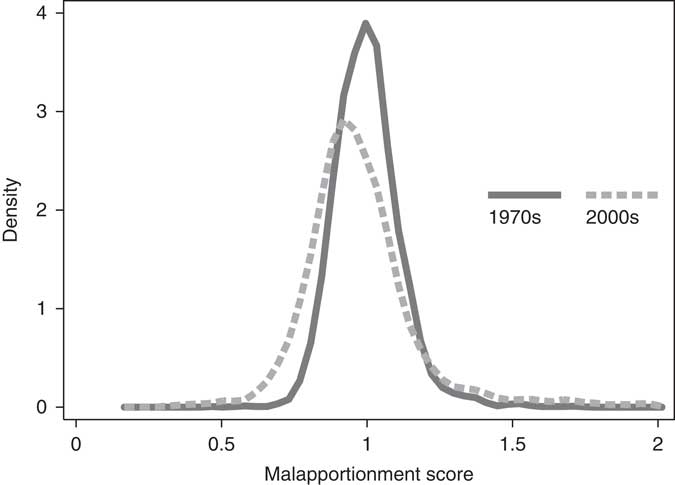
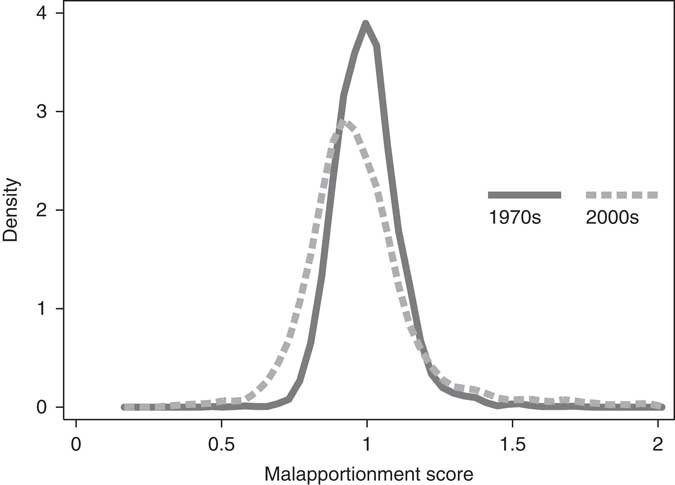
Figure 1 describes the increase in malapportionment across India’s state-level constituencies over time, by plotting the probability density function (PDF) of the malapportionment score in the 1970s and the 2000s. Although the mean malapportionment score equals one in each state-year, the PDF for the 2000s has fewer observations with a malapportionment score of around 1. The PDF for the 2000s is more spread out than the one for the 1970s, and its tails – particularly the left tail – are thicker. The leftward shift in the density indicates that malapportionment has produced more small than large constituencies over time, which occurs as people are concentrated in a few large constituencies.Footnote 22 Note that this corroborates, in the context of India’s states, the key assumption of the indirect mechanism by which malapportionment could affect cabinet formation: malapportionment creates more small constituencies than large ones.
Malapportionment over time
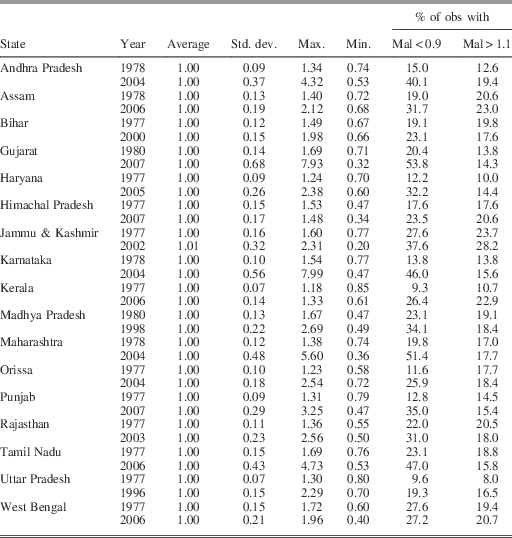
Since I focus on the effects of malapportionment in India’s state legislatures, I compare the extent of malapportionment across India’s states and over time in Table 1. This indicates, for example, that the largest constituency in Andhra Pradesh in 1978 had a malapportionment score of 1.34, while the smallest constituency had a malapportionment score of 0.74. This means that a citizen’s vote in the smallest constituency was worth approximately double that of a citizen’s vote in the largest constituency. By 2004, a citizen’s vote in Andhra Pradesh’s smallest constituency was worth eight times as much as that of a citizen’s vote in the state’s largest constituency. In the case of the worst offender, Gujarat in 2007, an individual’s vote in the smallest constituency was worth twenty-five times a person’s vote in the largest constituency. Estimates show that states that have experienced rapid economic growth since the 1970s are the ones that were the most malapportioned thirty years later.Footnote
23
Overall, while a small proportion of state assembly constituencies was 10 per cent smaller or larger than the average constituency size in the late 1970s,Footnote
24
50 per cent of assembly constituencies fell out of the
 $\pm$
10 per cent range of the average constituency size in the 2000s. This table also reconfirms the key assumption of the first mechanism proposed here: malapportionment creates more small than large constituencies. For example, the ratio of constituencies with malapportionment scores
 $\leq\! $
0.9 to those with malapportionment scores
 $\geq\! $
1.1 is 2:1 in Andhra Pradesh in 2004, and 3:2 in Assam in 2006.
Malapportionment Score by State, First and Last Observations
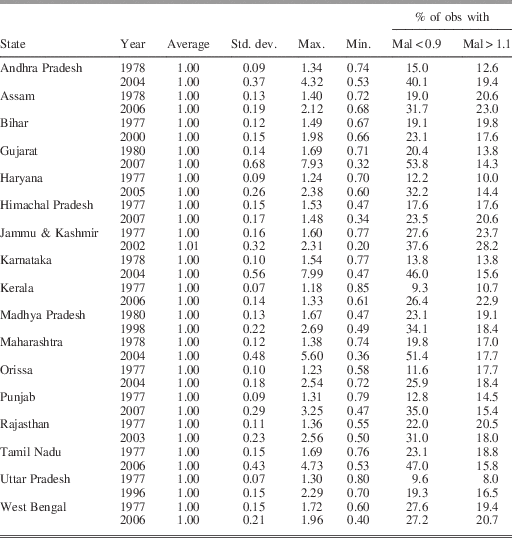
Note: Constituency malapportionment scores are defined as the number of registered voters divided by the average number of registered voters for that state-year.
Data and Empirical Strategy
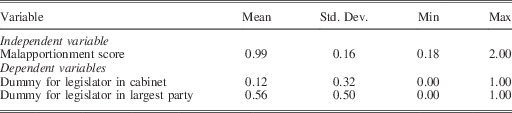
I use repeated cross-sectional data from India’s seventeen largest states (which encompass more than 97 per cent of India’s population; the country has twenty-eight states) from 1977–2007 to test my hypotheses.Footnote 25 The dataset draws on state election dataFootnote 26 and newly collected data on the composition of cabinets for each state approximately one year after every election;Footnote 27 116 state cabinets were formed during this time. As every state constituency enters the dataset after an election in that state (in other words, observations are for constituency-election years), there are over 23,000 observations. The dataset spans 1977–2007 because constituency boundaries were fixed in that period. Table 2 displays summary statistics for key dependent and independent variables.
Summary Statistics

A potential problem faced by efforts to estimate the impact of malapportionment is that malapportionment might be endogenous to the outcomes of interest, and the direction of the resulting bias in the estimated effect of malapportionment is ambiguous. For example, if those in power seek to perpetuate their hold on it by creating small districts – as was the case with England’s ‘rotten boroughs’ – the estimated effect of malapportionment will be inflated. If, on the other hand, the powerful create large constituencies because it pays to represent them, estimates of the effects of malapportionment will be attenuated. Save for a few exceptions,Footnote 28 most studies do not address the problem of the endogeneity of malapportionment.Footnote 29
The endogeneity problem might, in principal, be caused by reverse causality, omitted variables and errors in measuring the independent variable. To deal with these issues, I proceed on four fronts. First, I examine the causes of malapportionment in India and rule out the possibility of reverse causality, hypothetical examples of which were listed previously. Secondly, I employ the fullest possible set of constituency and legislature (that is, state-year) fixed effects to control for omitted variables that might cause the error term to be correlated with malapportionment. Constituency fixed effects control for omitted factors at the constituency level that are fixed or only vary slightly over time, including land area, the proportion of minorities (which is largely stable over time) and the like. Since each of the legislature (state-year) fixed effects is a cabinet-formation opportunity, these control for year-invariant, state-invariant and state-year-invariant factors such as patterns of political competition, national and state electoral waves, cabinet size and so forth. They also control for state-level trends, such as levels of economic development. The resulting estimates allow us to recover the effects of changing malapportionment within a constituency and over time, while controlling for factors specific to state-years and those that vary at the state level over time.
Thirdly, I check to see if the results are robust to dropping observations where politicians have the strongest incentives to influence constituency size (for example, those as redistricting approaches), to replacing malapportionment with lagged malapportionment (which is pre-determined but not exogenous), to controlling for malapportionment and lagged malapportionment, and to controlling for the effective number of parties. Lastly, I employ an alternative research design due to the redistricting of 2008 to better control for omitted variables, although this has drawbacks as well. While none of these methods entirely controls for endogeneity, their joint use should help improve inference.
In the rest of this section, I use archival and secondary research to explain why the Congress Party froze reapportionment, and why subsequent governments maintained the freeze.Footnote 30 I consider both the law’s publicly declared goals and aims that may be imputed to it. This analysis largely rules out the possibility of reverse causality in the relationship between malapportionment and cabinet inclusion. As detailed below, the analysis controls for any remaining marginal influence that politicians could have over the size of their constituencies.
The officially declared aim of the freeze in political constituencies in 1976 (which was reiterated in discussions about the partial extension of the freeze in 2003) was to avoid penalizing regions that were effectively curbing their fertility rates. It was thought that regular reapportionment, by reducing the proportion of legislative seats allotted to low-population-growth regions, would blunt these regions’ incentives to implement family planning programs. Surprising as it may seem, it is my contention that the freeze in malapportionment was genuinely instituted and maintained to help fulfill this population control aim.
To see why this is the case, consider the history of the delimitation freeze of 1976. It was part of the infamous forty-second constitutional amendment of India, a fifty-nine-clause piece of legislation that was passed by a chastened Indian Parliament at the behest of Indira Gandhi’s government during the country’s authoritarian interlude. All opposition leaders were in jail during the constitutionally declared ‘emergency’, and a number of opposition parties boycotted parliament. Although the few attending Members of Parliament (MPs) debated the bill over fifteen days, specific clauses were hardly discussed, and almost no amendments were made to the bill. The five clauses of the bill that dealt with the decennial reapportionment process in India were only directly referred to by one MP, who, taking the logic of the measures all too seriously, called for apportionment on the basis of the 1951 census.Footnote 31
Several MPs also rose to urge the government to vigorously pursue birth control measures, which the freeze in reapportionment was thought to be a part of. That Sanjay Gandhi, the prime minister’s son, led unlawful forced sterilization drives at the time with impunity illustrates the fixation that people had with population control. Also indicative of this concern were suggestions by MPs to grant women the ‘right’ to deny their husbands more than three children,Footnote 32 the dubbing of large families a crime,Footnote 33 and the suggestion that politicians with twoFootnote 34 or threeFootnote 35 children should be required to be sterilized if they wish to run for political office. That the freeze in reapportionment was explicitly mentioned as a ‘motivational measure’ in both the 1976 and 2000 national population policies,Footnote 36 which were announced before the 1976 and 2003 constitutional amendment bills were introduced in parliament, also indicates that the government’s intentions were genuine.
Those who dismiss the declared aim of the policy as a foil for something else point to its logical infirmities. They argue, first, that it is doubtful that the freeze would appreciably alter the incentives to curb population growth. Secondly, the modification of the one-man, one-vote principal in the pursuit of one specific policy objective (that is, the reduction in fertility rates) seems suspect. And thirdly, the policy effectively penalizes states (since it leads to their citizens being granted fewer votes in the legislature) that have high population growth rates for reasons (such as improved health and increased economic activity, which lead to a reduction in the death rate and increased in-migration, respectively) other than high fertility. At worst, these criticisms suggest that India’s MPs were foolish. They do not tell us, however, whether policy makers genuinely intended the freeze in malapportionment to help curb population growth rates or not.
There are three other reasons why the reapportionment freeze could have been instituted. First, some have argued that the freeze helps maintain the electoral balance between northern and southern states in India. Southern states, with about one-third of the seats in the Indian Parliament, are the primary beneficiaries of this freeze since their populations have grown less rapidly than those of northern states.Footnote 37 The parliamentary record does not suggest, however, differential support for reapportionment legislation from southern vs. northern politicians. Moreover, simulations suggest that if parliamentary constituencies were reapportioned today, southern states would lose less than 2 per cent of their seats in parliament.Footnote 38 Surely there were other ways for southern states to ensure that their representation was not gradually eroded over time?Footnote 39 And if the only purpose of the freeze in constituencies was to lock in a southern state advantage, why was the redistricting of state assembly constituencies suspended as well? Most importantly, the idea that southern states were trying to lock in an advantage need not concern us here because any such advantage would hold in the national legislature, and not within each of the country’s state legislatures. Since this is a study of the effect of malapportionment on government formation across India’s states, and not in the country’s national legislature, this concern need not detain us further.
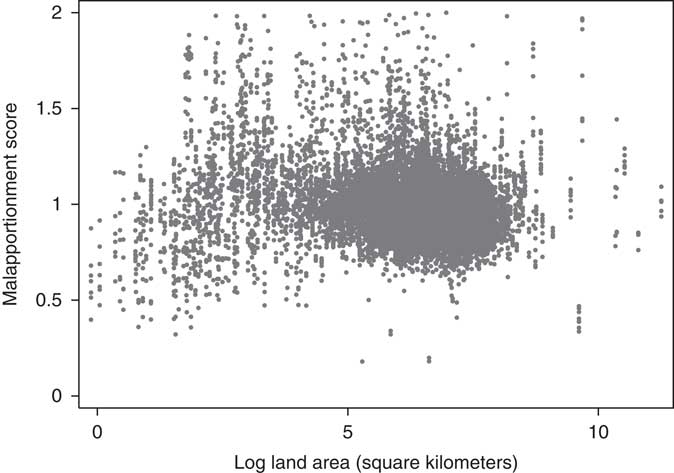
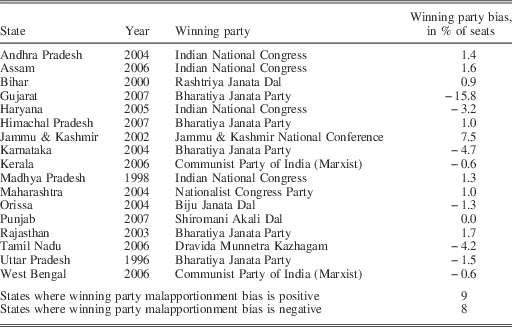
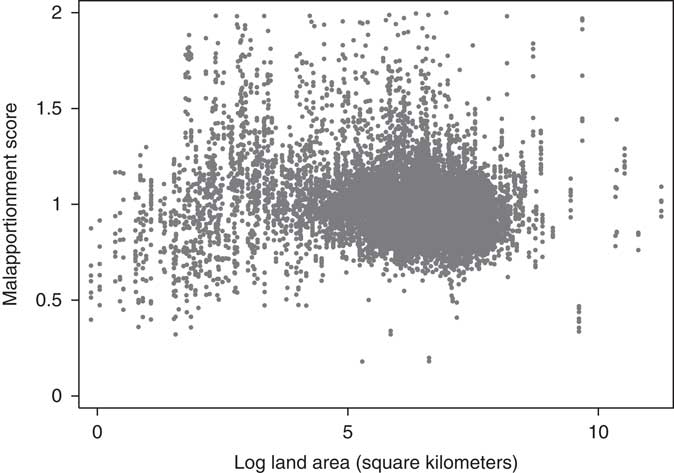
Secondly, the Congress Party could have instituted the freeze because it thought it would benefit from it in the future. Yet a close reading of the more than 1,600 pages of parliamentary debates that have occurred over the past thirty years with regard to reapportionment shows that there was not a single accusation of partisan bias leveled against the Congress Party. Accusations of partisan bias also seem unrealistic because the various non-Congress governments that have been in power over the past thirty years did not lift the freeze. Also, malapportionment could only have helped the Congress Party a decade or two along, and it is doubtful that in 1976 the Congress was looking to lock in an advantage that far ahead, particularly given the uncertainty at the time. Further, it is far from clear whether the Congress Party would have had the requisite ability or information to plan that far ahead. That there is no simple relationship between malapportionment and the land area of constituencies, which Figure 2 suggests, supports this argument: if there were such a relationship, legislators could have used land area to predict future malapportionment. Lastly, analysis of the partisan bias that was caused by malapportionment over the past thirty years does not reveal any systematic pro-Congress bias. Table 3 details the partisan bias due to malapportionment, calculated using the methodology proposed by Johnston, Rossiter and Pattie.Footnote 40 It shows, for example, that malapportionment secured for the Congress Party an extra 1.4 per cent of seats in Andhra Pradesh in 2004, while it deprived the Bharatiya Janata Party of 4.7 per cent of seats in Karnataka in 2004. This is the first analysis of the partisan effects of malapportionment in India. The table suggests that partisan bias in favor of winning parties, and particularly the Congress Party, was too small and variable for the parties to have wanted to tamper with the reapportionment process, even if they had perfect foresight.
Malapportionment and land area
Partisan Bias due to Malapportionment

Thirdly, it is possible that the freeze in malapportionment was simply instituted by legislators due to ‘a fear of change’.Footnote 41 While this may be a reasonable rationale for individual legislators to support the freeze in reapportionment once it was proposed, it is not a strong enough reason for Congress Party leaders to have introduced the freeze in the first place since it would, by strengthening individual incumbents, weaken party leaders vis-à-vis legislators. In fact, much of Mrs. Gandhi’s actions at the time were explicitly designed to undercut individual legislators.Footnote 42 This rules out a ‘fear of change’ as the reason why the freeze in reapportionment was proposed, although it might help explain why the freeze has been sustained all these years.
To summarize, I have argued that the freeze in reapportionment – which is the deep cause of malapportionment – was genuinely instituted to curb population growth. It was probably sustained thereafter to further this objective, and due to individual legislators’ fear of redrawing boundaries. Given this, the precise degree of malapportionment across state constituencies will depend on differences in birth and death rates, and rates of in- and out-migration between state-level constituencies. Of these two, the first is likely to be the major cause of malapportionment in India, since poverty levels and caste and linguistic fragmentation constrain the movement of people within the country.Footnote 43 Since constituency-level fertility and death rates are not directly manipulable by politicians, I argue that malapportionment is plausibly exogenous to the outcomes that we consider below. That said, and as mentioned, a number of the robustness tests I employ below directly address the possibility that politicians manipulate constituency populations at the margin.
Evidence
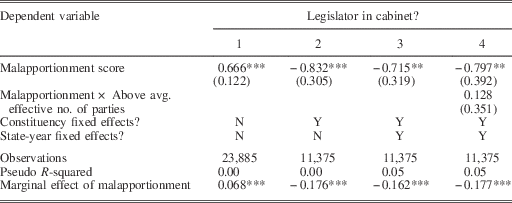
Table 4 presents the results of logistic regressions of the effects of malapportionment on cabinet inclusion. The first regression estimates the bivariate relation between the malapportionment score and a dummy for cabinet inclusion, and shows that the two are positively related to one another, which is the opposite of what we would expect. The next regression controls for over 3,500 constituency fixed effects, and thereby estimates the effects of changing malapportionment within constituencies. This regression controls for a variety of unobserved factors that are fixed or only vary slightly over time, including land area, the proportion of minorities, reservationsFootnote 44 and so forth. The estimated effect of malapportionment now takes on its expected negative sign. Being from a larger-than-average constituency, ceteris paribus, reduces the chances of a representative being in the cabinet. As the next regression shows, these results remain robust to the inclusion of 115 legislature (that is, state-year) fixed effects. These fixed effects control for cabinet-formation opportunities, and therefore for factors such as patterns of political competition, national and state electoral waves, and cabinet size. They also control for some time-varying factors: specifically, those that vary by state and over time, such as levels of economic development.Footnote 45 This is my preferred specification, since it controls for the greatest possible confounds. It indicates that an increase in malapportionment is, as predicted by Hypothesis 1, associated with a decrease in the chances of cabinet inclusion.
Logistic Regressions for the Effects of Malapportionment on Cabinet Inclusion
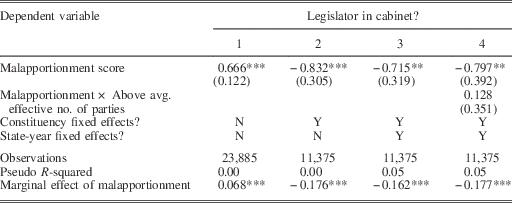
Note: the dependent variable is a dummy for whether legislators are in the cabinet. Standard errors in parentheses. Standard errors for regressions 2–4 are clustered by constituency. ***p < 0.01, **p < 0.05, *p < 0.1.
It is worth noting that these regressions deliberately do not control for whether legislators are members of the largest party or coalition, since doing so would lead to ‘post-treatment bias’.Footnote 46 Malapportionment could indirectly affect cabinet inclusion through its effect on the odds of relatively small constituencies being in the largest party. Indeed, this is what the first mechanism proposed in the theory section argues. This makes controlling for being in the largest party an appropriate way to test for the mechanism by which malapportionment affects cabinet inclusion. I conduct this exercise below, when I consider the mechanisms through which malapportionment has its effects.
The estimated impact of malapportionment on inclusion in the cabinet is large: a one-standard-deviation (0.16) increase in a constituency’s malapportionment score leads to a 2.6-percentage-point fall in the probability that the constituency’s representative is in the cabinet. Given that an average of 12 per cent of legislators are in the cabinet, malapportionment reduces the probability of a legislator being in the cabinet by 22 per cent. This effect is non-trivial, particularly given the considerable agenda-setting, supervisory and spending powers that cabinet members have.Footnote 47
The preceding analysis suggests that a citizen from a large constituency faces two distinct, empirically decomposable penalties to his or her representation in the executive due to malapportionment. The first of these is mechanical, and is simply caused by the fact that cabinet members are drawn from a malapportioned legislature. Recall that a citizen’s vote in a constituency with a malapportionment score of 1.16 (that is, in a constituency that is one standard deviation larger than the average constituency) is worth 1/1.16
 $\,\approx\,$
0.86 times the vote of a person in a correctly apportioned constituency. If cabinet members were drawn from the legislature without regard to constituency size, 0.86 would also be the value of this person’s vote in the executive. Secondly, per Hypothesis 1, we know that large-constituency representatives suffer the penalty of not being selected into the cabinet as often as representatives of smaller constituencies. This devalues the vote of a person from a large constituency by a further 22 per cent (this is, per the discussion above, the fall in the probability of a legislator whose constituency has a malapportionment score of 1.16 being selected into the cabinet) to 0.67. In other words, while malapportionment mechanically leads to a person’s vote being worth 0.86 in the legislature, the drawing of cabinets from legislatures further devalues the vote of a citizen from a large constituency to 0.67 in the cabinet.
I conclude this section by considering an observable implication of the account described here. In the period under study, the party system across India’s states underwent a dramatic change, with the median number of parties increasing from 2.1 in 1977 to 3.5 in 2007. This increase in electoral competition was accompanied by a near doubling in median cabinet size from fifteen to twenty-seven ministers, as more parties were accommodated in state cabinets. The fragmentation of the party system should have blunted the effect of malapportionment, as cabinet positions became less scarce. To test this observable implication, I interact malapportionment with a dummy for observations with above-average effective number of parties. The result of this exercise, reported in regression 4 of Table 4, confirms that the effect of malapportionment on cabinet inclusion is indeed somewhat attenuated (although not to a statistically significant degree) as the number of parties increases. This suggests scope conditions for the account proposed in the article: the effects of malapportionment on cabinet inclusion should particularly hold when there are fewer legislative parties and smaller cabinets.
Robustness Tests
In this section, I check the robustness of the estimated negative effect of the malapportionment score on cabinet inclusion.
The first three robustness tests address the possibility that politicians influence constituency sizes at the margin. First, note that to the degree that politicians influence constituency growth rates, they are particularly likely to have done so in the years leading up to the reapportionment of their constituencies. Since plans for India’s new redistricting, which took effect in 2008, started being drawn up in 2001, I rerun the main specification on pre-2001 data. These observations should be even less affected by politician efforts to influence constituency size. The results are robust to this modification (regression 1 of Appendix Table 1). Secondly, I employ lagged malapportionment instead of malapportionment as the key independent variable (regression 2). Although lagged malapportionment is not exogenously determined, it is predetermined. The results remain robust to this change. Lastly, I include both malapportionment and lagged malapportionment concurrently (regression 3). Although I do not do this in the main specification due to Nickell bias,Footnote 48 the result remains robust to this modification.
To account for the long tails of the distribution of malapportionment, I also confirm that the results are robust to the use of the logarithm of the malapportionment score (regression 4), the reciprocal of the malapportionment score (the RRI; regression 5) and the logarithm of the RRI (regression 6).
The tests for the effects of malapportionment on cabinet inclusion presented previously used the logistic estimator since the dependent variable is binary. For transparency, I also employ the ordinary least square (OLS) estimator (regression 7). The main result is robust to this change.
Yet another robustness test that I conduct is to examine the effects of malapportionment across India’s national parliamentary seats on inclusion in the national cabinet. The results (presented in Appendix Table 2) hold up to the use of these data.Footnote 49
Lastly, I consider whether the results are robust to better controlling for possible omitted variables. To do so, I first confirm that the results are robust to controlling for electoral competition, as measured by the effective number of parties (regression 8 of Appendix Table 1).Footnote 50 Relatedly, it is worth reiterating that, and as reported in footnote 45, the fixed effects employed in the main specification effectively control for education and income. Secondly, I employ an alternative research design – comparing cabinet inclusion before and after the redistricting of 2008 – to examine whether an abrupt change in malapportionment affected cabinet inclusion. Due to the narrow time period considered, this strategy makes it far less likely that omitted variables are driving the results.
That said, this exercise has two drawbacks, which is why I simply use it as a check. First, constituency boundaries and malapportionment changed in 2008, which means that this analysis estimates the effect of both changes. Secondly, the reapportionment of 2008 was somewhat endogenous, in that it only occurred in select states.Footnote 51 In order to implement this research design, I aggregate the data from the constituency to the administrative district level, since while redistricting changed the former, the latter remained frozen. Having aggregated the data, I use OLS to estimate the effect of district-level malapportionment (the independent variable) on the proportion of district seats included in the cabinet (the dependent variable). The results are robust to this exercise (see Appendix Table 3).
Mechanisms
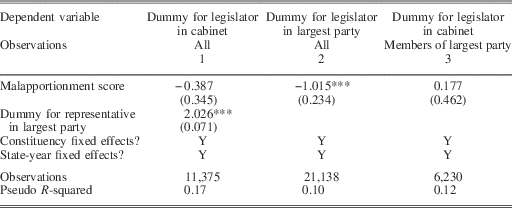
Recall that there are two mechanisms by which smaller-than-average constituencies could be advantaged in the cabinet-formation process. One of these is indirect, in that malapportionment alters the types of constituencies from which the largest parties tend to emerge and, therefore, the constituencies from which cabinets are drawn. If malapportionment affected cabinet inclusion by altering the membership of the largest party, including a dummy for being in the largest party in the main specification should attenuate the estimated effect of malapportionment on cabinet inclusion. If, however, malapportionment has a direct effect on cabinet inclusion, by altering the incentives of formateurs or legislators for cabinet inclusion, we should continue to expect a statistically significant association between malapportionment and the cabinet-inclusion dummy, even after controlling for being in the largest party. Regression 1 of Table 5 conducts this test, showing that controlling for the largest party severely attenuates the estimated effect of malapportionment such that it is not statistically significant. Malapportionment does not have a statistically significant direct effect on cabinet inclusion, after controlling for inclusion in the largest party. This suggests that malapportionment indirectly affects cabinet inclusion by altering the chances of a constituency being in the largest party.Footnote 52
Logistic Regressions to Test How Malapportionment Affects Cabinet Inclusion

Note: Standard errors, clustered by constituency, in parentheses. ***p < 0.01, **p < 0.05, *p < 0.1.
Two further tests corroborate our account of malapportionment affecting cabinet inclusion through its effect on being in the largest party. First, regression 2 estimates the effect of malapportionment on the proposed mediating variable, the dummy for being in the largest party. The coefficient on malapportionment suggests that relatively large constituencies are less likely to be in the largest party. This further corroborates the indirect mechanism, since we had argued that malapportionment causes parties – particularly successful parties – to focus on relatively small constituencies (and that this, in turn, affected the composition of the legislators from the largest party, and therefore cabinet inclusion).
The last regression allows us to test and reject the direct mechanism – that malapportionment affects cabinet formation due to the incentives of formateurs or individual legislators (regression 3). It does so by restricting the observations to constituencies represented by members of the largest party, and tests for the effect of malapportionment on cabinet inclusion within this subset of observations. If the direct mechanism is correct, relatively small constituencies within the largest party should be favored for cabinet inclusion due to the previously outlined cost-minimizing incentives of formateurs and the benefit-maximizing incentives of individual legislators. Malapportionment, however, is not statistically significantly correlated with cabinet inclusion in this subset of observations (in fact, the magnitude of the coefficient is positive, the opposite of what we would expect). This is evidence against the direct mechanism.
There are at least three alternative accounts of the findings above that do not rely on the effects of malapportionment on party strategies. First, small-constituency representatives could join winning coalitions more often than their counterparts from large constituencies because they are more moveable, perhaps because they are less ideological or more corrupt. Note, however, that we have no theoretical or empirical reason to suggest that the generalizations underlying this mechanism (‘relatively small constituencies elect politicians who are more corrupt and less ideological’) are true. In fact, a systematic study of the gains to office accrued by politicians in India suggests that these are not correlated with malapportionment.Footnote 53 Similarly, the probability that an independent candidate wins office – and being an independent candidate might be indicative of not having a strong ideology – is no greater in relatively small than in relatively large constituencies.
Secondly, it is possible that formateurs in India are simply ideologically committed to ‘taking care of’ relatively small constituencies, and that they do so by including small constituencies in their coalitions. This alternative mechanism is hard to disprove, since any behavior consistent with a rule could be caused by that rule, or by an underlying willingness to follow that rule. It seems unlikely, however, that politicians, who we often assume to be rational beings in every other regard, would consistently include small-constituency representatives in important coalitions out of kindness. Including legislators in a winning coalition is, after all, a particularly expensive way for formateurs to manifest their commitment to small constituencies. Further, if this mechanism is true, it should arguably hold even after controlling for whether a representative is in the largest party (or when the sample is restricted to members of largest parties). It does not.
A third possibility is that the formateur, in her bid to form a cabinet of highly skilled technocrats, gives them tickets in smaller constituencies because they are easier to win. This explanation does not make sense, however, since legislators typically have pre-existing ties with their constituencies, and cannot be assigned to new constituencies at will. Also, this account assumes that there is a trade-off between someone who is politically competent and a technocrat, which does not have an empirical basis.
Conclusions
I have argued and empirically demonstrated – using data from 116 government formation episodes across India’s states from 1977–2007 – that malapportionment in India doubly penalizes people from larger-than-average electoral districts or constituencies by descriptively under-representing them in the legislature and in the executive. The latter newly uncovered effect is normatively problematic, insofar as malapportionment – which is morally irrelevant to whether a person should have equal representation – affects the degree to which a person is represented in the cabinet. The effect of malapportionment on cabinet inclusion could have substantive costs for the under-represented as well, since ministers are typically much more powerful than the average legislator in these and other parliamentary systems.Footnote 54
The article shows that the advantages shown to be enjoyed by small constituencies in contexts such as the US Senate carry over to winning coalitions in India, albeit through a very different, indirect mechanism. By creating more smaller-than-average constituencies than larger-than-average constituencies, malapportionment incentivizes political parties – particularly large ones that form governments – to focus on relatively small constituencies. Since formateurs’ parties tend to be composed of these constituencies, their cabinets are also disproportionately drawn from relatively small constituencies.
The scope of the findings of this article is broad. I expect the effects uncovered here to hold in systems where the composition of the legislature affects cabinet formation. This is most obviously the case in parliamentary systems, since cabinets are drawn from the legislature in these systems. However, it also applies in some presidential and semi-presidential systems, where the partisan composition of legislatures is thought to influence the composition of the cabinet.Footnote 55 Lastly, since the effect of any factor – including malapportionment – is likely to be attenuated when cabinets are larger, malapportionment will likely particularly affect cabinet inclusion in contexts with fewer legislative parties and smaller cabinets.
The findings of this article suggest a number of avenues for future research. Most obviously, research should focus on examining whether the effects of malapportionment uncovered here hold in other contexts, particularly those suggested in the previous paragraph. Secondly, scholarship should examine the downstream effects – via cabinet inclusion – of malapportionment. Although the fact that cabinets dominate parliaments in many parliamentary systems,Footnote 56 including in India,Footnote 57 suggests that these effects could be large, this is an empirical question that warrants future work. Does malapportionment – in addition to formally over- and under-representing peoples in legislatures and cabinets – also affect spending patterns and socio-economic outcomes?
Investigating the socio-economic impacts of malapportionment is particularly important in the context of India, where the literature on malapportionment has been mainly descriptive. I dwell on some of these possible effects. Recall that while I have shown that malapportionment has not consistently benefited any one party across India’s states, I have documented that rural areas, and some slow-growing urban ones, have been over-represented due to malapportionment. Interestingly, the over-representation of rural areas is consistent with India’s ‘rural bias’Footnote 58 – the existence of which is puzzling from a cross-national perspective, since most developing countries favor urban areas due to the security threat that they pose.Footnote 59 The over-representation of slow-growing urban areas due to malapportionment is consistent with another aspect of India’s political economy: the favoring of these areas – often dominated by parastatals and old industries such as Mumbai’s mills – by the Indian state.Footnote 60 Of course, research would need to show that malapportionment has a causal impact on these aspects of India’s political economy, but the broad patterns are suggestive.
Lastly, this article draws our attention to an unfortunate and ironic turn in India’s politics. The country’s founders recognized ‘the principle of one man one vote and one vote one value’, in the constitution, and hoped that an equal politics would be a base from which Indians could challenge the country’s crushing socio-economic inequities.Footnote 61 However, successive governments have sacrificed the principal of political equality in the symbolic pursuit of a specific (population control) policy. That this has affected cabinet inclusion means that the political system has not remedied or merely reflected India’s inequities, but that it has exacerbated them.
Supplementary Material
To view supplementary material for this article, please visit http://dx.doi.org/10.1017/S0007123415000587