Introduction
Magnesium (Mg) alloys are attractive as lightweight materials due to their low density, high specific strength, good castability, and so on [Reference Pan, Yang and Chen1]. However, flammability of Mg alloys causes safety concerns [Reference Czerwinski2]. For expanding the use of Mg alloys, development of flame-retardant Mg alloys with superior mechanical properties is required. Ignition temperature can be significantly increased by adding Ca (>1 wt%) into Mg alloys [Reference Czerwinski2, Reference Sakamoto, Akiyama and Ogi3, Reference Han, Chen, Chen and Huang4]. For example, adding 2 wt% Ca into AZ91 (Mg–9Al–1Zn in wt%) alloy (i.e., becomes AZX912 alloy) may remarkably increase ignition temperature from 427–527 to 667–977 °C [Reference Akiyama, Ueno, Sakamoto, Hirai and Kitahara5], which is higher than the liquidus temperature (598 °C) of AZ91 alloy. This means that burning can be restricted even after melting into a liquid state. Consequently, it is possible to safely cast those flame-retardant alloys avoiding the use of protective gases such as SF6, which has a quite high global warming potential. On the other hand, flame-retardant AZX912 alloy contains a large amount of second-phase particles, which are mostly in the form of Mg17Al12 and Al2Ca compounds [Reference Huang, Chino, Yuasa, Ueda, Inoue, Kido and Matsumoto6, Reference Zhang, Wu, Liu, Zhang, Pang, Wang and Ding7, Reference Zhang, Wu, Liu, Zhang, Pang and Ding8]. The existence of second-phase particles induces damage initiation, and thus, remarkably affects the failure of metals. Particle cracking or void formation due to particle–matrix decohesion may occur during deformation depending on the hardnesses of second-phase particle and matrix [Reference Babout, Maire and Fougeres9, Reference Pineau, Benzerga and Pardoen10]. For AZX (Mg–Al–Zn–Ca) and AMX (Mg–Al–Ca) series Mg alloys, brittle Al2Ca particles tend to crack and act as crack initiation sites, which deteriorate both ductility and fatigue properties [Reference Saito, Suzuki, Fukuda, Ito, Noda, Gonda and Chino11, Reference Saito, Suzuki, Noguchi, Ito, Noda, Gonda and Chino12]. It is generally accepted that there is a trade-off relationship between material strength and ductility for metals, i.e., increasing ductility results in strength loss [Reference Ma and Zhu13, Reference Wang, He and Huang14]. The achievement of high-strength Mg alloys with the improved strength and meanwhile the maintained ductility is still a challenging task [Reference Wang, Xu, Wu, Chen, Peng, Jin, Xin, Zhang, Liu, Chen, Chen, Deng and Wang15]. On the other hand, it is possible to improve ductility without the sacrifice of mechanical strength if the cracking of brittle second-phase particles can be suppressed during deformation.
Solution heat treatment (ST) is possibly effective for dissolving second-phase particles into matrix. For example, ST at 450 °C may reduce intercrystalline cracking and, thus, improve hot workability due to the dissolution of Al2Mg3Zn3 intermetallic particles at grain boundaries for cast AZ31 (Mg–3Al–1Zn in wt%) alloy [Reference Prasad and Rao16]. For Mg alloys with Al contents higher than 6 wt%, ST is generally conducted at temperatures lower than 450 °C, aiming at the solid solution of Mg17Al12 phase with a low melting point of ∼460 °C [Reference Huang, Chino, Yuasa, Ueda, Inoue, Kido and Matsumoto6, Reference Xie, Jia, Zhang, Wang and Lü17, Reference Ragani, Donnadieu, Tassin and Blandin18, Reference Mathur, Maier-Kiener and Korte-Kerzel19]. For cast AZ91 alloy, ST at 410 °C can improve mechanical properties due to the significantly decreased amount of net-like Mg17Al12 phase at dendrite boundaries and, thus, the absence of a continuous easy crack path [Reference Zhao, Liu, Song and Atrens20]. In contrast, Al2Ca compound is much more stable during heat treatment due to its high melting point of 1079 °C [Reference Huang, Chino, Yuasa, Ueda, Inoue, Kido and Matsumoto6, Reference Koltygin, Bazhenov, Belova and Nikitina21, Reference Hort, Huang and Kainer22]. Consequently, ST at 420 °C for 48 h has almost no effect on changing the morphology of Al2Ca particles [Reference Huang, Chino, Yuasa, Ueda, Inoue, Kido and Matsumoto6]. It has been reported that the mechanical properties of cast AMX1001 (Mg–10Al–1Ca–0.2Mn in wt%) alloy were improved by ST at 490 °C [Reference Ito, Yanagihara, Noda and Mori23], which may be mainly attributed to the dissolution of Mg17Al12 phase into Mg matrix and, thus, the decreased fraction of intermetallic compounds. However, research on the effect of high-temperature ST at ∼500 °C is still lacking for Mg alloys, and little effort has been made to improve mechanical properties by tailoring the morphology and properties of Al2Ca compound.
In this study, AZX912 alloy ingots were STed at different temperatures in the range of 420–525 °C prior to extrusion at 280 °C. The influences of high-temperature ST on microstructure and mechanical properties of subsequently extruded alloys were investigated, aiming at the achievement of superior mechanical properties with high mechanical strength and high ductility.
Results and discussion
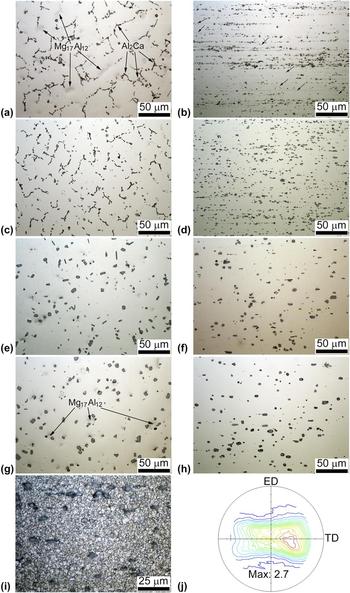
Optical micrographs of AZX912 as-cast alloy and the ingots STed at 420, 510, and 525 °C are shown in Figs. 1(a), 1(c), 1(e), and 1(g). The as-cast ingot contained coarse Mg17Al12 phase particles and Al2Ca compound with a large network morphology. After ST at 420 °C, Mg17Al12 phase disappeared due to dissolution into α-Mg matrix, whereas no apparent change was detected for Al2Ca compound. However, with increasing ST temperature, Al2Ca compound changed from a network-like morphology to a spheroidized shape. In addition, for the ingot STed at the highest temperature of 525 °C, some Mg17Al12 phase particles appeared again around Al2Ca particles. For AZX912 alloy, the solidus temperature and the liquidus temperature are 522 °C and 595 °C, respectively [Reference Suzuki, Saito, Huang, Nakatsugawa and Chino24]. In the present work, the highest ST temperature (525 °C) is slightly higher than the solidus temperature (522 °C), and thus, it is possible to induce partial melting. Therefore, the appearance of Mg17Al12 phase particles might be the result from the partial melting during ST for the ingot STed at 525 °C.
Optical micrographs of AZX912 (a, c, e, g) cast and (b, d, f, h) extruded (ED: horizontal direction) alloys (a, b) without ST and with ST at (c, d) 420 °C, (e, f) 510 °C, and (g, h) 525 °C. (i) Optical micrograph of etched surface and (j) (0002) pole figure of AZX912 extruded alloy with ST at 480 °C.
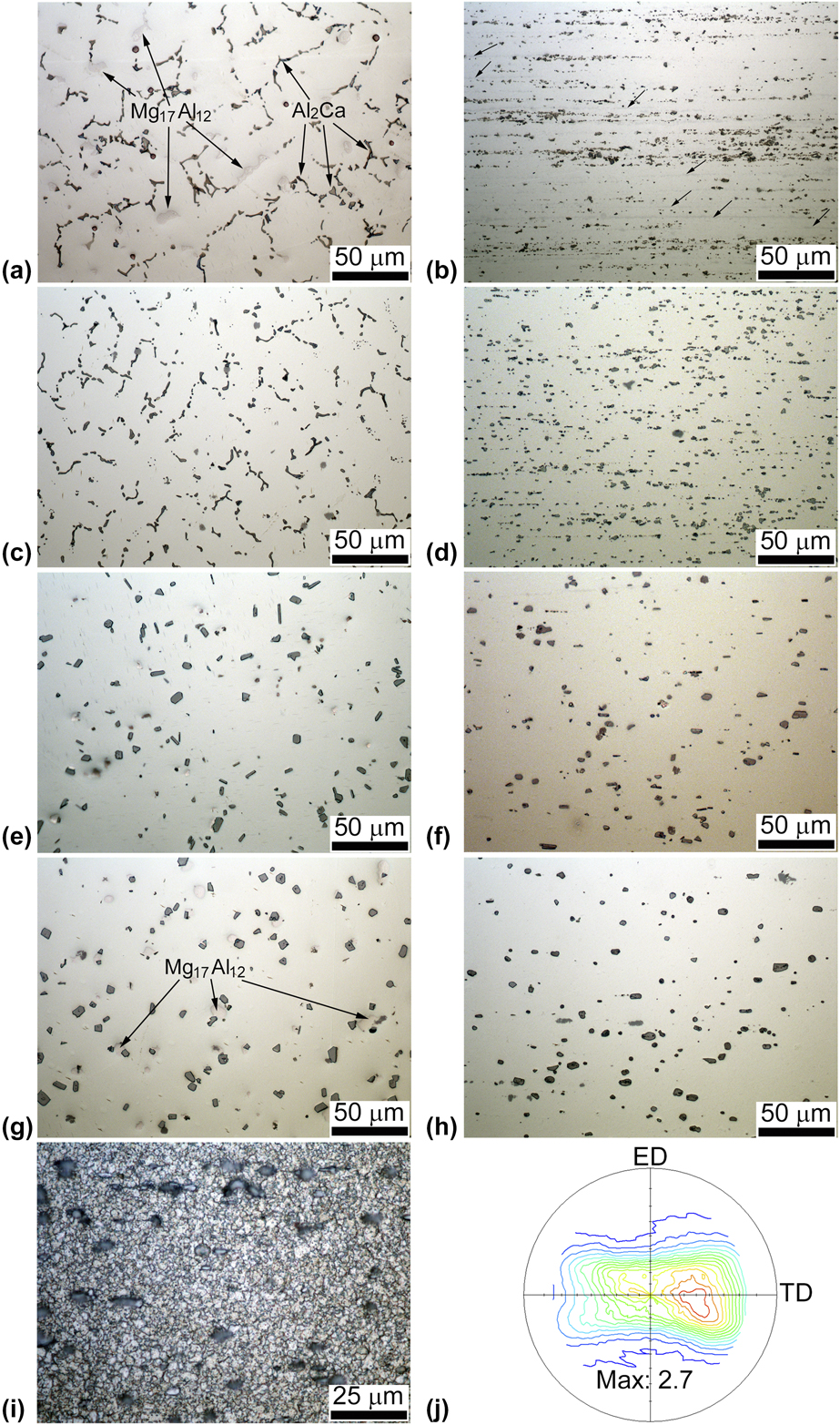
The optical micrographs of the corresponding extruded alloys are shown in Figs. 1(b), 1(d), 1(f), and 1(h). For the extruded alloys without ST and with ST at 420 °C, coarse Al2Ca particles were broken during extrusion. In contrast, Al2Ca particles became unbroken with increasing ST temperature. In addition, Mg17Al12 phase particles were significantly elongated along the extrusion direction (ED) as indicated by the arrows for the extruded alloy without ST [see Fig. 1(b)]. The elongated Mg17Al12 phase was also observed in AZ91 Mg alloy extruded at 270 °C [Reference Li, Dong, Zeng, Lu and Ding25]. Even though Mg17Al12 phase is extremely brittle at room temperature, a high deformability accompanied by a significant softening can be obtained at elevated temperatures (∼2/3 melting point), originating from the onset of dislocation climb [Reference Ragani, Donnadieu, Tassin and Blandin18, Reference Mathur, Maier-Kiener and Korte-Kerzel19]. It is suggested that this transition of deformation mechanism is responsible for the formation of significantly elongated Mg17Al12 phase particles without fracture during extrusion at 280 °C (0.75 melting point) in the present work.
The influences of the ST temperature on grain size and texture after extrusion appear to be weak. The grain structure and (0002) pole figure of the extruded alloy with ST at 480 °C are shown as the examples in Figs. 1(i) and 1(j). All extruded alloys exhibited approximately the same grain sizes of 2–3 μm. The refined microstructure can be attributed to dynamic recrystallization during extrusion. In addition, all extruded alloys exhibited a typical extrusion texture of round bar. For all extruded alloys, basal planes are roughly parallel to the ED, and there is a large spread of (0002) orientation along the transverse direction (i.e., the radial direction of the extruded bar). The extruded alloys exhibited the similar weak textures with the low basal texture intensities of 2.6–3.6.
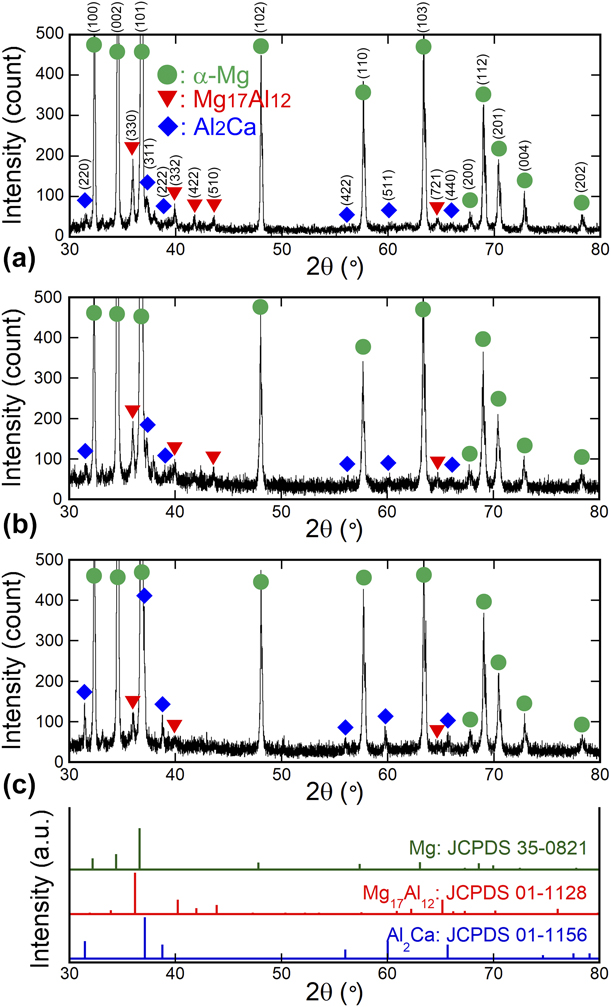
Figure 2 shows the X-ray diffraction (XRD) patterns of the extruded alloys without ST and with ST at the lowest and highest temperatures of 420 °C and 525 °C, respectively. For all extruded alloys, the XRD patterns exactly show the existence of the α-Mg, Mg17Al12, and Al2Ca (C15 Laves crystal structure) phases. Existence of the C15 Al2Ca Laves phase is consistent with the result that this stable phase forms in the case of Ca/Al ratio smaller than 0.4 for Mg–Al–Ca alloy system [Reference Zhang, Deng, Nie, Xu, Su and Lian26, Reference Zubair, Sandlöbes, Wollenweber, Kusche, Hildebrandt, Broeckmann and Korte-Kerzel27]. The extruded alloy with ST at 420 °C exhibited the pronounced peaks of the Mg17Al12 phase, even though this alloy before extrusion did not contain the Mg17Al12 phase due to dissolution into the α-Mg matrix [see Fig. 1(c)]. This indicates the dynamic precipitation of the Mg17Al12 phase during extrusion. Even after ST at a high temperature of 525 °C, the Al2Ca compound with the C15 Laves crystal structure is still stable, which can be attributed to its high melting point of 1079 °C [Reference Huang, Chino, Yuasa, Ueda, Inoue, Kido and Matsumoto6, Reference Koltygin, Bazhenov, Belova and Nikitina21, Reference Hort, Huang and Kainer22]. In addition, it is interesting to note that the peaks of the Al2Ca compound tend to slightly shift to the left (i.e., decreased diffraction angle) for the extruded alloy with the ST at 525 °C. For example, regarding the diffraction peak (511), 2θ deceased from 60.2° to 59.8° for the extruded alloy with ST at 525 °C compared with that with ST at 420 °C. This implies the expansion of lattice of the Al2Ca compound for the alloy subjected to high-temperature ST.
XRD patterns of AZX912 extruded alloys (a) without ST, with ST at (b) 420 °C and (c) 525 °C.
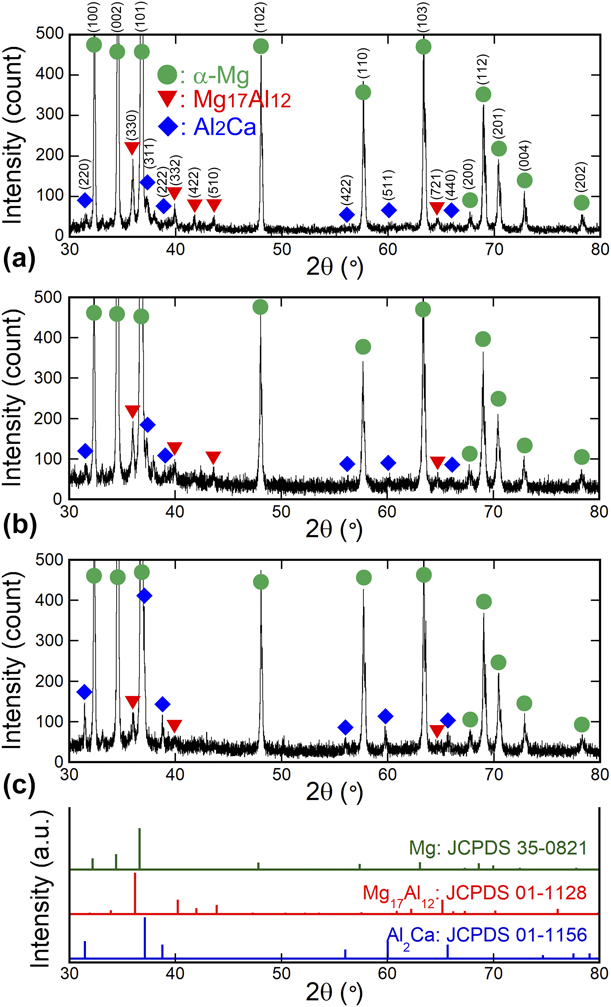
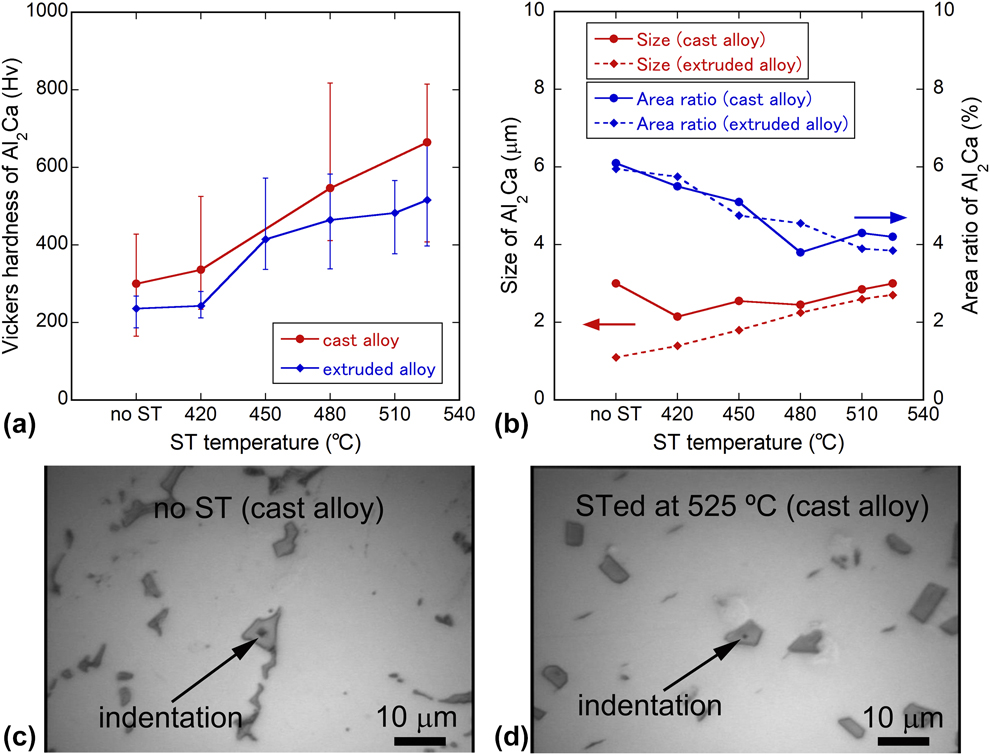
Figure 3 shows the changes in Vickers hardness, size, and area ratio of Al2Ca particles in cast and extruded alloys as a function of the ST temperature. As shown in Fig. 3(a), with increasing ST temperature, the measured Vickers harness increased about twice for both cast and extruded alloys. The average Vickers harnesses remarkably increased from 300 to 665 and from 236 to 516 for cast and extruded alloys, respectively. As shown in Figs. 3(c) and 3(d), the pictures after hardness measurements for the cast alloys without ST and with ST at 525 °C display a much smaller indentation size for the latter.
Changes in (a) Vickers hardness (The error bars indicate the minimum and maximum values) and (b) size and area ratio of Al2Ca particles in cast and extruded alloys as a function of the ST temperature. The pictures after hardness measurements for AZX912 cast alloy (c) without ST and (d) with ST at 525 °C.
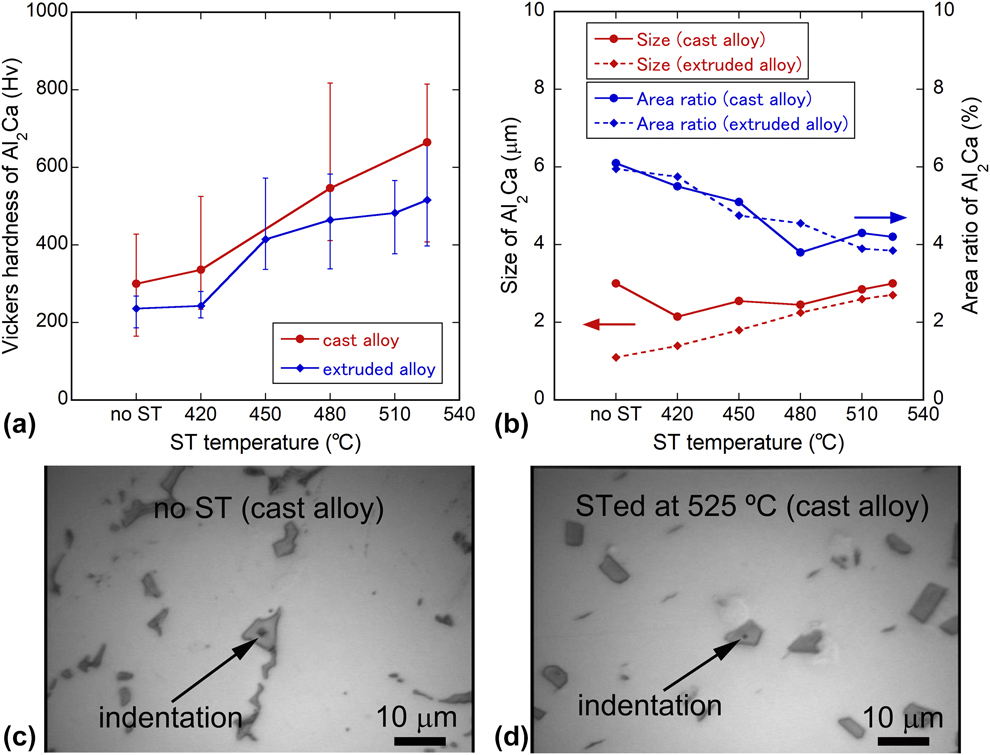
As shown in Fig. 3(b), the cast alloys exhibited approximately the same size (∼3 μm) of Al2Ca particles. However, for the alloy without ST, the size of Al2Ca particles considerably decreased from 3.0 to 1.1 μm after extrusion, resulting from fracture during extrusion. The difference in the size of Al2Ca particles between the cast alloys and the extruded alloys gradually reduced and became almost the same when increasing the ST temperature up to ∼500 °C, indicating the restricted fracture of Al2Ca particles. This can be attributed to the hardening of Al2Ca particles induced by high-temperature ST. Furthermore, it can be expected that stress concentration on Al2Ca particles caused by plastic flow during extrusion reduces due to the change from network morphology to spheroidized shape. The reduction of stress concentration would be beneficial in preventing Al2Ca particles from fracture. In addition, the area ratio of Al2Ca particles concurrently decreased from ∼6 to ∼4% with increasing ST temperature.
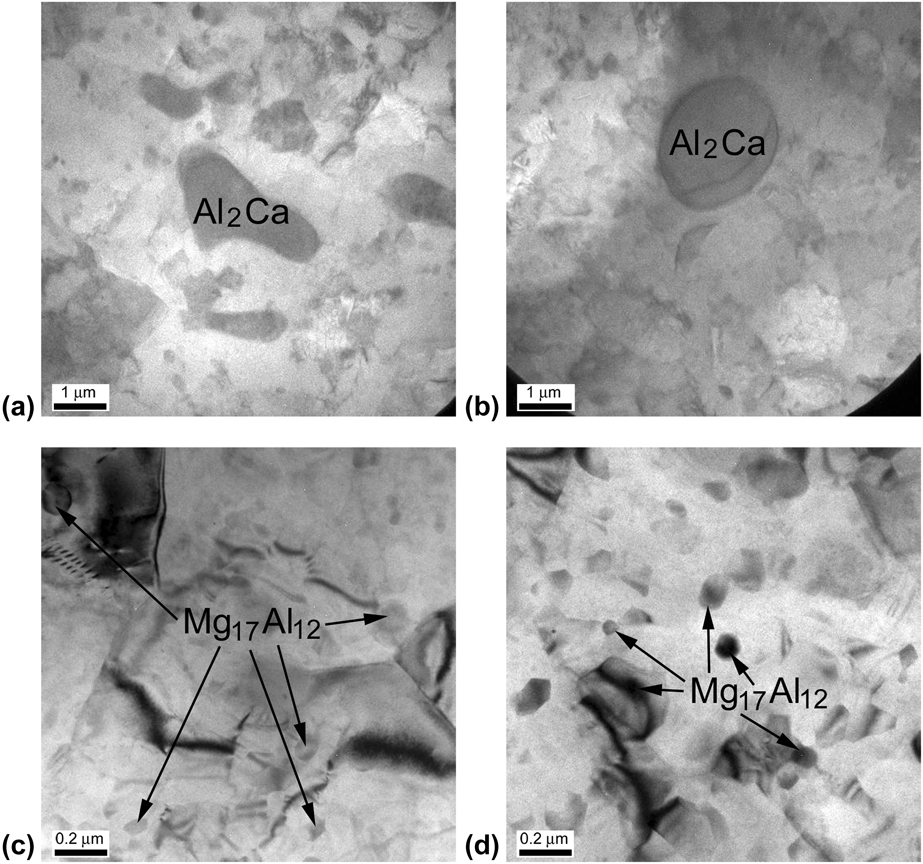
Figure 4 shows the transmission electron microscope (TEM) images of coarse Al2Ca particles and nanoscale Mg17Al12 particles in the extruded alloys with ST at 420 °C and 510 °C. Because Mg17Al12 phase was dissolved into the matrix during ST [see Figs. 1(c) and 1(e)], the presence of nanoscale Mg17Al12 phase particles with the sizes of 50–300 nm can be attributed to dynamic precipitation during extrusion.
TEM images showing (a, b) coarse Al2Ca particles and (c, d) nanoscale Mg17Al12 precipitates in AZX912 extruded alloys with ST at (a, c) 420 °C and (b, d) 510 °C.

Results of the compositions of matrix and secondary-phase particles in the extruded alloys with ST at 420 and 510 °C, investigated by TEM-EDS analyses, are given in Table I. Regarding Al2Ca particles, the alloy with ST at 510 °C exhibited a great decrease from 21.7 ± 1.8 to 5.3 ± 0.2 at.% in the concentration of Mg atoms dissolving into Al2Ca compound compared with the alloy with ST at 420 °C. The concentrations of Al and Ca correspondingly increased. The Al concentration slightly increased from 58.5 ± 1.3 to 65.2 ± 0.7 at.%, whereas the Ca concentration largely increased from 19.4 ± 0.6 to 29.4 ± 0.5 at.%. This resulted in a decrease in the ratio of Al/Ca from 3.0 to 2.2, which is close to the stoichiometric proportion of 2:1. As abovementioned, the XRD results indicate the expansion of lattice of Al2Ca compound for the alloy subjected to high-temperature ST (see Fig. 2). The atomic radius is 0.160 nm for Mg, 0.143 nm for Al, and 0.197 nm for Ca. The expansion of lattice may be attributed to large increase in the concentration of Ca, which has the largest atomic radius.
Results of average compositions of α-Mg matrix, Al2Ca, and Mg17Al12 particles in AZX912 extruded alloys with ST at 420 and 510 °C and investigated by TEM-EDS analyses (in at.%).

The reason for hardening of Al2Ca particles during high-temperature ST is still unclear. It is known that the hardness of intermetallic compound is sensitive to composition change and vacancy concentration [Reference Fukuchi and Watanabe28, Reference Chang, Pike, Liu, Bilbrey and Stone29, Reference Chen, Allen and Livingston30, Reference Chen, Chu, Kotula and Thoma31]. For example, it has been observed that the hardness of Co2Hf C15 Laves single phase, which has the same type of crystal structure as that of Al2Ca [Reference Liu, Wang, Wang, Ma and Zhao32], increased with decreasing the Co concentration and reached the maximum value around the stoichiometric Co2Hf composition [Reference Chen, Chu, Kotula and Thoma31]. In addition, it has been reported that the hardness of FeAl intermetallic compound increased as a function of the square root of vacancy concentration [Reference Chang, Pike, Liu, Bilbrey and Stone29]. It is well known that a higher heating temperature may lead to a higher equilibrium vacancy concentration [Reference Fredriksson and Akerlind33]. It can be expected that more vacancies are frozen by water quenching after high-temperature ST. It is suggested that the hardening phenomenon may be related to the composition change and also the increased vacancy concentration. Further research will be necessary for elucidating the mechanism of the hardening of Al2Ca compound.
On the other hand, the content of Ca in matrix was very low (only 0.02 ± 0.01 at.%). This is related to its low solid solubility limit in Mg. The compositions of Mg17Al12 precipitates are almost the same between the alloys with ST at 420 and 510 °C. Hence, high-temperature ST does not result in the solid solution of Ca atoms into matrix and also has no influence on the composition of the precipitated Mg17Al12 phase. In addition, no fine Ca-containing precipitate was detected. Therefore, it can be considered that Ca atoms mostly exist in coarse Al2Ca particles forming during solidification. Considering the total amount of Ca atoms in Al2Ca particles does not change, the increase in the Ca concentration in Al2Ca compound from 19.4 ± 0.6 to 29.4 ± 0.5 at.% implies that the amount of Al2Ca particles should be decreased by the same ratio (i.e., ∼1/3) for the extruded alloy with ST at 510 °C. This is roughly consistent with the reduction ratio (∼1/3) with a decrease from ∼6 to ∼4% in the area ratio of Al2Ca particles induced by high-temperature ST [see Fig. 3(b)]. According to the large decreases in the Mg concentration and also the ratio of Al/Ca, it is suggested that the abovementioned decrease in the area ratio of Al2Ca particles caused by high-temperature ST may be mainly due to the solid solution of excess Mg and Al atoms from Al2Ca compound into matrix.
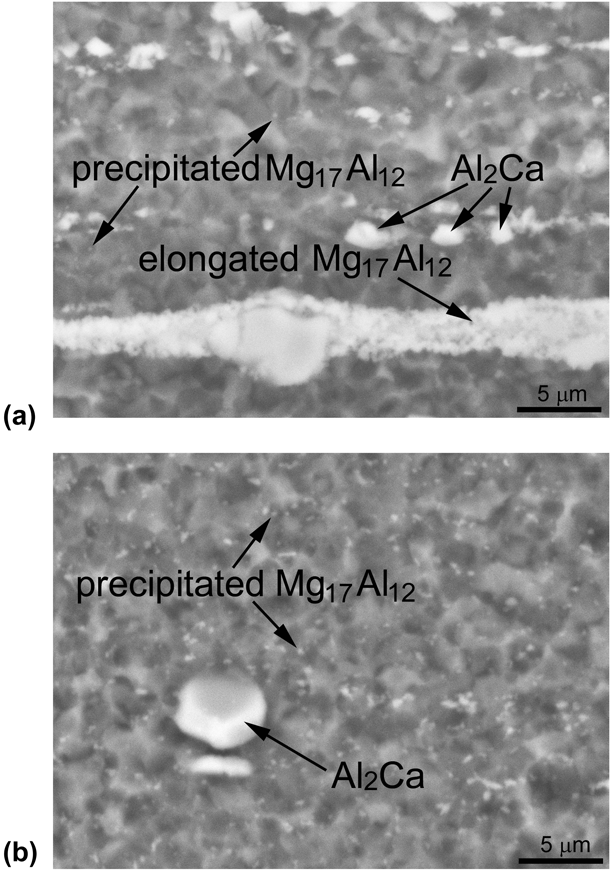
The scanning electron microscope (SEM) images of AZX912 extruded alloys without ST and with ST at 510 °C are shown in Fig. 5. For the extruded alloy without ST [Fig. 5(a)], some nanoscale Mg17Al12 precipitates with a spherical shape exist besides the significantly elongated Mg17Al12 phase particles. It is obvious that nanoscale Mg17Al12 precipitates in the extruded alloy with ST at 510 °C [Fig. 5(b)] are much more than those in the extruded alloy without ST. For the extruded alloy without ST, the reduced amount of nanoscale Mg17Al12 precipitates can be attributed to the existence of coarse Mg17Al12 phase particles in the as-cast alloy. This reduces the content of Al atoms dissolving into matrix and, thus, decreases the amount of nanoscale Mg17Al12 precipitates induced by dynamic precipitation during subsequent extrusion.
SEM images of AZX912 extruded alloys (a) without ST and (b) with ST at 510 °C.

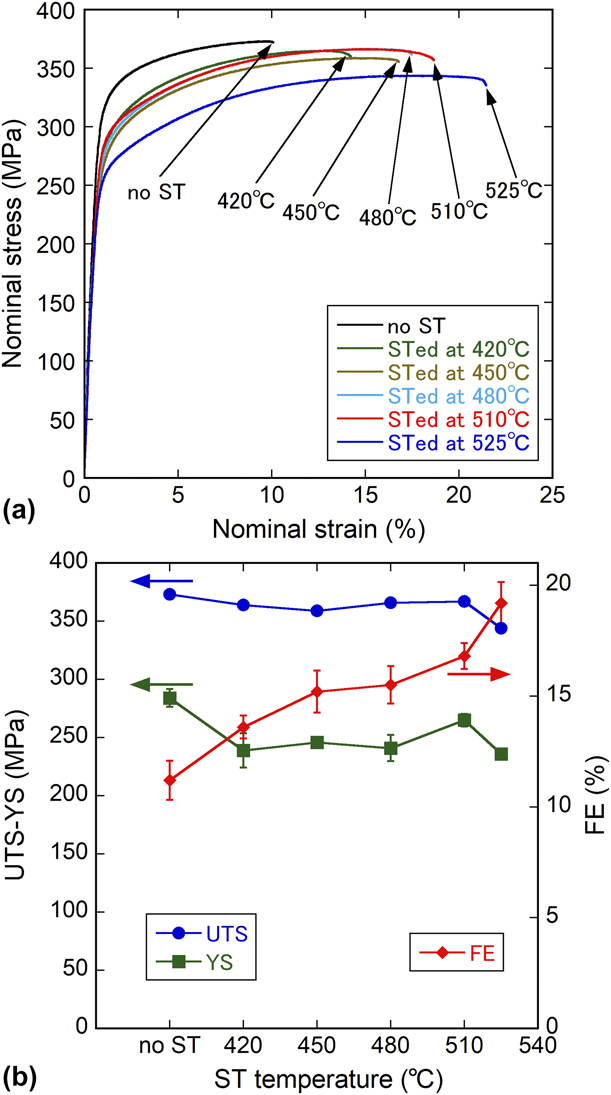
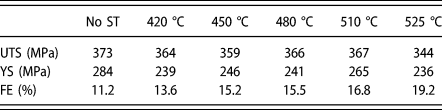
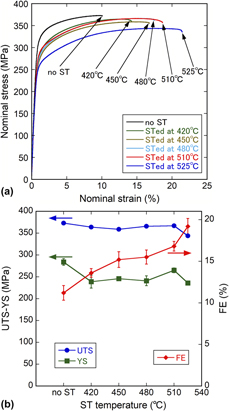
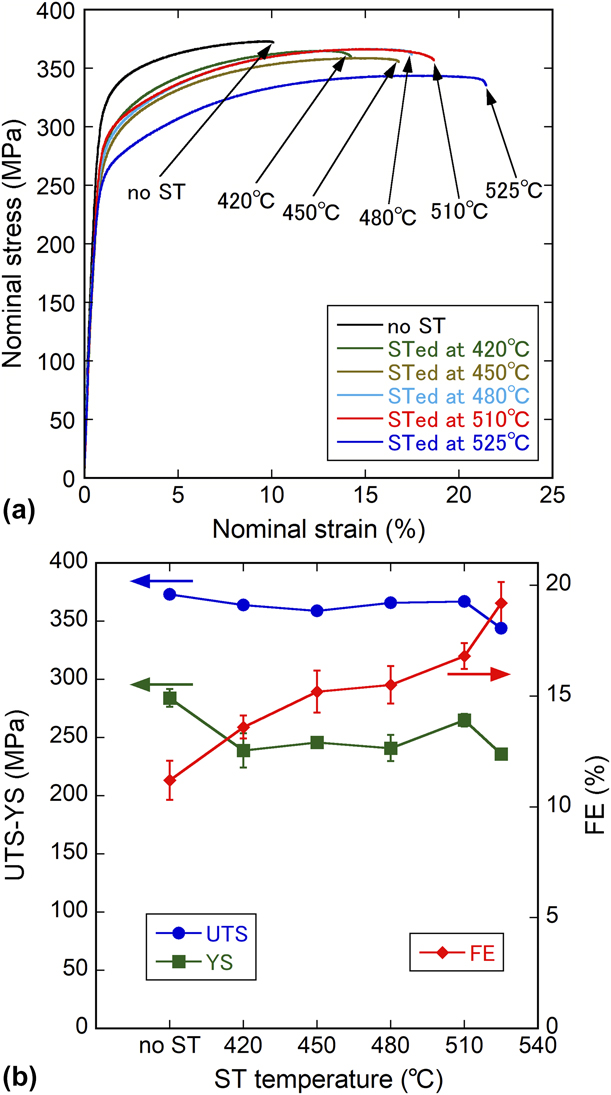
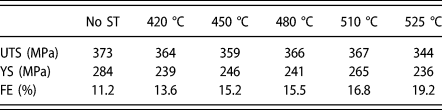
The nominal stress–strain curves of the extruded alloys with different ST temperatures are shown in Fig. 6(a). It is obvious that tensile ductility remarkably improves with increasing ST temperature. The changes in ultimate tensile strength (UTS), 0.2% offset yield strength (YS), and fracture elongation (FE), as a function of the ST temperature, are shown in Fig. 6(b). As also summarized in Table II, the FE significantly enhanced from 11.2 to 19.2% with increasing the ST temperature. High mechanical strength (∼360 MPa for UTS) was maintained with an improvement in ductility when increasing the ST temperature up to 510 °C. The high mechanical strength can be mainly attributed to the refined grain structure and the large amount of nanoscale Mg17Al12 precipitates (see Figs. 1(i), 4, and 5). However, the UTS slightly decreased to 344 MPa for the alloy with ST at 525 °C, even though it exhibited the highest FE of 19.2%. The decrease in mechanical strength may be related to the formation of Mg17Al12 phase particles in the STed ingot [see Fig. 1(g)], which may reduce the content of Al atoms dissolving into the matrix and, thus, decrease the amount of dynamically precipitated nanoscale Mg17Al12 particles during extrusion. Regardless of relatively low amount of dynamically precipitated nanoscale Mg17Al12 particles as shown in Fig. 5(a), the alloy without ST exhibited a high UTS of 373 MPa. The high mechanical strength may be related to the unbroken Mg17Al12 phase particles with the significantly elongated shape deformed by extrusion [see Figs. 1(b) and 5(a)], which are likely to act as sources for inducing fiber strengthening effect, as has been observed in carbon nanotube–reinforced Mg matrix composites [Reference Li, Wang, Liu, Wu, Shi, Ding, Hu and Zheng34]. In this case, the load can be transferred from matrix to fiber by a shear stress developing along the interface of matrix and fiber [Reference Li, Wang, Liu, Wu, Shi, Ding, Hu and Zheng34]. However, the FE was only 11.2% for the alloy without ST. It has been reported that stress concentration and subsequent fracture occurred in massive Mg17Al12 particles, and thus, resulted in early fracture during tensile deformation for AZ91 alloy hot compressed from an as-cast state [Reference Xu, Kamado and Honma35]. Therefore, the lowest FE (11.2%) of the alloy without ST in this work may be attributed to the fracture of brittle coarse elongated Mg17Al12 particles under high stress during tensile deformation. Consequently, the alloy with ST at 510 °C exhibited a superior balance between mechanical strength and tensile ductility with a high UTS of 367 MPa and a good FE of 16.8%.
(a) Nominal stress–strain curves of AZX912 extruded alloys with different ST temperatures. (b) Changes in UTS, YS, and FE as a function of the ST temperature.
Results of the tensile tests of AZX912 extruded alloys with different ST temperatures.
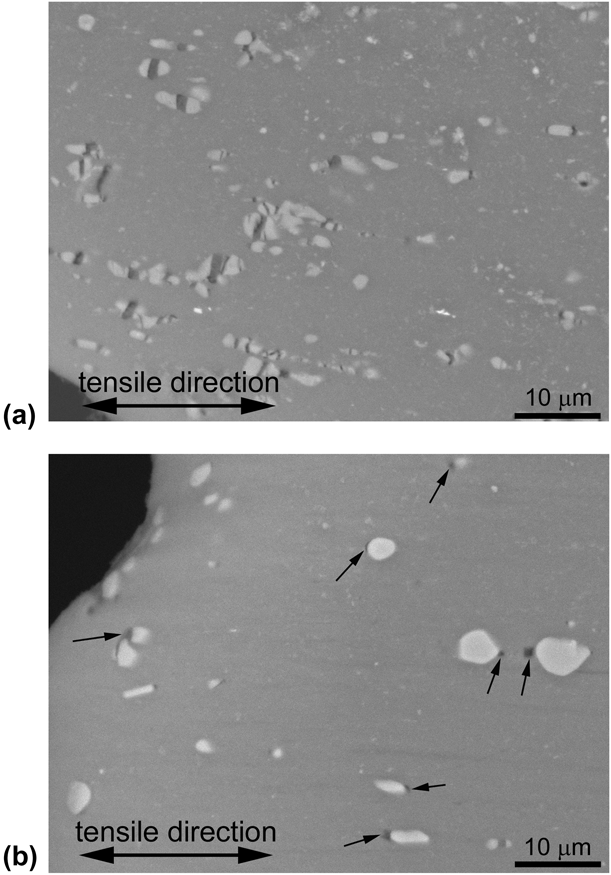
The SEM images of the polished surfaces of the fractured tensile specimens are shown in Fig. 7. In the SEM images, intermetallic compound particles exhibit a light gray white color, whereas cracks and voids exhibit a dark color. For the extruded alloy with ST at 420 °C shown in Fig. 7(a), the cracking of brittle Al2Ca particles occurred predominately perpendicular to the tensile direction, as frequently observed in Al2Ca-containing Mg alloys after tensile deformation [Reference Saito, Suzuki, Fukuda, Ito, Noda, Gonda and Chino11]. No distinct void formation originating from particle–matrix decohesion can be observed. This indicates that Al2Ca particles cannot provide sufficient strength for restricting cracking before the occurrence of particle–matrix decohesion. In the case of particle cracking, further deformation may result in the rapid widening of initial cracks and a junction between initial cracks in the second-phase particles [Reference Babout, Maire and Fougeres9, Reference Pineau, Benzerga and Pardoen10]. The coalescent cracks may act as fracture sites and cause a significant deterioration of ductility [Reference Babout, Maire and Fougeres9, Reference Pineau, Benzerga and Pardoen10, Reference Saito, Suzuki, Fukuda, Ito, Noda, Gonda and Chino11]. In contrast, particle cracking was remarkably restricted for the extruded alloy with ST at 510 °C [see Fig. 7(b)]. As indicated by the arrows in Fig. 7(b), with respect to the horizontal tensile direction, small voids tended to form at the left and/or right sides of Al2Ca particles, which may be attributed to particle–matrix decohesion. The change from particle cracking to particle–matrix decohesion may occur when the second-phase particles are much harder than matrix [Reference Babout, Maire and Fougeres9, Reference Pineau, Benzerga and Pardoen10]. The restriction of particle cracking may be attributed to the hardening of Al2Ca particles and the relaxation of stress concentration on Al2Ca particles due to the spheroidized shape. Compared with particle cracking, void formation due to particle–matrix decohesion may occur at a later stage of tensile deformation under a higher stress state. This should weaken the detrimental impact of brittle Al2Ca particles and in turn leads to an enhanced ductility. Furthermore, the decrease in the area ratio of Al2Ca particles as shown in Fig. 3(b), may also contribute to the improvement of ductility as a result of the reduction of possible fracture sites.
SEM images of the polished surfaces of the fractured tensile specimens for AZX912 extruded alloys with ST at (a) 420 °C and (b) 510 °C.

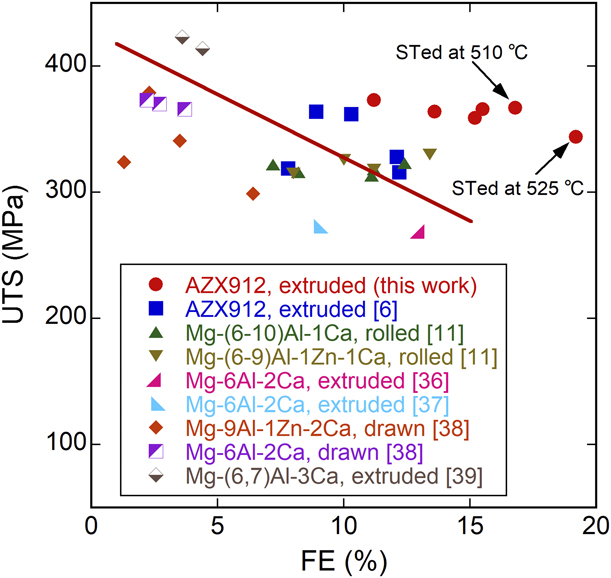
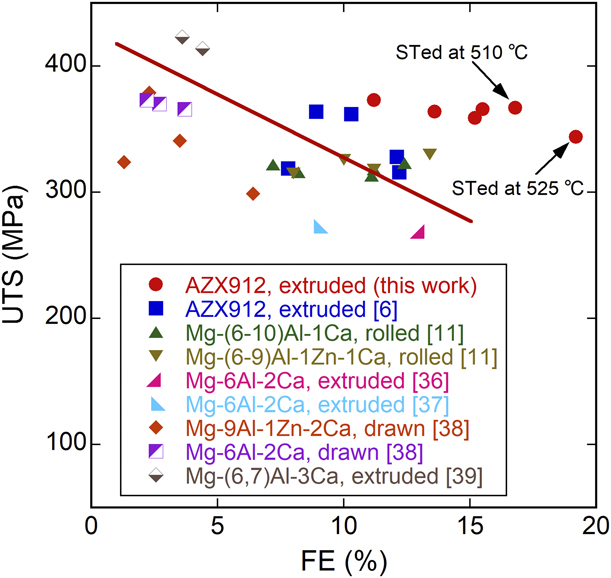
The comparison of mechanical properties between the extruded alloys STed at different temperatures in this work and the reported flame-retardant Mg alloys with high Al and Ca contents processed by extrusion, rolling, or drawing, is illustrated in Fig. 8. As guided by the red line, for the conventionally processed alloys in the literature [Reference Huang, Chino, Yuasa, Ueda, Inoue, Kido and Matsumoto6, Reference Saito, Suzuki, Fukuda, Ito, Noda, Gonda and Chino11, Reference Watanabe, Yamaguchi, Takigawa and Higashi36, Reference Masaki, Ochi, Kakiuchi, Kurata, Hirasawa, Matsumura, Takigawa and Higashi37, Reference Hristov and Yoshida38, Reference Li, Qiao, Xu, Kamado, Zheng and Luo39], the UTS and the FE roughly obey the trade-off strength–ductility relationship. In this case, a high UTS of ∼400 MPa results in a low FE of ∼3%, although a relatively good FE of ∼13% tends to be accompanied by a low UTS of ∼300 MPa. In contrast, the extruded alloys subjected to high-temperature ST in this work largely deviates from the red line and shifts to the high ductility region with almost no sacrifice of strength. The extruded alloys with ST at 510 °C exhibited a combination of a UTS of 367 MPa and a FE of 16.8%. In addition, the extruded alloy with ST at 525 °C exhibited a combination of a UTS of 344 MPa and a FE of 19.2%. These mechanical properties are superior to those conventionally processed flame-retardant Mg alloys in the literature. This work reveals that mechanical properties can be significantly improved by using high-temperature ST to tailor the morphology and properties of Al2Ca compound, which commonly exists in flame-retardant Ca-containing AZX and AMX series Mg alloys.
UTS and FE of AZX912 extruded alloys obtained in the present work and other conventionally processed flame-retardant Mg alloys with high Al and Ca contents.
Conclusions
The influences of high-temperature ST on microstructure and mechanical properties of subsequently extruded AZX912 alloys with flame-retardant property were investigated in the range of 420–525 °C. The main conclusions can be drawn as following:
(1) With increasing the solution treatment temperature, brittle Al2Ca intermetallic compound changed from a network-like morphology to a spheroidized shape with an increase in hardness. The Al2Ca particles became unbroken during extrusion. The high-temperature ST resulted in a composition change with a decreased ratio of Al/Ca for Al2Ca compound.
(2) The extruded alloys possessed high tensile strength due to fine-grained structure and dynamically precipitated nanoscale Mg17Al12 particles. The high mechanical strength (∼360 MPa for UTS) was maintained with an improvement in tensile ductility when increasing the ST temperature up to 510 °C.
(3) As the ST temperature increased, the FE of extruded alloys significantly enhanced from 11.2 to 19.2%. The restricted cracking of Al2Ca particles due to the hardening and spheroidizing behaviors contributed to the improvement of ductility.
(4) The extruded alloy STed at 510 °C exhibited a superior balance between mechanical strength and ductility with a high UTS of 367 MPa and a good FE of 16.8%. Further increasing the ST temperature to 525 °C resulted in an excellent FE of 19.2% but a slightly decreased UTS of 344 MPa.
Experimental procedure
Commercial AZX912 alloy with a composition of Mg–9Al–0.7Zn–2Ca–0.2Mn in wt% was molten at 820 °C and poured into a steel mold with an inner diameter of 40 mm in an argon atmosphere. AZX912 alloy ingots were STed at different temperatures of 420, 450, 480, 510, and 525 °C for 48 h and were followed by water quenching. The as-cast and STed ingots were set into a chamber with a diameter of 40 mm and extruded at 280 °C under the ram speed of 5 mm/min. The extrusion ratio was 44 and the diameter of the extruded bars was 6 mm. The microstructures and mechanical properties of the extruded bars were evaluated in the as-extruded condition.
The X-ray measurements were carried out to obtain (0002) pole figures and also to identify phases. The Vickers hardnesses of Al2Ca compound were measured at 20 points using the load of 1 g (holding time: 10 s) and 10 points using the load of 0.5 g (holding time: 10 s) for ingots and extruded bars, respectively. The size and area ratio of Al2Ca compound were measured by using the Image-Pro Analyzer software (Media Cybernetics, Silver spring/Maryland) to analyze optical micrographs, and the values were obtained by averaging the results from two optical micrographs for each specimen. The compositions of matrix and second-phase particles were analyzed using TEM equipped with energy-dispersive spectroscopy (EDS). The compositions were obtained by averaging ∼15, ∼30, and ∼18 measured points for matrix, Al2Ca, and Mg17Al12 compounds, respectively.
The tensile tests were performed at room temperature using an Instron 5565 (Instron, Norwood/Massachusetts) equipped with a noncontacting video extensometer under an initial strain rate of 2.4 × 10⁻³ s−1. The tensile specimens have a parallel length of 14 mm along the ED and a cross-sectional diameter of 2.5 mm. The mechanical properties were obtained by averaging the values of three repeat tests. Particle cracking or void formation associated with Al2Ca particles in some fractured specimens after the tensile tests were observed using SEM.
Acknowledgments
This paper is based on results obtained from a project commissioned by the New Energy and Industrial Technology Development Organization (NEDO).