One of the central paradoxes in bilingualism research is that this linguistic experience improves performance on nonverbal cognitive tasks but makes language processing more effortful (for review, Bialystok, Craik, Green & Gollan, Reference Bialystok, Craik, Green and Gollan2009). Bilinguals show poorer performance than monolinguals on picture naming (for adults: Gollan, Montoya, Fennema-Notestine & Morris, Reference Gollan, Montoya, Fennema-Notestine and Morris2005; Gollan, Montoya, Cera & Sandoval, Reference Gollan, Montoya, Cera and Sandoval2008; Gollan, Slattery, Goldenberg, van Assche, Duyck & Rayner, Reference Gollan, Slattery, Goldenberg, Van Assche, Duyck and Rayner2011; Ivanova & Costa, Reference Ivanova and Costa2008; for children: Poarch & Van Hell, Reference Poarch and Van Hell2012a) and verbal fluency tasks (for adults: Bialystok, Craik & Luk, Reference Bialystok, Craik and Luk2008a; Gollan, Montoya & Werner, Reference Gollan, Montoya and Werner2002; Pelham & Abrams, Reference Pelham and Abrams2014; Portocarrero, Burright & Donovick, Reference Portocarrero, Burright and Donovick2007; Rosselli et al., Reference Rosselli, Ardila, Araujo, Weekes, Caracciolo, Padilla and Ostrosky-Solis2000; Sandoval, Gollan, Ferreira & Salmon, Reference Sandoval, Gollan, Ferreira and Salmon2010; for children: Friesen, Luo, Luk & Bialystok, Reference Friesen, Luo, Luk and Bialystok2015) that require rapid lexical retrieval. Moreover, bilingual children (Bialystok, Luk, Peets & Yang, Reference Bialystok, Luk, Peets and Yang2010) and adults (Bialystok & Luk, Reference Bialystok and Luk2012) typically have smaller vocabularies than monolingual speakers of each language.
It is not clear how smaller vocabulary for bilinguals would lead to slower retrieval times. Verbal fluency studies that equate monolinguals and bilinguals for vocabulary level have found that both language groups perform equivalently on category fluency, supporting the role of vocabulary size in performance, but bilinguals outperform monolinguals on letter fluency (Bialystok, Craik & Luk, Reference Bialystok, Craik and Luk2008b; Luo, Luk & Bialystok, Reference Luo, Luk and Bialystok2010). Therefore, vocabulary size cannot explain why lexical retrieval is more effortful for bilinguals than monolinguals.
Two explanations have been proposed to account for the robust effects of slower bilingual lexical retrieval: the frequency-lag account (originally ‘weaker links’; Gollan et al., Reference Gollan, Montoya, Fennema-Notestine and Morris2005, Reference Gollan, Montoya, Cera and Sandoval2008, Reference Gollan, Slattery, Goldenberg, Van Assche, Duyck and Rayner2011) and the competition account (Abutalebi & Green, Reference Abutalebi and Green2007; Green, Reference Green1998; Kroll & Gollan, Reference Kroll, Gollan, Goldrick, Ferreira and Miozzo2014). According to frequency-lag, lexical retrieval is slower for bilinguals because they use words from each language less frequently than monolinguals, making concept-word connections less automatic or ‘weaker’ (Gollan et al., Reference Gollan, Montoya, Cera and Sandoval2008, p. 788). Greater experience with using a language should increase overall frequency of access over time, and in theory reduce lexical retrieval differences between bilinguals and monolinguals. Thus, the frequency-lag account explains slower lexical retrieval primarily in terms of a linguistic experience.
The competition account is based on the finding that both languages are jointly activated in bilingual minds, a claim supported by behavioral (Beauvillain & Grainger, Reference Beauvillain and Grainger1987; Francis, Reference Francis1999; Hermans, Bongaerts, de Bot & Schreuder, Reference Hermans, Bongaerts, de Bot and Schreuder1998), eye-tracking (Marian, Spivey & Hirsch, Reference Marian, Spivey and Hirsch2003), ERP (Martin, Dering, Thomas & Thierry, Reference Martin, Dering, Thomas and Thierry2009), and fMRI evidence (Rodriguez-Fornells, Rotte, Heinze, Nösselt & Münte, Reference Rodriguez-Fornells, Rotte, Heinze, Nösselt and Münte2002). On this view, slower word retrieval in bilinguals is caused by the need to resolve conflict between cross-language competitors. Although the mechanism for selection is still a matter of debate, it is likely rooted in domain-general attention (for discussion, see Bialystok, Reference Bialystok2015). Thus, the competition for production account explains slower lexical retrieval primarily in terms of a cognitive experience.
Identifying the source of differences in lexical retrieval is essential to understanding the mechanism underlying cognitive differences attributable to bilingualism (for review, Bialystok, Reference Bialystok2017). The explanation from frequency-lag is inherent to linguistic processing, but the explanation from competition provides a bridge between linguistic and cognitive processing. Such a link could potentially explain nonverbal cognitive differences between language groups.
Both accounts make similar predictions for bilingual picture naming but diverge for trilinguals. Trilinguals use each of their languages less than bilinguals because usage is divided across three languages, so connections should be weaker than for bilinguals and, therefore, retrieval even slower. However, the need to resolve conflict between competing options is likely similar for bilinguals and trilinguals, so there should be no difference between groups; studies comparing monolingual, bilingual, and trilingual children performing executive function tasks have found that both multilingual groups outperform monolinguals with no difference between bilinguals and trilinguals (Poarch & Bialystok, Reference Poarch and Bialystok2015; Poarch & Van Hell, Reference Poarch and Van Hell2012a, Reference Poarch and Van Hell2012b). If anything, trilinguals may have more efficient selection mechanisms than bilinguals because of the need to select among three jointly-activated languages rather than two, although there is no evidence at present to decide if this is the case. Therefore, trilinguals provide critical evidence for deciding between competing accounts for bilingual lexical retrieval, a resolution that contributes to understanding bilingual language and cognitive processing more broadly.
Empirical evaluation of these two accounts requires considering two further factors that affect picture naming latencies: word frequency and aging. For monolinguals, word retrieval is slower for low than high frequency words (Almeida, Knobel, Finkbeiner & Caramazza, Reference Almeida, Knobel, Finkbeiner and Caramazza2007; Forster & Chambers, Reference Forster and Chambers1973; Oldfield & Wingfield, Reference Oldfield and Wingfield1965), an effect that may be exacerbated for multilinguals. Gollan et al. (Reference Gollan, Montoya, Cera and Sandoval2008) asked younger and older Spanish–English bilinguals and English monolinguals to name pictures with high and low frequency names. Both bilingualism and aging resulted in slower naming, with larger language group differences for low frequency items than high and this frequency effect was consistent across age groups. Ivanova and Costa (Reference Ivanova and Costa2008) reported corroborating evidence using a group of Spanish–Catalan bilinguals and Spanish monolinguals, again demonstrating that there was a larger language group difference for low frequency items than for high. Therefore, in both studies, low-frequency words were retrieved more slowly than high-frequency words, with larger word frequency differences for bilinguals than monolinguals (reviews by Runnqvist, Strijkers, Sadat & Costa, Reference Runnqvist, Strijkers, Sadat and Costa2011; Sadat, Martin, Magnuson, Alario & Costa, Reference Sadat, Martin, Magnuson, Alario and Costa2016, for the contribution of additional variables to slower bilingual lexical access).
With aging, older adults take longer to name pictures (Britt, Ferrara & Mirman, Reference Britt, Ferrara and Mirman2016; Gordon & Cheimariou, Reference Gordon and Cheimariou2013; Verhaegen & Poncelet, Reference Verhaegen and Poncelet2013), independently of changes in speed of processing (Verhaegen & Poncelet, Reference Verhaegen and Poncelet2013), and are more error-prone (Feyereisen, Reference Feyereisen1997; Kavé, Samuel-Enoch & Adiv, Reference Kavé, Samuel-Enoch and Adiv2009; Newman & German, Reference Newman and German2005) than younger adults. Older adults tend to show similar effects of word frequency as young adults for picture naming accuracy (Newman & German, Reference Newman and German2005) and latency (LaGrone & Spieler, Reference LaGrone and Spieler2006), and for lexical decision tasks (Allen, Madden, Weber & Groth, Reference Allen, Madden, Weber and Groth1993; Bowles & Poon, Reference Bowles and Poon1981; Tainturier, Tremblay & Lecours, Reference Tainturier, Tremblay and Lecours1989). Mixed results are shown when older and younger adults are asked to read words out loud, with frequency effects found in younger but not in older adults (Morrison, Hirsh, Chappell & Ellis, Reference Morrison, Hirsh, Chappell and Ellis2002) or stronger frequency effects with aging (Balota & Ferraro, Reference Balota and Ferraro1993; Spieler & Balota, Reference Spieler and Balota2000). Stronger frequency effects with aging have also been reported for spoken word recognition (Revill & Spieler, Reference Revill and Spieler2012). Older adults also experience increased tip of the tongue states (TOT, Burke, MacKay, Worthley & Wade, Reference Burke, MacKay, Worthley and Wade1991). To explain this, Burke and colleagues proposed the Transmission Deficit model (TDM, Burke et al., Reference Burke, MacKay, Worthley and Wade1991; Burke, Reference Burke, Kemper and Kliegl1999) arguing that with age, there are weaker connections between lexical and phonological nodes resulting in inadequate priming between the two systems and subsequent problems with word retrieval. Burke (Reference Burke, Kemper and Kliegl1999) points out, however, that reduced lexical access may also reflect age-related problems with inhibitory control (Hasher & Zacks, Reference Hasher, Zacks and Bower1988) resulting in inadequate suppression of interfering words.
These two factors help to distinguish between the frequency-lag and competition accounts in explaining slower lexical retrieval in bilinguals. For aging, both accounts predict slower performance by older adults but different outcomes for language background. In the frequency-lag account, accumulated experience by older adults will lead to an attenuation of language group differences because concept-word associations would have reached a threshold of automaticity; in the competition account, there will continue to be language group differences across age because the need for selection and conflict resolution does not erode with years.
Predictions for word frequency are also different under the two accounts. For the frequency-lag view, the combination of low word frequency and low practice in retrieval should make low frequency words disproportionately more difficult to retrieve for bilinguals and trilinguals than high frequency words, leading to a word frequency by language group interaction. In the competition view, the additional retrieval time required for selection between jointly activated alternatives should not vary with word frequency. Therefore, there will be slower retrieval for low than high frequency words, but no interaction between word frequency and language group. Regarding accuracy, language group differences in vocabulary should be reflected as better performance by monolinguals than the other two language groups. Older adults are expected to show lower accuracy than younger adults (cf. Feyereisen, Reference Feyereisen1997). However, because older adults consistently show higher vocabulary scores than younger adults (cf. Verhaegen, Reference Verhaegen2003), the expected age-related declines in lexical production accuracy do not reflect vocabulary knowledge but rather correspond to increased rates of word finding failures with aging (Burke et al., Reference Burke, MacKay, Worthley and Wade1991; see also Ramscar, Hendrix, Shaoul, Milin & Baayen, Reference Ramscar, Hendrix, Shaoul, Milin and Baayen2014).
Method
Participants
The final sampleFootnote 1 of 200 participants included 106 young adults (40 monolinguals, 44 bilinguals, and 22 trilinguals), and 94 older adults (52 monolinguals, 20 bilinguals, and 22 trilinguals). Young adults were recruited from an undergraduate participant pool and older adults from the community.
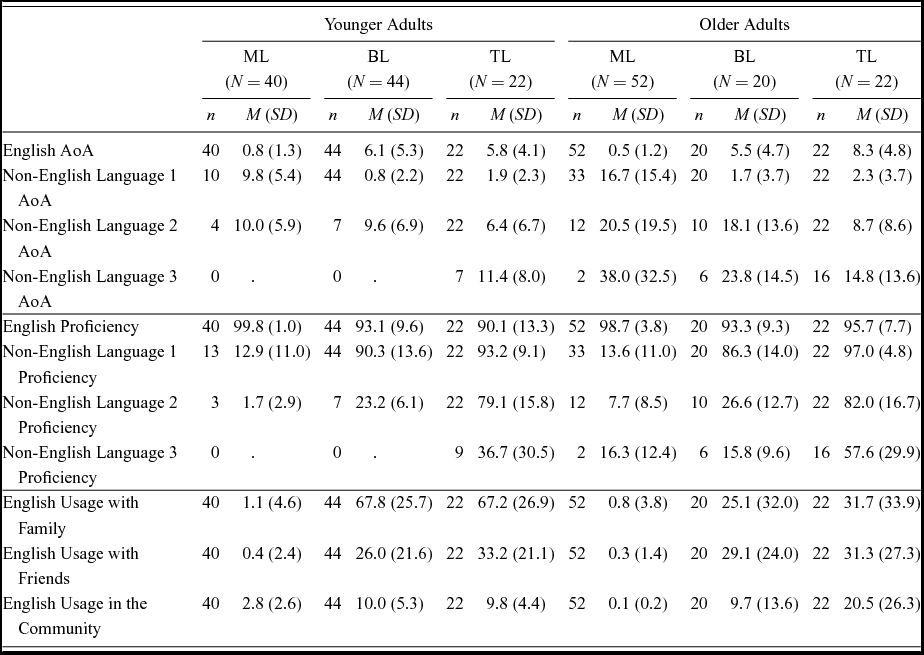
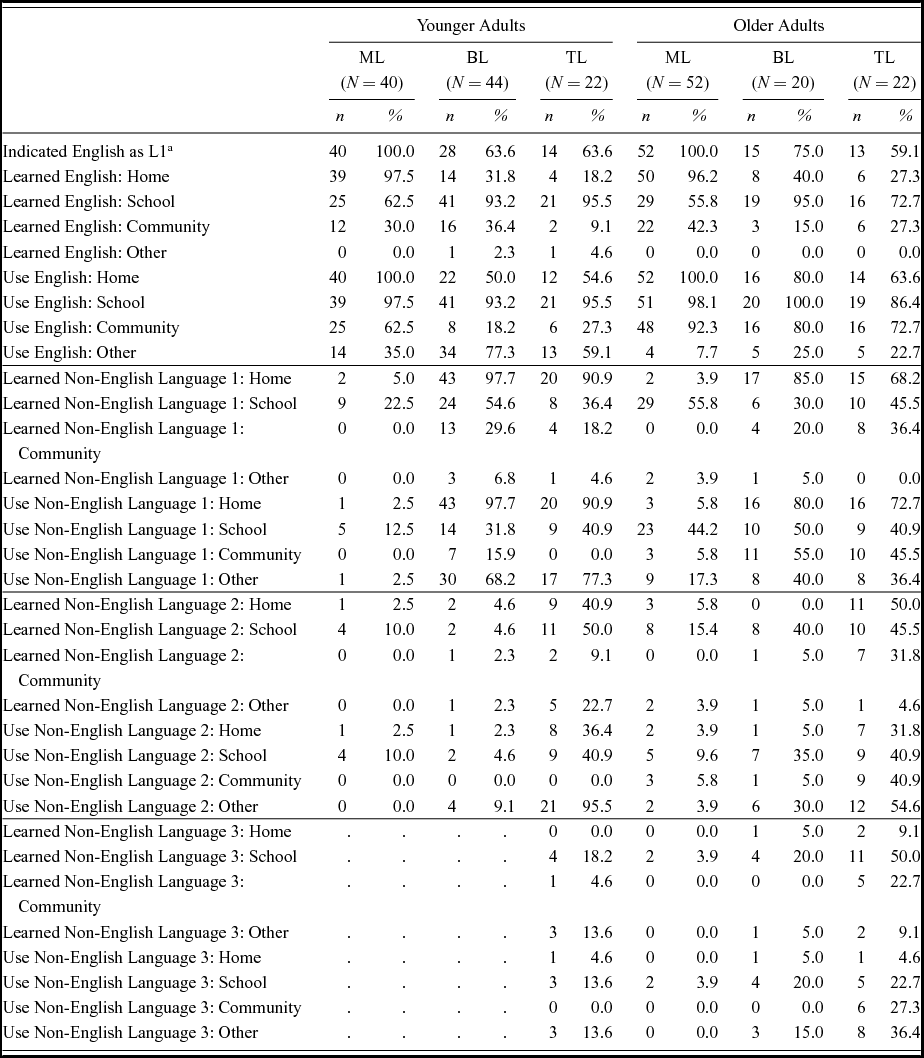
Participants completed the Language and Social Background QuestionnaireFootnote 2 (LSBQ; Anderson, Mak, Keyvani Chahi & Bialystok, Reference Anderson, Mak, Keyvani Chahi and Bialystok2017) to assess background experience and language use. The non-English languages of the bilingual and trilingual participants included a range of languages with no one language over-representedFootnote 3. All bilinguals and trilinguals reported high levels of fluency and regular use of all their languages (see Table 1 for age of acquisition (AoA), proficiency ratings, and English usage ratings; Table 2 for frequency of English as L1 and contexts where languages were used). As the picture naming task was performed in English, two-way ANOVAs for age group and language group were conducted on English AoA and English proficiency ratings. For English AoA, there was a main effect of language group, F(2, 194) = 58.45, p < .0001, η2p = .38, in that monolinguals learned English significantly earlier than bilinguals or trilinguals, with no difference between the multilingual groups. There was no effect of age group, F < 1, or interaction of age and language group, F < 2.9. For English proficiency ratings, there was a main effect of language group, F(2, 194) = 15.65, p < .0001, η2p = .14, in that monolinguals had higher ratings than both bilinguals and trilinguals, with no difference between the multilingual groups. Note, however, that all English proficiency ratings were at 90 or higher for all groups. There was no main effect of age, F < 1.9, or interaction of age and language group, F < 2.9. Finally, to assess whether bilinguals and trilinguals had differential usage of English, English usage with family, friends, and community were examined using two-way ANOVAs for age group and language group. For English usage with family, there was a main effect of age group, F(1, 104) = 44.65, p < .0001, η2p = .30, in that older adults indicated using English more with family than younger adults, but no main effect of language or interaction with age, Fs < 1. There were no main effects or interactions for English usage with friends, Fs ≤ 1, or for English usage in the community, Fs < 3.9. These values indicate that all groups were highly proficient in English and used English extensively in their daily lives. However, by the logic of the frequency-lag account, multilinguals had to divide their language usage across more languages than bilinguals who in turn used less of each language than monolinguals.
Language background measures by age group and language group.

Note. Self-report ratings of proficiency range from 0 = “no proficiency” to 100 = “fully fluent” and usage from 0 = Always English to 100 = Always Non-English. Proficiency averages are based on ratings of speaking and understanding. Participants were classified into their respective language group based on proficiency profiles of: one, two, or three languages, using a cut-off criterion of 50 as the LSBQ allows participants the option to provide ratings based on any language exposure throughout one's lifetime. Monolingual Proficiency Ranges: English (Min = 80, Max = 100), Non-English Language 1 (Min = 0, Max = 35), Non-English Language 2 (Min = 0, Max = 30), Non-English Language 3 (Min = 7.5, Max = 25). Bilingual Proficiency Ranges: English (Min = 62.5, Max = 100), Non-English Language 1 (Min = 50, Max = 100), Non-English Language 2 (Min = 5, Max = 45), Non-English Language 3 (Min = 0, Max = 30). Trilingual Proficiency Ranges: English (Min = 60, Max = 100), Non-English Language 1 (Min = 75, Max = 100), Non-English Language 2 (Min = 50, Max = 100), Non-English Language 3 (Min = 5, Max = 100).
Language background frequency measures by age group and language group.

a L1. Language listed first when asked to list known languages in order of fluency.
Note. Other responses included: Family, Friends, Roommate, Work, Travel, Classes, Self-instruction, Prayer, Phone Use, Reading, Media, Music, CDs, Movies, and TV.
TasksFootnote 4
Background measures
Younger participants completed the PPVT-III (Dunn & Dunn, Reference Dunn and Dunn1997) and KBIT-2 (Kaufman & Kaufman, Reference Kaufman and Kaufman2004) to assess English receptive vocabulary and nonverbal fluid intelligence. Older adults completed the Shipley-2 Institute of Living Scale Verbal and Blocks (Shipley, Gruber, Martin & Klein, Reference Shipley, Gruber, Martin and Klein2009).
Picture naming task
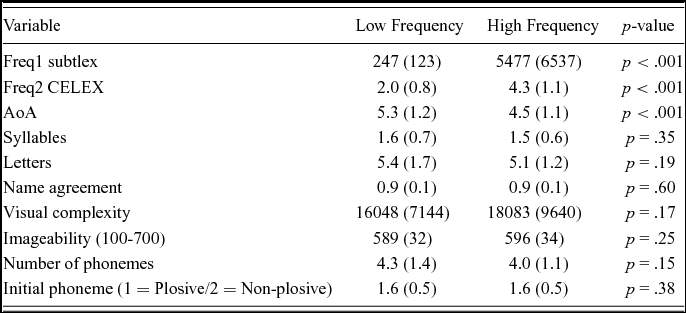
The task consisted of 132 black-and-white drawings (66 low frequency and 66 high frequency) from the IPNP database (Székely et al., Reference Székely, Jacobsen, D'Amico, Devescovi, Andonova and Herron2004). Stimuli from the two frequency lists were matched on number of syllables, number of letters, percent name agreement, visual complexity, imageability, number of phonemes, and initial phoneme type (plosive versus non-plosive), but differed on noun subtlex frequency, CELEX frequency (Brysbaert & New, Reference Brysbaert and New2009; Brysbaert, New & Keuleers, Reference Brysbaert, New and Keuleers2012), and age-of-acquisition (Table 3). The task was programmed using E-prime software (version 2.0, Psychology Software Tools). For each trial, a black fixation cross (+) appeared against the white background for 1000 ms, followed by the picture for 3000 ms or until the participant responded; afterwards a black minus sign appeared in the center of the screen until the experimenter coded the accuracy of the participant's response using a Serial Response Box (Psychology Software Tools, Inc.). Inaccurate/timed out trials and trials with RTs faster than 300 ms were excluded from analyses. Within-subject relative trimming using a threshold of 2.5 SDs was performed on RTsFootnote 5. Voice-key error trials on which the microphone was prematurely triggered prior to the production of a response were included in accuracy analyses but excluded from RT analyses. The number of voice-key errors did not differ by group, Fs < 3.0.
Stimuli characteristics by frequency used in the picture naming task.

Note. Freq1 subtlex: The frequency of the word as noun in Brysbaert and New (Reference Brysbaert and New2009); Brysbaert et al. (Reference Brysbaert, New and Keuleers2012).
Freq2 CELEX: Natural logarithm of the Celex frequency, as reported in the original IPNP database.
AoA: Age-of-acquisition ratings in Kuperman, Stadthagen-Gonzalez, and Brysbaert (Reference Kuperman, Stadthagen-Gonzalez and Brysbaert2012).
Name Agreement: Percent name agreement, as reported in the original IPNP database.
Visual Complexity: Estimates of objective visual complexity, as reported in the original IPNP database.
Imageability Rating: As reported in the MRC Psycholinguistic Database.
Results
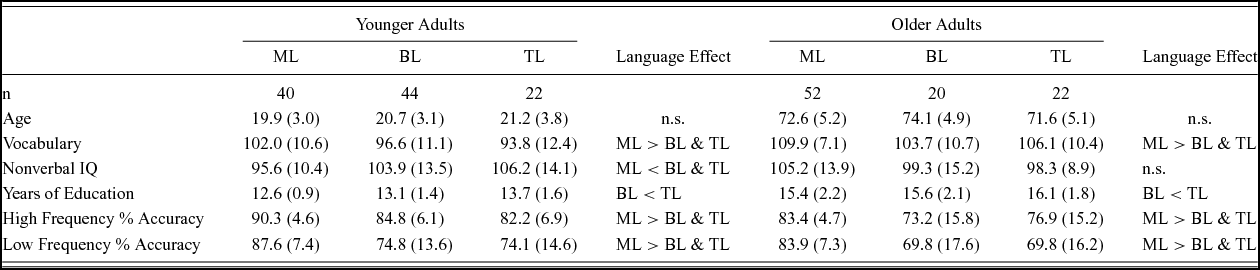
Background measures are presented in Table 4. Two-way ANOVAs for age group and language group were conducted on each measure. For English vocabulary, older adults scored higher than younger adults, F(1, 194) = 34.93, p < .0001, η2p = .15, and monolinguals scored higher than bilinguals and trilinguals, F(2, 194) = 7.95, p < .0006, η2p = .08, who did not differ from each other, with no interaction, F < 1.
Mean score (and SD) on background measures and accuracy as % correct (and SD) for picture naming by age group and language group.

Note. Raw vocabulary and nonverbal scores were converted to standardized scores based on a population mean of 100 and a standard deviation of 15.
For nonverbal intelligence, there were no main effects, Fs < 1, but a significant interaction of age group and language group, F(2, 194) = 8.93, p < .0003, η2p = .08. For young adults, monolinguals scored lower than the other two groups, F(2, 103) = 6.66, p < .002, η2p = .11, but there was no difference between language groups for older adults, F(2, 91) = 2.81, n.s. Years of education indicated more education by older adults, F(1, 194) = 97.9, p < .0001, η2p = .34, and an effect of language group, F(2, 194) = 4.29, p < .02, η2p = .04, in which bilinguals (M = 13.9, SD = 2.0) had fewer years of education than trilinguals (M = 14.9, SD = 2.1), with no difference between monolinguals (M = 14.2, SD = 2.2) and the other two groups, and no interaction, F < 1. Due to group differences in nonverbal intelligence and education, a correlation was run between these variables and average RT and average accuracy on picture naming. None of the correlations was significant (rangeabsolutevalue r = .01 to r = .10) so no further adjustment was made in the analyses.
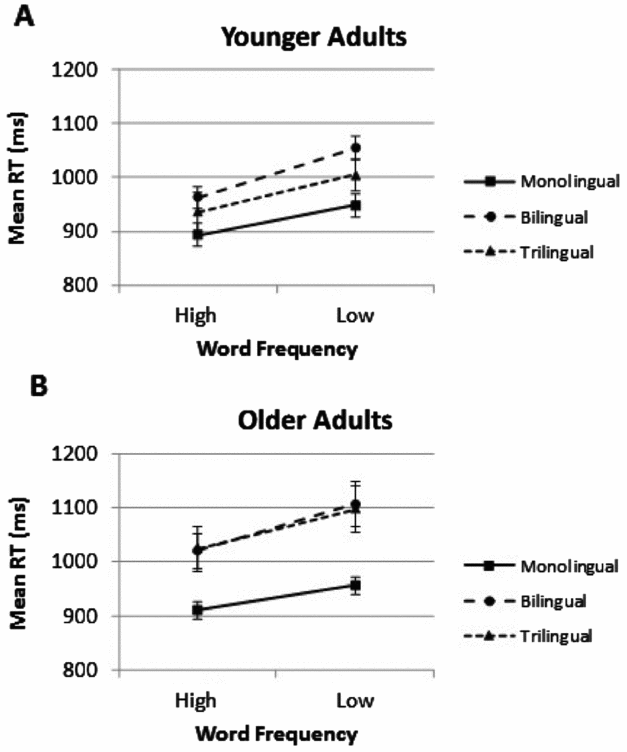
Accuracy scores from picture naming are presented in Table 4 and RT results are displayed in Figure 1. Scoring was carried out using both an exact method where only the pre-designated picture name was considered correct and a liberal method where synonyms were also accepted. There were no differences between these methods in RT outcomes, but the liberal method produced higher accuracy scores. Therefore, all data are reported using the exact method since it is more objective.
Mean RT (and standard error) for naming high and low frequency words by language group for (A) younger adults and (B) older adults.

A three-way ANOVA on accuracy for age group, language group, and word frequency showed main effects of age group, F(1, 194) = 17.97, p < .0001, η2p = .08, and language group, F(2, 194) = 29.20, p < .0001, η2p = .23, with no interaction, F = 0.54. Contrasts indicated that young adults were more accurate than older adults and monolinguals were more accurate than bilinguals or trilinguals, with no difference between the multilingual groups. There was a main effect of word frequency, F(1, 194) = 59.17, p < .0001, η2p = .23, that interacted with age group, F(1, 194) = 7.27, p < .008, η2p = .04, and language group, F(2, 194) = 11.07, p < .0001, η2p = .10, but the three-way interaction was not significant, F < 1.4. To understand the two-way interactions, word frequency effects were examined separately by age and language group. For age group, both younger, F(1, 105) = 49.61, p < .0001, η2p = .32, and older adults, F(1, 93) = 5.99, p < .02, η2p = .06, were more accurate on high than low frequency words, but the effect was larger in younger adults. For language group, there was no effect of word frequency for monolinguals, F = 1.71, but bilinguals, F(1, 63) = 32.23, p < .0001, η2p = .34, and trilinguals, F(1, 43) = 27.82, p < .0001, η2p = .39, were more accurate on high frequency words.
A three-way ANOVA for age group, language group, and word frequency for RTs showed main effects of age group, F(1, 194) = 6.24, p < .02, η2p = .03, with faster performance by young adults, and language group, F(2, 194) = 12.37, p < .0001, η2p = .11, with faster performance by monolinguals than the other two groups, who did not differ from each other. There was no interaction of age group and language group, F < 1.3. There was a main effect of word frequency, F(1, 194) = 155.71, p < .0001, η2p = .45, with high frequency words producing faster RTs than low frequency words, and an interaction of word frequency and language group, F(2, 194) = 4.91, p = .008, η2p = .05, that is plotted in Figure 1. The difference between frequency levels was significant for monolinguals, F(1, 91) = 67.45, p < .0001, η2p = .43, bilinguals, F(1, 63) = 53.54, p < .0001, η2p = .46, and trilinguals, F(1, 43) = 64.66, p < .0001, η2p = .60, so the interaction is likely due to the difference in effect size for language group for the high, F(2, 197) = 7.25, p < .001, η2p = .07, and low frequency items, F(2, 197) = 13.90, p < .0001, η2p = .12. In both cases, the contrasts showed faster times for monolinguals than the other two groups, but there is a wider gap between groups for low frequency words. No other interactions were significant, Fs < 1.
Although the three-way interaction was not significant, it appears visually in Figure 1 that older bilinguals and trilinguals performed more similarly to each other than did the younger bilinguals and trilinguals. Therefore, we re-analyzed the data separately by age group. For young adults, there was a main effect of language group, F(2, 103) = 4.49, p < .01, with monolinguals responding faster than bilinguals and trilinguals between them and not significantly different from either. For older adults, there was a main effect of language group, F(2, 91) = 9.14, p = .0002, with monolinguals responding faster than bilinguals and trilinguals and no difference between these latter two groups. Typically, however, the results of the whole model should take precedence in the interpretation.
Discussion
The goal of the present study was to adjudicate between the frequency-lag and competition accounts of lexical retrieval to understand the links between linguistic and cognitive processing in bilinguals. The crucial evidence is whether trilinguals have a greater deficit than bilinguals due to reduced frequency of usage across languages, as predicted by frequency-lag, or a comparable or smaller deficit than bilinguals, as predicted by competition. The frequency-lag view further predicts an interaction between word frequency and language group, and an interaction between age and language group whereas the competition view does not.
For both accuracy and reaction time, monolinguals outperformed bilinguals and trilinguals with no difference between these two groups. In a follow-up analysis of RT, young trilinguals performed partway between monolinguals and bilinguals, with no significant difference to either. Thus, aging did not attenuate lexical access for multilinguals through accumulated experience, as predicted by frequency-lag. This pattern is consistent with the conflict account.
Regarding word frequency, accuracy data conformed to the frequency-lag view in that there was an interaction between word frequency and language group. Word frequency did not affect monolingual accuracy but both multilingual groups were more accurate on high than low frequency items, with no difference between the bilinguals and trilinguals. These language group differences in accuracy likely reflect stronger English vocabulary in monolinguals than multilinguals.
All three language groups demonstrated word frequency effects for RT showing faster naming times for high frequency words, although the magnitude of the difference changed across groups. However, the effect was similar for bilinguals and trilinguals, a finding in line with the competition view. Moreover, differences in lexical retrieval between language groups did not attenuate with age, supporting competition.
The finding that low frequency items elicited larger language group differences than high frequency items means that linguistic processing is fundamental to understanding multilingual word retrieval. Nonetheless, competition provided a stronger account of the data and was in line with the majority of the outcomes. Therefore, the current data provided support for both models, indicating an interaction between linguistic and cognitive processing in lexical retrieval. Although the involvement of linguistic factors on a language task is not surprising, evidence for the substantial role of cognitive processing has great consequence, not only in terms of providing a more complete description of the phenomenon but also in terms of providing a link to help identify the mechanism by which bilingualism affects cognitive outcomes.