Russian-thistle is one of the most troublesome broadleaf weeds in semiarid to arid regions of the Pacific Northwest and Great Plains (Beckie and Francis Reference Beckie and Francis2009; Leeson et al. Reference Leeson, Thomas, Hall, Brenzil, Andrews, Brown and Van Acker2005). In the dryland hectares of the Pacific Northwest and Montana, Russian-thistle is a severe problem in summer fallow and in spring wheat (Triticum aestivum L.) and other crops such as pulses and canola and mustard (Brassica spp.), with a total infestation of approximately 41 million hectares (Schillinger Reference Schillinger2007; Young Reference Young1986, Reference Young1988). Season-long competition from Russian-thistle can reduce wheat grain yields up to 50% (Young Reference Young1988). Russian-thistle is a serious management concern in wheat–fallow cropping systems (Young et al. Reference Young, Yenish, Launchbaugh, McGrew and Alldredge2008). After wheat harvest, Russian-thistle plants are capable of vigorous regrowth, utilizing as much as 31 kg of water and producing up to 17,400 seeds per plant (Young Reference Young1986). Schillinger and Young (Reference Schillinger and Young2000) also reported a soil moisture use exceeding 70 liters per Russian-thistle plant in spring wheat. The ability of Russian-thistle to use large quantities of soil moisture is potentially detrimental to the moisture conservation benefits derived from the summer fallow (<35 cm annual precipitation), with possible adverse effects on the yield of the wheat crop grown in rotation.
Russian-thistle was first introduced to the United States in 1873 from southeastern Russia and western Siberia as a contaminant in flax (Linum usitatissimum L.) seed (Orloff et al. Reference Orloff, Cudney, Elmore and DiTomaso2008). Russian-thistle is a C4 summer annual belonging to the Chenopodiaceae family. Russian-thistle possesses several unique biological characteristics, including early seedling emergence, a deep and aggressive tap root system (at least 2 m in depth and up to 5 m in diameter), high competitive ability, hermaphroditic flowers (both outcrossed and self-fertile), and wind-mediated pollen dispersal (Beckie and Francis Reference Beckie and Francis2009; Holm et al. Reference Holm, Doll, Holm, Pancho and Herberger1997; Schillinger Reference Schillinger2007; Warwick et al. Reference Warwick, Sauder and Beckie2010; Young Reference Young1988). Russian-thistle is highly tolerant of drought and alkaline soil conditions (Orloff et al. Reference Orloff, Cudney, Elmore and DiTomaso2008). Seeds manifest low dormancy characteristics, and 99% of the seedlings can emerge in the first year (Ogg and Dawson Reference Ogg and Dawson1984). Russian-thistle is a prolific seed producer, and a single plant can produce >100,000 seeds (Beckie and Francis Reference Beckie and Francis2009; Stallings et al. Reference Stallings, Thill, Mallory-Smith and Lass1995). Furthermore, the wind-mediated tumbling of the mature plant in the late summer and fall allows rapid and long-distance dispersal of seeds (Baker et al. Reference Baker, Withrow, Brown and Beck2010; Beckie and Francis Reference Beckie and Francis2009; Stallings et al. Reference Stallings, Thill, Mallory-Smith and Lass1995).
The severity of the weed problems in dryland cereal production systems of the western United States is further exacerbated by the occurrence of herbicide-resistant weed biotypes (Heap Reference Heap2016; Jha et al. Reference Jha, Kumar and Lim2016). Biotypes of wild oat (Avena fatua L.), green foxtail [Setaria viridis (L.) Beauv.], kochia [Kochia scoparia (L.) Schrad.], prickly lettuce (Lactuca serriola L.), and Russian-thistle with resistance to one or more herbicide sites of action are an increasing concern for wheat producers in the western United States, including Montana and Washington (Heap Reference Heap2016; Jha et al. Reference Jha, Kumar and Lim2015; Kumar et al. Reference Kumar, Jha and Reichard2014, Reference Kumar, Jha, Giacomini, Westra and Westra2015). Russian-thistle resistant to acetolactate synthase (ALS) inhibitors was first reported from wheat fields in Washington and Montana in 1987 (Guttieri et al. Reference Guttieri, Eberlein, Mallory-Smith, Thill and Hoffman1992; Heap Reference Heap2016), and was later found in Kansas, California, North Dakota, Idaho, and Oregon (Heap Reference Heap2016; Peterson Reference Peterson1999). Currently, more than 75% of the wheat fields in Montana and eastern Washington are infested with ALS-resistant Russian-thistle populations (Jha et al. Reference Jha, Kumar and Lim2016; Saari et al. Reference Saari, Cotterman, Smith and Primiani1992; Stallings et al. Reference Stallings, Thill and Mallory-Smith1994).
In the wheat–summer fallow system, growers rely heavily and often exclusively on glyphosate (three to four applications per year) for weed control in chemical fallow. Glyphosate applications also occur prior to wheat planting (burndown) and in postharvest wheat stubble (Kumar et al. Reference Kumar, Jha and Reichard2014; Kumar and Jha Reference Kumar and Jha2015; Young et al. Reference Young, Yenish, Launchbaugh, McGrew and Alldredge2008; Young and Whitesides Reference Young and Whitesides1987). The enhanced selection pressure that resulted from the repeated glyphosate applications is similar to the selection pressure found in areas with heavy glyphosate-resistant (GR) crop adoption, and is similar to the situation that resulted in the recent evolution and escalating spread of GR kochia in two-thirds of the US Great Plains states (Heap Reference Heap2016).
Based on grower complaints during late summer of 2015, a Russian-thistle accession that survived multiple applications of glyphosate was collected from a fallow field (wheat–fallow rotation) in Choteau County, Montana. During the same year, a putative GR accession was collected from a fallow field in Columbia County, Washington. The objectives of this research were two-fold: 1) confirm and determine the levels of glyphosate resistance using whole-plant dose-response assays under greenhouse and outdoor/field conditions, and 2) evaluate the effectiveness of alternative POST herbicides labeled for use in wheat–fallow rotations to control GR Russian-thistle.
Materials and Methods
Seed Sources
Montana Accessions
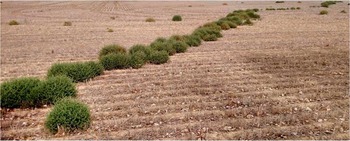
A trail of Russian-thistle plants surviving two applications of glyphosate (first application at 870 g ae ha−1 and subsequent application at 1,107 g ha−1) was identified during late summer of 2015 from a chemical fallow field in Choteau County, Montana (Figure 1). Upon maturity in the late fall of 2015, seeds were collected from 10 randomly selected putative GR plants in the field. The sampled field has been in a no-till wheat–fallow rotation for >10 yr, with a history of repeated glyphosate use. After threshing and cleaning with an air-propelled column blower, seeds from individual plants were composited into one sample and stored in paper bags at 4 C until used. The putative GR Russian-thistle accession was referred to as MT-R. A glyphosate-susceptible (GS) Russian-thistle accession known to be susceptible to the field-use rate (870 g ha−1) of glyphosate, referred to as MT-S, was obtained from a wheat–fallow field at the research farm of the Montana State University-Southern Agricultural Research Center (MSU-SARC) near Huntley, Montana.
A “trail” of Russian-thistle plants that survived glyphosate applications (870 g ae ha−1 followed by 1107 g ha−1) with no visual signs of injury, in a chemical fallow field in Choteau County, Montana. The MT-R seeds used in this experiment were collected from the putative glyphosate-resistant plants growing in this trail.

Field-collected seeds of MT-R and MT-S Russian-thistle accessions were sown separately on the surfaces of 53 by 35 by 10 cm germination flats filled with a commercial potting mixture (VermiSoilTM, Vermicrop Organics, Rocklin, CA). The greenhouse temperatures were 26/23±3Cday/night with 16/8 hday/night photoperiods, and metal halide lamps (400 μmol m−2 s−1) supplemented the available sunlight. A total of 100 seedlings from each accession were treated with a discriminate dose (870 g ha−1) of potassium salt of glyphosate (Roundup PowerMax®, Monsanto Company, St Louis, MO) when plants were 7.5 to 9 cm tall. Glyphosate, along with 2% (w/v) ammonium sulfate, was applied using a stationary cabinet spray chamber (Research Track Sprayer, De Vries Manufacturing, Hollandale, MN) equipped with an even flat-fan nozzle tip (TeeJet 8001EXR, Spraying System Co., Wheaton, IL) calibrated to deliver 94 Lha−1 of spray solution at 276 kPa. More than 98% of the plants from the MT-R accession survived the discriminate dose of glyphosate, whereas none of the MT-S accession plants survived that rate. After this initial screening, MT-R and MT-S plants were separately transplanted into 10-L pots containing the same potting mixture and allowed to grow in the greenhouse. Individual plants of MT-R and MT-S accessions were covered with pollination bags (DelStar Technologies, Inc., Middletown, DE) to prevent pollen contamination, and the progeny seeds were used for conducting whole-plant dose-response experiments.
Washington Accessions
Russian-thistle plants surviving a glyphosate application of 1,260 g ha−1 were identified in a chemical fallow field near Dayton in Columbia County, Washington in the summer of 2015. Although the glyphosate application completely controlled all other weed species in the field, the surviving Russian-thistle plants showed no visual signs of glyphosate injury, and were growing in a “trail” generally following the topography and prevailing wind direction. Twelve healthy individual plants were uprooted and transplanted into a field at the Washington State University Palouse Conservation Field Station near Pullman, Washington for the remainder of the growing season. Prior to flowering, plants were reproductively isolated using pollination bags. Seeds were harvested from the four surviving individuals at the end of the growing season, in mid-October 2015, and maintained as separate subaccessions (denoted WA-R1 through WA-R4) for the conduct of dose-response experiments. An accession collected near Anatone, Washington was used as a glyphosate-susceptible check. Mature seeds from two individuals were collected at this location in December of 2013. Offspring of these plants were grown to seed on the Washington State University (WSU) Spillman Agronomy Farm near Pullman, Washington in 2014. These plants were reproductively isolated as previously described, and the resulting seeds were combined and used as the glyphosate-susceptible accession (designated WA-S). A susceptible response to a typical field-use rate of glyphosate (870 g ha−1) was confirmed for this accession in field trials conducted in 2015 (J. Spring, unpublished data).
Whole-Plant Glyphosate Dose-Response Assay
Greenhouse Study on Montana Accessions. Two separate greenhouse experiments were conducted at the MSU-SARC near Huntley, Montana; one in April 2016 and the other in May 2016. The selfed progeny seeds of MT-R and MT-S Russian-thistle accessions were separately sown on the germination flats filled with a commercial potting mixture as previously described. At the two- to three-true-leaf stage, seedlings were individually transplanted into 50 by 25 by 10 cm cellular trays (Greenhouse Megastore, Danville, IL) containing the previously described potting mixture. Treatments were arranged in a randomized complete block design with four replications for each accession and glyphosate dose combination. Each replication consisted of one cellular tray with 18 cells, with each cell containing one Russian-thistle seedling. Glyphosate doses included 0, 109, 218, 435, 870, 1260, 1740, 2205, 2598, 3071, 3465, and 3937 g ha−1, and were applied when plants were 7.5 to 9 cm tall. Ammonium sulfate at 2.0% (w/v) was included in all glyphosate treatments. The glyphosate applications were made inside a stationary cabinet spray chamber as previously described. After the glyphosate treatment, Russian-thistle plants were returned to the greenhouse, watered as needed to avoid moisture stress, and fertilized (Miracle-Gro® water-soluble fertilizer [24–8–16], Scotts Miracle-Gro Products Inc., Marysville, OH) weekly to maintain good growth. Percent visible injury on a scale of 0% (no injury/control) to 100% (complete control/plant death) was recorded at 1, 2, and 3 wk after treatment (WAT). The aboveground shoot biomass of ten Russian-thistle plants per tray was harvested 3 WAT and dried at 65 C for 3 d to determine the shoot dry weight per plant, which was then expressed as percentage of the aboveground shoot biomass of the nontreated control.
Outdoor Study on Montana Accessions
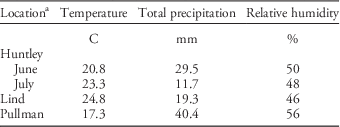
Two separate experiments were conducted at MSU-SARC near Huntley, Montana under outdoor conditions in June 2016 and July 2016, respectively. Russian-thistle seedlings from MT-R and MT-S accessions were separately grown in 18-cell cellular trays using the same potting mixture, and kept outdoors on a benchtop. Mean monthly temperatures, relative humidity, and monthly total precipitation during the study periods are presented in Table 1. Treatments were arranged in a randomized complete block design with four replications for each accession and glyphosate dose combination. Actively growing 7.5- to 9-cm-tall plants were treated with glyphosate doses of 0, 218, 435, 870, 1260, 1734, 3480, 5220, 6960, and 8700 g ha−1 using the same procedure as previously described, and transferred back to the outdoor benchtop. Plants were watered as needed and fertilized once a week as previously described. Data on percent visible injury and shoot dry weight per plant were recorded.
Mean monthly air temperature, total precipitation, and relative humidity during the study period at Huntley, Montana and Lind and Pullman, Washington.

a Experiments were conducted in June 2016 and repeated in July 2016 at Huntley, MT. Experiments at Lind and Pullman, WA were conducted in June 2016
Greenhouse Study on Washington Accessions
Two separate dose-response experiments were conducted in the WSU Plant Growth Facilities in Pullman, Washington: one in January 2016 and the other in May 2016, in a greenhouse with a supplementary daytime lighting for a 16 h photoperiod and 28/20Cday/night temperatures. For both experiments, seeds were planted into 66 mL (2.54 cm diameter by 16 cm depth) pots (Ray Leach Cone-tainer™, Steuwe and Sons, Inc., Tangent, OR), containing peat-based growing medium (Sungro™ Professional Growing Mix, Sungro Horticulture Distribution Inc., Agawam, MA). Seedlings were thinned to one plant per pot after emergence. Plants were watered as needed and fertilized (as previously described) on a weekly basis. Ten individual plants (replicates) of each GR subaccession and GS accession were used. Plants were sprayed using an air-pressurized indoor spray cabinet (Generation III Research Sprayer, DeVries Manufacturing) calibrated to deliver 140 L ha−1 total spray volume with a single 8002E flat-fan nozzle (Teejet Spraying Systems Co., Springfield, IL) at 172kPa when they reached a height of 6 to 10 cm (4 and 5 wk after planting for the first and second experiments, respectively). Glyphosate (Roundup® Origina, Monsanto Company, St. Louis, MO) treatments included applications at 0, 131, 263, 525, 788, 1182, 1839, 2627, 3363, and 4204 g ha−1. All treatments included 0.5% (v/v) nonionic surfactant (R11, Wilbur-Ellis Company, San Francisco, CA) and 14 g L−1 of ammonium sulfate. Treatments were arranged in a randomized complete block design with four replications for each accession and glyphosate dose combination. Position and orientation of trays was rearranged bi-weekly in an attempt to avoid artifact resulting from greenhouse location. Aboveground biomass was harvested at 3 WAT and dried for 48 h at 60 C to determine shoot dry weight per plant, which was then expressed as a percentage of that of the nontreated control.
Field Experiments on Washington Accessions
Two separate field experiments were conducted in June of 2016, one experiment at the WSU Lind Dryland Research Station near Lind, Washington and the other at the United States Department of Agriculture Agricultural Research Service (USDA/ARS) Palouse Conservation Field Station near Pullman, Washington. Due to limited seed availability of the other WA-R subaccessions, only WA-R1 (denoted WA-R hereafter in discussion of the field experiments) was used in these experiments. Both sites had a winter wheat crop in the previous year. The soil at the Lind site was a Ritzville silt loam (coarse-silty, mixed, superactive, mesic Calcidic Haploxeroll), with 1.3% organic matter and a pH of 6.3. Site preparation at the Lind site consisted of primary tillage with a sweep plough at a depth of approximately 15 to 20 cm, followed by secondary tillage with a rodweeder at an approximate depth of 10 cm. The soil at the Pullman site was a Thatuna silt loam (fine-silty, mixed, superactive, mesic Oxyaquic Argixeroll), with 4.2% soil organic matter and a pH of 5.0. Site preparation at this site consisted of thoroughly roto-tilling standing winter wheat stubble from the preceding year to a depth of approximately 15 cm. Mean monthly temperatures, relative humidity, and monthly total precipitation during the study period at each site are presented in Table 1.
Seeds from both accessions (WA-R and WA-S) were overplanted into 42 by 42 mm Jiffy Peat Pellets (Jiffy Products of America Inc, Lorain, OH) in the WSU greenhouse, as previously described. Emerged seedlings were thinned to one plant per pellet. Seedlings were transplanted intact in pellets into the field in mid-June, 16 d after planting at the Lind site and 21d after planting at the Pullman site. The experimental design was a factorial randomized complete block with five replications for each accession and glyphosate dose combination. Immediately after transplanting, approximately 0.2 L of water was applied to each plant. After this initial watering, existing soil moisture was adequate to sustain vigorous growth of plants at both locations. No supplemental fertility was provided; residual soil fertility from the previous crop year was adequate to sustain vigorous plant growth at both sites. Plots were hand-weeded to remove undesirable weeds as needed.
Russian-thistle plants were sprayed 4 wk after transplanting at both sites, when plants were 12 to 18 cm in height and 10 to 15 cm in diameter. Glyphosate (Roundup® Original) was applied at five different rates: 0, 420, 841, 1682, and 3363 g ha−1. All treatments included 0.5% (v/v) nonionic surfactant (R11) and 14 gL−1 ammonium sulfate. Applications were made using a CO2-pressurized hand boom with two 110015 XRAI flat-fan nozzles (Teejet Technologies) at 30-cm spacing, calibrated to deliver 94 L ha−1 at 138kPa. Aboveground shoot biomass was harvested at 3 WAT and dried (as previously described) to obtain shoot dry weight per plant, which was then expressed as a percentage of that of the nontreated control.
Alternative POST Herbicide Programs for GR Russian-thistle
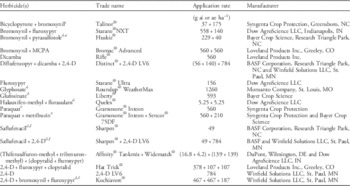
Greenhouse experiments were conducted at the MSU-SARC near Huntley, Montana in June of 2016, and repeated in July 2016, to determine the effectiveness of various alternative POST herbicides (labeled in wheat–fallow rotation) for controlling GR Russian-thistle. Seeds of one susceptible (MT-S) and two GR (MT-R and WA-R) accessions were separately sown on germination flats. Russian-thistle seedlings at the two- to three-true-leaf stage were individually transplanted into 10-cm-diameter plastic pots containing the same potting mixture previously described and were kept under the greenhouse conditions previously described. Uniform sized (7.5- to 9-cm-tall) plants from all three accessions were treated with the recommended field-use rates of various POST herbicides (Table 2) using the stationary spray chamber. Treatments were arranged in a randomized complete block design with five replications (one plant per pot). Data on visible injury (on a scale of 0% to 100%) and shoot dry weight per plant were recorded 3 WAT, and were expressed as percent reduction relative to that of the nontreated control for each accession.
List of alternative postemergence herbicides for glyphosate-resistant Russian-thistle control.Footnote a , Footnote b

a Herbicides are labeled in wheat or barley or in chemical fallow.
b All treatments were applied to 7.5- to 9-cm-tall Russian-thistle plants.
c Crop oil concentrate at 1% (v/v) was included.
d Ammonium sulfate at 2% (wt/v) was included.
e Nonionic surfactant at 0.25% (v/v) was included.
f Methylated seed oil at 1% (v/v) was included.
Statistical Analyses
All data were subjected to ANOVA using PROC MIXED in SAS® 9.2 (SAS Institute, Inc., Cary, NC) to test the significance of the fixed effects, i.e., experimental run/site, accession, treatment (glyphosate dose in whole-plant dose-response assay and herbicides in the alternative POST herbicide study), and their interactions. Replication and interactions involving replication were random effects in the model. ANOVA assumptions for normality of residuals and homogeneity of variance were tested using PROC UNIVARIATE and PROC GLM in SAS; all data met the ANOVA requirements. For the alternative POST herbicide study, means of percent visible injury and shoot dry weight reductions were separated using Fisher’s Protected LSD test at P<0.05.
For whole-plant glyphosate dose-response assays, the shoot dry weights (% of nontreated control) for each Russian-thistle accession were regressed over glyphosate doses using a three-parameter log-logistic model in R software (Ritz et al. Reference Ritz, Baty, Streibig and Gerhard2015; Seefeldt et al. Reference Seefeldt, Jensen and Fuerst1995):
 $$Y{\,\equals\,}\left\{ {D\,/\,1{\plus}\exp \left[ {B\left( {{\rm Log}\,X{\minus}{\rm Log}\,E} \right.} \right]} \right\},$$
where Y denotes the shoot dry weight (% of nontreated control), D is the upper limit, B is the slope of each curve, E is the glyphosate dose required to achieve 50% response (i.e., 50% shoot dry weight reduction, referred as GR50) and X is the glyphosate dose. As is evident from the lack-of-fit test (P>0.05), the nonlinear regression model accurately described the shoot dry weight data. Nonlinear regression parameter estimates, GR90 (glyphosate dose required for 90% reduction in shoot dry weight), standard errors, and 95% confidence intervals were determined using the drc package in R software (Knezevic et al. Reference Knezevic, Streibig and Ritz2007). Based on GR50 values, the resistance index (R:S ratio) for each GR Russian-thistle accession was estimated by dividing the GR50 value of GR accession by the GR50 value of GS accession.
Results and Discussion
Glyphosate Dose-Response for Montana Accessions
Greenhouse Experiments
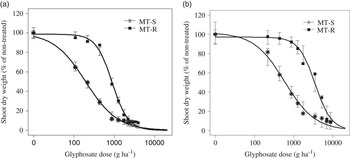
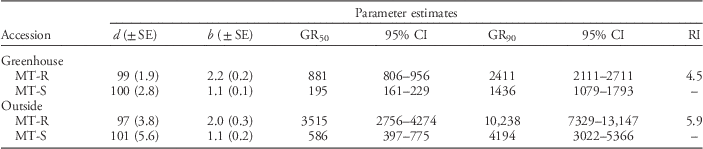
There was no significant interaction of glyphosate dose by experimental run (P=0.326); therefore, data were pooled over experimental runs. Based on shoot dry weight, MT-R and MT-S accessions differed in response to increasing doses of glyphosate (Figure 2). The GR50 value for the MT-R accession was 881 g ha−1, which was higher than the 195 g ha−1 value for the MT-S accession (Table 3, Figure 2). Furthermore, the GR90 value for the MT-R accession was 1.7 times greater than that of the MT-S accession. Based on these GR50 values, the MT-R accession had a 4.5-fold level of resistance to glyphosate at the whole-plant level.
Shoot dry weight response of glyphosate-resistant Russian-thistle accession (MT-R; from Choteau County, MT) and glyphosate-susceptible accession (MT-S; from Huntley, MT) to increasing doses of glyphosate in dose-response assays under (a) greenhouse and (b) outdoor environments in Huntley, Montana. Symbols represent actual values, and lines (solid or dashed) represent predicted values obtained from the three-parameter log-logistic model (Equation 1). Vertical bars indicate±standard errors of the mean values.

Parameter estimates from the whole-plant glyphosate-dose response, fitted using a three-parameter log-logistic model (Equation 1) for the shoot dry weight (percent of nontreated) of Russian-thistle accessions from Montana under greenhouse and outdoor conditions at Huntley, Montana.Footnote a

a Abbreviations: b, relative slope around GR50; CI, confidence interval; d, upper limit of the response; GR50, effective dose (g ae ha−1) of glyphosate causing 50% reduction in shoot dry weight; GR90, effective dose (g ae ha−1) of glyphosate causing 90% reduction in shoot dry weight; MT-R, glyphosate-resistant accession from Choteau County, MT; MT-S, glyphosate-susceptible accession from Huntley, MT; RI, resistance index (calculated as a ratio of GR50 of the GR accession to GR50 of the GS accession); SE, standard error of mean; WAT, wk after treatment.
Outdoor Experiments
The GR50 values from the dose-response study conducted under outdoor conditions were 3,515 and 586 g ha−1 for the MT-R and MT-S accessions, respectively (Table 3, Figure 2), resulting in a 5.9-fold resistance to glyphosate for the MT-R accession. Apparently, the GR50 value for the MT-R accession in the outdoor environment was four times the field-use rate (870 g ha−1) of glyphosate. The GR90 value of the MT-R accession was 2.4-fold higher than that of the MT-S accession. It is also noteworthy that these GR50 values for MT-R and MT-S Russian-thistle accessions were 3 to 3.9 times greater under outdoor conditions than they were under greenhouse conditions. Although the outdoor plants were watered as needed, those plants were expected to be more stressed due to a relatively rapid moisture loss from evapotranspiration under outdoor conditions compared to greenhouse conditions. The greater vagaries in weather conditions (temperature, relative humidity) outdoors compared to in a greenhouse might explain this observed difference in the resistance index of the GR accession. Similarly, the GR50 values of kochia accessions from Kansas were almost 2-fold higher in an outdoor environment compared to a controlled environment in the greenhouse, with plants grown in a commercial potting media under both environments (Godar et al. Reference Godar, Stahlman, Jugulam and Dille2015). The LD50 or GR50 values rely heavily on the environmental conditions during the dose-response assay, and can vary significantly even when using the same genotypes and experimental design (Coburn and Kniss Reference Coburn and Kniss2016; Godar et al. Reference Godar, Stahlman, Jugulam and Dille2015; Kudsk and Jensen Reference Kudsk and Jensen1988). Therefore, this comparison of glyphosate-dose response results from the greenhouse vs. outdoor environment would improve our ability to predict the field-level resistance of the putative GR Russian-thistle accession tested in the greenhouse, as suggested by Godar et al. (Reference Godar, Stahlman, Jugulam and Dille2015).
Glyphosate Dose-Response for Washington Accessions
Greenhouse Experiments
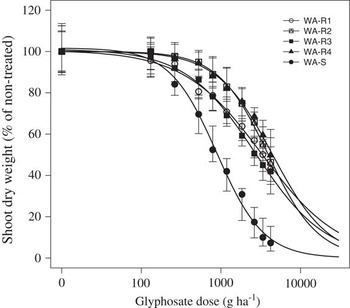
The interaction of glyphosate dose by experimental run was not significant (P=0.425); therefore, data were pooled. Each of the four Washington subaccessions (WA-R1, WA-R2, WA-R3, and WA-R4) generated from the field-collected putative GR accession had a differential response to glyphosate dose relative to the glyphosate susceptible (WA-S) accession (Figure 3). Based on the GR50 values (Table 4), the levels of glyphosate resistance in GR subaccessions WA-R1, WA-R2, WA-R3, and WA-R4, were 3.6-, 4.4-, 3.0-, and 5.0-fold that of the WA-S accession, respectively. The GR90 values of these GR plants were 6.4 to 9.9 times greater than those of the glyphosate-susceptible plants. Furthermore, the GR50 values were 3.1 to 5.1 times the recommended use rate of glyphosate, indicating that glyphosate would no longer be effective in controlling these GR Russian-thistle plants. It is apparent that the recommended field-use rate of glyphosate would allow the resistant plants to proliferate rapidly in field populations if they were not proactively managed by using alternative weed control methods.
Shoot dry weight response of glyphosate-resistant Russian-thistle subaccessions (WA-R1, WA-R2, WA-R3, and WA-R4; derived from WA-R accession from Columbia County, WA) and glyphosate-susceptible accession (WA-S; from Asotin County, WA) to increasing doses of glyphosate in dose-response assays conducted under greenhouse conditions in Pullman, Washington. Symbols represent actual values, and lines (solid or dashed) represent predicted values obtained from the three-parameter log-logistic model (Equation 1). Vertical bars indicate±standard errors of the mean.

Parameter estimates from the whole-plant glyphosate-dose response, fitted using a three-parameter log-logistic model (Equation 1) for the shoot dry weight (percent of nontreated) of Russian-thistle accessions from Washington under greenhouse conditions at Pullman, Washington.Footnote a

a Abbreviations: b, relative slope around GR50; CI, confidence interval; d, upper limit of the response; GR50, effective dose (g ae ha−1) of glyphosate causing 50% reduction in shoot dry weight; GR90, effective dose (g ae ha−1) of glyphosate causing 90% reduction in shoot dry weight; RI, resistance index (calculated as a ratio of GR50 of the GR accession to GR50 of the GS accession); SE, standard error of mean; WA-R1, WA-R2, WA-R3, and WA-R4 are subaccessions derived from the field-collected glyphosate-resistant accession from Dayton, Columbia County, WA; WA-S is glyphosate-susceptible accession collected from Asotin County, WA; WAT, wk after treatment.
Field Experiments
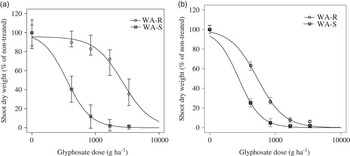
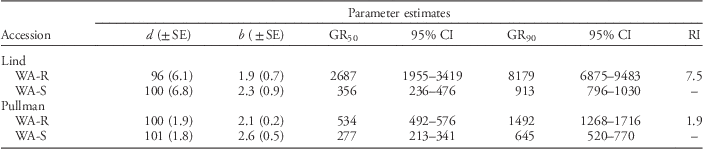
There was a significant interaction (P=0.005) of experimental site by accession by glyphosate dose. At the Lind site, the GR50 values for the WA-R and WA-S accessions were 2,687 and 356gha−1, respectively, (Figure 4, Table 5), indicating a 7.5-fold resistance to glyphosate for the WA-R accession. In addition, the WA-R GR50 value was 3 times the field-use rate of glyphosate. There was an 8.9-fold difference in the GR90 values between the WA-R and WA-S accessions at this site. However, at the Pullman site, the GR50 values were 534 and 277 g ha−1 for WA-R and WA-S accessions, respectively (Figure 4, Table 5), resulting in only a 1.9-fold resistance to glyphosate for the WA-R accession. The GR90 value for the WA-R accession was 2.3-fold greater than that of the WA-S accession at the Pullman site, much smaller than the difference observed at the Lind site. The higher glyphosate resistance at the Lind site is partially attributed to the hotter and drier weather conditions at the Lind site relative to the Pullman site (Table 1). Such conditions likely stress the plants and may result in a reduced glyphosate uptake and lower internal glyphosate concentrations in leaf and chloroplast (Nguyen et al. Reference Nguyen, Malone, Boutsalis, Shirley and Preston2016). In contrast, the relatively cool and wet conditions (Table 1) at the Pullman site seem to have resulted in a greater susceptibility of GR Russian-thistle plants to glyphosate. However, the GR50 value of the glyphosate susceptible WA-S accession did not differ between the Lind and Pullman sites (Table 5). Environmental conditions, including temperature and/or moisture, are known to influence glyphosate efficacy and glyphosate resistance levels in other weed species, such as horseweed [Conyza canadensis (L.) Cronq.], hairy fleabane [Conyza bonariensis L.) Cronq.], rigid ryegrass (Lolium rigidum Gaudin), johnsongrass [Sorghum halepense (L.) Pers.], and barnyardgrass [Echinochloa crus-galli (L.) Beauv.] (Adkins et al. Reference Adkins, Tanpipat, Swarbrick and Boersma1998; Ge et al. Reference Ge, d’Avignon, Ackerman, Duncan, Spaur and Sammons2011; Moretti et al. Reference Moretti, Hanson, Hembree and Shrestha2013, Nguyen et al. Reference Nguyen, Malone, Boutsalis, Shirley and Preston2016; Vila-Aiub et al. Reference Vila‐Aiub, Gundel, Yu and Powles2013). For instance, the GR50 value of the GR hairy fleabane from California was 5.2-fold higher than that of the GS population during the summer (hot and dry conditions), whereas during fall and winter (cool and wet conditions), the GR50 of the same GR population was similar to or lower than that of the GS population (Moretti et al. Reference Moretti, Hanson, Hembree and Shrestha2013). Low temperatures (≤16 C) made the GR horseweed plants sensitive to glyphosate, which was attributed to the inefficiency of the glyphosate-resistance mechanism (reduced translocation due to vacuolar sequestration) at those low temperatures (Ge et al. Reference Ge, d’Avignon, Ackerman, Duncan, Spaur and Sammons2011). On the other hand, a significantly higher glyphosate resistance level observed in GR barnyardgrass populations from northern Australia at 30 vs. 20 C was attributed to the reduced uptake of glyphosate at 30 C vs. 20 C. Further, in that study, the researchers ruled out the possibility of an increased tolerance of the GR barnyardgrass plants at the high temperature tested, or any differences in glyphosate translocation at 30 vs. 20 C (Nguyen et al. Reference Nguyen, Malone, Boutsalis, Shirley and Preston2016). Results from our field study indicate that growers should pay greater attention to glyphosate timing to obtain adequate control of Russian-thistle plants, and should avoid applications to stressed plants under hot and dry conditions in the field.
Shoot dry weight response of glyphosate-resistant Russian-thistle subaccession (WA-R; from Columbia County, WA) and glyphosate-susceptible accession (WA-S; from Asotin County, WA) to increasing doses of glyphosate in dose-response assays conducted under field conditions at (a) the Washington State University Dryland Research Station near Lind, Washington and (b) WSU/ARS Palouse Conservation Field Station near Pullman, Washington, in 2016. Symbols represent actual values, and lines (solid or dashed) represent predicted values obtained from the three-parameter log-logistic model (Equation 1). Vertical bars indicate±standard errors of the mean.

Parameter estimates from the whole-plant glyphosate-dose response, fitted using a three-parameter log-logistic model (Equation 1) for shoot dry weight (percent of nontreated) of Russian- thistle accessions tested under field conditions at the Washington State University Lind Dryland Research Station near Lind, Washington the and WSU/ARS Palouse Conservation Field Station near Pullman, Washington.Footnote a

a Abbreviations: b, relative slope around GR50; CI, confidence interval; d, upper limit of the response; GR50, effective dose (g ae ha−1) of glyphosate causing 50% reduction in shoot dry weight; GR90, effective dose (g ae ha−1) of glyphosate causing 90% reduction in shoot dry weight; RI, resistance index (calculated as a ratio of GR50 of the GR accession to GR50 of the GS accession); SE, standard error of mean; WA-R, glyphosate-resistant Russian-thistle accession collected from Dayton, Columbia County, WA; WA-S is glyphosate-susceptible accession collected from Asotin County, WA; WAT, wk after treatment.
Alternative POST Herbicides
Visual Assessment of Percent Control
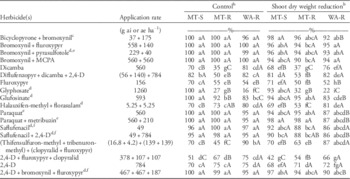
There was a significant interaction of herbicide treatment by accession (P<0.0001) for Russian-thistle control 3 WAT, indicating that the accessions showed a differential response to the POST herbicides (labeled in wheat–fallow rotation) evaluated in this study. Among all POST herbicide programs tested, bromoxynil in combination with bicyclopyrone, fluroxypyr, fluroxypyr plus 2,4-D, pyrasulfotole, or MCPA; paraquat alone or in combination with metribuzin; and saflufenacil alone or with 2,4-D provided the most effective control (≥95%) of all (MT-S, MT-R, WA-R) Russian-thistle accessions tested (Table 6). In another study, conducted by Young and Whitesides (Reference Young and Whitesides1987), control of Russian-thistle plants with paraquat (560 g ha−1) in postharvest wheat stubble was >95%. Similarly, in a greenhouse study, Russian-thistle control with bromoxynil (280 g ha−1) was >95% (Harbour et al. Reference Harbour, Messersmith and Ramsdale2003).
Percent control and shoot dry weight reduction (percent of nontreated control) of three Russian-thistle accessions at 3 weeks after treatment with various postemergence herbicides.Footnote a

a Abbreviations: MT-R, glyphosate-resistant Russian-thistle accession from Choteau County, MT; MT-S, glyphosate-susceptible accession from Huntley, MT; WA-R, glyphosate-resistant accession from Dayton, Columbia County, WA. Herbicides were applied to 7.5- to 9-cm-tall Russian-thistle plants.
b For percent control or shoot dry weight reduction, means for a Russian-thistle accession within a column that are followed by similar lowercase letters are not significantly different based on Fisher’s Protected LSD test at P<0.05; means for an herbicide within a row that are followed by similar uppercase letters are not significantly different based on Fisher’s Protected LSD test at P<0.05.
c Crop oil concentrate at 1% (v/v) was included.
d Ammonium sulfate at 2 % (wt/v) was included.
e Nonionic surfactant at 0.25% (v/v) was included.
f Methylated seed oil at 1% (v/v) was included.
Control of MT-S accession with dicamba plus diflufenzopyr plus 2,4-D (82%) was superior to dicamba alone (70%). However, control with fluroxypyr alone, 2,4-D (784 gha−1) alone, halauxifen-methyl plus florasulam, or thifensulfuron plus tribenuron tank-mixed with clopyralid plus fluroxypyr did not exceed 70% at 3 WAT (Table 6). The least control (51%) of the MT-S accession was observed with 2,4-D (378 gha−1) plus fluroxypyr plus clopyralid.
For the MT-R accession, control with a majority of the POST herbicides was similar to that seen for the MT-S accession, with only a few exceptions. For instance, control with glufosinate was lower (92%) for the MT-R accession than it was for the MT-S accession. Similarly, control of MT-R plants with dicamba alone (35%), dicamba plus diflufenzopyr plus 2,4-D (50%), fluroxypyr (55%), or thifensulfuron plus tribenuron tank-mixed with clopyralid plus fluroxypyr (45%) was lower compared with that seen in the MT-S plants. Control of MT-R plants with halauxifen-methyl plus florasulam (73%) did not differ from the 2,4-D alone treatment (75%), but was higher than that with the 2,4-D plus fluroxypyr plus clopyralid treatment (67% of control).
For the WA-R accession, control was comparable to that seen with the MT-R accession for most POST herbicides tested, with the exceptions of dicamba (more effective), dicamba plus diflufenzopyr plus 2,4-D (more effective), glufosinate (less effective), halauxifen-methyl plus florasulam (more effective), 2,4-D plus fluroxypyr plus clopyralid (more effective), and thifensulfuron plus tribenuron tank-mixed with clopyralid plus fluroxypyr (more effective; 90% for WA-R vs. 45% for MT-R) (Table 6). It is evident from the results that the MT-R accession has an enhanced tolerance to the ALS-inhibitor herbicide (thifensulfuron plus tribenuron). ALS-inhibitor-resistant Russian-thistle populations have been documented in both Montana and Washington (Heap Reference Heap2016). As was seen with the MT-R accession, fluroxypyr was one of the least effective products for controlling (<55%) the WA-R Russian-thistle accession.
Shoot Dry Weight Reduction
There was a significant interaction (P<0.0001) of herbicide treatment by accession on percent shoot dry weight reduction of Russian-thistle plants 3 WAT. Overall, the response based on shoot dry weight was consistent with the percent control rating for a majority of the POST herbicides tested. With a few differences among the accessions, bromoxynil in combination with bicyclopyrone, fluroxypyr, fluroxypyr plus 2,4-D, pyrasulfotole, or MCPA; paraquat alone or in combination with metribuzin; and saflufenacil alone or in combination with 2,4-D reduced GR Russian-thistle shoot dry weight by 86% to 98% (Table 6). Glufosinate provided 83% reduction in shoot dry weight of the WA-R accession compared with the 95% reduction seen in the MT-R accession.
The shoot dry weight reductions of the MT-R accession with dicamba, dicamba plus diflufenzopyr plus 2,4-D, fluroxypyr, and halauxifen-methyl plusflorasulam were 37%, 53%, 50%, and 53%, respectively, and were lower than those seen with the MT-S accession. However, these products, except fluroxypyr, reduced shoot dry weight by 76% to 82% for the WA-R accession. Consistent with the percent control ratings, the shoot dry weight reduction of MT-R and WA-R accessions from 2,4-D applied alone (784 g ha−1) averaged 71%.
Implications and Future Research
Our paper is the first global report of the simultaneous evolution of glyphosate-resistant Russian-thistle in wheat–fallow fields in Montana and Washington. These events can certainly be attributed to the widespread, recurrent selection resulting from extensive use of glyphosate in the cropping systems of these regions. Similar to GR kochia, the rapid spread of GR Russian-thistle populations may be expected, as both species share common biological characteristics: prolific seed production, tumbling mechanism of seed dispersal, and pollen-mediated gene flow through outcrossing. The mechanism of glyphosate resistance, genetic inheritance, and fitness cost (if any) associated with the GR trait would further determine the spread of resistance alleles in Russian-thistle populations. Furthermore, there is a widespread occurrence of ALS inhibitor–resistant Russian-thistle populations in wheat fields in the Pacific Northwest and US Great Plains. In fact, the GR accession from Montana (MT-R) also survived two times the field-use rate (36 g ha−1) of thifensulfuron plus tribenuron plus metsulfuron (Ally® Extra SG, DuPont Company, Wilmington, DE) in preliminary experiments (data not shown), indicating a possible multiple-herbicide-resistant Russian-thistle accession. The co-occurrence of resistance to glyphosate and ALS inhibitors in Russian-thistle accessions is of potential concern for wheat growers in this region. Furthermore, the reduced efficacy of dicamba evident in the MT-R accession could further limit herbicides options to control those GR Russian-thistle plants in the field.
Evolution of resistance to glyphosate in Russian-thistle populations is a recent phenomenon in this western region. Therefore, the adoption of best management practices, including diversified herbicide tools with multiple mechanisms of action, cultural and mechanical weed control methods, and late-season or harvest weed seed control methods, need immediate attention (Norsworthy et al. 2012). Growers should make all possible efforts to prevent seed production from suspected GR Russian-thistle plants, and use the effective alternative herbicides (multiple modes of action) highlighted in this study to control GR Russian-thistle in the wheat–fallow rotation. The results of the outdoor/field experiments suggest that GR Russian-thistle populations may be more problematic under the hot and dry conditions typical during the summer months in the Pacific Northwest and Montana. As an adaptation to this continuous no-till, dryland wheat–fallow cropping system, a shift towards later-emerging (summer rather than spring) Russian-thistle cohorts may be expected, which will cause the plants to be even more challenging to control with glyphosate if not managed proactively.
Future research will investigate the physiological or genetic basis of glyphosate resistance, the mechanism of inheritance of glyphosate resistance, and the population genetics and relative fitness of selected GR Russian-thistle accessions. Statewide field surveys will be conducted to further assess the frequency and distribution of GR Russian-thistle populations and evolution of multiple-herbicide-resistant Russian-thistle populations in this region. The low-temperature and/or high-moisture sensitivity to glyphosate in the selected GR Russian-thistle accessions needs further investigation.
Acknowledgments
The authors greatly appreciate Mrs. Peggy Lamb, Research Scientist at the MSU Northern Agricultural Research Center, and extension agents, growers, and consultants from Choteau County, Montana and Columbia County, Washington for their valuable assistance in seed collection of GR Russian-thistle accessions. We thank Anjani J, Charlemagne A. Lim, and Shane Leland for their technical assistance in conducting this research. We also thank the Montana Wheat and Barley Committee for funding this research at MSU, and the Washington Grain Commission for partial funding of the research at WSU.