Pathways to risk or resilience for children in the context of parent conflict are likely to involve multiple interactions among factors inherent within children and their environments. An extensive body of research has found that conflict between parents is associated with higher rates of child behavior and emotional problems (e.g., Cox, Paley, & Harter, Reference Cox, Paley, Harter, Grych and Fincham2001; Cummings & Davies, Reference Cummings and Davies1994; Katz & Gottman, Reference Katz and Gottman1993) and with greater physiological arousal and slower rates of recovery from arousal (Gottman & Katz, Reference Gottman and Katz1989, Reference Gottman and Katz1993; Katz, Reference Katz, Grych and Fincham2001), but that effective physiological regulation, specifically regulation of vagal tone, may buffer children from negative behavioral consequences of parent conflict (El-Sheikh, Harger, & Whitson, Reference El-Sheikh, Harger and Whitson2001; Katz & Gottman, Reference Katz and Gottman1995, Reference Katz and Gottman1997). Together this research suggests that the relation between parent conflict and behavior disorders may be moderated by children's vagal regulation of stress.
Understanding how parent conflict is related to the development of children's vagal regulation is a critical area of research, particularly during infancy, as early experiences in emotionally challenging environments can have a significant impact on neurological and physiological systems when they are undergoing rapid development (Panksepp, Reference Panksepp2001; Pollack, Reference Pollack2005; Schore, Reference Schore, Lewis and Granic2000; Siegel, Reference Siegel2001), signifying the possibility of a sensitive period for the development of physiological regulatory systems.
To date, research that has examined the relation between parent conflict and physiological regulation during early childhood is rare, even though very young children are more likely than older children to be exposed to parent conflict (Fantuzzo, Boruch, Beriama, & Atkins, Reference Fantuzzo, Boruch, Beriama and Atkins1997) and the highest levels of parent conflict occur during infancy and preschool years (Belsky & Rovine, Reference Belsky and Rovine1990). As an initial step, given the paucity of research examining parent conflict during infancy, the current study aimed to assess relations between parent conflict and infants' regulation of vagal tone during an experimental procedure designed to present a mild social stressor.
Cardiac vagal tone, typically indexed by respiratory sinus arrhythmia (RSA), is thought to play a central role in the organization of behavior, emotion, and attention. In infancy, RSA regulation (including measures of baseline RSA levels and RSA reactivity) has been found to be related to soothability, attentional control, and emotion regulation (Calkins, Reference Calkins1997; Huffman et al., Reference Huffman, Bryan, Del Carmen, Pedersen, Doussard-Roosevelt and Porges1998; Porges, Doussard-Roosevelt, Portales, & Suess, Reference Porges, Doussard-Roosevelt, Portales and Suess1994; Stifter & Corey, Reference Stifter and Corey2001; Suess, Porges, & Plude, Reference Suess, Porges and Plude1994), which are precursors of later behavioral and emotional adjustment. In children and adolescents, less effective RSA regulation, indicated by low RSA and atypical RSA reactivity to challenging situations, has been linked consistently to behavioral and emotional problems (see review by Beauchaine, Gatzke-Kopp, & Mead, Reference Beauchaine, Gatzke-Kopp and Mead2007).
There are various mechanisms to explain how parent conflict could be related to the development of RSA regulation: genetic factors shared between parents and children may be distally implicated in the association; parent conflict may directly increase demands on infants to regulate arousal, and higher conflict between parents may diminish parents' abilities to respond sensitively to infants' needs for support in regulation. Because vagal tone is theorized to have evolved to mediate social affiliation behaviors (Porges, Reference Porges2007) and because the development of RSA is sensitive to socialization experiences across 3 to 12 months of age (e.g., Field, Pickens, Fox, & Nawrocki, Reference Field, Pickens, Fox and Nawrocki1995; Propper et al., Reference Propper, Moore, Mills-Koonce, Halpern, Hill and Calkins2008), the current research was guided by the theory that parent conflict is associated with RSA regulation as a function of the spillover that parent conflict may have on parenting. Although parenting was not directly measured in the study, infants' RSA regulation was examined during a social interaction that typically functions as a social stressor for infants and that experimentally manipulated parents' availability to support infants' RSA regulation, the still-face paradigm (SFP; Tronick, Als, Adamson, Wise, & Brazelton, Reference Tronick, Als, Adamson, Wise and Brazelton1978).
Parent–Infant Interaction and Infants' Developing RSA Regulation
Infants' self-regulation mechanisms are rudimentary at first, and the development of effective RSA regulation may be a function of experiences in social interaction with parents during early infancy (Feldman, Greenbaum, & Yirmiya, Reference Feldman, Greenbaum and Yirmiya1999; Propper & Moore, Reference Propper and Moore2006). For example, although baseline levels of RSA typically increase across the first years of life (e.g., Bar-Haim, Marshall, & Fox, Reference Bar-Haim, Marshall and Fox2000), infants of mothers with high levels of depressive symptoms did not show the normative increase in RSA between 3 and 6 months (Field et al., Reference Field, Pickens, Fox and Nawrocki1995).
Similarly, recent research has found that maternal sensitivity moderated the relation between purported genetic risk for behavior problems and change in infants' RSA regulation across the first year of life (Propper et al., Reference Propper, Moore, Mills-Koonce, Halpern, Hill and Calkins2008). At 3 and 6 months of age, infants carrying the A1+ allele of the dopamine receptor D2 gene, which has been associated with novelty seeking, aggression, and impulse control disorders in adolescents and adults, failed to show expected and normative RSA withdrawal in response to mothers' disengagement during the SFP. By 12 months of age, infants with the A1+ allele whose mothers were rated as being higher in sensitivity at earlier ages now displayed RSA withdrawal when separated from mothers, reaching levels that were comparable to infants who were not at genetic risk. Infants with the A1+ allele whose mothers were rated lower in sensitivity failed to withdraw RSA in the expected situations at each age.
Together findings from these two studies suggest that the emotional quality of the early caregiving environment may influence trajectories of RSA development during periods of rapid physiological change.
Parenting may affect developing RSA regulation through support for infants' abilities to activate and to inhibit RSA appropriately during social interactions. Porges' (2007) polyvagal theory proposes that vagal regulation is associated with social affiliation behaviors that assist the individual in maintaining optimal arousal via parasympathetic influence on cardiac functioning. When there is little need to regulate arousal, RSA is activated, contributing to a slowing down of heart rate, whereas RSA is inhibited or withdrawn when the environment requires active (rather than passive) participation and/or requires active coping and self-regulatory behaviors.
Research has examined infants' RSA regulation during social interactions using the SFP, an experimental procedure that affords the opportunity to observe infants' RSA during periods of social engagement and during social disengagement when infants are presented with the challenge of self-regulation. According to polyvagal theory (Porges, Reference Porges2007), the expected pattern would be RSA activation (higher RSA) during interactive episodes when infants can rely on parents to structure and support social interaction, and RSA withdrawal (lower RSA) during the still-face episode when parents' support is withdrawn. Studies have confirmed this normative pattern of RSA regulation across episodes of the SFP (Bazhenova, Plonskaia, & Porges, Reference Bazhenova, Plonskaia and Porges2001; Moore & Calkins, Reference Moore and Calkins2004; Moore et al., Reference Moore, Hill-Soderlund, Propper, Calkins, Mills-Koonce and Cox2009; Weinberg & Tronick, Reference Weinberg and Tronick1996). This pattern of RSA activation and withdrawal may reflect infants' increased need for regulation in response to social disengagement and supports theories that infants rely on parents to structure social interaction and support regulation.
Consistent with this, infants who failed to show the expected response of RSA withdrawal when mothers disengaged from social interaction during the SFP, also showed an atypical pattern of responses when interacting with their mothers during normal play and reunion episodes (Moore & Calkins, Reference Moore and Calkins2004). Although their baseline levels of RSA did not differ from those of other infants, during the normal play episode of the SFP, they showed greater RSA withdrawal, less positive affect, and the dyad showed lower behavioral synchrony, suggesting that infants may have been less likely or able to rely on mothers' support for regulation and may have relied on self-regulation to a greater degree than other infants (Moore & Calkins, Reference Moore and Calkins2004). The reliance on self-regulation may also explain why they did not show RSA withdrawal during the still-face episode. If the infants were accustomed to relying on self-regulation whether or not their mothers were interacting with them, they may not have shown the expected RSA withdrawal in response to mothers' disengagement and unavailability.
As a whole, research examining infants' baseline RSA and RSA reactivity during parent–infant interaction supports the theory that a sensitive caregiving environment may promote the development of effective RSA regulation. Higher conflict between parents in a family may diminish parents' abilities to respond sensitively to their infants' needs for support in regulating behavior and emotions, obliging the child to become more dependent on self-regulation (e.g., Davies & Cummings, Reference Davies, Cummings, Cicchetti and Cohen2006; Donovan, Leavitt, & Walsh, Reference Donovan, Leavitt and Walsh1998).
Parent Conflict and Infants' RSA Regulation
Only one published study of which we are aware has examined infants' RSA in relation to parent conflict (Porter, Wouden-Miller, Silva, & Porter, Reference Porter, Wouden-Miller, Silva and Porter2003). Results of that study showed that 6-month-old infants in families reporting higher marital conflict showed lower baseline RSA, suggesting a decreased capacity for effective regulation. In addition, infants with lower baseline RSA also showed less behavioral regulation as assessed by the Behavior Rating Scales (Bayley, Reference Bayley1993). In contrast, Gottman and Katz (Reference Gottman and Katz1989) found that preschool-aged children in families reporting greater parent conflict showed higher RSA than other children. Gottman and Katz (Reference Gottman and Katz1989) proposed that this unexpected finding represented a temporary adaptation that, over the course of development, could overburden children's capacities for self-regulation.
The Current Study
The current study examined 6-month-old infants' mean levels of RSA and change in RSA, that is, RSA reactivity, across episodes of the SFP in relation to parent conflict. The overall prediction was that higher levels of parent conflict would be related to atypical patterns of RSA regulation. The first hypothesis was that greater parent conflict would be related to lower mean levels of baseline RSA and to lower RSA across episodes of the SFP. This prediction was consistent with empirical work with infants (Porter et al., Reference Porter, Wouden-Miller, Silva and Porter2003) and with older children (El-Sheikh et al., Reference El-Sheikh, Harger and Whitson2001).
The second hypothesis addressed RSA reactivity (i.e., change in RSA) in response to mothers' disengagement during the still-face episode of the SFP. In prior research, infants typically showed significant RSA withdrawal when mothers disengaged from social interaction (Moore & Calkins, Reference Moore and Calkins2004; Weinberg & Tronick, Reference Weinberg and Tronick1996) and those who did not showed less optimal interaction with their mothers in the normal play and reunion episodes (Moore & Calkins, Reference Moore and Calkins2004). We predicted that higher parent conflict would be related to a lesser degree of RSA withdrawal than typical in response to mothers' still-face, suggesting either ineffective RSA regulation or lack of reactivity to mothers' disengagement.
The third hypothesis was that infants in families reporting higher levels of parent conflict would show RSA withdrawal or a lesser degree of expected RSA activation during contexts in which infants were interacting with mothers (normal play and reunion episodes). This hypothesis was based on previous research finding that infants who failed to show expected RSA withdrawal in response to mothers' disengagement (see second hypothesis) failed to show expected RSA activation when they were interacting with their mothers (Moore & Calkins, Reference Moore and Calkins2004).
Methods
Participants
Approximately half of participants were recruited from birth records and the other half from a separate, longitudinal study of child health and development (Durham Child Health and Development Study), which also recruited participants from birth records and postings at birth and parenting classes. All participants were recruited from the same, urban area; thus, the two recruiting methods were comparable. Seventy-five mothers who delivered full-term, healthy infants and who were married and/or cohabiting or had at least weekly contact with infants' fathers in the presence of the infant agreed to participate. All mothers signed informed consent for their and their infants' participation and study procedures were approved by the institutional review board.
For analyses, 48 infants had complete physiological data across baseline and all three episodes of the SFP. Additional information regarding missing RSA data is provided below. Of the 48 infants, 61% were male, 51% were Euro American, and infants ranged in age from 6 to 8.5 months (M = 6.81, SD = 0.68). Thirty-eight of the 45 mothers who reported their marital status were cohabiting. Thirty-one percent of mothers reported family incomes below the poverty level. Of those families reporting incomes below poverty level, 36% were Euro American and 50% were noncohabitating. There were no significant differences in demographic variables between the full sample and the subsample with complete RSA data.
Procedures
Conflict between parents
Each mother completed a 23-item self-report instrument describing the quality of partner relationships (Braiker & Kelly, Reference Braiker, Kelly, Burgess and Huston1979). Four subscales can be derived from the measure; for the current study only the conflict subscale, composed of five items, was used. Sample items include: “How often do you and your partner argue with one another?” “When you and your partner argue, how serious are the problems or arguments?” “To what extent do you communicate negative feelings (anger, dissatisfaction, frustration) toward your partner?” Responses to items are scaled from 1 (not at all) to 9 (very much). Possible total scores range from 5 to 45. Validity of the instrument is supported by evidence of the instrument's sensitivity to marital change across the transition to parenthood and by correlations between husbands' and wives' reports ranging from .24 to .62 across subscales (Belsky, Lang, & Rovine, Reference Belsky, Lang and Rovine1985). Internal consistency in previous research on marital conflict and parenting ranged across subscales from .61 to .70, with a mean of .76 and test–retest reliability over a 12-month period ranged from .51 to .81 (Belsky et al., Reference Belsky, Lang and Rovine1985; Belsky & Hseih, Reference Belsky and Hseih1998).
In this sample, internal consistency for the conflict subscale was good (α = .759) and total scores ranged from 5 to 34 (M = 15.75, SD = 6.89), suggesting mild to moderate levels of conflict. The mean and range were comparable to those obtained using this same instrument in an independent study on marital conflict and infants' RSA functioning (Porter et al., Reference Porter, Wouden-Miller, Silva and Porter2003).
SFP
To examine infants' responses to social engagement and disengagement in relation to level of parent conflict in the home, infants were observed in the SFP. Prior to the SFP, the experimenter attached heart rate monitoring equipment as described below. Mothers placed infants in an infant seat and sat in a chair directly in front of the infants. Mothers were given verbal instructions for the SFP, and then were asked to sit quietly and to review the same instructions in written form for 3 min. During this period, baseline cardiac data was collected for infants. The baseline episode was designed to minimize stimulation for infants.
For the normal play episode mothers were instructed to play with their babies as they normally would. Immediately after the 2-min normal play episode, following standard SFP procedures, mothers were told to turn away from their infants for 15 s, then to turn back toward their infants for the still-face episode. Mothers were instructed to look at their infants for 2 min without responding in any way with facial or vocal expressions, and were assured that the examiner would stop the procedure if the infant became too distressed. A 2-min reunion episode followed the still face in which mothers were instructed to respond to their babies in any way they felt was appropriate. The episodes of the SFP were video recorded and a time code was added to the videotape.
Coding infants' and mothers' affective behaviors
Infants' and mothers' behaviors were coded by trained coders naive to hypotheses of the current study. Infants' and mothers' behaviors were coded by independent coders. Facial affect was coded at 1-s intervals as positive, neutral, or negative. If coders were unable to see infants' or mothers' faces, affect was coded as missing. Coders were initially trained to reliability using a large pool of videorecorded SFP interactions. To ensure that coders maintained interobserver reliability in the current study, 15% of the interactions were selected randomly and coded by a second coder. Agreement was calculated as coders observing the same behavior within 1 s of each other and quantified using kappa to correct for chance agreement (κ = .89 for infants, .83 for mothers).
Following previous research (Campbell, Cohn, & Meyers, Reference Campbell, Cohn and Meyers1995; Moore & Calkins, Reference Moore and Calkins2004), to determine the amount of time during the SFP that infants and mothers spent in positive and negative affective states, the time series of the affect codes were aggregated individually for each infant and each parent. The total number of seconds in which each affective state code occurred was calculated for infants for each episode of the SFP and expressed as percentages of valid (not missing) time. Because mothers rarely displayed negative affect, percentages of mothers' negative affect were not computed, and because mothers' affect was constrained to be neutral during the still-face episode, aggregate scores for mothers were computed only for the normal play and reunion episodes. Following previous research (e.g., Moore & Calkins, Reference Moore and Calkins2004), synchrony between mothers' and infants' behaviors was computed as the Pearson correlation between the second-by-second time series of mothers' and infants' affect during the normal play and reunion episodes.
Cardiac vagal tone
The researcher placed two disposable pediatric electrodes on the child's chest while the infant was seated in an infant seat on a table next to the mother. The electrodes were connected to a preamplifier, the output of which was transmitted to a monitor configured to collect heart interbeat intervals (IBIs; Mini Logger 2000, Mini-Mitter Corp., Bend, OR). A data file containing the IBIs for the entire period of collection was transferred to a laptop computer for later artifact editing and analysis using MXEdit software (Delta Biometrics, Bethesda, MD). Editing the files consisted of scanning the data for outlier points relative to adjacent data and replacing those points by dividing them or summing them so that they would be consistent with the surrounding data. Data files that required editing of more than 2% of the data were not included in the analyses. Porges's (Reference Porges1985) method of calculating RSA was used.
Porges' method applies an algorithm to the sequential IBI data. The algorithm uses a moving 21-point polynomial to detrend periodicities in heart period (HP) slower than RSA. Then, a bandpass filter extracts the variance of HP within the frequency band of spontaneous respiration in young children (0.24–1.04). Although lower frequency bands may be studied, research with young children has consistently examined this band and identified associations to child functioning (Huffman et al., Reference Huffman, Bryan, Del Carmen, Pedersen, Doussard-Roosevelt and Porges1998; Stifter & Fox, Reference Stifter and Fox1991). This estimate of RSA is derived by calculating the natural log of this variance. RSA was calculated every 30-s for the 3-min baseline period and every 15 s during each of the 2-min episodes of the SFP (normal play, still-face, reunion). These epoch durations are typical and valid for studies of short duration tasks with infants (Bar-Haim et al., Reference Bar-Haim, Marshall and Fox2000; Huffman et al., Reference Huffman, Bryan, Del Carmen, Pedersen, Doussard-Roosevelt and Porges1998). The mean RSA of the 15- or 30-s epochs within each episode was used in subsequent analyses. Larger values of RSA indicated greater vagal tone.
Change in RSA
To measure degree of RSA reactivity, following prior research (e.g., Donzella, Gunnar, Krueger, & Alwin, Reference Donzella, Gunnar, Krueger and Alwin2000; Moore & Calkins, Reference Moore and Calkins2004; Quigley & Stifter, Reference Quigley and Stifter2006), a set of change scores was computed (ΔRSA). Although change from baseline to a challenge task has traditionally been used as a measure of RSA reactivity, because the SFP presents a series of distinct but contiguous social contexts, the most relevant measure of RSA reactivity was change from the preceding episode. Thus, change scores were computed to measure ΔRSA from baseline to the normal play episode, from normal play to the still-face episode, and from the still-face to the reunion episode, by subtracting episode RSA from RSA in the previous episode or from baseline RSA in the case of change from baseline to normal play. Positive values of ΔRSA represented an increase in RSA (RSA activation) and negative values of ΔRSA represented a decrease in RSA (RSA withdrawal).
Missing data
RSA data were available for 52 infants in the baseline condition, 50 in the normal play episode, 51 in the still-face episode, and 48 in the reunion episode, with complete data across baseline and all episodes of the SFP available for 47 infants. One infant was missing only the baseline data point so this was replaced with the mean value, resulting in a sample size of N = 48 with complete data to test study hypotheses regarding RSA. RSA data were missing because of infants becoming too distressed to complete the SFP (N = 6), technical problems, such as electrodes falling off or other equipment failure (N = 4), editing of artifacts required for more than 2% of the episode, and invalid data indicated by a standard deviation across epochs greater than 1.00 for RSA (high degree of variability over the course of the episode) most likely because of movement artifact or infants' pulling or chewing on wires or (N = 17). This amount of missing physiological data is typical of studies collecting IBI from infants as they are often noncompliant with procedures, are physically active, and complete data were required across a number of assessment points (e.g., Calkins, Reference Calkins1997; Stifter & Jain, Reference Stifter and Jain1996). There were no differences in infant age, infant sex, behavioral measures, or parent conflict between infants with complete RSA data and those with missing data. Of the 48 infants who had complete RSA data across the SFP, four had missing behavioral data because the infants became distressed and mothers stood to soothe the baby, blocking the camera view (N = 2), or there were technical problems with the video equipment (N = 2).
Results
Preliminary analyses
Demographic variables
All preliminary and main analyses were conducted on the subsample of participants with complete RSA across baseline and the SFP (N = 48). One-way analyses of variance were conducted to examine differences in behavioral and physiological responses in relation to infant sex and ethnicity. Female infants were more positive than male infants during the still-face episode, F (1, 43) = 7.45, p < .05, with females showing positive expressions 8% of the time and males showing positive expressions 4% of the time. Male infants showed higher baseline RSA than female infants, F (1, 47) = 4.99, p < .05; Ms = 3.73 and 3.14 for males and females, respectively. Therefore infant sex was included in main analyses. There was no relation between infant sex and parent conflict.
Euro American infants showed more negative affect in the still-face episode than African American infants, F (1, 43) = 3.52, p < .05, with Euro American infants showing negative expressions 26% of the time and African American infants showing negative expressions 15% of the time. There were no differences between African American and Euro American infants for RSA. However, because of the difference in negative affect in the still-face episode, suggesting different levels of distress, and because two independent studies with larger samples than this pilot study have reported that African American infants had higher baseline RSA and higher RSA during testing with the Bayley scales (C. Stifter, personal communication, July 22, 2007) and during the SFP (Moore et al., Reference Moore, Hill-Soderlund, Propper, Calkins, Mills-Koonce and Cox2009), ethnicity was included in main analyses. There was no relation between infant ethnicity and parent conflict.
Level of parent conflict was unrelated to family income (below or above poverty) and did not differ between parents who lived together and those who did not. One-way analyses of variance revealed that infants' RSA and behavioral responses did not differ between cohabiting and noncohabitating families. Because it is possible that infants from cohabitating and noncohabitating families may be exposed to different rates and types of parent conflict, we conducted main analyses two ways: for all infants with complete RSA data across the SFP (N = 48) and excluding infants of parents who were not cohabitating (N = 7) or did not respond to the question about marital status (N = 3). Similar results were obtained for both sets of analyses; therefore, results are reported for the full subsample with complete RSA data.
There was no relation between family income and infants' behavioral or RSA measures or mothers' behavior. There were no significant correlations between infant age and behavioral and RSA measures or mothers' behavior.
Correlations among infants' behavioral and physiological responses
Higher baseline RSA was correlated with greater negative affect in the still-face episode, r (44) = .36, p < .05, but was unrelated to RSA reactivity change scores (ΔRSA). The ΔRSA was correlated with negative affect in the normal play episode, r (44) = −.33, p < .05, such that higher levels of negative affect were associated with greater RSA withdrawal from baseline. Higher RSA in the still-face episode was correlated with greater negative affect in the preceding normal play episode, r (44) = .29, p < .05. Consistent with this, ΔRSA between normal play and still-face was correlated with negative affect, r (44) = .34, p < .05, and positive affect, r (44) = −.32, p < .05, in the normal play episode, indicating that infants who were more negative and less positive when interacting with their mothers showed less RSA withdrawal when their mothers became still faced.
Correlations among mothers' behavior and infants' behavioral and physiological responses
Mothers' and infants' positive affect were correlated in the reunion episode only, r (44) = .41, p < .01. Mothers' positive affect was uncorrelated with infants' RSA or ΔRSA. Dyadic synchrony was uncorrelated with infants' RSA or ΔRSA.
Infants' responses across the SFP
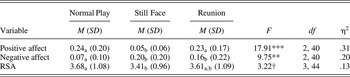
On average, infants showed normative patterns of behavioral and RSA responses across the SFP that have been found in prior research (Table 1). They were less positive during the still-face episode relative to the normal play and reunion episodes and more negative in the still face relative to the normal play episode. Consistent with other research (e.g., Weinberg & Tronick, Reference Weinberg and Tronick1996), they showed more negative affect during the reunion episode than during normal play and a carryover of negative affect from the still-face episode. Consistent with previous research (e.g., Moore & Calkins, Reference Moore and Calkins2004; Weinberg & Tronick, Reference Weinberg and Tronick1996), RSA decreased significantly between the normal play and the still-face episodes. RSA did not increase significantly between the still-face and reunion episodes but RSA in the reunion episode was not significantly different from RSA in normal play, suggesting a carryover of physiological responses similar to that observed with behavioral responses.
Mean values of infants' behavioral and physiological responses across the still-face paradigm
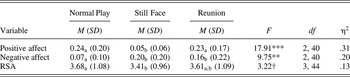
Note: RSA, respiratory sinus arrhythmia. Values with different subscripts within rows differ significantly.
†p < .10. **p < .01. ***p < .001.
Parent conflict and infants' responses across the SFP
To examine whether parent conflict was related to mean levels of infants' positive and negative affect during episodes of the SFP, separate repeated measures general linear models were tested with parent conflict, infant sex, and infant ethnicity as independent variables and episode (normal play, still face, reunion) as the within-subjects factor. There were no effects of parent conflict on infants' positive or negative affect during episodes of the SFP.
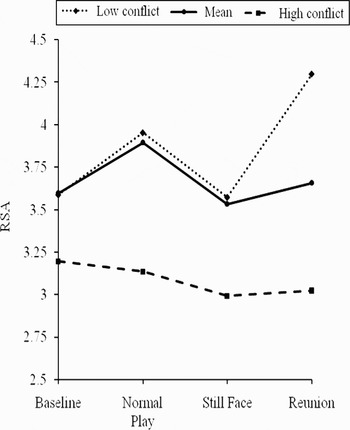
To test the first study hypothesis regarding the relation between parent conflict and mean levels of infants' RSA at baseline and during each episode of the SFP, a repeated-measures general linear model was tested with parent conflict, infant sex, and infant ethnicity as independent variables, and episode (baseline and each episode of the SFP) as the within-subjects factor. There was a main effect for parent conflict, F (1, 43) = 5.22, p < .05, η2 = .11 (see Figure 1). The interaction between episode and parent conflict was not significant, F (3, 41) = 2.32, p < .09, η2 = .15. To probe and to illustrate the main effect, infants were categorized into three groups based on the interval conflict score (low conflict = −1 SD below the mean; average conflict = mean levels; high conflict = +1 SD above the mean) and the values of RSA were plotted by level of conflict (low, average, high; see Figure 1). Pairwise comparisons identified significant differences in RSA for infants in families highest in parent conflict compared to all other infants (all p < .05), indicating that mean levels of RSA were lower at the highest levels of parent conflict during baseline as well as during each episode of the SFP.
Levels of RSA across baseline and episodes of the SFP by parent conflict.

RSA reactivity
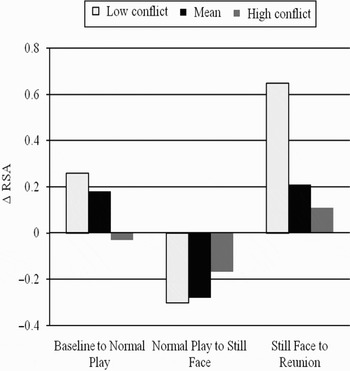
To address hypotheses regarding the degree of change in RSA in the SFP in relation to parent conflict, that is, RSA reactivity, we tested repeated-measures general linear models with ΔRSA as the dependent repeated measure, parent conflict, infant sex, and infant ethnicity as independent variables, and episode (ΔRSA from baseline to normal play, ΔRSA from normal play to still-face, ΔRSA from still face to reunion) as the within-subjects factor. There was a significant main effect for parent conflict, F (1, 43) = 5.46, p < .05, η2 = .14, (see Figure 2), with higher parent conflict related to a lesser degree of ΔRSA across episodes. Pairwise comparisons identified a significant difference between the lowest (−1 SD) and highest levels (+1 SD) of parent conflict (p < .05) in degree of ΔRSA. The interaction between episode and parent conflict was not significant, indicating that the degree of RSA reactivity was lower for infants in the highest conflict families compared to the lowest conflict families across episodes of the SFP.
Infants' RSA reactivity (ΔRSA) in episodes of the SFP by parent conflict. Positive values indicate RSA activation, and negative values indicate RSA withdrawal.

Correlations between parent conflict and infants' behavioral and RSA responses
To further describe relations between parent conflict and infants' responses, we computed correlation coefficients among parent conflict scores, positive and negative affect, RSA at baseline and during each episode of the SFP, and the ΔRSA change scores. Results were consistent with analyses of mean levels of RSA and ΔRSA. Parent conflict was uncorrelated with infants' behavioral responses. Parent conflict was negatively correlated with RSA in each episode of the SFP (rs = −.30, −.30, −.35, all p < .05 for normal play, still-face, and reunion episodes, respectively). Of the ΔRSA reactivity scores, the correlation between parent conflict and change from baseline to the normal play episode approached significance, r (48) = −.28, p = .058, suggesting that higher conflict was associated with greater RSA withdrawal from baseline to the first interactive episode of the SFP.
As post hoc analyses, the Sobel test and bootstrapping methods (Preacher & Hayes, Reference Preacher and Hayes2004) were used to test possible indirect effects of parent conflict on infant behavior via RSA, given that conflict was related to RSA and RSA was related to infants' behavior (in a few cases) even though conflict was unrelated to behavior. None of the tests were significant. In addition, relations were examined between parent conflict and mothers' positive affect and dyadic synchrony in the normal play and reunion episodes. No significant relations were found.
Discussion
To understand better the impact that parent conflict may have on infants' developing physiological regulation, this study examined the relation of parent conflict to infants' RSA regulation while interacting with their mothers. Based on prior research, we hypothesized that infants in families with higher levels of conflict would show lower levels of RSA at baseline and during episodes of the SFP, that they would show a lesser degree of RSA withdrawal in response to mothers' disengagement in the still-face episode, and that they would show an atypical response of RSA withdrawal or attenuated RSA activation when interacting with their mothers during the SFP.
The first hypothesis, that greater parent conflict would be related to lower levels of RSA, was confirmed, consistent with one previous study with infants (Porter et al., Reference Porter, Wouden-Miller, Silva and Porter2003) and with a larger body of research with older children (e.g., El-Sheikh et al., Reference El-Sheikh, Harger and Whitson2001; Katz & Gottman, Reference Katz and Gottman1995, Reference Katz and Gottman1997). Given that low RSA is generally found to be linked to disorders that involve problems with regulating behavior and emotion (Beauchaine et al., Reference Beauchaine, Gatzke-Kopp and Mead2007), these findings suggested that the robust association between parent conflict and behavior problems later in development may be moderated by ineffective RSA regulation that could be evident as early as 6 months of age.
The second question addressed whether parent conflict was related to the degree of RSA reactivity (i.e., change in RSA) in response to mothers' disengagement in the still-face episode. Mothers' disengagement is a challenge task that has been found typically to elicit RSA withdrawal in infants (Moore & Calkins, Reference Moore and Calkins2004; Weinberg & Tronick, Reference Weinberg and Tronick1996), a purported indicator that infants are engaging in effective self-regulation in response to their mothers' unavailability. We found that infants from the highest conflict families did show RSA withdrawal in response to the still face but to a significantly lesser degree than infants in the lowest conflict families. Note that in this study, RSA reactivity to mothers' still face was measured as change in RSA from the previous normal play episode rather than change from baseline, although change from baseline to a challenge task has traditionally been used as a measure of RSA reactivity. Because the SFP presents a series of distinct but contiguous social contexts and because RSA shows rapid, dynamic change to contexts, we believed that the most relevant measure of RSA reactivity was change from the preceding episode.
Because we measured RSA reactivity to mothers' still face as a function of change from RSA during normal play, results regarding RSA reactivity to mothers' disengagement should be interpreted in the context of RSA during the preceding normal play episode. The third study hypothesis that infants in families reporting higher parent conflict would show RSA withdrawal or a lesser degree of expected RSA activation during episodes in which infants were interacting with mothers (the normal play and reunion episodes) was supported. The normative response of infants during interactive episodes of the SFP is RSA activation (Moore & Calkins, Reference Moore and Calkins2004; Moore et al., Reference Moore, Hill-Soderlund, Propper, Calkins, Mills-Koonce and Cox2009; Weinberg & Tronick, Reference Weinberg and Tronick1996). However, in the current study, infants in the highest conflict families showed RSA withdrawal rather than RSA activation when interacting with their mothers during the normal play episode and significantly lower levels of activation during the reunion episode than infants in families with the lowest levels of parent conflict. This is consistent with previous research finding that 3-month-old infants who failed to show expected RSA withdrawal in response to mothers' disengagement also failed to show RSA activation when interacting with their mothers (Moore & Calkins, Reference Moore and Calkins2004).
Together with the finding that higher parent conflict was associated with a lesser degree of RSA withdrawal when mothers disengaged from interacting with their infants between the normal play and still-face episodes, the finding that higher parent conflict was associated with RSA withdrawal during the preceding normal play episode suggests that infants in the highest conflict families may have been less physiologically reactive to mothers' disengagement because they were already showing a reliance on self-regulatory mechanisms. RSA withdrawal or low levels of RSA activation while interacting with parents may suggest greater self-regulation, and we theorized that this may be due to the impact that parent conflict may have on diminishing parents' abilities to respond sensitively to their infants' needs for support in regulating arousal. Note, however, that there were no observed differences in mothers' positive affect during the SFP or in mother–infant behavioral synchrony, the only measures of parenting available in this study, in relation to parent conflict. However, measures of parenting behaviors or qualities outside of the SFP may provide more insight into relations among parenting, infants' RSA, and parent conflict, and should be included in future research.
Taken together, our findings suggested that infants in families with relatively higher parent conflict may have a diminished capacity for RSA regulation in response to challenge, based on their lower overall RSA and attenuated degree of RSA reactivity in all episodes of the SFP, and may have adapted to rely on self-regulatory mechanisms even when interacting with their mothers, based on their failure to show significant RSA activation during interactive episodes. Alternative explanations, such as infants in highest conflict families were less distressed by the still face or more distressed during normal play or reunion episodes were not supported by analyses of the behavioral data.
Whether infants in higher conflict families are likely to have negative or positive outcomes or to show ineffective RSA regulation later in development is unclear. At 6 months of age, they appeared to have adapted to rely on self-regulation even when interacting with their mothers, and this could suggest a precocious ability to self-regulate that may serve them well in environments where parents cannot be depended on to reliably provide support for regulating arousal, perhaps because of being absorbed or distracted by coping with conflict with the other parent. This would be consistent with the biological sensitivity to context theory (Boyce & Ellis, Reference Boyce and Ellis2005), which proposes a developmental plasticity of stress–reactivity systems that evolved to facilitate successful adaptation to the specific environments in which children are raised, and with the physiological toughness theory (Dienstbier, Reference Dienstbier1989; Dienstbier & Zillig, Reference Dienstbier, Zillig, Snyder and Lopez2002), which proposes that experiencing intermittent and mild to moderate stress has a beneficial effect on some biological systems.
In contrast, an overreliance on self-regulation that is already less effective (indicated by overall low RSA) may have cumulative negative effects over time. Regulatory fatigue has been demonstrated in adults over short periods of time in conditions that require self-control (Muraven & Baumeister, Reference Muraven and Baumeister2000; Muraven & Slessareva, Reference Muraven and Slessareva2003), suggesting that chronic activation of self-regulatory mechanisms could detract from resources that could be utilized to promote optimal social and cognitive development. Thus, as Gottman and Katz (Reference Gottman and Katz1989) suggested, a pattern of RSA regulation that may be an effective adaptation in early childhood, with time could become a maladaptive regulatory response.
In addition, research findings linking RSA reactivity and behavioral problems have been mixed. Although lack of expected RSA withdrawal in response to challenge situations during infancy generally has been thought to indicate ineffective regulation (Calkins, Reference Calkins1997; Huffman et al., Reference Huffman, Bryan, Del Carmen, Pedersen, Doussard-Roosevelt and Porges1998; Porges et al., Reference Porges, Doussard-Roosevelt, Portales and Suess1994; Stifter & Corey, Reference Stifter and Corey2001; Suess et al., Reference Suess, Porges and Plude1994), greater than normal RSA withdrawal was found to be associated with more anger in 3- to 5-year-olds (Donzella et al., Reference Donzella, Gunnar, Krueger and Alwin2000), and studies of older children with disruptive behavior disorders have found that low levels of RSA overall, rather than atypical RSA reactivity, are functionally related to problem behaviors (Beauchaine et al., Reference Beauchaine, Gatzke-Kopp and Mead2007). Therefore, a lesser degree of expected RSA withdrawal, relative to other children, in response to a challenge situation may not necessarily mean ineffective regulation, and normative levels of change in RSA may not necessarily indicate effective regulation. However, because baseline RSA reflects the system's capacity for effective reactivity, low baseline RSA is typically associated with a lesser degree of RSA reactivity (Salomon, Matthews, & Allen, Reference Salomon, Matthews and Allen2000). Therefore, the findings of the current study that infants in families with the highest levels of conflict showed lower baseline RSA and lower levels of RSA across episodes of the SFP than other infants suggest that these infants may be at risk for later problems in behavioral and emotional regulation.
Limitations
There are several limitations of the study to be considered when interpreting results. First, the sample size in this study precluded the power to identify significant interactions between context (episode) and level of conflict. Some findings approached significance in theoretically consistent patterns and effect sizes of the findings were moderate. Although significant findings for RSA reactivity were from comparisons of the highest and the lowest levels of parent conflict, visual inspection of the profiles of change in RSA across the SFP suggested that RSA reactivity of infants in families with the highest levels of parent conflict may have differed from average levels of conflict, in the same way that mean levels of RSA did.
Second, it is important to note that the highest levels of conflict reported in this sample, which was not selected for marital distress or conflict, were moderate levels, compared to very little or almost no conflict. Therefore, findings apply to relatively normative levels of parent conflict, given that rates of parent conflict are highest during infancy and preschool and typically subside thereafter (Belsky & Rovine, Reference Belsky and Rovine1990). In families with more intense or frequent conflict or conflict that reaches levels of physical violence, we might expect there to be more severe and lasting negative effects on children's functioning.
Third, another limitation of the study was that there was no independent measure of parenting. Thus, we do not know whether infants in higher conflict families showed RSA withdrawal or diminished RSA activation when interacting with their mothers because of less sensitive and responsive parenting. The theoretical basis of the hypotheses was that parent conflict could affect RSA during infancy because caregivers' abilities to provide sensitive support for infants' developing physiological regulation may be undermined by parent conflict. Although we were unable to measure quality of parenting in this study, the SFP afforded the opportunity to observe infants' RSA when mothers' support for regulation was available (normal play and reunion episodes) and when mothers' support was unavailable (still-face episode). In addition, mothers' affective behaviors were observed during the interactive episodes as was dyadic behavioral synchrony, but both were unrelated to either parent conflict or to infants' RSA regulation.
Irrespective of parent conflict, in the current study, we found that infants who were more negative and less positive when interacting with their mothers in the normal play episode showed diminished RSA reactivity to their mothers' disengagement, consistent with prior research finding that infants who showed RSA withdrawal when interacting with mothers were less positive and showed less behavioral dyadic synchrony with their mothers, and also failed to show RSA withdrawal during the still-face episode (Moore & Calkins, Reference Moore and Calkins2004). This pattern of findings suggests that when interactions between mothers and their infants are less positive and less mutually responsive, infants show greater self-regulation of RSA while interacting with their mothers and are less physiologically reactive to mothers' disengaging from interaction. An example of this pattern of interaction that we have observed is where a mother engaged her baby insensitively by poking roughly at his cheeks, to which the baby responded by turning his face away. The mother then used her hands to turn the baby's face back toward her and the baby became negative and fussy and tried to turn away again. However, as soon as this mother adopted the still-face, the infant relaxed and began to look quietly at his mother.
The developmental theory guiding the current research, that infants' physiological regulation may moderate the relation between parent conflict and behavior disorders, could not be assessed in the current study. Parent conflict was not directly related to infant behavior during the SFP, but parent conflict was related to RSA, and RSA was related, in a few episodes of the SFP, to infant behavior. Various tests of indirect effects of parent conflict on infant behaviors via RSA did not result in significant findings. This could be a function of sample size, although the bootstrapping method provides reliable results with small samples (Preacher & Hayes, Reference Preacher and Hayes2004).
A likely explanation for not finding associations between parent conflict and infant behavior and for finding relatively few significant associations between infants' RSA and behavior is that at 6 months of age, infants' behaviors are not consistently linked to their physiological responses (e.g., Gunnar, Mangelsdorf, Larson, & Hertsgaard, Reference Gunnar, Mangelsdorf, Larson and Hertsgaard1989; Weinberg & Tronick, Reference Weinberg and Tronick1996; Zelenko et al., Reference Zelenko, Kraemer, Huffman, Gschwendt, Pageler and Steiner2005). Therefore, associations between parent conflict and children's behavior may emerge later in development as children's physiological and behavioral responses consolidate into predictable patterns. Longitudinal research is needed to examine these developmental trajectories.
Another important limitation of the study is that there were not measures of the extent to which infants were directly exposed to parent conflict. A few of the families included in analyses were not cohabiting. It could be the case that even if children of parents who are not cohabiting are exposed to conflict less often that the conflict they do see is more intense; perhaps the parents are not cohabiting because of conflict, and, given that the noncustodial parent may be more likely to be in contact with the custodial parent only to visit with the child, it may be that conflict between the two occurs more often in the child's presence, whereas in cohabiting couples conflict may occur at other times. Questions about frequency of and exposure to conflict are very important ones that should be addressed in future research. Given the small sample size, we could not analyze differences in relation to cohabiting, so these families were included in reported results after analyses excluding noncohabiting families resulted in similar findings.
The duration of parent conflict and whether it is chronic may be another important variable in understanding developmental consequences of parent conflict. The prevailing theory is that children are sensitized to parent conflict through repeated exposure (Davies & Cummings, Reference Davies, Cummings, Cicchetti and Cohen2006). However, El Sheikh and Whitson (Reference El-Sheikh and Whitson2006) note that there is “scant” evidence regarding the effects of exposure over time, mainly because the work has not yet been done. We propose that timing in terms of developmental stage of exposure to parent conflict may be a particularly important variable for understanding the effects of parent conflict on developing biological systems. Exposure during sensitive periods may be sufficient to set a child on a particular trajectory of risk, regardless of whether or not conflict persists over time. Developmental research is needed to identify whether such sensitive periods exist and, if so, whether they coincide with critical shifts in other domains. For example, given that RSA is thought to mediate social affiliation (e.g., Porges, Reference Porges2007) and to be a function of positive engagement with the environment (e.g., Bazhenova et al., Reference Bazhenova, Plonskaia and Porges2001), does the onset of social smiling between 3 and 4 months of age coincide with important developmental transitions in RSA functioning? In future research, moderators such as timing, chronicity, frequency, and degree of exposure to conflict will be critical factors to measure. Of note, these parameters have also been relatively neglected in the larger body of research on marital conflict and older children.
There are several caveats when interpreting research findings on infants' vagal tone. It is important to take into account individual differences in reactivity; some individuals respond with parasympathetic (e.g., vagal tone) activation, some with sympathetic activation, and others with activation of both systems (Berntson & Cacioppo, Reference Berntson, Cacioppo, Cacioppo, Tassinary and Berntson2007; Quigley & Stifter, Reference Quigley and Stifter2006) and infants may also show patterns of individual differences that are not apparent when studying only RSA. Therefore, conclusions regarding whether the infants were regulating and, if so, how effectively they regulated, are tentative. Because there are methodological limitations on the ability to measure both parasympathetic and sympathetic responses in early infancy (Fox, Schmidt, Henderson, & Marshall, Reference Fox, Schmidt, Henderson, Marshall, Cacioppo, Tassinary and Berntson2007), researchers may need to rely on behavioral indicators of reactivity. Two important directions for future research would be to identify groups of infants with distinct patterns of behavioral and physiological responses across the SFP or other challenge tasks and to follow the developmental trajectories of these groups of children with an emphasis on outcomes in early and middle childhood, when most of the research on the consequences of parent conflict has been conducted.
In summary, the current study suggested that moderate levels of parent conflict are associated with low levels of RSA, a physiological risk factor for later problems with behavioral and emotion regulation, as early as 6 months of age. Parent conflict may also result in an adaptation of greater reliance on self-regulation rather than on parents to provide structure and support for infants' regulation. Whether this adaptation is protective or maladaptive in the long term requires further study.