Introduction: of waste, precarity and the city in late capitalism
On the outskirts of Ghana's port city of Tema, the crew at Ashaiman's rubbish dump spend hours sorting. Besides offloading the waste once it arrives, packing it into the dumpster and shovelling the fallout, they sift through the contents of each delivery, carefully dividing items by composition, condition and value. The items are roughly sorted near the dumpster. Whatever can be salvaged or otherwise recycled and resold is brought over to the sorting bays – a collection of old tubs and dismembered refrigerators – to be worked over, divided up again, and moved forward in the next step of de- and re-composition.
Idriss, from northern Ghana, and his colleague Dogo, who harks from Niger, are working the sorting bays. They break, separate, crush and compact the waste they encounter. Each bay is reserved for a different material or type of item. There are piles behind them, mostly fragments of plastic buckets, cups and bowls and the sundry other items made out of what Ghanaians refer to as ‘rubber’. Idriss and Dogo sort through the discards and pack similar items into large sacks. Idriss wears work gloves along with a sporty pink watch, both retrieved at the dump. He folds, stomps on and compresses the various pieces so that they can fit into the narrow bag, inspecting each item along the way to see how best to reshape it. After a couple of hours, Idriss and Dogo carry the bags over to Marco and the weigh station at the edge of the dump. Heavy, rough-hewn logs form a scaffold with a rusty spring scale. Marco stays in place as Idriss and Dogo haul the bags onto the hook. The bags are hefty, weighing forty to fifty pounds. Marco enters the weight into his mobile phone, which he also found among the trash. The young men are paid per weight regardless of the content, freeing Marco to sell the bags up the waste-processing chain.
In addition to plastics, the sorting bay of Ashaiman's Waste Transfer Station – the dump's official name – are filled with metalware: bowls, pots and pans, umbrellas, and discarded housewares of all sorts. Reflecting the historically specific terms of global manufacture and commodity circulation, there are electronics such as Marco's phone, television and computer screen parts, and a radio the guys test, along with paper and tons of cardboard boxes used for packing consumer goods. Apart from the few items made in Ghana and neighbouring Nigeria, such as the ubiquitous West African flip-flop, it is the detritus of more far-flung global flows. Mirroring consumption habits but also conditions of production and exchange, most of the goods are made in China. They also come from the Middle East, North Africa and Dubai – wherever they are lowest in price, quality and transport costs.
In this sketch of the sprawling, working-class city of Ashaiman, it is apparent that not only do cities hold different positions in the global capitalist order (Sassen Reference Sassen2002), so do their residents and the waste they generate, discard and disassemble. Ethnographic evidence from Ashaiman's dump suggests that waste and waste labour, due to their very precarity, are crucibles of late-capitalist contradiction as well as recalibration. Indeed, a view from the global urban periphery demonstrates late capitalism's open-ended outcomes in social, material and systemic terms. In Ashaiman, as in other cities of the global South, this is because urban waste concentrates the assured yet unstable after-effects of global overproduction, offering both novel possibilities and risks for the equally insecure urban precariat. Here we see what can be described as a ‘dialectics of precarity’, where the precarity of labour's objects and subjects converge within the unsettled space of the dump.Footnote 1 Transfused across bodies, goods and infrastructures, their dialectical play evinces more than just structural realignment.Footnote 2 New material configurations, value formations, social positions and labour practices are engendered, each with its own possibilities and contradictions.
This reading of late-capitalist waste work challenges the presumed divide between old and new materialist outlooks in social theory, the former focused on labour, class and human action (Marx Reference Marx1967), and the latter on objects, networks and non-human agency (Latour Reference Latour2005).Footnote 3 Co-constituted at the nexus of human and non-human amidst the intersecting forces of structural overdetermination and radical insecurity, a dialectic that is thoroughly relational at the level of analysis and ontology (Ingold Reference Ingold2008) is apparent in Ashaiman's dump.Footnote 4
Configured in this way, the work routines of Dogo and Idriss and their compatriots in Ashaiman provide a window onto the co-production of surplus labour and surplus value under late capitalism in less industrialized locales and the life worlds that emerge out of their conjuncture. These young men, like many other across the continent and across the world, belong to the ranks of an increasingly unanchored, able-bodied population excluded from both rural agricultural endeavour and urban waged work.Footnote 5 As they labour over and within the waste of others at Ashaiman's dump, intensified consumption and decomposition of commodities provide an opportunity to build lives and livelihoods anew. Supplying a means of socio-economic attainment, these conditions nevertheless dramatize the realities of profound economic insecurity, where the potential for accumulation is ever present yet largely fleeting due to the accelerated pace of physical and material breakdown.
The analytical impulse driving this inquiry into the lived conditions of urban waste work as a window on contemporary capitalism is multiplex. If late capitalism's global advance renders economic precarity the rule rather than the exception (Neilson and Rossiter Reference Neilson and Rossiter2008), it is essential to comprehend the precise contours and trajectories of precarity as a social condition. Not all precarity is the same (Munck Reference Munck2013): late capitalism may be expansive and fundamentally uneven, but it is also variegated, taking different forms in different places, reflecting distinct histories, resource endowments and political arrangements (Scully Reference Scully2016). Also, if precarity is the ‘new normal’ (Weeks Reference Weeks2015) on which the future stands, it is critical to understand the possibilities of precarity in specific locations and lives (Allison Reference Allison2012): that is, what do people make of precarity? What are the different ways in which people live with and within precarity? And what are the terms and limits of precarity's transformative possibilities?
The dense precarity of Ashaiman's waste dump – of its objects and labouring bodies – forces an examination of these processes in concrete terms. At the dump, following Muehlebach's (Reference Muehlebach2013: 298) call for a ‘phenomenology of precariousness’, it is possible to move beyond both structures of feeling and structures of practice to encompass the visceral world of precarity via the entanglements of surplus bodies, surplus things and surplus urban spaces. Bringing the investigation of the ‘relationship between precarious labor and precarious life’ (Millar Reference Millar2014: 35) full circle, here the optic includes a close reading of the precarious objects and precarious infrastructures in which lives and labour are embedded.Footnote 6
Putting Ashaiman's waste in its place
Ashaiman's urban existence is a direct outcome of global capitalism's mid-century expansion. The settlement emerged as an offshoot of Ghana's port city of Tema. Born of decolonization and post-Second World War modernization, Tema was designed to secure the new nation's position on the international stage through its industrial complex, shipping harbour and planned middle-class communities (Chalfin Reference Chalfin2014; d’Auria Reference d’Auria2010; Doxiadis Reference Doxiadis1975). People from across the sub-region flocked to the area. Loosely classified as ‘Northerners’ and ‘Nigerians’, they were traders, tradesman, skilled and unskilled labourers straddling the formal and informal sector (Hart Reference Hart1973; Peil Reference Peil1974; Reference Peil1976; Pellow Reference Pellow2008). Largely males, they settled in Tema Zongo, the ‘strangers’ quarter’ of the indigenous fishing village slated for demolition (Butcher Reference Butcher, Amarteifio, Butcher and Whitman1966: 31). Although the new city's realization depended on migrant labour, housing was inadequate to meet demand. There were few workers’ camps and the resettlement area was designated for Tema's ‘original’ inhabitants, not Zongo residents.Footnote 7
To fill the gap, the wilds of Ashaiman, six miles from the heart of the planned city, were posed as an alternative for the migrant working class. With a population of 185 in 1948, it was referred to in government documents simply as ‘Mile 17 on the Accra–Ada Road’ (Butcher Reference Butcher, Amarteifio, Butcher and Whitman1966: 25, 31). Displaying the barest outline of formal order, the new settlement was little regulated by government authorities (Peil Reference Peil1976). Foreshadowing the significance of Ashaiman's waste matters in the present, the original structures were wrought from Tema's rubbish. Ashaiman's first urban chronicler writes:
The 1960 census recorded 299 houses and 2,624 residents, most of whom had been removed from the Old Tema Zongo. The fortunate among the immigrants were permitted to salvage building materials after the bulldozers knocked down the old houses. Of the householders allocated plots at mile 17, of these 95% wanted houses built of iron sheets [salvaged] from Old Tema. (Butcher Reference Butcher, Amarteifio, Butcher and Whitman1966: 25–6, 31)
In short, Ashaiman was a near perfect illustration of Marx's (Reference Marx1967: 600) ‘general law of capitalist accumulation’. It was a space for the evacuation of surplus persons and materials and a pool for extraction of the surplus value on which the new nation's engagement of global capitalism depended.
Fifty years hence, Ashaiman is no longer a dependency of Tema. Gaining autonomous municipal status in 2008, Ashaiman is among Greater Accra Region's main migrant catchment areas (Kissieh Reference Kissieh2007; Owusu and Oteng-Ababio Reference Owusu and Oteng-Ababio2015). The city is marked by mobility and accelerated flows of people and goods from a broad arc of ‘elsewheres’. A booming market town where everything is for sale and nearly everyone for hire, those who gather here envision Ashaiman as a gateway to economic opportunity across the entirety of the capital region. In 2010, the city's recorded population reached 250,000, more than tripling its 1995 population of 75,000 (Owusu Reference Owusu1999).
Hard to count because of its transience, Ashaiman's unanchored populace remains predominantly male and continues to draw from an expansive region extending across West Africa (cf. Peil Reference Peil1974; Reference Peil1976). Among the fastest growing areas of the city is the neighbourhood known as Mali Estates, a mix of long-established and newer émigrés from Mali and Niger. Kissieh, an urbanist who has worked in Ashaiman since the early 2000s, described the constant influx of people into the area: young men who disembark from the market lorries by the dozens each day, ‘sleeping rough’ while they search for work, mates and prospects of wealth. Like earlier inhabitants of Tema Zongo, they furnish capital with an ‘inexhaustible reservoir of disposable labor power’ (Marx Reference Marx1967: 602). Yet with waged and formal-sector employment in deep decline and rural dispossession and de-agrarianization on the rise across the region (Berry Reference Berry2009; Lund Reference Lund2008), they are, in the terminology of neo-Marxist theorist Bauman (Reference Bauman2004: 5), the ‘excessive and wasted’ workers of late modernity, firmly in the ranks of the global precariat. Largely extraneous to late-capitalist production, this vast corps of unanchored persons is a consumer class nonetheless. Mirroring their livelihoods, they subsist on the temporary and the disposable. Their daily lives revolve around packaged meals purchased and eaten on the street, single servings of soap, cigarettes and water sachets, along with pay-per-use public toilets and bath houses, short-term jobs and unstable accommodation (Chalfin Reference Chalfin2017).
Although Ashaiman was created as a repository for the marginalized and remains so, the city is also the locus of socio-economic attainment and upward mobility. Complicating the image of wholesale urban abjection, and indicating Ashaiman's shifting standing in the national and international order, people can and do prosper here. Revealing the play of urban transience and situated accumulation, beyond the original cluster of zinc shacks at Mile 17 is a sprawling urban agglomeration with a range of income brackets. From shanties to well-planned compound houses and stylish single-family homes, Ashaiman's congested commercial core gives way to suburban-style settlements with all the typical markers of economic attainment: satellite dishes, flush toilets, private vehicles and sleek housing finishes.
Exercising the purchasing power of disposable income, more affluent urban residents make quotidian use of imports and commodities formerly considered luxuries and invest in consumer and leisure items. In their consumption habits, Ashaiman's upwardly mobile social strata are vulnerable to a different sort of economic insecurity than the footloose underemployed, but it is precarity all the same. Namely, they pursue expenditures in the world of goods but their purchases are of questionable durability in the wake of overproduction, easy credit and the rapid intercontinental transportation characteristic of late capitalism (Harvey Reference Harvey2010).Footnote 8 As Bauman (Reference Bauman2004: 96) notes: ‘Liquid modern life is the daily rehearsal of human transience. Today's useful and indispensable objects, with but few exceptions, are tomorrow's waste. Everything is born with the branding of imminent death.’
The centrality of waste within urban life is intensified by Ashaiman's new governance structure. Waste-management services are no longer provided by Tema's municipal authorities: the city is accountable for its own waste (Ghana Government 1999). Under the dispensation of administrative decentralization, residents, transients and officials alike must grapple with the intersecting undersides of late-capitalist connectivity, status mobility, and material decomposition and disposability. At the dump, the negotiation of these varied material circuits and breakdowns takes vivid form. Above all, surplus labour and surplus value find common ground. With each element unstable in its own right, the dump, belying Idriss's and Dogo's quotidian work routines and carefully sorted piles of waste, is a space at once overdetermined and full of possibility.
The official purview of Ashaiman Municipal Assembly (ASHMA), the dump occupies a boggy tract bordering the forested buffer zone of the Accra–Tema motorway. It is an eyesore, dusty and foul-smelling. A sea of trash extends from the mass of overflowing dumpsters to the treeline. Cows roam between the garbage piles, the dilapidated structures, and the trucks and carts coming and going. Trash from Ashaiman's households, shops and market stalls comes here before being hauled to an engineered landfill at the district's edge. In the parlance of waste-management professionals, the site is considered a ‘secondary collection point’ where rubbish is amassed after removal from ‘primary collection points’ such as households, businesses and communal dumpsters (Oteng-Ababio Reference Oteng-Ababio2011: 552).
Waste workers operate within officially managed and sanctioned infrastructures. This is in some ways akin to Dakar's quasi-formalized waste economy (Fredericks Reference Fredericks2018), but in contrast to the housewives mobilized and ultimately disabled by urban authorities in Dakar, in Ashaiman young men utilize waste work to pursue their own uncharted social and economic potentials. Although the conditions of waste work are not their own, Ashaiman's young male dispossessed maintain control of their own labour and much of the detritus of the dump. In doing so, they continually strive to configure durable social trajectories through their interactions with one another and with spent things.
With the municipal authority exercising command but by no means full control, the dump is managed by Zoomlion, a large private waste collection firm holding municipal waste contracts throughout much of Ghana (Hanson Reference Hanson2012). Targeting working-class residents from the local area, distinct from the migrants who work informally, Zoomlion's employees are considered formal-sector workers. Attesting to the ever critical role of the informal sector in urban waste management, even as cities grow and governance structures are rationalized (Oteng-Ababio Reference Oteng-Ababio2010: 328), their labour is indispensable both to Zoomlion and to the city authorities, who need to keep the overburdened transfer station operational.
Demonstrating the interdependence of state and statelessness in the operation of urban infrastructure, the municipality has a representative at the site. Today, Churchill is working. Exercising loose territorial oversight, he is the site supervisor and collects tolls from all who bring waste to the transfer station. Zoomlion employees are primarily attendants, directing traffic and monitoring the workflow, and collecting a nominal levy of their own. Throughout the morning and early afternoon, traffic moves in and out of the dump. There are Zoomlion's trucks, along with Zoomlion workers who bring loads by bicycle trailer. They are joined by another tier of informal trash collectors who come with pushcarts; these are known as ‘bola-boys’ or ‘kaya-bola’ (trash carriers) in the local parlance – a mix of Twi and Hausa languages (Oteng-Ababio Reference Oteng-Ababio2010: 324).Footnote 9
According to a Danish non-governmental organization (NGO) operating in the area, about 60 per cent of the waste is organic matter. The rest is inorganic and thus fair game for reclamation by the cadre of waste workers who in the same transaction sell their services and purchase the right to sort through municipal discards. They offload and dispose of the trash for a fee of one or two cedis (approximately US$0.50) per job. Working alone and in pairs, the young men unload and sort the trash, recycling, reusing and reselling whatever they can. Although the work is physically demanding and requires a tolerance for the grime, decay and bodily risks of waste handling, it is ultimately profitable. It is possible to make fifteen to twenty cedi (US$5–10) or more per day. Earlier surveys from the Greater Accra Region, which includes Ashaiman's transfer station, indicate that: ‘Scavengers average between $7USD and $17USD per day depending on items recovered and market trends’ (Rockson et al. Reference Rockson, Kemausuor, Seassey and Yanful2013: 148). For a single male in Ashaiman, this is a respectable wage, providing enough for food and daily living expenses along with a small surplus to send home or with which to purchase clothes and more expensive items such as phones and used motorbikes, if wisely managed.
Who works waste?
The young men working at the dump range in age from mid-teens to mid-twenties. A distinct class fraction, they are at the forefront of twenty-first-century West Africa's ‘floating surplus population’ (Marx Reference Marx1967: 600). Their mobility is symptomatic of the intensifying struggles for social reproduction faced by young males across the continent due to agrarian decline and land loss coupled with political instability, militarization and the perils of mineral extraction (De Boeck Reference De Boeck2004; Ferguson Reference Ferguson2013; Hoffman Reference Hoffman2011; Makori Reference Makori2017; Newell Reference Newell2012). Showing how Bauman's (Reference Bauman2004) grand category of ‘wasted lives’ masks specific experiences, some weather the crisis in place, others pursue strategies of mobility, and some do both. Whether or not their displacement is solely compelled by the forces of late capitalism, like the young men at the Ashaiman dump, once in motion they are forced to confront its limit conditions (Cross Reference Cross2013; Lucas Reference Lucas2006).
Of the dozen or so waste workers with whom I interact at the dump, a few are from northern Ghana. Idriss, wearing a Ghana football jersey, is from Bimbilla, near the Togo border. Isa's family is Kotokoli and hails from northern Togo. He is one of the younger labourers at the dump and was born in Hohoe in the northern reaches of Ghana's Volta Region. Talu, a recent arrival, is from the Kabre area in northern Togo. Dogo, Abdul Karim and Salam are all from western Niger, not far from Mali, and share the Zabarma language and heritage. Hausa, the closest thing to a lingua franca and the language of our interviews, was acquired by Dogo and Karim while working in the markets of southern Nigeria (cf. Peil Reference Peil1974: 370). In Nigeria, Dogo explains, he was a kayaya, or carrier, offloading and unpacking goods for Ibo merchants. Another Zabarma man is from northern Nigeria, born to a Malian mother. Jonah, from across Ghana's western border, traces his roots to Côte d'Ivoire and the Abidjan working-class neighbourhood of Treichville, where he completed primary school before relocating to Ghana.
In most of the world, waste work is associated with low social status or specific castes (Furniss Reference Furniss2012; Gidwani Reference Gidwani2013). In West Africa, waste is often considered the purview of migrants or other minority groups (Fredericks Reference Fredericks2018). In Ghana, waste work has long been associated with ‘northerners’ (Oteng-Ababio Reference Oteng-Ababio2011: 553), including the ‘Fra-Fra’ night-soil carriers often mentioned in the classic literature on Ghana's informal sector (Hart Reference Hart1973). Given that a high percentage of Ashaiman's residents are newcomers, and that they and those with a longer history of settlement hark from across West Africa, the ‘permanent stranger’ designation rings false in Ashaiman. Here, rather than reflecting cultural or geographical identity, waste work appears to be a stage in a wider arc of socio-economic mobility for young men from a range of regions and backgrounds. Indeed, just as the nature of capitalism has changed, so too has the character of waste and the standing of the waste worker.
Nigeriens are demographically dominant. Rahman, one of the Zoomlion attendants, himself from northern Ghana, remarked: ‘They are here plenty. A lot of them came and did the bola [garbage] work for a long time and went back to their home town. The folks I'm seeing now are somewhat new. The ones who came earlier learned how to ride the motorbikes.’ In Hausa, he says, ‘Bukatan so yaabaiya’ (‘They got what they wanted and returned’). Some of the young men have been around for a while. Others, like the young man from Kabre, arrived within the past couple of months. Indicative of the inclusiveness and moral grounding of this occupational niche, despite its relatively atomistic organization and limited cultural core beyond a nominal Muslim ascription, Rahman explained:
The Kabre guy when he came told us he wanted to work. We gave him a chance because ‘modokagudani’ [a Hausa expression meaning ‘we are all brothers’]. He came not quite long ago and he didn't know anyone. He was speaking French. I didn't understand. Someone asked him what he was looking for. He made a gesture that he was looking for a job. Then we gave him the go-ahead.
Marco, somewhat older, is identified as ‘the boss’. He is at once representative, ringleader and go-between. According to the younger men, Marco gets paid a couple of cedis when one begins working and decides who does what. Most importantly, Marco holds the right of resale over the recyclable waste collected, paying those who assist him with sorting, breakdown and bagging.Footnote 10 Besides people's assent to Marco's exactions and baseline moral code of inclusion, work at the dump hinges above all on a willingness to dive into its overwhelming materiality. Workers must be able to balance on the nine-feet-high container walls lifting bags of waste in rapid succession and stand atop the waste piles within the containers to ensure that they are properly compacted – all the while tolerating the noxious scent, unstable footing, and risk of fall, infestation and infection.
Just as trash moves from the specificity of household property to the generic entity of urban waste, the workers must surrender their bodies to the filth, disorder and material excess of the work environment to benefit from it. Signalling a conceptual merging of body, waste and wealth, in Idriss's words: ‘Any kind of work is work.’ Belying this quest for the uncomplicated commensurability of different value forms, in relation to rubbish collection in Dakar, Fredericks (Reference Fredericks2018) notes that the material and sensorial excess of waste is matched by the arduous physicality of waste labour. As affirmed by Millar (Reference Millar2018), in the dumps of Rio waste work comes with the attendant risks of illness, injury, exhaustion and bodily breakdown. Here, we see the critical yet fragile connection of labouring bodies and disposable things, both of which, in the words of Millar (ibid.: 14), are multiplex ‘forms of life’.
At Ashaiman's dump, risk is central – just as it is on the floor of the Chicago Board of Trade as described by Zaloom (Reference Zaloom2004), a vastly different locus of late capitalism. While the dump is marked by directly embodied risks rather than abstract financial risk, both are sites of speculative rather than directly productive endeavours, where wagering on uncertain futures is all important. Leveraging indeterminacy, they are spaces where successive rounds of speculation pay off – providing more chances for gain, allowing for a better reading of the odds, and prompting the reconsideration of what counts as value. As Beuving (Reference Beuving2016: 163) describes with reference to other situations of dislocation shaped by the distinctive risks and opportunities of late capitalism on the continent, at the dump Ashaiman's waste workers straddle the double edge of marginality: it is simultaneously ‘a site of human tragedy and … one where unexpected things can happen’.
Bringing waste back to life
In its material variety and density, the dump is an inversion of the marketplace. In battered, broken-down form, it contains the common stock of the households, chop bars, shops and table-top provision and food stalls that line Ashaiman's crowded streets and alleyways. Nothing says more about class and consumption than the material evidence of waste, as archaeologists well know (Rathje and Murphy Reference Rathje and Murphy1992). Reflecting the diets of Ashaiman residents along with their values, work schedules and aspirations, there are tomato tins ranging in size from single-serving to extra-large, sardine and mackerel cans, corned-beef containers, empty bottles and jugs for cooking oil, milk and Milo tins, soft-drink cans and bottles, in addition to countless plastic water bottles, already reused many times. A point equally appreciated by archaeology, bringing past into present, the inversions of waste are temporal as much as material. Thus waste work, though driven by the desire to make futures, is implicitly past-due, attaching to what might be, what has already happened.
The mark of the past on post-consumer waste also applies to its post-industrial counterpart. Industrial discards crowd the sorting area: wood, metal, wire, pipes, spare parts. I notice several bags of motorcycle batteries beside the sorting bays. Bauman (Reference Bauman2004: 27) states that ‘waste is the dark shameful secret of all production’, but at Ashaiman's dump, production is the secret brought to light by waste. With whole neighbourhoods devoted to car and motorcycle repair, Ashaiman is a semi-industrial space. It hosts a workforce able to fix, fabricate and reassemble car and bike parts and consumers hoping to buy them for a minimum price and a modicum of operability. Ashaiman is a prime market for second-hand consumer goods, since it is near Tema port, where they are delivered in vast quantities (Chalfin Reference Chalfin2010). The fridges, television sets and sound systems eventually turn up, in pieces or whole, at the dump. Similarly reflecting global flows catering to the growing population and increased prosperity, Ashaiman's streets are lined with shops and stalls selling building materials. The remnants – boards, tiles, paint, hardware, security gates – are visible at the dump.
Together, these permutations reveal the status of precarity as both a general feature of late capitalism and specific to commodities, locations and labour forms. Shaped by globally mobile things and consumption standards, in the palimpsest of the dump it is apparent that accelerating in step with residents’ aspirations and purchasing power is the ‘cruel optimism’ (Berlant Reference Berlant2011) of material decline. Rendering the functionality and possession of consumer items all the more fleeting, the accessibility of these goods is afforded by their diminished quality and likely breakdown. Exemplifying a generalized state of precarity wrought by late capitalism's untrammelled advance, these conditions reflect the tenuous promise of global economic integration and socio-economic mobility in working-class cities of the global South such as Ashaiman, poised on the margins of survival and expanded reproduction.
Nevertheless, the material failures of global capitalist flows are full of possibility for those who glean a livelihood via waste. Heightened consumption and hastened breakdown augment the range, volume and speed of items moving through the dump. There is more waste to process and more money spent by municipal authorities and waste-management firms on the services of informal waste workers. ‘Excess value’ is made available when the general precarity of consumption is married to precarities specific to waste workers and spaces of waste work, material disassembly and breakdown. Encapsulated in Bataille's (Reference Bataille1988) notion of ‘le part maudite’ (the accursed share) as opposed to surplus value extracted from the labour of others as per Marx (Reference Marx1967), this is a form of value released in the process of destruction. It is a core feature of Bataille's (Reference Bataille1988) discussion of ‘general economy’, which recognizes waste's centrality to expanded reproduction and status attainment. Attending to such transformations and interconnections in relation to Indian urbanism, Gidwani (Reference Gidwani2013: 781) speaks of ‘a waste/value dialectic that brackets the capitalist dialectic’. In this nexus of late-capitalist overdeterminations and the indeterminacies of waste, the possibilities of precarity open up. While it does not offer the ‘affirmative precarity’ evident in artistic subversions of precarious landscapes (Davidson Reference Davidson2013: 128), new experiences, perspectives and material positions emerge.
By engaging such ‘dialectics of precarity,’ alongside opportunities for income generation, a secondary stream of self-making is possible at the dump. Exposed to the general precarity of things, the young men working Ashaiman's waste site gain intimate knowledge of the trappings of socio-economic attainment through their visceral encounters with the inventory of material possibility. Here, the interplay of waste's excessive materiality and the intensive nature of waste labour mentioned by Fredericks (Reference Fredericks2018) begets social and symbolic value. A case in point: those working at the dump report that they can identify the status of people based on what is found in their garbage. Dogo asserted, ‘We can see if the garbage comes from the house of a rich person,’ stating rhetorically: ‘Isn't it the rich person who drinks plenty of Ideal milk?’ Dogo's is a materialized imaginary based on intimate knowledge of things, not abstract desire.
Waste workers such as Dogo bear physical witness to the vast magnitude and inevitability of material breakdown, day in and day out. Occasionally, they attain the actuality of material possession. There are everyday finds of limited value, such as Idriss's watch, or the bracelet spotted by Rahman that he first offered to me and later decided to give to a friend as a gift. Further fusing aspiration, signification and waste's materiality, there is more substantial treasure for the taking. When asked about their finds, the waste crew mentioned pen drives and phones. Reversing the usual temporality of waste as past-due, they shared a collective memory of ‘unexpired champagne’ that they drank at the dump. Adding to the lore/lure of waste work, without specifying where or when, workers reiterated a tale of 2,000 cedis (about US$1,000) found in a black plastic bag. These mystery finds, seemingly propelled by their own vitality, signify a fetishism of waste (Marx Reference Marx1967). What is animated, however, is not productive labour lodged within, but consumptive excess twice released.
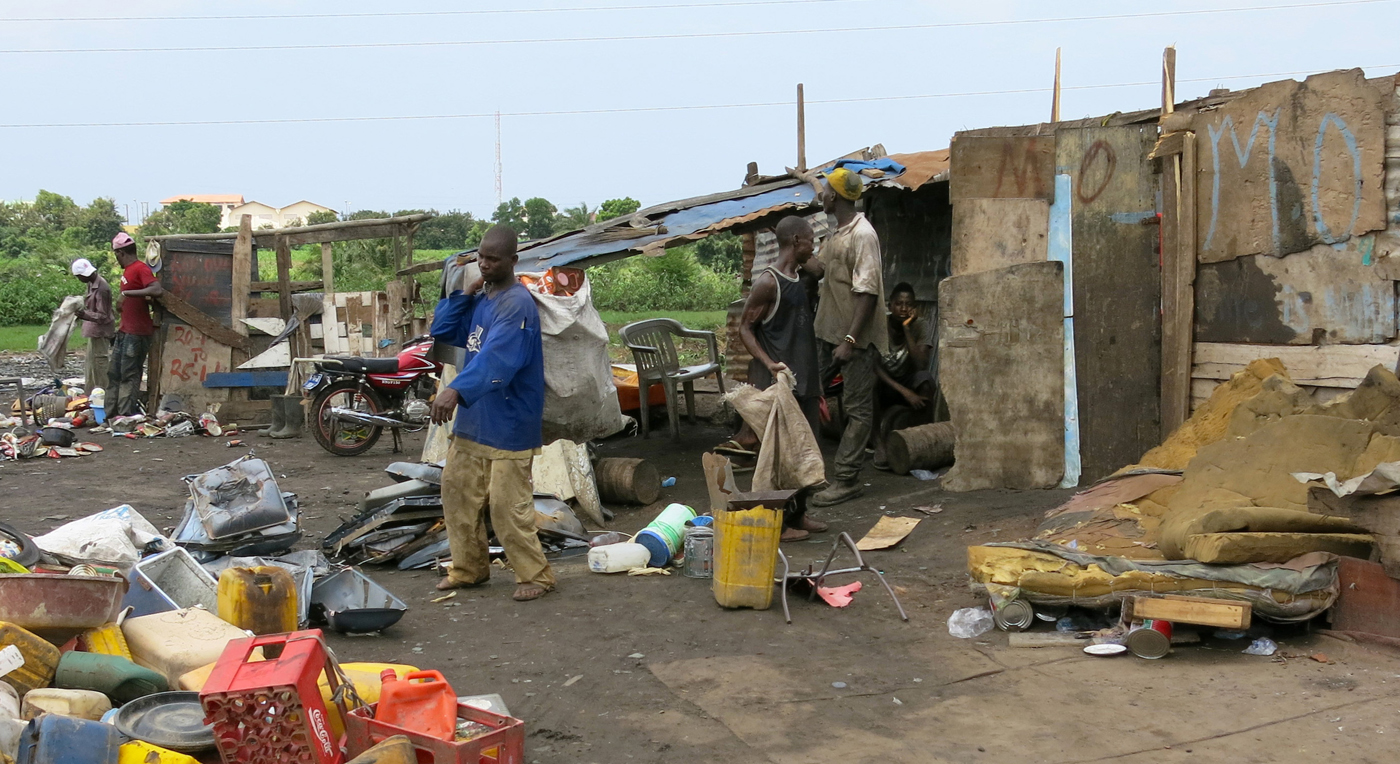
Premised on vicarious possibility, even in the absence of such spectacular finds, waste work can contribute to improved living standards – or at least an approximation of them. When I returned after a year-long absence, I immediately noticed an array of new structures adjacent to the sorting bays. The exterior resembled the type of compound house popular in rural areas and working-class urban settlements. There was a wall around the entire structure, a swinging gate and a veranda. The structure was assembled from wood scraps, tarpaulins and rusted, graffiti-covered sheets of corrugated zinc – perhaps not too different from the cast-offs from Tema Zongo carted by city authorities to Ashaiman's Mile 17 in the 1950s (see Figure 1).
Fragile domesticity and the afterlives of discard. Presby Junction Waste Transfer Station, Ashaiman, Ghana, July 2014. Photograph by Eva Egensteiner.

A truck hood formed the veranda's front wall. The shaded space held a few plastic chairs and a radio suspended from one pillar just high enough to reach while sitting. There was a clothesline and a dog kennel with a latched gate, roofing and feeding bowls. Around the corner was a curtained doorway marking the entrance to a bedroom, where foam mattresses were piled in a corner. The worksite and mounds of sorted trash were a few steps away. Like a scene of deconstructed domesticity fuelling its own aspirational reassembly, there were dedicated piles for television frames, buckets, jerrycans and buta (plastic teapots used for ablutions before prayer), with suitcases and sleeping mats salvaged from the mix. The structure vividly embodied the dialectical life world of precarity. Fully inhabited yet fraught with ontological indeterminacy, the dwelling was at once an imagined whole and a disjointed ruin. Displacing the ‘cruel optimism’ of Berlant (Reference Berlant2011), in this transduction of bodily labours, material aspirations and past lives, the dialectical dis- and re-assembly of waste in Ashaiman begets a ‘fragile realism’ that pushes the limit conditions of lived possibility.
Disposable things, vital relations
In contrast to their makeshift homestead and the surrounding mounds of ephemeral things, as Dogo and Idriss work it is hard not to notice the force they exert in breaking down each pile of discarded items. Similar physical endurance and agility are required to balance on the dumpster's edge, climb from the waste cart to the top of the waste pile, gather the fallout and hoist it high into the dumpster. Here, the breakdown of things instigated by late capitalism's accelerated rhythm of creative destruction – a rhythm that is necessary for waste workers’ wealth accumulation – depends on bodily fortitude. Indeed, the operability of Ashaiman's waste-management system hinges on the resilience of the collectively ‘embodied infrastructure’ (Simone Reference Simone2004) of the dump's youthful workforce even as they are exposed to the dump's material, physical and moral degradations.
Such embodied transformations of and through infrastructures are at work across the continent, demonstrating a similar ‘relational ontology’ (Ingold Reference Ingold2008). They are found among the cadres of young men inhabiting Kinshasa cemeteries (De Boeck Reference De Boeck2004; Reference De Boeck, Dehaene and De Cauter2008) and those who build and readily abandon the portable architectures of Congo mining colonies (Makori Reference Makori2017), as well as the ex-combatants who repair and reside within the ruined edifices of Sierra Leone's and Liberia's urban war zones (Hoffman Reference Hoffman2011; Reference Hoffman2017).Footnote 11 The precarity faced by young men in Ashaiman, however, differs from the near total exclusion of Congolese youth from productive citizenship or the intensive exploitation of Sierra Leone's and Liberia's youth army by the ‘war machines’ of late modern state building. Ashaiman's workforce instead forgoes the promises and perils of intensive violence and resource extraction and the endemic insecurity of self-formation in the face of near total political collapse for the mere uncertainties of underemployment and exposure to the chronic physical risks of waste work in the more politically stable and consumption-driven Ghana (Chalfin Reference Chalfin2010).
In another regional variant of male social reproduction under acute precarity, in contrast to the unemployed men of urban South Africa who look to government-issued basic income grants for status and sustenance (Ferguson Reference Ferguson2013), in Ashaiman the ‘accursed share’ (Bataille Reference Bataille1988) of late-capitalist surplus is not freely given but must be extracted from waste. Nevertheless, in some respects similar to South Africa, in Ashaiman it too is pursued under the auspices of Ghana's privatizing state (Chalfin Reference Chalfin2010). Although the status displays and aspirations of Ashaiman's waste workers are more veiled than those of the fashion-savvy flâneurs of Abidjan, who are their neighbours and age-mates (Newell Reference Newell2012), they likewise bet their future on the fleeting possibilities of an intensely emplaced yet globally inflected consumerism. Here again we see the critical value of ‘self mastery under conditions of hazard’ (Zaloom Reference Zaloom2004: 366), at once entirely different from the futures markets of Chicago and eerily parallel.
Amid the physical exertions of breaking down and disassembling Ashaiman's discarded items, Dogo and Idriss engage in sporadic conversation and help one another as needed. My research assistant – like the waste workers, also in his twenties – casually quizzes them about their long-term plans. Do they remit money to those back home? Do they frequent Ashaiman's well-known prostitutes’ row? Are they preparing for marriage? Laughing off more intrusive queries, Dogo explains that he and his Nigerien compatriots regularly dispatch funds, taking advantage of the movement of friends and relations along the north–south migration and trade corridor.
In these retorts, another kink becomes apparent in the assumed order of capitalist things brought about by waste workers in Ashaiman. Not only does the durability of their labouring bodies supersede that of things; by pushing forward the disassembly and breakdown of material objects, their labour is ultimately geared towards building and maintaining inalienable social ties – what might be termed social durables (cf. Weiner Reference Weiner1992). For the young men at the dump, turning loss into gain and concrete labour into social connection is a move that simultaneously accepts and rejects the perils of commodification. Revealing again the ‘dialectics of precarity’ in relational terms, these investments affirm the tricky capacity of waste, due to both its excess and its ambiguity, to span multiple registers of symbolic and material value for those bold or desperate enough to take it in hand.
This glimpse from the periphery of global capitalism and from the bottom rung of the ladder of material attainment muddies the more conventional structuralist reading of accumulation and dispossession under late capitalism (Bauman Reference Bauman2004; Harvey Reference Harvey2010). For Ashaiman's waste workers, the successive dispossession of others (first through the monetization of their own alienated labour, then by its investment in the alienated labour contained within a commodity, and finally through the hasty dissolution of the commodity's material form) is their means of sustenance and material gain. This trajectory of material breakdown enables the fantasy of consumption, providing real and imagined access to valuable things. Waste work in Ashaiman similarly confounds the usual terms of production. Rather then composing durable objects through an additive process that includes labour, capitalizing on the potential of waste's material and social ‘plasticity’ (cf. Millar Reference Millar2018: 149–50), labour is applied to aid and accelerate a process of decomposition already under way, one from which they reap the spoils.
Enabling all of this and complicating the accompanying reversals, the ability to glean excess value in the course of material decomposition and disassembly is premised on the bodily capacities of young men. Waste work may break down otherwise durable bodies due to the drudgery of their efforts as well as the more insidious threats of injury, disease and toxic exposure, as Aboh et al. (Reference Aboh, Sampson and Nyaab2013) demonstrate for Tema's neighbouring recycling industry.Footnote 12 Finally, while material decay may signal the loss of use value and the collapse of social markers and meanings, the very process of material dissolution at the dump actualizes social relations, effectively turning the lost vitality of decomposed things into inalienable social ties. Here, we see a distinctive ‘cultural-historical dialectic of value and waste’ (Gidwani Reference Gidwani2013: 774) that both mediates and generates contradictions anew. Bringing together the ‘wasted humans’ and ‘human waste’ of late capitalism described by Bauman (Reference Bauman2004), but contesting the conceptual overdetermination of Bauman's received rubric, a focus on the interlaced agency of human actors and the unstable valances of wasted things reveals more open-ended outcomes. Underwriting collective transformation and accumulation, at stake here is not just an alternative analytic but a historical moment marked by new co-minglings of human labour, non-human things and material infrastructures (cf. Haraway Reference Haraway2016).
The drama of the dump
The material possibilities of waste work and their attendant risks and contradictions unfolded dramatically during my visits to the dump. In the course of an otherwise quiet afternoon, my research assistant and I encountered a ‘social situation’ in the vein of Gluckman's classic essay Analysis of a Social Situation in Modern Zululand (Reference Gluckman1958), commonly known as ‘The Bridge’, in which values, fault lines and generative principles are vividly revealed.
It started during a conversation with Jonah (Jo) while watching Dogo and Idriss sort and pack recyclables. Although work is winding down, a load has just come in and the workers are figuring out who is going to take it. A few minutes later, a motorcycle with a trailer attached turns into the dump. It is not coming from town, like the rest of the vehicles, but approaches from the opposite direction. A muscular man in a red tank top (‘Red’) is driving. A tall, skinny fellow in a gleaming white tailored shirt, whom the waste crew call ‘Rasti’, stands behind him. Red and Rasti turn off the road and speed into the dump. Their voices are raised as they get off the moto and rush towards Jo. We all assume that this is the usual boisterous exchange between friends to lighten the exertions of the workday. Instead, it is a real provocation, confirmed when the new arrivals grab some wooden posts.
The story isn't clear at first, but the men are furious at Jo and make it evident that they have come to beat him up. Jo's mates try to shout them down. When that doesn't work, Jo and the others remove their shirts to reveal their readiness to fight. There is shouting and some pushing. Red charges Jonah with a bat but he's too slow. The two outsiders are suddenly outmatched by the eight guys who have put their work aside to rush to Jo's aid near Marco's weigh station. Holding their ground, one throws a rock towards Red and Rasti. After being shouted down, the interlopers finally pull out. They take off in anger, threatening to return, but the encounter is over.
I later learn the details. Red and Rasti are from the Tema dump and they came to Ashaiman to look for a set of plastic chairs they had found. I recall someone dropping off a stack earlier in the day: the ubiquitous plastic chairs found in every restaurant, public gathering or waiting area in Ghana. The chairs in question are a mix of colours and conditions; none are in good repair. Apparently, Jo noticed them in Tema and took it upon himself to bring them to Ashaiman, knowingly or unknowingly removing them from Rasti's stockpile. When Rasti returned to retrieve them, despite the fresh white shirt, he was intoxicated and his body thin and wasted. He is no match for the youthful and well-toned Jo, so he brought his own ‘macho man’, Red, to make his case. In the course of his unwelcome visit, Rasti lambasted Jo for taking his goods, which he claimed he could easily sell for as much as 12 Ghana cedi (US$5). Rasti raved about the chairs, the money, how he was going to sell them, how Jo stole them, and how much they were worth.
Explaining his presence alongside the formally contracted Zoomlion personnel, Churchill, the ASHMA representative, tells me that fights are common here. The state's expected monopoly of force (Weber Reference Weber1968) has been reduced to arm's-length managerial oversight, and so he depends on the self-policing of the cadre of informal workers. It is Marco, the bossman, who carefully observes the ordeal while going about his work weighing the scrap and recyclables. When it is over he explains that he would have negotiated with Red and Rasti and returned the chairs if they had not come to fight. He also says that he would never allow – as the labourers at the dump would not allow – someone from elsewhere fighting with anyone from the site. Solidarities are shaped by the conditions of waste work, but only in the heat of conflict are they vividly asserted. Suggesting a mix of affective depth and organizational ambivalence not entirely different from what Millar (Reference Millar2018) finds in Rio's dump, assertions of collective action are quickly made and unmade like the worn goods Ashaiman's waste workers sort and reassemble. Again complicating Bauman's (Reference Bauman2004) broad-stroke rendering of wasted lives, here we glimpse the nuances of wasted labour and its distinctive patterning of worker solidarities.
Demonstrating again the multidimensional material transformations of the dump, the collective mobilization of force conveys the interdependence of durable social bonds and the extraction of value from broken things. Read from a different angle, also evident in this scenario is the link between physically resilient and wasted bodies captured by waste labour. Rasti, despite his status at Tema dump, is doubly undermined: first by the degradations and second by the temptations of waste work. Threatening to deepen rather than transcend the cycle of dispossession, expenditure on the fleeting pleasures of consumption looms alongside the counter-mode of accumulation that is enabled by waste. In contrast are the still durable bodies of Jo and Red, who benefit from Rasti's faded prowess. We observe Rasti's erroneous conviction that waste is a form of durable wealth and property amenable to exclusive ownership. This is a claim that Jo deliberately defies; for him, the chairs’ value and ownership are not stable but lie in their potential for quick capture and recirculation, as precarious as Rasti's expenditures. In a sign of his active oversight, compared with the state agent's distant stance, Marco affirms that Jo's booty – mere waste to Churchill – is more gift than commodity and under his aegis to return and repossess.
Conclusion: fragile futures and precarious things
The complex landscape of risk and opportunity, value generation and decay, social bonds and social breakdown that is Ashaiman's rubbish dump indicates that precarity, even for those at the bottom of Ghana's economic ladder, is not a fixed condition. Rather, it is a position, constrained yet open to negotiation. The transformative possibilities and attendant paradoxes of precarity in Ashaiman, created by late capitalism writ large, are actualized through the distinctive material makeup of the city and the embodied capacities and desires of the urban working class. Indeed, Ashaiman's dump reveals the open-ended dialectical interplay between a surplus labour force in search of work and the surplus of disposable things purchased and discarded by the city's upwardly mobile demographic.
Further inflecting the disposition of value and lives at the dump is Ashaiman's fledgling municipal authority, newly established, underfunded, and dependent on a range of private partners – some official, such as Zoomlion, and others de facto, like Marco. These arrangements both replay and reverse the conditions of Ashaiman's founding half a century ago when the lowest tier of Tema's working class was forcibly resettled by state agents along with the discarded remains and roofing sheets of Old Tema. Fifty years later, in the face of a now over-burdened, largely managerial state, goods consumed locally are turned into a renewable asset by those who choose to invest their labour and build their lives and livelihoods in situ. No longer ‘strangers’ to the city, but once again predominantly young adult males harking from elsewhere in the sub-region, these individuals are a vital engine of urban reordering on which their own survival depends. Neither matter nor men out of place, the members of this urban underclass play a formative role in claiming, configuring and securing urban space.
The dialectic that results exceeds the structural realignment of relations of production to include the terms and possibilities of self- and system reproduction. Crossing materialisms both new and old (Haraway Reference Haraway2016; Marx Reference Marx1967), it is a multi-layered material process, engendering new labour disciplines, value systems, economic imaginaries, alliances, animosities and built and bodily forms. Making explicit an otherwise largely embedded articulation of ‘relational ontologies’ within Africanist anthropology (cf. De Boeck Reference De Boeck2004; Reference De Boeck, Dehaene and De Cauter2008; Fredericks Reference Fredericks2018; Hoffman Reference Hoffman2011; Reference Hoffman2017; Makori Reference Makori2017; Newell Reference Newell2012), these processes speak to Ashaiman's immediate context and a historical moment where economic systems can no longer be functionally or analytically divided from their fused human and non-human ecologies (Haraway Reference Haraway2016; Ingold Reference Ingold2008).
In sum, reflecting the deep structures of late capitalism and neoliberal states, and analytically compelling the intersection of relational and dialectical optics, the conjuncture of precarious labour and material de- or re-composition in Ashaiman's dump lays bare the ontological limits and possibilities of both persons and things. Existing at the edge of economic and physical insecurity, integral – that is, living, breathing, loving, thinking, dreaming, drinking, fighting – human bodies are turned into matter. In turn, the materially and symbolically dense matter of the dump comes to life, releasing lost labour and offering the possibility of recapture. Together, their generative force feeds the cycle of expanded reproduction and successive dispossession even as new worlds are built and bodies sustained.
At the city's waste site, the ‘relationship between precarious labor and precarious life’, to again quote Millar (Reference Millar2014: 35), is vitally mediated by the dense and disorderly array of precarious things deposited there. Born out of the devaluation of persons, labour and purchasing power, the precarious materialities of body, city and commodity enfold in mutual transformation. Simultaneously registering the harsh terms of social reproduction and survival, those who work with waste evince hidden properties of things and infuse them with unexpected meaning and purpose in the process of breakdown, decay and reassembly. From Idriss's and Dogo's tales of ‘unexpired champagne’ and ‘black plastic bags’ full of cash, to repurposed scrap metal and car parts that fashion a temporary home, and the ever fungible currency of Marco's old phone and Jonah's plastic lawn chairs, the forms of life they embody and enable hold a fleeting durability. The flipside of the ‘cruel optimism’ of neoliberal imaginaries theorized by Berlant (Reference Berlant2011) is the ‘fragile realism’ of Ashaiman waste workers and their Tema compatriots Red and Rasti, who push the capacities of already spent bodies and objects to their limits.
Bringing waste to the analytical fore, these operative logics are fundamentally shaped by the character of the things disposed. Waste is not only laden with significance (Rathje and Murphy Reference Rathje and Murphy1992); it is also a force in its own right as its unruly residues and brittle forms leave their marks on limbs, lungs and landscapes (Aboh et al. Reference Aboh, Sampson and Nyaab2013). Waste holds different orders of importance at different times and in different places. Full of used electronics, batteries and building materials, Ashaiman's dump, effectively unmediated, directly registers the scope of the city's second-hand urban economy. Spawning a precarity premised on a dynamic recycling of post-production materials into the stuff of reproduction, those who operate here push the ends and means of urban economic possibility. De Jong and Valente-Quinn's (Reference De Jong and Valente-Quinn2018: 333) assertion that African modernity is premised on ruins and their afterlives resonates with the case of Ashaiman. Like ruins, waste offers possibility in the wake of destruction and exclusion. But unlike built forms, immobile in the face of decay, Ashaiman's urban waste is more easily reanimated, even if it is more fleeting in structure and significance.
Acknowledgements
This article draws on research conducted in Ashaiman, Ghana in July 2013 and June 2014 with the assistance of Mustapha Mohammed. Access to Ashaiman's Waste Transfer Station was provided by Ashaiman Municipal Assembly Waste Management Division. Research was funded by a University of Florida College of Liberal Arts and Science Humanities Enhancement Grant. Earlier versions of this article were presented at the University of Bergen ‘Localizing globalization: gendered transformation of work in developing economies’ conference and at Duke University's ‘Rethinking global cities’ symposium. I appreciate the input of Ragnhild Overa, Halldis Valestrand, Ara Wilson and Charles Piot. In Ghana, Erika Kissieh and Ibrahim Badu provided important insight and advice on urban settlement and transience in Ashaiman. Andrew Sanchez and Catherine Alexander offered valuable comparative commentary. Research would not have been possible without the openness and cooperation of the many waste workers mentioned. In order to preserve confidentiality, pseudonyms are used throughout the article.