




No CrossRef data available.
Article contents
Congenital cardiac disease in children with Down's syndrome in Guatemala
Published online by Cambridge University Press: 03 May 2005
Abstract
Background: Congenital cardiac disease is the greatest cause of death in patients with Down's syndrome during the first two years of life, with from two-fifths to two-thirds of those with Down's syndrome also having congenital cardiac malformations. The lesions within the heart can be single or multiple. Our objective was to evaluate the frequency and type of such congenital cardiac malformations in patients born with Down's in Guatemala, and to provide baseline information for further research. Methods: We reviewed all patients with Down's syndrome who underwent a cardiologic screening examination between January, 1997, and December, 2003, in the only department dealing with Paediatric Cardiology in Guatemala. Results: Of the 349 patients reviewed, 189 (54.1 per cent) also had an associated congenital cardiac malformation. The median age at diagnosis was 6 months, with a range from 2 to 13 months. In 152 patients (80.4 per cent), the cardiac lesion was isolated, while 37 patients (19.6 per cent) had multiple defects. The most common single defect was patency of the arterial duct, found in 54 of the 189 patients (28.6 per cent), followed by ventricular septal defect in 27.5 per cent, atrial septal defect in 12.7 per cent, and atrioventricular septal defect with common atrioventricular junction in 9.5 per cent. The most frequent concomitant malformation found co-existing with other congenital cardiac lesions was patency of the arterial duct, found in 17.5 per cent. Conclusions: As far as we are aware, ours is the first epidemiologic study concerning the frequency and type of congenital cardiac disease found in Guatemalan children with Down's syndrome. The high frequency of patency of the arterial duct, and the differential distribution of the cardiac malformations associated with Down's syndrome among Guatemalan children, differ from what has been reported in the United States of America, Europe, and Asia. This difference warrants further research.
Information
- Type
- Original Article
- Information
- Copyright
- © 2005 Cambridge University Press
Congenital cardiac malformations continue to pose a significant problem in public health worldwide.1, 2 Such malformations include all structural and functional cardiac defects present at birth, even if discovered later in life,3 and account for almost all heart disease seen in children. The incidence of such lesions is commonly reported as 8 children in each 1,000 live births.1–3 About half of all deaths in children with such congenital cardiac malformations occur within the first year of life. After the first year of life, however, the mortality rate for children with congenital cardiac disease is similar to that of other children without such disease.3 Among all patients having congenital cardiac disease, up to one-tenth also exhibit Down's syndrome, while between two-fifths and two-thirds of those with Down's syndrome have an associated congenital cardiac malformation.4–10
The clinical features of trisomy 21 were first described in 1866 by John Langdon Haydon Down.11 Occurring in 1 in 700 live births,1–3 it is the most common form of chromosomal abnormality, and is characterized by whole chromosomal aneuploidy in about 95 per cent of cases, with the remaining 5 per cent presenting with translocations or mosaic forms.12 The risk of a mother producing a fetus with Down's syndrome increases with maternal age, occurring in 1 in 30 live births at a maternal age older than 45 years.9 Unpublished data from Guatemala reports an incidence for Down's syndrome of 1 in 515 live births. Of these, 1.4 in 1,000 live births occurred at a maternal age of less than 24 years, and 11.4 in 1,000 live births at a maternal age greater than 35 years. In Latin America, the rate of mortality during the first year of life for children born with Down's syndrome without concomitant congenital cardiac disease was reported to be 21 per cent.13 Of these, 10 per cent die during the neonatal period. The figure of 79 per cent survival during the first year in Latin America is significantly lower than that reported from Denmark, at 93 per cent, England at 90 per cent, Canada at 89 per cent, Ireland at 88 per cent, and Italy at 84 per cent.14
Although Down's syndrome is frequently associated with intellectual impairment and with other congenital anomalies, especially of the gastrointestinal tract,11, 14, 15 the association with congenital cardiac disease represents the leading cause of death within the first two years of life.16, 17 According to Castilla et al.,13 the association of Down's syndrome and a congenital cardiac disease decreases the probability of survival during the first year of life from 79 per cent to 66 per cent. The most common causes of death include congestive cardiac failure, pneumonia, and pulmonary vascular obstructive disease. These are more common in the presence of an atrioventricular septal defect with a common atrioventricular junction having a common valvar orifice.
The type of congenital cardiac disease in patients with Down's syndrome is known to vary according to geographical location. In the United States of America and Europe, an atrioventricular septal defect with common valvar orifice is the commonest malformation, being found in up to three-fifths of patients.3, 5, 8, 17–23 In Asia, in contrast, a single ventricular septal defect is reported to be the most common defect, seen in about two-fifths,7, 9, 10 while in Latin-America, an atrial septal defect in the oval fossa was reported to be the most common lesion, again seen in about two-fifths of cases.6
For Guatemala, however, there is currently no data regarding the frequency of congenital cardiac disease in patients with Down's syndrome. Our objective, therefore, was to determine the frequency and type of congenital cardiac malformations in Guatemalan children with Down's syndrome.
Materials and methods
We found records for 349 patients with Down's syndrome who also underwent a cardiologic screening examination between January, 1997, and December, 2003, in the Paediatric Cardiology Unit of Guatemala.
This Unit is the only department providing paediatric cardiological services in Guatemala to which patients can be referred for diagnosis and treatment of congenital cardiac disease. Children included in this study were referred to the Unit mostly by general paediatricians, from public hospitals, and from the Margarita Tejada Foundation, this being a specialized center for the treatment of children with Down's syndrome. All diagnoses of Down's syndrome were based on clinical criterions. All children underwent a cardiologic work-up, including an echocardiogram. Data of each patient was collected from the medical records, and reviewed to determine age at diagnosis, sex, and the type of congenital cardiac malformation. No patients were excluded from this study.
Results
Of the 349 patients with Down's syndrome, 189 (54.1 per cent) had an associated structural congenital cardiac malformation (Table 1). Three-quarters of the patients were aged less than one year when diagnosed with the congenital cardiac defect (Fig. 1). The median age at diagnosis as made by echocardiography was 6 months, with a range from 2 to 13 months. Of our patients, two-thirds, 119 of 189, were female (Table 1). Of the overall number of patients, 152 (80.4 per cent) had a single cardiac lesion, while the remaining 37 patients (19.6 per cent) had multiple defects. Of the patients with a single cardiac defect, 54 had patency of the arterial duct (28.6 per cent), followed by 42 with ventricular septal defect (27.5 per cent), 24 with an interatrial communication (12.7 per cent), and 18 with atrioventricular septal defect with common atrioventricular junction (9.5 per cent) (Tables 2 and 3). Of the 52 patients with solitary ventricular septal defects, the defect was perimembranous in 37 (71 per cent), with 11 having muscular defects (21 per cent). In only four of these patients (8 per cent) did a perimembranous defect extend to open predominantly to the inlet of the right ventricle, the lesion sometimes incorrectly described as an “atrioventricular canal” type of ventricular septal defect. Of those having a single defect permitting atrial shunting, and excluding the “ostium primum” defect, almost all were within the confines of the oval fossa (94 per cent). With regard to atrioventricular septal defects with common atrioventricular junction, the true atrioventricular canal defects, three quarters had a common valvar orifice, with four-fifths of these being the so-called Rastelli type A, and the remainder the so-called type C, while one-quarter had separate valvar orifices for the right and left ventricles within the common junction, the so-called “ostium primum” defects (Tables 2 and 3). As already emphasized, patency of the arterial duct was the most frequent single defect, seen in 54 patients (28.6 per cent), and was also the lesion most frequently associated with other cardiac defects, being found in 33 additional patients (17.5 per cent), thus giving an overall prevalence of 46 per cent (Table 3).
Table 1. January 1997–December 2003: number of Guatemalan children with Down's syndrome without and with congenital heart disease.


Figure 1. Distribution of patients with Down's syndrome according to congenital heart disease and age at diagnosis. PAD: patent arterial duct; VSD: ventricular septal defect; ASD: atrial septal defect; AVSD: atrioventricular septal defect; EBS: Ebstein's malformation of the tricuspid valve; TAPVC: totally anomalous pulmonary venous connection; DIV: double inlet ventricle; TGA: transposition.
Table 2. Frequency and age of congenital heart disease in patients with Down's syndrome.

Table 3. Frequency and type of single and associated congenital heart disease in Guatemalan patients with Down's syndrome.

Regarding multiple associated lesions (Tables 2 and 3), a ventricular septal defect associated with a patent duct was the commonest combination, seen in 18 of the 37 with multiple defects (48.6 per cent), followed by an atrial septal defect associated with a patent duct, this combination found in 8 patients (21.6 per cent).
Discussion
When children are born with Down's syndrome, the presence of a an associated congenital cardiac malformation is known to increase mortality in the first two years of life.16, 17 We found that more than half of our patients evaluated for Down's syndrome had an associated congenital cardiac malformation. This prevalence is similar to that reported for the United States of America, Europe, and Mexico.3, 6, 12–14, 23, 24
In Guatemala, however, patency of the arterial duct was the most common single malformation, found in almost three-tenths of our patients. This differs considerably from findings in other countries, where an isolated duct is reported only to occur in about one-tenth of patients.6, 7, 9, 10 The only similar prevalence for patent duct has been reported in Mexico by Figueroa et al.6 They found a duct as a single lesion in one-fifth of their cohort, and in association with other congenital cardiac malformations in a further one-fifth.
Our finding that a single ventricular septal defect is the second most frequent single lesion, again present in one-quarter of our patients, is similar to data from other countries, where the prevalence has been reported to be between one-quarter and two-fifths.4, 6–10 The relatively high frequency of solitary atrial septal defects, excluding the “ostium oprimum” defect, found in one-eighth of our patients in Guatemala, is also worthy of note, since other studies have indicated a prevalence of less than one-tenth.6, 9 In Mexico, nonetheless, an atrial septal defect, excluding the “ostium primum”, was the most common isolated congenital cardiac malformation found in patients with Down's syndrome, being found in almost two-fifths.6
In most countries, of course, atrioventricular septal defect with common atrioventricular junction, the so-called “atrioventricular canal defect”, is either the most common single congenital cardiac malformation, as in the United States of America and Europe,3, 5, 8, 17–20, 22 or the second most common as in Asia.7, 9, 10 Surprisingly, we found such lesions in only one-tenth of patients in Guatemala, the malformation ranking only fourth in the list of isolated cardiac malformations to be found in patients with Down's syndrome.
The reasons for this different distribution remain unclear. Publications from Mexico,6 Peru,24 and Colombia25 have suggested that the lower partial pressure of oxygen at high altitude may contribute to the higher frequency of patency of the arterial duct, albeit that this hypothesis remains to be proven. In the near future, our Unit will have a cytogenetics laboratory, which will then allow us to include cytogenetic and chromosomal analysis, and hopefully provide us with important additional information.
Ours is the first article, as far as we are aware, to document the prevalence and type of congenital cardiac malformations in children born with Down's syndrome in Guatemala. Our study, nonetheless, has several limitations. First, it is not population-based, and we might have missed patients with Down's syndrome who have either died at home, have never been diagnosed with congenital heart defect due to the inadequacies of our current system of healthcare, or because some families ignore the existence of our specialized Unit, the only such facility in Guatemala. Lack of sufficient medical resources, inadequate health-related education of the general public, geographic and language barriers, with 23 different languages spoken by the native population, and severe economic limitations further limit the accuracy of our data. It is conceivable that these limitations may have led us to underestimate the prevalence of congenital cardiac malformations in our children with Down's syndrome, and might also explain the differences in prevalence of defects found in this study. Despite these limitations, we believe that we have made some progress. Most of our patients are now diagnosed and undergo surgery within the first year of life. We hope further to decrease the limitations discussed above within the next few years, and we then hope more accurately to compare data from Guatemala, a country which continues to have low incomes, with data from North America and Europe.
References
Moss A. Heart disease in infants, children and adolescents. The Year Book Publisher, Vol. 49, Chicago, 1970.
Hoffman JI, Kaplan S. The incidence of congenital heart disease. J Am Coll Cardiol 2002; 39: 1890–1900.Google Scholar
Hoffman JI. Incidence, mortality and natural history. Paediatric Cardiology, 2nd edn, Vol. 1. Churchill Livingstone, Philadelphia, 2002, Chapter 6, pp 111–131.
Greenwood RD, Nadas AS. The clinical course of cardiac disease in Down's syndrome. Pediatrics 1976; 58: 893–897.Google Scholar
Grech V. Epidemiology, and diagnostic and surgical trends in atrioventricular septal defect in Malta. Eur J Epidemiol 1999; 15: 403–405.Google Scholar
Figueroa JdR, Magana BdP, Hach J, Jimenez C, Urbina R. Heart malformations in children with Down's syndrome. Rev Esp Cardiol 2003; 56: 894–895.Google Scholar
Jacobs EG, Leung MP, Karlberg J. Distribution of symptomatic congenital heart disease in Hong Kong. Pediatr Cardiol 2000; 21: 148–157.Google Scholar
Busacca P, Pozzolini A, Minutiello L. Association between parachute mitral valve and Down's syndrome. Report of a case. G Ital Cardiol 1998; 28: 1144–1148.Google Scholar
Hoe TS, Chan KC, Boo NY. Cardiovascular malformations in Malaysian neonates with Down's syndrome. Singapore Med J 1990; 31: 474–476.Google Scholar
Lo NS, Leung PM, Lau KC, Yeung CY. Congenital cardiovascular malformations in Chinese children with Down's syndrome. Chin Med J (Engl) 1989; 102: 382–386.Google Scholar
Down's J. Observation on an ethnic classification of idiots. Clinical Lecture Reports. London Hosp 1866; 3: 259.Google Scholar
Hamerton JL, Briggs SM, Giannelli F, Carter CO. Chromosome studies in detection of parents with high risk of second child with Down's syndrome. Lancet 1961; 2: 788–791.Google Scholar
Castilla EE, Rittler M, Dutra MG, et al. Survival of children with Down's syndrome in South America. ECLAMC-Down'ssurv Group. Latin American Collaborative Study of Congenital Malformations. Am J Med Genet 1998; 79: 108–111.Google Scholar
Frid C, Drott P, Lundell B, Rasmussen F, Anneren G. Mortality in Down's syndrome in relation to congenital malformations. J Intellect Disabil Res 1999; 43 (Pt 3): 234–241.Google Scholar
Stoll C, Alembik Y, Dott B, Roth MP. Study of Down's syndrome in 238,942 consecutive births. Ann Genet 1998; 41: 44–51.Google Scholar
Tubman TR, Shields MD, Craig BG, Mulholland HC, Nevin NC. Congenital heart disease in Down's syndrome: two year prospective early screening study. BMJ 1991; 302: 1425–1427.Google Scholar
Chin AJ, Keane JF, Norwood WI, Castaneda AR. Repair of complete common atrioventricular canal in infancy. J Thorac Cardiovasc Surg 1982; 84: 437–445.Google Scholar
Hanley FL, Fenton KN, Jonas RA, et al. Surgical repair of complete atrioventricular canal defects in infancy. Twenty-year trends. J Thorac Cardiovasc Surg 1993; 106: 387–394; discussion 394–397.Google Scholar
Malec E, Mroczek T, Pajak J, Januszewska K, Zdebska E. Results of surgical treatment of congenital heart defects in children with Down's syndrome. Pediatr Cardiol 1999; 20: 351–354.Google Scholar
Hayes C, Johnson Z, Thornton L, et al. Ten-year survival of Down's syndrome births. Int J Epidemiol 1997; 26: 822–829.Google Scholar
Khoury MJ, Erickson JD. Improved ascertainment of cardiovascular malformations in infants with Down's syndrome, Atlanta, 1968 through 1989. Implications for the interpretation of increasing rates of cardiovascular malformations in surveillance systems. Am J Epidemiol 1992; 136: 1457–1464.Google Scholar
Mathew P, Moodie D, Sterba R, Murphy D, Rosenkranz E, Homa A. Long-term follow-up of children with Down's syndrome with cardiac lesions. Clin Pediatr (Phila) 1990; 29: 569–574.Google Scholar
Velasquez T, Martinez C, Pezzia W, Gallardo N. Ventilatory effects of oxygen in high altitude natives. Respir Physiol 1968; 5: 211–220.Google Scholar
Diaz GF, Velez J. Ductus arteriosus. In: Diaz GF, Sandoval N, Velez JF, Carrillo G (eds). Cardiologia Pediatrica. McGraw-Hill, Bogota, 2003, pp 296–313.
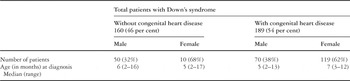
Table 1.

Distribution of patients with Down's syndrome according to congenital heart disease and age at diagnosis. PAD: patent arterial duct; VSD: ventricular septal defect; ASD: atrial septal defect; AVSD: atrioventricular septal defect; EBS: Ebstein's malformation of the tricuspid valve; TAPVC: totally anomalous pulmonary venous connection; DIV: double inlet ventricle; TGA: transposition.
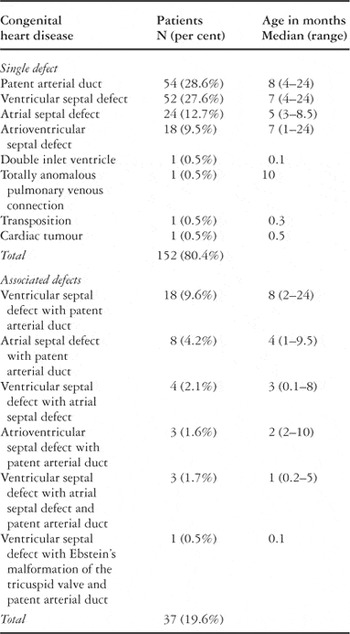
Table 2.
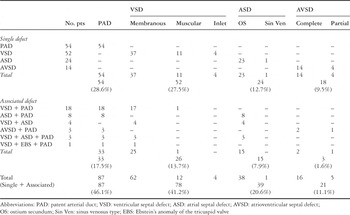
Table 3.
 You have
Access
- 40
- Cited by