INTRODUCTION
Whale and dolphin-watching (hereafter collectively referred to as whale-watching) brings tourists into close interaction with cetaceans (whales, dolphins and porpoises) in the wild. Since the late 1980s, the whale-watching industry has experienced spectacular growth in demand and visitor numbers (Hoyt Reference Hoyt1995, Reference Hoyt2001, 2007; Muloin Reference Muloin1998). In 2000, viewing and interacting with cetaceans in the wild involved over ten million participants and was worth $US 1250 million (Hoyt Reference Hoyt2001). Whale-watching now takes place on all continents and in more than 500 communities in over 70 countries, targeting over 600 regional populations of cetaceans (Hoyt Reference Hoyt2007).
In different parts of the world, whale-watching exists within contrasting social, cultural, economic, political and environmental contexts. Different countries and regions have contrasting historical relationships with cetaceans. Varying cultural and environmental values, sometimes motivated by political independence, and cultural and social identity (Levine & Levine Reference Levine1987; Smith & Hanna Reference Smith and Hanna1993; Sawada & Minami Reference Sawada and Minami1997), result in contrasting management contexts. In some instances cetaceans are hunted on indigenous, subsistence or scientific grounds, such that whale hunting and whale-watching are drawn into competition (Higham & Lusseau Reference Higham and Lusseau2007). All are subject to varying degrees to different levels of policy, planning and management.
With the rapid development of commercial whale-watching has come some concerted scholarly effort aimed at understanding the likely impacts of tourist interactions with cetaceans in the wild (Corkeron Reference Corkeron2004; Constantine & Bejder Reference Constantine, Bejder, Higham and Lück2008) and the management initiatives that are required to mitigate those impacts (Bejder et al. Reference Bejder, Samuels, Whitehead, Gales, Mann, Connor, Heithaus, Watson-Capps, Flaherty and Krützen2006). The potential impact of whale-watching has been studied for more than twenty years (Baker & Herman Reference Baker and Herman1989; Corkeron Reference Corkeron2004) and a wide variety of short-term effects have been detected (for example Bejder et al. Reference Bejder, Dawson and Harraway1999; Au & Green Reference Au and Green2000; Nowacek et al. Reference Nowacek, Wells and Solow2001; Van Parijs & Corkeron Reference van Parijs and Corkeron2001; Williams et al. Reference Williams, Trites and Bain2002; Hastie et al. Reference Hastie, Wilson, Tufft and Thompson2003; Lusseau et al. Reference Lusseau, Slooten and Currey2006). These include changes in vocalization and respiration patterns, variations in path directedness and other short-term behavioural alterations resulting from apparent horizontal and vertical avoidance tactics (Frid & Dill Reference Frid and Dill2002). However, it has been difficult to move from the description of short-term changes, which sometimes appear contradictory, to a comprehensive understanding of the biological relevance of these effects (Corkeron Reference Corkeron2004; Bejder et al. Reference Bejder, Samuels, Whitehead, Gales, Mann, Connor, Heithaus, Watson-Capps, Flaherty and Krützen2006). Other wildlife disturbance studies have shown that interpreting behavioural responses outside the biological and ecological context in which they are studied is usually uninformative (Gill et al. Reference Gill, Norris and Sutherland2001; Beale & Monaghan Reference Beale and Monaghan2004).
Short-term avoidance tactics can have long-term consequences for individuals and their populations (Foote et al. Reference Foote, Osborne and Hoelzel2004; Lusseau Reference Lusseau2005; Bejder et al. Reference Bejder, Samuels, Whitehead, Gales, Mann, Connor, Heithaus, Watson-Capps, Flaherty and Krützen2006; Lusseau et al. Reference Lusseau, Slooten and Currey2006; Williams et al. Reference Williams, Lusseau and Hammond2006). Comparisons between control and impact sites and long-term life history data have revealed how whale-watching disturbance has short-term effects on the lives of cetaceans that lead to long-term consequences for the viability and fitness of individuals and their populations. Populations respond non-linearly to impacts. There is an apparent need for effective management that monitors tourist activities, establishes appropriate thresholds of those activities, monitors and responds to the impacts of tourist activities and that is actively adaptive to change over time.
The sustainable management of whale-watching is fraught with difficulty. An expanding literature addresses the potential impacts of tourist interactions with cetaceans, but the sustainable management of such interactions has not been well addressed. Although this paper is concerned primarily with the management of tourist interactions with cetaceans at specific sites in different parts of the world, the complex and dynamic ecological, environmental, political and socio-economic contexts within which these interactions take place must be acknowledged. We review the whale-watching management context, describing the dynamic interplay of the macro (global), meso (national/regional) and micro-level (local/site specific) policy, planning and management settings. Given the current failing of the long-term sustainable management of whale-watching activities (Higham & Bejder Reference Higham and Bejder2008), we argue that integrated and adaptive management approaches should be developed and applied with priority (Higham et al. Reference Higham, Bejder and Lusseau2007). No such management approaches currently exist, and we thus propose a management framework to address the long-term sustainable management of tourist interactions with cetaceans.
MULTIPLE LEVEL PLANNING, POLICY AND MANAGEMENT CONTEXTS
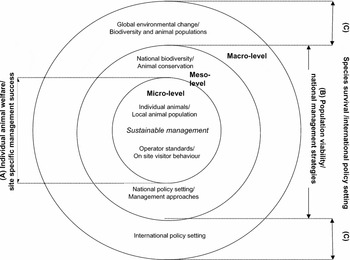
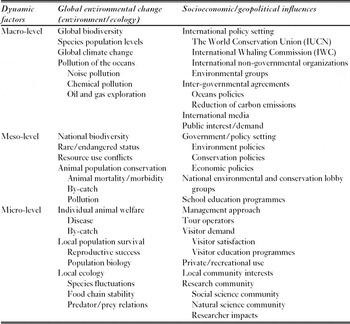
Policy, planning and management input take place at macro (global), meso (national) and micro (local-regional) levels (Fig. 1, Table 1).
Macro, meso and micro-level policy and planning contexts.

Macro, meso and micro-level factors influencing the management of human interactions with cetaceans.

The macro-level context is characterized by growing concerns for declining levels of global biodiversity and the increasing instability of complex ecosystems (Tilman Reference Tilman1999; Worm et al. Reference Worm, Barbier, Beaumont, Duffy, Folke, Halpern, Jackson, Lotze, Micheli, Palumbi, Sala, Selkoe, Stachowicz and Watson2006). Species and population changes in the marine environment have been influenced by human activities resulting in such phenomena as depleted fisheries, global climate change and marine pollution (Gössling Reference Gössling and Higham2007). The development of marine mammal protection regulations in different parts of the world since the mid-1970s predates the growth of large-scale commercial whale-watching interests (Lusseau Reference Lusseau2003). The growth in demand for commercial tourist interactions with cetaceans (Hoyt Reference Hoyt2001) has been so swift that planning and management agencies have, as a rule, been poorly prepared in terms of the preparation of management priorities, directions, licensing regimes and outcomes, in addition to the policy directives required to oversee the sustainable development of the industry (Hoyt Reference Hoyt2001; Parsons et al. Reference Parsons, Warburton, Woods-Ballard, Hughes and Johnston2003). Furthermore, the management of commercial tour operations is quite distinct from the related issues of managing private or recreational marine (J. Kind-Keppel, A. Nikolay, S. Muloin & R. Otis, personal communication 1999) and research activities (Lusseau Reference Lusseau, Higham and Lück2007).
Within this context, various intergovernmental panels, non-governmental organizations, international environmental groups and media continue to discuss and debate concerns surrounding the issues of global environmental change, biodiversity conservation and habitat protection. For example, the International Whaling Commission (IWC 2006) has actively discussed impact issues associated with whale-watching, responding directly to empirical research and engaging in dialogue with IWC member countries where concerns for sustainable tourist interactions with cetaceans exist (Higham et al. Reference Higham, Bejder and Lusseau2007). Thus, the dynamics of global environmental change, and the ongoing discussion of governmental responses to change (for example international oceans policies, Intergovernmental Panel on Climate Change, the World Conservation Union [IUCN] red list and the IWC), demonstrate the influence of the macro upon the meso and micro-levels of policy, planning and management.
The meso-level context concerns the establishment of national policy, planning and management priorities relating to tourism development and the conservation of marine mammals. The meso-level context varies greatly between countries where concerns for national biodiversity, conservation, animal ethics and resource use, as well as government priorities relating to economic, social and cultural development, vary markedly. The dominant meso-level context is one of a non-existent, inadequate or dated policy setting for the management of marine tourism (Lusseau Reference Lusseau2003; Corkeron Reference Corkeron2004). Policy and planning responses, aimed at sustainable long-term tourism management, have been hindered by the political priority ascribed to the social and economic development dimensions of tourism (Higham & Lusseau Reference Higham and Lusseau2007), at the expense of sustainable management.
As a rule, management agencies also lack rigorous scientific evidence to support the continued expansion, limiting or curtailing of commercial tourism operations that bring tourists into contact with marine mammals in the wild. They also lack scientific information about the economic costs of management actions that are therefore assumed to always be significant. Meanwhile, the mortality or morbidity rates in focal animal populations may also change due to natural phenomena (Lusseau & Higham Reference Lusseau and Higham2004; Shelton & McKinley Reference Shelton, McKinley, Higham and Lück2007). These meso-level issues contribute to the complexities of the management context for whale-watching. However they are rarely, if ever, accommodated in existing management approaches which lack the adaptability to respond to short- or medium-term changes in the mortality or morbidity of local or regional populations of wild animals. This is demonstrated in the few instances where scientific information is available but not acted upon (Bearzi Reference Bearzi2007), which can have detrimental consequences for the survival of populations (Jaramillo-Legorreta et al. Reference Jaramillo-Legorreta, Rojas-Bracho, Brownell Jr, Read, Reeves, Ralls and Taylor2007).
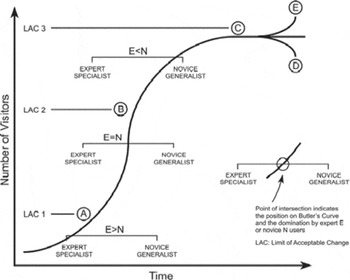
The micro-level management context focuses on site-specific issues. Duffus and Dearden (Reference Duffus and Dearden1990, p. 221) identified the dynamic nature of tourist interactions with wild animals at specific sites, where wildlife tourism sites, like commercial products, tourism destinations (Butler Reference Butler1980) and animal populations (Higham & Lusseau Reference Higham and Lusseau2007), evolve over time. Duffus and Dearden (Reference Duffus and Dearden1990) illustrated the dynamics of wildlife tourism sites by employing a tourist typology (expert-novice) in combination with the limits of acceptable change (LAC) management planning framework (Fig. 2).
Duffus and Dearden's (Reference Duffus and Dearden1990) conceptual framework for non-consumptive wildlife tourism. LAC = limits of acceptable change, E-N = expert-novice visitor continuum, A = initiation, B = development, C = stagnation, D = decline and E = rejuvenation (reproduced with the permission of the authors).

Thus, after a period of slow growth (Fig. 2, A), visitor numbers often undergo a phase transition of rapid growth (Fig. 2, B) to reach an equilibrium (Fig. 2, C) (Duffus & Dearden Reference Duffus and Dearden1990). Tourist destinations and visitor attractions try to achieve sustainability by maintaining visitor numbers close to their carrying capacities. In tourism, the likelihood that sustainability will be achieved is related to many extrinsic and intrinsic factors such as economic viability, competition and the sustainability of the resources upon which the system relies. So, for example, whale-watching relies on whales and/or dolphins as the primary resource that attracts visitors. However, other factors such as fishing, recreational boating activity, prey availability, whaling and pollution can affect the number of whales present at a tourism site (Higham & Lusseau Reference Higham and Lusseau2007). Three key elements highlighted in Duffus and Dearden's (Reference Duffus and Dearden1990) conceptual framework include the profile of the user group, the individual/s or groups of wild animals that are the focus of visitor attention and the wider ecology of the site where tourist activities take place, all of which are engaged in a complex and dynamic association.
It is important to emphasize the dynamic nature of the three (macro, meso and micro) contextual levels outlined above. Although these levels of context are subject to change over time, they are also subject to catastrophic (as opposed to incremental) change. At the macro-level, the lobbying and voting actions of governmental IWC representatives may have serious consequences for the IWC position on whale-watching and/or whaling industry activities. Changes in national government policy directions may have immediate consequences for the meso-level tourism and environmental conservation contexts. Perhaps most urgently, at the micro-level, unsustainable business management practice, non-existent or inept licensing (numbers, duration and conditions), inappropriate boat manoeuvres, accidents, habitat degradation, predation and disease may also impact upon the viability of an animal population. The dynamics of the macro, meso and micro-level contexts require that management frameworks must be integrated, dynamic and adaptive.
AN INTEGRATED, DYNAMIC AND ADAPTIVE MICRO-LEVEL MANAGEMENT FRAMEWORK
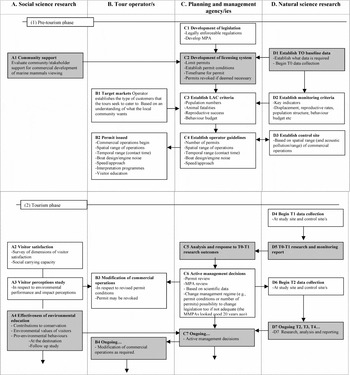
Addressing the long-term management of tourist interactions with cetaceans in the wild is particularly pressing at the micro-level at sites where tourists are brought into contact with cetaceans (Bejder et al. Reference Bejder, Samuels, Whitehead, Gales, Mann, Connor, Heithaus, Watson-Capps, Flaherty and Krützen2006). These various policy, planning and management contexts suggest the need for an integrated and dynamic management approach which incorporates the perspectives of a range of key stakeholders. The micro-level management setting supports the need for active adaptive management (McCarthy & Possingham Reference McCarthy and Possingham2007, p. 957) to enable optimum management in changing circumstances over a specified number of years. To accommodate this complexity it might be argued that at least four key stakeholders, all operating under dynamic circumstances, exist in the management equation. Our management framework proposes, as a minimum, the integration of four key stakeholder groups: the commercial tourism operator, the social science research community, natural scientists and planning/management agencies (Fig. 3).
Model for the integrated, dynamic and adaptive management of tourist interactions with cetaceans.

The pre-tourism phase
This management framework places the initial onus on policy, planning and management agencies to establish a legislative context to oversee tourist engagements with marine mammals (Fig. 3, C1). Such a context may require spatial planning (for example the designation of marine protected areas [MPAs]), or to otherwise ensure that regulations are enforceable, a notable weakness in management systems in many parts of the world (IFAW [International Fund for Animal Welfare] 1997). The legislative framework should allow management agencies to develop a licensing system which provides guidance on the limitation of permits and permit conditions, including timeframes for permit review. Management agencies must withhold the right to revoke permits if such action is deemed necessary (Fig. 3, C2).
Bejder et al. (Reference Bejder, Samuels, Whitehead, Gales, Mann, Connor, Heithaus, Watson-Capps, Flaherty and Krützen2006) noted that the relative success of managing tourist interactions with bottlenose dolphins (Tursiops sp.) at Shark Bay (Western Australia) arises from the fact that appropriate scientific data were collected for some years predating the onset of commercial tourism. In the pre-tourism stage (Fig. 3, T0) the collection of baseline data should, wherever possible, generate frameworks for monitoring and, where necessary, management action (Fig. 3, D1). Monitoring criteria should be established for the focal animal population, as well as other species in the wider ecology of the wildlife/tourism setting. Baseline data should address population estimates, population structure, behaviour budget and reproductive rates (Lusseau Reference Lusseau2004) (Fig. 3, D2). Data collection should allow the analysis of key variables to provide an understanding of such factors as breeding seasons and both spatial and temporal ecology (Lusseau & Higham Reference Lusseau and Higham2004). In establishing baseline data collection and monitoring criteria it is necessary to ask ‘what is needed to have an adequate understanding of the local population of animals’?
Part of the process of establishing a monitoring programme is the consideration and delineation of an appropriate control site(s) (Fig. 3, D3), which should be entirely free of anthropogenic influence related to tourism (Bejder & Samuels Reference Bejder, Samuels, Gales, Hindell and Kirkwood2003). Thus, the control site must be contemplated in relation to the permitted spatial range of any commercial tourism ventures and target animals. In addition to the location or range (in the case of mobile air or boat-based operations) of the viewing facility, the acoustic range of visitors, machinery and other forms of pollution must be considered in the delineation of the control site (Bejder et al. Reference Bejder, Samuels, Whitehead, Gales, Mann, Connor, Heithaus, Watson-Capps, Flaherty and Krützen2006). It may also be prudent for biologists to establish key indicators in two categories. The first may be termed warning indicators that include, for example, changes in behavioural budget which may be an early sign of impact relating to tourism operations. The second set of indicators, which may be termed ‘show stoppers’, are those that provide immediate evidence of significant impact. These impacts might include evidence of decline in reproductive success within the focal population. Such indicators should be set and agreed upon by all stakeholders in advance, with ‘show-stoppers’, including those that relate to critical indicators of population viability, being clearly articulated.
In the pre-tourism phase it is important that social science is engaged to investigate community support for a proposed tourism venture and that approval of the venture is conditional upon that support (Fig. 3, A1). Findlay's (Reference Findlay1997) study of land-based tourists viewing southern right whales (Eubalaena australis) in Hermanus (South Africa) revealed resident support for land-based whale-watching and opposition to the development of boat-based whale-watching owing to concerns regarding whale disturbance. Such viewpoints should be understood and incorporated into management practice wherever possible.
The collection of baseline data is critical as it should inform management agencies in the establishment of appropriate LAC criteria, as they relate to what we describe here as ‘warning’ and ‘show stopper’ indicators (see Duffus & Dearden Reference Duffus and Dearden1990). LAC criteria must be measurable and accountable in the monitoring programme (Fig. 3, C3). Quantifiable limits of acceptable change should be clearly stated in such terms as population numbers, animal fatalities, reproductive rates and demonstrated changes in the behavioural budget of the focal population (Lusseau Reference Lusseau2004; Bejder et al. Reference Bejder, Samuels, Whitehead, Gales, Mann, Connor, Heithaus, Watson-Capps, Flaherty and Krützen2006). All of these indicators should inform the management agency when they deliberate upon operator guidelines (Fig. 3, C4). This forethought should include consideration of reasonable and appropriate limits on numbers of operator permits, the spatial range of operations, temporal range (season of operation, numbers of tours, contact time with focal animals), boat design (including appropriate levels of engine noise) and guidelines on approach speed and direction.
Having established operator regulations, management agencies will be appropriately placed to issue one or more operator permits (Fig. 3, B2). Increasingly permits require operators to provide interpretation and visitor education programmes to tour participants (Higham & Carr Reference Higham and Carr2002). Additionally, all aspects of operation, as clearly informed by carefully considered operator guidelines, including the expiry date of the permit, should be clearly stated in all permits issued. The processes for monitoring permit conditions, permit review and, if deemed necessary, the revoking of permits, should also be unambiguously outlined. These steps collectively comprise the pre-tourism phase. Only when all of these steps have been negotiated should commercial tourism operations begin.
Tourism phase
With the establishment of a commercial tourism venture (or, where commercial tourism already exists, the issuing of new operator permits) comes new phases in continuing social and natural science research (Fig. 3, A2, D4).
Social science research
Where whale-watching ventures become operational, the focus of social science research should extend to the analysis of visitor profiles, including the levels of expertise of visitors, and incorporate dimensions of visitor satisfaction to inform the ongoing management of visitor operations (Fig. 3, A2–A4). Visitor profiling should be undertaken to ascertain whether the target market is being reached and to allow an understanding of the ‘expertise’ of visitors, given that the ‘expert-novice’ status of visitors has a considerable bearing on many aspects of visitor management (Duffus & Dearden Reference Duffus and Dearden1990). Visitor data should be collected on an ongoing basis to ascertain dimensions of visitor satisfaction, including elements of social carrying capacity (Fig. 3, A2). Studies directed towards understanding visitor perceptions of their wildlife experiences, including perceptions of environmental performance and impact, may also be conducted (Fig. 3, A3). The effectiveness of interpretation and visitor education programmes, perhaps extending to determining the extent to which the environmental values of visitors are challenged by the education programmes that they experience, may further inform the management of visitor operations (Higham & Carr Reference Higham and Carr2002).
Regular reporting on these elements of the visitor operation should take place (Fig. 3, A4). The results of visitor research should inform modifications to commercial operations as they relate to the visitor experience (Fig. 3, C7, B4). These may extend to visitor behaviour guidelines, where specific behaviours can be linked to disruption of environmental or social systems that should be incorporated into the process of permit revision. The continuing social science research effort should take into account host community residents who may seek some input into the permit review process for various reasons such as concerns for local environmental stewardship (Findlay Reference Findlay1997; Finkler & Higham Reference Finkler and Higham2004).
Natural science research
The science programme associated with the animals that are the focus of tourist attention continues into the tourism phase (T1) (Fig. 3, D4, D5). The programme should relate closely to monitoring of population estimates, population structure, reproductive rates and behaviour budget (Lusseau Reference Lusseau2004). These estimates should be directly compared to baseline (Fig. 3, T0) information collected during the pre-tourism phase. The science programme should also include the monitoring of commercial operations which should extend to the number of trips offered, numbers of visitors, global positioning system (GPS) tracking of tours and, where relevant, engine noise. Allowing for these elements may help understanding of the biology of an industry in a given area and may be related to measured impacts.
The natural science research context should extend to other human activities and additional changes to the local marine ecology where they bear relevance upon the sustainability of whale-watching taking place at physically and socially dynamic sites (Shelton & McKinley Reference Shelton, McKinley, Higham and Lück2007). The interests of management agencies, in this case, should extend to changes to the whale-watch ecology that may be the consequence of unrelated human activities or known/unknown non-human causes. The former may consist of evolving patterns and forms of marine recreation and pollution, whereas the latter may take into account evolving predator-prey relationships, altered availability of food sources, algal blooms and biological disease (Shelton & McKinley Reference Shelton, McKinley, Higham and Lück2007). In any such cases the viability of animal populations, and therefore the sustainability of whale-watching activities, may require urgent reassessment (Fig. 3, D5–C5, D7–C7).
Regular research monitoring and reporting should take place in association with analysis, interpretation and considered response, leading to active management decisions on the part of the management agency (Fig. 3, C5, C6). Any subsequent changes to the operational environment, such as alterations to permit conditions or the issuing of new permits, should herald a new phase in data collection (Fig. 3, T2) (for example Fig. 3, D6). Regular research and monitoring reports should, once again, be submitted to the management agency allowing analysis and responses to research outcomes. Active management decisions may, if necessary, result in revised permit conditions or the abeyance or revoking of permits. Furthermore, they may serve as the basis for the regular review of MPA designations, changes relating to the management regime and possibly marine mammal protection legislation. For example, New Zealand's Marine Mammals Protection Regulations of 1988 were effective at the time that they were enacted but are now dated and ineffective (Lusseau Reference Lusseau2004). Enforcement, and consequently compliance, is the critical determinant of effectiveness. The international context is replete with examples of legislation being in place, with compliance being directly linked to the degree within which these laws are enforced (Kuperan & Sutinen Reference Kuperan and Sutinen1998; Sirakaya Reference Sirakaya1998; Nielsen Reference Nielsen2003). All of these processes should be ongoing (see Fig. 3, D7, C7, B4) to ensure that research, analysis and reporting informs both active and evolving management decisions and the modification of commercial operations.
CONCLUSIONS
Currently no comprehensive management regime exists anywhere in the world where tourists interact with cetaceans in the wild. The nearest approximation to such a management model possibly exists at Shark Bay (Western Australia), where low level tourism development, a large and robust resident population of bottlenose dolphins, a long-standing programme of research and government/management responsiveness to research outcomes are present (see Bejder et al. Reference Bejder, Samuels, Whitehead, Gales, Mann, Connor, Heithaus, Watson-Capps, Flaherty and Krützen2006; Higham & Bejder Reference Higham and Bejder2008). However, at most sites, worldwide tourism development has taken place unchecked. This situation is most pressing at high volume tourism and recreational boating sites such as Port Stephens (Australia) and San Juan Islands (USA) and at sites where tourists interact with populations of cetaceans that are small and genetically isolated (for example Doubtful Sound, New Zealand).
As a minimum, commercial tourism operators, planning/management agencies, social science researchers and the natural science research community should be incorporated into an integrated and adaptive management model. Inevitably, given the wide contextual variation that applies in the case of a global phenomenon such as whale-watching, this model should be adapted to accommodate other stakeholders wherever necessary. They may include indigenous communities and fishing industry and perhaps local government representatives (for example where infrastructure investments and sustainable waste management services may be required to support tourism development). In some instances local community groups may seek direct and collective involvement in such a management model as opposed to voicing indirect and individual views through the medium of social science research. In settings less removed from anthropogenic impacts, it may be necessary to build other elements, such as ‘other human activities’ (for example recreational activities and/or industrial causes of pollution or noise) into the parameters of the management model.
The integrated management model presented emphasizes the importance of research to inform managers on critical elements of sustainability. This responds to the growing recognition of the role of science in achieving sustainability. A study of wildlife tours in Australia specifically addressed the place of science and monitoring in wildlife tourism businesses and demonstrated low levels of engagement of scientists in protecting the wildlife of interest to tours (Rodger et al. Reference Rodger, Moore and Newsome2007).
It is likely that this management framework would apply equally to other species of wild animals, such as penguins (see Seddon & Ellenberg Reference Seddon, Ellenberg, Higham and Lück2007), fish (Milazzo et al. Reference Milazzo, Anastasi and Willis2006), polar bears (see Dyck & Baydack Reference Dyck and Baydack2004), pinnipeds (see Newsome & Rodger Reference Newsome, Rodger, Higham and Lück2007) and terrestrial mammals (see Nevin & Gilbert Reference Nevin and Gilbert2005), which become the subject of growing tourist demand, as has been the case in recent years with the rapid development of the phenomenon of whale-watching. While comprehensive and adaptive management approaches should be developed and applied to promote the prospects of the long-term sustainable management of tourist interactions with wild animals, the case relating to cetaceans is perhaps most urgent.