Introduction
An organization's long-term success often depends on successfully managing conflicting priorities, such as efficiency versus flexibility (Eisenhardt, Furr, & Bingham, Reference Eisenhardt, Furr and Bingham2010), adaptability versus alignment (Gibson & Birkinshaw, Reference Gibson and Birkinshaw2004), incremental versus discontinuous innovation (Tushman, Anderson, & O'Reilly, Reference Tushman, Anderson, O'Reilly, Tushman and Anderson1997), or global integration versus local responsiveness (Barlett & Ghoshal, Reference Barlett and Ghoshal1999). This ability to effectively balance conflicting demands is known as ambidexterity (Tushman & O'Reilly, Reference Tushman and O'Reilly1996) and is a valued attribute among firms competing in dynamic arenas (Reeves, Haanæs, Hollingsworth, & Pasini, Reference Reeves, Haanæs, Hollingsworth and Pasini2013). Our research complements existing studies that analyzed an organization's ability to simultaneously exploit existing resources while also exploring new opportunities (March, Reference March1991; Raisch, Birkinshaw, Probst, & Tushman, Reference Raisch, Birkinshaw, Probst and Tushman2009) by examining exploration and exploitation at the individual level.
Ambidexterity research has focused on the firm level tension between exploration and exploitation, thereby helping both academics and practitioners understand how organizations can make choices among competing organizational demands (Birkinshaw & Gupta, Reference Birkinshaw and Gupta2013; O'Reilly & Tushman, Reference O'Reilly and Tushman2013; Raisch & Birkinshaw, Reference Raisch and Birkinshaw2008). For instance, scholars such as Hill and Birkinshaw (Reference Hill and Birkinshaw2014) and Kauppila (Reference Kauppila2010) have considered how to achieve ambidexterity through structural means of either temporal or spatial separation [see Duncan (Reference Duncan1976) and Tushman and O'Reilly (Reference Tushman and O'Reilly1996) for a review of temporal separation and spatial separation, respectively]. In addition to structural means, organizations can also achieve ambidexterity by creating a supportive work environment where individuals make the decision to engage in explorative and exploitative activities as they respond to the organization's competing demands for exploration and exploitation. This form of ambidexterity is known as contextual ambidexterity (Gibson & Birkinshaw, Reference Gibson and Birkinshaw2004). Our contextual approach departs from the temporal separation (sequential ambidexterity) and spatial separation (simultaneous ambidexterity) approaches widely utilized to analyze firm-level ambidexterity.
Diverging from previous approaches to achieve ambidexterity through spatial or temporal separation, Gibson and Birkinshaw (Reference Gibson and Birkinshaw2004) suggested that ambidexterity was best achieved through contextual ambidexterity by building a context that encourages individuals to resolve the conflicting demands for alignment (exploitation) and adaptability (exploration). Although these ambidextrous contexts were thought to provide a supportive environment that allows individuals to make their own choices to divide their attention between explorative and exploitative activities, this approach did not reveal the extent to which contextual factors influenced ambidextrous behavior. The reason for this omission is that ambidexterity was measured at the business unit level.
Mom, van den Bosh, and Volberda (Reference Mom, van den Bosh and Volberda2009) were the first to empirically measure individual ambidexterity. Although important, this research is confined to managers and cannot be generalized to other types of employees. Only a study by Jasmand, Blazevic, and Ruyter (Reference Jasmand, Blazevic and Ruyter2012) focused on ambidextrous behavior of customer service representatives. Our study extends this prior work on individual ambidexterity by analyzing contextual factors that motivate individuals to engage in ambidextrous behavior. In addition, we analyze employees that work under managerial oversight and include both office workers and line-workers.
In general, research on individual ambidexterity is limited (Birkinshaw & Gupta, Reference Birkinshaw and Gupta2013), and more specifically the impact of contextual factors (i.e., empowerment) on individual ambidexterity is limited. We suggest that to make predictions about individual motivation to engage in ambidextrous behavior, we need to understand theory on psychological needs. Self-determination theory argues that the need for autonomy (to be self-regulating), competence (to be effective), and relatedness (to feel connected) are innate psychological needs that, when satisfied, are essential for facilitating self-motivation (Ryan & Deci, Reference Ryan and Deci2000). We use self-determination theory to propose two antecedents of ambidextrous behavior in contexts where individuals are empowered to use their capabilities, are given autonomy to perform activities, and are regarded as important members of the organization. We argue that such contexts allow for the development of individuals' feelings of psychological empowerment (Spreitzer, Reference Spreitzer1995) and feelings of psychological ownership (Pierce, Kostova, & Dirks, Reference Pierce, Kostova and Dirks2001).
Our study makes a number of contributions to research considering individual ambidexterity. First, our study is, to the best of our knowledge, the first to examine the separate effects of empowerment and ownership perceptions as antecedents of ambidextrous behavior. In addition, our study is unique in that we incorporate accountability theory to analyze the impact of feeling accountable on such perceptions. We generate novel predictions regarding explorative and exploitative behavior that have not previously been considered in the literature. This study is also unique in that we argue feelings of empowerment and ownership will interact with perceptions of accountability to impact ambidextrous behavior. Second, in contrast to prior research in which ambidexterity was analyzed by combining explorative and exploitative behavior, we analyze the effects on explorative behavior and on exploitative behavior separately. We think this separation is important to understand in greater detail the nature of explorative and exploitative behaviors.
Last, our study contributes to the growing, but still relatively small body of research on individual ambidexterity. In doing so, we have also responded to prior calls for research on individual ambidexterity (e.g., Gupta, Smith, & Shalley, Reference Gupta, Smith and Shalley2006; Laureiro-Martinez, Brusoni, & Zollo, Reference Laureiro-Martinez, Brusoni and Zollo2010; Nosella, Cantarello, & Filippini, Reference Nosella, Cantarello and Filippini2012; Raisch & Birkinshaw, Reference Raisch and Birkinshaw2008). Scholars agree that research on individual ambidexterity is important because the conflicting needs for exploration and exploitation found at the firm level are also often present at the individual level (Gibson & Birkinshaw, Reference Gibson and Birkinshaw2004; Raisch et al., Reference Raisch, Birkinshaw, Probst and Tushman2009) and because firm-level analysis can neither reveal what drives individual behavior nor explain how individuals ultimately resolve the organizational demands for explorative and exploitative behavior (Birkinshaw & Gupta, Reference Birkinshaw and Gupta2013; Laureiro-Martinez, Brusoni, & Zollo, Reference Laureiro-Martinez, Brusoni and Zollo2010).
Literature Review and Hypothesis Development
Self-determination theory
Self-determination theory is a theory of individual motivation that analyzes individuals' psychological needs for competence, autonomy, and relatedness that, when satisfied, are essential for the development of their self-motivation. Given the importance of need satisfaction, managers can help individuals feel competent by displaying confidence in individuals' abilities and providing them with encouragement and task support. Managers can also help individuals feel related to the working environment by displaying genuine concern for their thoughts and feelings. Finally, managers can foster feelings autonomy by giving individuals the opportunity to ‘own’ a task and to make their own choices for pace and effort (Gagné & Deci, Reference Gagné and Deci2005).
Self-determination theory recognizes that there are intrinsic and extrinsic factors that directly influence individual behavior and that both influence an individual's overall motivation. Specifically, the intrinsic component is an inherent autonomous motivation that responds to an interest in and enjoyment of the task, which directly enhances the individual's sense of autonomy, competence, and relatedness (Ryan & Deci, Reference Ryan and Deci2000). The extrinsic component is composed of four motivational states varying in their degree of self-determination along a control-to-autonomy continuum and respond to varying degrees of external rewards. These extrinsic motivation states are integrated regulation, identified regulation, introjected regulation, and external regulation [see Ryan & Deci (Reference Ryan and Deci2000) for a full review].
What is particularly important about self-determination theory is that because intrinsic and extrinsic motivations may operate simultaneously, individuals may be simultaneously motivated by both (Gagné & Deci, Reference Gagné and Deci2005; Deci & Ryan, Reference Deci and Ryan2000). Consequently, we argue that self-determination theory can be used to analyze contexts that provide competence support, autonomy support, and relationship support to encourage ambidextrous behavior. In the next sections, we review organizational and individual ambidexterity to introduce explorative and exploitative behavior. We then consider contextual factors that engender feelings of empowerment and ownership, which in turn facilitate ambidextrous behavior.
Organizational ambidexterity
Organizational ambidexterity refers to the firm's ability to explore and exploit and to simultaneously compete in mature and new markets (O'Reilly & Tushman, Reference O'Reilly and Tushman2013). Although Duncan (Reference Duncan1976) first introduced ambidexterity to describe how firms balance the demands for innovation and efficiency, March (Reference March1991) broadened the term to include exploration and exploitation, which was then followed by Tushman and O'Reilly’s (Reference Tushman and O'Reilly1996) inclusion of radical and incremental innovation. Subsequent empirical work studied ambidexterity in the context of organizational learning (Filippini, Güttel, & Nosella, Reference Filippini, Güttel and Nosella2012; Im & Rai, Reference Im and Rai2008), innovation (Andriopoulos & Lewis, Reference Andriopoulos and Lewis2009; Jansen, Van den Bosch, & Volberda, Reference Jansen, Van den Bosch and Volberda2005), absorptive capacity (Fernhaber & Patel, Reference Fernhaber and Patel2012; Rothaermel & Alexandre, Reference Rothaermel and Alexandre2009), and dynamic capabilities (Eisenhardt, Furr, & Bingham, Reference Eisenhardt, Furr and Bingham2010; O'Reilly & Tushman, Reference O'Reilly and Tushman2008).
Achieving ambidexterity traditionally involved three approaches: sequential ambidexterity using temporal separation, structural ambidexterity using autonomous business units simultaneously, and contextual ambidexterity using organizational support (Gibson & Birkinshaw, Reference Gibson and Birkinshaw2004; O'Reilly & Tushman, Reference O'Reilly and Tushman2013; Simsek, Heavey, Veiga, & Souder, Reference Simsek, Heavey, Veiga and Souder2009; Tushman & O'Reilly, Reference Tushman and O'Reilly1996). A shift from focusing solely on these firm-level mechanisms for achieving ambidexterity to include individual-level factors has gained increasing interest among scholars (Good & Michel, Reference Good and Michel2013; Gupta, Smith, & Shalley, Reference Gupta, Smith and Shalley2006; Jasmand, Blazevic, & Ruyter, Reference Jasmand, Blazevic and Ruyter2012; Mom, van den Bosh, & Volberda, Reference Mom, van den Bosh and Volberda2009) given the importance of better understanding the individuals who end up balancing the demands for exploration and exploitation (Birkinshaw & Gupta, Reference Birkinshaw and Gupta2013).
Individual ambidexterity
Research on contextual ambidexterity (Gibson & Birkinshaw, Reference Gibson and Birkinshaw2004) highlights the role of contexts that encourage individuals to solve the organizational demands for exploration and exploitation. According to this view, individuals are not given instructions to focus on activities that support either exploration or exploitation; instead, they are encouraged to use their own judgment on when to divide their time among activities that support exploration and exploitation. However, a limitation of this research is that it does not provide details on how individuals might resolve the conflicting demands for exploration and exploitation. Individual ambidexterity addresses this limitation. In addition, prior research suggests that individual ambidexterity can and does happen at all levels of the organization. For example, O'Reilly and Tushman (Reference O'Reilly and Tushman2004) found that ambidextrous senior managers had the ability to combine the attributes of cost cutting and free-thinking; Tushman, Smith, and Binns (Reference Tushman, Smith and Binns2011) observed that CEOs were charged with promoting ambidextrous behavior by demanding discipline while encouraging experimentation; and Miron, Erez, and Naveh (Reference Miron, Erez and Naveh2004) found that engineers and technicians had the ability to be both creative (explore) and be attentive to details (exploit).
Mom, van den Bosh, and Volberda (Reference Mom, van den Bosh and Volberda2009), whose work represents the first empirical study to consider two contextual factors (i.e., formal structure and personal coordination mechanisms) to analyze managers' individual ambidexterity, found that a manager's formal decision-making authority is an important structural mechanism that influences a manager's ambidexterity. In their work, the authors define ambidexterity at the manager level as ‘a manager's behavioral orientation toward combining exploration and exploitation related activities within a certain period of time’ (p. 812). In our study, we extend this notion to employees working under managerial or supervisory oversight.
The work of Jasmand, Blazevic, and Ruyter (Reference Jasmand, Blazevic and Ruyter2012), which examined the antecedents of ambidextrous behavior using contextual factors (response to call center characteristics) and individual differences (motivational orientations), reveals that individuals responsible for both generating sales and providing customer service must simultaneously perform order taking (a form of exploitation) and order seeking (a form of exploration) or switch between them to be ambidextrous. We extend these contextual factors to include employees' perceptions of a working environment that encourages ambidextrous behavior through empowering employees and making them feel that they belong to an organization. This is consistent with Gibson and Birkinshaw’s (Reference Gibson and Birkinshaw2004) idea that environments that allow or promote ambidextrous behavior provide the flexibility individuals need to use their own judgment to self-regulate and perform two seemingly contradictory activities at once. Supported by these prior studies, we define ambidexterity of an employee as the resulting behavior that combines exploration and exploitation behavior in response to organizational demands for exploration and exploitation. While previous research has operationalized individual ambidexterity using the multiplicative effects of explorative and exploitative behaviors (Jasmand, Blazevic, and Ruyter, Reference Jasmand, Blazevic and Ruyter2012; Mom, van den Bosh, and Volberda, Reference Mom, van den Bosh and Volberda2009), our study analyzes the effect of these behaviors both individually and by using the multiplicative effects measure.
Exploitative behavior
Exploitation refers to actions such as refinement, choice, production, efficiency, selection, implementation, execution, incremental innovation, and innovation for current customers. This form of behavior, which is associated with positive, proximate, and predictable returns (Benner & Tushman, Reference Benner and Tushman2003; March, Reference March1991), is also associated with a distinctive neurological activity that drives behavior toward current tasks by focusing attention on processes aimed at completing such tasks and attaining their rewards (Aston-Jones & Cohen, Reference Aston-Jones and Cohen2005). In practice, exploitation considers the extent to which individuals engage in routine activities that are focused on achieving short-term goals using present knowledge (Mom, van den Bosh, & Volberda, Reference Mom, van den Bosh and Volberda2009).
Explorative behavior
Described in terms of search, variation, risk taking, experimentation, play, flexibility, discovery, and radical innovation, explorative behavior is consistent with experimentation with new alternatives and with behavioral outcomes that are uncertain, distant, and often negative (Benner & Tushman, Reference Benner and Tushman2003; March, Reference March1991). It is also associated with a distinctive neurological activity that drives behavior away from a current task to explore other tasks that are thought to provide greater rewards (Aston-Jones & Cohen, Reference Aston-Jones and Cohen2005). Drawing on research from Mom, van den Bosh, and Volberda (Reference Mom, van den Bosh and Volberda2009), Jasmand, Blazevic, and Ruyter (Reference Jasmand, Blazevic and Ruyter2012), and Good and Michel (Reference Good and Michel2013), we define exploration as the extent to which individuals engage in work-related activities that require searching for new products or services, searching for alternative ways of approaching a task, adapting or developing new skills, focusing on renewal of products or services, experimenting with new alternatives, risk taking, procedural flexibility, or innovation.
To analyze employee's responses to organizational demands for exploitation and exploration, we consider organizational contexts (psychological empowerment and ownership) as individual-level attributes that affect the way individuals adapt their behavior to day-to-day work requirements. This can then help us understand the drivers of specific behaviors and help managers implement effective practices that encourage and promote ambidextrous behavior.
Psychological empowerment
Empowerment involves developing individuals' ‘can do’ attitude by enhancing their conviction that they can successfully execute desired behaviors. It also constitutes a beneficial tool for encouraging employees to engage in preferred behaviors despite challenges (Conger & Kanungo, Reference Conger and Kanungo1988). There are two complementary approaches to empowerment: psychological and social-structural. While both are important for developing contexts that promote ambidextrous behavior, the individual-level focus of our research makes the former the appropriate form for this study (for a review on social-structural empowerment see Bowen and Lawler, Reference Bowen and Lawler III1995; Conger & Kanungo, Reference Conger and Kanungo1988; Lawler, Reference Lawler III1986; Spreitzer, Reference Spreitzer2008). Psychological empowerment considers how employees feel about their job and their role within the organization (Spreitzer, Reference Spreitzer2008). Feelings of meaning, competence, impact, and self-determination are the four psychological dimensions that define the degree to which individuals feel empowered (Spreitzer, Reference Spreitzer1995).
Understanding psychological empowerment is important for promoting explorative and exploitative behaviors because it is through feelings of empowerment that managers may truly influence employee behavior toward desired activities and outcomes. Although no research that we are aware of has considered the direct relationship between empowerment and ambidextrous behavior, there are, as discussed below, theoretical reasons to expect such a relationship to exist.
Empowerment and exploration
When individuals have a job that provides skill variety, task identity, and task significance (Hackman & Oldham, Reference Hackman and Oldham1976), they should develop feeling of meaning toward their work, and as a result, become intrinsically motivated to achieve work-related goals (Gagne, Senecal, & Koestner, Reference Gagne, Senecal and Koestner1997). This intrinsic motivation is expected to motivate employees to engage in explorative behavior in contexts where innovation and creativity are encouraged and valued. While creativity refers to the production of novel and useful ideas, innovation considers the application of new ideas, processes, or procedures to generate products or services that can be mass-produced or implemented for productive uses (Scott & Bruce, Reference Scott and Bruce1994). Innovative behavior is the employee's application of new ideas, processes, or procedures to his or her work or work role. Innovative behavior includes creative behavior because innovative behavior not only considers new ideas self-generated using one's own creativity but also adopts new ideas from others. Examples of innovative behavior include searching for new technologies, suggesting new ways to approach work, and applying new work methods (Yuan & Woodman, Reference Yuan and Woodman2010).
Creative behavior and innovative behavior are important variables to consider for exploration because when employees engage in activities that require explorative behavior, coming up with new ideas (creativity) and applying those new ideas or other, adopted ideas (innovation) to explorative tasks will help employees achieve exploration goals. Research has found that psychological empowerment, particularly feelings of meaning and self-determination, is positively related to intrinsic motivation (Gagne, Senecal, & Koestner, Reference Gagne, Senecal and Koestner1997). In turn, intrinsically motivated workers tend to be more creative and innovative than those less intrinsically motivated (Grant & Berry, Reference Grant and Berry2011; Spreitzer, Reference Spreitzer1995). Intrinsic motivation has also been associated with initiative, activity, flexibility, and resilience (Thomas & Velthouse, Reference Thomas and Velthouse1990), and has been found to be the most important environmental factor affecting creativity in the workplace (Amabile, Reference Amabile1988). Finally, creativity is strongly correlated with discovering alternative possibilities (Amabile, Conti, Coon, Lazenby, & Herron, Reference Amabile, Conti, Coon, Lazenby and Herron1996). These relationships are consistent with exploration, which focuses on searching for new ideas, exercising creativity, and satisfying preferences for flexibility (Good & Michel, Reference Good and Michel2013).
Hypothesis 1
Employee perceptions of psychological empowerment are positively related to explorative behavior.
Empowerment and exploitation
Exploitation involves refinement, production, efficiency, implementation, execution, and performance to achieve short-term goals (Aston-Jones & Cohen, Reference Aston-Jones and Cohen2005; Jasmand, Blazevic, & Ruyter, Reference Jasmand, Blazevic and Ruyter2012; March, Reference March1991; Mom, van den Bosh, & Volberda, Reference Mom, van den Bosh and Volberda2009). Because empowered individuals strongly believe in their ability to perform activities with skill and personal mastery, believe that effort leads to performance, display high levels of perseverance, are highly efficient, and achieve high levels of performance (Bandura, Reference Bandura1989; Reference Bandura2012; Spreitzer, Reference Spreitzer1995), they are more likely to proactively engage in exploitative behavior by, for instance, taking the initiative to concentrate their efforts to efficiently perform current tasks or tasks prescribed by their job descriptions. This motivation to act and to concentrate one's energy to ‘work hard’ on tasks is the behavioral outcome of feelings of empowerment. This motivation is in line with Thomas and Velthouse’s (Reference Thomas and Velthouse1990) cognitive model of empowerment, which supports the notion that empowered individuals tend to increase initiative, concentration, and resilience on tasks.
Empowered individuals also experience self-determination, or the autonomy to initiate or continue activities, to make decisions about pace and effort (Spreitzer, Reference Spreitzer1995). Research on self-determination found that work environments that supported worker's autonomy helped in the development of workers' feelings of competence, relatedness, and autonomy (Ryan & Deci, Reference Ryan and Deci2000). In turn, workers showing greater levels of autonomous motivation reported greater effort, more goal attainment, and higher levels of performance evaluations. More specifically, autonomous motivation was found to predict better performance on tasks that were not ‘interesting’ but were important and required discipline and determination (Gagné & Deci, Reference Gagné and Deci2005). Exploitative tasks fall under this last characterization as they are more likely an important component of the employee's job description to exploit current organizational resources to achieve short-term goals. Thus, we expect that self-determination will provide individuals with the motivation to autonomously make decisions about engaging in exploitative behaviors that would allow them to use their capabilities to achieve higher levels of performance. In line with Spreitzer’s (Reference Spreitzer1995) findings that considered psychological empowerment as an antecedent to behaviors conducive to effort, persistence, and performance, we consider psychological empowerment as an antecedent of exploitative behavior.
Hypothesis 2
Employee perceptions of psychological empowerment are positively related to exploitative behavior.
Psychological ownership
Psychological ownership refers to individuals' feeling of possessiveness and attachment toward objects they claim as theirs (Pierce, Kostova, & Dirks, Reference Pierce, Kostova and Dirks2001). Its roots are grounded in three human motives. The first is efficacy, which is the competence individuals possess to interact effectively with their environment. The second is self-identity, which develops as individuals maintain close relationships with their job. Finally, having a place to call home represents the extent to which individuals feel comfortable with their surroundings (Pierce, Kostova, & Dirks, Reference Pierce, Kostova and Dirks2003; Pierce, Iiro, & Cummings, Reference Pierce, Iiro and Cummings2009).
It is important to note that although psychological empowerment and psychological ownership share the same motivational state of self-efficacy, both represent two distinct constructs. Whereas the conceptual core of psychological empowerment can be characterized as feeling energized, psychological empowerment can be distinguished as experiencing possessiveness. The shared motivational state of self-efficacy makes psychological ownership a psychological state that is likely to be present when individuals experience or develop feelings of empowerment. Therefore, inclusion of psychological ownership in the presence of psychological empowerment could help us understand ambidextrous behavior above and beyond what psychological empowerment by itself can provide. In empowerment-driven environments, including psychological ownership is also justified by the likelihood of finding jobs that would also provide individuals with opportunities to exercise their own discretion, to become more familiar with their jobs, and to invest more of themselves; all of which can also help develop feelings of possessiveness, and thus psychological ownership (Brown, Pierce, & Crossley, Reference Brown, Pierce and Crossley2014).
Ownership and exploration
Research suggests that highly efficacious individuals are more likely to be innovative (Amabile, Reference Amabile1988) and that explorative tasks often require innovative behavior. This one facet of psychological ownership (efficacy) is, however, not the only area that helps explain why psychological ownership should be related to exploration. Belongingness, the feeling that one belongs, is realized when individuals develop a sense of attachment to a particular job, team, unit, or organization (Avey, Avolio, Crossley, & Luthans, Reference Avey, Avolio, Crossley and Luthans2009). Individuals with a strong sense of belonging not only devote significant time, energy, and resources to protect their possessions, but also develop feelings of responsibility to protect, care, and nurture organizational targets (Pierce, Kostova, & Dirks, Reference Pierce, Kostova and Dirks2003). Thus, it is expected that individuals who feel as if they are owners of the organization will engage in explorative behavior when they perceive responsibility for the organization's long-term survival. To succeed, they will direct time and energy toward searching and experimenting with new alternatives.
Hypothesis 3
Employee perceptions of psychological ownership are positively related to explorative behavior.
Ownership and exploitation
Since feelings of self-efficacy can be related to job performance (Liden, Wayne, & Sparrowe, Reference Liden, Wayne and Sparrowe2000) and efficacy is a component of psychological ownership (Pierce, Kostova, & Dirks, Reference Pierce, Kostova and Dirks2003), employees that experience a strong sense of psychological ownership will be more likely to engage in exploitative behaviors that assist in fulfilling job-related performance expectations. This is consistent with Bandura’s (Reference Bandura1977) argument that individuals scoring high in self-efficacy tend to engage in activities that have high-performance expectations and require great effort and persistence. As established earlier, exploitative tasks often require effort and persistence on current tasks and provide individuals with opportunities to further satisfy their efficacy needs. In addition, individuals who feel like owners of their organization are also expected to engage in exploitation when they believe it is their responsibility to protect the short-term returns of the organization.
Hypothesis 4
Employee perceptions of psychological ownership are positively related to exploitative behavior.
Moderating role of accountability for ambidexterity
Accountability refers to the perceived requirement that one must answer to an audience for following pre-established prescriptions, and thus, for fulfilling prescribed outcomes (Schlenker, Britt, John, Murphy, & Doherty, Reference Schlenker, Britt, John, Murphy and Doherty1994). According to this view, when supervisors monitor employees' performance and these evaluations have important personal consequences, employees perceive greater accountability for their decisions and actions (Mero, Guidice, & Brownlee, Reference Mero, Guidice and Brownlee2007). The stronger this perception of accountability, the greater the effect it has on behavior (Siegel-Jacobs & Yates, Reference Siegel-Jacobs and Yates1996). Based on this, we define accountability for ambidexterity as the perception that one must respond to the supervisor's requirement to comply with organizational demands for both exploration and exploitation.
Prior research provides evidence for how accountability influences individual behavior. For example, accountability has been shown to positively influence (1) performance ratings of supervisors (Klimoski & Inks, Reference Klimoski and Inks1990), (2) attention and engagement in tasks (Mero, Guidice, & Werner, Reference Mero, Guidice and Werner2014; Mero & Motowidlo, Reference Mero and Motowidlo1995), and (3) the accuracy of performance ratings (Mero, Guidice, & Brownlee, Reference Mero, Guidice and Brownlee2007). Therefore, it is expected that perceptions of accountability for ambidexterity will lead to increased ambidextrous behavior.
Accountability with empowerment and ownership
When individuals perceive themselves as accountable to others, feelings of personal obligation toward the task, personal control over the task, and the clarity on how to perform the task are expected to guide their behavior (Christopher & Schlenker, Reference Christopher and Schlenker2005) in a way that will help them fulfill audience expectations (Schlenker et al., Reference Schlenker, Britt, John, Murphy and Doherty1994). Prior research has found that changes in accountability practices had a significant role, both separately and in conjunction with empowerment, in influencing changes in employee behavior (Ogden, Glaister, & Marginson, Reference Ogden, Glaister and Marginson2006). Similarly, accountability was found to be positively related to psychological ownership (Avey et al., Reference Avey, Avolio, Crossley and Luthans2009).
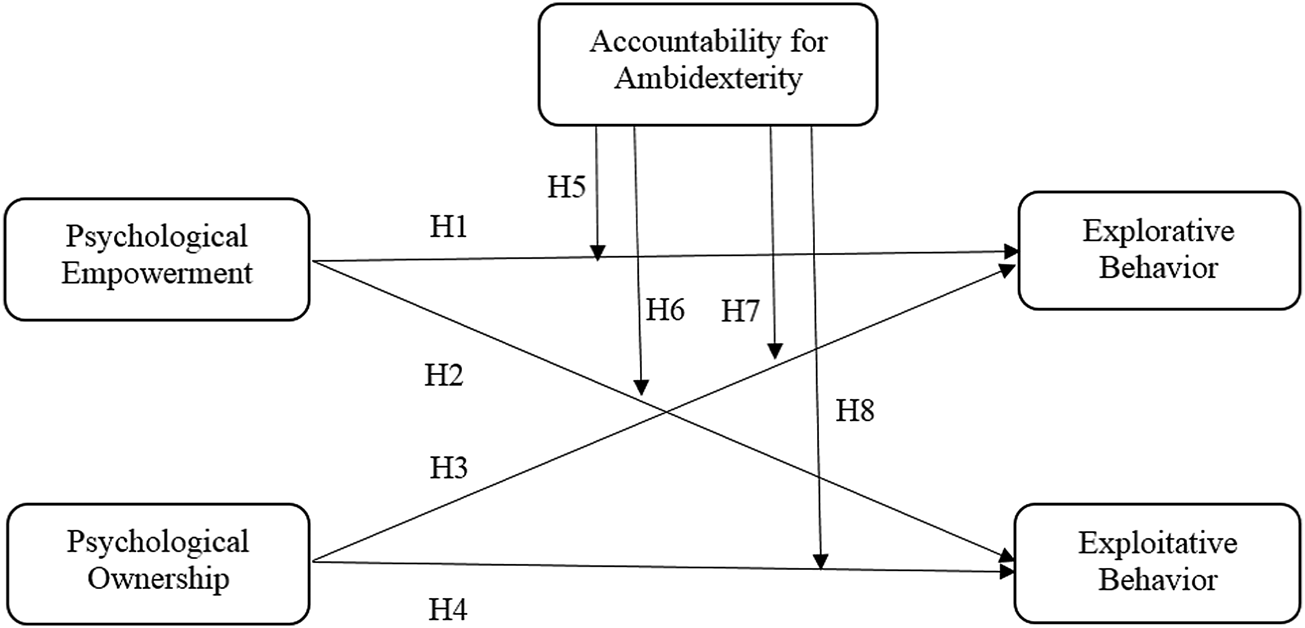
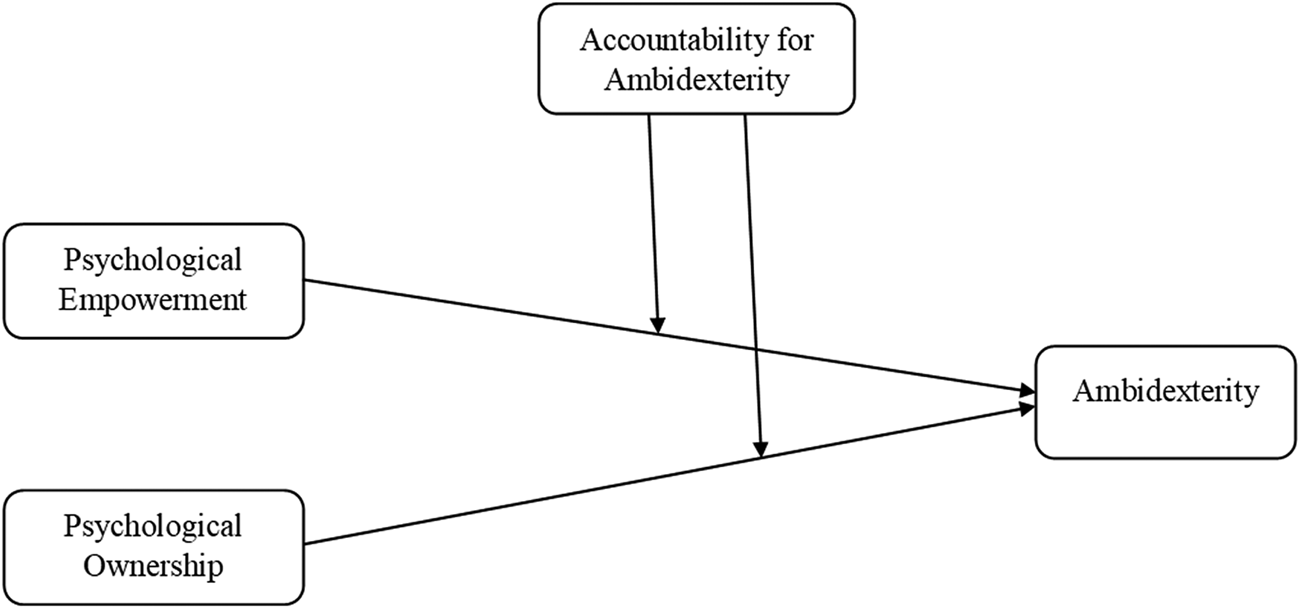
In this study, we examine the effect of accountability for ambidexterity on empowered employees and employees experiencing ownership. It is expected that accountability will cause individuals with either characteristic to be more attentive to fulfilling formal expectations. That is, for either explorative or exploitative tasks, it is expected that empowered employees and/or employees experiencing ownership should increase their exploration and exploitation under conditions of accountability beyond that of employees who are not held accountable because accountability will engender the sense of answerability to the audience of oversight to perform each type of task well (Figure 1).
Research model

Hypothesis 5
Accountability for ambidexterity moderates the positive relationship between psychological empowerment and explorative behavior such that the relationship is stronger with higher levels of perceived accountability for ambidexterity.
Hypothesis 6
Accountability for ambidexterity moderates the positive relationship between psychological empowerment and exploitative behavior such that the relationship is stronger with higher levels of perceived accountability for ambidexterity.
Hypothesis 7
Accountability for ambidexterity moderates the positive relationship between psychological ownership and explorative behavior such that the relationship is stronger with higher levels of perceived accountability for ambidexterity.
Hypothesis 8
Accountability for ambidexterity moderates the positive relationship between psychological ownership and exploitative behavior such that the relationship is stronger with higher levels of perceived accountability for ambidexterity.
Methods
Sample and procedures
We drew our sample from an American manufacturing company that distributes its products mainly to North America and employs approximately 800 workers. Our choice for selecting this company as the focus of our study was due to its commitment to empowering its employees to achieve organization goals. As part of the firm's management strategy, employees were provided with the workplace autonomy and flexibility to adapt their behaviors to achieve their job goals. This flexibility provided employees with discretion to engage in exploration activities in addition to the required exploitation activities required by their job descriptions. The variability in job requirements provided ample opportunities for observing different levels of explorative and exploitative behaviors within the work group. The company also provides a family-oriented environment that includes referring to its employees as ‘associates,’ promoting loyalty, and offering a profit-sharing program to all employees. These factors provided the opportunity to develop and enhance a sense of belonging and ownership to the organization.
The company has responded well to continuing demands for exploration to address changes in customer demands, competition, and industry trends. As a result, it received product innovation awards in 2012, 2014, and 2016. The company has also faced relentless pressure to exploit its resources and has focused on efficiencies, cutting costs, and economies of scale to remain competitive in an industry dominated by larger, well-established manufacturers. This represents a dynamic context that requires shifting between the demands for exploration and exploitation, and thus represents a suitable context for testing the hypotheses. To minimize common method bias, we measured the independent and dependent variables from different sources (Podsakoff, MacKenzie, Lee, & Podsakoff, Reference Podsakoff, MacKenzie, Lee and Podsakoff2003).
We recruited 704 line-workers and office workers from all supporting areas and their supervisors. Because the company is a manufacturer of a diverse set of flooring products for commercial applications, line-workers support core manufacturing processes assisted by specialized machines to produce carpet and hard floor products. To a large extent, line-workers' job responsibilities involve specific tasks for meeting production demands or special customer orders. Along the supply chain, office workers provide general administrative and logistical support from product ordering to product shipping through the company's functional areas such as marketing, accounting, IT, and finance. Example of office workers' responsibilities include taking orders, ordering production supplies, product sampling, quality inspection, customer service, and product delivery.
Workers completed the survey measuring the independent, moderator, and control variables while their supervisors completed a survey measuring the dependent variables. To encourage participation, the company's vice president sent out a company-wide announcement to all managers indicating the company's support of the study and asked them to facilitate voluntary participation of employees and supervisors. All participants were provided with consent forms prior to participating in the study. These consent forms indicated that their participation was voluntary, that the study was academic in nature, and that only the researchers would have access to the data from the study. To protect confidentiality of survey responses, we deleted all identity-revealing information in the dataset after data pairing.
Of the 704 employee surveys distributed, 365 were returned. From those, 40 were excluded due to missing data, irregular response patterns, or missing identifiers. Of the 704 surveys sent to supervisors, 554 were returned. After pairing supervisor and employee responses, we identified three outliers using the Mahalanobis distance test D 2 and excluded them from the analysis. The final sample size was 297, corresponding to a response rate of 42%. The average age of the respondents was 44.6 years, their average tenure at the firm was 9.5 years, and their average tenure at the position was 5.6 years. Men comprised 51.5% of the group.
Measures and validation
Independent variables
We used the 12-item scale created by Spreitzer (Reference Spreitzer1995) to measure psychological empowerment (α = .83). Scale items included, ‘The work I do is meaningful to me’ and ‘I am confident about my ability to do my job.’ We used the 6-item scale created by Brown, Pierce, and Crossley (Reference Brown, Pierce and Crossley2014) to measure psychological ownership (α = .92). Items included, ‘I sense that this job is mine’ and ‘I sense that the work I do as part of my job is mine.’ Both measures use a 7-point Likert scale (1 = strongly disagree to 7 = strongly agree).
Moderator variable
We measured accountability for ambidexterity using measures adapted from a 3-item scale created by Mero, Guidice, and Werner (Reference Mero, Guidice and Werner2014) that uses a 5-point Likert scale (1 = strongly disagree to 5 = strongly agree). We modified the questions (in [ ]) to include accountability for explorative tasks and for exploitative tasks. Four of the six questions are, ‘Others in my organization can observe the outcome of my [(1) explorative] [(2) exploitative] work performance in terms of achieving unit goals’ and ‘I am required to justify or explain my performance [(3) of explorative tasks] [(4) of exploitative tasks] in terms of achieving unit goals.’ The combined measure, accountability for ambidexterity, contained six items (α = .82).
Dependent variable
To measure the extent to which individuals engage in explorative and exploitative behaviors, we used the 7-item scales developed by Mom, van den Bosh, and Volberda (Reference Mom, van den Bosh and Volberda2009). For example, supervisors were asked to evaluate the extent to which their subordinates engaged in ‘searching for new possibilities with respect to product/services, processes or markets’ (exploration) and in ‘activities which [subordinates] carry out as if it were routine’ (exploitation). Both instruments use a 7-point Likert scale (1 = strongly disagree to 7 = strongly agree). Cronbach's α was .92 for explorative behavior and .90 for exploitative behavior.
Control variables
We controlled for employee age, ethnicity, tenure, work area, and conscientiousness, which were measured using Saucier’s (Reference Saucier1994) 4-item, 7-point Likert scale.
Validation
We followed Brown’s (Reference Brown2014) and Hair, Black, Babin, and Anderson’s (Reference Hair, Black, Babin and Anderson2010) recommendations to use confirmatory factor analysis for assessing model fit and construct validation. We refined scales following MacKenzie, Podsakoff, and Podsakoff’s (Reference MacKenzie, Podsakoff and Podsakoff2011) method and, consistent with Hair et al., (Reference Hair, Black, Babin and Anderson2010), removed an item only if it would result in no more than 20% of the items being removed. The resulting model fit improved from (CFI (comparative fit index) = .86 and RMSEA (root mean square error of approximation) = .089) to (CFI = .90, RMSEA = .076) when we let three pairs of error terms covary within their own constructs. In addition, since the upper limits of the 90% confidence interval for RMSEA (HI90 = .094 for RMSEA = .089 and HI90 = .082 for RMSEA = .076) were below .10, our model was considered an acceptable research model (Loehlin, Reference Loehlin2004).
We then assessed convergent validity using the average variance extracted (AVE) estimates for each construct. AVEs for all but accountability (.49) were greater than the recommended .50 for adequate convergent validity (Fornell & Larcker, Reference Fornell and Larcker1981), and one that was under the threshold was only by .01. Thus, convergent validity was deemed acceptable. In addition, AVE results indicate that the variance captured by the variables, except for accountability, is larger than the variance due to measurement error, suggesting that our variables are adequate (Fornell & Larcker, Reference Fornell and Larcker1981).
To assess discriminant validity, we compared each AVE with the squared inter correlation estimates. As seen in Table 1, the AVEs were greater than the inter-construct squared correlations for each construct thereby providing evidence of discriminant validity (Fornell & Larcker, Reference Fornell and Larcker1981).
Composite reliability, average variance extracted, and construct correlations

Note: Values below the diagonal are correlation estimates among constructs.
Values above the diagonal are squared correlations.
CR, composite reliability, AVE, average variance extracted.
Analysis and Results
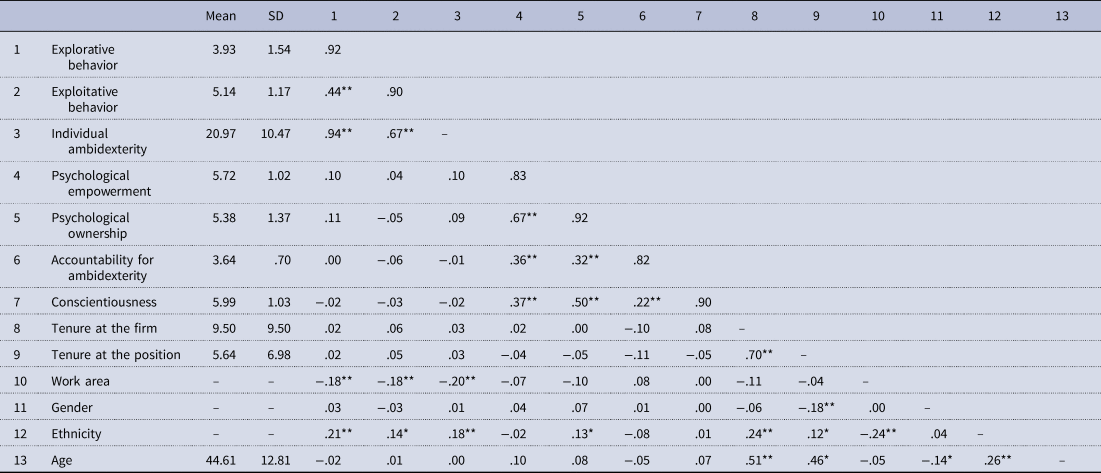
Means, standard deviations, correlations, and reliabilities are shown in Table 2. We used hierarchical regression to test our hypotheses. We assessed multicollinearity by analyzing variance inflation factors (VIF) for all predictor variables. All VIF values were below the recommended threshold of VIF <10 (Kutner, Nachtsheim, & Neter, Reference Kutner, Nachtsheim and Neter2004), suggesting that multicollinearity is not a major issue.
Descriptive statistics, inter-correlations, and reliability

Note: N = 297; Cronbach's α coefficients are shown on the diagonal; ** p < .01 (2-tailed); * p < .05 (2-tailed).
Gender (female = 0, male = 1); ethnicity (African American = 1, American Indian = 2, Asian = 3, Caucasian = 4, Hispanic = 5).
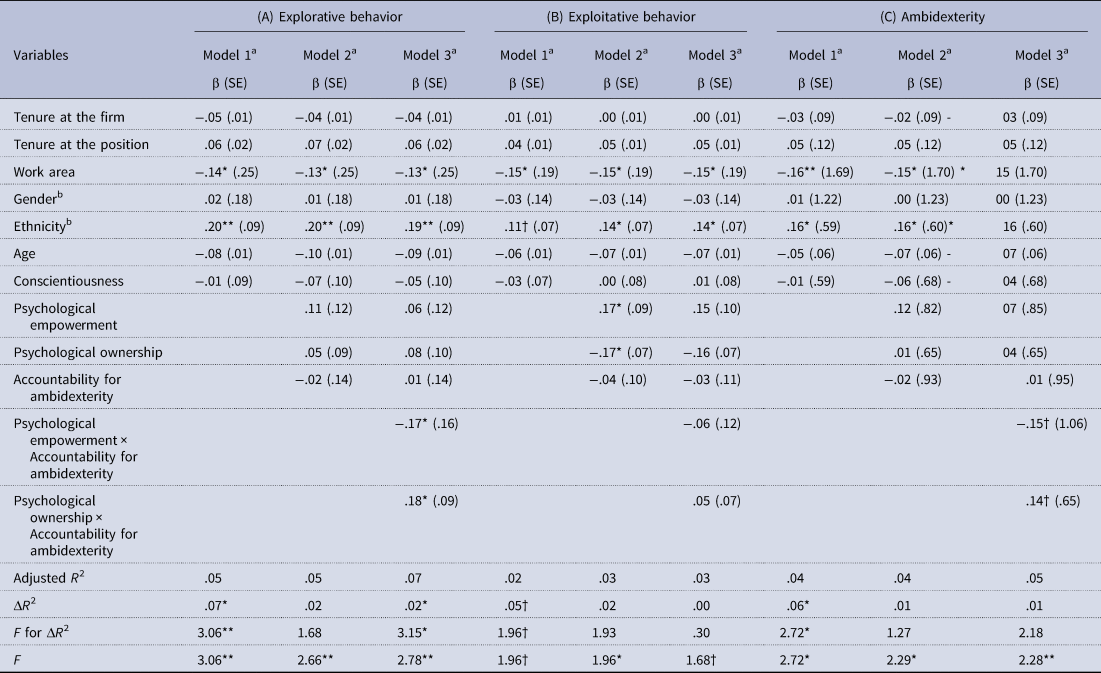
Because the intraclass correlation obtained with the unconditional model (Hox, Moerbeek, & Van de Schoot, Reference Hox, Moerbeek and Van de Schoot2017) was below 5% for both dependent variables, there were not enough differences between work areas to justify a multi-level analysis. Consequently, we conducted two independent regression analyses; one for explorative behavior and one for exploitative behavior (see Table 3). Model 1 presents the results of the control variables. Model 2 adds the independent variables and the moderator variable. Model 3 follows Cohen and Cohen’s (Reference Cohen and Cohen1983) approach and Lee, Park, and Baker’s (Reference Lee, Park and Baker2018) example for analyzing moderating effects by including the multiplicative interaction item in the last step. Prior to testing for moderation, the predictor variables were mean-centered to increase interpretability of the results (Aiken & West, Reference Aiken and West1991).
Results of moderated regression analysis for exploration, exploitation, and individual ambidexterity

a Standardized betas (β) with standard errors (SE) are reported. N = 297. †p < .10; *p < .05; **p < .01.
b Gender: female = 0, male = 1; ethnicity: African American = 1, American Indian = 2, Asian = 3, Caucasian = 4, Hispanic = 5.
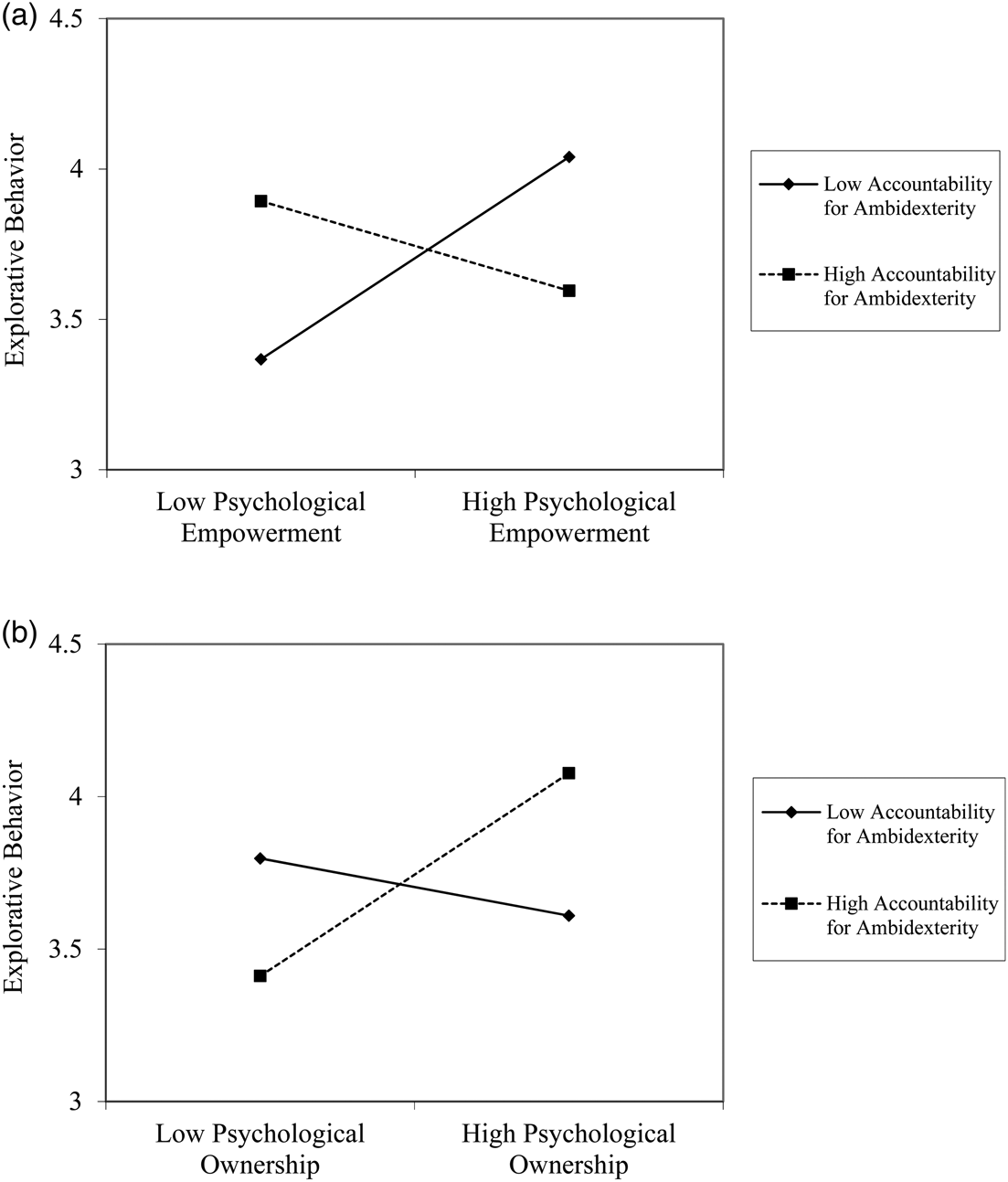
Regression results reveal no significant main effects of empowerment and ownership on exploration (Table 3A, Model 2), thereby failing to support Hypotheses 1 and 3. Although results show significant main effects of empowerment (β = .17, p < .05) and ownership (β = −.17, p < .05) on exploitation (Table 3B, Model 2), thus supporting Hypotheses 2 and 4, Hypothesis 4 was unexpectedly in the opposite direction. These results indicate that empowerment has a positive effect on exploitation while ownership has a negative effect. As shown in Table 3A, Model 3, we also found a significant interactive effect between empowerment and accountability on exploration (β = −.17, p < .05). To further understand the nature of this relationship, we used the approach suggested by Aiken and West (Reference Aiken and West1991) to illustrate this interaction. As depicted in Figure 2A, the relationship was opposite to what was predicted in Hypothesis 5. That is, as perceptions of accountability increased, gains in explorative behavior were lower (rather than higher) at increasing levels of empowerment.
Moderating effects of accountability for ambidexterity on (A) psychological empowerment and exploration and (B) psychological ownership and exploration

As shown in Table 3A, Model 3, and in support of Hypothesis 7, accountability also moderated the relationship between ownership and exploration (β = .18, p < .05). Figure 2B illustrates the nature of this interaction. The positive relationship between psychological ownership and explorative behavior was stronger when accountability was high. Finally, and as shown in Table 3B, Model 3, there were no significant moderation effects on exploitation. Therefore, Hypotheses 6 and 8 were not supported.
Post hoc analysis
Following previous approaches that operationalized ambidexterity by multiplying exploration and exploitation (e.g., Gibson and Birkinshaw, Reference Gibson and Birkinshaw2004; Mom, van den Bosh, and Volberda, Reference Mom, van den Bosh and Volberda2009), we calculated ambidexterity and included it in our regression analysis. Figure 3 displays the model from this post hoc analysis, and Table 3C displays the regression results. Although the moderation effects of accountability on ambidexterity were not significant at p < .5, they were significant at p < .10 for empowerment (β = −.15, p = .058) and for ownership (β = .14, p = .062). These results highlight the offsetting effects (and restriction) of analyzing ambidexterity as one combined behavior. This separation did help us find (1) the moderation effects of accountability and both empowerment and ownership on exploration and (2) the direct effects on exploitation. These results could not be found using only the combined measure.
Post hoc analysis

Discussion and Conclusion
Our research makes three distinct contributions. First, our main contribution is the development of a conceptual model that uniquely integrates research on psychological empowerment, psychological ownership, and accountability with individual ambidexterity. Using the lens of self-determination theory, we argue that working contexts that support autonomy, competence, and relatedness can foster feelings of psychological empowerment and psychological ownership and thus motivate employees toward exploration and exploitation. Our results suggest that psychological empowerment did not influence explorative behavior. While self-determination was theorized to predict explorative behavior through intrinsically motivating employees, the working context may not be conducive for generating explorative behavior even among empowered employees.
Although neither psychological empowerment nor ownership influenced explorative behavior, psychological empowerment, as predicted, positively influenced exploitative behavior. This finding is consistent with research on the psychological empowerment-performance link in that when individuals experience empowerment, their behavioral outcomes are positively related to job performance (Maynard, Luciano, D'Innocenzo, Mathieu, & Dean, Reference Maynard, Luciano, D'Innocenzo, Mathieu and Dean2014).
Although psychological ownership was theorized to have a positive effect on exploitative behavior, we found evidence for its negative effects instead. This unanticipated finding was, upon reflection, not an anomaly, as Van Dyne and Pierce’s (Reference Van Dyne and Pierce2004) study also did not find support for the theorized positive effect of psychological ownership on employee performance. Similarly, Sieger, Zellweger, and Aquino (Reference Sieger, Zellweger and Aquino2013) found that psychological ownership had a weaker indirect effect on performance when monitoring was high rather than low. Findings such as these suggest that ownership may influence performance in conjunction with other moderating or mediating variables, including accountability as was considered in our study.
Second, our research contributes to the ambidexterity literature by examining the interactive mechanisms by which psychological empowerment and ownership combine with perceptions of accountability to influence ambidextrous behavior. Our results show a positive interaction between ownership and accountability on explorative behavior (Figure 2B). This finding aligns with both theory and prior research findings in that individuals tend to focus on behaviors that enhance the outcomes for which they are held accountable (Mero, Guidice, & Brownlee, Reference Mero, Guidice and Brownlee2007, Reference Mero, Guidice and Werner2014; Roch & McNall, Reference Roch and McNall2007). However, we found that the interaction between empowerment and accountability had a negative influence on explorative behavior. Specifically, higher accountability perceptions were found to be associated with higher levels of exploration for individuals scoring low in psychological empowerment but not with individuals who felt more empowered (Figure 2A). One explanation for this unexpected finding may be that individuals that experienced low empowerment also reported low levels of self-determination but ultimately engaged more in explorative behavior simply because they felt they were personally obligated to perform well when supervisor oversight was perceived to be high.
Third, our research contributes to the ambidexterity literature by analyzing exploration and exploitation behaviors separately. Our goal was to reveal the diluting effects of combining both by using the multiplicative effects approach advanced by Gibson and Birkinshaw (Reference Gibson and Birkinshaw2004) and used in other individual-level ambidexterity research (Mom, van den Bosh, and Volberda, Reference Mom, van den Bosh and Volberda2009; Jasmand, Blazevic, and Ruyter, Reference Jasmand, Blazevic and Ruyter2012). Analyzing exploration and exploitation separately revealed important main effects and interaction effects that were attenuated when using the combined approach (see Table 3).
Theoretical implications
First, operationalizing ambidexterity as a combined behavior may have a diluting effect, suggesting that future research considering ambidexterity should also include analyses of exploration and exploitation separately. We suggest this since the multiplicative calculation of ambidexterity does not measure the phenomenon directly, and thus interpretation of ambidextrous behavior should include its originating components.
Second, the average rating on exploration (M = 3.93, SD = 1.54) was not as high or dispersed as it was with exploitation (M = 5.14, SD = 1.17), indicating that participants primarily rated exploitation at the high end of the scale and with less response variation. This low variance could be why we did not find moderation effects for exploitation. One explanation for this may be the timing of our study. Since data were collected at the end of the year, it is possible that managers may have required employees (successfully) to focus on behaviors to meet end-of-year goals (exploitation). Thus, more research is needed to capture ambidextrous behavior in other business cycles that have a more diverse set of organizational demands for exploration and exploitation.
Implications for practice
As managers seek to understand contextual factors that encourage and promote ambidextrous behavior, careful attention should be given to how accountability may enhance or undermine gains in exploration. For example, if managers create conditions of high expectations for accountability, this could be detrimental to employee motivation when employees feel empowered because rather than volitionally exploring, employees may simply feel they have to perform and thus, lose some of the passion or the intrinsic motivation that is associated with empowerment. This passion, known as harmonious passion (Vallerand et al., Reference Vallerand, Blanchard, Mageau, Koestner, Ratelle, Léonard and Marsolais2003), is the passion that manifests in environments where individuals feel autonomous, connected, and competent. This is in contrast to the other form of passion, obsessive passion, which results from merely pursuing ego-affirming motives.
Knowing that accountability can be a valuable governance tool for managing decisions and behavior, managers should consider, based on our findings, using accountability mechanisms to increase explorative behavior with employees who do not feel empowered and with those high in psychological ownership. In addition, managers should use caution when using accountability mechanisms with employees who feel empowered and with those low in psychological ownership as gains in explorative behavior may not provide a substantial impact.
Another implication from our findings is that working conditions that empower employees increase exploitative behavior, providing managers with a tool for achieving performance goals that depend on exploitative tasks. Our study also suggests that caution and further study are warranted when implementing measures to increase psychological ownership as this was found to be detrimental to both explorative and exploitative behavior, and thus, ambidextrous behavior. Managers are advised to consider steps to foster empowerment and ownership among employees before or in tandem with instituting accountability as a governance mechanism.
Limitations and future research
This study, as with all research, has limitations. Although there are theoretical reasons to support the unidirectional relationships proposed in our research model, our study is cross-sectional and thus, no inferences of causality can be made. It is through further studies that use temporal information and structural modeling that the assumed directions can be confirmed (Wunsch, Russo, & Mouchart, Reference Wunsch, Russo and Mouchart2010). Second, data for our study were drawn from a single company. Although using one company provided the advantage of ruling out organizational differences in behavior, it also means that the findings cannot be generalized to contexts that are meaningfully different from the context analyzed in this study. Last, we analyzed the behavior of line-workers and office workers only. Therefore, the findings may not be generalizable to individual behaviors of managers, top management, or chief officers.
Future research should investigate the applicability of our model in other contexts. It may be that in other industries, research will find stronger relationships than those found in our study and could confirm the diluting effects of using a combined measure to examine ambidexterity. Future research might also consider whether the effect of either empowerment or ownership on exploration and exploitation is mediated by other variables not considered in our study. For example, psychological ownership has been previously examined in terms of its consequences on the promotion of and resistance to change (Brown, Pierce, & Crossley, Reference Brown, Pierce and Crossley2014). Thus, it is possible that the promotion of change will mediate the ownership-ambidexterity relationship.
Two other limitations of our study are the restricted variance of the dependent variables and the seemingly overestimated performance ratings of subordinate's exploitative behavior. While we encouraged supervisors to evaluate their employees accurately, it could be that raters viewed their employees' performance as a reflection of their management skills and thus, viewed workers more favorably than actual performance warranted. As a result, there may have been less differentiation between the top and bottom performers. In addition, since the company offers products in a mature and highly competitive industry, this may be why exploitation ratings were consistently high. This does not mean that explorative behaviors were not valued as the company does value innovation and has received several awards on product innovation, but it does suggest greater emphasis on exploitative tasks during a business cycle that demanded exploitation.
The infancy state of individual-level ambidexterity research provides a fertile field for future studies; thus, we recommend that researchers consider the unexpected negative effect that accountability had on ambidextrous and explorative behavior when employees felt highly empowered. Accountability theorists have argued that accountability is a complex construct that can produce an array of effects, some of which could not be beneficial (Lerner & Tetlock, Reference Lerner and Tetlock1999). This appears to be one instance where this effect would explain our unexpected results. Finally, and despite its limitations, this study contributes to the small body of research on individual-level ambidexterity by empirically analyzing employees' ambidextrous behavior.
Author ORCIDs
Fernando Garcia, 0000-0002-7870-1566