Introduction
Malpractice and related lawsuits are of growing interest among physicians and attorneys. This is a relatively uncharted territory about which physicians need to be informed. In this growing era of malpractice accusation, physicians may feel pressured to refrain from requisite operations, or request unnecessary laboratory or radiological examinations. This attitude is mostly brought about by the lack of education regarding legal aspects in the medical curriculum and fear of litigation.
Most complications do not result in litigation, and management of the post-complication period is important to prevent lawsuits. As the World Health Organization states, a distinction between malpractice and untoward results that occur in the course of treatment should be made, as the latter may not indicate fault of the physician. 1 In a review of a random sample of malpractice claims, nearly 37 per cent of claims were found to be frivolous and accounted for 15 per cent of the total estimated cost.Reference Studdert, Mello, Gawande, Gandhi, Kachalia and Yoon 2 Nearly 75 per cent of physicians in ‘low-risk’ specialties and nearly all physicians in ‘high-risk’ specialties are at a risk of facing malpractice litigation during their career; however, most claims favour the defendant physician.Reference Jena, Seabury, Lakdawalla and Chandra 3
Among otorhinolaryngology head and neck surgery malpractice claims, poor performance in rhinology accounted for two-thirds of all cases in terms of paid indemnity.Reference Dawson and Kraus 4 Functional endoscopic sinus surgery (FESS) is the foremost litigated procedure in the field of rhinology. Differences among legal systems, laws and the socioeconomic status of countries, as well as educational differences, may influence the distribution and characteristics of lawsuits.
The present study aimed to investigate the characteristics of rhinology-related malpractice cases and identify physicians who work in potential risk areas in order to optimise safe practice.
Materials and methods
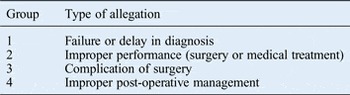
The National Institute of Forensic Medicine database was reviewed and relevant case reports from 2005 to 2012 were identified. The National Institute of Forensic Medicine is an independent expert institution to where courts refer all malpractice claims for expert judgement. This superior Institution constitutes an authoritative position for a three-line whip. Each malpractice claim file is investigated by a forensic medicine specialist in the Institute and grouped according to the type of the allegation (Table I). Later, a grand jury of the Institute adjudicates whether malpractice occurred. Decisions are made by quorum. A final judgement is made by the court according to the decision of the Institute.
Classification of allegations

For this study, data of all malpractice cases associated with otorhinolaryngology were extracted. A total of 241 malpractice case reports were evaluated, and 83 malpractice cases that involved surgical or medical treatments in rhinology were separated.
Data extracted included age, sex, diagnosis, treatment details, surgical epicrisis, plaintiff allegations and date of verdict. Cases were classified into medical or surgical treatment groups, and an analysis of the distribution of cases by year was performed. Regarding treatment centres, cases were grouped into those from secondary or tertiary hospitals: secondary hospitals consisted of private hospitals or state hospitals, whereas tertiary hospitals consisted of university hospitals or research and education hospitals.
This study was approved by the ethics review board of the Scientific Committee of the National Institute of Forensic Medicine (number 108400987-117).
Results
Demographics
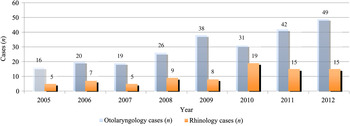
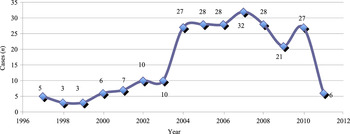
Of the 241 otorhinolaryngology malpractice cases, 83 rhinology-related cases (34 per cent) were reviewed. The distribution of otolaryngology and rhinology cases according to year of claim is shown in Figure 1. There were an almost equal number of male (n = 42) and female (n = 41) claimants. Only one case involved a paediatric patient (a 10-year-old boy). Patient age ranged from 10 to 75 years, with a mean (± standard deviation) age of 32.07 ± 10.53 years. There was an almost 10-fold increase in the number of malpractice allegations made in the 2000s compared with the 1990s (Figure 2).
Distribution of malpractice cases related to otolaryngology and rhinology.

Number of litigations in otorhinolaryngology from the mid-1990s to 2011.

Four (4.8 per cent) of 83 cases were related to medical therapy, and 79 cases involved surgical treatment. The most frequent charge was improper medical or surgical performance (53 cases), followed by complications of surgery (26 cases) and improper post-operative management (4 cases).
Judgement characteristics
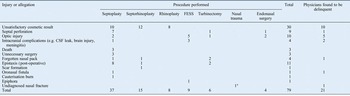
Of the 83 cases, 21 (25.3 per cent) received a unanimous verdict of ‘malpractice’ (result against the defendant) by the National Institute of Forensic Medicine grand jury. The cases given a malpractice verdict are summarised in Table II. No delinquency was found in the other 62 cases (74.7 per cent).
Procedures performed and patient injuries or plaintiff allegations

Data represent numbers of cases. *Patient with nasal trauma had an undiagnosed nasal fracture. FESS = functional endoscopic sinus surgery; CSF = cerebrospinal fluid
The causes of malpractice were: improper performance, in 18 cases (86 per cent); misdiagnosis, in 2 cases (9 per cent); and carelessness and imprudence during the post-operative period, in 1 case (5 per cent). For cases in which patients underwent surgery, the most common complaint was unsatisfactory cosmetic results (n = 30; n = 10 deemed malpractice), followed by: optic nerve injury (n = 10; n = 5 deemed malpractice), septal perforation (n = 9; n = 1 deemed malpractice) and intracranial penetration (n = 4; n = 2 deemed malpractice). The one paediatric case in this study was related to surgical treatment of nasal polyps, and an unsatisfactory functional result was the reason for accusation. However, this case had an unfavourable outcome for the plaintiff. The distribution of performed surgical treatments and related injuries or allegations is summarised in Table II.
Treatment centre
Treatment was provided in secondary care hospitals in 16 (76 per cent) of the 21 malpractice cases; 9 of these patients were treated in state hospitals and the remaining 7 were treated in private hospitals. Five cases (24 per cent) involved patients referred from tertiary care hospitals: three were from university hospitals, and two were from education and research hospitals.
Discussion
Otorhinolaryngology, particularly the field of rhinology, is one of the leading medical branches subject to malpractice lawsuits. Despite the fact that legal regulations regarding medical malpractice differ among countries, similar risks and medicolegal aspects exist, and physicians are well suited to pursue growing trends and practice safely. In this growing era of malpractice accusations, it is common for physicians to feel pressured to order extra, unnecessary tests or non-essential examinations. Current legislation on health and increasing numbers of surgical procedures associated with technical improvements have resulted in increased numbers of malpractice litigations.
We found septal deviation to be the most common diagnosis in malpractice cases in our study (71 per cent). Chronic sinusitis was the second most common diagnosis (15 per cent), and almost all of these patients were diagnosed with chronic rhinosinusitis with nasal polyposis. However, other studies have reported sinusitis to be the most common diagnosis in otorhinolaryngology malpractice cases. Tolisano et al. reported sinusitis (64 per cent) and nasal polyposis (10 per cent) to be the most common diagnoses in rhinology malpractice cases.Reference Tolisano, Justin, Ruhl and Cable 5 Another study revealed similar results, with sinusitis (73 per cent) and nasal polyposis (12 per cent) being the most frequent diagnoses.Reference Lynn-Macrae, Lynn-Macrae, Emani, Kern and Conley 6 In another study conducted in the USA, nearly one-half (46 per cent) of the patients were found to have sinusitis as a primary diagnosis.Reference Dawson and Kraus 4 Winford et al. reported chronic sinusitis (42 per cent) and nasal obstruction (27 per cent) as the most common presenting symptoms.Reference Winford, Wallin, Clinger and Graham 7
The causes of medical malpractice are classified into five juridical categories: carelessness, imprudence, improper performance, negligence and failure to conform to the standard of care for treatment. In our study, improper performance and failure to diagnose were the most common allegations. Winford et al. found negligent technique (38 per cent) to be the most common allegation, followed by lack of informed consent (27 per cent).Reference Winford, Wallin, Clinger and Graham 7 Lynn-Macrae et al. reviewed 41 cases of FESS in which negligent technique (76 per cent) and lack of informed consent (37 per cent) were reported as the most common types of malpractice, although multiple causes were present in many of the cases.Reference Lynn-Macrae, Lynn-Macrae, Emani, Kern and Conley 6 Hong et al. found that improper performance and failure to diagnose and treat were two of the most commonly cited legal allegations.Reference Hong, Yheulon, Wirtz and Sniezek 8 Dawson and Kraus reported that improper performance accounted for more than one-half of the total monies paid for malpractice indemnity.Reference Dawson and Kraus 4
The most frequent rhinology operations associated with claims in our study were septoplasty, septorhinoplasty and FESS. Hong et al. reviewed lawsuits involving otolaryngologists in the past decade and found that 35 of 198 cases were related to FESS.Reference Hong, Yheulon, Wirtz and Sniezek 8 Nikoghosyan-Bossen et al. reviewed 480 malpractice cases in an otorhinolaryngological practice, and found that septoplasty, rhinoplasty and septorhinoplasty (nasal reconstructive surgery) combined were the second most common source of complaints (25.5 per cent) after tonsillectomy.Reference Nikoghosyan-Bossen, Hauberg and Homøe 9 Functional endoscopic sinus surgery is the most commonly litigated rhinology operation in the USA.Reference Jena, Seabury, Lakdawalla and Chandra 3 Thus, most studies from the USA have investigated medicolegal aspects in terms of FESS and sinonasal diseases.Reference Tolisano, Justin, Ruhl and Cable 5 , Reference Winford, Wallin, Clinger and Graham 7 , Reference Lydiatt and Sewell 10 , Reference Becker and Duncavage 11
In our study, unsatisfactory cosmetic results and septal perforation were the most alleged situations or injuries after septoplasty or septorhinoplasty, and intracranial penetration and optic nerve injury were the most common allegations following FESS. Furthermore, physicians were found to be delinquent in: 33 per cent of cases with allegations of unsatisfactory cosmetic results; 50 per cent each of optic nerve injury and intracranial penetration cases; and 11 per cent of septal perforation cases. Overall, physicians were found to be delinquent in 26.5 per cent of malpractice cases. In a recent study from the UK, Harris et al. found poor cosmetic outcomes to be the most common reason for claims in litigations related to rhinology.Reference Harris, Edwards and Pope 12 Hong et al. reported physicians to be delinquent in 17 of 35 cases (49 per cent).Reference Hong, Yheulon, Wirtz and Sniezek 8 The most common injuries caused by surgery were cerebral spinal fluid rhinorrhoea (12 cases) and orbital injury (10 cases). The most frequent complaints were no effect of the operation on nasal flow (10 cases) and unsatisfactory cosmetic results (9 cases), followed by post-operative septal perforation, post-operative nasal pain, rough handling, inattention to patient discomfort, post-operative infection and post-operative bleeding.Reference Hong, Yheulon, Wirtz and Sniezek 8
Surgeons should be aware of the anatomical limits of their surgical field and the consequences of manoeuvres performed during the operation. Optic injury is an extremely rare and disastrous condition during septoplasty. In one case, aggressive removal of the vomer resulted in optic nerve damage due to small bony fragments penetrating the dehiscent optic nerve within the sphenoid sinus. In another case, during removal of the maxillary crest, an inadvertently placed chisel slipped off the bone of the nasal floor and injured the orbital apex. The resulting orbital haematoma caused ischaemia of the optic nerve. Both cases resulted in an unfavourable juridical outcome for the defendant. Surgeons should always avoid brutal or unnecessary manoeuvres during surgery, particularly in rhinology practice, because of the close relationship with critical structures such as the optic nerve, carotid artery, orbita or skull base. Furthermore, co-operation with the anaesthesiologist before, during and after the operation is very important, particularly when the airway is involved in the surgery.
The most frightening situation during surgery is certainly death. Although death during surgery may be related to anaesthesia, the surgeon also carries responsibility. In our study, there were three cases, all related to septoplasty, in which death occurred. In the first case, the patient could not be intubated after pre-medication because of maxillofacial structural abnormalities, which caused a difficult airway. A tracheostomy was conducted, but ventilation could not be maintained. In the second case, the patient aspirated blood during surgery under local anaesthesia. Although the anaesthesiologist switched to endotracheal anaesthesia intra-operatively, the patient developed pneumonia and died. Malignant hyperthermia was responsible for the death in the third case.
-
• Rhinology is one of the most litigated areas in otolaryngology
-
• Of 241 otorhinolaryngology malpractice cases reviewed, 83 were rhinology-related and were analysed separately
-
• A verdict of malpractice against the physician was decided in 21 cases, all related to surgical treatment
-
• An unsatisfactory cosmetic result was the most common alleged reason for complaints against delinquent physicians
-
• ‘Optic injury’ was the second most common reason, mostly related to functional endoscopic sinus surgery
-
• Attentive and delicate practice, comprehensive knowledge of anatomy, and co-operative study are essential
Of note, the disparity among these studies might reflect territorial differences, and a lack of universally accepted terminology relating to definitions and treatment of malpractice. In our study, all cases reported were evaluated and resolved in the National Institute of Forensic Medicine, and the study results reflect the decisions of the grand jury. These decisions represent explicit provision of a ‘malpractice’ verdict, but do not include court punitive or monetary awards for the plaintiff. Other investigations of malpractice claims utilised different databasesReference Dawson and Kraus 4 – Reference Hong, Yheulon, Wirtz and Sniezek 8 and mostly investigated indemnities paid. Legal regulations for medical malpractice vary by country, and disparities in terms of compensation make comparison difficult. Medical professionals should be educated in the medicolegal aspects of malpractice and awareness should be raised accordingly. Despite the increasing number of studies, more research and collaboration with legists in this topic are needed.
Acknowledgement
We would like to thank Mr David Chapman for English editing.