





Antisocial behavior (ASB) includes aggressive and nonaggressive/rule-breaking behaviors that violate societal norms and others’ rights (American Psychiatric Association, 2022). Although ASB is observed across development in boys and girls, studies examining the etiology and development of ASB have predominantly focused on boys, likely because ASB is generally more prevalent in boys (e.g. Moffitt, Reference Moffitt, Lahey, Moffitt and Caspi2003). Nevertheless, ASB is associated with adverse outcomes in girls, including alcohol/substance use (Jangard, Olsson, Molero, Jayaram-Lindström, & Raninen, Reference Jangard, Olsson, Molero, Jayaram-Lindström and Raninen2025), internalizing symptoms (e.g. depression; Heerde et al., Reference Heerde, Curtis, Bailey, Smith, Hemphill and Toumbourou2019), and later mental health problems (Odgers et al., Reference Odgers, Moffitt, Broadbent, Dickson, Hancox, Harrington, Poulton, Sears, Thomson and Caspi2008; Popli, Maughan, & Rowe, Reference Popli, Maughan and Rowe2025). Importantly, these deleterious outcomes may be more pronounced in girls, as girls with clinically significant ASB show more comorbid lifetime mental disorders and more severe ASB presentations than boys (Konrad et al., Reference Konrad, Kohls, Baumann, Bernhard, Martinelli, Ackermann, Smaragdi, Gonzalez-Madruga, Wells, Rogers, Pauli, Clanton, Baker, Kersten, Prätzlich, Oldenhof, Jansen, Kleeven, Bigorra and Freitag2022). Finally, while the incidence and severity of ASB tend to increase from childhood to adolescence (Carroll, Mikhail, & Burt, Reference Carroll, Mikhail and Burt2023; Moffitt, Reference Moffitt, Cullen, Wright and Blevins2006), this increase may be steeper in girls than boys (Silverthorn & Frick, Reference Silverthorn and Frick1999), highlighting this transition as a potential period of heightened vulnerability for girls.
At the core of this transition is puberty. Although all typically developing girls progress through the same pubertal stages, there are individual differences in pubertal timing, or the age at which pubertal changes occur. Pubertal timing is categorized as early (i.e. maturing earlier than peers), on time (i.e. maturing at the same age), or late (i.e. maturing later than peers), and is defined using both objective and subjective indices. Objective timing assesses the timing of observable markers of pubertal maturation (e.g. age at menarche) compared to a normative group of same-age peers. By contrast, subjective timing assesses how a girl perceives their pubertal maturation relative to same-age peers (e.g. breast development is earlier, later, or same time as their peers) (Barendse et al., Reference Barendse, Byrne, Flournoy, McNeilly, Guazzelli Williamson, Barrett, Chavez, Shirtcliff, Allen and Pfeifer2022; Hoyt, Niu, Pachucki, & Chaku, Reference Hoyt, Niu, Pachucki and Chaku2020; Kretsch, Mendle, & Harden, Reference Kretsch, Mendle and Harden2016).
Importantly, early pubertal timing has been identified as particularly risky for psychopathology in girls, including ASB (e.g. Dimler & Natsuaki, Reference Dimler and Natsuaki2015; Goering & Mrug, Reference Goering and Mrug2022; Graber, Seeley, Brooks-Gunn, & Lewinsohn, Reference Graber, Seeley, Brooks-Gunn and Lewinsohn2004; Harden & Mendle, Reference Harden and Mendle2012; Hoyt et al., Reference Hoyt, Niu, Pachucki and Chaku2020; Mendle, Turkheimer, & Emery, Reference Mendle, Turkheimer and Emery2007; Ullsperger & Nikolas, Reference Ullsperger and Nikolas2017). Studies show that early subjective timing may be more strongly associated with girls’ delinquency/ASB than early objective timing (Carter, Caldwell, Matusko, Antonucci, & Jackson, Reference Carter, Caldwell, Matusko, Antonucci and Jackson2011; Carter, Jaccard, Silverman, & Pina, Reference Carter, Jaccard, Silverman and Pina2009; Deppen, Jeannin, Michaud, Alsaker, & Suris, Reference Deppen, Jeannin, Michaud, Alsaker and Suris2012), suggesting that how adolescents interpret/internalize their own development may be more salient for ASB than the biological timing itself, particularly given the importance of peer-based social comparisons for girls’ formation of identity, self-concept, and body image during adolescence (Harter, Reference Harter1999; Jones, Reference Jones2001). In this way, girls who perceive themselves as maturing earlier than peers, even if they objectively are not, may be especially vulnerable to ASB.
Moving forward, it is important to identify mechanisms of subjective timing/ASB effects. To date, no studies have examined how or why early subjective timing increases risk for ASB. Existing theories (e.g. maturation disparity or contextual amplification hypotheses; Ge & Natsuaki, Reference Ge and Natsuaki2009) have largely focused on objective rather than subjective timing and emphasize environmental/social mechanisms. For example, theories posit that earlier maturing girls might affiliate with older or more deviant peers (Stattin, Kerr, & Skoog, Reference Stattin, Kerr and Skoog2011; Stattin & Magnusson, Reference Stattin and Magnusson1990) and/or face greater environmental and social stressors/challenges in adjusting to pubertal changes (see Caspi & Moffitt, Reference Caspi and Moffitt1991) and consequently experience more adverse outcomes (Cheng, Ong, & Biro, Reference Cheng, Ong and Biro2022; Mendle et al., Reference Mendle, Turkheimer and Emery2007; Sun et al., Reference Sun, Liu, Mu, Liu, Hao and Xin2024).
Importantly, however, environmental explanations alone may not fully account for subjective timing/ASB associations. ASB is heritable (aggression heritability = 18–65%, rule-breaking heritability = 17–48%; Burt, Reference Burt2009; Rodgers, Buster, & Rowe, Reference Rodgers, Buster and Rowe2001), with data suggesting that novel genetic influences on ASB emerge in adolescence (Harden et al., Reference Harden, Patterson, Briley, Engelhardt, Kretsch, Mann, Tackett and Tucker-Drob2015; Jacobson, Prescott, & Kendler, Reference Jacobson, Prescott and Kendler2002; Niv, Tuvblad, Raine, & Baker, Reference Niv, Tuvblad, Raine and Baker2013). One mechanism that integrates genetic and environmental processes is gene × environment interactions (G×E), whereby a stressor, developmental event, or psychosocial process activates or enhances genetic predispositions and/or environmental vulnerabilities that lead to the development of a behavior/disorder. In the case of ASB, it could be that early subjective timing acts as a stressor that triggers/enhances genetic influences only, environmental influences only, or both genetic and environmental influences on ASB.
A powerful approach for investigating G×E processes is the twin study design that examines the extent to which additive genetic (i.e. effects that add across genes), shared environmental (i.e. factors common to twins reared in the same family), and nonshared environmental (i.e. experiences unique to each co-twin) influences on ASB differ across pubertal timing (Purcell, Reference Purcell2002). To our knowledge, no study has evaluated these G×E interactions for girls’ subjective timing compared to peers for ASB or any other psychopathology. Two twin studies of other pubertal timing measures (i.e. age of menarche; girls’ perceptions of changes in breast size and curviness across years) and ASB found support for G×E interactions (Burt, McGue, DeMarte, Krueger, & Iacono, Reference Burt, McGue, DeMarte, Krueger and Iacono2006; Harden & Mendle, Reference Harden and Mendle2012), whereby both genetic and environmental influences on ASB differed across pubertal timing. Given the noted importance of subjective timing relative to peers, it is important to expand these findings to subjective timing to inform and advance etiologic and theoretical models that have predominantly focused on environmental/psychosocial contributions to girls’ ASB.
We investigated G×E interactions for subjective pubertal timing and ASB in a large, population-based twin sample of girls (N = 995; ages 8–16 years). To examine a broad range of ASB, we assessed aggressive and nonaggressive/rule-breaking symptoms. Although aggression and rule breaking are moderately correlated, they are at least partially distinct and demonstrate different developmental trajectories and risk factors (e.g. Burt, Reference Burt2012). We also improved upon past studies by assessing subjective timing using a multi-item measure that asked girls to compare their development to peers across several secondary sex characteristics (e.g. breast development and growth spurts). Past studies have generally been retrospective and relied on a single timing indicator (i.e. asking if their development is/was earlier, on time, or later than same-age peers). We also expanded the reference group by asking girls to report their development relative to their co-twin (proximal peer) versus “other girls” their age (broader peer group). This distinction is important because research suggests that girls are more likely to compare their development to peers perceived as more alike, rather than peers perceived as less similar (Carter, Blazek, & Kwesele, Reference Carter, Blazek and Kwesele2020). As such, the reference group used for timing comparisons may meaningfully shape those perceptions.
Methods
Participants
Participants were 995 female twins aged 8–16 years (M[SD] = 11.76[2.03]) from the Twin Study of Mood, Behavior, and Hormones during Puberty (TSMBH; Klump et al., Reference Klump, Fowler, Mayhall, Sisk, Culbert and Burt2018). Twins were recruited from the population-based Michigan State University Twin Registry (MSUTR; for recruitment details, see Burt & Klump, Reference Burt and Klump2019). Response rates for the MSUTR (Burt & Klump, Reference Burt and Klump2019) and TSMBH (~65%) are on par or better than those for other twin registries (e.g. Baker et al., Reference Baker, Tuvblad, Wang, Gomez, Bezdjian, Niv and Raine2013). Inclusion/exclusion criteria for the TSMBH are described in Supplemental Materials, but notably, both the TSMBH (see Supplementary Table S1 for sample characteristics) and MSUTR twins are broadly representative of Michigan in race, ethnicity, and socioeconomic status (SES) (Burt & Klump, Reference Burt and Klump2019). This study was approved by the Michigan State University Institutional Review Board. Children provided informed assent, and parents provided informed consent.
Measures
Zygosity determination
Zygosity was determined using a well-validated physical similarity questionnaire with an accuracy of ≥95% (Lykken, Bouchard, McGue, & Tellegen, Reference Lykken, Bouchard, McGue and Tellegen1990; Peeters, Van Gestel, Vlietinck, Derom, & Derom, Reference Peeters, Van Gestel, Vlietinck, Derom and Derom1998). Unclear scores were resolved using review of twin photographs and twin concordance across single-nucleotide polymorphisms (see Supplemental Materials for additional details about this measure).
Aggressive and rule-breaking behaviors
ASB was assessed using maternal report on the 17-item Rule-Breaking Behavior (e.g. lies, breaks rules, steals, and truant; current sample α = 0.61) and 18-item Aggressive Behavior (e.g. destroys people’s things, fights, threatens people, and argues; current sample α = 0.87) scales from the Achenbach Child Behavior Checklist (CBCL; Achenbach & Rescorla, Reference Achenbach and Rescorla2001). Mothers rated statements describing each twin’s behavior over the last 6 months on a 3-point scale (0 = never true to 2 = often/mostly true). As expected (Achenbach, McConaughy, & Howell, Reference Achenbach, McConaughy and Howell1987), children’s aggressive and rule-breaking behaviors were moderately intercorrelated (r = 0.59), sharing only 35% of their variance.
Subjective pubertal timing
Twins self-reported their timing relative to others using a modified Pubertal Development Scale (PDS). The original PDS (Petersen, Crockett, Richards, & Boxer, Reference Petersen, Crockett, Richards and Boxer1988) includes five items assessing changes in secondary sex characteristics, including growth spurts, skin changes, body hair, breast development, and menses. In the modified version, we added questions to each item asking twins to compare their development to their co-twin (Would you say that your [pubertal change] is/was earlier or later than your twin sister’s?) and to other girls (Would you say that your [pubertal change] is/was earlier or later than other girls your age?). These items were rated on a five-point scale (1 = much earlier to 5 = much later) for all PDS items except menses; subjective timing was not assessed for menses since it is a private event (relative to other changes; e.g. growth spurts) that is more difficult for comparisons. Subjective timing scores were then computed by summing and averaging the scores separately for co-twin and other girls. Lower scores indicate earlier perceived pubertal timing, while higher scores indicate later/delayed perceived pubertal timing. Subjective timing scores showed good internal consistency (co-twin α = 0.77; other girls α = 0.74) and were only moderately associated with each other (r = 0.46; 21% shared variance).
Statistical analyses
Data preparation
Aggression and rule-breaking scores were log-transformed to correct for positive skew and standardized before analysis. Although continuous data are typically preferred over categorical data for most statistical analyses, twin moderation models require several cases per level of the moderator to obtain robust and interpretable estimates. The range of timing scores was larger in our data, with 25 different values/levels. Similar to previous work (e.g. Burt, Klahr, Neale, & Klump, Reference Burt, Klahr, Neale and Klump2013), we accounted for this variability by using within-sample tertiles for each comparison group to “bin” participants into three approximately equal-sized groups: relatively earlier (coded 0), on time (coded 1), or later (coded 2) subjective timing. We chose tertiles over other binning methods because roughly equal-sized groups are needed in twin moderation models to maximize statistical power and produce reliable/stable parameter estimates (van der Sluis, Posthuma, & Dolan, Reference van der Sluis, Posthuma and Dolan2012). Nonetheless, in sensitivity analyses, we examined alternative specifications of timing (i.e. continuous scores and different bins) in the twin moderation models and observed a nearly identical pattern of results to that reported herein (see Supplemental Materials, Tables S2 and S3).
Twin moderation models
Both monozygotic (MZ) and dizygotic (DZ) co-twins reared together share their overall environment but differ in the proportion of segregating genes shared. By comparing correlations between MZ (rMZ) and DZ (rDZ) co-twins, we can estimate the contribution of additive genetic (A), shared environmental (C), and nonshared environmental (E) influences to variation in behavior/symptoms. Additive genetic influences reflect the cumulative (additive) effect of genes on a behavior. Because MZ twins share 100% of their genes, whereas DZ twins share 50% (on average), additive genetic influences are suggested if rMZ ≈ 2*rDZ. Shared environmental influences are experiences common to co-twins reared in the same family that increase their similarity (e.g. familial SES) and are suggested if rMZ ≈ rDZ. Nonshared environmental influences reflect experiences unique to each co-twin and tend to contribute to co-twin dissimilarity (e.g. peer group differences), including measurement error. They are suggested if rMZ < 1. Twin moderation models capitalize on this logic by comparing MZ/DZ co-twin similarity across each level of the moderator (i.e. earlier, on time, or later timing). For example, if rMZ is significantly greater than rDZ in the earlier group only, this would suggest stronger genetic effects on ASB at earlier subjective timing relative to on-time and later groups. Importantly, these models do not identify specific genes or environments that contribute to subjective timing/ASB associations; rather, they estimate variance components underlying associations at each level of the moderator.
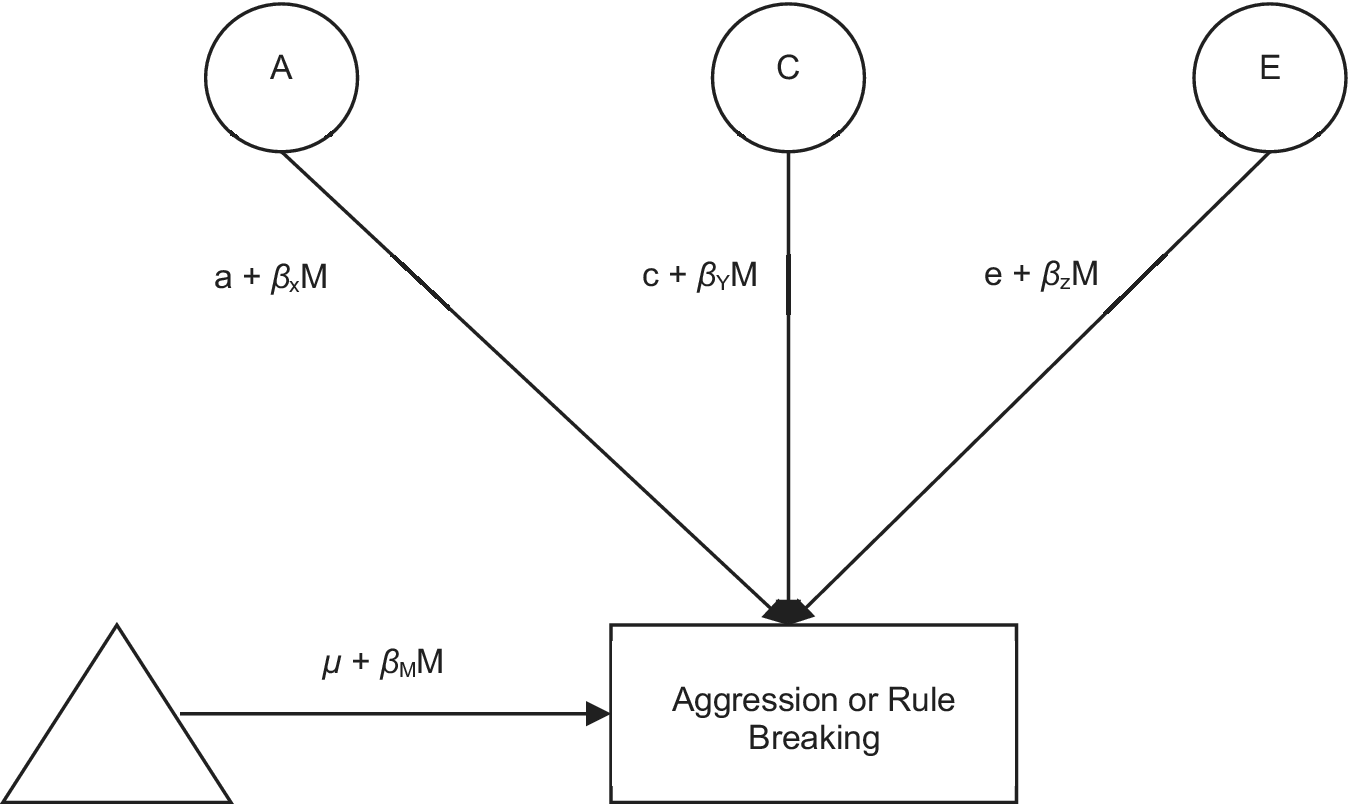
We used extended univariate twin moderation models (van der Sluis et al., Reference van der Sluis, Posthuma and Dolan2012) to examine these moderation effects. As shown in Figure 1, path coefficients (a, c, e) in these models assess how much variance in ASB is explained by genetic/environmental influences on rule breaking/aggression at the reference level of the moderator (i.e. earlier timing), whereas linear moderation coefficients (β XM, β YM, β zM) assess linear increases/decreases in genetic/environmental influences on aggression/rule-breaking across timing groups.
Partial path diagram for the full moderation model for one twin only. Abbreviations include: A, additive genetic effects; C, shared environmental effects; E, nonshared environmental effects; M, moderator (i.e. subjective pubertal timing); triangle, mean for aggression or rule breaking; β M, phenotypic regression coefficient; a, c, and e, paths or intercepts; β X, β Y, β Z, linear moderators.

Figure 1. Long description
A structural equation model path diagram.
At the top of the diagram are three circles representing latent variables:
* On the left is A, representing additive genetic effects.
* In the center is C, representing shared environmental effects.
* On the right is E, representing nonshared environmental effects.
Three arrows descend from these circles and converge on a central rectangular box at the bottom labeled Aggression or Rule Breaking. Each path is labeled with a linear moderation equation:
* The path from A is labeled a plus beta sub X M.
* The path from C is labeled c plus beta sub Y M.
* The path from E is labeled e plus beta sub Z M.
To the left of the central rectangle is a triangle representing the mean. A horizontal arrow points from the triangle to the Aggression or Rule Breaking box, labeled with the equation mu plus beta sub M M.
In terms of model fitting, we first fit “full” models that included all path coefficients and moderators, and then we compared the fit of these models to nested submodels that differentially constrained genetic, shared environmental, and nonshared environmental parameters to 0. Consistent with prior work (e.g. Klump et al., Reference Klump, Fowler, Mayhall, Sisk, Culbert and Burt2018), we first fit common nested submodels (e.g. where all moderators were constrained to 0) and then used parameter estimates from the full model to identify relevant submodels. This strategy allowed us to examine key submodels without excessively increasing the number of tests. Comparisons of model fit were made by taking the difference in minus twice the log-likelihood (−2lnL) between the full and nested models, which is chi-square (χ 2) distributed under the null hypothesis implied by the reduced model. Large, statistically significant differences led to the rejection of the submodel. To identify the best-fitting model, Akaike’s information criterion (AIC) (Akaike, Reference Akaike1987), Bayesian information criterion (BIC) (Schwarz, Reference Schwarz1978), and sample-size adjusted BIC (SABIC) (Sclove, Reference Sclove1987) were used, with preference given to models that minimized the greatest number of these criteria.
Models were fit in Mplus (version 8.11; Muthén & Muthén, Reference Muthén and Muthén2017–2024) using full-information maximum likelihood estimation to handle missing data. Unstandardized parameter estimates are presented in the figures, as unstandardized estimates depict absolute differences in etiologic effects, as compared to standardized estimates (presented in parentheses in Results below) that depict differences as proportions of the total variance.
Importantly, twin moderation models assume that the moderator (i.e. subjective timing) is genetically independent of the dependent variable (i.e. aggression/rule breaking). If there is not independence, then genetic mediation (i.e. gene–environment correlations [rGE]) may ‘masquerade’ as moderation effects. For example, if ASB stems, in part, from genes common to subjective timing, then increases in genetic influences at earlier subjective timing could reflect shared genes and/or environments, rather than an independent effect of timing on ASB. To avoid this interpretative difficulty, twin researchers test “G×E in the presence of rGE” models (Purcell, Reference Purcell2002) to evaluate the significance of genetic and/or environmental mediation. We fit these models and found that, for aggression, rule breaking, and both timing measures, moderation of the genetic, shared environmental, and nonshared environmental covariance between timing and ASB could be constrained to 0 without any detriment to model fit (Δχ 2 (3) = 1.00–4.44, ps > .05). These findings support our ability to detect significant moderation that reflects independent timing effects rather than rGE.
Results
Descriptive statistics are presented in Supplementary Table S1. Girls engaged in slightly more aggressive than rule-breaking behaviors, but both demonstrated sufficient variability for analysis. Importantly, there was sufficient variability in both subjective timing measures, as prior to binning, the full range of possible scores was present.
Nearly all phenotypic correlations between subjective timing and ASB were in the expected direction (i.e. negative; girls with earlier timing showed more ASB), although a significant association (albeit small in magnitude) was only observed for rule breaking and timing compared to co-twin (r = −0.11, p < .001; other rs = −0.03–0.01, ps > .05). Importantly, the absence of significant phenotypic associations does not negate the presence of etiologic moderation, as moderation would be expected to attenuate phenotypic associations (e.g. subjective timing/ASB association is only present in girls with genetic/environmental predispositions). Phenotypic correlations index between-person associations (i.e., the extent to which ASB/subjective timing correlate across individuals), whereas the twin moderation models index MZ/DZ co-twin similarity for ASB across timing levels, which allows for the partitioning of variance into genetic/environmental influences, regardless of the phenotypic correlation in the overall sample.
Twin moderation models
Aggression
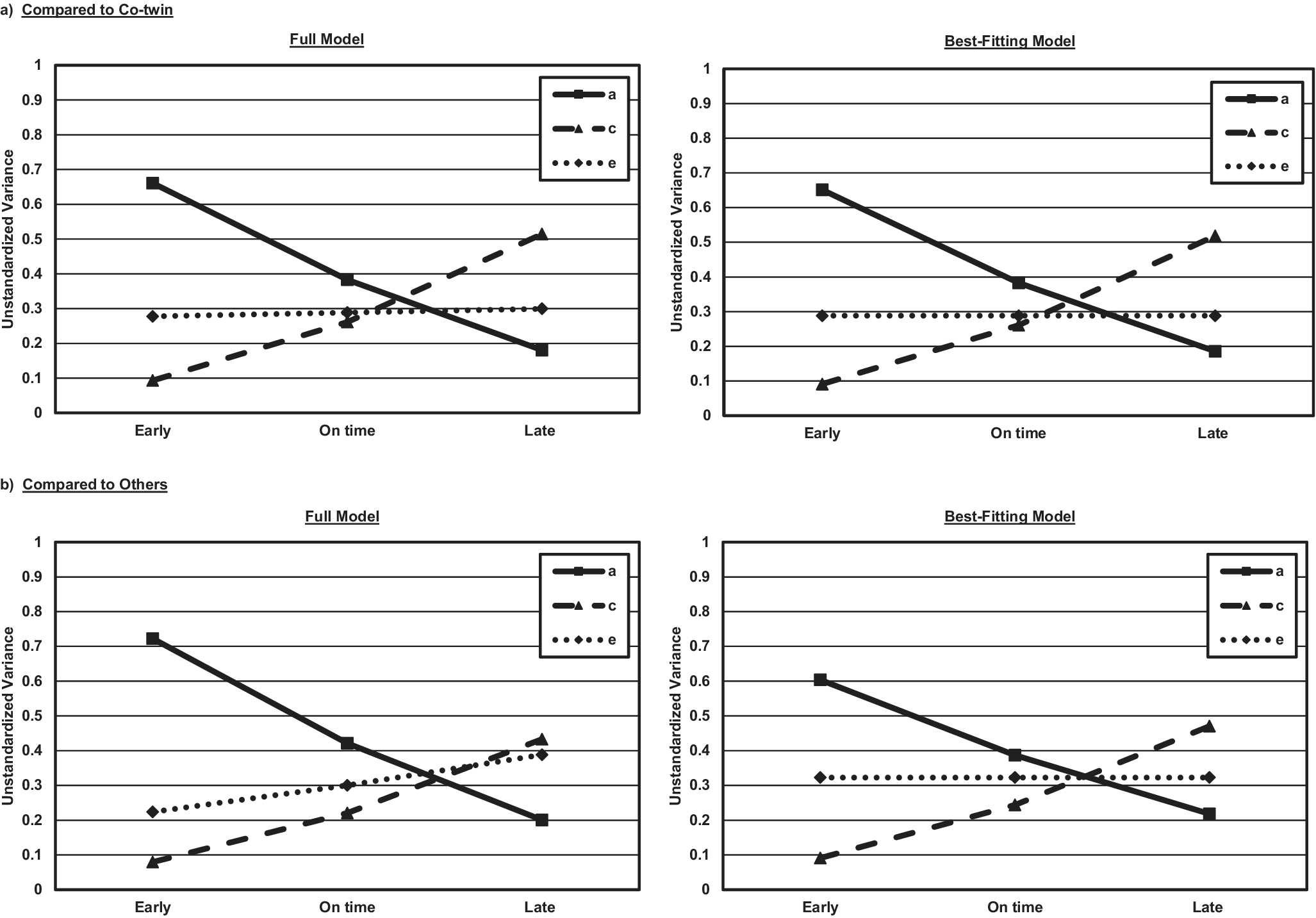
Parameter estimates from the full models for co-twin and other girls showed a very similar pattern of results (see Figure 2a and b), with stronger genetic influences on aggression in the earlier versus on-time and later groups. By contrast, shared environmental influences increased across these groups, while nonshared environmental factors showed minimal changes.
Unstandardized estimates of additive genetic (a), shared environmental (c), and nonshared environmental (e) effects from the full and best-fitting models for aggression. Subjective pubertal timing data were binned into three approximately equal groups (i.e. earlier, on time, and later) using tertiles. The best-fitting models were those that constrained the nonshared environmental moderator to 0.

Figure 2. Long description
A multi-panel figure with four line graphs arranged in a two-by-two grid.
Row a, Compared to Co-twin:
* The left graph, Full Model, has a Y-axis of Unstandardized Variance from 0 to 1 and an X-axis with categories Early, On time, and Late. Line a (solid with squares) shows a linear decrease from 0.65 to 0.18. Line c (dashed with triangles) shows a linear increase from 0.1 to 0.52. Line e (dotted with diamonds) is nearly flat at approximately 0.3.
* The right graph, Best-Fitting Model, is identical to the Full Model except line e is perfectly horizontal at 0.29.
Row b, Compared to Others:
* The left graph, Full Model, shows line a decreasing from 0.72 to 0.2. Line c increases from 0.08 to 0.43. Line e increases from 0.22 to 0.39.
* The right graph, Best-Fitting Model, shows line a decreasing from 0.6 to 0.22. Line c increases from 0.09 to 0.47. Line e is constrained to a horizontal line at 0.32.
In all graphs, line a and line c intersect near the On time category, representing the shift in genetic and environmental influence based on pubertal timing.
We fit submodels that constrained all moderators to 0 and submodels that constrained only the genetic, shared, or nonshared environmental moderators to 0. For both comparison groups, the models constraining only the genetic or shared environmental moderators to 0 provided poor fits to the data, as evidenced by significant χ 2 change tests (see Table 1). The model constraining all moderators to 0 showed an equivalent fit (i.e. similar AIC and SABIC) to the model constraining nonshared environmental influences only, and both models provided an adequate fit to the data (i.e. nonsignificant χ 2 change tests). This was surprising, given that the genetic and shared environmental moderators were significant in the full model and in the model constraining nonshared environmental factors to 0 (see Table 2). Limited power may have contributed to the adequate fit of the no-moderation model (see Martin, Eaves, Kearsey, & Davies, Reference Martin, Eaves, Kearsey and Davies1978), particularly given findings from models discussed above showing that we could not constrain genetic or shared environmental moderators without a significant worsening of model fit. Consequently, we chose the model that retained both additive genetic and shared environmental moderation, but constrained nonshared environmental moderation, as the best-fitting model for both comparison groups.
Model fit comparisons for the twin moderation models

Table 1. Long description
The table is organized into two primary sections: Aggression and Rule breaking. Each section is further divided into ‘Compared to co-twin’ and ‘Compared to others’ sub-sections. The columns from left to right are: Model, minus 2 ln L (d f), Delta chi-squared (d f), p, A I C, B I C, and S A B I C.
Key data points for Aggression (Compared to co-twin):
* Full model: minus 2 ln L = 2,054.63 (16), A I C = 2,078.63.
* Best-fitting model (bold): Constrain E mod, minus 2 ln L = 2,054.66 (17), Delta chi-squared = 0.02 (1), p = .888, A I C = 2,076.66.
Key data points for Aggression (Compared to others):
* Full model: minus 2 ln L = 1,889.29 (16), A I C = 1,913.30.
* Best-fitting model (bold): Constrain E mod, minus 2 ln L = 1,892.16 (17), Delta chi-squared = 2.87 (1), p = .090, A I C = 1,914.16.
Key data points for Rule breaking (Compared to co-twin):
* Full model: minus 2 ln L = 2,074.70 (16), A I C = 2,098.70.
* Best-fitting model (bold): Constrain C path and mod, minus 2 ln L = 2,075.02 (18), Delta chi-squared = 0.32 (2), p = .852, A I C = 2,095.02.
Key data points for Rule breaking (Compared to others):
* Full model: minus 2 ln L = 1,935.99 (16), A I C = 1,959.99.
* Best-fitting model (bold): Constrain C path and mod, minus 2 ln L = 1,935.99 (18), Delta chi-squared = 0.00 (3), p = 1.000, A I C = 1,955.99.
Italicized p-values indicate statistical significance at p < .05, such as the Constrain A mod and Constrain C mod submodels under Aggression.
Note: Δχ 2, the difference in –2lnL values between the full model and the nested submodel, which is χ 2 distributed under the null hypothesis implied by the reduced model; −2lnL, minus twice the log-likelihood; A, Additive genetic influences; AIC, Akaike Information Criterion; BIC, Bayesian Information Criterion; C, shared environmental influences; df, degrees of freedom; E, nonshared environmental influences; mod, moderation parameter; SABIC, sample size adjusted Bayesian Information Criterion. The best-fitting model is noted in bold text. Δχ 2 between the full and reduced models that are statistically significant at p < .05 are italicized. Dashes indicate that those parameters are not applicable for that particular model.
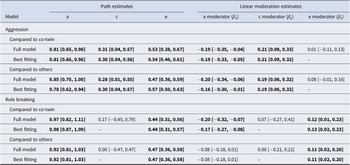
Unstandardized path and moderation estimates for the full and best-fitting moderation models

Table 2. Long description
The table is divided into two main sections: Aggression and Rule breaking. Each section compares ‘Compared to co-twin’ and ‘Compared to others’ across ‘Full model’ and ‘Best fitting’ rows. Columns are grouped into Path estimates (a, c, e) and Linear moderation estimates (a moderator beta sub x, c moderator beta sub y, e moderator beta sub z).
For Aggression (Compared to co-twin):
* Full model: a = 0.81, c = 0.31, e = 0.53; a moderator = -0.19, c moderator = 0.21, e moderator = 0.01.
* Best fitting: a = 0.81, c = 0.30, e = 0.54; a moderator = -0.19, c moderator = 0.21, e moderator is constrained to 0.
For Aggression (Compared to others):
* Full model: a = 0.85, c = 0.28, e = 0.47; a moderator = -0.20, c moderator = 0.19, e moderator = 0.08.
* Best fitting: a = 0.78, c = 0.30, e = 0.57; a moderator = -0.16, c moderator = 0.19, e moderator is constrained to 0.
For Rule breaking (Compared to co-twin):
* Full model: a = 0.97, c = 0.17, e = 0.44; a moderator = -0.20, c moderator = 0.07, e moderator = 0.12.
* Best fitting: a = 0.98, c is constrained to 0, e = 0.44; a moderator = -0.17, c moderator is constrained to 0, e moderator = 0.13.
For Rule breaking (Compared to others):
* Full model: a = 0.92, c = 0.00, e = 0.47; a moderator = -0.08, c moderator = 0.00, e moderator = 0.11.
* Best fitting: a = 0.92, c is constrained to 0, e = 0.47; a moderator = -0.08, c moderator is constrained to 0, e moderator = 0.11.
Significant parameters are indicated in bold in the source. 95 percent confidence intervals are provided in brackets for all estimates.
Note: a, additive genetic influences path coefficient; c, shared environmental influences path coefficient; e, nonshared environmental influences path coefficient. Dashes indicate that those parameters were constrained to be 0 in that particular model. 95% confidence intervals are presented just below their respective estimates in brackets, and significant model parameters are noted in bold text.
Unstandardized (see Table 2) and standardized (see parentheses below) parameter estimates from the best-fitting models showed significantly stronger genetic effects at earlier (co-twin = 63%; others = 59%) versus later (co-twin = 19%; others = 22%) timing, while shared environmental influences were significantly more modest at earlier (co-twin and others = 9%) versus later (co-twin = 52%; others = 47%) subjective timing. Nonshared environmental influences remained stable and significant across all groups (co-twin = 28–31%; others = 32–34%).
Rule breaking
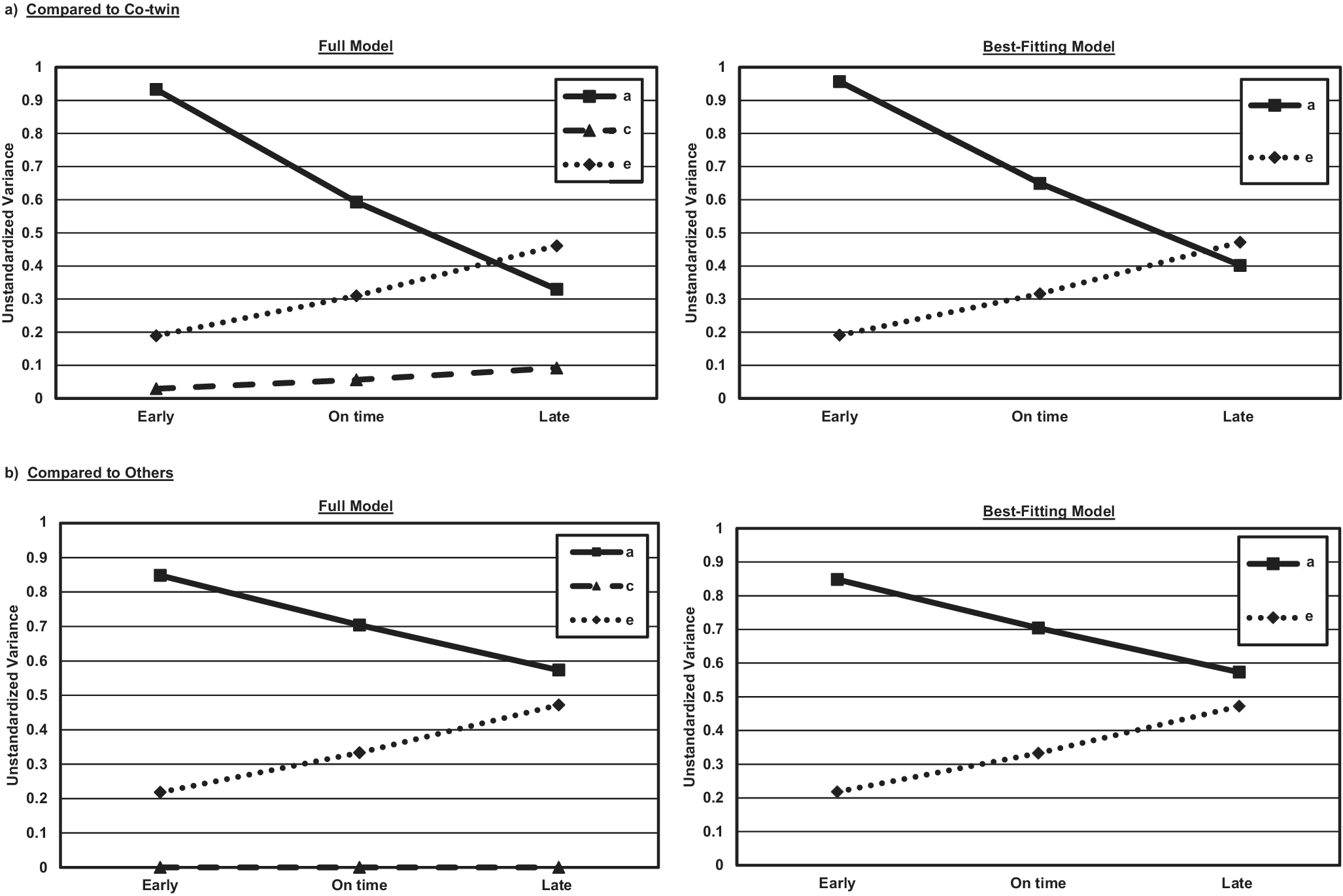
Parameter estimates from the full models for rule breaking appeared to show, once again, stronger genetic influences in earlier compared to on-time and later groups (see Figure 3a and b). However, nonshared environmental influences increased across subjective timing groups, while shared environmental influences were minimal.
Unstandardized additive genetic (a), shared environmental (c), and nonshared environmental (e) parameter estimates from the full and best-fitting models for rule breaking. Subjective pubertal timing data were binned into three approximately equal groups (i.e. earlier, on time, and later) using tertiles. The best-fitting models were those that constrained the shared environmental path and moderator to 0.

Figure 3. Long description
The figure contains four line graphs arranged in a two-by-two grid. All graphs share an X-axis with three categories: Early, On time, and Late. The Y-axis represents Unstandardized Variance from 0 to 1.
Row a: Compared to Co-twin.
- Full Model (Left): Variable ‘a’ (solid line with squares) shows a steep linear decrease from approximately 0.93 at Early to 0.33 at Late. Variable ‘c’ (dashed line with triangles) shows a slight increase from 0.03 to 0.09. Variable ‘e’ (dotted line with diamonds) shows a linear increase from 0.19 to 0.46.
- Best-Fitting Model (Right): Variable ‘c’ is removed. Variable ‘a’ decreases from 0.95 to 0.40. Variable ‘e’ increases from 0.19 to 0.47.
Row b: Compared to Others.
- Full Model (Left): Variable ‘a’ decreases from 0.85 at Early to 0.57 at Late. Variable ‘c’ remains flat at 0. Variable ‘e’ increases from 0.22 to 0.47.
- Best-Fitting Model (Right): Variable ‘c’ is removed. The trends for ‘a’ and ‘e’ are identical to the Full Model in this row, with ‘a’ decreasing from 0.85 to 0.57 and ‘e’ increasing from 0.22 to 0.47.
We fit submodels that constrained all moderators to 0 and submodels that retained the genetic and nonshared environmental parameters but constrained both the shared environmental path estimate and its moderation to 0. Model fit comparisons (see Table 1) indicated that the shared environmental path and moderators could be constrained without any worsening of fit (i.e. nonsignificant χ 2 change and smaller values on all fit indices) for both timing measures, and this model fit better than the model constraining all moderators to 0. Finally, to test the significance of additive genetic and nonshared environmental influences, we fit submodels that further constrained either the additive genetic or the nonshared environmental moderator to 0. Although in general, these models exhibited nonsignificant χ 2 changes from the full model (except for the co-twin model constraining genetic influences; p = .033), they tended to produce larger or essentially equivocal values on at least two fit indices as compared to the model constraining shared environmental factors only. Consequently, the model that constrained all shared environmental effects to 0 but retained genetic and nonshared environmental moderation was chosen as best fitting.
Unstandardized (see Table 2) and standardized (see parentheses below) estimates from these best-fitting models confirmed differences in genetic and nonshared environmental influences across subjective timing, although effects were somewhat stronger for the co-twin model, as the genetic moderator was significant for this model but just missed significance for other girls. Nonetheless, results across both measures showed stronger genetic influences at earlier (co-twin = 83%; others = 80%) compared to later (co-twin = 46%; others = 55%) subjective pubertal timing, and significantly weaker nonshared environmental influences at earlier (co-twin = 17%; others = 20%) versus later (co-twin = 54%; others = 45%) subjective timing.
Discussion
We conducted the first study examining the effects of subjective pubertal timing compared to peers on genetic and environmental risk for girls’ ASB. Across all models, genetic influences were stronger at earlier (vs. on time or later) subjective timing. Findings were remarkably consistent for aggression and rule breaking across the co-twin and other girls reference groups. Collectively, these findings highlight the importance of genetic factors in ASB/subjective timing associations and the need to incorporate enhanced genetic influences into etiologic models of earlier subjective timing effects.
Although the nature of these G×E effects remains unclear, the diathesis–stress model may provide a useful framework. This model posits that both environmental stressors or ‘triggers’ and genetic risk are needed for the development of psychological dysfunction/disorders. The experience of significant stressors is thought to activate genetic predispositions that then, in combination, lead to the behavior/disorder. In the case of early subjective timing, girls who perceive themselves as maturing earlier than peers face greater social/environmental challenges, including greater susceptibility to negative peer influence (Kretsch et al., Reference Kretsch, Mendle and Harden2016) and greater reactivity to peer stress (Sontag, Graber, & Clemans, Reference Sontag, Graber and Clemans2011). Our findings suggest that this stress may activate genetic influences and lead to enhanced risk for ASB. Importantly, our findings do not suggest genetic mediation, as the G×E in the presence of rGE models above showed no significant moderation of the genetic or environmental covariation between subjective timing and aggression or rule breaking. Taken together, findings highlight the need to further probe G×E and diathesis–stress models to replicate our results and clarify how environmental stressors and genetic factors interact and contribute to subjective timing/ASB associations. Additionally, future studies should seek to identify the specific genetic pathways to ASB enhanced among earlier maturers.
The genetic findings have potentially important implications for developmental models of ASB and prevention efforts by helping to identify for whom intervention may be most warranted. Our results suggest that girls with underlying genetic risk for ASB, whether indicated by family history or genotyping, are poised to face the greatest risk for ASB if they perceive themselves to be maturing ahead of peers. These findings highlight the potential utility of considering subjective timing, alongside genetic liability, to identify youth at heightened risk for ASB who may benefit from increased monitoring/support during the pubertal transition.
Importantly, we also found more prominent environmental influences among later maturers. Significant increases in shared environmental influences were observed for aggression, whereas increases in nonshared environmental influences were observed for rule breaking. Potential reasons for these differences are unclear, but phenotypically, later pubertal timing has been associated with lower levels of ASB (e.g. Hoyt et al., Reference Hoyt, Niu, Pachucki and Chaku2020), and past work shows associations between later pubertal timing and ASB protective factors (e.g. decreased affiliation with deviant peers and participation in deviant activities, better parent–child relationships; Hoyt et al., Reference Hoyt, Niu, Pachucki and Chaku2020; Savin-Williams & Small, Reference Savin-Williams and Small1986; Stattin & Magnusson, Reference Stattin and Magnusson1990). Consequently, the increased environmental variance in the later timing group may reflect protective environmental factors that buffer against ASB. Additional research exploring this possibility is needed to identify the specific shared and nonshared environmental factors contributing to this environmental variance.
Future research is also needed to compare/contrast G×E results for subjective and objective pubertal timing to develop comprehensive models of risk. Prior studies suggest that subjective measures have limited agreement with objective measures (Dorn, Dahl, Woodward, & Biro, Reference Dorn, Dahl, Woodward and Biro2006). Early objective timing may reflect hormonal and neurobiological changes occurring during puberty (including organizational effects that impact the brain and behavior; Sisk, Reference Sisk2016), whereas early subjective timing may be more closely tied to psychosocial processes (Cance, Ennett, Morgan-Lopez, & Foshee, Reference Cance, Ennett, Morgan-Lopez and Foshee2012) that activate genetic/biological vulnerabilities/pathways. Interestingly, although some of our findings replicate those for other timing measures (e.g. increased genetic influences on violent delinquency with earlier menarche; Harden & Mendle, Reference Harden and Mendle2012), other findings do not (e.g. increased genetic influences on conduct disorder symptoms with on-time menarche; Burt et al., Reference Burt, McGue, DeMarte, Krueger and Iacono2006), highlighting potential deviations in G×E results across timing constructs. Further illuminating these etiologic differences and their implications for risk models is an important area for future research.
Strengths of our study include our focus on girls across a broad spectrum of pubertal development and multi-item assessments of subjective timing that tapped comparisons to co-twins and other girls. We observed striking similarities in findings across comparison groups, suggesting universal effects of subjective timing on etiologic influences on ASB, regardless of who girls are comparing themselves to in their environment. Nonetheless, we observed somewhat stronger effects for timing compared to co-twin, suggesting that proximity may matter and should be considered in future studies.
There are also several limitations to note. Although the effects of subjective timing on genetic and environmental risk for ASB appeared to be linear (see Figures 2 and 3), we lacked the statistical power to examine quadratic moderation, as well as age and pubertal status as additional etiologic moderators of ASB (via double moderation models). Our sample size, which is on the smaller end of recommended sizes for twin moderation models (van der Sluis et al., Reference van der Sluis, Posthuma and Dolan2012), prohibited testing these more computationally intensive models. However, in order to confirm findings were not unduly influenced by age/pubertal status, we conducted sensitivity analyses adjusting for age and pubertal status, and results were nearly identical to those presented herein (i.e. stronger genetic influences in the earlier timing group; see Supplemental Materials, Tables S2 and S3). Nonetheless, it will be important to examine age/pubertal status in double moderator models and test nonlinear effects in future G×E studies.
Our G×E models estimated variance components, and consequently, we cannot identify the specific genetic or shared/nonshared environmental influences contributing to our findings. Future research should prioritize testing specific peer, family, school, hormonal, and genetic factors to elucidate the factors underlying our observed G×E effects.
Although our sample was representative of Michigan in terms of sociodemographic characteristics, participants were still primarily White, non-Latinx, and of middle-to-upper SES. Recent work on pubertal timing highlights the need to consider similarity of peers on sociodemographic characteristics, as similarity may impact whether girls perceive themselves to be earlier, on time, or later (Anaya, Reference Anaya2024; Carter et al., Reference Carter, Blazek and Kwesele2020). Relatedly, our measure of subjective timing was defined using within-sample tertiles. Although results replicated across alternative timing specifications (see Supplemental Materials), we did not use an objectively defined timing measure. To our knowledge, there currently are no objective cutoffs for subjective timing comparable to those for objective pubertal timing (e.g. ±2.50 standard deviations above/below the population mean age at menarche; Klump, Di Dio, & Culbert, Reference Klump, Di Dio and Culbert2026). Additional studies are needed to determine whether objective and replicable cutoffs can be established for subjective timing, and to evaluate the generalizability of our findings in more racially and ethnically diverse samples.
Finally, our population-based sample had lower ASB severity than a clinical population, and we did not examine relational aggression (i.e. nonphysical aggression aimed at harming others through damaging peer relationships or social standing; Crick & Grotpeter, Reference Crick and Grotpeter1995), which is an important form of ASB in girls. Moreover, we utilized a single informant for ASB, which may not capture context-specific experiences with the child (e.g. with teachers) (De Los Reyes & Kazdin, Reference De Los Reyes and Kazdin2005). Future studies should examine more severely affected samples with measures of relational aggression and multi-informants to determine if significant gene–environment interplay is present across the full spectrum and subtypes of ASB in girls.
Supplementary material
The supplementary material for this article can be found at http://doi.org/10.1017/S0033291726105893.
Acknowledgments
The authors thank the Michigan State University Twin Registry and all participating twins and their families for making this work possible.
Funding statement
This project was supported by a grant from the National Institute of Mental Health (R01MH092377), awarded to KLK, SAB, and CLS.
Competing interests
The content is solely the responsibility of the authors and does not necessarily represent the official views of the National Institutes of Health. The primary and corresponding author had full access to all of the data in the study and takes responsibility for the integrity of the data and the accuracy of the data analysis.
Ethical standards
The authors assert that all procedures contributing to this work comply with the ethical standards of the relevant national and institutional committees on human experimentation and with the Helsinki Declaration of 1975, as revised in 2008.



 Open access

