Introduction
Borderline personality disorder (BPD) is characterized by affective instability, impulsivity, difficulties with self-image and pervasive pattern of disturbances in interpersonal relationships (APA, 2000; Lieb, Zanarini, Schmahl, Linehan, & Bohus, Reference Lieb, Zanarini, Schmahl, Linehan and Bohus2004). Emotional dysregulation, particularly within interpersonal context is a core feature of BPD (Linehan, Reference Linehan1993). BPD is associated with intense affective responses to stressful social stimuli. Negative affective states are frequent in BPD and mostly triggered by real or imagined negative events in relationships. Prominent difficulties in social behavior is a hallmark feature of BPD across the lifespan (Hill et al., Reference Hill, Pilkonis, Morse, Feske, Reynolds, Hope and Broyden2008; Winsper et al., Reference Winsper, Marwaha, Lereya, Thompson, Eyden and Singh2015).
These behavioral and emotional disturbances in response to experiences in social context led number of theorists to suggest that abnormality in social cognitive information processing is a core mechanism underlying the development of BPD (Bateman & Fonagy, Reference Bateman and Fonagy2003; Fonagy, Reference Fonagy1989). Fonagy and colleagues have proposed a mentalization-based theory of BPD that suggests a vulnerability in understanding and misinterpreting of actions in social context in terms of underlying mental states may account for core features of BPD (Fonagy, Reference Fonagy1989, Reference Fonagy1991; Sharp & Fonagy, Reference Sharp, Fonagy, Sharp, Fonagy and Goodyer2008). The concept of ‘mentalization’ [or mentalizing, reflective functioning (RF)] has been in use in psychoanalytic thinking since 1970s. It refers to elaboration of drive–affect experiences as mental phenomena and structures (Lecours & Bouchard, Reference Lecours and Bouchard1997; Sharp et al., Reference Sharp, Pane, Ha, Venta, Patel, Sturek and Fonagy2011). ‘Mentalization’ is critical for making sense of each other and ourselves, implicitly and explicitly, in terms of subjective states and mental processes (Bateman & Fonagy, Reference Bateman and Fonagy2010). It was argued that problems in the child' attachment relationships in BPD lead to serious problems in the acquisition of social cognitive capacities during development (Sharp & Fonagy, Reference Sharp, Fonagy, Sharp, Fonagy and Goodyer2008). The notion of developmental abnormality in acquiring mentalization skills has been the focus of attention to explain the development of symptoms in BPD. Other concepts such as ‘affect consciousness’, ‘metarepresentation’ and ‘psychological mindedness’ might be considered as constructs referring to abilities partly similar to mentalization (McCallum & Piper, Reference McCallum and Piper1996; Monsen, Eilertsen, Melgård, & Odegård, Reference Monsen, Eilertsen, Melgård and Odegård1996; Semerari et al., Reference Semerari, Carcione, Dimaggio, Nicoló, Pedone and Procacci2005). Most of the previous studies in BPD examined mentalization with the Reflective Functioning Questionnaire (RFQ) (Sharp et al., Reference Sharp, Williams, Ha, Baumgardner, Michonski, Seals and Fonagy2009).
Another line of neuroscientific research has been interested in neuro-social-cognitive abilities which are critical for interpersonal functioning in human beings. The concept of theory of mind (ToM), which refers to the ability to understand and reflect on others' mental experiences through perspective- taking, reasoning and interpreting affective cues, was first coined in primates (Premack & Woodruff, Reference Premack and Woodruff1978). One important aspect of ToM includes the ability of perspective-taking to infer others' thoughts, beliefs, emotions (ToM-reasoning) (Sabbagh, Reference Sabbagh2004). However, decoding perceptual and affective stimuli also contributes to ToM ability beyond basic emotion recognition. Human beings use unambiguous and subtle affective perceptual stimuli together with contextual information to decode others' complex emotions and mental states (ToM-decoding) (Sabbagh, Moulson, & Harkness, Reference Sabbagh, Moulson and Harkness2004). Objective impairment in ToM ability is an important feature of a number of developmental, neuropsychiatric and neurodegenerative conditions (Bora & Berk, Reference Bora and Berk2016; Bora & Pantelis, Reference Bora and Pantelis2016; Bora, Özakbaş, Velakoulis, & Walterfang, Reference Bora, Özakbaş, Velakoulis and Walterfang2016; Bora, Walterfang, & Velakoulis, Reference Bora, Walterfang and Velakoulis2015; Chung, Barch, & Strube, Reference Chung, Barch and Strube2014; Savla, Vella, Armstrong, Penn, & Twamley, Reference Savla, Vella, Armstrong, Penn and Twamley2013).
In recent years, a number of studies investigated ToM deficits in BPD and discussed their findings in the context of the mentalization-based theory. Previous behavioral studies examining ToM in BPD used both ToM-reasoning (i.e. false belief tasks, picture sequencing tasks) and ToM-decoding tasks [i.e. reading the mind in the eyes test (RMET)]. The findings of these studies have been largely inconsistent. While ToM impairment has been reported in BPD in some of these studies, others reported intact or superior performance of individuals with BPD compared to healthy comparison subjects. Richmann and Unoka (Reference Richman and Unoka2015) found no evidence of impairment in the RMET. An earlier meta-analysis including 17 studies found that ToM-reasoning but not ToM-decoding is impaired in BPD (Németh et al., Reference Németh, Mátrai, Hegyi, Czéh, Czopf, Hussain and Simon2018). Other authors argued that BPD is characterized by a specific kind of ToM impairment that involves overattributing extreme mental states to other people that go far beyond observable data (Hypermentalizing/HyperToM) (Sharp et al., Reference Sharp, Ha, Carbone, Kim, Perry, Williams and Fonagy2013; Sharp & Vanwoerden, Reference Sharp and Vanwoerden2015).
However, it is important to note that most researchers ignored the significant differences between ToM, which is a lower-level neuro-social cognitive construct, and a higher-level mentalization construct in psychoanalytical thinking. While social impairment can be explained by a ‘bottom-up’ effects of true neuropsychological deficit in social cognitive processes, many social-cognitive biases can arise in people who have intact neurodevelopment in brain areas which are critical for ToM and other social cognitive abilities. A number of attentional biases to emotional stimuli and misinterpretations of other social stimuli are characteristics of some psychiatric disorders including BPD. For example, heightened sensitivity to negative or threatening social cues in BPD can be a consequence of neuroplastic changes in normally developed social-cognitive brain networks in response to intensive negative interpersonal experiences and can be a type of adaptation for survival in an abusive environment. Therefore, studies investigating mentalizing abilities in BPD using objective methods are important to reveal whether a true ‘neuro-social cognitive’ impairment related to abnormal brain development or a higher-level deficits/biases reflecting abnormal meta-social-cognitive style can explain abnormalities in social functioning in BPD. It is also important to consider the top-down effects of abnormal meta-social cognitive style in BPD on ToM tasks. Some ToM-reasoning rather than ToM-decoding tasks are expected to be more prone to such effects including hyperToM errors and faux pas recognition. For example, in the context of meta-social cognitive style in BPD, a simple faux pas in a story can be interpreted as a deliberate verbal act by someone who ‘hates’ the other character.
Current meta-analysis aimed to estimate the effect sizes of group differences between BPD and healthy controls for mentalization and different aspects of ToM. It was hypothesized that BPD would be associated with very large deficits in RF but only mild-to-modest low performance in ToM which would be relatively more pronounced in ToM-reasoning tasks prone to effects of meta-social-cognitive style of BPD.
Methods
Study selection
PRISMA guidelines were followed in conducting this meta-analysis (Moher, Liberati, Tetzlaff, & Altman, Reference Moher, Liberati, Tetzlaff and Altman2009). A literature search was conducted using the databases Pubmed and Scopus to identify the relevant studies (January 1990 to July 2021) using the combination of keywords as follows: (‘Theory of mind’ AND ‘social cognition’ OR reflective OR mentali*) AND ‘borderline personality disorder’. Reference lists of published reports were also reviewed for additional studies. Inclusion criteria were studies that: (1) Compared ToM or RF performances of BPD and healthy control groups; (2) reported sufficient data to calculate the effect size and standard error of the social cognition and RF measures. Studies reporting ToM and RF correlates of borderline traits in nonclinical or clinical populations were excluded.
Social cognition and RF measures
Several different ToM tasks have been utilized across studies, most commonly the reading the mind from the eyes (RMET), Faux Pas Recognition task and (MASC) tasks were used (Baron-Cohen, Wheelwright, Hill, Raste, & Plumb, Reference Baron-Cohen, Wheelwright, Hill, Raste and Plumb2001; Dziobek et al., Reference Dziobek, Fleck, Kalbe, Rogers, Hassenstab, Brand and Convit2006; Stone, Baron-Cohen, & Knight, Reference Stone, Baron-Cohen and Knight1998). RMET was the only measure of mental state decoding aspect of ToM (ToM-decoding) (Baron-Cohen et al., Reference Baron-Cohen, Wheelwright, Hill, Raste and Plumb2001). In the RMET, examiner instructs to individuals to look at a series of photographs of just the eye region of the face, and picking which of four words best describe what the person in the photo is thinking or feeling. All other tasks used in the studies were mainly measures of perspective taking/mental state reasoning aspect of ToM (ToM-reasoning) including the faux pas recognition (the task involves recognizing faux pas in series of short stories) (Stone et al., Reference Stone, Baron-Cohen and Knight1998) and Movie for the Assessment of Social Cognition (MASC) which is a task involving watching a short film and answering questions referring to the actors' mental states (Dziobek et al., Reference Dziobek, Fleck, Kalbe, Rogers, Hassenstab, Brand and Convit2006). MASC includes mutually exclusive response options for no mentalizing (NoToM errors), undermentalizing (HypoToM) errors, hypermentalizing (HyperToM errors), and accurate ToM.
Self-reported mentalization was most commonly assessed with the RFQ and its adaptation to adolescents (Fonagy et al., Reference Fonagy, Luyten, Moulton-Perkins, Lee, Warren, Howard and Lowyck2016; Sharp et al., Reference Sharp, Williams, Ha, Baumgardner, Michonski, Seals and Fonagy2009). The RFQ has two subscales that assess certainty (RFQ-C) and uncertainty (RFQ-U) about the mental states of self and others. A single study used the Mentalization Questionnaire (MZQ) (Hausberg et al., Reference Hausberg, Schulz, Piegler, Happach, Klöpper, Brütt and Andreas2012).
Statistical analyses
For studies that reported more than one ToM task, pooled effect sizes (Cohen' d) and standard error values were calculated. A separate effect size for ToM-decoding was also calculated. Meta-analyses were performed using packages in the R environment (Metafor) (Viechtbauer, Reference Viechtbauer2010). Effect sizes were weighted using the inverse variance method. A random-effects model (DerSimonian–Laird estimate) was used. Homogeneity of the distribution of weighted effect sizes was tested with the Q and I 2 tests. Publication bias was assessed by inspection of funnel plots, Egger' test and trim and fill method.
Meta-regression analyses were conducted for gender (ratio of females in BPD group), age (BPD group), co-morbid major depression (ratio of patients with major depression in BPD group), effect size of BPD v. control differences (duration of education), with a random-effects model were using the restricted-information maximum likelihood method with a significance level set at p < 0.05.
Results
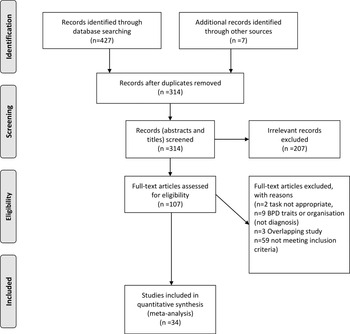
The flow chart of the process of study selection is shown in Fig. 1. One study reporting very extreme effect sizes for ToM considered as an outlier and excluded (Zabihzadeh et al., Reference Zabihzadeh, Maleki, Richman, Hatami, Alimardani and Heidari2017). Thirty-four studies involving 1448 (89.9% females) individuals with BPD and 2006 (77.3% females) healthy controls were included (Table 1). Mean age of the BPD group ranged from 15.3 to 38.4 across studies. There was no significant between-group difference for age (d = 0.02, confidence interval (CI) = −0.18 to 0.22, Z = 0.21, p = 0.88). Psychiatric co-morbidities were excluded only in five studies. The percentage of patients with co-morbid depression ranged from 0 to 67% across studies (Table 1).
Flow diagram of meta-analysis of ToM and RF in BPD.

Characteristics of the studies included in the current meta-analysis

BPD = Borderline personality disorder, HC = Healthy controls, MASC = Movie for the assessment of social cognition, RMET = Reading the mind in the eyes, RFQ = Reflective functioning Questionnaire, MZQ = Mentalizing Questionnaire D/A = Drug and Alcohol abuse.
ToM
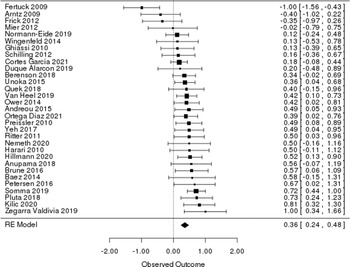
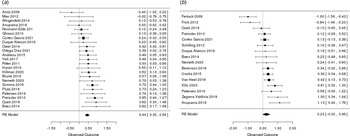
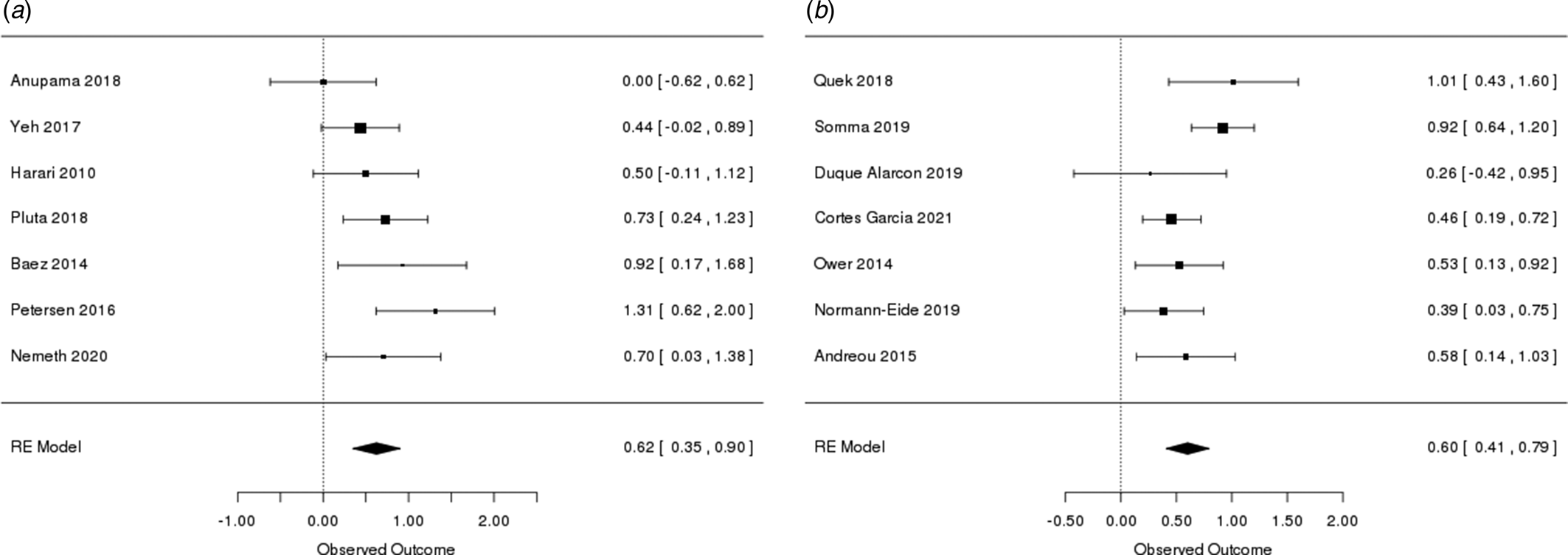
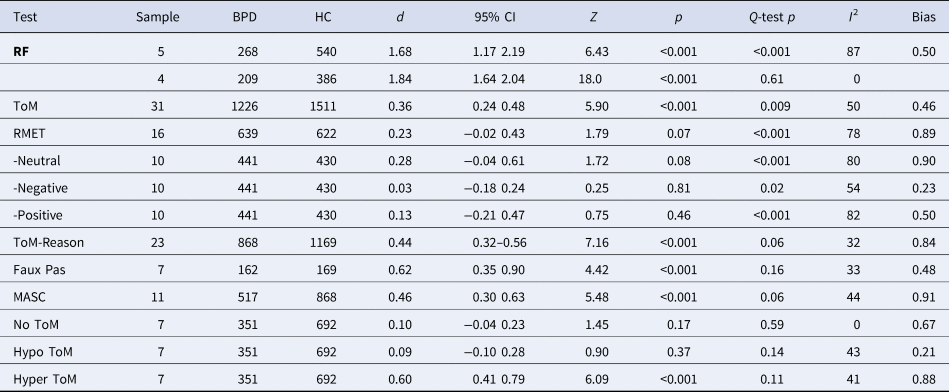
ToM was significantly impaired (d = 0.36, CI = 0.24–0.48) (Fig. 2) in BPD in comparison to healthy controls (Table 2). In separate analyses of the two main ToM domains, the performance of BPD patients was significantly poorer than healthy controls for ToM-reasoning (d = 0.44, CI = 0.32–0.56) but not ToM-decoding (d = 0.23, CI = −0.02 to 0.43) (Table 2 and Fig. 3). In the analysis of individual ToM-reasoning tasks, patients with BPD significantly underperformed controls both in faux pas recognition (d = 0.62, CI = 0.35–0.90) (Fig. 4a) and MASC (d = 0.46, CI = 0.30–0.63) (Table 2). In the analysis of subscores of the MASC task, patients with BPD had significantly increased HyperToM errors (d = 0.60, CI = 0.41–0.79) (Fig. 4b) but they had no significant deficits in NoToM and HypoToM (Table 2). In subgroup analyses of the RMET (ToM-decoding) task, there was no significant group-difference between BPD and healthy controls in neutral, negative and positive emotional stimuli (Table 2) (eFigure 1). Distribution of effect sizes for ToM was modestly but significantly heterogeneous (I 2 = 50%, p value for Q test = 0.009). The distributions of effect sizes of all individual ToM-reasoning task were homogenous. In contrast, there was a pronounced heterogeneity for ToM-decoding variables (I 2 = 54–82%). Egger' tests, trim and fill method and inspection of funnel plots provided no evidence of publication bias for any of these measures (Table 2).
Forest plot of effect sizes and 95% CIs for ToM differences between BPD and healthy controls using random effects model.

(a) Forest plot of effect sizes and 95% CIs for ToM-reasoning differences between BPD and healthy controls using random effects model; 3b Forest plot of effect sizes and 95% CIs for ToM-decoding differences between BPD and healthy controls using random effects model.

(a) Forest plot of effect sizes and 95% CIs for Faux Pas Recognition differences between BPD and healthy controls using random effects model; 4b Forest plot of effect sizes and 95% CIs for MASC HyperToM differences between BPD and healthy controls using random effects model.

Mean weighted effect sizes for ToM and RF between individuals with BPD and healthy controls

d = Effect size of between-group difference (Cohen' d), Bias = p value of the Egger' test, HC = Healthy controls, RF = Reflective functioning.
Reflective functioning
In the meta-analysis of RF scores, patients with BPD had a significant and very large abnormality compared to healthy controls (d = 1.68, CI = 1.17–2.19) (Fig. 5). There was a significant heterogeneity of distribution of effect sizes of RF score (I 2 = 87%, p value for Q test <0.001) which was caused by a single study (Morandotti et al., Reference Morandotti, Brondino, Merelli, Boldrini, De Vidovich, Ricciardo and Luyten2018). In the re-analysis of RF scores after removing this study, BPD patients significantly underperformed healthy controls (d = 1.84, CI = 1.64–2.04) and distribution of the effect sizes were homogenous (I 2 = 0%). There was no evidence for publication bias.
Forest plot of effect sizes and 95% CIs for RF differences between BPD and healthy controls using random effects model.

Effect of confounding variables
The percentage of females (Z = −0.35, p = 0.73), mean age (Z = −0.43, p = 0.67) and current depression rate (Z = −1.29, p = 0.20) within BPD had no significant effect on ToM difference between BPD and healthy controls. Differences in the duration of education between BPD and healthy controls had no significant impact on the effect size of ToM abnormality in BPD (Z = 0.36, p = 0.72).
Discussion
The current manuscript reports the outcome of meta-analyses of ToM and RF in BPD. BPD was characterized by a very large impairment in RF. In contrast, ToM impairment was modest and was only evident in ToM-reasoning tasks.
This was the first meta-analysis of RF in BPD. The current results suggest that impairment in self-reported RF was a consistent and robust feature of BPD. The severity of impairment (Cohen d = 1.68–1.84) in self-reported RF in BPD in this meta-analysis was similar to the level of impairment (Cohen d = 1.63) in a study using an interview-based measure of RF based on Adult Attachment interview (Fonagy et al., Reference Fonagy, Luyten, Moulton-Perkins, Lee, Warren, Howard and Lowyck2016). Only two studies have separately investigated certainty and uncertainty scores of RF and preliminary evidence suggest that uncertainty subscale might be more sensitive in showing differences between BPD and healthy controls (Morandotti et al., Reference Morandotti, Brondino, Merelli, Boldrini, De Vidovich, Ricciardo and Luyten2018; Perroud et al., Reference Perroud, Badoud, Weibel, Nicastro, Hasler, Küng and Debbané2017). These results suggest that mentalization is a potentially important determinant of psychosocial impairment in BPD. However, it is important to note that meta-social cognitive style of BPD as measured by RF is not specific to this condition. Recent evidence suggests that eating disorders and other personality disorders might present with similar levels of deficits in RF (Fonagy et al., Reference Fonagy, Luyten, Moulton-Perkins, Lee, Warren, Howard and Lowyck2016; Sacchetti et al., Reference Sacchetti, Robinson, Bogaardt, Clare, Ouellet-Courtois, Luyten and Fonagy2019).
The findings of this meta-analysis do not suggest that mentalization impairment in BPD are explainable by neuro-social cognitive deficits. ToM impairment in BPD was very modest in comparison to mentalization deficit (d = 0.36). As expected, ToM impairment was relatively more pronounced for ToM-reasoning. Group difference between BPD and healthy controls was not statistically significant for ToM-decoding. In contrast, BPD patients underperformed healthy controls in ToM-reasoning tasks particularly in HyperToM and faux pas recognition errors. The errors in many ToM-reasoning tasks including faux pas recognition do not necessarily reflect a deficit in neuro-social cognitive processes but can also be caused by bottom-up effects of the meta-social cognitive style of the respondents. Importantly, MASC provides separate error types which include more direct measures of neuro-social cognitive deficits (HypoToM and NoToM errors) as well as HyperToM errors which are more susceptible to higher level meta-social cognitive biases. The errors which were labeled as ‘Excessive ToM’, hypermentalizing and hyperToM in BPD by some authors (Dziobek et al., Reference Dziobek, Fleck, Kalbe, Rogers, Hassenstab, Brand and Convit2006; Sharp & Vanwoerden, Reference Sharp and Vanwoerden2015) should be considered as reflections of patients' maladaptive meta-social cognitive style rather than a genuine neuro-social cognitive impairment. BPD should not be considered as an outcome of a severe abnormality in neurodevelopment in social brain. However, BPD can be better conceptualized as reflection of a maladaptive higher level reorganization of a relatively intact social brain in response to intense negative emotional experiences and disrupted attachment relationships in childhood.
It is also important to investigate symptomatic correlates of abnormal meta-social cognitive style in BPD. For example, psychotic-like symptoms in BPD might potentially be related to mentalization errors. However, potential symptomatic correlates of mentalization impairment in BPD (including psychotic-like experiences) has not been the focus of available research. Another consideration is the potential effects of co-morbid psychiatric conditions such as major depression, posttraumatic stress disorder and substance abuse on mentalization and ToM in BPD. Only a minority of studies excluded these conditions in the current meta-analysis. However, current depression rate had no significant effect on ToM performance in this meta-analysis.
The specific pattern of findings in BPD including severe impairment in RF with co-occurring modest ToM-reasoning impairment which is more pronounced than ToM-decoding is quite different from most of the other psychiatric disorders. However, disproportionately affected ToM-reasoning abilities has also been reported in anorexia nervosa in a recent meta-analysis (Bora & Köse, Reference Bora and Köse2016). It can be argued that ToM-reasoning abnormalities in anorexia nervosa might be exacerbated by top-down effects of severe meta-social-cognitive style of the patients as severe difficulties in RF is also evident in this disorder (Fonagy et al., Reference Fonagy, Luyten, Moulton-Perkins, Lee, Warren, Howard and Lowyck2016). However, it is also important to note that starvation is likely having an additional negative effect on cognitive functions and all aspects of ToM in anorexia nervosa.
The findings of the current meta-analysis might have clinical implications. Not only clinical symptoms of BPD but also difficulties in processing social information in this disorder can be managed with relevant psychotherapeutic approaches such as mentalization based treatment and metacognitive interpersonal therapy rather than social cognitive remediation (Bateman and Fonagy, Reference Bateman and Fonagy2009; Carcione et al. Reference Carcione, Riccardi, Bilotta, Leone, Pedone, Conti and Semerari2019; Popolo et al. Reference Popolo, MacBeth, Canfora, Rebecchi, Toselli, Salvatore and Dimaggio2019).
The current meta-analysis has a number of limitations. No sufficient data was available for important variables which can contribute to the heterogeneity of the findings including substance abuse, childhood trauma, and medication use. Only a minority of the studies included in this meta-analysis assessed intelligence or cognitive functions and most of these studies did not report correlations between ToM and intelligence/cognitive functions. Therefore, it was not possible to investigate the potential effects of cognitive deficits on ToM functioning in BPD.
As a conclusion, BPD is characterized by severe abnormalities in RF but modest underperformance in ToM. The underperformance of BPD patients compared to healthy controls in ToM tasks is likely to reflect the top-down impact of the meta-social cognitive style of these patients rather than a core neuro-social cognitive deficit in most patients.
Supplementary material
The supplementary material for this article can be found at https://doi.org/10.1017/S0033291721003718.
Acknowledgements
I would like to thank to Berna Yalınçetin for her support in coding the data and literature search.
Financial support
None.
Conflict of interest
None.