Introduction
The relationship between extreme environmental heat and increased patient mortality has been described in the literature.Reference Pengelly, Campbell and Cheng1-Reference Pirard, Vandentorren and Pascal4 Compared with extreme cold weather, hot weather and heat waves have been generally shown to increase the risk of death. This mortality exists even after adjusting for temperature and season, suggesting the general public is less capable of adapting to extreme heat than other types of extreme climate changes.Reference Barnett, Hajat and Gasparrini5 A critical review of heat wave mortality and its impact as a public health concern examined the history of 16 heat waves that occurred in Europe from 1976 through 2003, demonstrating a consistent short-term increase in the number of deaths attributable to a heat wave event during those defined periods.Reference Kovats and Hajat6 Higher mortalities during heat waves are associated with populations in the age extremes (infants/children or the elderly). During three heat waves experienced in Spain during 2003, total excess deaths seen were eight percent above predicted, with those deaths exclusively occurring in the elderly population (15% more deaths than expected for age group 75-84 and 29% for those aged 85 or over).Reference Simon, Lopez-Abente and Ballester7 Similar mortalities in the elderly population have been observed in other heat waves world-wide as well.Reference Rajpal, Weiskopf and Rumm8-Reference Basu11Infants and children are also at risk for higher mortality during heat wave events. A rise in mortality of 25% was seen in one study examining heat wave effects on the infant population less than one year of age.Reference Basagana, Sartini and Barrera-Gomez12 In addition to age, other factors such as low socioeconomic status, lower education levels, certain racial/ethnic groups, and women were associated with higher mortality due to heat wave events compared with the general population.Reference Kaiser, Le Tertre and Schwartz9, Reference Basu11, Reference Michelozzi, de Donato and Bisanti13 The reason for these associations is not entirely clear, but it can be surmised that the common element in all these factors is a lack of access to adequate resources to help reduce the effect of heat. In an analysis of deaths during the 1999 Chicago, Illinois USA heat wave, the strongest risk factors for heat-related death were living alone and not leaving home daily. The strongest protective factor was a working air conditioner.Reference Naughton, Henderson and Mirabelli14
While much of the existing literature confirms the fact that heat waves are associated with higher mortality, little data exists on the impact that heat waves have on the operational capabilities of public health and Emergency Medical Services (EMS) response. When a heat wave begins to develop, public health traditionally has focused on public service announcements, as well as media broadcasts of the dangers of extreme heat, establishing cooling centers and safe havens for individuals without air conditioning or other means to cool; as well as fortifying already existing emergency response capabilities in the event of increased patient volume. Emergency Medical Services are typically the first line of emergency medical care for individuals during a heat wave. Individuals tend to stay within their homes or shelters and may not always self-present to an urgent care clinic or emergency department (ED) for medical care. Changes in emergency medical needs of a community can be identified rapidly by EMS officials since they are able to see in real-time the community's needs for emergency medical care during heat waves. While studies have been performed examining the impact of heat waves on hospital operations and ED patient volumes, there are currently no published studies that look at the relationship between heat wave events and the impact on EMS systems.Reference Josseran, Caillere and Brun-Ney15, Reference Kovats, Hajat and Wilkinson16 Examining this relationship can help provide public health and EMS officials a better understanding of how a heat wave can affect the demand of a response system. The objective of this study is to examine the effect of heat wave periods on overall call volume and transport volume as well as the nature of EMS calls in an urban EMS system.
Methods
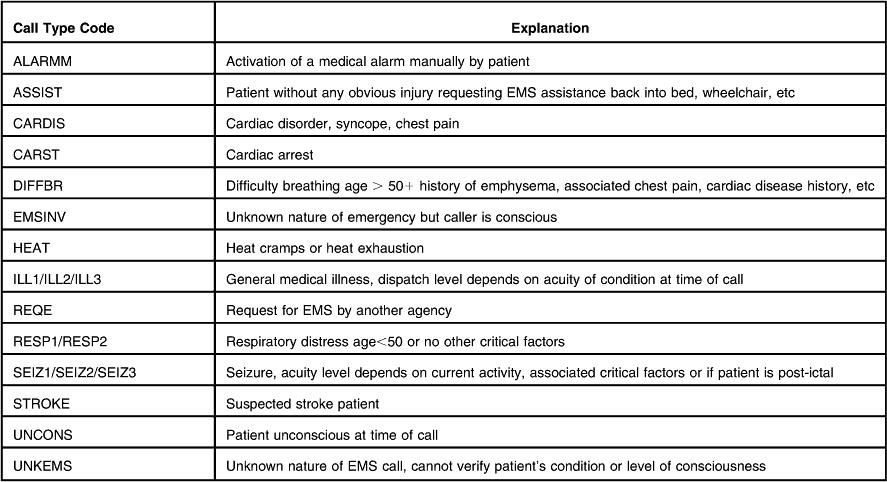
This was a retrospective database analysis of the Boston, Massachusetts USA EMS computer-aided dispatch (CAD) data over a 5-year period from January 1, 2006 through December 31, 2010. Boston EMS operates 19 Basic Life Support (BLS) and five Advanced Life Support (ALS) units, and handles approximately 300 calls per day in a city with a residential population of 618,000. All public calls for medical emergencies are coded based on a series of pre-arrival questions and given an initial type code using the Association of Public Safety Communications Officials (APCO) Institute Emergency Medical Dispatch Guidecards. Examples of typical EMS call type codes entered into the CAD by call-takers and their meanings are provided in Table 1. The type of response (BLS only or dual BLS/ALS response) is based on the initial type code assigned to the call. For example, a high priority call would require a dual ALS/BLS response due to higher acuity conditions, such as chest pain due to cardiac etiology, significant cardiac medical history, or syncopal event, whereas a lower priority medical call would get an initial BLS response (cough, flu-like or cold symptoms, etc). The CAD system assists call-takers in dispatching appropriate resources based on the initial information and tracks data such as the initial call type code, caller information, types of resources dispatched, dispatch time intervals (such as dispatch, arrival and transport to hospital), as well as any other additional data related to the call.
List of EMS Call Type Codes

Abbreviations: EMS, Emergency Medical Services
Historical weather data for the Boston area was obtained through an online search of a national climate database maintained by the National Climatic Data Center (NCDC) for the study period to include daily high and low temperatures, average daily temperatures, and number of recorded days with a high temperature >32.2°C (90°F).17 The NCDC's archive is considered the world's largest collection of historical weather data available to researchers and has been used in other published studies.Reference Bhattacharyya18-Reference Houck, Lethen and Riggs20 “Heat wave” definition was based on the National Weather Service (NWS) glossary as a period of abnormally and uncomfortably hot and unusually humid weather, typically lasting two or more days.21 A daily high temperature of >32.2°C (90°F) was used to describe excessively hot weather. While this may not be considered a high temperature in other geographic locations, this temperature was chosen since it is considered by many as an accepted level of abnormally high heat in the Northeast United States region, where average summer temperatures in Boston range from 19.5°C (67.2°F) to 21.6°C (71°F), and has been used locally by both the news media and regional NWS offices to define a heat wave.22, 23 In Boston, this temperature is regularly used to trigger public heat advisories since it may be easier for the general public to understand.24 Other calculated markers of hot weather, such as “heat index,” which accounts for humidity and temperature, were not used since historical humidity data for the study region could not be obtained.
Heat wave days (HWD) were identified and compared with similar dates from the previous year that were considered non-heat wave days (nHWD). In addition to previous historical comparison dates, the two calendar days prior to and after a defined heat wave were also used as nHWD for comparison. Emergency Medical Services’ call volume, number of patients transported, and call type codes for HWD and nHWD in this analysis were obtained and organized using Microsoft Office Excel 2007. Descriptive statistics and frequencies were performed using Minitab 14 statistical software for education (Minitab Inc., State College, Pennsylvania USA). An unmatched t-test was performed for comparison of all continuous data with statistical significance set at .05. This study was reviewed and approved by the Human Subjects Research Office of the Institutional Review Board at the Boston University School of Medicine.
Results
Between 2006 and 2010, eleven heat waves were identified based on the definition used in this study. Heat waves occurred during the months of June through August. A total of 58 days with a high temperature > 32.2°C (90°F) were observed. This represented 85% (58/68) of all days with a high temperature > 32.2°C (90°F) from 2006 to 2010 and only three percent (58/1825) of all days within the 5-year study period. The average high temperature during the study period was 26.2°C (79.2°F) while the average low temperature was 17.6°C (63.8°F). The average daily temperature during the study period was 21.9°C (71.5°F). The hottest day on record during the study period was 37.7°C (100°F) on July 6, 2010. There was a total of 31 HWD (26 weekday/5 weekend days) compared with 93 nHWD (64 weekday/29 weekend days) based on study definition. All recorded heat waves lasted approximately two to four days in duration. Table 2 shows the results for average daily temperature as well as the daily EMS call volume and actual number of patients transported. Mean temperature during HWD was significantly warmer than on nHWD. There was no difference in average daily temperature on weekdays or weekends for both HWD and nHWD. Both average daily emergency calls for EMS as well as the number of patient transports were significantly higher during HWD.
Average Daily High Temperature, Daily Total EMS Calls and Patients Transported

Abbreviations: EMS, Emergency Medical Services
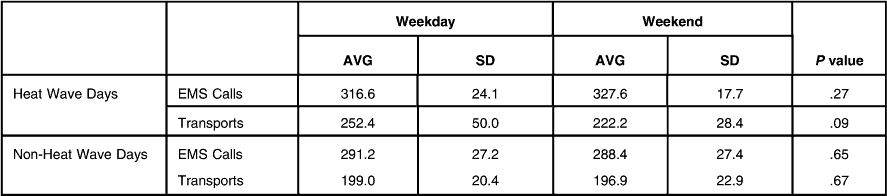
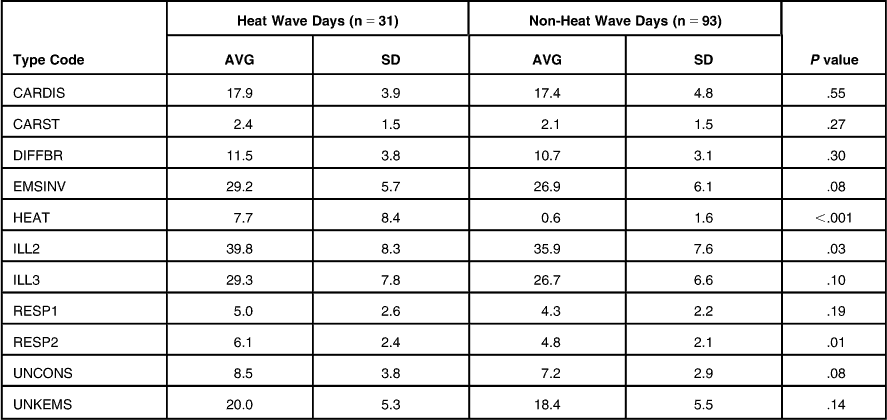
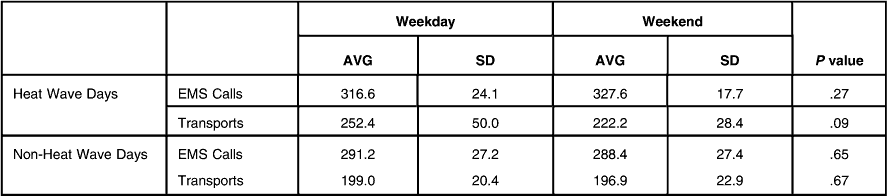
Table 3 represents the daily mean EMS call volume and daily transports based on weekday versus weekend days. There was no difference found for either HWD or nHWD. Results on average daily EMS calls for specific type codes are shown in Table 4. There were significantly more EMS calls for the following call types: HEAT, ILL2 and RESP2. There was a trend towards more ILL3, UNCONS, and EMSINV calls during HWD, but this difference was not significant. No difference was found when comparing the volume of HEAT calls occurring on either weekday or weekend days for both HWD and nHWD.
Average Daily EMS Calls and Actual Patient Transports Based on Day of the Week
Abbreviations: EMS, Emergency Medical Services
Average Daily EMS Call Volume Based on Dispatcher Type Code
Abbreviations: EMS, Emergency Medical Services
Discussion
This is the first known published study demonstrating a relationship between periods of hot weather to both the volume of daily emergency medical calls and ambulance transports. The finding that significantly more emergency medical calls and ambulance transports occurred on HWD compared with nHWD is not surprising. During periods of high heat, vulnerable populations will have less physiological reserve to handle heat stress. Similarly, other populations such as non-ambulatory patients, and individuals with significant physical or mental handicap, may not have the resources or ability to respond to such environmental stress. Emergency Medical Services usage also can rise due to the fact that patients needing medical attention may be less inclined to initiate transport on their own to hospitals due to heat and instead call for emergency medical assistance. Heat wave days saw an average daily increase in medical emergency call volume by 9.7% (28.1 calls per day). The increase in average daily EMS transports performed rose by 24.8% (49.2 transports per day) during HWD compared with similar dates in cooler weather. When considering the transport results within the context of the EMS system studied, this change would result in an average additional two transports per ambulance. Assuming the majority of these call changes reflected the statistically more frequent call type codes encountered (HEAT, RESP2, ILL2) and that these type codes are typically transported by BLS within the studied EMS system, this change in volume theoretically could increase BLS daily call volume by 2.5 transports per day. The data examined in this study was raw call volume and transport data categorized by call type code. A review of each individual call was not performed and thus, it could not be determined what type of units actually transported.
Metropolitan areas throughout the world have developed response plans for anticipated heat waves. The Boston Public Health Commission routinely will activate a response to heat waves that includes activities such as public service announcements to avoid prolonged activities outdoors, opening area shelters with air conditioning and other “cooling centers,” extending hours of community swimming pools, and proactively monitoring the health and well-being of vulnerable residents, such as the elderly, by performing “well-being” checks. The improved public health response to hot weather events has been shown to decrease overall patient mortality. Weisskopf et al demonstrated an overall decrease in both heat-related deaths as well as overall EMS runs when comparing experimental model data from 1995 to 1999, and attributed this change to improved public health preparedness and response.Reference Weisskopf, Anderson and Foldy25 Recently, the Institute of Medicine published a report on the current state of affairs with EMS in the United States, which highlights the challenges faced by EMS services nationally in the face of increased call volume, decreased funding, inconsistent and variable levels of care, as well as need for better integration with the health care system.26 Knowing the actual change in call volume during significant climate changes is important since officials need to consider overall system utilization to develop and implement appropriate response plans to increased patient volume, both in the EMS and the health care systems. The importance of knowing demand patterns of EMS and call volumes help public health and safety officials make appropriate changes in staffing patterns in response to predicted increased use.Reference Brown, Lerner and Larmon27 Proper staffing changes can be made in anticipation of increased EMS call volumes during extreme heat. Increased EMS transports result in increased ED patient volume, suggesting that ED managers can plan appropriately for increased ED volume when EMS sees an increase during these events.
Limitations
Although the results demonstrated a statistically higher number of calls, the specific call type codes reported are based on information provided to EMS call-takers during the initial conversation and do not necessarily represent the actual nature of the call. Individual patient run reports were not reviewed and dispatch data extracted did not reveal each individual call disposition. It is conceivable that some higher priority calls were actually lower priority upon evaluation by emergency medical technicians and paramedics. The opposite also could be true. For example, although there was no statistical difference in the incidence of cardiac arrest emergency calls during HWD and nHWD, it is conceivable that a number of calls could have been cardiac arrests since the final call disposition code was not available in this CAD dataset. Additionally, the APCO Emergency Medical Dispatch cards work to limit the amount of data required by the call-taker to code a call type and determine responding resources by quickly resulting in the highest, most appropriate type code. The trend of higher frequencies for some call types during HWD versus nHWD may actually have represented heat-related calls in addition to the HEAT type calls since information gathered would have categorized the patient with a different type code but still produce similar response resources. Call type codes which were found to occur more often during HWD easily could have represented actual heat-related illnesses but met that specific call type code criteria.
The mode of transport (ALS versus BLS) was not available in this dataset, limiting the ability to study the use of more advanced levels of EMS care during HWD versus nHWD. Since dispatch data is based on the information gathered by the call-taker during an emergency call, there is inherent bias in emergency medical dispatch systems (eg, APCO), as well as the call-takers themselves, to code calls as a higher acuity in order to provide the most resources for higher acuity patients than to not have the appropriate resources respond initially. This was a retrospective study design which also contains inherent biases both in the data review process as well as the analysis. However, the dataset contained only raw numbers for analysis and limited the degree of subjective interpretation for the reviewers. An additional limitation of the dataset included the reporting of daily average temperatures. The NCDC's climate data on daily weather provides only an average temperature without any comment to daily humidity or heat index. In an attempt to limit multiple factors to confound interpretation, a strict definition of two or more consecutive days of hot weather >32.2°C (90°F) was used. Additional indices of heat were not used in this analysis since this data was not available or consistent. Also, there could have been additional days within the period studied that with humidity and heat index factored in, could have been considered a HWD.
While the definition of hot weather day used in this study does not necessarily represent extreme heat for many other regions of the world, relative to average summer temperatures experienced in the New England region of the United States, this temperature has significance in triggering heat wave advisories and response. Given that the average daily temperature during the study period was 21.9°C (71.5°F), this demonstrates the significant difference between what was defined as hot weather days relative to the average daily temperature. It can be argued that residents living within the study region are not readily used to, or prepared to deal with, even the degree of hot weather based on the study definition. Findings from this analysis should be taken in the context of other regional definitions of extreme heat.
Conclusion
Daily average emergency call volumes for EMS as well as ambulance transport to hospitals were significantly increased during hot weather days, specifically during heat waves when the average daily temperature was above 32.2°C (90°F). Emergency Medical Services and public health officials should see this climate event as a risk to the health of individuals within their communities and be prepared to take appropriate measures so that the EMS response system will be able to meet this increased need. Further studies should be performed to look at actual EMS operational impact during HWD. Ambulance utilization data, such as unit-hour utilization, level of EMS care rendered, critical interventions performed, as well as patient mortality, should be studied to better understand the true impact of extreme hot weather on the preparedness and response of a community during such an event.
Acknowledgements
The authors would like to thank Superintendent Thomas Macjeiko and Ms. Jin Xiang for their assistance in data gathering for this study. We would also like to thank the men and women of Boston EMS for the great work they do every day.