The end of World War II triggered an explosion in foreign trade and investment. This flurry of economic activity has often been linked to the emergence of new separatist movements around the world and the reinvigoration of quiescent ones. The Zapatista uprising in Mexico and the renewed momentum of the Québécois in Canada have both, for example, been attributed to the signing of the North American Free Trade Agreement (NAFTA) (Fox Reference Fox1994). The eagerness of the former republics of Yugoslavia to declare independence has been similarly linked to the willingness of the European Union (EU) to open its doors to these states upon independence (Crawford Reference Crawford1996). Even the illicit drug trade in the South Caucasus and the legal oil trade in the Sudan have been associated with separatist activity in these areas (Woods Reference Woods2003).
Economic integration—that is, the elimination of tariff and non-tariff barriers to the flow of goods, services and factors of production between states—is believed to advance separatist movements like these by minimizing the need for regions to belong to large states in order to have access to large free-trade zones (Alesina and Spolaore Reference Alesina and Spolaore1997, Reference Alesina and Spolaore2003). Economic integration that occurs through international organizations like the EU is supposed to spur separatist movements even further by weakening the political and economic authority of national governments (Lynch Reference Lynch1996; Jeffery Reference Jeffery1997), by motivating regions to secede in order to influence economic decisions made at the supranational level (Dardanelli Reference Dardanelli2005) and by facilitating cooperation among separatist groups (Lynch Reference Lynch1996; de Winter and Gomez-Reino Cachafeiro Reference de Winter and Gomez-Reino Cachafeiro2002).
If true, the implications are far-reaching. According to the World Trade Organization (WTO), foreign trade has grown in volume more than 32 times since 1950 (WTO 2009). In this year, foreign trade made up only from 6 percent of the world's gross domestic product (GDP) in 1950 to 21 percent in 2007. A major factor behind this growth has been the rise of new international trade organizations such as NAFTA, the Andean Community and the Common Market of the South (MERCOSUR), as well as the expansion of old ones, like the EU and the Association of Southeast Asian Nations (ASEAN). Today, one-third of the world's trade takes place within regional trade blocs (Schiff and Winters Reference Schiff and Winters2003). Even though the world has become increasingly more integrated, however, there has not been a commensurate growth in separatist activity around the world. In fact, by some measures, violent separatist activity has declined globally since the 1990s (Hewitt, Wilkenfeld and Gurr Reference Hewitt, Wilkenfeld and Gurr2008).
In this study, I theoretically and empirically challenge the widely held view that economic integration advances separatism even within international trade organizations, where the effect of integration is likely to be the greatest. Only a few scholars have thus far sought to challenge this relationship theoretically. Annalisa Zinn (Reference Zinn2006) argues, for example, that although economic integration and separatism are statistically correlated, they are not causally linked, but rather form two parallel trends. Nicholas Sambanis (Reference Sambanis2006) argues, meanwhile, that economic integration is unlikely to increase separatism because it is likely to be offset by fiscal and political decentralization. A number of qualitative case studies have also shown that the attitudes of particular separatist parties toward economic integration are complex and not always supportive of integration (Lynch Reference Lynch1996; Murray and Tonge Reference Murray and Tonge2005; McGarry and Keating Reference McGarry and Keating2006; Dardanelli Reference Dardanelli2005, Reference Dardanelli2010).
Building on the work of these scholars, I also challenge the predominant view of economic integration. But in contrast to these works, I argue that economic integration is unlikely to promote separatism in general because all regions do not necessarily benefit very much from integration, and because even regions that do gain from integration generally do not benefit enough to provide for their own defense in order to sustain themselves as independent states. Moreover, since economic integration does not make most regions’ threats to secede more credible, the effect of economic integration is not likely to be offset by decentralization. In addition to theoretically challenging the conventional view of economic integration, I also present a stronger empirical test of the relationship between economic integration and separatism than previous studies have done.
To analyze the effect of economic integration on separatism, I adopt a mixed-method approach. First, I analyze quantitatively the effect of economic integration on separatism in post-WWII Europe—a hard test of my argument and the locus of most of the debate on economic integration. This analysis not only examines the overall effects of economic integration on separatism as others have done, but also tests the conditions under which integration is most likely to encourage separatism. Second, I conduct qualitative case studies of the two countries associated with an increase in separatism in the statistical analysis in order to evaluate the extent to which the relationship between economic integration and separatism is likely to be causal. Together, these analyses indicate that the overall effects of economic integration on separatism are weak and likely to be conditional on certain aspects of the political and security environment in which integration takes place. Moreover, decentralization does not offset the effect of economic integration on separatism according to the analysis—in fact, it has the opposite effect.
The Impact of Economic Integration on Separatism
Economic integration is commonly argued to promote demands for independence by enabling regions to have access to large free-trade zones without having to belong to large states (Alesina and Spolaore Reference Alesina and Spolaore1997, Reference Alesina and Spolaore2003). As Alesina and Spolaore argue in their seminal work on this issue, “political separatism should go hand and hand with integration” (1997, 1042). According to this argument, large states provide certain economic benefits to regions that keep states together, including a low per capita cost of public goods and a sizable area over which to exchange products and services without trade barriers. Thus by removing interstate barriers to trade, economic integration is supposed to reduce the need for regions to belong to large states in order to participate in large free-trade zones. Free-trade zones can also increase foreign direct investment (FDI) because foreign firms often locate to countries without trade barriers in order to exchange goods and services more easily with other countries (WTO 1996; Feenstra Reference Feenstra1998). FDI, in turn, can lead to job creation and growth and further minimize the need for regions to belong to large states.
Integrationist scholars do not suggest that economic integration causes the demand for independence, but rather that economic integration serves as a permissive condition of it (Alesina and Spolaore Reference Alesina and Spolaore1997, Reference Alesina and Spolaore2003; Meadwell and Martin Reference Meadwell and Martin1996; Lynch Reference Lynch1996; Jeffery Reference Jeffery1997; Sorens Reference Sorens2005; Jolly Reference Jolly2006; McGarry and Keating Reference McGarry and Keating2006). As Hudson Meadwell and Pierre Martin write, “freer trade in a tight institutionalized setting lowers the barrier to exit for groups contemplating secession” (1996, 74–5). The desire for independence is driven, according to these scholars, by many different issues internal to states, including economic wealth and job competition, ethno-cultural differences, authoritarianism and repression, governmental structures and natural resources.
International trade organizations like ASEAN, the EU and MERCOSUR are believed to further bolster demands for autonomy and independence, because they reduce trade barriers as well as undermine the political and economic authority of national governments (Lynch Reference Lynch1996; Jeffery Reference Jeffery1997). Most integration schemes exert little authority over their member states other than requiring them to meet certain political or financial standards in order to join. The EU's economic authorities, though, are expansive, encompassing a range of activities including agriculture, commerce, currency and fisheries. Its political powers are more limited and are only intended to safeguard its member states’ common values and fundamental interests, to protect the independence and integrity of the Union, and to promote democracy, human rights and the rule of law.
International trade organizations are also thought to spur separatism by motivating regions to secede in order to influence important economic decisions made at the supranational level, where regions generally have little influence even within the EU (Dardanelli Reference Dardanelli2005). Some scholars argue that the EU, in particular, further promotes separatism by enabling separatist parties from different countries to interact with each other at the supranational level (Lynch Reference Lynch1996; de Winter and Gomez-Reino Cachafeiro Reference de Winter and Gomez-Reino Cachafeiro2002). These interactions are supposed to advance separatist parties at home by providing them with logistical and administrative support, assistance in developing party programs and organizational structures, enhanced political status and prestige, and even a boost in morale. Other trade organizations do not have such opportunities, because most other organizations lack the EU's dense networks of formal institutions.
Only a few scholars have explicitly challenged this view of economic integration. Annalisa Zinn (Reference Zinn2006) argues that increases in economic integration and separatism are not causally linked but constitute two unrelated trends, finding in her statistical analysis that economic integration is associated with more separatist movements. Nicholas Sambanis (Reference Sambanis2006) argues that in general, economic integration can increase separatism, but that decentralization can offset its effect. Consistent with Alesina and Spolaore (Reference Alesina and Spolaore1997, Reference Alesina and Spolaore2003), Sambanis argues (but does not test his argument empirically) that integration makes threats to secede more credible because it gives regions access to large free-trade zones without having to belong to large states, and that governments react to those threats by decentralizing. He claims that decentralization, in turn, dampens the demand for independence by giving groups more control over their own political, social and economic affairs.
Sambanis’ argument builds on an extensive literature about the impact of decentralization on intrastate conflict and state dissolution. According to this literature, giving regions control over their own political, social and economic affairs helps keep states united by enabling regions to redress the concerns that drive them to seek independence in the first place (Lijphart Reference Lijphart1977; Horowitz Reference Horowitz1991). If, for example, a region is motivated to secede because it contributes more to the national budget in taxes than it receives from the government in public services, as Catalonia does in Spain, decentralization can lessen the desire for independence by allowing regional and local governments to collect their own taxes. Similarly, if a region is motivated to secede because its ethnic majority group feels that the country's national culture is obliterating its own, decentralization can reduce the desire for independence by giving regional and local governments autonomy over the structure of education, language and culture in their jurisdictions.
However, some scholars argue that decentralization can strengthen separatist parties by reducing the incentives for parties to compete throughout a country, and, consequently, increase demands for independence. Chhibber and Kollman (Reference Chhibber and Kollman2004) and Brancati (Reference Brancati2008, Reference Brancati2009) argue that decentralization reduces the incentives for parties to compete throughout a country by reducing the power of national legislatures, and thereby giving parties fewer incentives to merge with each other in order to control the national government. In their argument, Chhibber and Kollman (Reference Chhibber and Kollman2004) focus more on the distribution of power between national and subnational authorities to explain variation in the effect of decentralization on party systems, while Brancati (Reference Brancati2008, Reference Brancati2009) looks more at differences within the institutional structure of decentralization to explain this variation. For Brancati (Reference Brancati2009), this variation is key to explaining whether decentralization mitigates or encourages intrastate conflict and separatism.
In addition to the work of Zinn (Reference Zinn2006) and Sambanis (Reference Sambanis2006), a number of qualitative case studies has also shown that the attitudes of particular regional and separatist parties toward economic integration are complex and do not always support economic integration. These scholars have pointed out that while some parties—like the Vlaams Blok in Belgium (Breuning Reference Breuning2007; Dardanelli Reference Dardanelli2010) and the Bloc Québécois in Canada (Meadwell and Martin Reference Meadwell and Martin1996)—have consistently supported economic integration, other parties, like Sinn Fein in Northern Ireland, have consistently opposed it (Frampton Reference Frampton2005; Murray and Tonge Reference Murray and Tonge2005), while still others, like the Scottish National Party (SNP), have changed their positions over time (Hepburn Reference Hepburn2006; Dardanelli Reference Dardanelli2010). Separatist parties have not always perceived economic integration as beneficial for their regions, according to these studies, and have at times opposed the EU due to its policies and its centralized and bureaucratic structure.
The statistical evidence examining the relationship between economic integration and separatism favors the conclusion that economic integration increases separatism. Separatist sentiment, however, is not measured precisely in these studies. Tosutti (Reference Tosutti2002) measures separatist sentiment in terms of ethnic, religious and regional parties combined, only some of which may be separatist. Jolly (Reference Jolly2006) looks at the electoral strength of regional parties, which includes (but is not limited to) separatist parties, while Sorens (Reference Sorens2005) analyzes secessionist parties, among which he includes both parties that advocate independence and those that only advocate autonomy. Finally, Zinn (Reference Zinn2006) measures separatism in terms of the number of separatist movements in a country with more movements indicating greater strength. Fractionalization, though, can signify a movement's weakness and disunity rather than strength, and does not necessarily imply public support for separatism.
In this analysis, I examine the relationship between economic integration and separatism using both statistical analysis and qualitative case studies. The former allows me to evaluate the generalizability of my argument, while the latter lets me examine my causal claims more deeply. In the statistical analysis, I provide a stronger test of the effect of integration on separatism than previous studies by defining separatism in terms of the vote for independence-seeking parties only, and by exploring how the effect of integration depends on certain characteristics of separatist parties and the regions they represent. In the case studies, I use qualitative techniques to evaluate the extent to which any increase in separatism observed in the statistical analysis is likely attributable to economic integration.
Challenging The Separatist Illusion
In sum, I argue that while economic integration may promote separatism among some regions, it is not likely to increase separatism in general because many regions and groups within regions do not benefit very much from economic integration, and because those that do benefit from integration do not typically benefit enough from it to provide for their own defense so that they can sustain themselves as independent states. Moreover, when economic integration takes place as part of a regional integration scheme, as more than one-third of all trade in the world does today, the political environment in which integration takes place often complicates the benefits of integration and the ability of regions to take advantage of these benefits.
Some regions and groups therein do not benefit very much from economic integration. Yet some regions benefit from it more than others due to their position in the global economy (Paelinck and Polèse Reference Paelinck and Polèse1999; Braunerhjelm et al. Reference Braunerhjelm, Faini, Norman, Ruane and Seabright2000; Hiscox Reference Hiscox2003). Regions that are well positioned to gain from free trade tend to have export-driven production (mostly industrial) that is already competitive on the global market. They also tend to depend less on government aid in the form of subsidies and protections than other regions and have more diversified economies that allow them to shift more easily to more competitive sectors. Governmental policies, particularly those that affect intersectoral and geographic mobility, also influence how easily regions can shift to more competitive sectors.
Similarly, some regions are also better positioned to attract FDI than others. Regions with low labor costs, high unemployment, strong property rights and favorable tax policies are more attractive in this regard than other regions (Barrell and Pain Reference Barrell and Pain1999; Büthe and Milner Reference Büthe and Milner2008). Low labor costs and high unemployment rates can increase FDI by attracting investment from manufacturing industries, which require a lot of low-skill labor to produce their goods. Strong property rights, typical of democracies, are also important for attracting FDI because they protect multinationals against appropriation, while low tax policies are helpful because they increase corporations’ profit margins.
Within regions, different segments of the population also vary in the degree to which they benefit from and support economic integration (Rogowski Reference Rogowski1990; Eichenberg and Dalton Reference Eichenberg and Dalton1993). Only those groups for whom free trade leads to more demand for products in the sector in which they are employed—and higher FDI—are likely to benefit from economic integration. Higher FDI can lead to more jobs and higher wages if it results in more labor competition. Groups for whom free trade and the removal of governmental subsidies and protections reduces the demand for products in the sector in which they are employed, and leads industries in this sector to relocate to other countries, are unlikely to benefit. In advanced economies, this means that skilled and educated workers are likely to benefit, while in developing countries, the opposite is likely to be true (Gabel Reference Gabel1998).
The economic gains from integration through regional trade organizations are also not clear cut, because separatist regions often face major challenges in joining free trade organizations upon independence. Separatist regions are not likely to join free trade organizations automatically if they declare independence, even if they belong to states that are already members of these organizations, because they constitute new political entities upon independence. They would not be bound, therefore, by the treaty obligations of the state from which they declared independence, as codified in the 1978 Vienna Convention on the Succession of States in Respect of Treaties.
As a result, many separatist regions and separatist movements do not seek to join free trade organizations upon independence. In Italy, for example, the Northern League has at times campaigned against the currency union, believing that the euro has added to Italy's high inflation and has reduced the competitiveness of its Northern industries (Browne and Owen Reference Browne and Owen2005). Many separatist movements are also opposed to joining free trade organizations because they limit the autonomy of states. In Bosnia and Herzegovina, separatist parties representing the country's ethnic Serb population rejected the notion of joining the EU for this reason and advocated joining a loosely configured, pan-Serb union with the former Yugoslavia upon independence instead. Until 1999, Sinn Fein also opposed joining the EU because it believed that the EU exerted too much authority over its member states.
Meeting an organization's accession requirements can also be very difficult for separatist regions that do seek to join these organizations upon independence. These requirements can be stringent and separatist regions are likely to be much weaker politically and economically than the states from which they have seceded. The EU maintains more stringent accession requirements than any other international organization. To join the EU, countries must have robust democracies and functioning market economies. They must also adhere to the aims of the political, economic and monetary union and adopt the acquis communautaire, which includes all the treaties, regulations and directives of the EU and all judgments issued by the Court of Justice. Wealthy regions, and regions that were members of countries that belonged to regional trade organizations before independence, are better positioned to meet these accession requirements upon independence.
All regions face a potentially more onerous obstacle to joining regional trade organizations upon independence: political opposition to their membership from within the organization. An organizational member state is likely to try to prevent a region that seceded from it from joining a regional trade organization of which it is a member in order to oppose the region's independence if it did not secede from the state amicably, to project a sense of power vis-à-vis the region or to deter other secessionist regions within its borders from declaring independence. Other members of international organizations that face their own separatist movements are also unlikely to invite separatist regions to join these organizations to avoid encouraging regions in their own countries to declare independence. Spain, for example, which faces its own separatist movements in the Basque Country and Catalonia, has explicitly refused to recognize Kosovo as an independent state unless Serbia recognizes it, or unless the United Nations passes a resolution to this effect, though this has not yet derailed Kosovo's accession to the EU. Even countries that do not face their own separatist movements may be reluctant to jeopardize their relationships with other states by recognizing separatist regions.
In practice, many international organizations have gone so far as to publicly support member states in opposition to separatist movements within their borders. In 1995, when Quebec held a referendum to decide its independence, Mexico sided with the Canadian government, its partner in NAFTA. In 2001, the EU urged Montenegro not to declare independence from Serbia and warned that “[s]eparation is not a rapid train to the EU…[i]t would be a slower train.”Footnote 2 Likewise, when the Santa Cruz region of Bolivia voted in 2009 for autonomy in a referendum that led many to worry that the next step was independence, the Organization of American States, the Bolivarian Alternative for the Americas and the Rio Group all outwardly opposed the referendum.
Few states are likely, moreover, to benefit enough from integration to provide for their own national defense in order to sustain themselves as independent states.Footnote 3 Economic integration may help regions provide for their own security by raising the income of individuals and enlarging a region's tax base. However, many separatist regions tend to be small, with populations of a few million or less, including Chechnya and Kosovo, and often do not have the economic capacity or manpower to provide for their own defense. Many separatist regions may also face a significant security threat upon independence if the states they have seceded from oppose their independence. The effect of integration in these cases depends on whether regions can rely on bilateral security arrangements or multilateral security structures, like the National Atlantic Treaty Organization (NATO), for their defense.
Finally, the effect of integration is not likely to be offset by decentralization, as others have argued (Sambanis Reference Sambanis2006). First, as discussed in the previous section, decentralization can promote separatism by strengthening separatist parties (Brancati Reference Brancati2008, Reference Brancati2009). Second, states are not more likely to decentralize because economic integration is not more likely to increase support for independence in most regions for reasons already described.Footnote 4 Moreover, no international trade organization, with the recent exception of the EU, explicitly requires states to decentralize in order to become members. The EU has only asked this of recent applicants to aid in the management of its Structural Funds and does not specify what these regional structures must entail. Thus in practice, these structures tend to have very little authority and are thus unlikely to offset demands for independence. The EU's policy on minorities has also failed to strengthen regional autonomy because it is ambiguous and not well monitored or enforced (Sasse Reference Sasse2006).
Methodology
In the statistical analysis and case studies that follow, I examine the effect of economic integration on separatism in post-World War II Europe. I focus on Europe because it presents a hard test of my argument. According to the conventional view of integration, the effect of economic integration should be greatest in Europe because it is the most integrated region in the world. Not surprisingly, Europe is also the focus of most of the debate on economic integration and separatism (Lynch Reference Lynch1996; McGarry and Keating Reference McGarry and Keating2006; Jolly Reference Jolly2006). There is also significant, measurable variation in Europe within and across countries over time in order to investigate the conditions under which integration is more likely to lead to separatism. The statistical analysis encompasses 35 countries in Western and Eastern Europe between 1945 and 2008.Footnote 5
Data and Measures
To evaluate the effect of post-WWII European integration on separatism, I use the following data and measures in the analysis.
Separatism
I measure separatist sentiment in the analysis in terms of the electoral strength of separatist parties. I define separatist parties as those that demand the complete independence of a subnational territory of a state from that state.Footnote 6 I identify parties as separatist or not based on their position toward independence in each election year. As a result, the same party may be classified as separatist in one year and non-separatist in another. To identify parties as separatist and to identify particular characteristics of these parties, I draw on various primary and secondary resources (e.g., party platforms, party websites, newspaper articles, and scholarly books and articles.). For a list of these parties, see the Appendix.
The electoral strength of separatist parties is a good, but imperfect, proxy for separatism. Not everyone who supports independence may participate in elections, and not all support for separatist parties can be interpreted as support for independence, because people can vote for separatist parties for reasons other than their position on independence. Electoral support for separatist parties can also vary based on parties’ political ideologies and strategies. However, most separatist sentiment in Europe is expressed peacefully through the political system and only a few violent separatist parties, such as Batasuna in Spain, have been barred from electoral competition in Europe in the post-WWII period. Moreover, while separatist party strength may not fully represent the overall strength of separatism within countries, the statistical analysis herein examines changes in the level of separatist sentiment within countries over time, not the overall strength, and therefore should not be biased.
I measure the electoral strength of separatist parties in this study in terms of the percentage of votes that they win in national lower house elections. I only include lower house elections in the analysis since not all countries in the sample have upper houses or subnational legislatures, making comparisons across countries impossible.Footnote 7 Although separatist parties are typically stronger at the subnational level than at the national level, I expect any changes in the electoral strength of separatist parties at the national level due to economic integration to correlate with changes at the subnational level. The election data is taken from the Global Elections Database.Footnote 8 The analysis is restricted to parties that win seats because there is too little information available on non-seat winning parties to reliably code them.Footnote 9 Separatist parties sometimes participate in pre-election coalitions with non-separatist parties so that it is impossible to identify their vote count precisely. To address this issue, I created another measure that attributes the entire vote for such a coalition to separatist parties. This variable, combined with the previous one, represents the maximum possible vote for separatist parties in a country.
Separatist parties have won seats in nine of the 35 countries included in the analysis: Belgium, Bosnia and Herzegovina, France, Germany, Italy, Moldova, Spain, the United Kingdom and West Germany. The vote for separatist parties is significantly higher under each level of integration in only two of these nine countries: Belgium and the United Kingdom. In Belgium, separatist parties won 2.5 per cent of the vote under the European Economic Community (EEC), 7.8 per cent under the EU and 11 per cent under the European Monetary Union (EMU). In the UK, separatist parties won less than 1 per cent of the vote when the UK was not a member of any integration scheme, 1 per cent of the vote under the EEC and 3 per cent under the EU. The UK is not a member of the EMU. In France and West Germany, the vote for separatist parties is lower under higher degrees of integration, and in Germany, Italy and Spain it is higher in some cases and lower in others. Bosnia and Herzegovina and Moldova were not members of any of these integration schemes during the period examined.
Although separatist parties did not win seats in 26 countries in the sample, it is important that these countries are included in the analysis because separatist parties had the potential to win seats in many of them. Separatist parties existed in a number of these countries although they did not garner enough support among the electorate to win seats, as in the case of Aralar in the Basque Country of Spain. Many of these countries also had regional parties that had the potential to transform themselves into separatist parties. Regional parties had enough electoral support in 20 of these 26 countries to win seats.Footnote 10
In addition to measuring the overall electoral strength of separatist parties, I distinguish among different types of separatist parties that may be more or less likely to benefit from economic integration and to pursue independence as a result. I typologize parties based on four characteristics: rich/poor, right-wing/left-wing, pro-EU/anti-EU and violent/non-violent. I code each characteristic for each election year. As a result, a party may be coded anti-EU one year and pro-EU in another. I distinguish between parties that represent rich regions and those that represent poor regions because in Europe, economic integration is more likely to increase support for the former than the latter since the former are better positioned to benefit from economic integration, and are also more likely to be able to meet the EU's accession requirements upon independence. I code parties as a 1 for Rich if they represent a region that has a GDP per capita above the national average, and 0 otherwise.Footnote 11
I also differentiate among right- and left-wing parties. In Europe, right-wing parties tend to favor economic integration more than left-wing parties because they generally support free trade and reduced government involvement in the economy more than left-wing parties (Marks et al. Reference Marks, Hooghe, Nelson and Edwards2006). They should be more likely, therefore, to use European integration to increase their electoral support than left-wing separatist parties, and to gain as a result. I code separatist parties 1 for Right (RT) if they favor reduced taxes, decreased government spending and a smaller welfare state, and 0 otherwise.
Parties’ positions toward EU membership are also structured by issues besides economic ones, including sovereignty and cultural assimilation. Some parties, for example, oppose EU membership because they believe it reduces the autonomy of states or will increase immigration (Hooghe and Marks Reference Hooghe and Marks2005). For this reason, I also identify the position of separatist parties on the EU directly. Parties that support EU membership should be more likely to use the EU to increase their support among the electorate than those that do not, and to experience an increase in support as a result. Separatist parties are coded 1 for Pro-EU if they want their country or territory to be a member of the EU, and 0 if they do not.
Finally, I distinguish among separatist parties in terms of the strategies they use to achieve independence, and whether they advocate the use of violence in this regard. Violent separatist parties cannot belong to the European Free Alliance (EFA), which is an alliance of regional parties that facilitates interaction among separatist parties within the EU and is supposed to increase support for separatism as a result (Lynch Reference Lynch1996; de Winter and Gomez-Reino Cachafeiro Reference de Winter and Gomez-Reino Cachafeiro2002). According to this logic, violent separatist parties should be less likely to benefit from integration than non-violent parties. I code separatist parties as Violent if they use (or advocate the use of) violence to achieve their political goals, and 0 otherwise.
Economic Integration
I measure economic integration in two ways. The first is in terms of EU integration, which I represent with an ordinal measure identifying four major advances in integration that have taken place in Europe over the post-World War II period. These advances involve the creation of the following four organizations: (1) the European Coal and Steel Community (ECSC), (2) the EEC, (3) the EU and (4) the EMU. Each of these institutions significantly increased the level of economic integration in Europe. The ECSC established a common market for coal and steel, lifted restrictions on imports and exports, and created a unified labor market. The EEC, which superseded the ECSC, enlarged the common market beyond coal and steel, created a customs union, and established common policies in areas such as agriculture and trade. The EU, which superseded the EEC, expanded the scope of integration to include, among other things, foreign policy and security as well as police and justice in respect to criminal matters. Finally, the EMU established a common currency within the EU.
For a given election, ECSC members (1952–56) are coded 1, EEC members (1957–91) are coded 2, EU members (1992–2008) are coded 3 and EMU members (1999–2008) are coded 4. Non-members, like Switzerland and Albania, are coded 0. Countries cannot belong to more than one organization in a given election, except in the case of the EU and the EMU. In this case, countries are coded 4 to represent the most advanced integration scheme of which they are a member. Separatist parties did not play any role in the evolution of the EU at these four major junctures, mitigating concerns of reverse causation. These changes in EU integration were due to interstate bargains and/or elite bargaining within the EU (Moravcsik Reference Moravcsik1991, Reference Moravcsik1998). Within countries, decisions to join the EU have been made by national governments (where separatist parties have a very small presence and little influence on decision making) and/or national referendums.
The second way in which I measure economic integration is in terms of international trade and FDI using the World Development Indicators (1960–2010). These measures isolate the effects of trade and FDI—which are thought to increase demands for separatism by reducing the need for regions to belong to large states in order to have access to large free-trade zones—from other aspects of EU integration that scholars have suggested might encourage separatism in different ways. These include a reduction of the political and economic decision-making authorities of national governments (Lynch Reference Lynch1996; Jeffery Reference Jeffery1997), the desire to influence decisions at the EU level (Dardanelli Reference Dardanelli2005) and the facilitation of interactions among separatist parties across regions (Lynch Reference Lynch1996; de Winter and Gomez-Reino Cachafeiro Reference de Winter and Gomez-Reino Cachafeiro2002). I measure international trade in terms of total imports and exports of goods and services (percent of GDP) and FDI in terms of total inflows (percent of GDP) and total outflows (percent of GDP). Like trade, FDI is higher, as economic integration is greater.
Control Variables
I also include a number of time-varying control variables in the analysis to account for concurrent changes in countries over the post-WWII period that may influence subnational demands for independence. I do not include non-time varying control variables, including certain regional, ethnic or linguistic identity measures in the model, even though they might affect separatist sentiment, because they cannot affect changes in separatism within countries over time. I control for these issues by including country fixed effects in the analysis.
Since decentralization may offset demands for independence, I measure it with an indicator variable. Decentralization is coded 1 if at least one region in a country has independent decision -making power over at least one political issue area, and 0 otherwise (Brancati Reference Brancati2006).Footnote 12 To capture the extent of political and fiscal decentralization in countries, I use a 4-point index of decentralization based on whether (1) regional legislatures are elected in countries, whether these legislatures have control over (2) education and (3) public order or police, and (4) whether they can raise or levy their own taxes (Brancati Reference Brancati2006). Countries receive a point on this index for each characteristic they possess. This measure is strongly correlated with the Regional Authority Index (RAI) (Hooghe, Marks and Schakel Reference Hooghe, Marks and Schakel2008).Footnote 13
I also measure national GDP Per Capita (constant 2000 USD) using the World Development Indicators (1960–2010) because economic wealth, like decentralization, can offset the negative consequences of integration in some regions, according to Sambanis (Reference Sambanis2006). I also measure natural resource wealth in terms of oil rents (percent of GDP) using the same database. Separatism is arguably higher in oil-rich regions than oil-poor regions because the former are better positioned to sustain themselves as independent states than the latter (Ross Reference Ross2004). Only three countries in the dataset have sizable oil sectors: Norway, Romania and the United Kingdom, and only two of these countries, Romania (Transylvania) and the United Kingdom (Scotland), have oil reserves located in separatist regions.
To control for concurrent military integration in Europe, I track membership in NATO. NATO, which was established in 1949 four years before the first wave of economic integration in Europe, may promote separatism if independence-seeking regions look toward it to provide military security, especially against attempts by states to reabsorb them. NATO intervened in Bosnia and Herzegovina (1992–95) and Kosovo (1999) for this purpose.Footnote 14 I code NATO membership as 1 if a country is a member of NATO in a given year, and 0 otherwise. This measure cannot detect whether separatist regions are motivated to seek independence because they expect to join NATO upon independence even if the countries from which they are seceding are not NATO members. NATO intervened in both Bosnia and Herzegovina and Kosovo without either country or the former Yugoslavia being a member.
I measure the level of democracy in countries using the Polity II Index ranging from –10 (authoritarianism) to +10 (democracy). Separatism should be lower when democracy is greater because groups are more likely in this context than in another to use the political system to redress the concerns that drive their demand for independence in the first place. Separatists could also be weaker when elections are less democratic since separatist parties cannot effectively compete in these elections, but very few separatist parties have been banned outright in Europe in the post-WWII period.
Transitions to democracy are also likely to affect the electoral strength of separatist parties because issues related to the structure of the political system tend to be salient at this time. I measure transitional periods based on whether elections are the first democratic ones in a country. First Elections is coded 1 if elections are the first elections that score 5 or higher on the Polity IV index and occur after an extended period of non-democratic rule (a period of 10 years or longer with a Polity IV score of 4 or lower), and 0 otherwise.
Finally, I measure the type of executive system and the type of electoral system in a country. Presidentialism can give parties incentives to compete throughout a country in order to win the office of the chief executive and reduce electoral support for separatist parties, because candidates generally need to earn a majority of the national vote in order to win the presidency, whereas in parliamentary systems candidates do not need to win even a plurality of the national legislature's vote in order to become the prime minister (Brancati Reference Brancati2008, Reference Brancati2009). Presidentialism is measured based on data from the Comparative Political Data Set I and II, and is coded 1 for presidential and semi-presidential systems, and 0 otherwise.
The proportionality of the electoral system can also affect the percentage of votes and seats that separatist parties win in elections. Separatist parties tend to be small, and small parties tend to win more votes under more proportional systems. However, parties with votes that are regionally concentrated, as in the case of separatist parties, tend to perform better under majoritarian and plurality systems. I measure the proportionality of the electoral system based on the average district magnitude (Average DM)—the higher the district magnitude, the more proportional the electoral system.
Results
To test my argument quantitatively, I conduct two separate analyses. The first assesses the effect of economic integration on the vote for separatist parties within countries as a whole, while the second looks at the effect of integration on particular types of separatist parties. In the first analysis, the dependent variable is the percentage of votes won by separatist parties in a national election; the unit of analysis is the national election. In the second, the dependent variable is the percentage of votes won by individual separatist parties in an election; the unit of analysis is the separatist party.
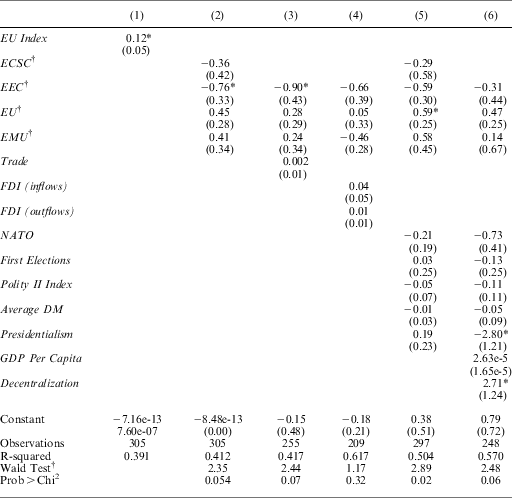
The results of the first analysis are presented in Table 1. In this analysis, I use ordinary least squares regression (OLS) with robust standard errors and country fixed effects to evaluate the impact of economic integration on separatism.Footnote 15
Separatist Party Vote–National Aggregates

†variables included in the Wald Test. **p < 0.01, *p < 0.05.
Model 1 examines the effect of integration on separatist parties in terms of EU integration measured as an index (EU Index). According to the model, higher levels of integration are significantly associated with a higher percentage of votes for separatist parties. In Model 2, I decompose the index into five separate indicator variables in which non-membership is the omitted category. The indicators are jointly significant in this model at the p ≤ 0.06 level according to Wald tests. Only membership in the EU and the EMU, though, is associated with a higher percentage of votes for separatist parties than non-membership. ECSC and EEC membership is associated with a lower percentage of votes for separatist parties in contrast to the conventional view of economic integration. These results are driven by two countries: Belgium and the United Kingdom. The effect of EU integration is not significant if either of these two countries is dropped from the analysis.Footnote 16
Model 3 investigates the effect of trade on separatist parties. The ECSC variable drops out of the model because the trade data are only available for the post-1960 period. The relationship between trade and separatist party vote is not significant in this model, and the effects of EU integration and trade do not cancel each other out. The correlation between the EU Index (and each of its subcomponents) and trade is low (r = 0.142 or below), and trade is still not significant if EU integration is excluded from the model. The indicator variables for EU integration are jointly significant in this model at the p ≤ 0.07 level.
In Model 4, I measure integration in terms of FDI instead of trade. The ECSC is also excluded from this model due to the post-1960 coverage of the FDI data. In this model, neither FDI (outflows) nor FDI (inflows) is significant. The two FDI measures are not significant if each is included separately in the model. I dropped Trade from this model to maximize the number of observations in the analysis. However, including both Trade and FDI in the same model does not change the results of either variable. The indicator variables for EU integration are not jointly significant in this model.
Model 5 controls for international and domestic factors that vary over the post-WWII period but do not vary as a function of economic integration. The EU and EMU are again associated with a higher percentage of votes for separatist parties. Although the signs on the individual coefficients for these variables are not significant, all four EU indicators are jointly significant at the p ≤ 0.05 level. These results are sensitive, though, to case selection. If I drop Belgium or the UK from the analysis, the variables are no longer jointly significant. None of the control variables is significant in this model either.
In Model 6, I add control variables for domestic factors that vary over the post-WWII period and are potentially affected by economic integration. Only the EU and EMU are positively associated with a higher percentage of votes for separatist parties in this model, and all four EU indicators are jointly significant in this model at the 0.06 level. The ECSC drops out of this model because GDP Per Capita restricts the data to the post-1960 period. Decentralization, meanwhile, is significantly associated with a higher percentage of votes for separatist parties in this model.Footnote 17 The vote for separatist parties is almost 3 percentage points higher in decentralized systems of government than in centralized systems of government according to this model. If I replace the dichotomous measure of decentralization with the index of decentralization, or if I add Oil Rents to the model, the former is positively and significantly related to separatist party strength, while the latter is positive but not significant.
Although the effect of integration is no longer significant in Model 6, it is not because decentralization is offsetting the effects of EU integration, as theorized by Sambanis (Reference Sambanis2006). The correlation between the EU Index (and each of its subcomponents) and Decentralization is low (r = 0.180 or below), but more importantly, it increases the strength of separatist parties, according to the model. This is consistent with the empirical results of Brancati (Reference Brancati2008), which find that decentralization increases regional and separatist parties’ electoral support, depending on how decentralization is designed.
Overall, the results of the previous statistical analysis suggest that there is a very weak relationship between EU integration (but not foreign trade or investment) and the percentage of votes won by separatist parties. These results, except for Model 1, are robust to the inclusion of decade fixed effects. They are also robust to the exclusion of certain countries. That is, if I drop every country from the analysis in which regional parties never won any votes (i.e., those countries where the likelihood that regional identities might evolve into demands for independence as a result of economic integration is lowest), EU integration continues to be weakly and positively associated with the vote for separatist parties, while Trade and FDI remain insignificant. The same is true if I drop every country from the analysis in which separatist parties have never won any seats in the national legislature. All of the significant results in Table 1, though, are highly dependent on Belgium and the United Kingdom—the only countries in the dataset for which the average percentage of votes for separatist parties is higher under higher degrees of EU integration.
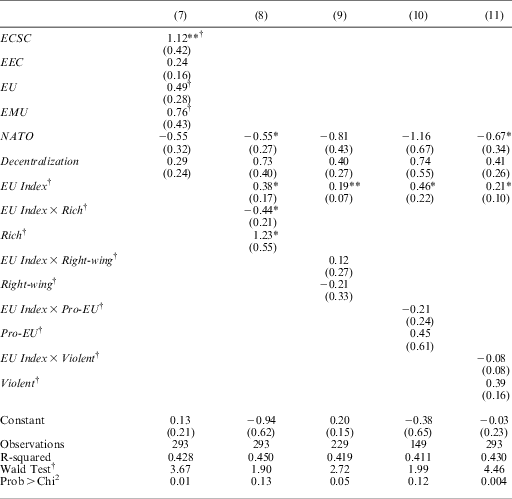
In the next analysis, I investigate the interaction between economic integration and certain characteristics of separatist parties. This analysis allows me to explore whether integration has a stronger impact on certain regions and segments of the population than others. Since the purpose of these models is to explain variation among separatist parties, they do not include non-separatist parties and therefore should not be understood as explaining the overall effect of integration on the vote for separatist parties, but on seat-winning separatist parties in particular. These models are presented in Table 2. They are estimated using OLS regression with robust standard errors and region fixed effects.Footnote 18 The control variables included in these models are those that were significant in the previous set of models, and either magnify or offset the effect of integration on separatism. Conclusions about the statistical significance of the interaction effects in these models are based on the joint significance of the main effects and the interaction terms, because interaction terms introduce collinearity into models, making the significance of individual coefficients unreliable. The joint significance is based on the Wald tests reported in the table.
Separatist Party Vote–Party Aggregates
†variables included in the Wald Test. **p < 0.01, *p < 0.05.
Model 7 shows the general relationship between EU integration and separatist party vote. According to the model, the ECSC, EEC, EU and EMU are all associated with a higher percentage of votes for separatist parties than non-membership in any organization, which is consistent with the conventional view of economic integration. The variables are jointly significant at the p ≤ 0.01 level. Higher forms of integration, however, are not consistently associated with a higher percentage of votes for separatist parties—that is, the effect of ECSC membership is greater than that of EEC, EU and EMU membership.
Model 8 examines the importance of regional economic wealth. For presentation purposes, in this model and all subsequent ones, I show the results for the EU index instead of the results for the separate indicators that comprise it (which are all in the same direction) and describe the result of the models using the indicators in the text. According to Model 8, the EU index is associated with a higher percentage of votes for separatist parties in rich regions than in poor regions for less extensive forms of integration (EU Index = 1 or 2), but a lower percentage of votes for separatist parties in rich regions for more extensive forms of integration (EU Index = 3 or 4). Since separatist voting is higher in rich countries, however, this implies that with little economic integration, rich countries experience more separatist voting than poor ones. With more extensive economic integration, however, poor countries experience more separatist voting than rich ones. The individual coefficients for the EU Index, Rich and the interaction term in Model 8 are individually, but not jointly, significant.
If I decompose the EU Index into separate indicators and interact each indicator with the variable for rich regions, the effects of the ECSC and EU are higher for rich regions and significant at the p ≤ 0.05 level.Footnote 19 The effect for the EEC is also higher for rich regions but is not significant. In alternative models, I explore the interaction effects between economic wealth and both Trade and FDI (outflows and inflows). In these models, only the interaction for Trade indicates that higher levels of trade are associated with a higher percentage of votes for separatist parties in rich regions, but it is not significant.
Model 9 examines the effect of parties’ left-right ideological positions. The interaction effect suggests that right-wing parties gain more from high-level integration (EU Index = 2, 3 or 4) than left-wing parties. However, the interaction effect is only significant when the EU Index takes on the value of 2 (EEC) in the model. If I decompose the EU Index into separate indicator variables, and interact each indicator with the variable for left-right ideology, none of these interactions indicates that right-wing parties gain significantly more votes from economic integration than left-wing parties. In alternative models, I interact Trade and FDI with right-wing ideology. None of these interaction effects is significant. However if I aggregate the vote for all right-wing parties within a region and use the vote for right-wing parties as my dependent variable, I do find that higher levels of EU integration and trade significantly increase the vote for right-wing parties over lower levels of integration.
In Model 10, I examine the effect of parties’ positions regarding EU membership. According to the model, the EU Index is significantly related to the vote for separatist parties, with pro-EU parties gaining more from EU integration than anti-EU parties for low levels of integration (EU Index = 2) and anti-EU parties gaining more for high levels of integration (EU Index = 3 or 4), in contrast to expectations. If I decompose the EU Index into separate indicator variables and interact each indicator with the variable for pro-EU parties, only the interaction effects for the EU are significant. Having a pro-EU stance is associated with a lower percentage of votes for separatist parties than having an anti-EU stance. There are two countries in the dataset for which the vote for separatist parties is higher for anti-EU parties with greater EU integration: Spain, where Herri Batasuna has consistently opposed the EU, and the UK, where the SNP and Plaid Cymru opposed EU integration until the 1980s and where Sinn Fein opposed it through the end of the 1990s. In separate models, I analyze the relationship between parties’ attitudes toward EU membership and Trade and FDI. Only the interaction effect for FDI (outflows) is significant. It indicates, as expected, that pro-EU parties gain more from FDI (outflows) for a range of values than anti-EU parties do. If I aggregate the vote for all pro-EU parties within a region, I find that higher levels of EU integration and Trade also significantly increase the vote for pro-EU parties over lower levels of integration.
In Model 11, I examine the interaction effect between parties advocating the use of violence to achieve independence and EU integration. In this model, the EU Index is significantly associated with a higher percentage of votes for violent separatist parties than for non-violent ones for all levels of integration. If I decompose the EU Index into separate indicator variables, and interact each indicator with the variable for violence, all of the interaction effects are also significant. All but the interaction effect for the EMU indicates that violent parties gain more from EU integration than non-violent parties in contrast to expectations. In alternative models, the interaction effects between violent separatist parties and trade and FDI are significant as well. The interactions suggest that Trade, FDI (outflows) and FDI (inflows) favor violent parties. Violent separatist parties have won seats in only two countries in the analysis—Spain and the United Kingdom. These parties are Herri Batasuna and the Basque Country Left in Spain, and Sinn Fein in Northern Ireland. All three of these parties at one point opposed EU membership and none were members of the EFA. Thus any relationship between violence and integration is unlikely to be causal. Moreover, if I aggregate across violent parties and use the vote for violent separatists parties as my dependent variable, I do not find that higher levels of integration significantly increase the vote for violent separatists.
Overall, the results of the previous analysis suggest that there is not a clear and consistent pattern in the types of parties most likely to gain from economic integration. Most of the relationships in the previous analysis are inconsistent in direction and significance across specifications and are driven by the inclusion of certain cases. They are also generally not robust to the inclusion of decade fixed effects. The strongest relationships emerging from this analysis are for violent separatist parties, but this relationship is unlikely to be causal.
Discussion
Since the results of the previous analyses are driven primarily by two countries—Belgium and the United Kingdom—I investigate these two cases more closely in this section to determine the extent to which economic integration likely contributed to the increased support for separatist parties in these countries, and to what extent the factors that I discussed previously have limited the impact of integration on secessionism. If integration contributed to their support, I expect these parties to have portrayed economic integration as a positive development for their regions, to have supported membership in the EU, to have depicted it as a likely outcome of independence and to have used integration to increase their electoral support. If parties exhibited these behaviors, it does not mean that people voted for these parties for these reasons. Nor does it rule out the possibility that people independently concluded that independence was a more viable option thanks to integration. However, if parties did behave in these ways, it makes it more likely that people shared these views.
Belgium
In Belgium, two parties are primarily responsible for the increased support for separatist parties at the national level—the Vlaams Block (VB), renamed the Vlaams Belang in 2004, and the New Flemish Alliance (N-VA).Footnote 20 Both parties advocate the independence of Flanders, the Dutch-speaking region of Belgium. In 1981, in the first national elections in which VB competed, the party won only one seat. In 2010, it won 12. N-VA's rise has been more dramatic. Like VB, it won only one seat in the first national elections in which it competed in 2003. Less than 10 years later, in the third elections in which it competed, it won 27.
Since its emergence, the right-wing VB has portrayed economic integration as a positive development for Flanders because Flanders’ economy is based on very competitive, light industries and is attractive to foreign investors due to its tax and real estate base, its developed transportation and communication infrastructure, and its educated population. VB has always supported an independent Flanders’ membership in the EU, but has also been highly critical of the Union and does not use the EU to increase its support among the electorate (Breuning Reference Breuning2007; Dardanelli Reference Dardanelli2010). VB voted against the Maastricht Treaty in 1993, which established the EU, because the treaty envisioned an EU that was too bureaucratic and centralized for VB, and did not sufficiently protect minority languages and cultures. VB also voted against the Constitutional Treaty in 2006 and the Lisbon Treaty in 2008 for similar reasons. In its criticism, VB has advocated curtailing the competencies of the EU, especially in terms of culture, education, law and order, and social security, and for reforming the EU's policies on immigration.
Like VB, the right-wing N-VA has always seen economic integration as a positive development for Flanders and believes that an independent Flanders ought to be a member of the EU. However, in contrast to VB, N-VA actively tries to use the EU to achieve independence. Yet the party is careful not to suggest that Flanders will be able to join the EU automatically upon independence (Dardanelli Reference Dardanelli2010). In the view of Bart De Wever, president of the N-VA, Belgium will eventually just ‘evaporate’ into Europe (Spiegel Online 2010). N-VA, which voted in favor of the Constitutional and Lisbon Treaties, strongly supports the currency union, and even advocates expanding EU authority in certain areas, such as immigration and energy. At times, N-VA has criticized the EU, but its criticism is much more muted than that of VB. Currently, N-VA wants more protection for minority languages and more decentralized decision making.
In order to allay fears that an independent Flanders will not be able to pay for its own defense, both VB and N-VA have pledged to cooperate with other countries to provide for Flanders’ defense. VB does not want an independent Flanders to be a member of NATO, since the United States is a major leader in this organization. Instead, it wants the EU to build a stronger security apparatus, which would situate Europe on the same plane as the United States. N-VA also supports expanding the EU's powers in the area of defense, but it supports an independent Flanders joining NATO. As a step toward creating a strong European defense structure, N-VA also advocates establishing a fully merged Benelux Army or Army of the Low Countries. Neither N-VA, nor VB, envisions the rump state of Belgium posing a threat to Flanders’ security upon independence.
In Belgium, the case for integration is strong. Both VB and N-VA have portrayed economic integration as a positive development for Flanders and have tried to use integration to varying degrees to build support among the electorate, though in neither case has the support for these parties been driven entirely by economic integration. Their support has also been based on the parties’ positions on immigration and the electorate's general discontent with the governing parties (Moufahim and Humphreys Reference Moufahim and Humphreys2012). Belgium, moreover, represents the ideal case in which to expect economic integration to increase separatism since Flanders has benefited substantially from integration, has a diversified economy that does not benefit from government transfers or protections, and has a defense apparatus available to it within Europe, which makes it possible for an independent Flanders to defend its borders in a region where the likelihood of militarized conflict is already small. Obviously, the effect of economic integration has not been offset in Belgium by decentralization, since separatist parties and demands for independence have continued to grow in Belgium since it undertook a series of decentralization reforms in the 1970s.
United Kingdom
Three parties have contributed to the increased support for separatist parties in national elections in the United Kingdom—the SNP, Sinn Fein in Northern Ireland and Plaid Cymru in Wales. Although these parties existed earlier, they only really began to win seats in Parliament in the 1960s and 1970s. Since this time, only Sinn Fein, an irredentist party for which the theoretical link between integration and separatism is already weak, has grown significantly.Footnote 21 Sinn Fein won five seats in the House of Commons in 2010, twice as many as it won in the previous two decades. The SNP's electoral support peaked at the national level in the 1970s, while Plaid Cymru's has remained rather stable ever since. The SNP won six seats and Plaid won three in 2010. At the regional level, the SNP's support has grown more significantly, while Plaid Cymru's has fluctuated somewhat over time. In the 2011 elections, the SNP won more than half of the seats in the Scottish Parliament, compared to slightly less than a third in 1999, the first election to the reconstituted Scottish Parliament.
When these parties first rose to prominence, they did not perceive integration as a positive development for their regions, and opposed joining the EEC. Thus, it is unlikely that economic integration contributed to any of these parties’ support at this time. The SNP feared that Scotland's working class would be harmed by the common market and its fishing policies (Laible Reference Laible2002; Hepburn Reference Hepburn2006; Dardanelli Reference Dardanelli2005). Plaid Cymru believed, meanwhile, that the EEC would harm Wales’ agricultural industry by consolidating small farms, eliminating price subsidies and deficiency payments, and raising the cost of feed for livestock (Lynch Reference Lynch1996; Jones Reference Jones2009). Sinn Fein was even more strident in its criticism of the EEC, claiming that it would destroy Northern Ireland's agriculture, decimate its local industry, and generate massive unemployment and inflation in the region (Frampton Reference Frampton2005; Murray and Tonge Reference Murray and Tonge2005).
Both the SNP and Plaid reversed their positions toward the EEC in the 1980s, and have since tried to use European integration to elevate their support among the electorate. Initially, the SNP and Plaid changed their positions toward the EEC out of pragmatism and a recognition that an anti-EEC stance would not fare well among the electorate. But by the mid-1980s, both parties came to believe that the EEC would be largely beneficial to their regions due to changes in the Community's regional and social policies, which help develop the Community's economically less advanced areas (Lynch Reference Lynch1996; Dardanelli Reference Dardanelli2005). Most of these parties’ gains in this period, though, were due largely to domestic issues, including a growing anti-Thatcherist sentiment in the country and the failure of the national government to allow for regional autonomy (Lynch Reference Lynch1996; Dardanelli Reference Dardanelli2005).
Aware of the doubts that some people might harbor about Scotland's ability to join the EU upon independence, the SNP has claimed that Scotland would automatically become a member if it declared independence. The SNP has argued that the Vienna Convention does not apply to Scotland because the UK is not a signatory to the Convention and because the Convention originally applied to post-colonial states. However, there is much uncertainty around this issue. National parties and international lawyers have contested the SNP's claims, and recently EU President José Barroso announced that “[a] new state, if it wants to join the European Union, has to apply to become a member like any state” (Carrell Reference Carrell2012).
The SNP has also recently tried to allay worries that Scotland would not be able to survive as an independent state in terms of defense by expressing a willingness to work with other countries in this domain—including, most recently, NATO. In the 1990s, the SNP claimed that an independent Scotland could provide for its own defense without resorting to a conscription-based military by reducing its military commitments (Sinclair Reference Sinclair1996). A few years ago, it suggested that an independent Scotland would cooperate with the UK to provide for its defense by sharing facilities with it—a plan the British government rejected as chimera (Cochrane Reference Cochrane2009; The Telegraph 2011). In 2012, the SNP changed its 30-year-long opposition to NATO and announced that the party now officially supports NATO membership for an independent Scotland (BBC News 2012).
Plaid Cymru has not expressed similar intentions. Plaid opposes joining NATO because of its reliance on nuclear weapons for defense. It also opposes a more expanded role for the EU in terms of defense and has pledged to provide for its own defense by reducing its international commitments and downsizing its military (Evans Reference Evans2009). Both Plaid Cymru's and the SNP's defense plans are premised on the reasonable assumption that independence from the UK will be peaceful, and that the UK will not pose a threat to their security afterwards.
Unlike the SNP and Plaid, Sinn Fein did not change its position toward membership in the EU until 1999 and the currency union until 2003. Like the SNP and Plaid, Sinn Fein reversed its position toward integration largely out of pragmatism than a marked affinity for integration. Unlike, these two parties, though, Sinn Fein has remained highly critical of the EU and has not actively tried to use the EU to enhance its electoral support since reversing its stance on the EU (Frampton Reference Frampton2005; Murray and Tonge Reference Murray and Tonge2005). In the last decade, Sinn Fein has opposed various policies of the EU on agriculture, taxes, fisheries, and justice. It has also demanded that the EU's authorities be curtailed in general and that its institutions be democratized. Integration is unlikely, therefore, to have contributed to Sinn Fein's increased support in this period.
Sinn Fein, which aspires to merge with Ireland upon independence, does not see a need for Northern Ireland to cooperate with other countries in order to preserve its security upon independence from the UK. It not only rejects membership in NATO, but also believes that the EU's authorities in terms of defense should be eliminated (Sinn Fein 1999, 2004). Sinn Fein argues that cooperation is not necessary in this regard because Northern Ireland, independent of the UK, would be neutral in terms of foreign affairs and have minimal foreign policy commitments.
In the UK, the case for integration in mixed. No party is likely to have gained votes at the national level due to integration in the 1970s because all three separatist parties opposed EU membership at this time. Integration may have contributed to the modest electoral gains that the SNP and Plaid Cymru have made at the national level, and the more significant gains they have made at the subnational level since this time, because both parties switched their positions toward integration in the 1980s and have tried ever since to use integration to increase their support among the electorate. Their support, though, was also based on other issues, including the economy and public services (Dardanelli Reference Dardanelli2005). As expected, the SNP and Plaid Cymru have faced significant challenges in using integration to bolster their case for independence, particularly in terms of convincing the electorate of their regions’ chances of joining the EU immediately upon independence and of providing for their defense. Even after changing its position toward European integration in the late 1990s, Sinn Fein is unlikely to have gained votes due to European integration because it is highly critical of the EU and does not actively try to use EU integration to increase its support among the electorate. Finally, decentralization is unlikely to have offset any effect of economic integration on separatist parties in the UK since these parties have not diminished in strength at the national level, and have continued to grow in strength at the subnational level, since the UK devolved power to Scotland, Wales and Northern Ireland in the late 1990s.
Conclusion
Overall, economic integration is only weakly associated with separatism according to the statistical analysis in this study. While EU integration has a weakly significant effect on the percentage of votes won by separatist parties in general, neither bilateral trade nor foreign direct investment has a significant effect on the vote for separatist parties. This suggests that any effect of integration on separatism is due to other aspects of EU integration besides international trade and investment. These results do not mean that economic integration has not increased support for separatism in some regions of countries at certain periods of time. In fact, the analysis suggests that it has in Belgium and the UK. The qualitative analysis of these two cases suggests, however, that the effect of integration on separatism may be conditional on the political context in which integration takes place, which in Europe has led separatist regions in these two countries to anticipate joining the EU eventually (if not immediately upon independence) and to be able to provide for their own defense as independent states.
While the predominant view of integration suggests that the effect of integration on separatism should be greatest in Europe where integration is the most extensive, my argument about the limitations of integration suggests that certain aspects of European integration favor separatism, while others undermine it. While a low likelihood of militarized conflict and the presence of transnational defense structures on the continent make separatism more likely to result from integration in Europe, other aspects, such as the stringency of EU accession requirements, make it less likely to result. It follows, therefore, that in Sub-Saharan Africa, Latin America and South Asia—where economic integration is much lower than in Europe, where the likelihood of militarized dispute is much higher and where regional peacekeeping structures are weak—economic integration should be less likely to increase separatism even though the accession requirements for joining regional trade organizations in these regions are less onerous than in Europe. In the Middle East and North Africa, economic integration is even less likely to encourage separatism, not only because economic integration is less extensive in these regions (which lack regional trade organizations), but also because the likelihood of militarized conflict is much higher.
APPENDIX
Separatist Parties in Western and Eastern Europe, 1945–2008 (Seat Winners Only)
Belgium
Flemish Block (Vlaams Blok)
New Flemish Alliance (Nieuw-Vlaamse Alliantie)
Flemish Interest (Vlaams Belang)
Dedecker List (Lijst Dedecker)
Bosnia-Herzegovina
Serbian Radical Party of Republic of Serbia (Srpska Radikalna Stranka Republike Srpske)††
Serbian Democratic Party (Srpska Democratska Stranka)††
France
Guadeloupe Communist Party (Parti Communiste Guadeloupen)
Martinique Independence Movement (Mouvement Indépendantiste Martiniquais)
Germany
Bavarian Party (Bayernpartei)
Italy
Northern League (Lega Nord)
Moldova
Unity Movement (Unitate-Edinstvo)†
Spain
Basque Country Left (Euskadiko Ezkerra)
Basque Solidarity (Eusko Alkartasuna)
Basque Left (Euskal Ezkerra)
Canarian Peoples Union Coalition (Coalición-Unión del Pueblo Canario)
Catalonian Left Electoral Coalition (Coalición Electoral Esquerra de Cataluña)
Catalonian Republican Left (Esquerra Republicana de Catalunya)
Conservatives of Catalunya (Conservadors de Catalunya)
National Front of Catalunya (Front Nacional de Catalunya)
Peoples Union (Herri Batasuna)
United Kingdom
Anti-partition Party††
Independent Nationalist Party
Independent Unity Party
Irish Nationalist Party
Irish Republican Party
Plaid Cymru
Republican Labour Party
Scottish National Party
Sinn Fein††
Unity
†Member of pre-electoral coalition only. Irredentist.
††All parties not separatist for entire period.