Conduct problems are harmful to children, families, and communities, representing one of the primary reasons for referral to mental health treatment (Kazdin et al., Reference Kazdin, Whitley and Marciano2006). Children with conduct problems are at risk for low educational attainment, substance abuse, and suicidality (Bevilacqua et al., Reference Bevilacqua, Hale, Barker and Viner2018; Vander Stoep et al., Reference Vander Stoep, Adrian, Mc Cauley, Crowell, Stone and Flynn2011), conferring significant cost to society through greater uptake of health, educational, and justice services (Rivenbark et al., Reference Rivenbark, Odgers, Caspi, Harrington, Hogan, Houts, Poulton and Moffitt2018). However, there is significant heterogeneity in the presentation of symptoms, developmental trajectories, and long-term outcomes of children with conduct problems, complicating our understanding of their etiology and the effectiveness of treatments (Frick et al., Reference Frick, Ray, Thornton and Kahn2014; Waller et al., Reference Waller, Wagner, Barstead, Subar, Petersen, Hyde and Hyde2020). In particular, the presence of callous–unemotional (CU) traits designates a group of children at very high risk of developing severe antisocial behavior across the lifespan, even taking into account prior conduct problems (Cardinale & Marsh, Reference Cardinale and Marsh2020; Frick et al., Reference Frick, Ray, Thornton and Kahn2014).
CU traits are characterized by low guilt and empathy, reduced concern for others, limited prosociality, and insensitivity to punishment (Frick et al., Reference Frick, Ray, Thornton and Kahn2014; Waller et al., Reference Waller, Wagner, Barstead, Subar, Petersen, Hyde and Hyde2020). The developmental origins of CU traits are distinct from those for conduct problems more broadly, which has implications for creating personalized treatments for children with CU traits (Hyde et al., Reference Hyde, Waller and Burt2014; Waschbusch et al., Reference Waschbusch, Willoughby, Haas, Ridenour, Helseth, Crum, Altszuler, Ross, Coles and Pelham2020). Namely, CU traits appear to be under stronger genetic influence than conduct problems (Viding et al., Reference Viding, Blair, Moffitt and Plomin2005; Viding et al., Reference Viding, Jones, Paul, Moffitt and Plomin2008) and are specifically associated with reduced neural activity to cues of fear, pain, or laughter in others (Lockwood et al., Reference Lockwood, Sebastian, McCrory, Hyde, Gu, De Brito and Viding2013; O’Nions et al., Reference O’Nions, Lima, Scott, Roberts, McCrory and Viding2017; Viding et al., Reference Viding, Sebastian, Dadds, Lockwood, Cecil, De Brito and McCrory2012). At the same time, a systematic review of 24 studies (combined N = 82,909, age range 2–24) reported the heritability of CU traits to range broadly from 25% to 80% (Moore et al., Reference Moore, Blair, Hettema and Roberson-Nay2019), with lower estimates reported in middle-childhood and late adolescence (ages 7–19) and among community samples (Moore et al., Reference Moore, Blair, Hettema and Roberson-Nay2019).
The mid range of these estimates is comparable, and lower even, to heritability estimates obtained for childhood depression (Rice et al., Reference Rice, Harold and Thapar2002), ADHD (Freitag et al., Reference Freitag, Rohde, Lempp and Romanos2010), and ASD (Sandin et al., Reference Sandin, Lichtenstein, Kuja-Halkola, Hultman, Larsson and Reichenberg2017). Thus, as with these other psychiatric disorders of childhood, we need to establish malleable factors in the environments of children to inform more effective interventions for CU traits (Waller et al., Reference Waller, Gardner and Hyde2013). Environmental factors have long been linked to the development of conduct problems more broadly, including parent characteristics (e.g., psychopathology, history of substance use; Clark et al., Reference Clark, Cornelius, Wood and Vanyukov2004; Ehrensaft et al., Reference Ehrensaft, Wasserman, Verdelli, Greenwald, Miller and Davies2003), parenting practices (e.g., harshness; Shaw et al., Reference Shaw, Bell and Gilliom2000), and the wider family context (e.g., conflict within families, impoverished or violent neighborhood; Dishion & Patterson, Reference Dishion, Patterson, Cicchetti and Cohen2006; Ingoldsby et al., Reference Ingoldsby, Shaw, Winslow, Schonberg, Gilliom and Criss2006), which together shape a child’s environment.
Parenting factors have also been implicated in the development of CU traits (see Waller et al., Reference Waller, Gardner and Hyde2013 for a review). For example, harsh parenting (e.g., punitive discipline) and exposure to family conflict (e.g., aggressive family interactions) have been linked to increases in CU traits in early (Waller et al., Reference Waller, Gardner, Hyde, Shaw, Dishion and Wilson2012; Waller & Hyde, Reference Waller and Hyde2017; Wilhoit et al., Reference Wilhoit, Trentacosta, Beeghly, Boeve, Lewis and Thomason2021) and middle-to-late childhood (Goulter et al., Reference Goulter, McMahon, Pasalich and Dodge2020; Hawes et al., Reference Hawes, Dadds, Frost and Hasking2011; Kimonis et al., Reference Kimonis, Centifanti, Allen and Frick2014; Pardini et al., Reference Pardini, Lochman and Powell2007). The direct experience of harshness or exposure to family conflict is thought to increase risk for CU traits by disrupting conscience development and children’s ability to internalize rules, in turn modeling aggression and coercion as adaptive interpersonal strategies (Gershoff, Reference Gershoff2002; Pardini et al., Reference Pardini, Lochman and Powell2007). The experience of low parental warmth and acceptance (e.g., reduced positivity, affection, or nurturance) has also been linked to increases in CU traits over time, including in early (Pasalich et al., Reference Pasalich, Dadds, Hawes and Brennan2011; Waller et al., 2019) and middle-to-late childhood (Hawes et al., Reference Hawes, Dadds, Frost and Hasking2011; Muratori et al., Reference Muratori, Lochman, Lai, Milone, Nocentini, Pisano, Righini and Masi2016; Waller et al., Reference Waller, Shaw and Hyde2017). Low parental warmth stymies the development of a reciprocal affective bond between parent and child, leading to fewer positive parent-child interactions and disrupting the social processes that promote empathy and prosociality (Kochanska et al., Reference Kochanska, Kim, Boldt and Yoon2013). Finally, parental psychopathology, including internalizing (e.g., depression and anxiety; Barker et al., Reference Barker, Oliver, Viding, Salekin and Maughan2011) and externalizing psychopathology (e.g., aggression, substance use, and antisocial personality; Mendoza Diaz et al., Reference Mendoza Diaz, Overgaauw, Hawes and Dadds2018) may increase risk for CU traits, including through a reduction of positive parent–child interactions (Waller et al., Reference Waller, Hyde, Grabell, Alves and Olson2015).
Despite this literature, prior studies offer only limited conclusions about the influence of parenting and the home environment on the development of CU traits. The majority of prior studies have used non-genetically informed designs, which makes it hard to separate environmental influences on CU traits from the effects of unmeasured gene–environment correlations (rGE; Perlstein & Waller, 2020). Passive rGE reflects a shared genetic predisposition of parents and children for the same underlying traits (Plomin, Reference Plomin2014). Passive rGE can inflate the magnitude of reported associations when children are reared by biological parents (i.e., parents with CU traits may be less warm or empathic, the inherited risk for which they share with their child; Waller et al., Reference Waller, Shaw and Hyde2017). Evocative rGE effects capture the fact that an inherited predisposition for certain characteristics may shape a child’s environment in ways that are concomitant with their characteristics (Plomin, Reference Plomin2014). For example, the characteristics of children with CU traits (e.g., fearless, low on warmth, unresponsive to punishment) may elicit greater harshness, more conflict, or lack of acceptance from a parent. The majority of prior studies that have explored the etiology of CU traits are limited in accounting for these rGE effects, which are important sources of unobserved variance in traditional study designs of biological families. Thus, studies are needed that establish the extent to which associations between parenting and CU traits reflect nonheritable effects, rather than simply characterizing a correlation between genes and environments.
A handful of genetically-informed studies shed some light on these processes, clarifying the role of the parenting environment in the development of CU traits, even in the context of heritable risk. For example, low levels of maternal positive reinforcement were related to higher CU traits in toddlerhood within an adoption design that eliminated passive, but not evocative, rGE effects (i.e., adoptive parents are genetically unrelated to their adopted children; Hyde et al., Reference Hyde, Waller, Trentacosta, Shaw, Neiderhiser, Ganiban, Reiss and Leve2016). In the same sample, and using a cross-lagged model, higher levels of harsh parenting and higher CU traits were reciprocally related to each other between 27–54 months (although the model did not disaggregate within- versus between-person changes; Trentacosta et al., Reference Trentacosta, Waller, Neiderhiser, Shaw, Natsuaki, Ganiban, Reiss, Leve and Hyde2019). Finally, in a monozygotic (MZ) twin difference study, twin differences in parental warmth were related to differences in CU traits, such that the twin who received less warm parenting had higher CU traits (Waller et al., Reference Waller, Hyde, Klump and Burt2018). Thus, even when controlling for heritability and shared environmental influences (i.e., within MZ twins), parenting factors were still related to risk for CU traits (Waller et al., Reference Waller, Hyde, Klump and Burt2018).
Collectively, these studies go some way towards accounting for rGE effects and establishing the role of the environment in the development of CU traits. However, prior studies do not address how genetic risk for CU traits is exacerbated within given environmental contexts, after accounting for potential rGE effects (i.e., passive, evocative, or active). In addition to rGE processes, genetic and environmental factors operate in concert to exacerbate risk for psychopathology (i.e., gene-by-environment [G×E] interactions; Plomin et al., (Reference Plomin, DeFries and Loehlin1977), including CU traits (Hyde et al., Reference Hyde, Bogdan and Hariri2011). For example, candidate gene studies suggest that risk for CU traits is heightened when children have the long/long 5-HTTLPR genotype and experience low socioeconomic status (Sadeh et al., Reference Sadeh, Javdani, Jackson, Reynolds, Potenza, Gelernter, Lejuez and Verona2010) or the met allele in BDNF and experience harsh and intrusive parenting (Willoughby et al., Reference Willoughby, Mills-Koonce, Propper and Waschbusch2013). However, candidate gene studies do not capture the full genetic load that contributes to complex phenotypes, can be subject to low power and publication bias, and often fail to replicate (Duncan & Keller, Reference Duncan and Keller2011). Moreover, candidate gene studies cannot fully account for rGE effects, which could still partially account for observed associations (e.g., parents and child both share genotypic risk for CU traits and/or harsh parenting/lack of parental warmth). Thus, studies are needed that explore interacting heritable and environmental influences on CU traits, while simultaneously accounting for known rGE effects that confound typical studies of parenting and CU traits. In particular, studies need to investigate whether parenting factors moderate the etiology of CU traits by increasing or decreasing the relative importance of genetic or environmental influences.
To determine the influence of different environmental factors on the etiology of CU traits, studies have used advanced variations of twin modeling to estimate G×E interactions while controlling for rGE effects (i.e., underlying associations between CU traits and the environment that could be due to passive, evocative, and/or active rGE processes). Specifically, twin studies have investigated whether parenting factors moderate the additive genetic, shared environmental, and non-shared environmental effects on both psychopathic and CU traits. For example, shared environmental influences on adult psychopathic traits were stronger among individuals retrospectively reporting that they had experienced more negative parenting (Dotterer et al., Reference Dotterer, Vazquez, Hyde, Neumann, Santtila, Pezzoli, Johansson and Burt2021). Among 662 twin pairs, Henry et al. (Reference Henry, Dionne, Viding, Vitaro, Brendgen, Tremblay and Boivin2018) used teacher reports of child CU traits (averaged across four assessment periods from 7–12-years-old) and parent reports of parental warmth to investigate whether parenting moderated the heritability of CU traits. Controlling for rGE processes, parental warmth moderated genetic influences on CU traits, such that heritability for CU traits was higher when parents reported lower warmth (Henry et al., Reference Henry, Dionne, Viding, Vitaro, Brendgen, Tremblay and Boivin2018). However, this study did not test competing G×E interaction models to isolate whether parenting moderated shared or non-shared environmental influences.
More recently, Tomlinson et al. (2021) assessed rGE and G×E processes among 600 twin pairs (ages 6–11) oversampled for families from lower-income neighborhoods (Tomlinson et al., 2021). Data came from parent reports of child CU traits and composite scores of parental involvement and conflict derived from parent and child reports. The association between CU traits and parental involvement was due to overlapping nonshared environmental (52%) and genetic influences (48%), while the association between conflict and CU traits was largely due genetic influences (92%) (Tomlinson et al., 2021). After controlling for these effects, there was evidence of moderation by the environment, with heritability of CU traits greater among children who experienced lower parental involvement and higher parental conflict (Tomlinson et al., 2021). Together, the use of twin modeling methods to estimate G×E interactions while controlling for rGE effects suggests that the environment plays a critical role in moderating genetic versus environmental influences on the etiology of CU traits.
Nevertheless, a number of outstanding questions warrant further study to parse genetic and environmental influences on CU traits during childhood. First, CU traits co-occur with conduct problems (Cardinale & Marsh, Reference Cardinale and Marsh2020; Frick et al., Reference Frick, Blair, Castellanos, Tolan and Leventhal2013). Thus, studies are needed to test whether the moderating effects of parenting on the etiology of CU traits are specific to CU traits or driven by conduct problems (e.g., that parents perceive children as showing more conduct problems so also rate them as higher on CU traits or that parenting is impacted by child conduct problems more broadly, rather than CU traits specifically). Second, prior studies have focused on adolescence or early adulthood (Dotterer et al., Reference Dotterer, Vazquez, Hyde, Neumann, Santtila, Pezzoli, Johansson and Burt2021; Tuvblad et al., Reference Tuvblad, Grann and Lichtenstein2006) or studied samples with a wide age range (i.e., sampling across early childhood-to-late childhood; Henry et al., Reference Henry, Dionne, Viding, Vitaro, Brendgen, Tremblay and Boivin2018 [ages 7–12]; Tomlinson et al., 2021 [ages 6–11]). A narrower focus on middle-childhood is warranted given that this period precedes the onset of more severe forms of antisocial behavior and delinquency (Fonagy, Reference Fonagy, Venta, Sharp, Fletcher and Fonagy2021). The family environment also remains a primary influence on emerging features of psychopathology during this stage (i.e., prior to the growing salience of peer or community influences; Lam et al., Reference Lam, McHale and Crouter2014; Nickerson & Nagle, Reference Nickerson, Nagle, Dannerbeck, Casas, Sadurni and Coenders2004). Third, studies are needed that leverage children’s own reports of their family and parenting environment independent of parent-reports to minimize shared method effects when parents are also reporting on child CU traits and prior studies suggest that from age 8, children are reliable reporters of their own environment (McKee et al., Reference McKee, Jones, Forehand, Cuellar, Saklofske, Reynolds and Schwean2013; Riley, Reference Riley2004; Tein et al., Reference Tein, Roosa and Michaels1994). Finally, although recent studies using twin modeling methods to estimate G×E interaction effects have focused on parental harshness and warmth (Henry et al., Reference Henry, Dionne, Viding, Vitaro, Brendgen, Tremblay and Boivin2018; Tomlinson et al., 2021), additional studies are needed both to replicate and extend these prior efforts. Such efforts include exploring how parenting behavior (e.g., warmth/acceptance), factors in the broader family environment (e.g., conflict in the home), and parental psychopathology (i.e., parental externalizing and internalizing problems) each moderate the etiology of CU traits, after controlling for rGE, especially since each represents a viable and malleable target of intervention.
The current study addresses these gaps by examining environmental and genetic influences on CU traits in middle childhood (ages 9–10) within a large community sample of twins derived from the Adolescent Brain and Cognitive Development (ABCD) Study (https://abcdstudy.org/). We focused first on whether overlapping genetic and/or environmental influences explained associations between child-reported family conflict and parental acceptance and parent-reported CU traits. Second, we investigated whether specific aspects of the parenting environment (i.e., family conflict, parental acceptance, parental externalizing and internalizing psychopathology) moderated the etiology of CU traits while accounting for rGE. To establish the specificity of effects to CU traits, we controlled for the overlap of CU traits and conduct problems. Based on prior research we hypothesized that genetic and non-shared environmental influences would account for associations between parenting factors perceived by children in their environment and parent-reported CU traits (Henry et al., Reference Henry, Dionne, Viding, Vitaro, Brendgen, Tremblay and Boivin2018; Tomlinson et al., 2021). We hypothesized that greater family conflict and lower parental acceptance would be associated with higher heritability of CU traits (Henry et al., Reference Henry, Dionne, Viding, Vitaro, Brendgen, Tremblay and Boivin2018; Tomlinson et al., 2021). Given that no prior study has examined the role of parental psychopathology in moderating the etiology of CU traits, analyses involving parental internalizing and externalizing symptomatology were considered exploratory.
Method
Participants
We used data from the baseline assessment of the Adolescent Brain Cognitive Development (ABCD) study (Garavan et al., Reference Garavan, Bartsch, Conway, Decastro, Goldstein, Heeringa, Jernigan, Potter, Thompson and Zahs2018; Iacono et al., Reference Iacono, Heath, Hewitt, Neale, Banich, Luciana, Madden, Barch and Bjork2018) (https://abcdstudy.org/). The ABCD study recruited 11,874 healthy children, 9 to 10 years of age (M age = 9.49 years) from the United States (48% girls; 57% White; 15% Black; 20% Hispanic/Latino/a), to be followed into early adulthood (Volkow et al., Reference Volkow, Koob, Croyle, Bianchi, Gordon, Koroshetz, Pérez-Stable, Riley, Bloch, Conway, Deeds, Dowling, Grant, Howlett, Matochik, Morgan, Murray, Noronha and Weiss2018). Participants across 21 study sites were recruited through public and private elementary schools (including charter schools) with sampling approaches intended to yield a final sample that closely approximates national socio-demographics (Garavan et al., Reference Garavan, Bartsch, Conway, Decastro, Goldstein, Heeringa, Jernigan, Potter, Thompson and Zahs2018). As part of a substudy, 1,000 pairs of same-sex twins were recruited across four sites embedded within the overall ABCD design (Iacono et al., Reference Iacono, Heath, Hewitt, Neale, Banich, Luciana, Madden, Barch and Bjork2018). At each ABCD twin site, twins were recruited from registers of all twin births during 2006–2008 (Iacono et al., Reference Iacono, Heath, Hewitt, Neale, Banich, Luciana, Madden, Barch and Bjork2018). The human research protections programs and institutional review boards at universities participating in the ABCD project approved all experimental and consenting procedures, and all participants provided assent and their legal guardians provided written consent. Additional ABCD study information is provided in Garavan et al. (Reference Garavan, Bartsch, Conway, Decastro, Goldstein, Heeringa, Jernigan, Potter, Thompson and Zahs2018).
We used survey-based phenotypic data collected from same-sex twins (N = 2,000; M age = 10.10; 49.4% female; 76.85% White; 14.9% Black; 4.35% Mixed Black and White; 11.3% Hispanic/Latino/a) and their biological parents (M age = 41.37; 88.9% mothers; 8.3% fathers) at the baseline ABCD assessment. Of the parents assessed, 79.1% were employed and 13.5% were stay-at-home parents. Sixty-eight percent reported annual family income >$75,000. Finally, of the same-sex twin pairs, zygosity information was available for 1,544 children (i.e., 772 twin pairs and their parents; 90.22% mothers; 7.77% fathers; 2.01% other). Zygosity was determined with questionnaire items completed by the parents, a method which is 95% accurate relative to blood typing analyses (Dotterer et al., Reference Dotterer, Vazquez, Hyde, Neumann, Santtila, Pezzoli, Johansson and Burt2021; Sarna et al., Reference Sarna, Kaprio, Sistonen and Koskenvuo1978).
Measures
Callous-unemotional (CU) traits
CU traits were quantified using a measure derived and validated in a prior study using ABCD study data (Hawes et al., Reference Hawes, Waller, Thompson, Hyde, Byrd, Burt, Klump and Gonzalez2020), which includes one item from the parent-reported Child Behavior Checklist (CBCL; Achenbach & Ruffle, Reference Achenbach and Ruffle2000) (“lack of guilt after misbehaving”) and three items (reverse-scored) from the Strengths and Difficulties Questionnaire (SDQ; Goodman, Reference Goodman1997) (“is considerate of others’ feelings”; “is helpful if someone is hurt or upset”; “offers to help others”). Internal consistency was adequate in the full ABCD sample (ωt = .79) and the twin sub-sample (ωt = .80).
Conduct problems
Conduct problems were assessed using the 17-item DSM-Oriented “Conduct Problems” scale from the parent-reported CBCL (Achenbach & Ruffle, Reference Achenbach and Ruffle2000). Items were rated on a 3-point scale ranging from 0 (Not true) to 2 (Very true or Often true) and summed such that higher scores represent increased levels of problems (e.g., “breaks rules”, “steals”, “fights”; total sample, ωt = .84; twin sub-sample, ωt = .81). To avoid content overlap with CU traits, a single item (“lack of guilt”) was omitted from the conduct problems scale.
Perceived family conflict
Family conflict was assessed using the 9-item family conflict scale from the child-reported ABCD Parent Family Environment Scale-Family Conflict Subscale Modified from PhenX (Garavan et al., Reference Garavan, Bartsch, Conway, Decastro, Goldstein, Heeringa, Jernigan, Potter, Thompson and Zahs2018; Moos, Reference Moos1994). Children rated items on this scale as either true or false (e.g., “family members rarely become openly angry” [reverse coded], and “family members sometimes hit each other”; total sample, ωt = .71; twin subsample, ωt = .71).
Perceived parental acceptance
Perceived parental acceptance was assessed using the 5-item acceptance subscale from Children’s Report of Parental Behavior Inventory (CRPBI) – Short (Margolies & Weintraub, Reference Margolies and Weintraub1977). Children rate perceptions of their primary caregiver on a 3-point Likert scale (1 = not like them, 2 = somewhat like them, 3 = a lot like them) in terms of the acceptance and warmth they experience (e.g., “smiles at me very often”, and “believes in showing their love for me”; total sample, ωt = .75; twin subsample, ωt = .75).
Parental psychopathology
Parental psychopathology was assessed using the externalizing and internalizing problem scales of the Adult Self-Report (ASR; Rescorla & Achenbach, Reference Rescorla, Achenbach and Maruish2004). The externalizing problem scale includes 34-items (e.g., “I am mean to others” and “I break rules at work or elsewhere”) and the internalizing problem scale includes 39-items (e.g., “I feel lonely” and “I worry about my future”) with items scored on a 3-point Likert scale (0 = not true, 1 = somewhat/sometimes true, and 2 = very/often true). For our main analyses we summed the externalizing and internalizing scales to produce a total parental psychopathology score. We also ran analyses separately testing the externalizing and internalizing problems (see Supplemental Materials). Internal consistency was high for the total scale (full sample, ωt = .94; twin sub-sample, ωt = .93) and externalizing (total sample, ωt = .87; twin sub-sample, ωt = .86) and internalizing (total sample, ωt = .93; twin sub-sample, ωt = .92) subscales.
Demographic covariates
Covariates included child sex (i.e., 0 = female, 1 = male), age, family income, and conduct problems. To account for the effects of covariates within twin models, we regressed CU traits onto child sex, age, family income, and conduct problems and create residualized CU traits scores using standard regression techniques (McGue & Bouchard, Reference McGue and Bouchard1984). We focus presentation of the results on residualized CU traits regressing out conduct problems; results when conduct problems were not regressed out are presented in the Supplemental Materials. To account for shared method variance between child reports of family conflict and child reports of parental acceptance and between parent-reported externalizing versus internalizing problems, we created additional residualized scores for the parenting factors (i.e., regressing out family conflict from parental acceptance and vice versa and regressing internalizing problems from externalizing problems and vice versa). Results without residualizing the parenting factors are presented in the Supplemental Materials.
Data analysis plan
First, to assess genetic and environmental influence on CU traits, parental acceptance, and family conflict, we explored a series of behavioral genetic models. We computed ICCs to explore general MZ and DZ twin pair differences and establish that data met basic assumptions for twin modeling (Schönemann, Reference Schönemann1997). Next, we estimated univariate genetic models of CU traits, parental acceptance, and family conflict to decompose their variance into additive genetic (A), common/shared environmental (C), and non-shared environmental (E) influences (Takahashi et al., Reference Takahashi, Pease, Pingault and Viding2020; Verweij et al., Reference Verweij, Mosing, Zietsch and Medland2012). Following the univariate analyses, we estimated bivariate ACE models to characterize associations between CU traits and the parenting environment (i.e., separate models for parental acceptance and family conflict). These models allowed us to parse the phenotypic covariance between CU traits and the parenting environment and quantify the extent to which ACE effects on CU traits overlapped with those for the parenting factors.
Second, we used a series of univariate and extended univariate G×E interaction models (Purcell, Reference Purcell2002; van der Sluis et al., Reference van der Sluis, Posthuma and Dolan2012) to test whether the environment moderated the etiology of CU traits, controlling for rGE effects. In univariate G×E interaction models, the standard A, C, and E paths that indicate the magnitude of additive genetic, shared environmental, and non-shared environmental effects are specified to include a β term, which indicates the significance of a potential moderator on each influence (Dick et al., Reference Dick, Viken, Purcell, Kaprio, Pulkkinen and Rose2007; Purcell, Reference Purcell2002). For example, in the moderation model the additive genetic value is a linear function of the moderator, represented by the equation A + βxM, where M is the moderator and βx is an unknown parameter representing the magnitude of the moderating effect (Dick et al., Reference Dick, Viken, Purcell, Kaprio, Pulkkinen and Rose2007; Purcell, Reference Purcell2002). Similiary, shared and non-shared environmental values can be represented by the following equations, C + βYM and E + βZM, which represent the extent to which the moderator alters the importance of these environmental influences, respectively. Finally, the model includes rGE effects between the moderator variable and outcome (i.e., CU traits). As such, any correlation between the moderator and outcome are incorporated into the means model (Dick et al., Reference Dick, Viken, Purcell, Kaprio, Pulkkinen and Rose2007; Purcell, Reference Purcell2002; Turkheimer et al., Reference Turkheimer, Haley, Waldron, D’Onofrio and Gottesman2003) and significant interactions will be associated with the variance components unique to the outcome (i.e., genetic influences on CU traits that are not shared with influences on parenting; Dick et al., Reference Dick, Viken, Purcell, Kaprio, Pulkkinen and Rose2007; Purcell, Reference Purcell2002). Importantly, the “extended univariate G×E interaction model” (Purcell, Reference Purcell2002), allows for the moderator variable to differ between twins (e.g., individual twin-reports of parental acceptance and family conflict) by placing the moderator values of each twin into a means model of each twin’s CU traits score (van der Sluis et al., Reference van der Sluis, Posthuma and Dolan2012). Thus, for analyses utilizing child-reported measures of parental acceptance and family conflict, we utilized extended univariate G×E interaction models, and for analyses utilizing parent reports of their own externalizing and internalizing psychopathology (i.e., the same for each twin) we utilized univariate G×E interaction models. For each parenting moderator, we estimated a no moderation model, a full moderation model, and a series of nested models in which non-significant moderators were constrained to zero.
Prior to analysis, we standardized all variables to improve the interpretation of the unstandardized model-fitting estimates. To examine specific associations for child-reported family conflict after controlling for child-reported parental acceptance and for parent-reported externalizing problems after controlling for parent-reported internalizing problems, we created residualized scores for each parenting environment factor (i.e., regressing out child-reported family conflict scores from child-reported parental acceptance and vice versa and regressing out parent-reported internalizing problems from parent-reported externalizing problems and vice versa). Thus, we could isolate the unique influence of each factor while removing any method bias that could arise from relying on the same informant for different constructs. Finally, to adjust for positive skew in CU traits (skew was 1.87; kurtosis was 3.39), we followed recommendations (Burt et al., Reference Burt, Clark, Pearson, Klump and Neiderhiser2020) and transformed data by taking the square root prior to analysis to approximate normality (skew after transformation was 1.00; kurtosis after transformation was −.49).
All analyses were conducted in Mplus version 8.1 (Muthen & Muthen, Reference Muthén and Muthén1998–2012) using ML procedures (Dotterer et al., Reference Dotterer, Vazquez, Hyde, Neumann, Santtila, Pezzoli, Johansson and Burt2021; Slane et al., Reference Slane, Burt and Klump2011; Tomlinson et al., 2021). To assess model fit we used the Akaike’s information criterion (AIC = χ 2-2df; Akaike, Reference Akaike, Parzen, Tanabe and Kitagawa1998). The AIC measures model fit relative to parsimony with lower values indicating better fit. Further, we used the CFI (Bentler, Reference Bentler1990), TLI (Gerbing & Anderson, Reference Gerbing and Anderson1992), and RMSEA (Browne & Cudeck, Reference Browne, Cudeck, Bollen and Long1993) when available to assess absolute model fit. To compare and select competing G×E interaction models (e.g., no moderation model vs. moderation of all ACE pathways), we performed likelihood-ratio tests of nested models. The difference in −2 times the log-likelihoods of the competing models is asymptotically distributed as a chi-square (χ 2), with df equal to the difference in the number of parameters estimated. All effects were tested against a criterion level α of 0.05. If the nested model’s 2 log-likelihood differed significantly from the more complex model, the nested model’s fit was judged to be worse (Cooke et al., Reference Cooke, Meyers, Latvala, Korhonen, Rose, Kaprio, Salvatore and Dick2015; Suisman et al., Reference Suisman, Alexandra Burt, McGue, Iacono and Klump2011; Zheng et al., Reference Zheng, Brendgen, Meyer, Vitaro, Dionne and Boivin2021). Finally, we derived confidence intervals using non-parametric bootstrapping (i.e., 10,000 simulations) and significance was determined via 95% confidence intervals that did not overlap with zero (Falk, Reference Falk2018). All analysis files are available on OSF: https://osf.io/pt24f/?view_only=84bc133127164e7888740c4b581b144b.
Results
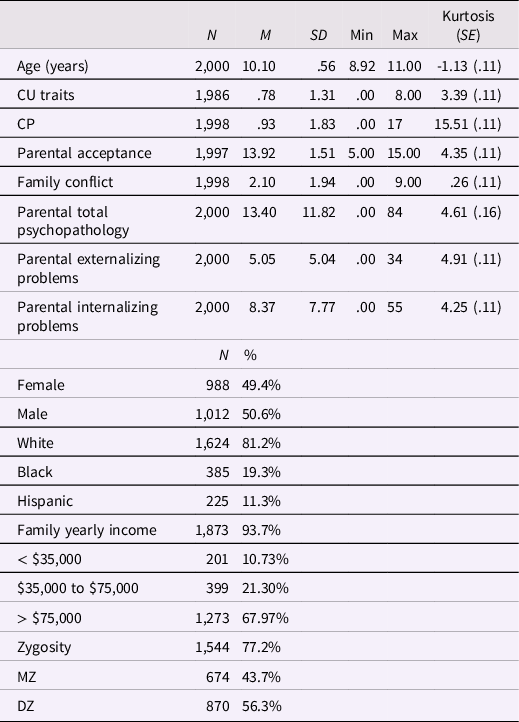
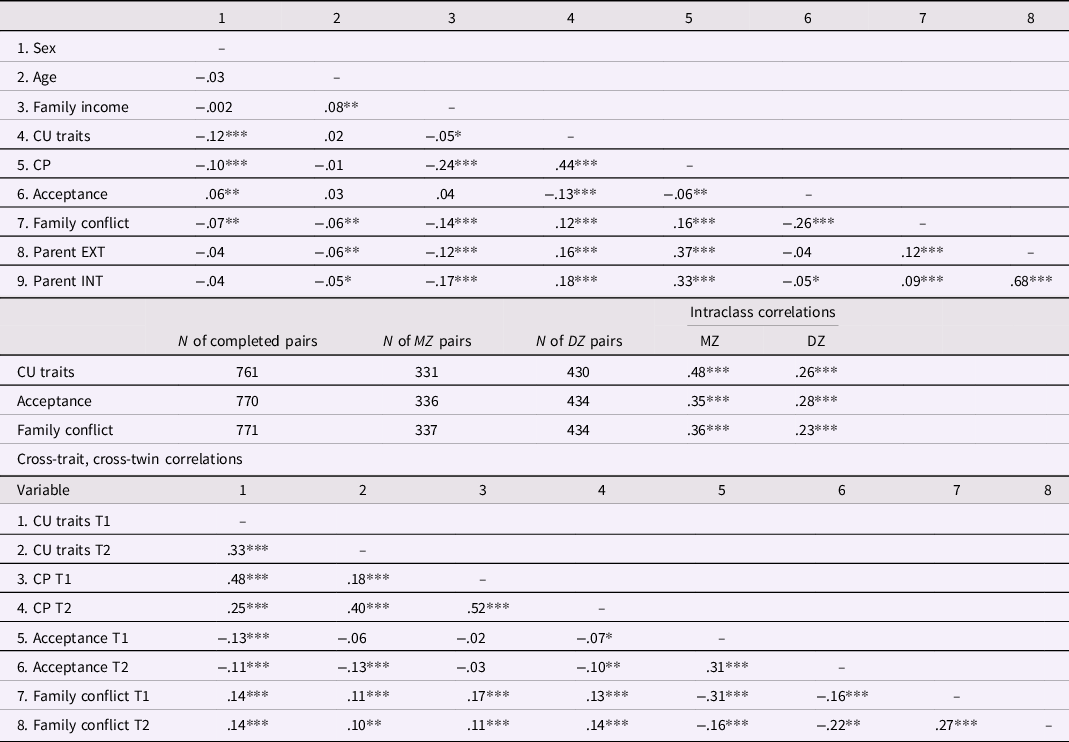
Table 1 presents descriptive statistics and Table 2 presents phenotypic, intraclass, and cross-trait, cross-twin correlations for all study variables. The phenotypic associations showed that CU traits were related to lower child-reported parental acceptance (r = -.14, p < .001) and higher child-reported family conflict (r = .12, p < .001), as well as more parent-reported parental externalizing (r = .16, p < .001) and internalizing (r = .18, p < .001) problems. The MZ intraclass correlation for CU traits (r = .48, p < .001) was about twice the DZ intraclass correlations (r = .26, p < .001), indicating moderate heritability for CU traits. In contrast, the MZ intraclass correlations for parental acceptance and family conflict were higher than, but not double the magnitude of the DZ intraclass correlations implying genetic and shared environmental influences (acceptance, MZ, r = .35, p < .001 and DZ, r = .28, p < .001; conflict, MZ. r = .36, p < .001 and DZ, r = .23, p < .001). Moreover, cross-trait, cross-twin correlations for CU traits and parental acceptance were similar for MZ (r = -.16, p < .001) and DZ (r = -.11, p < .05) twin pairs, as well as for CU traits and family conflict across MZ (r = .11, p < .05) and DZ (r = .19, p < .001) twin pairs (see Table S1), suggesting the presence of overlapping genetic and shared environmental influences.
Descriptive statistics and Kurtosis of dimensional study variables

Note. CU = callous unemotional; CP = conduct problems; MZ = monozygotic; DZ = dizygotic. To adjust for positive skew in CU traits we transformed the data by taking the square root prior to analysis to approximate normality (kurtosis after transformation was −.49).
Phenotypic correlations and intraclass correlations

Note. CU = callous unemotional; CP = conduct problems; Acceptance = parental acceptance; Parent EXT = parental externalizing problems; Parent INT = parental internalizing problems; Sex = 0 for male, 1 for female; MZ = monozygotic; DZ = dizygotic; T1 = Twin 1; T2 = Twin 2. This table presents correlations using the un-transformed CU traits variable. Cross-trait, cross-twin correlations by MZ and DZ twins are presented in Table S9. p < .05*, p < .01**, p < .001***.
Univariate and bivariate genetic models
Univariate estimates revealed that CU traits were under moderate genetic (43%, 95% CI [32, 56]) and non-shared environmental (57%, 95% CI [48, 69]) influence, with no influence of the shared environment (0%, 95% CI [−.04, .04]). Similar estimates (49% A, .01% C, 51% E) were obtained when we did not covary for conduct problems (Table 3). Univariate ACE estimates revealed that parental acceptance was under no genetic influence (0%, 95% CI [−.36, .36]), but significant shared (26%, 95% CI [18, 36]) and non-shared environmental (73%, 95% CI [67, 83]) influence. Finally, family conflict was under significant genetic (16%, 95% CI [.04, 59]), shared environmental (12%, 95% CI [.04, 46]), and non-shared environmental (72%, 95% CI [62, 83]) influence. Given, the absence of shared environmental influences on CU traits, we utilized an AE model of CU traits for all subsequent models (see Supplemental Figure 1). Similarly, given the absence of genetic influence on parental acceptance, we utilized a CE model of parental acceptance for all subsequent models (although, see Supplemental Results for results utilizing full unrestricted ACE models).
Univariate variance estimates of additive (a 2), shared environmental (c 2), and non-shared environmental (e 2) contributions to CU traits, parental acceptance, and family conflict [with 95% CIs]

Note. CU = callous unemotional; CP = conduct problems. Confidence intervals derived from 10,000 bootstrap draws. Bolded estimates contain 95% confidence intervals that do not overlap with zero.
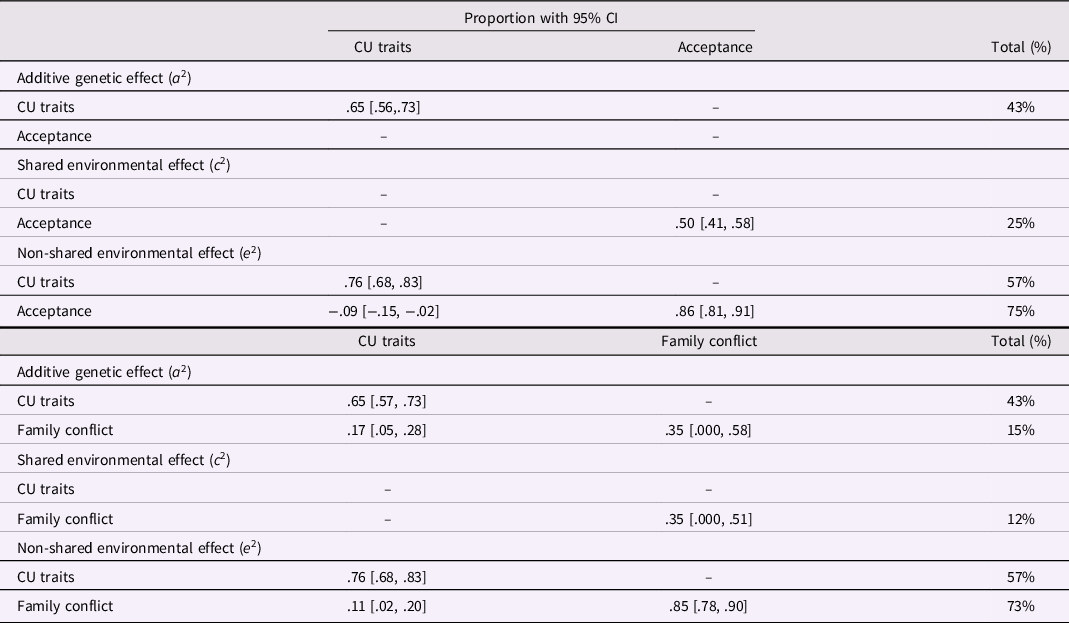
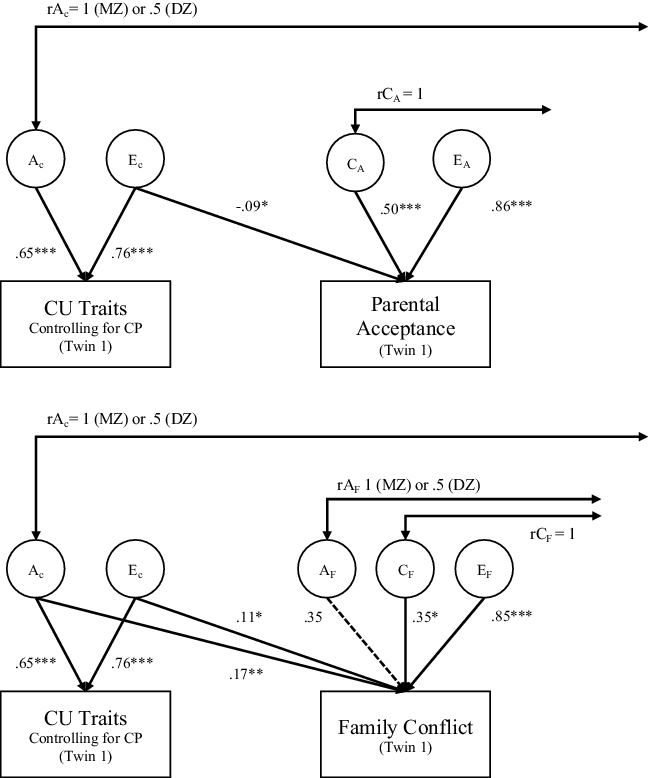
Results from the bivariate variance decomposition of CU traits and parental acceptance showed acceptable model fit (CFI = .92, TLI = .95, RMSEA = .04, 90% CI [.001, .06]). Model fit was also good for CU traits and family conflict (CFI = .98, TLI = .99, RMSEA = .02, 90% CI [.000, .05]; see Table 4 and Figure 1). The bivariate estimate for non-shared environmental factors on CU traits and perceived parental acceptance was significant (.8%, E = -.09, 95% CI [−.15, .02]). Additionally, the association between perceived family conflict and CU traits was due to modest genetic (3%, A = .17, 95% CI [.05, .28]) and non-shared environmental factors (1%, E = .11, 95% CI [.02, .20]; see Table 4 and Figure 1). Findings were similar when we did not control for conduct problems (Table S2).
Bivariate ACE models of additive genetic (a 2), shared environmental (c 2), and non-shared environmental influences (e 2) for CU traits (controlling for CP) and each parenting environment factor [with 95% CIs]

Note. As we found no evidence of shared environmental influences (C) on CU traits from our univariate etiological model all C pathways on CU traits were dropped in subsequent models. Furthermore, as we found no evidence of genetic influences (A) on parental acceptance, all A pathways on parental acceptance were dropped in subsequent models. The bivariate etiological model of CU traits and parental acceptance showed acceptable model fit well (CFI = .92, TLI = .95, RMSEA = .04 [90% CI = .01, .06]), as did the model for CU traits and family conflict (CFI = .98, TLI = .99, RMSEA = .02 [90% CI = .000, .05]). Bolded estimates contain 95% confidence intervals that do not overlap with zero. Confidence intervals were derived from 10,000 bootstrap draws. CU = callous unemotional. CP = conduct problems.
Bivariate decomposition of the overlap in genetic and non-shared environmental influences between CU traits and parental acceptance and family conflict. Note. CU = Callous Unemotional; CP = conduct problems; A = additive genetic effect; C = shared environmental effect; E = non-shared environmental effect; MZ = monozygotic; DZ = dizygotic. p < .05*, p < .01**, p < .001***.

G×E interaction models
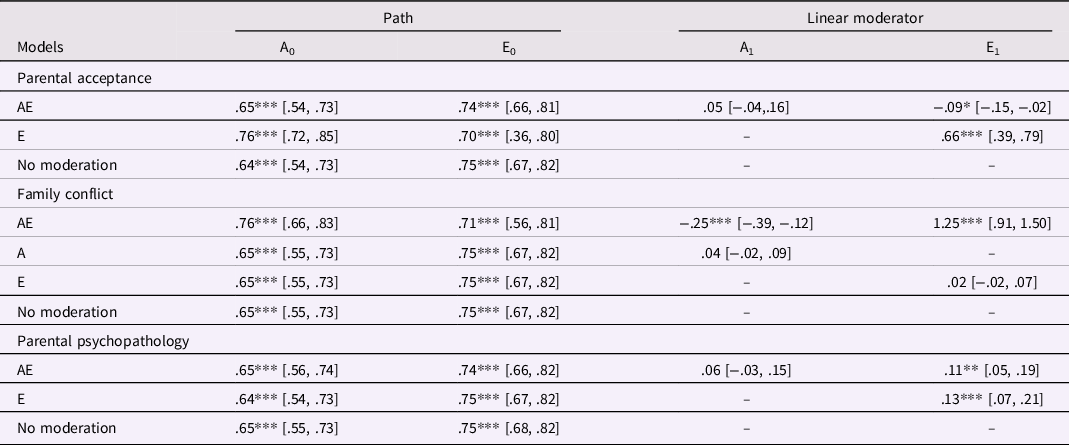
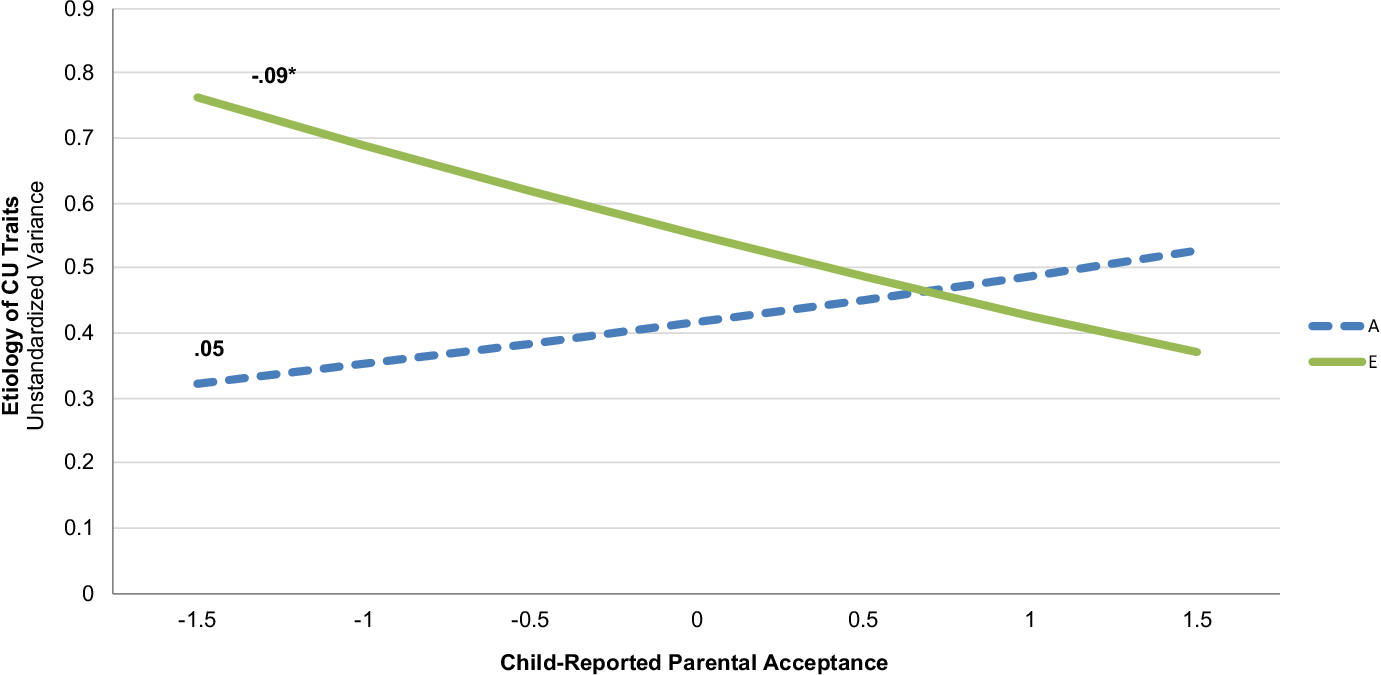
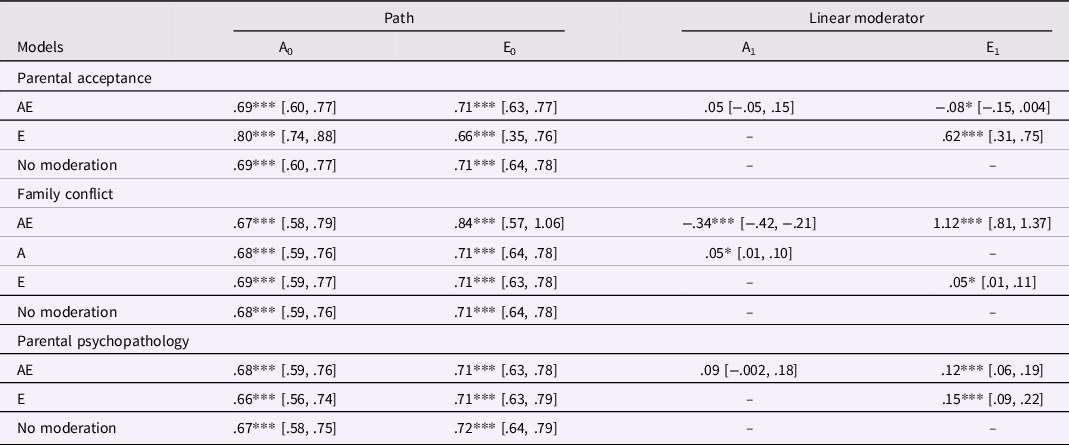
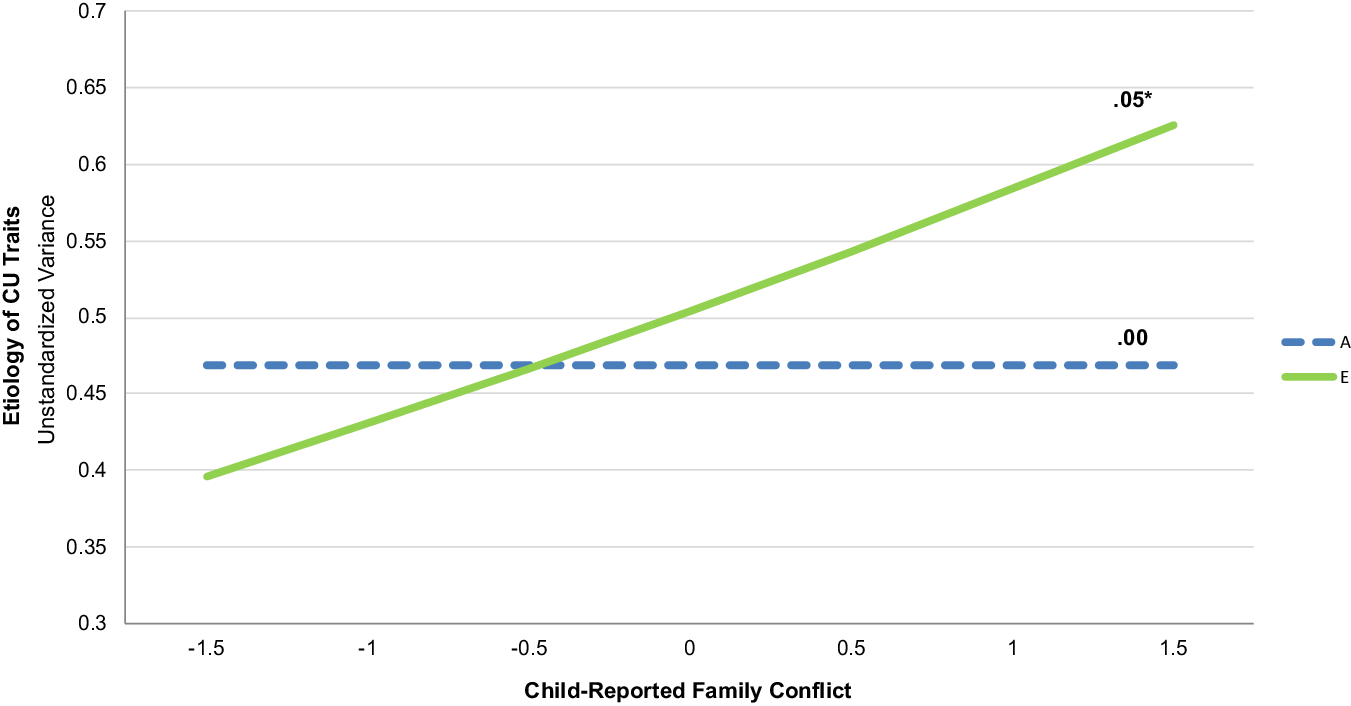
The best-fitting extended G×E interaction model for parental acceptance was the full AE moderation (Table S3). Nonshared environmental influences on CU traits varied as a function of parental acceptance, with nonshared environmental influences on CU traits stronger among children who reported lower parental acceptance (E1 = -.09; p < .05; Table 5 and Figure 2). Although the full AE moderation model fit best, we found non-significant moderation of genetic influences by parental acceptance (A1 = .05, p = .30). Findings were similar when we did not control for conduct problems (Table S4 and Table 6). Results examining moderation by family conflict indicated that a no-moderation model fit best (Table S3). However, moderation of non-shared environmental influences on CU traits by family conflict was significant when we did not control for conduct problems (E1 = .05; p < .05; Table 6 and Figure 3). That is, when we did not account for variance shared between CU traits and conduct problems, non-shared environmental influences on CU traits were greater when children reported more family conflict.
Unstandardized path and moderator estimates for univariate G × E models of CU traits, controlling for CP

Note. The best-fitting model is indicated in bold. CU = callous unemotional; CP = conduct problems; A = additive genetic effect; E = non-shared environmental effect. Confidence intervals (95%) were derived from 10,000 bootstrap draws. Given that univariate ACE models of CU traits showed no evidence of shared environmental influences this parameter was dropped. See Table S13 for additional means model parameters.
p < .05*, p < .01**, p < .001***.
Twin reports of parental acceptance moderates the etiology of CU Traits. Note. This figure depicts unstandardized additive genetic (A) and non-shared environmental (E) contributions to CU traits as predicted by the best-fitting Genotype x Environment (G × E) interaction models at varying levels of the moderator of parental acceptance (N = 770 pairs, 336 monozygotic). Non-shared environmental contributions of CU traits increase with decreasing reported parental acceptance (p < .05). This finding remained whether or not we controlled for conduct problems (see Table S3 and Table 6). Dashed line indicates non-significance. p < .05*, p < .01**, p < .001***.

Unstandardized path and moderator estimates for univariate G × E models of CU traits, without controlling for CP

Note. The best-fitting model is indicated in bold. CU = callous unemotional; CP = conduct problems; A = additive genetic effect; E = non-shared environmental effect. Confidence intervals (95%) were derived from 10,000 bootstrap draws. Given that univariate ACE models of CU traits showed no evidence of shared environmental influences this parameter was dropped. See Table S13 for additional means model parameters.
p < .05*, p < .001***.
Child-reported family conflict moderates the etiology of CU Traits when not controlling for CP. Note. This figure depicts unstandardized additive genetic (A) and non-shared environmental (E) contributions to CU traits as predicted by the best-fitting Genotype x Environment (G × E) interaction models at varying levels of the moderator of family conflict (N = 770 pairs, 336 monozygotic). Non-shared environmental contributions to CU traits are higher among children who experience more child-reported family conflict (p < .05), but only when models did not account for the covariance of CU traits and conduct problems. Dashed line indicates non-significance. p < .05*, p < .01**, p < .001***.

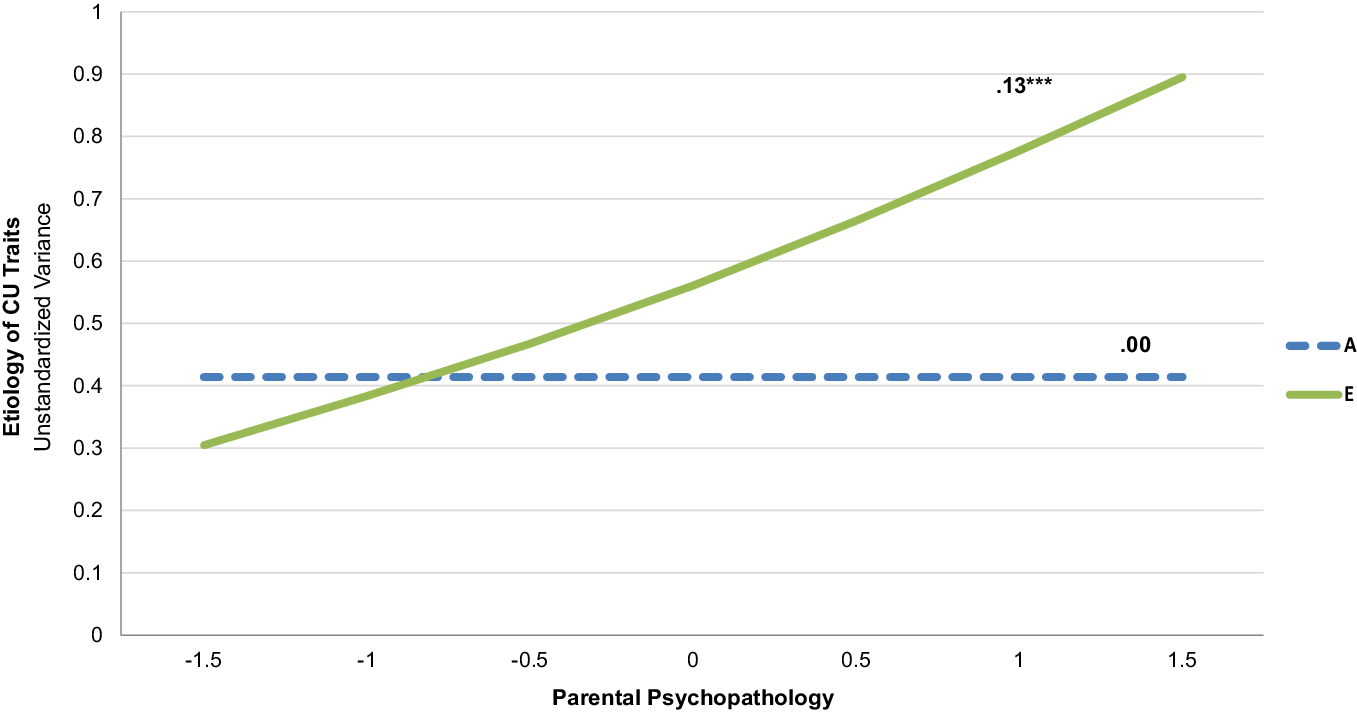
Finally, the best fitting univariate G×E model for parental psychopathology showed that a nonshared environmental-moderation-only model fit the data best (Table S3). Non-shared environmental influences on CU traits varied as a function of parental psychopathology, with nonshared environmental influences on CU traits greater when parents reported more psychopathology (E1 = .13; p < .001; Figure 4). Results were similar when we did not control for conduct problems (Table S4 and Table 6). Further, when examined separately, parental externalizing and internalizing scores both independently moderated non-shared environmental influences on CU traits (Table S5). However, when examined separately using residualized scores for parental externalizing and internalizing (i.e., parsing out variance shared between the two), there was no moderation of AE influences on CU traits (Table S6). See Tables S5–S9 for models using nonresidualized parenting scores. See Tables S10–S12 for results from an unrestricted ACE model (note that results for G×E models did not differ when allowing a C path on CU traits. Finally, all input and output files have been made available online at: https://osf.io/pt24f/?view_only=9a692cb8f181492a9425d8c114c96686.
Parental psychopathology moderates the etiology of CU Traits. Note. This figure depicts unstandardized additive genetic (A) and non-shared environmental (E) contributions to CU traits as predicted by the best-fitting Genotype x Environment (G × E) interaction models at varying levels of the moderator of parental psychopathology (N = 729 pairs, 315 monozygotic). Non-shared environmental contributions of CU traits increase with increasing reported parental psychopathology (p < .001). This finding remained whether or not we controlled for conduct problems (see Table S3 and Table 6). Dashed line indicates non-significance. p < .05*, p < .01**, p < .001***.

Discussion
In a large population-based sample of 772 twin pairs between the ages of 9 and 11, we explored the etiology of the associations between parent-reported CU traits and child reports of parental acceptance and family conflict, as well as with parent reports of their own psychopathology. Higher CU traits was significantly related to lower parental acceptance, more family conflict, and greater parental psychopathology. CU traits were moderately heritable (43%) and under significant non-shared environmental influence (57%), with little evidence of shared environmental influences. Associations between CU traits and parental acceptance were attributable to modest overlap in nonshared environmental effects. G×E interaction analyses revealed that nonshared environmental influences on CU traits were stronger for children reporting lower levels of parental acceptance. In contrast, associations between CU traits and family conflict were attributable to modest overlap in genetic and nonshared environmental factors, with no significant moderation of the etiology of CU traits by family conflict. An exception to this finding was when we did not control for the variance shared between CU traits and conduct problems. That is, when we did not covary for conduct problems, nonshared environmental influences on CU traits were stronger among children reporting greater family conflict. Finally, nonshared environmental influences on CU traits were stronger for children whose parents reported higher levels of their own psychopathology. We discuss each of these findings in more detail below.
Our results replicate and extend those from other population-based samples as the heritability estimate for CU traits (43%) was consistent with past estimates (Moore et al., Reference Moore, Blair, Hettema and Roberson-Nay2019). This estimate was similar (49%) after covarying for conduct problems, suggesting that at least some of the variance in genetic influences on CU traits does not overlap with that influencing conduct problems. The moderate heritability of CU traits is thought to manifest through reduced neural activity to cues of fear, pain, or laughter in others (Lockwood et al., Reference Lockwood, Sebastian, McCrory, Hyde, Gu, De Brito and Viding2013; O’Nions et al., Reference O’Nions, Lima, Scott, Roberts, McCrory and Viding2017; Viding et al., Reference Viding, Sebastian, Dadds, Lockwood, Cecil, De Brito and McCrory2012) and aberrant responsiveness to stimuli indicating reward or punishment among reward processing regions of the brain (Hawes et al., Reference Hawes, Waller, Byrd, Bjork, Dick, Sutherland, Riedel, Tobia, Thomso, Laird and Gonzalez2021; Zhang et al., Reference Zhang, Aloi, Bajaj, Bashford-Largo, Lukoff, Schwartz, Elowsk, Dobbertin, Blair and Blair2021). These neural markers manifest as fearlessness, reduced sensitivity to social threat or punishment, and low affiliative tendencies towards others (Blair et al., Reference Blair, Leibenluft and Pine2014; Frick et al., Reference Frick, Ray, Thornton and Kahn2014; Waller & Wagner, Reference Waller and Wagner2019), which likely contribute to the interpersonal and behavioral challenges posed by children high on CU traits. At the same time, our results also show that CU traits are significantly shaped by environmental influences. Thus, we add to the growing body of literature establishing environmental factors that could be important intervention targets, while the moderate heritability estimates continue to speak to an urgent need for personalized treatments that address the specific challenges and characteristics of children high on CU traits (Hyde et al., Reference Hyde, Waller and Burt2014; Wilkinson et al., Reference Wilkinson, Waller and Viding2016).
In contrast to hypotheses, we did not find significant overlap in genetic effects of CU traits and parental acceptance. However, there was evidence of very modest overlap in nonshared environmental effects (0.8%). There was also evidence of modest overlap in genetic and non-shared environmental effects between CU traits and family conflict. These findings may be due, in part, to the modest phenotypic correlations between CU traits and parental acceptance (r = -.13) and family conflict (r = .12). Importantly, findings were similar when we did not control for conduct problems and effect sizes were somewhat comparable to those reported in prior observational studies (i.e., those that have not used a genetically-informed design) (Clark & Frick, Reference Clark and Frick2018; Pasalich et al., Reference Pasalich, Dadds, Hawes and Brennan2011; Waller et al., Reference Waller, Gardner, Viding, Shaw, Dishion, Wilson and Hyde2014). However, our findings differ from one prior study that implemented a similar analytic approach, which reported that 48% of the genetic influences on CU traits overlapped with the genetic influences on parental involvement and 92% overlapped with the genetic influences on harsh parenting (Tomlinson et al., 2021). Several differences between our study and this prior effort could contribute to the different findings, including method of assessment (i.e., we relied solely on child reports of parenting vs. their combined measure of child and parent report), sample differences (i.e., we used a community sample vs. their sample enriched for risk for antisocial behavior), and age (i.e., we focused on 9–11-year-olds vs. 6–11-year-olds). Finally, we examined different parenting constructs (i.e., we focused on parental acceptance and family conflict vs. parental involvement and harshness). Most critically, our measure of family conflict differs from parental harshness in that it assessed overall family conflict and not conflict specifically directed towards the child. Accordingly, the results could reflect true differences in the etiology of CU traits for different children, depending on age or severity, but could also be indicative of important method effects (e.g., if the same informant reports on both child CU traits and the environmental factors).
The modest overlap in non-shared environmental influences between CU traits and parental acceptance (.8%) and modest overlap in genetic and non-shared environmental influences between CU traits and family conflict (3% and 1% respectively) provides some evidence of overlapping etiological influences. Notably, when we specified an unrestricted ACE model allowing for additive genetic, shared environmental, and non-shared environmental factors on CU traits, parental acceptance, and family conflict we found much greater overlap in the shared environmental influences between CU traits and both parental acceptance (26%) and family conflict (13%) (see Supplement). These findings could be explained by environmental mediation or passive rGE processes (Neiderhiser et al., Reference Neiderhiser, Reiss, Pedersen, Lichtenstein, Spotts, Hansson, Cederblad and Elthammer2004). For example, children with high CU traits are more likely to report less parental acceptance and greater family conflict due to underlying associations between their genotype and the genotype of their parents (Perlstein & Waller, 2020). Continued research is needed to examine the relationships between CU traits, and perceptions of parental acceptance and family conflict in samples of twins assessed at different ages, drawn from community and clinic populations, and leveraging different assessment methods for key constructs. However, since our univariate model implied negligible shared environmental etiology for CU traits and family conflict and negligible genetic influences on parental acceptance, these findings should be interpreted cautiously. Future research is needed to investigate the effect of using different structural approaches to modeling bivariate ACE associations on the shared etiology of CU traits and parenting factors.
In addition to testing for the overlap in the genetic and environmental influences on CU traits and the parenting environment, we also investigated whether parental acceptance and family conflict buffered or exacerbated genetic or environmental risk for CU traits. Replicating and extending prior research (Dotterer et al., Reference Dotterer, Vazquez, Hyde, Neumann, Santtila, Pezzoli, Johansson and Burt2021; Tomlinson et al., 2021), we found that nonshared environmental influences on CU traits were stronger among children who reported lower parental acceptance. Findings were similar whether or not we controlled for conduct problems or whether or not we included a C path on CU traits. However, family conflict only significantly moderated nonshared environmental influences when we did not control for conduct problems, such that nonshared environmental influences on CU traits (not covarying out conduct problems) were stronger among children reporting more family conflict. Thus, our findings extend prior research in genetically informed (Dotterer et al., Reference Dotterer, Vazquez, Hyde, Neumann, Santtila, Pezzoli, Johansson and Burt2021; Tomlinson et al., 2021; Waller et al., Reference Waller, Hyde, Klump and Burt2018) and observational studies (Pisano et al., Reference Pisano, Muratori, Gorga, Levantini, Iuliano, Catone, Coppola, Milone and Masi2017; Waller et al., Reference Waller, Gardner and Hyde2013, Reference Waller, Gardner, Hyde, Shaw, Dishion and Wilson2012) suggesting that family conflict has a nonspecific influence on the etiology of CU traits, reflecting instead broader environmental risk for childhood behavior problems.
Unlike prior studies (Henry et al., Reference Henry, Dionne, Viding, Vitaro, Brendgen, Tremblay and Boivin2018; Tomlinson et al., 2021) we did not find evidence of moderation of heritable influences on CU traits by parental acceptance or family conflict. Notably, in the prior study by Tomlinson and colleagues, when observational methods of parenting were used instead of parent report (i.e., eliminating shared method variance), estimates for moderation of the heritable pathway by parental warmth dropped from −.50 to −.15 and no evidence was found for moderation by parental harshness (Tomlinson et al., 2021). Moreover, in models that parsed the variance unique to involvement and harshness (i.e., residualizing scores), moderation by parental involvement became non-significant (Tomlinson et al., 2021). These differences highlight the importance of leveraging a host of methods and informants to assess key study constructs across different-aged samples of twins. Of note, past twin studies that have utilized multi-informants have provided key insights into how both trait (e.g., self-other agreement) and method (e.g., rater-specific) variance affect the decomposition of genetic and environmental influences (Hudziak et al., Reference Hudziak, Derks, Althoff, Copeland and Boomsma2005; Kandler et al., Reference Kandler, Riemann, Spinath and Angleitner2010; Tackett et al., Reference Tackett, Waldman and Lahey2009). For example, among female twin pairs aged 6–18 years old (N = 1,981 twin pairs), maternal reports of relational aggression indicated significant, moderate genetic influences (42%), but twin self-reports suggested non-significant genetic influences (15%); the opposite pattern emerged for male twins (Tackett et al., Reference Tackett, Waldman and Lahey2009). Thus, future efforts are needed that utilize multiple methods and informants to thoroughly assess the impacts of trait and method variance on our understanding of the etiology of CU traits.
Overall, our finding provides support for the idea that environmental influences take on a more prominent role in negative environments (i.e., lower parental acceptance/greater family conflict is associated with a higher magnitude of nonshared environmental influences) (Dotterer et al., Reference Dotterer, Vazquez, Hyde, Neumann, Santtila, Pezzoli, Johansson and Burt2021; Raine, Reference Raine2002). Moreover, our results add to a growing body of work highlighting that parental warmth, which includes acceptance and involvement, may buffer risk for CU traits (i.e., protective factor; Hyde et al., Reference Hyde, Waller, Trentacosta, Shaw, Neiderhiser, Ganiban, Reiss and Leve2016; Waller et al., Reference Waller, Hyde, Klump and Burt2018, Reference Waller, Shaw and Hyde2017), including by modeling and fostering empathic responding, nurturing behaviors, and affection (Kiang et al., Reference Kiang, Moreno and Robinson2004). Further, supportive parent–child relationships characterized by reciprocal positive affect and cooperation enhance the internalization of prosocial norms and conscience development (Kochanska, Reference Kochanska2002). Thus, parental warmth and acceptance may be particularly important for the development of prosocial emotional responsiveness and the affiliative aspects of interpersonal relationships, both of which are social processes that appear to go awry in the development of CU traits (Alshukri et al., Reference Alshukri, Lewis, Centifanti, Garofalo and Sijtsema2022; Waller & Hyde, Reference Waller and Hyde2018; Waller & Wagner, Reference Waller and Wagner2019).
Finally, we found that parental psychopathology (i.e., externalizing and internalizing symptomatology) moderated the effects of nonshared environmental influences on the etiology of CU traits. Similar to our findings for parental acceptance, this effect remained regardless of whether we controlled for conduct problems. Interestingly, moderation was evident only when using total psychopathology scores or nonresidualized scores (i.e., neither was predictive on its own using residualized scores that parsed out variance shared between the two dimensions, r = .68). Overall, these results suggest that parental psychopathology more broadly exacerbates environmental risk factors that impact the development of CU traits. Indeed, both internalizing and externalizing problems among parents may undermine effective parenting behavior, including based on evidence that maternal depression is associated with lower warmth and structuring of child behavior (Shaw et al., Reference Shaw, Connell, Dishion, Wilson and Gardner2009) and higher parental antisocial behavior is associated with negative parenting practices (Smith & Farrington, Reference Smith and Farrington2004). Notably, unlike analyses examining parental acceptance and family conflict, we could not decompose the genetic and environmental influences of parental psychopathology and test overlap with the influences on CU traits as each twin pair shares the same parent. Thus, future work is needed to investigate the overlap in the genetic and environmental influences on CU traits and parental psychopathology using more sophisticated twin and family modeling procedures.
This study has several notable strengths, including examination of a large population-based sample of twins, use of multiple informants, a narrow developmental range of focus, and use a sophisticated modeling approach for parsing genetic and environmental influences in the context of rGE. Nonetheless, our findings should be considered in light of several limitations. First, the effects of our findings were modest and we only found evidence of moderation of nonshared environmental influences. Thus, future work is needed to replicate our findings across different sample types and using different measurement methods. Second, relatedly, our sample was a community sample and few children had significant levels of behavior problems. For example, within our twin sample, 120 (7% of the sample) children were diagnosed with either conduct disorder or oppositional defiant disorder (MZ = 50; DZ = 70). Our results may therefore not generalize to clinic or forensic samples of youth with potentially higher levels of CU traits. Third, we only measured family conflict and thus were not able to examine the potentially different associations between CU traits and conflict directed specifically at each twin. That is, the measure may have simply been an index of the general conflict observed experienced in the home, including directed to other family members, including siblings or alternate caregivers (and not to children). Thus, without a direct measure of parental harshness directed towards children (cf., Tomlinson et al., 2021), we may have underestimated the effects of the negative parenting environment. Fourth, we regressed out child age, sex, and family income from CU traits to eliminate mean differences. Given associations between these covariates and CU traits (Markowitz et al., Reference Markowitz, Ryan and Marsh2015; Orue et al., Reference Orue, Calvete and Gamez-Guadix2016), future research is needed to investigate whether the moderating effects of the parenting environment on the etiology of CU traits differ across age, sex, and income levels.
In sum, we found evidence that nonshared environmental influences on CU traits were significantly reduced when children reported experiencing more acceptance from their parent, including that their parent smiled at them or believed in showing love for them. We also replicated prior work demonstrating moderate heritability of CU traits with significant nonshared environmental influences on the etiology of CU traits. Overall, our results strengthen the existing literature, highlighting the importance of the parenting environment in buffering risk for CU traits (i.e., serving as a protective factor). This evidence is critical for informing parent management training programs to reduce conduct problems when children also have co-occurring CU traits. Our findings highlight the need for future research to test adaptations of treatments that incorporate modules targeting the emotional aspects of the parent−child relationships linked to acceptance and warmth. Trials of these treatments can directly test whether targeting positive parenting is beneficial in reducing child CU traits (e.g., Kimonis et al., Reference Kimonis, Fleming, Briggs, Brouwer-French, Frick, Hawes, Bagner, Thomas and Dadds2019).
Supplementary material
The supplementary material for this article can be found at https://doi.org/10.1017/S0954579422000888
Acknowledgments
We thank Reviewers for their helpful feedback on earlier versions of this manuscript.
Funding statement
Data used in the preparation of this article were obtained from the Adolescent Brain Cognitive Development (ABCD) Study (https://abcdstudy.org), held in the NIMH Data Archive (NDA). The ABCD Study is supported by the National Institutes of Health and additional federal partners. This manuscript reflects the views of the authors and may not reflect the opinions or views of the NIH or ABCD consortium investigators. Additional funding from the National Science Foundation Graduate Research Fellowship awarded to the third author also supported this work. Manuscript preparation was partially supported by a grant from the National Institute of Mental Health to the last author (R01MH125904).
Conflicts of interest
None.