Introduction
The pea weevil, Bruchus pisorum (L.) (Coleoptera: Chrysomelidae), is one of the most intractable pest problems of cultivated pea, Pisum sativum L., in Europe (Burov, Reference Burov1980; Marzo et al., Reference Marzo, Aguirre and Alonso1997; Girsch et al., Reference Girsch, Cate and Weinhappel1999). It causes considerable damage to the pea plants. Many authors (Ali et al., Reference Ali, Habtewold, Tilaye, Bejiga, Saxena and Solh1994; Damte & Dawd, Reference Damte and Dawd2003) found that losses as high as 50% may often be encountered in pea. Even with only a small amount of actual biological losses by seed yield per plant, economic losses can reach up to 100% (Boeke et al., Reference Boeke, Baumgarta, Jvan Loona, van Huisa, Dickea and Kossoub2004; Somta et al., Reference Somta, Talekar and Srinives2006).
Pea weevils attack peas that are grown in fields. Infestation results in seeds that may not germinate or produce weak plants. Weevils cannot persist in storage as they cannot re-infest stored seed. Females lay eggs on the outside of the pod. Larvae develop in growing seeds within the pods. After pupation within the seed, the adult chews an exit hole through the seed coat. Damage is distinctive. Both adult and larvae feed on the inside of seeds. The final effect of seeds with a beetle infestation on the germination of host legumes can be unforeseeable (Fox et al., Reference Fox, Wallin, Bush, Czesak and Messina2012). In some cases, the larva feeding effectively kills the embryo or removes so much endosperm that the seed cannot germinate (Fox et al., Reference Fox, Wallin, Bush, Czesak and Messina2012).
The pea weevil control is difficult and mainly conducted through chemical means. Development of resistant cultivars would solve this problem to a great extent. In addition, in terms of the modern organic farming, the use of resistant cultivars against phytophagous insects is very important to environmental protection.
Entomologists have investigated morphological and biochemical bases of resistance to storage insect pests (Morton et al., Reference Morton, Schroeder, Bateman, Chrispeels, Armstrong and Higgins2000; Shaheen et al., Reference Shaheen, Khaliq and Aslam2006; Srinivasan & Durairaj, Reference Srinivasan and Durairaj2007; Acosta-Gallegos et al., Reference Acosta-Gallegos, Kelly and Gepts2008). Literature surveys indicate that cultivars of chickpea grains often differ in resistance to bruchid incidence due to variable traits, and it is now the generally agreed-upon fact that a broad genetic base, formed upon physical or chemical characteristics of grains, is essential for crop improvement (Sarwar, Reference Sarwar2012). The author reported that the variation in seed parameters was primarily due to variation in percent infestation level, adult emergence, reduction in seed weight and inherent capacity of each genotype to be attacked by bruchids.
According to some authors, chemical composition is the main responsible for the resistance against bruchids, no tegument thickness (Moss & Credland, Reference Moss, Credland, Highley, Wright, Banks and Champ1994; Maldonado et al., Reference Maldonado, Marinjarilla, Castellanos, Demejia and Acostagallegosc1996, Ghizdavu et al., Reference Ghizdavu, Paşol, Pălăgeşiu, Bobîrnac, Filipescu, Matei, Georgescu, Baicu and Bărbulescu1997). Regnault-Roger (Reference Regnault-Roger, Hamraoui, Bareau, Patrice, Isabel, Gil and Barberan1999) concluded that even though a clear mechanism of leguminous resistance against bruchids is not well known yet, isolation and characterization of the chemical components and the quantification of their role in resistance determination being necessary.
Haruta et al. (Reference Haruta, Major, Christopher, Patton and Constabel2001) found that plant–insect interaction is a dynamic system, subjected to continual variation and change. In order to reduce insect attack, plants developed different protective mechanisms, including chemical and physical barriers, such as the induction of defensive proteins. Similar results reported Leite de Lima et al. (Reference Lima, de Oliveira, Barros, Torres and Gonçalves2001) and according to them a reduction in the bruchids infestation probably due to chemical substances present in the grains that affected the survival of the insects. Yankova et al. (Reference Yankova, Kalupchieva and Ilieva2007) suggested that varieties with low trypsin inhibitor activity had a relatively low percentage of damage seeds.
In the earlier, our study was found that in the pea weevil damaged seeds, crude protein (CP), total phenols, water-soluble sugars and phosphorus (P) contents were increased, while the calcium (Ca) content and trypsin inhibitory activity were decreased (Nikolova et al., Reference Nikolova, Ilieva and Pachev2009). Similar results reported War et al. (Reference War, Paulraj, War and Ignacimuthu2012). According to the authors, the protein content was increased in insect-damaged groundnut genotypes as compared with uninfected control plants.
Use of different markers for resistance as a genetic material in the creation of new pea cultivars is one of the most effective methods for defense and control against B. pisorum. The introduction of resistant pea cultivars would help farmers reduce losses due to pea weevil and provide an environmentally safer option to weevil control.
The aim of this study was to determine the resistance in five pea cultivars to B. pisorum based on the weevil damage and chemical composition of seeds.
Material and methods
During the 2012–2014 period in the experimental field of the Institute of Forage Crops, Pleven, Bulgaria (43°23.312′N; 24°34.856′E; altitude 230 m), a study was conducted on the resistance of five spring pea cultivars to B. pisorum L. (Coleoptera: Chrysomelidae): Glyans, Modus; Kamerton and Svit (Ukrainian cultivars) and Pleven 4 (Bulgarian cultivar). The field trial was conducted using a long-plot design with a sowing rate of 120 germinating seeds m−2 in three replications, plot size of 4 m2 and a natural background of soil supply with the major nutrients. In the long-plot design, the replications are arranged in an elongate strip, i.e. the replications are arranged one after the other. The method was applied because the soil fertility was equalized. The soil type was a leached chernozem with pH (KCl) – 5.49 and content of total N – 34.30 mg 1000 − 1 g soil, P205 – 3.72 mg 100 − 1 g soil as well as K20 – 37.50 mg 100 − 1 g soil. No pesticides were applied.
After pea harvesting bulk samples, containing 1500–2000 seeds, were taken for each cultivar. The seeds of each cultivar every year were classified as three types: healthy seeds (type one), damaged seeds with parasitoid emergence holes (type two) and damaged seeds with bruchid emergence holes (type three). For every cultivar and type of seeds, the seed damage ratings were evaluated by taking 200 seeds in each replication. Seed damage ratings were determined based on comparing the recorded number of seeds without damage with the number of damaged seeds.
Susceptibility coefficient (q, %) was calculated by the following formula: q = (a–b)/a x 100 (a, weight of 1000 healthy seeds; b, weight of 1000 seeds damaged by B. pisorum).
From visibly damaged pea seeds by pea weevil, B. pisorum was isolated the parasitoid Triaspis thoracica Curtis (Hymenoptera, Braconidae).
The chemical composition of the grain was determined in the chemical laboratory of the Institute as follows: CP by Keldahl method (Kjeldahl, Reference Kjeldahl1883), crude fiber (CF) by Weende method (AOAC Official Method) and P colorimetrically by the hydroquinone method and Ca – complexometrically.
The data were subjected to one-way ANOVA, and the means were compared by Tukey's test at 5% probability (P ≤ 0.05). The Multiple Regression Analysis of Statgraphics (1995) for Windows Ver. 2.1 Software program was used.
Results
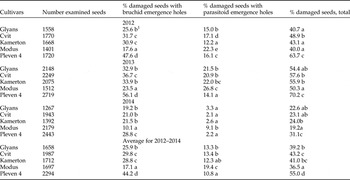
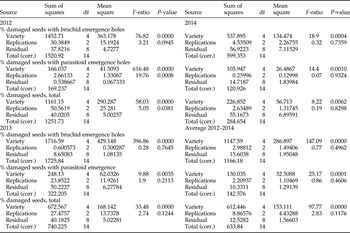
Tested cultivars had a different proportion of seed damage from the three types (table 1). Modus was distinguished with the lowest seed damage with bruchid emergence holes (type three) over the years (ranged from 17.6 to 23.5%) and the average for the period (17.1%) (P < 0.05) – table 2. Differences between Modus and other cultivars were statistically significant. The opposite trend was observed in Pleven 4, which had the highest values (average 44.2%) and differences to others were statistically significant (P < 0.05). At the other cultivars, the seeds from the type three had similar values as in Glyans was found significantly lower seed damage in 2012 and the average for the period.
Seed damage ratings by Bruchus pisorum in pea cultivars.

1 Means in each row followed by the same letters are not significantly different (P > 0.05).
Analysis of variance.

Total (corr.), – Total (corrected).
Of importance was that there were differences between cultivars concerning the damaged seeds with parasitoid emergence holes (type two). These seeds looked like a prick. The highest value of this type of damage over the years and average for the period was found in Modus by 19.4% (excluding 2013 when differences between Modus and Kamerton were not significant) and differences to others were significant. Prevailing trend over the years was a lower proportion of damaged seeds from type two in Pleven 4 and Kamerton an average of 10.8 and 12.3%, respectively as differences between them and other cultivars were significant (P < 0.05).
In terms of the total seed damage ratings regardless of seed types average for 2012–2014, Modus had the lowest values (36.5%) and Pleven 4 – the highest (55.0%) as differences between them and other cultivars were significant (P < 0.05). In the other cultivars, the parameter varied in similar levels as significant difference was observed between Glyans and Svit.
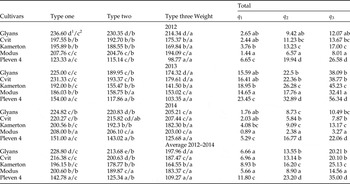
In a comparative analysis of influence of weight seeds on the degree of damage was observed following trend – the cultivars with higher weight seeds had lower rates of damage (table 3). Pleven 4 had the lowest weight of 1000 healthy seeds (142.8 g) as simultaneously, it had the highest total rate of damage (55.0%). It was found that between the weight of healthy seeds and the proportion of damaged seeds with bruchid emergence holes was a strong negative relationship (r = −0.838).
Weight of 1000 seeds (g) and susceptibility coefficient (q, %) in pea cultivars.

Type one-healthy seeds, Type two-damaged seeds with parasitoid emergence holes, Type three-damaged seeds with bruchid emergence holes; q 1 – susceptibility coefficient of Type two seeds; q 2- susceptibility coefficient of Type three seeds; q 3- susceptibility coefficient of Type two and Type three seeds.
1 Means in each column followed by the same letters are not significantly different (P > 0.05).
2 Means in each row followed by the same letters are not significantly different (P > 0.05).
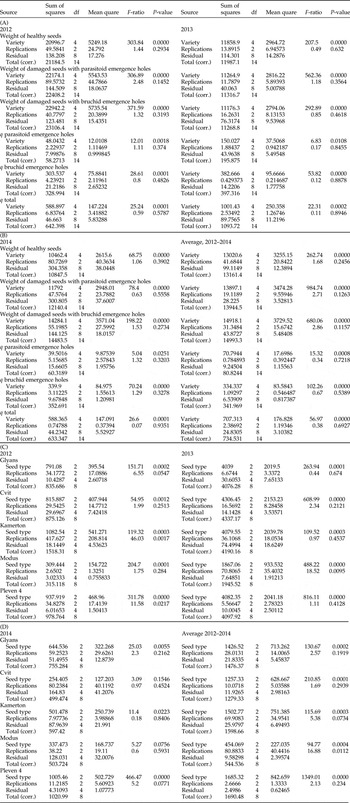
As a result of the harmful effect to B. pisorum was the loss in weight of damaged seeds (types two and three) as compared to healthy seeds differences were always statistically significant (P < 0.05) – table 4(C) and (D). It should be noted that Modus had the lowest reduction of the weight in types two and three damaged seeds. The cultivar was characterized by the lowest values of susceptibility coefficients q 1, q 2 and q 3 (8.9; 5.7 and 14.6%, respectively, average for the period) as compared with other cultivars, statistically significant differences not found only between the values of q 1 average for the period – table 4(A) and (B).
Analysis of variance, (A) 2012 and 2013; (B) 2014 and average, 2012–2014; (C) 2012 and 2013; (D) 2014 and average 2012–2014.

Total (corr.), Total (corrected).
Pleven 4 had the highest values of q 1 and q 2 – 23.2 and 11.8%, respectively. The reduction in the seed weight, expressed through relevant susceptibility coefficients in Glyans and Cvit had similar values. In Kamerton were observed higher susceptibility coefficients, as differences between the cultivar and Glyans and Svit were significant (P < 0.05).
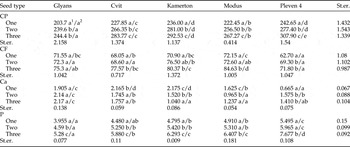
The chemical composition of healthy seeds (CP and CF contents, mineral composition) was different depending test cultivars (table 5). Glyans and Modus had the lowest CP content in the healthy seeds, while Pleven 4 – the highest (P < 0.05) as differences between them and the others were statistically significant (P < 0.05). The opposite trend was observed concerning CF content as Pleven 4 had the lowest value. The variety were characterized with the lowest Ca and the highest P content as differences between it and the others were statistically significant (P < 0.05). Ca and P concentrations were similar in the other cultivars.
Chemical composition of pea seed cultivars (g/kg dry matter) (on average for the period 2012–2014).

Type one-healthy seeds, Type two-damaged seeds with parasitoid emergence holes, Type three-damaged seeds with bruchid emergence holes; St.er, Standard error.
1 Means in each column followed by the same letters are not significantly different (P > 0.05).
2 Means in each row followed by the same letters are not significantly different (P > 0.05).
The result of the harmful effect by pea weevil was an increase quantity of CP, CF and P in the type two and type three seeds. The increase of the CP, CF and P content was expressed to a greater extent in damaged seeds from type three than in the damaged seeds from type two. Differences between the health and damaged seeds from type three were statistically significant in all tested cultivars (except Cvit about CF). It simultaneously was observed a significant increase in the content of those components in the type three damaged seeds to type two (except Glyans regarding to CP and Glyans, Kamerton and Pleven 4 regarding to CF).
Trend of decrease of Ca content in damaged seeds predominated (in Cvit, Kamerton and Modus).
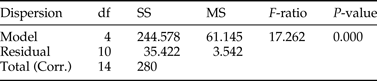
The results of carrying out analysis showed that the linear component in the regression of insect density with respect of the investigated chemical traits was significant (table 6). From the complex study of the traits was obtained model (1) which demonstrated the complicated character of the change of density depending on the variation of investigating plant traits.
Regression analysis (ANOVA) of the insect density with regard to the chemical traits.

The common type of the obtained equation of regression was:
 $$\eqalign{Y & = 11.3632 + 0.0340285^{\ast}X_1 - 0.147315^{\ast}X_2 - 3.79988^{\ast}X_3 \cr & \quad + 4.11145^{\ast}X_4;}$$
where Y was the B. pisorum infestation; X 1 the crude protein; X 2 the crude fiber; X 3 the calcium; X 4 the phosphorus.
The applied analysis in table 7 showed that on pea weevil infestation, the highest significant influence had P content (4.111) followed by Ca (−3.800) which was with negative value. Considerably weaker influence had CP and CF.
Regression coefficients of the insect density with regard to the chemical composition.

CP, crude protein; CF, crude fiber, Ca, calcium, P, phosphorus.
Discussion
The number of emergence holes is a better indicator of seed resistance than the number of eggs present on the pods (Makanurn, Reference Makanurn2010). It, therefore, was calculated the ratio of damaged seed from types two and three to healthy seeds (type one).
Modus was characterized with the lowest damaged seeds from the type three and the highest damaged seeds from type two (P < 0.05) as differences between Modus and others were significant. In the most sensitive cultivar, Pleven 4, was observed reverse trend. It was observed a negative correlation between the seed damage from type two and type three (r = −0.863). It was important for the developmental stage of the pea weevil at harvest time. When weevil larvae in the damaged seeds were in early instars, parasitoids reduced part of them. Modus had the shortest duration of flowering and pod development stages, and they occurred earlier than other cultivars (Nikolova, Reference Nikolova2015). The development time of larvae to adult very likely was relatively insufficient and shortly, and damaged seeds from type two predominated at harvest time. In addition, the parasitoid probably was entered into the seeds in the moment, when bigger part of damaged seeds had younger host larvae. That resulted in the highest percentage of damaged seeds with the parasitoid emergence holes by 19.4% (on average over the period) in Modus. The difference between Modus and other cultivars was statistically significant. The biological control of the pea weevil by its natural enemy, T. thoracica can be quite successful in cultivars with earlier and shorter stages of flower and pod development.
Parasitoid control in pea cultivars, which had the larger duration of pod development stage, was ineffective. The beginning of stages of flowering and pod development in Pleven 4 compared with other cultivars occurred up to 7 days later, which affected the seasonal dynamics of B. pisorum (Nikolova, Reference Nikolova2015). The parasitoid was entered into the seeds in the moment, when maybe a greater part of damaged seeds had older host larvae. Pleven 4 was distinguished with long flowering and pod development duration, and a bigger part of the larvae could complete their development to the adult stage at harvest time.
Similar results reported Schmale et al. (Reference Schmale, Wäckers, Cardona and Dorn2005), according to which suppression of the Acanthoscelides obtectus population with a high level of initial infestation depended on the developmental stage of the weevil population at harvest time. When weevil larvae were present as early instars, parasitoids (Dinarmus basalis) reduced weevil populations by 88–97%, while development of populations of older weevil instars was delayed by the parasitoid, without reducing the build-up of the population (Schmale et al., Reference Schmale, Wäckers, Cardona and Dorn2006). In a previous study, Schmale et al. (Reference Schmale, Wäckers, Cardona and Dorn2001) concluded that feeding on the host' shaemolymph acted as a source of addition energy.
The development and use of cultivars with pod and seed resistance to B. pisorum would provide an environmentally safer option than contact insecticides for adult weevil control. Many authors studied the resistance of different cultivars against B. pisorum. Ahmed et al. (Reference Ahmed, Khalique, Afzal, Tahir and Malik1989) evaluated chickpea genotypes for their susceptibility to pulse beetle, Callosobruchus maculatus F. (Bruchidae) taking into account the number of undamaged seeds (resistance to bruchids), number of eggs oviposited (ovipositional preference), and number of emergence holes (adult survival) per 50 seeds. The authors found that resistance to bruchids appeared to be a more heritable trait than the other two damage characters. According to Doss (Reference Doss2000), some P. sativum lines with the Np gene respond to the presence of pea weevil eggs on pods by forming callus (neoplastic pod trait) that reduces larval entry into the pod. In addition, the authors found that in a field trial, this pod-based resistance was responsible for a lower rate of weevil-infested seed (62.2%) in Np plants compared with that in a susceptible line (85.4%). Clement et al. (Reference Clement, Hardie and Elberson2002) identified sources of natural weevil resistance in the Pisum genome (26 moderately resistant and resistant accessions of P. fulvum) to endow pea cultivars with pod and/or seed resistance to B. pisorum.
The loss in seed weight varied depending on the cultivars from 14.6 to 35.0% (total q) because of the harmful effect to B. pisorum. Mateus et al. (Reference Mateus, Mexia, Duarte, Pereira and Tavares de Sousa2011) reported that the attack by bruchids caused a significant reduction in seed weight, between 0.03 and 0.08 g, depending on the genotypes/cultivars, corresponding to a decrease in nutrients available to the embryo development. In addition, Zubareva (Reference Zubareva2006) found that the pea damage by B. pisorum was accompanied not only by a reduction of seed weight by 31%, but also the seed sowing quality: germination energy by 35% and germination by 54%.
In the present study, the seed weight was affected by the degree of damage seeds as the cultivars with a higher weight of 1000 seeds had lower rates of damage and lower values of the susceptibility coefficient. The small-seeded cultivar Pleven 4 had significantly the smallest seed weight and the highest susceptibility coefficients. It was characterized with the highest percentage of damaged seeds as the larva destroyed most of the grain content for its feeding. Nikolova & Pachev (Reference Nikolova, Pachev, Kobilijski, Burton, Denčić, Noel Ellis, Friedt, Ivanović, Kendall, Saftić-Panković and Sorrels2008) found that the small-seeded varieties were characterized by the highest percentage of B. pisorum damaged seeds (46.4 and 38.1%), and they had the longest period of flowering and pod formation. The degree of attack was associated with plant height and there was a positive correlation between that trait and percentage of damaged seeds. Similar results reported Poryazov (Reference Poryazov1990).
In a comparative analysis, concerning the contents of chemical components in pea cultivars was found that cultivars with lower protein and P content had lower levels of damaged seeds (for example, Glyans and Modus). The preference of the pea weevil concerning to CP and P content in seeds was related to a higher concentration. This resulted in a higher rate of damaged seeds. Pleven 4 had the highest protein and P content, which resulted in the highest damaged seed percent. Similar trend observed Marzo et al. (Reference Marzo, Aguirre and Alonso1997), which found a linear correlation between both protein and phytic acid content and B. pisorum infestation (r 2 = 0.735 and 0.732, respectively). However, the authors suggest that greater phytate and protein contents reduce the risk of Bruchus infestation in pea seeds. Opposite opinion had Odagiu & Porca (Reference Odagiu and Porca2002), according to which the chemical components had no direct influence on the tolerance against bruchids so that grains must be deeply studied in order to determine the influence of both pigments, and amino acids on tolerance of beans.
The results in table 7 indicated that the CP, CF and P content in damaged seeds of the cultivars of P. sativum significantly or no significantly was increased as compared with the healthy seeds due to weevil damage. In addition, the increase was expressed to greater extent in damaged seeds from the type three than in the damaged seeds from type two. The increase in the protein concentration may be due to the generation of defense-related proteins after insect infestation, which resulted in higher protein content in damaged seeds from the type three than type two. Similar results were reported in an earlier study (Nikolova et al., Reference Nikolova, Ilieva and Pachev2009). Lawrence & Koundal (Reference Lawrence and Koundal2002) was found that plants defend themselves by producing these defense related proteins at high concentrations. Our results are similar to Rani & Pratyusha (Reference Rani and Pratyusha2013) who found that infested cotton plant expressed higher levels of proteins than normal plant. The protein content was increased in insect damaged groundnut genotypes as compared to uninfected control plants according to War et al. (Reference War, Paulraj, War and Ignacimuthu2012). Zubareva (Reference Zubareva2006) added that the pea weevil damage led to an increase of total protein content at the expense of albumin fraction and induced increase of trypsin inhibitor activity almost double.
The present data suggest that two pea cultivars may be tolerant cultivars and can be used through breeding programmes. In general, the eventual incorporation of yield traits and the biochemical markers for the selected pea cultivars are efficient tools, which are to be applied as marker-assisted selection closely linked to important traits, which greatly contribute to practical crop improvement programmes.
Conclusions
Modus, followed by Glyans was outlined as resistant cultivars against the pea weevil. They had the lowest total damaged seed degree, while Pleven 4 – the highest. A strong negative relationship (r = −0.838) between the weight of healthy seeds and the proportion of damaged seeds with bruchid emergence holes was found.
B. pisorum damage resulted in loss in weight of damaged seeds (type two and three) as Modus had the lowest reduction and the lowest values of susceptibility coefficients, followed by Glyans.
Cultivars with lower protein and P content had a lower level of damage. The CP, CF and P content in damaged seeds of the pea cultivars significantly or no significantly were increased as compared with the healthy seeds due to weevil damage. The P content had the highest significant influence on pea weevil infestation.
Use of chemical markers for resistance to the creation of new pea cultivars may be effective methods for defense and control against B. pisorum.
Acknowledgements
I am very grateful to Institute of Forage Crops for technical assistance and to the anonymous reviewers whose suggestions highly improved an earlier version of the manuscript.