1. INTRODUCTION
In describing the pronunciation of oral vowels next to nasal consonants in Standard French, pedagogical and general linguistic surveys frequently evoke an overarching, distributional ban on nasal vowel-nasal consonant sequences (Walker, Reference Walker2001: 64–65), a lack of nasalizing processes, usually in comparison with English (Tranel, Reference Tranel1987: 72; Valdman, Reference Valdman1993: 113–114) and/or an intermediate category of ‘nasalized’ vowels, which are distinguished from nasal vowels by the length or degree of nasal coupling (Coveney, Reference Coveney2001: 145–147, citing Bothorel et al., Reference Bothorel, Simon, Wioland and Zerling1986; Fagyal et al., Reference Fagyal, Kibbee and Jenkins2006: 32–33, citing Cohn, Reference Cohn1990). Quite often, these accounts explain the supposed lack of contextual nasalization by the existence of contrastive nasal vowels in French (see also Clumeck, Reference Clumeck, Ferguson, Hyman and Ohala1975: 139–141; Laver, Reference Laver1994: 293; Chafcouloff and Marchal, Reference Chafcouloff, Marchal, Hardcastle and Hewlett1999: 75).
Phonetic studies of nasal coarticulation in French largely support this characterization of the language, especially with respect to the proposed explanation. That is, for those vowel categories participating in the oral-nasal contrast (low and mid vowels), rates of contextual nasalization are more often than not low to negligible (Rochet and Rochet, Reference Rochet and Rochet1991; Spears, Reference Spears2006; Delvaux et al., Reference Delvaux, Demolin, J.-Tarmegnies and Soquet2008). However, these same studies find relatively elevated rates of nasalization on high vowels, in certain cases exceeding 50% nasality when measured acoustically. In all studies comparing progressive and regressive nasalization, the former is found to be more pervasive, typically again with the noted differentiation of heights.
These findings alone may be enough to lead us to question whether high vowel nasalization is (or is becoming) a controlled property of French pronunciation, yet the multifaceted relationship between vowel height, duration and nasality may either cast some doubt on this hypothesis or reinforce it. On one hand, certain inherent properties of high vowels make them the most susceptible to spontaneous nasalization and to perception as nasal with the slightest degrees of nasal coupling. On the other hand, high vowels being naturally the shortest of peripheral vowels and vowel nasality being facilitated by increased duration, controlled nasalization of high vowels may alternatively be dispreferred, and their elevated rates of nasality may thus be artificially inflated.
This study probes this question regarding which vowels, if any, are planned for contextual nasalization, and in which positions (pre- or post-nasal), in Northern Metropolitan French (NMF hereafter). To do so, we look at the relationship between an instrumental, acoustic measure of magnitude of nasal coupling as a function of vowel height and overall duration in NMF as spoken in the departments of Finistère and Somme. The results of this study suggest that high vowel nasalization is a planned property of NMF, but only in post-nasal settings. Elsewhere, and for other vowels, variation is either permitted, in that shorter vowels may be more nasal, or the oral-nasal contrast is more strictly upheld. Especially in light of the oral-nasal contrast in non-high vowels, these findings are likely to have interesting consequences for the phonological system of NMF as a whole, with respect to where overlap of categories is lexically or phonotactically possible and where it is tolerated or blocked. Specifically, nasalization appears to be tolerated at faster rates, though only in the context in which vowel nasality is contrastive (i.e., post-nasal position).
The rest of this article is structured as follows: in section 2, background information on vowel nasality in French, a survey of the general phonetic literature on vowel nasality and height, and a brief discussion of quantification of vowel nasality are provided. Section 3 lays out the methodology of the experiment at hand. Results are provided in section 4. Section 5 discusses these results and potential future research, and section 6 concludes the article.
2. BACKGROUND
2.1. Nasality in French
2.1.1 Phonetic properties
The nasal vowel inventory of NMF comprises a low vowel, a mid-open front unrounded vowel and a mid-open back rounded vowel, traditionally transcribed /ɑ̃, ɛ̃, ɔ̃/, respectively. A lexically marginal mid-front rounded nasal vowel /œ̃/ has largely been lost in NMF, especially among younger generations (Walter, Reference Walter1976) due to a merger with its unrounded counterpart (e.g., Tranel, Reference Tranel1987). Articulatory studies find, based on the positioning of intraoral articulators (typically lip rounding, tongue height and tongue anteriority), evidence for a counterclockwise shift of nasal vowels with respect to their oral counterparts (Delattre, Reference Delattre1968a, b; Brichler-Labaeye, Reference Brichler-Labaeye1970; Walter, Reference Walter1976; Zerling, Reference Zerling1984; Bothorel et al., Reference Bothorel, Simon, Wioland and Zerling1986; Fónagy, Reference Fónagy1989; Malderez, Reference Malderez1991; Hansen, Reference Hansen2001; Delvaux, Reference Delvaux2003; Demolin et al., Reference Demolin, Delvaux, Metens and Soquet2003; Engwall et al., Reference Engwall, Delvaux and Metens2006; Carignan, Reference Carignan2014).Footnote 1 The consensus is that the tongue is lower and more retracted for mid front nasal vowels than their transcriptions would suggest, while the low and mid back nasal vowel are further back and rounded, the latter also being more tense. Meanwhile, from an acoustic point of view, Longchamp (Reference Longchamp1979, as cited in Delvaux Reference Delvaux2012: 138) concludes the vowels /ɑ̃, ɛ̃, ɔ̃, œ̃/ are closer to [ɔ̃, æ̃, õ, ʌ̃], while Carignan (Reference Carignan2014: 31) proposes [ɔ̃ ø̃, õʿ] for the first three.
Outside of their vocalic qualities, the nasal vowels of French cannot necessarily be characterized as ‘entirely nasal’, which is not unexpected, given the relatively slow-moving (Bell-Berti, Reference Bell-Berti, Huffman and Krakow1993: 66) and unnuanced (Shelton et al., Reference Shelton, Harris, Scholes and Dooley1970) nature of the velum, in comparison with other articulators. To this effect, the physical correlates of nasality of the contrastive nasal vowels of European French often show a non-negligible delay with respect their vocalic gestures (e.g., Delvaux, Reference Delvaux2006; Montagu, Reference Montagu2007; Delvaux et al., Reference Delvaux, Demolin, J.-Tarmegnies and Soquet2008) and are sensitive to their surrounding context (Cohn, Reference Cohn1990). The prominence of nasality in French nasal vowels may also be beneath ceiling rates, depending on the type of instrument and calculation used. For instance, Delvaux et al. (Reference Delvaux, Demolin, J.-Tarmegnies and Soquet2008) find the average ratio of nasal to total airflow of nasal vowels to be 41%, and van Reenen (Reference Reenen1982: 73–75) concludes that European French nasal vowels are on average maximally 75%, and even then, only for the second half of their duration. Amelot (Reference Amelot2004: 105) similarly finds a non-negligible delay of nasal airflow in European French nasal vowels.
2.1.2 French nasal phonology
Nasal vowels contrast with oral vowels in French in multiple contexts but have a more restricted distribution in that they generally are not found before nasal consonants in the same word. Word-internal, marginal exceptions in the native vocabulary include the pseudo-prefix en- as in enneiger [ɑ̃neʒe] ‘to snow in’, compounds such as grand-messe [ɠʁȿɑ̃mɛs] ‘High Mass’, and the first-person plural of certain verbs in the passé simple, e.g., (nous) vînmes [vɛ̃m] ‘(we) came’. Otherwise, oral and nasal vowels may occur in similar contexts. Finally, nasal consonants generally may not occur in coda position other than word-finally.Footnote 2 A notable class of potential exceptions follows schwa deletion, e.g., poissonnerie [pwasɔn(ə)ȿi] ‘fish market’, though resyllabification may not apply here (e.g., Rialland, Reference Rialland, Wetzels and Sezer1986). All in all, these restrictions conspire against nasal vowels occurring before nasal consonants (no such condition barring nasal consonant + nasal vowel sequences).
Vowel nasality in French is manipulated by certain morphophonological alternations, such as in gender agreement, where nasal vowels in the masculine optionally alternate in the feminine with oral vowel + nasal consonant sequences.Footnote 3 Nasal vowels do not necessarily alternate with VN sequences, though, and may precede Ø ~ C alternations such as in grand [ɠʁȿɑ̃] ~ grande [ɠʁȿɑd] ‘tall (m.) ~ (f.)’. Finally, denasalization may take place as a consequence of liaison, as in the case of bon [bɔ̃] vs. (un) bon ami [bɔ.na.mi] ‘(a) good friend’.Footnote 4
Despite the phonetic complexity and variability of the nasal vowels of French, their abstract phonological representations are comparatively simple. That is, each is typically specified as identical to its closest oral counterpart, with the exception of added nasality (see, for example, Jakobson and Lotz, Reference Jakobson and Lotz1949; Schane, Reference Schane1968: 45; Brousseau and Nikiema, Reference Brousseau and Nikiema2001: 77 for featural approaches and Ploch, Reference Ploch1999: 232 for an approach in Element Theory).
In light of such approaches, it is worthwhile to question whether the representation of non-high vowels undergoing a hypothetical, phonological process of nasalization might be indistinguishable from that of their contrastive nasal vowel counterparts at the level of phonological spell-out, or whether the articulatory counterclockwise shift mentioned in §2.1.1 applies to only underlying nasal vowels and not their underlying oral, but contextually nasalized counterparts. In practice, this means that a lack of controlled nasalization in non-high vowels may be construed as stemming from a prohibition against conflating the two categories. This point is not crucial to the main objectives of this article, though it does inform some of the speculation offered in the discussion in section 5.
2.2 Nasality and vowel height
The velum lowers in the articulation of nasal segments to provide access to the velopharyngeal port (VP) and the nasal cavities, and during oral segments it is raised to block this passage. Multiple studies conclude that velic lowering is achieved by relaxation of the levator palatini muscle (Fritzell, Reference Fritzell1969; Lubker et al., Reference Lubker, Fritzell and Lindqvist1970; Bell-Berti, Reference Bell-Berti1973, Reference Bell-Berti1976) but may also be aided by activation of the palatoglossus muscle, at least on select vowels (e.g., Dixit et al., Reference Dixit, Bell-Berti and Harris1987). Velic movement or position is not unilaterally bound to this parameter, though, and changes fluidly even over the course of oral segments (see Bell-Berti, Reference Bell-Berti, Huffman and Krakow1993 and references therein). In particular, velic height has long been observed to covary with vowel height in a multitude of studies (e.g., Bell-Berti, Reference Bell-Berti1976; Henderson, Reference Henderson1984; see Passavant, Reference Passavant1863 for an early example), being highest on high vowels and lowest on low.Footnote 5 Note, though, that certain studies find no significant differences in velic height between oral vowels of different heights (Bream, Reference Bream1968; Condax and Krones, Reference Condax and Krones1976).
Early theories of the diachronic development of nasal vowels made use of this relationship to explain patterns in French (Pope, Reference Pope1934; Straka, Reference Straka1955; Haden and Bell, Reference Haden and Bell1964; Chen, Reference Chen1973), among other languages, positing that distinctive low nasal vowels emerge first in languages due to physiological concerns. Namely, according to the ‘opening hypothesis’, low vowels are normally articulated with a slightly open VP (Straka, Reference Straka1955; Delattre, Reference Delattre1967; Ruhlen, Reference Ruhlen1973; Chen and Wang, Reference Chen and Wang1975; Hombert, Reference Hombert1987). This is evidenced anecdotally by early phoneticians (see Hiroto et al., Reference Hiroto, Hirano and Umeno1963: 43 for references) and experimentally (Fritzell, Reference Fritzell1969; Bell-Berti, Reference Bell-Berti1973; Clumeck, Reference Clumeck1976; Al-Bamerni, Reference Al-Bamerni1983). Additional evidence from the perceptual literature would initially appear to support these findings. The vowel /a/ is judged as slightly more nasal than /i/ with no nasal coupling in Maeda’s (Reference Maeda1982) study, and other studies find that oral low vowels are judged as more nasal than mid and high (Lintz and Sherman, Reference Lintz and Sherman1961; Ali et al., Reference Ali, Gallagher, Goldstein and Daniloff1971; Brito, Reference Brito, Ferguson, Hyman and Ohala1975). House and Stevens (Reference House and Stevens1956: 228) also report oral /æ/ was judged as nasal by their participants. In sum, low vowels would appear most susceptible to spontaneous nasalization. However, the remainder of evidence, to which we now turn our attention, skews the opposite and bears reinterpretation on the above cited phenomena.
Acoustically, nasal coupling leads to a general reduction in available formant space (Feng & Castelli, Reference Feng and Castelli1996; Serrurier & Badin, Reference Serrurier and Badin2008), although there is some disagreement in the literature concerning the effect of vowel quality on the direction and intensity of formant changes. In addition, as Carignan (Reference Carignan2018) notes, it is not unlikely that modeling studies have difficulty distinguishing high-amplitude first nasal poles from an oral vowel’s F1 or F2 (depending on height), complicating a synthesis of the literature. In general, however, nasal coupling of /i/ is routinely observed or modeled to lead to F1 raising (Maeda, Reference Maeda, Huffman and Krakow1993; Feng & Castelli, Reference Feng and Castelli1996; Serrurier & Badin, Reference Serrurier and Badin2008; Carignan, Reference Carignan2018). This vowel aside, Carignan (Reference Carignan2018) finds general effects of lowering of both F1 and F2 as a result of nasal coupling. Serrurier and Badin (Reference Serrurier and Badin2008), a production study like Carignan (Reference Carignan2018), also model F1 lowering for /a/. These findings are inconsistent with modeling studies (Fujimura & Lindqvist Reference Fujimura and Lindqvist1971; Maeda, Reference Maeda, Huffman and Krakow1993; Feng & Castelli, Reference Feng and Castelli1996) if only the oral vowel’s F1 and F2 are considered (i.e., the first nasal pole is ignored).
On the perceptual side, nasal coupling can have a centralizing effect along the height parameter, in that high and mid nasalized vowels are perceived as lower than their oral counterparts and low vowels perceived as higher (e.g., Wright, Reference Wright, Ferguson, Hyman and Ohala1975). However, this effect may arise only when in violation of language-specific phonotactics, such as non-contextual nasal vowels for American English listeners (Krakow et al., Reference Krakow, Beddor, Goldstein and Fowler1988), though see Kingston and Macmillan (Reference Kingston and Macmillan1995) and Macmillan et al. (Reference Macmillan, Kingston, Thorburn, Walsh Dickey and Bartels1999) for contradictory results. As for the perception of backness, Beddor (Reference Beddor, Huffman and Krakow1993) claims there is no consistent effect of nasal coupling, though Delvaux (Reference Delvaux2009) finds F2 lowering to be a principal percept of nasality for Belgian French speakers.
Decrease of F1 amplitude and increase of its bandwidth (e.g., Delattre, Reference Delattre1954; House and Stevens, Reference House and Stevens1956; Hawkins and Stevens, Reference Hawkins and Stevens1985) are reported as vowel-independent effects of nasal coupling, the direct result of the interaction of added pole-zero pairs from the nasal tract with the oral tract’s formant structure (Maeda, Reference Maeda, Huffman and Krakow1993). In a landmark analog study (House and Stevens, Reference House and Stevens1956), this effect is more prominent on high vowels, relative F1 amplitude being modeled as routinely two to three times less prominent than low vowels, at any given degree of nasal coupling. Other approaches in modeling arrive at similar conclusions but for different reasons. Maeda’s (Reference Maeda1982) port model finds no significant effect of F1 amplitude reduction on nasalized high vowels. Rather, they are characterized by the appearance of a nasal pole-zero pair above the vowels’ F1. Seeing as greater nasal coupling has the effect of increasing the frequency of these zeroes, there is no chance for the oral vowel’s F1 to be crossed and therefore weakened by this zero. Such is the case, however, of low vowels, whose first nasal pole-zero pair appears beneath the F1 (see also Bell-Berti and Baer (Reference Bell-Berti and Baer1983), Feng and Castelli (Reference Feng and Castelli1996) and Pruthi (Reference Pruthi2007)). Essentially, nasal coupling on high vowels is best evidenced, and immediately so, by the appearance of a nasal pole between the first two formants, or a ‘large domain for validation of nasality’ (Feng and Castelli, Reference Feng and Castelli1996: 3701). Whatever the cause, it remains that a small amount of nasal coupling is sufficient to induce significant changes to high vowels’ spectra, while low vowels require much greater degrees (Maeda, Reference Maeda, Huffman and Krakow1993; Feng and Castelli, Reference Feng and Castelli1996).
A similar relationship holds at the aerodynamic level. For a given amount of egressive air, amount of nasal airflow is dependent not only on resistance of the velopharyngeal port but also on intraoral pressure (e.g., Warren et al., Reference Warren, Hinton, Pillsbury and Hairfield1987). Because of the relatively smaller quantity of intraoral air (and resultantly higher pressure) characteristic of high vowels, only a small surface area of VP opening is needed to suitably expel air through the nasal cavities as well (Hajek, Reference Hajek1997: 128–129). Several studies find nasal airflow to be significantly greater on high vowels in pre-nasal contexts than on low vowels in the same environment (McDonald and Baker, Reference McDonald and Baker1951; Lubker and Moll, Reference Lubker and Moll1965; Al-Bamerni, Reference Al-Bamerni1983; Delvaux et al., Reference Delvaux, Demolin, J.-Tarmegnies and Soquet2008). Essentially, this means a smaller amount of velic lowering is required to nasalize high vowels, whereas a greater amount is required to produce the same amount of nasalization on low vowels.
Percepts of nasality increase with greater nasal airflow (Warren et al., Reference Warren, Dalston, Mayo, Huffman and Krakow1993), providing a direct link between the above aerodynamic results and perceptual results. Returning to Maeda (Reference Maeda1982), in which /a/ was judged as more nasal than high vowels at no nasal coupling, once a small degree of synthesized nasal coupling (0.2 cm2) is imposed, /i/ is immediately perceived as more nasal, and it is not until the largest degree of nasal coupling utilized (2.5 cm2) that /a/ achieves the same degree of perceived nasality as /i/. Other perceptual studies using natural stimuli (Spriestersbach and Powers, Reference Spriestersbach and Powers1959; Carney and Sherman, Reference Carney and Sherman1971; Benguerel and Lafargue, Reference Benguerel and Lafargue1981; Henningsson and Hutters, Reference Henningsson and Hutters1997) and synthesized stimuli (House and Stevens, Reference House and Stevens1956; Abramson et al., Reference Abramson, Nye, Henderson and Marshall1981; Hawkins and Stevens, Reference Hawkins and Stevens1985; Stevens et al., Reference Stevens, Fant, Hawkins, Channon and Shockey1987; Kingston and Macmillan, Reference Kingston and Macmillan1995; Macmillan et al., Reference Macmillan, Kingston, Thorburn, Walsh Dickey and Bartels1999) find similar results. Hajek (Reference Hajek1997: 132) also notes anecdotal evidence of this height disparity of perception of nasality before nasal consonants in Bengali, Chamorro and Portuguese, as well as between contrastive nasal vowels in Molinos Mixtec.
In light of such evidence, the lower velic position and occasional nasal leakage of low vowels suggest in fact that the oral-nasal category threshold may be shifted for low vowels (Ohala, Reference Ohala, Ferguson, Hyman and Ohala1975: 299–301), or that speakers intentionally raise the velum higher during high oral vowels in order to avoid inappropriate nasal coupling (Bell-Berti, Reference Bell-Berti, Huffman and Krakow1993: 69). In other words, a small degree of nasality on low vowels, whether required or accidental, is not necessarily perceived nor implemented as nasal coupling, as its effects are minimal in comparison with other vowels, especially high (Schwartz, Reference Schwartz1968). As such, the weight of evidence strongly suggests the ‘opening hypothesis’ is no longer tenable, and that cases supporting it, largely diachronic, require another explanation, as considered below.
The previous discussion considers only the relationship between vowel height and nasality. Vowel length and its separate interactions with height and nasality must also be taken into account, and the resulting sum of factors suggests a parameter wherein nasal vowels are better formed and/or better perceived as nasal as vowel opening increases. First, numerous language descriptions and experimental studies, if not the vast majority, find that average vowel length increases proportionately with aperture (see Toivonen et al., Reference Toivonen, Blumenfeld, Gormley, Hoiting, Logan, Ramlakhan and Stone2015: 64 for references). Physiological explanations appeal to jaw displacement (Lehiste, Reference Lehiste1970; Lehnert-LeHouillier, Reference Lehnert-LeHouillier2007) and the distance of low vowels to the necessary maxillary opening for the articulation of most consonants (Catford, Reference Catford1977; Maddieson, Reference Maddieson, Hardcastle and Laver1997; Gussenhoven, Reference Gussenhoven, Cole and Hualde2007). Meanwhile, additional experimental evidence suggests through the notion of inherent duration that low vowels are cross-linguistically – or at least, language-specifically, but by most languages – actively specified as longest (Lisker, Reference Lisker1974; Tauberer and Evanini, Reference Tauberer and Evanini2009; Solé and Ohala, Reference Solé and Ohala2010). Sonority-based scales of vowel markedness (e.g., De Lacy, Reference Lacy2006) provide a phonological counterpart to this notion.
Vowel duration also interacts with nasality. Diachronically, contrastive long nasal vowels develop before, and are implied by, short nasal vowels, as was the case in French (Hajek, Reference Hajek1997). Synchronically, nasal vowels are, in the vast majority of languages reported in the literature, longer than oral vowels (see Ruhlen, Reference Ruhlen, Ferguson, Hyman and Ohala1975; Greenberg et al., Reference Greenberg, Ferguson and Moravcsik1978 for references), including in French (Delattre and Monnot, Reference Delattre and Monnot1968; Baligand and James, Reference Baligand and James1979; Di Cristo, Reference Di Cristo1980; O’Shaughnessy, Reference O’Shaughnessy1984; Bartkova and Sorin, Reference Bartkova and Sorin1987; Ouellet, Reference Ouellet1992; Santerre and Roberge, Reference Santerre and Roberge1992; Delvaux, Reference Delvaux2000; Dominicy, Reference Dominicy2000; Delvaux et al., Reference Delvaux, Demolin, J.-Tarmegnies and Soquet2008). Synchronically, this difference may reasonably be explained by temporal constraints on achieving sufficient, or sufficiently perceivable, nasal coupling (recall the findings on temporal alignment in §2.1.1). More importantly, several studies show that perception of nasality (of the vowel itself or of adjacent, removed consonants) is facilitated by increased vowel duration (Lintz and Sherman, Reference Lintz and Sherman1961; Cagliari, Reference Cagliari1977; Casablanca, Reference Casablanca1987; Whalen and Beddor, Reference Whalen and Beddor1989; Lahiri and Marslen-Wilson, Reference Lahiri and Marslen-Wilson1991). Note also that in French, the duration of nasal airflow is in positive correlation with overall segment duration (Amelot, Reference Amelot2004: 104–105).
In sum, when vowel duration is considered, languages may first develop and/or prefer lower nasal vowels, whether through compensatory lengthening following the loss of nasal consonants or reanalysis of longer, contextually nasalized tokens (Hajek, Reference Hajek1997). Note that this parameter does not negate the previously evoked phonetic factors favouring high nasal vowels. In fact, they should be considered competing forces to be resolved at the discretion of the individual language (Hajek and Maeda, Reference Hajek, Maeda, Broe and Pierrehumbert2000).
2.3 Quantifying nasality
We have already seen allusions to numerical indices of nasality and multiple types of instruments used to provide them. While instrumentation is not necessary to quantify vowel nasality, non-instrumental methods have difficulty measuring all types of vowels equally and thus demonstrate important limitations. Otherwise, a large number of diverse types of instruments may be used to quantify nasality, namely, acoustic, aerodynamic, imaging and mechanical. In this section, we discuss the type of instrument used in this study (that is, nasometry) and the various formulae employed, as representative examples of the stakes involved in quantifying nasality. The reader is referred to Krakow and Huffman (Reference Krakow, Huffman, Huffman and Krakow1993: 10–39), Baken and Orlikoff (Reference Baken and Orlikoff2000: 457–460) and Delvaux (Reference Delvaux2012: 66–74) for detailed discussions on other types of instruments.
Nasometry, like its precursor TONAR (Fletcher and Bishop, Reference Fletcher and Bishop1970), performs ratio-based measurements of acoustic energy. This type of instrument is often used in clinical studies of hyper- and hyponasality and expresses nasality as the average ratio of nasal energy to total energy (dubbed nasalance) over expressions or entire passages, each with varying degrees of proportionality of nasal segments (see Fletcher et al., Reference Fletcher and Bzoch1989 for frequently used English passages and their baselines). It should be noted that nasalance was explicitly designed as a measurement of voiced segments. Audibert and Amelot (Reference Audibert and Amelot2011) propose the use of accelerometers and a difference-based (not unlike the DER formula used here), rather than ratio-based, approach to more accurately differentiate oral and nasal consonants, including voiceless ones.
Each type of method presents its own advantages and disadvantages in the study of coarticulation. Nasometry was chosen for this study over articulatory methods for its non-invasive nature and its lack of physical confounds (e.g., velic movement unassociated with nasality), in addition to arguments that speech targets are acoustic (see Carignan Reference Carignan2014: 32 for references). Aerodynamic methods have similar benefits, as evoked by Delvaux et al. (Reference Delvaux, Demolin, J.-Tarmegnies and Soquet2008: 579). However, seeing as the acoustic signal is most readily accessible to listeners over aerodynamic and articulatory information (see Styler, Reference Styler2015: 4 for a similar argument), nasometry was selected as the preferred method for the current study’s ultimately phonological aim.
Regardless of instrument type, individual points of a vowel may be converted to a global percentage of vowel nasality in different ways. This is typically with reference to a threshold of either above-zero nasal activity or the point where nasal activity overtakes oral activity. The formula employed here, the Differential Energy Ratio (DER), belongs to the latter type but differs from traditional nasalance (Fletcher, Reference Fletcher1976) first and foremost with respect to the definition of limits (i.e., what values of 0 and 100 represent). The DER also differs crucially from the binary transformation of Rochet and Rochet (Reference Rochet and Rochet1991), which calculates nasalance at each point for a token and then takes a ratio of points with a nasalance greater than 50% to the number of total points measured. We return to these points in §3.4.
The DER envisions vowel nasality as the ratio of predominantly nasal energy to total energy. First, differential energy is calculated at each point by subtracting nasal energy (y) from oral energy (x). An arbitrary threshold of differential energy is set at zero. Positive values are taken as predominantly oral, whose sum provides the prominence of the oral phase, while the absolute value of the sum of negative values (which are taken as predominantly nasal) provides the prominence of the nasal phase. The ratio of the nasal phase energy to total energy, multiplied by 100, returns the DER, whose formula can thus be defined as
 $${\rm{DER = 100}}\,{\rm{ \times }}\,\,\frac{{{\left| {\sum\nolimits_i {{\rm{min}}\left( {{x_i}{\rm{ - }}{y_i}{\rm{,0}}} \right)} } \right|}}\over{{\left| {\sum\nolimits_i {{\rm{min}}\left( {{x_i}{\rm{ - }}{y_i}{\rm{,0}}} \right)} } \right|{\rm{ + }}\sum\nolimits_i {{\rm{max}}\left( {{x_i}{\rm{ - }}{y_i}{\rm{,0}}} \right)} }},$$
in which i is defined as any measured point until the end of the segment.
As the interpretation of this study’s results depends directly on that of the DER, a brief discussion of the formula is warranted. The DER models the proportion of a segment’s total energy which is predominantly nasal, akin to a measurement of magnitude of nasal coupling, though specifically ratio-based. DER values increase as the sum of negative values of differential energy increases, whether due to intensity, number of points or both (for instance, a nasal phase comprised of a sole point of value of -n would be functionally the same as a longer nasal phase with two points of value -0.5n, and so on). Extreme values of the DER are exceptionally not sensitive to degree of difference; a value of 0 means at no point of a segment is nasal energy greater than oral energy, while a value of 100 means that all points meet this criterion.
Unlike Rochet and Rochet’s formula, but akin to traditional nasalance, the DER intentionally does not have access to temporal information. This is because it was hypothesized based on observations of the data that temporal approaches, which model the proportion of the duration of this phase to total vowel duration, may conflate crucial information concerning the magnitude of nasal coupling. To illustrate this, Dow (Reference Dow2016) presents two pre-nasal tokens of [y] from the present data with nasal phases of the same duration. As such, these tokens are not differentiated by Rochet and Rochet’s formula. However, the two tokens differ greatly in the behaviour of nasal energy after their threshold points, remaining relatively stable for one token and demonstrating a steep rise in the other. By consequence, the DER provides different scores of nasality to these two tokens.
Certain questions remain concerning these two types of information. It is not evident, for example, that listeners perceive and/or speakers intentionally manipulate the velocity or magnitude of change in nasal energy primarily over a purely temporal parameter. This matter must be left for future work, in particular with regards to perception. In the interest of transparency, a temporal-based measurement is performed in this study (as discussed in §3.4), and its results are compared with those using the DER (see §4.1.2). As will be shown, both measurements are in strong correlation, and statistical tests using the temporal-based measurement overwhelmingly did not differ from those using the DER, regarding the interaction of duration and nasality with respect to vowel height.
2.4 Mechanical versus controlled nasalization
As we have seen, nasal coupling is facilitated or hindered by various factors, which themselves may interact with vowel duration. When taken into consideration with the relative slowness of the velum and/or the muscles responsible for its movement, the possibility arises that two similar tokens of vowels may be nasalized to a certain extent for opposite reasons. On one hand, nasal coupling may be planned, even if potentially imperfectly interpolated (cf. §2.1.1). On the other hand, nasal coupling may in certain cases be unintentional, necessarily imperfect due to the transition between oral and nasal targets. This is especially the case when such a transitional period may occupy a more substantial portion of the vowel’s duration, specifically, on shorter vowels, and thus more likely high vowels. In sum, determining whether a vowel is controlled for nasalization requires more than just a simple percentage.
Solé (Reference Solé1992, Reference Solé, Solé, Beddor and Ohala2007) provides a useful methodology for distinguishing mechanical from controlled nasalization. Using variable-speech rate data, she shows that the nasal phase of American English vowels increases in duration proportionately to overall vowel length, while in Spanish, it remains similar, regardless of speech rate. The former she argues to be indicative of an active process of nasalization, while the latter suggests targets in Spanish are indeed oral. The present study is inspired by this approach, in that it incorporates overall vowel duration, and expands upon this methodology by separating vowels into height categories. It should be made clear that the current study does not examine variable-speech rate data, however. Nevertheless, certain durational effects were robust, and therefore the comparison with Solé’s studies is offered on a preliminary basis, pending future studies.
2.5 Nasal coarticulation in French
We finish this section with a review of the phonetic literature on nasal coarticulation in French, in light of the previous discussion. Studies mentioned here are limited to those which quantify contextual nasalization and which include vowels of all heights. First of all, the types of methods used and, by extension, the definition of relative nasality are varied. Basset et al. (Reference Basset, Amelot, Vaissière and Roubeau2001) and Delvaux et al. (Reference Delvaux, Demolin, J.-Tarmegnies and Soquet2008) are aerodynamic, while Rochet and Rochet (Reference Rochet and Rochet1991) and Montagu (Reference Montagu2007) are nasometric. Clumeck (Reference Clumeck1976) is articulatory, and Spears (Reference Spears2006) is acoustic (spectrographic).
The studies looking at both progressive and regressive nasalization are in agreement that the former is more predominant in French (Rochet and Rochet, Reference Rochet and Rochet1991; Delvaux et al., Reference Delvaux, Demolin, J.-Tarmegnies and Soquet2008). Second, with the exception of Clumeck (Reference Clumeck1976) and Montagu (Reference Montagu2007),Footnote 6 high vowels show the most significant rates of nasalization (Rochet and Rochet, Reference Rochet and Rochet1991; Basset et al., Reference Basset, Amelot, Vaissière and Roubeau2001; Spears, Reference Spears2006; Delvaux et al., Reference Delvaux, Demolin, J.-Tarmegnies and Soquet2008). Rates of high vowel regressive nasalization exceed 50% in Rochet and Rochet (Reference Rochet and Rochet1991) and Spears (Reference Spears2006). Meanwhile, high vowels are only 22% nasalized in regressive contexts in Delvaux et al. (Reference Delvaux, Demolin, J.-Tarmegnies and Soquet2008), versus 7% for non-high vowels. However, 100% in their measurement references pure nasality (i.e., nasal consonants), not an entirely nasalized vowel. Finally, Basset et al. (Reference Basset, Amelot, Vaissière and Roubeau2001) find an average of 77 ms of anticipatory nasalization on high vowels, versus 54 ms for low vowels. Velic activity begins slightly before the onset of high vowels in their study but not that of low vowels. Note that this trend is reversed in NV contexts, in that low vowels are more nasalized.
2.6 Hypotheses
The main question of this study is whether, and for which vowels, nasalization (regressive or progressive) is a controlled property of NMF, as reflected by changes (or lack thereof) of rates of nasality as a function of overall vowel duration. Based on the phonetic literature and previous findings on nasal coarticulation in French, the following hypotheses are put forward.
First, it is predicted that duration will increase and nasality will decrease proportionately with vowel opening, regardless of direction of nasalization. That is, high vowels are predicted to be shortest but most nasal in both VN and NV settings, low vowels the longest and least nasal, and mid vowels intermediate. Second, nasalization in NV settings is predicted to be greater than in VN settings for any given vowel height. Finally, concerning the relationship between nasality and duration, a null hypothesis is made that high vowels are predicted not to behave differently from mid and low vowels. Specifically, this hypothesis will be nullified if high vowels are highly nasal in coarticulatory settings and additionally remain highly nasal in longer tokens, while mid and low vowels either will start low in nasality for shorter tokens and remain low in longer tokens, or that nasality will decrease drastically as the overall length of tokens increases.
3. METHODOLOGY
3.1 Participants
Twenty native speakers of French were recruited from the departments of Finistère (Brittany) and Somme (Hauts-de-France) in France, principally around the city of Brest and the commune of Abbeville, respectively. As an additional aim of the study was to investigate structural differences between French and Picard (not discussed in this article), the group of speakers from Somme breaks down into five monolinguals and 10 French-Picard bilinguals. Despite a previous report of optional regressive nasalization in Picardy French (Carton et al., Reference Carton, Rossi, Autesserre and Leon1983: 24)Footnote 7 , nearly no significant differences were found based on region (see §4.2 and 4.2.2). For these reasons, all speakers have been grouped together in the group-level analysis, and only their French data are considered here. Though some individual results are provided, this paper focuses on the behaviour of the group as a whole.
Speakers consisted of 14 men and six womenFootnote 8 with an average age of 53.4 years. The age and sex of speakers are not taken into account in the analysis, as neither factor is conclusively significant in the literature on nasality and nasal coarticulation. While several studies find physiological differences between sexes concerning the velum (McKerns and Bzoch, Reference McKerns and Bzoch1970; Kuehn, Reference Kuehn1976) and differences in nasal coupling values according to sex (Thompson and Hixon, Reference Thompson and Hixon1979; Seaver et al., Reference Seaver, Dalston, Leeper and Adams1991; Sussman, Reference Sussman1995; Zajac et al., Reference Zajac, Mayo and Kataoka1998), results are not convergent, nor are they always significant (see Young et al., Reference Young, Zajac, Mayo and Hooper2001: 53–54 for a summary). In addition, Rochet et al. (Reference Rochet, Rochet, Sovis and Mielke1998) and Zajac et al. (Reference Zajac, Mayo and Kataoka1998) warn that such differences may be due to instrument sensitivity; in addition, similar, small differences in results exist between models and manufacturers of the same instrument (Awan, Reference Awan, Ziegler and Deger1998; Reddy et al., Reference Reddy, Sheela and Kishore Pebbili2012). Similarly, age is either inconclusive (Hoit et al., Reference Hoit, Watson, Hixon, McMahon and Johnson1994) or yields conflicting results. For instance, Marino et al. (Reference Marino, Cardoso, De Boer, Dutka, Fabbron and Bressmann2018) find higher scores in Brazilian Portuguese-speaking middle-aged and elderly populations, while Xu et al. (Reference Xu, Kang, Park, Yoon, Bai, De Jin, Kim and Rha2019) find the opposite in Korean speakers.
3.2 Stimuli
A reading list of three-word expressions in French (definite article + noun + adjective) was created for this study. Each expression contains a target vowel and a specific sound or combination of sounds comprising the environment. Targets are found in the final syllable of the noun (regressive) or the first syllable of the adjective (progressive), while the environment belongs in the final consonant of the noun and/or as the initial segment of the adjective.
Targets consist of the seven major oral vowels of French (/a, e, ø, o, i, y, u/) and the four nasal vowels (/ɑ̃, ɛ̃, ɔ, œ̃/). Because of the unbalanced distribution of mid-high and mid-low vowels in the mid oral series, this distinction was conflated within targets. One symbol may therefore represent either in a pair; for instance, target /e/ may refer to [e] or [ɛ]. In addition, though /œ̃/ is likely to have merged with its unrounded counterpart, this category is still maintained separate in the stimuli.
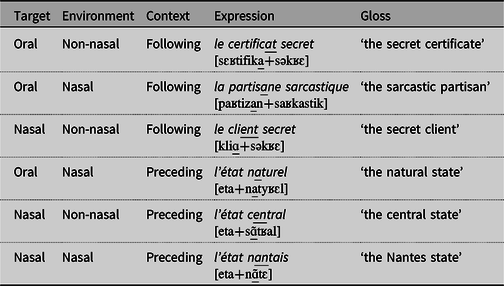
Environments are either non-nasal or nasal. The former consists of either another oral vowel or the consonant /s/. Nasal environments consist of either a following, noun-final nasal consonant (‘pre-nasal’) or a preceding nasal consonant in a word-initial syllable (‘post-nasal’). Because of phonotactic restrictions, word-final nasal vowel + nasal consonant sequences were necessarily absent from the stimuli. The types this system yielded are illustrated in Table 1 for low vowels. A broad transcription in IPA of each example, minus the determinant, is provided underneath the orthographic expression; ‘+’ indicates a word boundary. For a complete list of stimuli, see Appendix A.
Sample stimuli for low vowels (targets underlined), by type

3.3 Procedure & instrumentation
Recording was conducted in a quiet setting, typically a classroom or the participant’s house, using a Glottal Enterprises hand-held nasometer (NAS-1 SEP Clinic). This device consists of two equally-spaced microphones and one of three separator plates, depending on the participant’s anatomy. The plate, when pressed against the upper lip, effectively blocks the nasal signal from the oral signal, allowing for separate but simultaneous recording and/or measuring of the two. The instrument is factory-calibrated once for the rest of its usage; regardless, the proper functioning of the nasometer was verified with the subject near the beginning of each recording session. For all recordings, the nasometer was connected to a laptop. Recordings were done in Praat at a sampling rate of 44.1kHz in stereo, in which each channel corresponded to one of the two microphones.
After filling out a standard sociolinguistic survey (including information such as age, sex, area of birth and linguistic history), it was verified that participants were not suffering from a cold, allergies or anything which may alter their speech. They were then fitted for the proper sized plate and trained on how to use the nasometer. Speakers performed the reading task three times. The list of stimuli was randomized anew for each repetition for each speaker. Items were displayed in a spreadsheet, which participants scrolled through at a self-directed pace.
3.4 Measurements and calculations
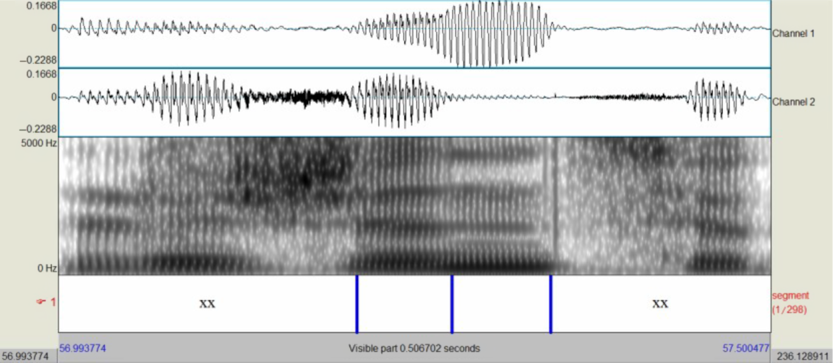
Target vowels were isolated manually in Praat using indices in both the spectrogram and waveform, as illustrated for the expression (la) jeune secrétaire in Figure 1. The first empty label (later filled in via a script) corresponds to the vowel and the second to the nasal consonant. The absence of oral pressure in the second channel waveform was construed as the vowel-nasal consonant boundary. Note that the first channel corresponds to the nasal microphone.
Example of segmentation of the segments /ø/ and /n/, respectively, in a pronunciation of the word jeune.

Energy measurements were then extracted over 5 ms intervals within each channel via a Praat script. Intervals were calculated progressively starting from the beginning of the vowel, and final intervals shorter than 5 ms were not measured. Individual vowel duration was also extracted. Outliers were defined as any point whose oral or nasal energy was either (1) above three times the interquartile range plus the third quartile or (2) below the first quartile minus three times the interquartile range (all calculated on the basis of participant and vowel, separately for oral and nasal energy). These points, numbering 1,750 out of 68,228 (2.6%), were removed, leaving 66,478 points. Total vowels in the corpus numbered 4,315 after this procedure.
Oral and nasal energy readings were then normalized separately, within participant and phoneme, using min-max scaling. This procedure was performed by subtracting from every reading the minimum energy value of that channel for that speaker’s phoneme, which was then divided by the maximum energy value of that speaker’s phoneme within that channel minus the minimum energy of that channel for that speaker’s phoneme. That is, oral energy values of a particular phoneme were normalized for each speaker using the minimum and maximum of that person’s oral energy readings for that same phoneme. This was similarly performed on nasal energy values with respect to nasal energy minima and maxima.
A consequence of intra-phonemic normalization that must be borne in mind is that the threshold of nasality is effectively defined independently for each phoneme. For example, let us consider a hypothetical system in which pre-nasal [a] and [i] each have a mean DER of 50. This result means that [a] is on average half nasal in this context with respect to fully oral [a], as is pre-nasal [i] with respect to oral [i]. We cannot conclude from this information, however, that the profiles of raw oral and nasal energy, or the raw proportion of one to the other, are the same between phonemes. This is a desired consequence, as the methodological design of this study intentionally attempted to mitigate the potential height-specific confounds of nasal coupling discussed in §2.2.
Normalized oral and nasal energy readings were then used to perform the DER, as described in §2.3. Note that contrastive nasal vowels and their oral counterparts were treated the same by this process; this assumes that a fully nasalized token of a given underlying oral vowel should have the same energy ranges as a comparable, contrastive nasal vowel for the same speaker. Mean DER and standard deviation were finally calculated according to vowel quality and context for the whole corpus.
The DER was also calculated on pre-normalized energy values in order to determine the effect of normalization on the results. The mean and standard deviation of the difference between pre- and post-normalized DER (that is, the DER as performed on pre- and post-normalized energy values, respectively) were calculated for each speaker and each of the four major types (i.e., contrastive nasal vowels, oral vowels in non-nasal settings, pre-nasal oral vowels and post-nasal oral vowels). The Spearman’s rank order correlation test was run for pre- and post-normalized DER scores as a whole, and the coefficient was then calculated between pre- and post-normalized DER scores within each speaker’s data. As it was hypothesized that the correlation between these two scores was negatively proportional with a speaker’s overall acoustic intensity, mean oral energy was also performed for each speaker.Footnote 9 This same process was performed for nasal energy in the place of oral energy with insignificant results and is thus no longer considered.
In order to ensure the results presented here are not an artefact of the DER, the same, normalized energy readings were also fed into Rochet and Rochet’s (Reference Rochet and Rochet1991) temporal, nasalance-based formula in the following manner: First, for each point of a token, the ratio of nasal energy to total energy was performed. The number of points with a ratio greater than or equal to 0.5 were then summed for each token. This sum was finally divided by the total number of points measured for that token and multiplied by 100 to provide a score comparable to the DER. This formula is hereafter referred to as NAS, and values of the NAS increases only as the duration of the nasal phase (modeled as number of points measured, that is, increments of 5 ms) increases.
The difference of the NAS from the DER (i.e., DER minus NAS) was calculated for each token. The mean and standard deviation of the difference were then performed for the underlying oral vowels within each phoneme and within each phonological context (i.e., non-nasal, pre-nasal and post-nasal); the mean and standard deviation of the difference were also calculated for each of the contrastive nasal vowels separately. The Spearman’s rank order correlation coefficient was also calculated between the DER and the NAS. Finally, in order to gauge the severity of difference between these two measurements for individual vowels, the number of tokens lying within the 95% limits of agreement was calculated following Bland and Altman (Reference Bland and Altman1999). These limits were defined as the mean difference (DER minus NAS) ± 1.96 standard deviations of the difference, which were again performed within phoneme and (where relevant) phonological context.
Finally, the DER and durational results of pre- and post-nasal vowels were analysed separately with respect to the three following factors, using a Generalized Estimating Equation (GEE) with an exchangeable covariance matrix in order to take into account the cluster effect of repeated measures from each participant: First, the association between duration and vowel category was analysed using a GEE with a normal distribution and identity link function, with one factor of height at three levels (high, mid and low). Second, the analysis of nasality was done using the same approach with the height factor, controlling for duration, followed by a post hoc test with Bonferroni correction. Finally, proportion of nasality (DER ≥ 50%) was done based on the same approach but with binomial distribution and identity link function. These same procedures were then duplicated with the NAS data. These analyses were done in SAS version 9.4 with a significance level of 5%.
4. RESULTS
4.1 Preliminary matters
4.1.1 Effects of normalization
The mean and standard deviation of the difference between pre- and post-normalized DER according to speaker and phonological context is presented in Table 2. Positive numbers indicate greater post-normalized DER. For each of the contexts, speaker-specific mean differences outside the group mean difference ± 1 standard deviation of the group are arbitrarily shaded in the table in order to facilitate its interpretation. Note that ‘BM’ indicates monolingual speakers from Brest, ‘PB’ bilingual speakers from the Picard-speaking region and ‘PM’ monolingual speakers from this same region.
Mean and standard deviation of post-normalized DER minus pre-normalized DER, by speaker and phonological context

With few exceptions, oral vowels showed little average difference between scores, while some speakers showed a large positive difference in the contextual nasal vowels, meaning pre-normalized DER scores were abnormally low for these speakers’ vowels. In VN and NV contexts, effects were much more variable, though again, certain speakers stood out.
The Spearman’s correlation test run showed a strong, positive, monotonic correlation between pre- and post-normalized DER scores for the dataset as a whole (r s = 0.78, p < 0.001). The Spearman’s coefficient was also calculated between the two scores for each speaker, and a simple linear regression was performed to predict the coefficient value based on each speaker’s mean oral energy. A significant regression equation was found (F(1,18) = 18, p < 0.001), with an R 2 of 0.5135. Mean oral energy significantly predicted the Spearman’s correlation coefficient between pre- and post-normalized DER values, such that greater mean oral energy led to a lower correlation score (β = -2.1, p < 0.001). This is not totally unsurprising, as loudness is a salient secondary cue to nasality (see, for example, Zraick et al., Reference Zraick, Liss, Dorman, Case, LaPointe and Beals2000 and references therein) but risks overwhelming ratio-based formulae of nasality after a certain point.
Note that the inclusion of height in the above regression as an interaction factor with mean oral energy did not lead to an improvement of the overall model (p < 0.001, R 2 = 0.4499). In fact, height proved insignificant for the correlation coefficient between pre- and post-normalized DER, whether as a main or interaction effect.
All in all, normalization had an effect of raising nasality scores for speakers with lower pre-normalized nasality scores due to higher-than-average oral energy being fed into the DER equation. Nevertheless, the strong correlation between pre- and post-normalized DER shows that the two are not radically different from one another. As we shall see in §4.1.3, the behaviour of control vowels after normalization argues for the appropriateness of this procedure.
4.1.2 NAS vs. DER
The mean and standard deviation of the difference of the NAS from the DER values (both performed on normalized energy readings) according to phoneme and phonological context (where relevant) are presented in Table 3. Note that a positive mean indicates that the DER is higher, while a negative mean indicates the NAS is higher. Vowel-specific differences outside an arbitrary value of the group mean difference ± 1 standard deviation of the group for any given context are shaded in the table to ease interpretation of the table.
Mean and standard deviation of DER minus NAS, per vowel and phonological context

High vowels and [ø] exhibited a relatively large positive mean difference in post-nasal position, between 6.44 and 9.49, with [ø] having the highest mean difference. These vowels were characterized as slightly more nasal by the DER than by the NAS. In this same context, [o] was judged as on average less nasal by the DER. Meanwhile, [a, e, o] all demonstrated a relatively large negative mean difference in pre-nasal position, between -4.16 and -6.51; the DER thus characterized these as slightly less nasal, with [a] as the most extreme of the group. Underlying oral vowels showed little difference in general, [u] having the largest difference of -3.5 (see §4.1.3 for more discussion of this vowel). The measurements also showed relatively little difference in underlying nasal vowels, with the mid front unrounded vowel showing the most variation.
The Spearman’s correlation test showed a very strong, positive, monotonic correlation between the DER and the NAS (r s = 0.99, p < 0.001). The Spearman’s order correlation coefficient between the DER and the NAS was also calculated separately for all vowels in all phonological contexts and proved very strong for all cases. The lowest value was 0.84 for post-nasal [o], with all other cases being higher than 0.9. Concerning the proportion of points within 95% limits of agreement, post-nasal [i] had the lowest score at 90%; that is, only 10% of post-nasal [i] tokens had a difference outside of the limits of agreement. All other cases had a larger percentage of tokens within these limits of agreement.
All in all, the DER and the NAS correlate strongly and show high levels of agreement. In the absence of perceptual data, we can only speculate as to whether the NAS or the DER differ with listener judgements of nasality and, if so, which correlates better. For the time being, the DER is taken as, at worst, acceptably similar to Rochet and Rochet’s (Reference Rochet and Rochet1991) implementation of nasalance, especially seeing as nearly no differences in statistical significance obtained between the two measurements’ models (see §4.2.1 and 4.2.2). At best, though, the DER may prove more sensitive to potentially important acoustic cues to nasality (i.e., the velocity of changes in oral and/or nasal energy).Footnote 10
4.1.3 Controls
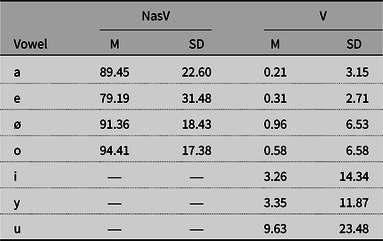
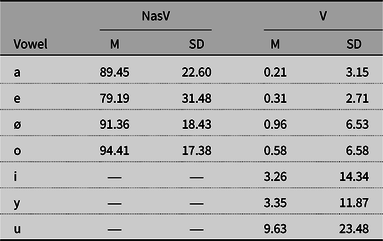
Table 4 provides the mean DER and standard deviation for nasal and oral controls. Nasal control vowels (that is, underlying nasal vowels) showed appropriately elevated DER rates, further suggesting the positive effects of normalization. Averages ranged from 79.19 in the case of /ɛ̃/ to 94.41 in the case of /ɔ̃/. Standard deviation was lowest within this group for /ɔ̃/ at 17.38 and highest for /ɛ̃/ at 31.48. Meanwhile, control oral vowels (that is, oral vowels in non-nasal contexts) showed predictably low DER rates. The average rates of all these vowels were beneath 3.35, with the sole exception of /u/, with an average DER of 9.63. Standard deviation was also consistently low for non-high vowels, with a maximum of 6.58 for /o/; these numbers were slightly elevated among high vowels, at 14.34, 11.87 and 23.48 for /i, y, u/, respectively. A closer examination of high vowels, especially /u/, revealed that oral tokens of this vowel with relatively elevated DER rates also displayed abnormally low oral energy values, often due to pre- or post-voiceless obstruent vowel devoicing.Footnote 11 The erroneously high nasal percentages of voiceless segments in general are a known problem for ratio-based measurements (e.g., Audibert and Amelot, Reference Audibert and Amelot2011). In future work, such vowels may be removed. All in all, however, controls suggested correct functioning of the instrument and the calculations performed.
Mean and standard deviation of DER for nasal and oral controls
4.2 Test vowels
Descriptive statistics on test vowels (i.e., pre- and post-nasal vowels) and figures are provided here before each context is presented separately in more depth. As region of origin (Finistère vs. Somme) had no significant effect on nasality of pre-nasal vowels (p = 0.454), and the interaction of region and height had no effect on nasality either (p = 0.335), the results of both groups are pooled for the discussion of these vowels. Region is addressed in more detail for the post-nasal vowels in §4.2.2.
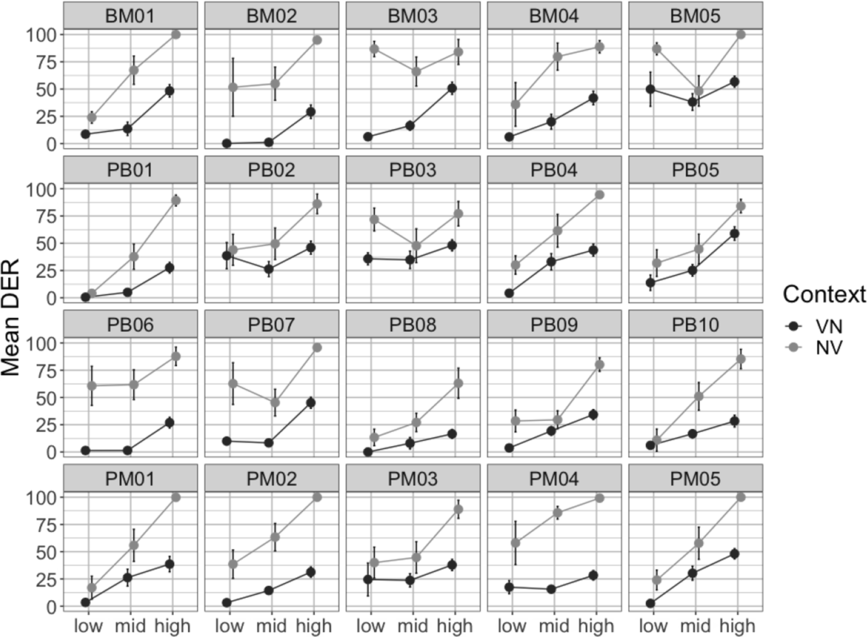
Figure 2 plots the mean DER for each participant’s test vowels according to height and context (VN and NV). The darker dots represent mean DER for each height (in the order of low, mid and high) for each participant in the VN context, while lighter dots represent this same information, but in the NV context. A line connects the dots from one height to the next within each context, allowing for a comparison of heights. Different contexts can be compared within a given height by looking at the two dots in any of the three x-axis bins. Black error bars indicate standard error of the mean within these group factors.
Mean DER by speaker and height, pre- and post-nasal vowels.

Within height categories, all speakers uniformly showed higher DER rates in NV settings, in comparison with VN settings. Within speakers, inter-height trends generally held in both settings. Finally, though some speakers stood out in that their low vowels were more nasal than mid in VN and/or NV settings, in general, either a monotonic relationship (low < mid < high) or a distinction between non-high and high (low = mid < high) held within a given context for a given speaker.
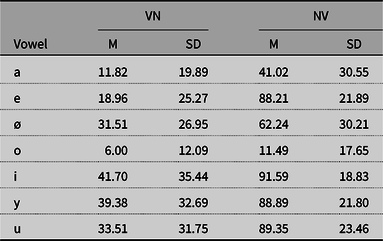
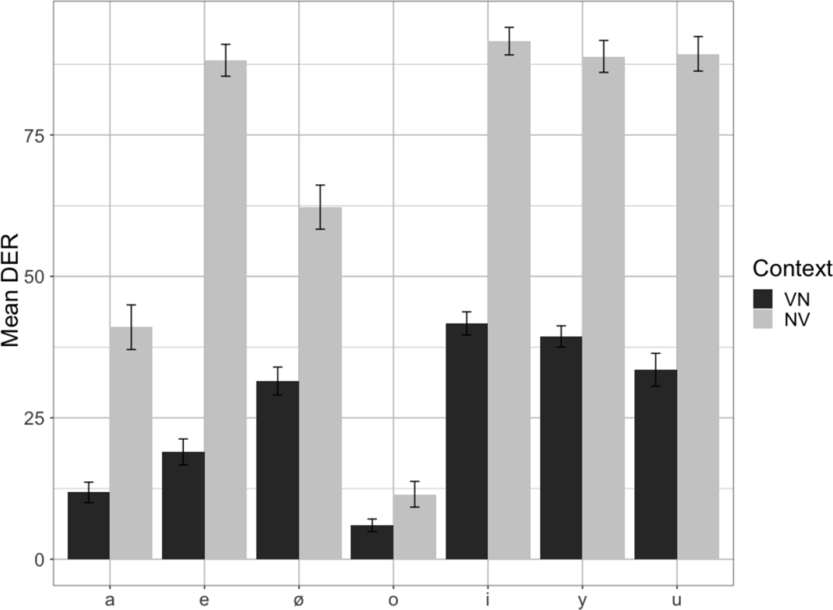
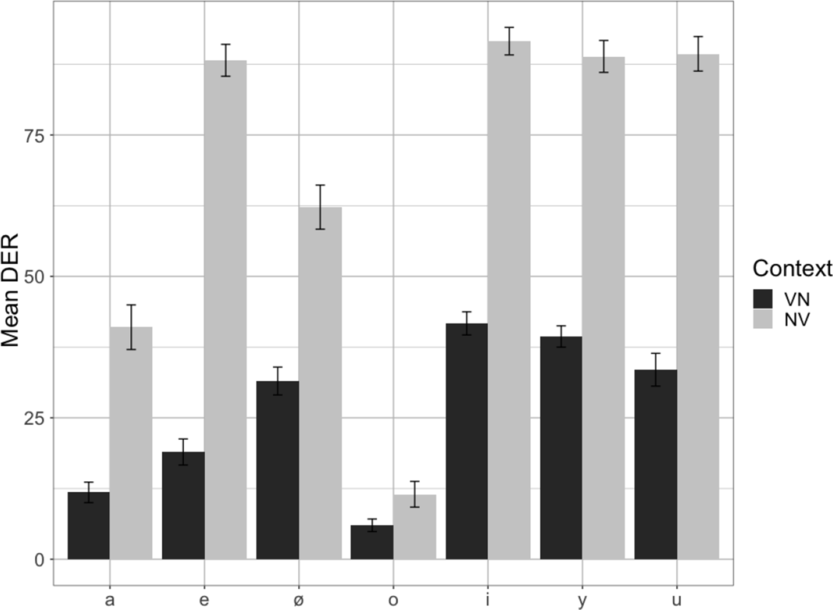
Table 5 provides the mean and standard deviation of the DER of pre- and post-nasal vowels by individual target for the group as a whole. These means are plotted in the bar graph in Figure 3, in which shade indicates context and bins on the x-axis indicate target vowel. Error bars represent standard error of the mean within these group factors.
Mean and standard deviation of DER, pre- and post-nasal vowels

Mean DER of pre- and post-nasal vowels, by target.
Finally, the scatterplot in Figure 4 shows the relationship between DER and duration, in seconds, of each token. Panes are broken out into height (low, mid and high) and context (pre-nasal and post-nasal). The x-axis represents DER from 0 to 100, and the y-axis represents overall vowel duration in seconds.
Nasality (DER) vs. duration (s) of pre- and post-nasal vowels, by height.

4.2.1 Pre-nasal vowels
As demonstrated in Table 5, pre-nasal /a, e, o/ showed relatively low DER averages at 11.82, 18.96 and 6, respectively (SD = 19.89, 25.37, 12.09). /ø/ had the highest rate of non-high vowels at 31.51 (SD = 26.95). High vowels /i, y, u/ were on average 41.7, 39.38 and 33.51 nasal, respectively (SD = 35.44, 32.69, 31.75).
Estimated mean difference was highly significant for duration between all height categories in pre-nasal position (p < 0.001 for all comparisons) in the following directions: high vowels (
 $$\hat \beta $$
= 0.073 seconds, SE = 0.004) were significantly shorter than both low (
 $$\hat \beta $$
= 0.099 s, SE = 0.005) and mid (
 $$\hat \beta $$
= 0.082 s, SE = 0.004) vowels, while low vowels were significantly longer than mid vowels.
A highly significant effect of nasality according to height was observed (p < 0.001), though slopes of change in nasality over time as a function of height were not significantly different (p = 0.1378). Controlling for duration (at the average of 0.08 s), the estimated means of nasality were 38.81 for high vowels (SE = 2.44), 19.24 for mid (SE = 3.17) and 13.85 for low (SE = 2.42). The difference between high and mid vowels and high and low vowels proved highly significant (p < 0.001), but not that between low and mid vowels (p = 0.088).
A highly significant effect of proportion of nasality (that is, number of tokens with a DER equal to or exceeding 50) according to vowel height was also obtained (p < 0.001); the reader is referred back to §3.4 for the aspects of the model accounting for the cluster effect of repeated measures from each participant. An estimated 35.8 of pre-nasal high vowels met this criterion (SE = 0.031), versus 12.3 of mid (SE = 0.027) and 6.7 of low vowels (SE = 0.032). Again, the difference between high and mid and high and low vowels both proved highly significant (p < 0.001), while that between low and mid vowels did not (p = 0.131).
The same statistical tests were run on the pre-nasal results using the NAS, the temporal-based measurement of nasality discussed in §3.4. No differences in significance (or lack thereof) were found.
4.2.2 Post-nasal position
Post-nasal /a/ showed the second lowest DER average of 41.02 (SD = 30.55). Mid vowels were more stratified, from /o/ with the lowest value at 11.49 to /ø/ at 62.24 and /e/ with the highest of mid vowels with an average DER of 88.21 (SD = 17.65, 30.21, 21.89, respectively). High vowels showed uniformly high levels of nasality, with average DER rates of 91.59, 88.89 and 89.35 for /i, y, u/, respectively (SD = 18.83, 21.8, 23.46).
Differences in estimated mean of vowel duration according to height is also highly significant for all pairwise comparisons (p < 0.001), though not in the same directions as in pre-nasal position. Mid vowels (
 $$\hat \beta $$
= 0.114 seconds, SE = 0.004) were longer than both high (
 $$\hat \beta $$
= 0.085 s, SE = 0.002) and low (
 $$\hat \beta $$
= 0.072 s, SE = 0.002), with low vowels showing the shortest estimated mean.
The link between nasality and duration was not the same according to height level (p < 0.01). An estimated slope of -55.17 (SE = 63) was observed for high vowels, versus -563.53 (SE = 79.46) for mid and -463.57 (SE = 358.22) for low vowels. Pairwise comparisons of height were thus performed for estimated nasality at three different durations: at the first quartile (0.072 s), the median (0.086 s) and the third quartile (0.113 s).
At the shortest duration, high vowels had an estimated mean of nasality of 90.4 (SE = 2.08), while this number decreased for mid vowels (
 $$\hat \beta $$
= 77.39, SE = 3.57) and was lowest for low vowels (
 $$\hat \beta $$
= 41.02, SE = 5.21). All pairwise comparisons of nasality according to height were significant: high vowels were highly significantly more nasal than low (p < 0.001) and very significantly more nasal than mid (p < 0.01). Low vowels were highly significantly less nasal than mid (p < 0.001).
At the second duration, the same patterns generally held, though nasality was slightly decreased for all levels, and all pairwise comparisons were highly significant (p < 0.001). High vowels (
 $$\hat \beta $$
= 89.97, SE = 2.11) were more nasal than mid (
 $$\hat \beta $$
= 70.38, SE = 3.19) and low (
 $$\hat \beta $$
= 35.93, SE = 6.84), and mid vowels were more nasal than mid.
At the longest of these three durations, high vowels remained quite nasal (
 $$\hat \beta $$
= 88.96, SE = 3.11), while mid vowels were much less nasal than at shorter durations (
 $$\hat \beta $$
= 53.98, SE = 3.32), and low vowels remained low in nasality (
 $$\hat \beta $$
= 24.01, SE = 15.83). The pairwise comparisons of high and low and high and mid vowels were highly significant (p < 0.001), high being more nasal than both, while the difference between low and mid vowels was insignificant (p = 0.1066).
Just as pre-nasal vowels, the effect of height on proportion of nasality proved highly significant (p < 0.001) for post-nasal vowels. 92.8% of high vowels met this criterion (SE = 0.023), versus 53.3% of mid (SE = 0.041) and 35% of low vowels (SE = 0.08). The differences between high and mid and high and low vowels both proved highly significant (p < 0.001), while that between low and mid vowels did not (p = 0.0965). A significant main effect of region obtained for the proportion of nasality (p < 0.05), though not in interaction with height (p = 0.4688). Upon closer inspection, a slightly greater proportion of pre-nasal vowels in the group from Finistère had a DER greater than or equal to 50 than in that from Somme (although the height effects detailed above all held within the Somme group). Seeing as participants in the former group numbered only five, however, more data may be needed to investigate this effect.
The same tests were repeated with the NAS in lieu of the DER as the measurement of nasality for post-nasal vowels. Only three differences emerged: First, the difference in nasality between low and mid vowels at the longest duration tested (0.113 s) remained significant (p < 0.05). Second, with respect to the effect of height on proportion of nasality (here, whether NAS was equal to or exceeded 50), the difference between low and mid vowels again remained significant with this measurement (p < 0.01). Finally, the main effect of region of origin no longer proved significant (p = 0.1247). Otherwise, no differences in significance or lack thereof were found.
5. DISCUSSION
The results partially support the first of the three hypotheses made in §2.6. High vowels in pre-nasal position were the shortest and more nasal than mid and low vowels. Mid vowels were longer than low in this same position, but not significantly different with respect to nasality. It must be noted, though, that in terms of average nasality and standard deviation, the three vowel qualities composing the high vowel group behaved as a more coherent group than those making up the mid vowels (average DER: /o/ < /e/ < /ø/).
The post-nasal results go more strongly against the first hypothesis. In this context, mid vowels were the longest of the three heights, and low vowels were the shortest. On average, low vowels had an intermediate nasality with the highest amount of variation of post-nasal vowels, while high vowels showed consistently elevated rates of nasality and mid vowels were less nasal at any duration, but especially at longer ones. The three vowels again demonstrated heterogeneity within their category (average DER: /o/ < /ø/ < /e/). Seeing as /o/ stands out in both cases (and arguably /u/ in some cases), future studies may need to take into consideration the front-back parameter.
Unsurprisingly, the second hypothesis was borne out by the data. For all vowel heights (and indeed, all vowel qualities), post-nasal vowels showed greater average DER than pre-nasal vowels. This did not imply, however, that the relationship between duration and DER held the same for any given height between the two contexts. We now turn our attention to this matter.
The relationship between nasality and duration by height level can be construed for the most part as confirming the third (null) hypothesis, with one important exception. In pre-nasal position, high vowels decreased in nasality as a function of tokens’ duration at a non-significantly different rate as that of low and mid vowels. High vowels were on average more nasal in this position but also showed a large degree of variation, especially at shorter durations. In post-nasal position, mid and low vowels behaved similarly to pre-nasal high vowels in that they exhibited a considerable degree of variation in nasality and their nasality declined sharply and proportionately as tokens’ duration increased. High vowels, however, showed near-ceiling rates of nasality and remained significantly different from mid and low vowels at all durations investigated, as well as having a rate of decline in nasality over duration nearly ten times flatter than those of other vowels.
This article was framed in the dichotomy of controlled versus mechanical nasalization. Many of the groups observed in the results can confidently be categorized as indicative of one or the other. Namely, the data strongly suggest nasalization of high post-nasal vowels is a controlled property of NMF, while that of high pre-nasal vowels and mid and low post-nasal vowels is mechanical, as suggested by their variation and decline in nasality with duration. Meanwhile, low and mid vowels in pre-nasal position appear more resistant to mechanical nasalization, as suggested by their low rates of nasality and the lack of significant difference between them (but both being significantly different from high vowels). These results may, then, be indicative of blocking of nasalization under these circumstances as a controlled property of NMF. Such an analysis is in accordance with Spears’ (Reference Spears2006) notion of ‘sloppy’ vs. ‘strict’ coarticulation on high and mid vowels, respectively, which is also mirrored by Rochet and Rochet (Reference Rochet and Rochet1991) and Delvaux et al. (Reference Delvaux, Demolin, J.-Tarmegnies and Soquet2008). Note that this equivalence may not be borne out at the speaker-specific level, which may require further investigation.
The implementation of these findings within a phonological framework, specifically in the notions of process targets and blockers, is tenuous at this stage. In fact, speculation around the motivation of these tendencies offers more questions than it does answers. To begin with, recalling Coveney’s (Reference Coveney2001: 147) doubt that ‘there would hardly ever be any possible confusions between [contextually nasalized and intrinsically nasal vowels], since they occur in quite different contexts’, it would appear that NMF speakers adhere completely to lexical trends in their avoidance of nasal vowel + nasal consonant sequences, but only insofar as the process is structure-preserving (that is, creating nasal vowels that are contrastive elsewhere in the language). Non-contrastive nasal vowels (i.e., high) are tolerated here, though presumably not actively targeted. Whether its optional nasalization is the provenance of some gradient or variationist instantiation of phonology or a purely phonetic phenomenon is outside the scope of this article but may be probed in future research.
In the case of pre-nasal low and mid vowels, the intolerance of nasal coarticulation is particularly curious given that mechanical nasalization of these same vowels in post-nasal position may conflate actual minimal pairs in the language, seeing as the lexicon of French has no constraint against nasal consonant + nasal vowel sequences. That is, whether a lexical form such as peine ‘effort, punishment’ is pronounced [pɛn] or [pɛ̃n], the underlying orality of the vowel should still be recoverable, given the lack of lexical forms such as /pɛ̃n/ (or however one wishes to represent nasality at the underlying level). Meanwhile, pairs such as mais [mɛ] ‘but’ and main [mɛ̃] ‘hand’, which differ primarily by nasality, are more liberally subjected to potential confusion when the former is subjected to nasalization.
Of course, other, more covert distinctions may serve to differentiate underlying NṼṼ-underlying but nasalized NV pairs, such as perseverance of nasal airflow into voiced oral stops following underlying nasal vowels but not underlying oral vowels, as documented by Cohn (Reference Cohn1990: 110) and Amelot (Reference Amelot2004: 68–70), for example. It is also a possibility that underlying nasal vowels may be distinguished from contextually nasalized vowels by the absence of modifications made to intraoral articulators observed in NMF contrastive nasal vowels (for instance, a heavily nasalized mais [mɛ̃] ‘but’ versus main [mø̃] ‘hand’, using Cariginan’s (Reference Carignan2014) notation). The diversity, pervasiveness and perceptibility of such effects in the present data may be investigated in future work, especially with respect to vowel formants.
It may be that in the case of post-nasal vowels, mechanical considerations are more demanding (e.g., Chafcouloff and Marchal, Reference Chafcouloff, Marchal, Hardcastle and Hewlett1999: 74–75), despite Laver’s (Reference Laver1994: 293) claim that regressive nasalization occurs more frequently in the world’s languages. Recall from §2.2 that lowering of the velum involves relaxation of the levator palatini muscle, widely thought to be the principle muscle regulating access to the velopharyngeal port (see Bell-Berti, Reference Bell-Berti, Huffman and Krakow1993: 65 for references), while raising of the velum can be conversely considered a more active process. As such, transitioning from a nasal to an oral segment may present greater difficulties than in the opposite scenario (VN), in which case the blocking observed in pre-nasal mid and low vowels may not be realistic. Cross-linguistic and perceptual data may be able to disentangle these effects.
All in all, these data suggest that the phonetic factors making high vowels more susceptible to spontaneous nasalization discussed in §2.2 play an important role in NMF, leading to elevated rates of nasality in shorter tokens of these vowels in pre-nasal context, and furthermore becoming a planned property of pronunciation in post-nasal context. As for non-high vowels, the oral-nasal contrast was not maintained everywhere. Articulatory concerns may explain why these vowels demonstrated middling to high rates of nasality at shorter durations in post-nasal contexts. However, at longer durations, as well as in pre-nasal contexts, these vowels remained relatively oral. The explanation of these effects is more nebulous at this stage, though a blocking effect due to contrast is a likely candidate frequently evoked in the literature.
A few final caveats are in order. First, though a robust range of durations was attested in most subcategories (post-nasal low vowels are a notable exception), again, the data examined here come from a single-rate reading task, unlike the variable-rate reading task in Solé’s (Reference Solé1992, Reference Solé, Solé, Beddor and Ohala2007) methodology. Such variable-rate data were gathered from these same speakers for a follow-up study and may nuance the portrait provided here (both in their more rapid rates and their slower rates). Second, the position in the word was unfortunately not controlled between regressive and progressive nasalization stimuli (being the word-final syllable in the former and the word-initial syllable in the latter, neither being utterance-final). If anything, however, lexical stress increases the likelihood for nasalization (e.g., Krakow, Reference Krakow, Huffman and Krakow1993), meaning the observed trends in post-nasal position manifested themselves despite this potentially adverse factor. This disparity was corrected in the stimuli for the follow-up (variable-rate) study. Finally, the conflation of mid-low and mid-high vowels may have had an impact on the cohesion of the group and/or certain differences between pre- and post-nasal contexts in the mid vowels. This may potentially be explored in the future by looking at formant values and/or different positions in the word.
6. CONCLUSION
This study examined the effect of vowel height on contextual nasalization, both regressive and progressive, in Northern Metropolitan French, using the behaviour of nasality with increasing overall duration as a proxy for the distinction between controlled and mechanical properties of speech. Evidence was robust that French differentiates both height and position in the following respects: First, high vowels appear actively targeted for nasalization in post-nasal settings. Second, nasalization appears actively avoided or blocked on low and mid vowels in pre-nasal settings. Finally, all other vowels show variation, being at times nasalized, but seemingly mechanically so.
These findings largely agree with previous studies on French coarticulation in the average rates of nasality. However, this study adds the precision that high vowel nasalization appears to be mechanical regressively but controlled progressively, and that non-high post-nasal vowels, though showing on average high to intermediate rates of nasality, decline rapidly in nasality outside of their shortest realizations. Meanwhile, in pre-nasal positions, non-high vowels resist nasalization, in keeping with previous analyses.
This variety of French appears to tolerate or require nasalization when the outputs of said process are non-phonemic, that is, high nasal vowels. However, the tolerance of potential conflation of oral-nasal pairs in post-nasal settings stands in stark contrast with the more categorical prohibition of low and mid vowel nasalization in pre-nasal settings, where nasal vowels cannot occur in native vocabulary. Explanation of this apparent paradox is likely to reside in French speakers’ knowledge and internalization of the lexicon, and by turn, the representation of vowel nasality itself.
Appendix A – Complete stimuli
‘#’ indicates a word boundary, ‘V’ an oral vowel and ‘N’ a nasal consonant of any place. The stimuli originally distinguished pre-nasal [i, y] sequences according to the participation, or lack thereof, of the nasal consonant in a nasal vowel ~ VN alternation (e.g., fine [fin] ‘fine (f.)’, which alternates with fin [fɛ̃] ‘fine (m.)’, versus routine [ȿutin] ‘routine’, which participates in no such alternation). As such, three additional sequences of [iN] and [yN] each are present in the stimuli.