INTRODUCTION
Tubeworms, Chaetopteridae (Annelida: Polychaeta) is a taxon found worldwide from intertidal sediments down to abyssal regions. This group posed species that bury their tubes, generally in sand or mud while others attach their tubes to hard substrates (Rouse & Pleijel, Reference Rouse and Pleijel2001). Depending on the species, the body can be divided in two or three conspicuous regions, a peristomium that may have one or two pairs of tentacular cirri and palps of variable length. The anterior region holds uniramous parapodia while median and posterior regions present biramous parapodia; setae include capillary, limbae setae and modified spines in setiger 4 with uncini pectiniform in posterior setigers (Fauchald, Reference Fauchald1977).
Phyllochaetopterus is a genus comprising 19 species (WoRMS, 2014), of which Phyllochaetopterus socialis Claparède, 1870 was found in the following regions of the world: New Zealand (Probert & Wilson, Reference Probert and Wilson1984); South Africa (Kalk, Reference Kalk1958); India (including Pakistan, Ceylon, Burma and Malaya) (Day, Reference Day1973); Mediterranean Sea (Southward et al., Reference Southward, Kennicutt, Herrera-Alcalà, Abbiati, Airoldi, Cinelli, Bianchi, Morri and Southward1996); South Carolina Continental Shelf (Gettleson et al., Reference Gettleson, Phillips and Hammer1985); rocky shore of Brazil (Nalesso et al., Reference Nalesso, Duarte, Pierozzi and Enumo1995); Mexico, Gulf of California (Kudenov, Reference Kudenov1975); and Costa Rica, Gulf of Nicoya (Dean, Reference Dean1996). Recently, it has been described for seas surrounding the Arabian Peninsula (Red Sea, Gulf of Aden, Arabian Sea, Gulf of Oman and Arabian Gulf) (Wehe & Fiege, Reference Wehe and Fiege2002), Argentina in estuarine areas of Río de La Plata (Obenat et al., Reference Obenat, Ferrero and Spivak2001) and harbour areas (Albano et al., Reference Albano, Pon, Obenat and Genzano2006), and in Japan (Nishi & Hsieh, Reference Nishi and Hsieh2009).
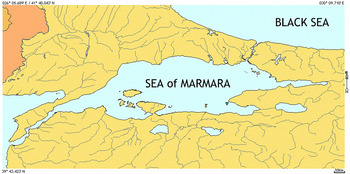
Southward et al. (Reference Southward, Kennicutt, Herrera-Alcalà, Abbiati, Airoldi, Cinelli, Bianchi, Morri and Southward1996) found P. socialis to be abundant close to the oxic/anoxic interface in caves with sulphurous springs at Cape Palinuro, Campania, Italy, which have a richer fauna than expected from the known oligotrophic nature of the cave habitat. The warm water containing sulphide issues from springs and rises above the cooler ambient seawater with a sharp thermocline/chemocline between. The warm water then escapes from the caves mixed with cooler seawater, probably inducing an inflow of ambient seawater. Dominant members of the community include sponges, cnidarians and tubicolous polychaetes. Nishi & Rouse (Reference Nishi and Rouse2007) found and described a new species of Chaetopteridae from the vicinity of hydrothermal vents in the Lau Basin, western Pacific Ocean and Phyllochaetopterus polus Morineaux Nishi Ormos & Mouchel, Reference Morineaux, Nishi, Ormos and Mouchel2010 were recorded as the first chaetopterid from the Atlantic hydrothermal vents on the Mid-Atlantic Ridge, from 4100–4200 m depth (Morineaux et al., Reference Morineaux, Nishi, Ormos and Mouchel2010). During a Marmara Environmental Monitoring (MAREM) project cruise, along the North Anatoly Earthquake Fault (NAF), near the deep-sea hydrothermal vents, in the Sea of Marmara, Turkey, on 7 August 2008, aggregates of Phyllochaetopterus socialis were first registered during beam trawl sampling on the biological sampling site; this record extends the geographical distribution of this species to the Sea of Marmara (Figure 1).
Location map of sampling site in Gemlik Bay, Sea of Marmara, Turkey.

Study area
The Sea of Marmara has, in vertical section, three different water layers distinctly separated from each other. The top layer originates from low salinity Black Sea water, in which salinity increases, but the thickness of the layer decreases considerably with the distance travelled from the Bosphorus to the Dardanelles by mixing and upwelling of the deeper layers originating from the Aegean and Mediterranean Seas (Artüz et al., Reference Artüz, Okay, Mater, Artüz, Gürseler, Okay and Artüz2007). The average depth of this top layer is about 25 m, in which salinity ranges from 19–26‰ according to the season and inflow from the Black Sea. This mixing of the top and the middle water masses has also a considerable effect on the temperature of both layers (Artüz et al., Reference Artüz, Artüz, Aydın, Gülen, Koç, Yalçın, Akdemir, Aydemir, Sönmez, Üstün, Ulunehir, Serter, Küçük, Kasap, Baki, Erzaim, Bulut, Özdemir and Artüz2010b). The middle layer of water has its greatest thickness near the Dardanelles, where the top layer tends to diminish to a thin film of water of some few metres, but becomes markedly thinner from this point to the entrance of the Bosphorus. This high salinity water fills all the deeper parts of the Bosphorus below 25–30 m and extends, under certain conditions, into the depths of the Black Sea (Artüz et al., Reference Artüz, Artüz, Aydemir, Sönmez, Özel, Öztaş, Tan, Merako and Artüz2008). There are also considerable changes of sea level caused by the outflow from the Black Sea, which is also largely responsible for the surface and deep currents in both directions, as well as the position of the vertical and horizontal boundaries of both layers (Artüz et al., Reference Artüz, Artüz, Gülen, Aydın, Yalçın, Gürseler, Sakınç, Demir, Ökten, Kubanç, Kubanç, Tezcan, Çubuk, Sönmez, Yalçın, Demir, Funda, Saçlıgil, Aslan, Çağlayan, Mancia, Kuyumcu, Tanrıkulu, Akay, Dinç and Artüz2013). The third and unaffected mass of water, which occupies all depths below 200 m in the Sea of Marmara, has a constant temperature of 14.2°C, a salinity of 38.5‰ and no seasonal variations occurred (Artüz et al., Reference Artüz, Artüz, Aydemir, Sönmez, Özel, Öztaş, Tan, Merako and Artüz2008, Reference Artüz, Artüz, Gülen, Torcu, Üzen, Aydemir, Sönmez, Akdemir, Bakacak and Artüz2009, Reference Artüz, Artüz, Aydın, Gülen, Torcu, Akdemir, Aydemir, Sönmez, Üstün, Serter, Küçük, Bakacak, Uzun, Bulut and Artüz2010a, Reference Artüz, Artüz, Aydın, Gülen, Koç, Yalçın, Akdemir, Aydemir, Sönmez, Üstün, Ulunehir, Serter, Küçük, Kasap, Baki, Erzaim, Bulut, Özdemir and Artüzb).
The main problem in the Sea of Marmara since 1980 is the exponentially growing pollution. All the settled areas around the Sea of Marmara are discharging the wastes using ‘deep sea discharges’ without any treatment directly under the pycnocline–thermocline layer in the Sea of Marmara (Artüz et al., Reference Artüz, Okay, Mater, Artüz, Gürseler, Okay and Artüz2007). This marine pollution has 3 phases: first the pollutant effects and sensitive species reduce. In the second phase, when species diversity reduced, the survivor unit members in the environment would be increased/or invasive-alien species target there too. In other words the Sea of Marmara is developed to a paradise for invasive species that comes via water currents and/or ballast waters. It should be borne in mind that the 3rd phase of pollution is ‘adding an unimportant amount of pollutant to the environment changes the biotic environment to abiotic’ (Artüz et al., Reference Artüz, Artüz, Aydın, Gülen, Yalçın, Gürseler, Bargu, Koç, Köksoy, Deniz, Çubuk, Sönmez, Üstün, Ulunehir, Akay, Bulut, Özdemir and Artüz2012).
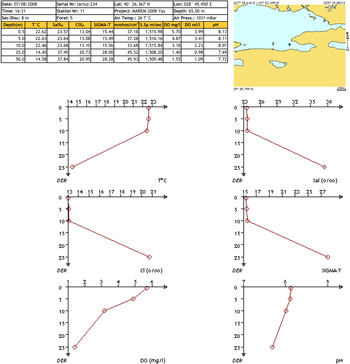
During our literature search we have not found an important record of P. socialis in the Sea of Marmara. It is considered that due to the decrease in the variety of species, P. socialis, found an appropriate environment and began to become widespread like many other new forms. The Gemlik Bay is located in the south-east region of the Sea of Marmara (Figure 1). Mean water depth is about 65 m, ranging between 30 and 70 m. Water of high turbidity along with low salinity on upper water mass and high salinity on lower water mass divided with sharp pycnocline layer, low dissolved oxygen (1.40–1.55 mg/l) and low pH (7.70–8.02) characterize the area (Figure 2). This harbour has an appreciable increased pollution due to sewages without any treatment, industrial discharged sewage, naval traffic and other contributions of surroundings waters (Artüz et al., Reference Artüz, Okay, Mater, Artüz, Gürseler, Okay and Artüz2007).
Hydrographic data representing the Gemlik Bay (summer season).

Prior to the intense pollution, the Sea of Marmara had a rich biological structure composed of different biological events and various forms in discrete layers depending on the special geo-ecological location factors such as: narrow and shallow thresholds of the Dardanelles and Bosphorus as biological corridors/barriers, Black Sea originated water mass with low salinity and Mediterranean originated water mass with a high salinity as located one over another, 1000 m and deeper basins that are surrounded and limited by the shallow shelf areas; and variable surface water mass temperature, fluctuating depending on meteorological conditions between 6°C and 29°C annually, whereas 14.2°C constant temperature of the under thermocline interface, can be considered (Artüz et al., Reference Artüz, Artüz, Aydemir, Sönmez, Özel, Öztaş, Tan, Merako and Artüz2008). One of the factors that create this difference is the places that are connected to the earthquake faulting structure at the Sea of Marmara, NAF. This is mainly due to the different mineral and gas concentrations in the areas influenced by seismic activity. Microhabitats exist due to the warm water layer along the earthquake faults and as a result of the geological deformation caused by earthquakes (Artüz et al., Reference Artüz, Artüz, Aydın, Gülen, Yalçın, Gürseler, Bargu, Koç, Köksoy, Deniz, Çubuk, Sönmez, Üstün, Ulunehir, Akay, Bulut, Özdemir and Artüz2012).
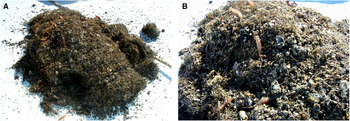
The main Marmara Fault exhibits numerous sites of fluid venting, observed during the previous MAREM project monitoring cruises (Artüz et al., Reference Artüz, Artüz, Aydın, Gülen, Yalçın, Gürseler, Bargu, Koç, Köksoy, Deniz, Çubuk, Sönmez, Üstün, Ulunehir, Akay, Bulut, Özdemir and Artüz2012). They are highly visible because of the different density level on the echo-sounder outputs. On the echo outputs, density cones extend in the water column 30–35 m high and with an 11–13 m diameter up to the pycnocline/thermocline layer. The average environmental temperature above the vent mouth of hydrothermal vent was measured up to 45–47°C while no salinity/pH change was observed (34.5 ‰Sal, pH 7.98). The beam trawl sample, which included dense P. socialis aggregates (Figure 3), was taken around the hydrothermal vents at Gemlik Bay, Sea of Marmara, Turkey.
Phyllochaetopterus socialis aggregates (A) on-board total; (B) detail.

MATERIALS AND METHODS
Aggregates (mats) of P. socialis Claparède, 1870, were hauled by an annual beam trawl survey on 5 August 2008, at a depth of 53 m along the NAF, near the deep-sea hydrothermal vents, in the Sea of Marmara, Turkey, along the coordinates (40°28.700′N/028°45.683′E and 40°28.267′N/028°45.950′E) (Figure 1). The material was landed with single 3.50 m (length overall: 3.75 m) beam trawl with 18 mm stretched mesh size at cod-end. Hauls were repeated once at each station with a 15 min duration and boat speed of 2 mph. The hauled area was 308 m2 in total. After washing the total landed material in sieves (10 mm and 5 mm), the aggregates of P. socialis were selected and sampled; mats were collected by hand and washed with seawater in sieves for separating from mud rests, stored in plastic bags with seawater and then fixed with formaldehyde solution/seawater (5%) on-board. Random samples were photographed alive, collected in glass jars also fixed with a mixture of formaldehyde solution/seawater (5%) for further examinations, bar-coded and listed in a database with bar-code number: 155-43AL.
Water quality data
All the in situ parameters were measured with a CTD YSI 6600 V2 multi-parameter data sonde along the water column with 1 sec duration (approximately 10 cm intervals) from the surface (0.5 m) to the deepest section of the station, then stored and processed in Hidro-QL database and software.
Biological data
The identification of macrobenthic fauna was undertaken in the laboratory on-board, or transported as formalin fixed material (5% with seawater) to the main laboratories by the scientists of related disciplines and added to the inventory database of the MAREM project. After computing the abundance of each taxon at the sampling station, the macrobenthic community structure was described calculating the following descriptors: the diversity of species of the station was shown with the Shannon–Wiener diversity index. H′= –∑ p i ln p i where p i is the proportion of the total sample belonging to the i th species and the Margalef species richness index D mg = (S – 1)/1nN where N is the total number of individuals in the sample and S is the number of species recorded.
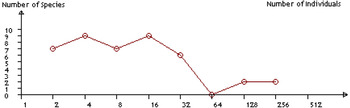
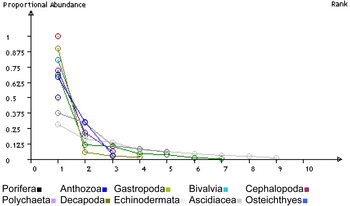
Abundance lognormal distribution was applied, where a bell-shaped curve (called a normal distribution) indicates that most species have an intermediate number of individuals. A few species have very many individuals and a few species have very few individuals. In order to produce a normal distribution, the categories on the X axis were plotted so that each one was twice as great as the preceding one (1, 2, 3, 8, 16, 32, etc.), creating a log2 scale. The distribution thus produced is called a lognormal distribution and rank abundance of the station (where plotting proportional abundance against rank in the community) produces a rank-abundance curve. This curve can provide information on species diversity and richness. The slope of a line on the graph is associated with evenness. If most of the species have a similar number of individuals (high evenness), the line on the graph will have a smaller slope. A horizontal line indicates that all of the species have the same number of individuals. A community that is dominated by one or a few species will have a steep slope—these factors are also calculated and shown respectively.
RESULTS
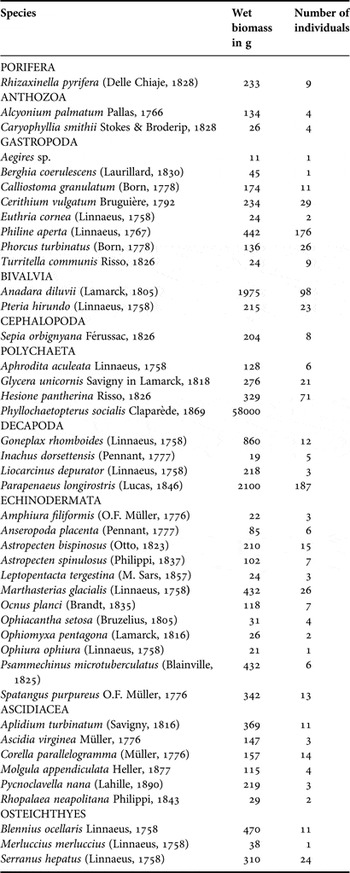
Mats of P. socialis (Figure 2) were observed arising from the scattered hard substrate of mud (sapropel) bottom between the lower limits of the sub-tidal floor belonging to the north-west outer shelf of Gemlik Bay, along the following sub-sea section of NAF on the connection area with other local earthquake faults. Aggregates were stuck to different sides of the hard substrates, such as empty shell blocks stuck together, equally hanging or arising. Accumulation of organic material was observed at the basal structure of P. socialis mats. Total wet weight of the mats was 58 kg. Forty-three species belonging to 10 phyla were recorded from the total of landing species: Porifera, Anthozoa, Gastropoda, Bivalvia, Cephalopoda, Polychaeta, Decapoda, Echinodermata, Ascidiacea and Osteichthyes. The blanked species diversity and wet biomass of the total landed material from the site are shown in Table 1.
Species diversity and abundance table of the whole landing material (Artüz et al., Reference Artüz, Artüz, Gülen, Aydın, Yalçın, Gürseler, Sakınç, Demir, Ökten, Kubanç, Kubanç, Tezcan, Çubuk, Sönmez, Yalçın, Demir, Funda, Saçlıgil, Aslan, Çağlayan, Mancia, Kuyumcu, Tanrıkulu, Akay, Dinç and Artüz2013).

Regarding our measurements, a Shannon–Wiener diversity index of 2.74 indicates moderate diversity in the P. socialis mats. These calculated values will give us a general idea about dominance. The relationship between dominance and diversity is stated as follows: low dominance indicates high diversity, whereas high dominance indicates low diversity. In this case, since 2.74 tells us that the diversity in the P. socialis mats is moderate, the dominance and occurrence of the P. socialis is probably from the effect of hydrothermal vents in this area.
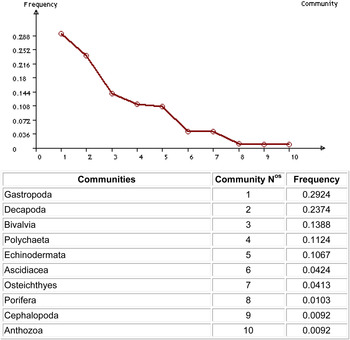
The lognormal distribution of species abundance is given as the graph in Figure 4 and for plotting proportional abundance against rank in the community. The presence graph and table are given in Figure 5 and the rank abundance curve of the station is given as a graph in Figure 6, respectively.
The lognormal distribution of species abundance; the number of species in the community is plotted (Y axis) against the individuals per species (X axis).

Presence graph and related table of Phyllochaetopterus socialis habitat.

Rank-abundance plot for 10 landed phyla (Porifera, Anthozoa, Gastropoda, Bivalvia, Cephalopoda, Polychaeta, Decapoda, Echinodermata, Ascidiacea and Osteichthyes) from the sampling site.

Species diversity is a function of species richness (number of species) and evenness. Echinodermata and Gastropoda are more diverse than the others, because of the evenness and higher species richness (with 12 and 8 species, respectively) (Figure 5).
DISCUSSION
Chaetopterida are soft and fragile tube-dwellers with characteristic mid-body modifications for filter feeding by means of secreted mucous bags. The lengthy tubes are the easiest part of chaetopterids to recognize and are found in dense vertical tangled clusters buried partly or wholly in the sediment, or attached to rock or other faunal growths. Most are composed of very durable hardened secretions from anterior ventral glands and long outlast the original builders (Gilbert, Reference Gilbert, Uebelacker and Johnson1984).
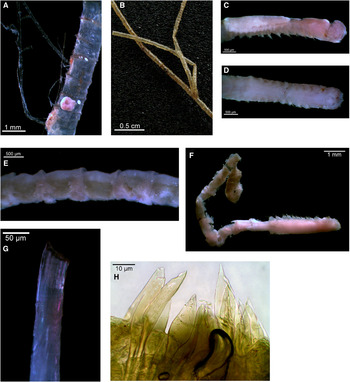
Some species live in characteristically annulated, translucent, slender tubes, e.g. Spiochaetopterus, and some in very tough opaque tubes, brown (chitinous) or white (parchment-like) in colour. Both types may be branched (Figure 7 A, B). The tubes of Chaetopterus species are less durable, but still long-lasting. They are fibrous like a heavy paper (parchment), opaque, and likely to be more or less buried horizontally in the sediment, although some may be surface dwelling. The largest chaetopterid, large enough to be used for fish bait, is Chaetopterus variopedatus (Renier, 1804), a famous animal beloved by biology textbook authors for its bioluminescence, remarkable powers of regeneration from fragments and rhythmic behaviour (Blake, Reference Blake, Blake, Hilbig and Scott1996). They are tolerant of low oxygen and proliferate in sulphidic conditions; they also feed on bacteria, but do not contain symbionts (E.C. Southward, personal communication)
Phyllochaetopterus socialis: (A) details of part of the tube; (B) branched part of the tube; (C) lateral view of anterior section of P. socialis with mucous bag; (D) ventral view of anterior section of P. socialis; (E) lateral view of posterior section ‘fans’ of P. socialis; (F) whole worm dissected from tube of P. socialis; (G) darkfield image of the modified chaetae; (H) chaetae of anterior region notopodium.

Chaetopterids have a blunt head bearing a pair of palps outside an ovoid prostomium and sometimes a pair of small eyes. The body is strongly regionalized. There are a few anterior segments with notopodia only, with distinctive strong spines present on chaetiger four, then two regions with notopodia and neuropodia. Middle-region notopodia are supported by embedded chaetae. Neuropodia have bands of fine uncini (Figure 7). There are no gills. Only about 30 chaetopterid species are known worldwide (Nalesso et al., Reference Nalesso, Duarte, Pierozzi and Enumo1995). Adult size: the tubes may be tens of centimetres long, but only 1–2 mm wide, except for Chaetopterus tubes which may be 2 cm or more wide. Chaetopterus species may be 80 mm in length; species of other genera are smaller (Figure 7 A, B).
The relationships and separation of the four chaetopterid genera are currently under re-evaluation; however, the distinguishing characters are broadly as follows: the last anterior segment in Chaetopterus has a pair of long notopodia which secrete the mucous bag used in feeding (Figure 7 C), the first middle segment has a cupule which collects it, then follow three fan-like segments (Figure 7 F); in Phyllochaetopterus, Spiochaetopterus and Mesochaetopterus the mid-body segments include one or more with cupules and several with notopodial lobes which are bilobed in the first two genera but never bilobed in Mesochaetopterus; and Phyllochaetopterus has an additional short pair of cirri-like structures (‘antennae’ of some descriptions, although they are probably modified notopodia) (Figure 7 G) close to the palps and has chitinous bristles protruding from pockets in the body wall (Figure 7 H). In all chaetopterids the notopodia of the posterior region are elongate (Albano et al., Reference Albano, Pon, Obenat and Genzano2006) (Figure 7 E).
Albano & Obenat (Reference Albano and Obenat2009) studied the assemblage of benthic macrofauna in the aggregates of the tubiculous worm P. socialis in the Mar del Plata Harbour, Argentina. Their results allow us to consider P. socialis as an autogenic ecosystem engineer in the Mar del Plata Harbour. The assemblage of benthic macrofauna with permanent and temporary organisms in P. socialis aggregates suggests the existence of microhabitats in the mats that provide substrate, refuges for predation and availability of food, thus increasing richness and diversity. Also, these studies will contribute to the knowledge about the very important role this Chaetopteridae worm has in the benthic community.
Apart from the long term structure of the work of Albano & Obenat (Reference Albano and Obenat2009), assemblage of benthic macrofauna in the aggregates of P. socialis in the Mar del Plata Harbour, Argentina and oceano-ecological condition differences, the compared basic results of that work and our study are as follows: Albano & Obenat (Reference Albano and Obenat2009) found a total of 57 species associated with P. socialis compared with our results of 43 species. Crustaceans and molluscs were the most abundant species and crustaceans and polychaetes were the most diverse groups (14 and 11 species richness, respectively) in their work. In our work, molluscs and crustaceans are the most abundant species and echinoderms and molluscs (Gastropoda, Bivalvia and Cephalopoda) are the most diverse groups (12 and 11 species richness, respectively). The main and the major difference of both works is the availability/absence point of the echinoderm community of benthic macrofauna in comparable aggregates on the different locations in the world. Contrary to the study of Albano & Obenat (Reference Albano and Obenat2009), the echinoderm community in benthic fauna takes a major place in our study.
The benthic material monitoring has been carried out on the same site by the MAREM project, in the Sea of Marmara since 1954. According to our experiences of previous years, measured dredged species composition of thise site was unusually stringent. When we compare the species composition of the site with the previous experiments, it would be impossible to guess that the site belongs to the same area. That experience makes us think that habitat change occurred due to the effect of the huge phytoplankton blooming based (Rhizosolenia calcar-avis Schultze, 1858) mass mucilage aggregate sunk into the bottom, throughout the Sea of Marmara in 2007 (Artüz et al., Reference Artüz, Artüz, Aydemir, Sönmez, Özel, Öztaş, Tan, Merako and Artüz2008).
ACKNOWLEDGEMENTS
We acknowledge the Sevinç-Erdal İnönü Foundation that oversaw the long term Marmara Environmental Monitoring project. We also acknowledge the crew of the vessel ‘Oktay 4’ for their help with collecting the material. We also thank Eve Southward for her assistance during the identification work. We appreciate the assistance of Professor Dr. Dinçer Gülen who provided relevant information.