The Roma are Europe’s most vulnerable and disenfranchised population (European Union Agency for Fundamental Rights, 2009a), with profound consequences for their health. Some are completely excluded from access to health care, whereas many others face hostility and discrimination in health care settings. Although there are many challenges in obtaining data, including on how to define the Roma population (Fesus et al., Reference Fesus, Ostlin, McKee and Adany2012), it is estimated that life expectancy for Roma is typically 10 years below the average of the country in which they live (Fundacion Secretariado Gitano, 2012), and infant mortality is twice the national average in countries such as Serbia (Statistical Office of the Republic of Serbia, 2011). Roma communities must further contend with disproportionate unemployment and poverty (European Commission Against Racism and Intolerance, 2010), with many living in segregated informal settlements under precarious living conditions (Kósa et al., Reference Kósa, Széles, Kardos, Kósa, Németh, Országh, Fésüs, McKee, Ádány and Vokó2007; European Union Agency for Fundamental Rights, 2009b). In health care settings, Roma experience outright denial of medical services, low levels of immunisation (Duval et al., Reference Duval, Wolff, McKee and Roberts2016), substandard health care and even segregation (European Roma Rights Centre, 2006; Ezer et al., Reference Ezer, Cohen and Quinn2014).
The Roma plight has been the subject of considerable national and international attention (Hajioff and McKee, Reference Hajioff and McKee2000; Foldes and Covaci, Reference Foldes and Covaci2012), leading to the Decade of Roma Inclusion 2005–2015 (2015) which concluded in 2015. The activities undertaken within the framework of this initiative have had limited success (Jovanovic, Reference Jovanovic2015). In Hungary, where changes in health over the Decade have been evaluated, there was some progress in reducing reported discrimination and improving health of older Roma, but worsening among the young (Sandor et al., Reference Sandor, Kosa, Boruzs, Boros, Tokaji, McKee and Adany2017). There are many reasons for the limited progress, such as lack of facilities in Roma communities. One important factor has been the inability of Roma to realise their legal entitlements to obtain appropriate and responsive services. Some reasons relate to legal status, such as inability to obtain official identity documents, whereas others relate to the behaviour of health workers, including denial of treatment or other forms of discrimination (Kuhlbrandt et al., Reference Kuhlbrandt, Footman, Rechel and McKee2014; Arora et al., Reference Arora, Kuhlbrandt and McKee2016).
Since 2010, the Open Society Foundations (OSF) have supported legal approaches to address the rights of Roma in the health sector. These approaches have emphasised increasing accountability for violations of Roma rights in health care settings and addressing systemic impediments to accessing health care in the first place. This initiative is based on the premise that rights violations have an impact on health (OSF, 2015) and that legal tools exist that can address violations against Roma in health care settings but are not adequately enforced (Abdikeeva et al., Reference Abdikeeva, Ezer and Covaci2013). For the law to be useful, it is critical for those who might benefit to be aware that they have rights and there are avenues to challenge violations, but also the capacity to bring challenges. Indeed, rights literacy often serves as a prerequisite for legal advocacy (OSF, 2015), and the OSF initiative includes an explicit focus on this important aspect. It is vital that civil society can carry out effective advocacy if the gap is to be closed between the existing law and its implementation, ensuring accountability for violations of the rights of Roma in health care settings while addressing the systemic impediments that this population faces in access to health care.
A baseline assessment of the situation facing Roma in three countries – Macedonia, Romania and Serbia – was conducted in 2012 (Abdikeeva et al., Reference Abdikeeva, Ezer and Covaci2013). This found that Roma lacked knowledge of their rights and ‘rarely challenged violations’. Roma-centred non-governmental organisations (NGOs) had limited capacity to educate or empower Roma on health and human rights. Accountability for violations of rights in health care settings was ‘practically non-existent’. However, the assessment did note that in those cases where advocacy had been used, ‘violations decrease, and power dynamics shift’, enabling Roma to assert their rights. Crucially, it found that where health care had become more responsive to Roma communities, it also benefited non-Roma – a finding with important implications for advocacy with key stakeholders in each country (Abdikeeva et al., Reference Abdikeeva, Ezer and Covaci2013).This paper describes the follow-up investigation to this assessment, undertaken in 2014–2015 in the same three countries.
Methods
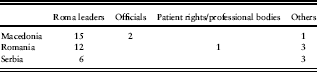
Progress was assessed during a series of site visits and interviews with key informants. Sampling of key informants was purposive, primarily designed to include Roma community leaders. However, a number of other interviews were undertaken with those responsible for implementing programmes, as well as with government officials, professional and patients’ rights associations and journalists who have played a role in reporting violations (Table 1).
Details of interviewees

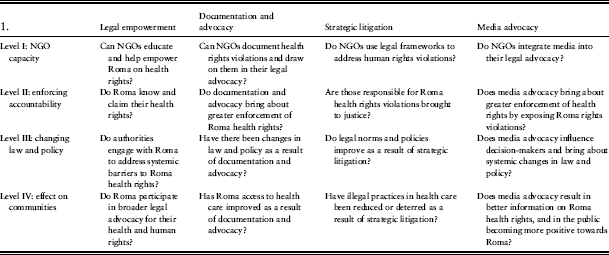
A topic guide was developed, based on the activities supported by OSF. For consistency, this was used in both the baseline and current studies (Table 2). The topics were legal empowerment of Roma communities, human rights documentation and advocacy, strategic litigation and media advocacy. It sought to identify the impact of these activities at four levels: strengthening the capacity of Roma-centred NGOs to address rights violations, increasing the enforcement of Roma rights, changing laws and policies and consequences for communities. Interviews followed the topic guide and were then mapped onto the conceptual framework.
Assessment framework (Abdikeeva et al., Reference Abdikeeva, Ezer and Covaci2013)

Note: NGO=non-governmental organisations.
We sought to achieve validity in data collection in several ways (Morse et al., Reference Morse, Barrett, Mayan, Olson and Spiers2002). First, we explored whether there was any reason to believe that personal biases may have influenced findings. Second, we considered whether there might be any biases in sampling. Third, we sought to ensure that our interviews were enabling us to achieve sufficient depth of insights. Fourth, we engaged in meticulous record keeping, including a clear decision trail, so that we could ensure that our interpretations were consistent and transparent. Fifth, in our interview notes we included rich and thick verbatim descriptions of participants’ accounts. Sixth, we have undertaken respondent validation, inviting participants to comment on interview transcripts and confirm that the conclusions reflect the issues as seen by them.
Results
Legal empowerment
The baseline study indicated that Roma were ‘largely unaware of their health and human rights and remedies available to them’. Consequently, they ‘seldom’ moved forward with ‘formal complaints’ (Abdikeeva et al., Reference Abdikeeva, Ezer and Covaci2013). The follow-up assessment, however, revealed considerable advances in the capacity of Roma-centred NGOs to conduct legal empowerment, facilitating the ‘transfer of power from the usual gatekeepers of the law—lawyers, judges, police and state officials—to ordinary people who make the law meaningful on a local level and enhance the agency of disadvantaged populations’ (OSF, 2013). The Macedonian Association for Emancipation, Solidarity and Equality of Women (ESE) has provided paralegal training to its three Roma partner NGOs: Centre for Democratic Development and Initiatives, KHAM Delcevo (Humanitarian and Charitable Association of Roma Delcevo), and Initiative for Development and Inclusion of Communities (IDIC) (formerly the Roma Resource Center). Paralegals drawn from the communities they serve not only deliver educational sessions on a broad set of issues related to rights but also offer help to address individuals’ concerns about health rights. They provide ‘legal first aid’, responding quickly to violations, addressing multiple needs that are not just legal and connecting their peers to further support as needed (OSF, 2015).
Legal empowerment was also reported to have led to increased capacity in Romania and Serbia. In Romania, the leading Roma NGO, Romani CRISS, supported the NGO Hope and Trust in developing their capacity for advocacy to advance Roma health rights. Hope and Trust has thereby progressed from cultural mediation and help in facilitating communication with health care providers to documenting complaints and working with local authorities to remedy violations ranging from denial of services to forced evictions (Interviews with Romani CRISS and Hope and Trust in Bucharest and Constanta, Romania, October 2014). Likewise, in Serbia, Bibija has provided mentorship and support to two grassroots Roma NGOs, Novi Becej and Romani Cikna. Members of Roma communities attending a meeting in Ohrid, Macedonia, in 2012 reported that the projects have helped local Roma communities, particularly women, to claim their health rights (Questionnaire completed by Novi Becej and Romani Cikna, Ohrid, Macedonia, July 2012).
This, in turn, has contributed to greater capacity among Roma communities. In all three countries, interviewees reported greater awareness among Roma communities of their rights, their increased willingness to challenge violations and greater facility with the relevant legal frameworks and procedures. In Macedonia, Roma paralegals reported that the nature of their work had changed. When they began, Roma clients needed assistance with basic paperwork and navigating bureaucratic procedures, but by 2014, this was much less of an issue, and clients brought in complaints that were better articulated and more specific. The paralegals were thus able to concentrate their efforts on more complex cases and to address rights violations directly (Interviews with HERA, ESE and KHAM Delcevo in Skopje, Macedonia, September 2014).
This has had important impacts on communities. In all three countries, Roma communities in the areas where the projects were operating described a marked reduction in denial of care, the charging of illicit fees, the confiscation of personal identity documents as well as harassment and other flagrant abuses by health care personnel (Report from KHAM Delcevo, May 2013; Interviews with Roma-centred NGOs in Macedonia, Romania and Serbia, September–October 2014). Empowerment of Roma communities was also evident. For example, villagers in Crnik, Macedonia, have successfully advocated for the opening of a local vaccination centre and have applied for status as a ‘rural health area’, which would provide government-funded incentives for health care providers to practice there.
However, much remains to be done. A 2014 survey conducted by ESE in Macedonia reported that over one-third of Roma still described receiving ‘unkind treatment’ from medical specialists, whereas the corresponding figure among non-Roma was just over 5%. Almost 1 in 10 Roma reported being insulted by doctors, whereas the figure among non-Roma was just over 1% (ESE, 2014). Moreover, patients in need of serious medical care are in a particularly vulnerable position. As a Roma activist in Romania noted, ‘It is very hard to shout, “Accountability!” when your wife is in labour, or your child is in pain, and they are in the doctor’s hands’ (Interview in Romania, October 2014).
Another major concern is the ability to attract sustainable funding. This is a particular problem in Romania, where there had been relatively generous funding available before European Union (EU) accession, in large part, because better treatment of the Roma minority had been a criterion for accession (McKee et al., Reference McKee, MacLehose and Nolte2004). However, since accession, these funds have largely dried up. Although EU structural funds are now available, few organisations have the skills to access and manage these complex grants. In Macedonia, groups have taken a creative step towards the sustainability of the paralegal programme through municipal support. KHAM and IDIC succeeded in obtaining some municipal funding as well as permission to use official premises once a week for receiving clients (Ezer et al., Reference Ezer, McKenna and Schaaf2015). National-level recognition and support, however, would be necessary to expand these programmes beyond a few localities and to genuinely meet Roma needs across the country.
Documentation and advocacy
In the baseline assessment, although certain NGOs in all three focus countries carried out human rights documentation, confusion prevailed about ‘the difference between documenting human rights violations and filing cases for court purposes’, and most groups could not ‘accurately detect, identify, and document human rights violations against Roma in healthcare settings’ (Abdikeeva et al., Reference Abdikeeva, Ezer and Covaci2013). The follow-up assessment, however, found that documentation served a crucial role in identifying patterns of rights violations and conducting tailored legal advocacy. In Macedonia, ESE and HERA (Health Education and Research Association) have established a sophisticated documentation system for their legal empowerment projects, enabling them to monitor the achievements of paralegals and to capture changing patterns in health-related human rights complaints. They are experimenting further with the integration of legal empowerment and social accountability approaches, which rely on community participation to demand government accountability, in order to effect a more sustainable shift in power relations (Ezer et al., Reference Ezer, McKenna and Schaaf2015). In addition, both ESE and HERA collaborate with Roma grassroots groups on documentation that they have then integrated into shadow reporting before international human rights bodies. In 2015, based on participation by ESE and their partners in Macedonia’s Universal Periodic Review, the United Nations Human Rights Council urged the government to ensure that a lack of documentation does not bar access to health care, particularly for ethnic minorities; to provide access to primary health care services for all children, particularly Roma; and to conduct a country-wide assessment of Roma health needs (United Nations, 2014). Engagement of international human rights bodies is considered an important strategy because the governments of the three countries – particularly Macedonia and Serbia, which aspire to EU accession – seem more sensitive to criticism from abroad than to that from domestic civil society.
Collaboration on documentation between national-level NGOs and grassroots groups has played an important role. In Romania, Romani CRISS has established a network of human rights monitors, including Trust and Hope, enabling them to base their advocacy on an assessment of systemic problems and community needs. In Serbia, partnerships between grassroots Roma NGOs and Belgrade-based legal NGOs have proven effective for documenting human rights violations and selecting potential cases for strategic litigation. Examples of such partnerships include Bibija with Law Scanner and Praxis; similarly, the Minority Rights Center has partnered with Little Prince, Roma Researchers and Women’s Space (Interviews with Roma-centered NGOs in Belgrade, Serbia, October 2014).
Documentation and advocacy have led to some significant changes in law and practice. For instance, in Romania, the College of Physicians, the main body reviewing patients’ complaints, has agreed to include lawyers in its reviews, following years of human rights monitoring by Roma-centred NGOs. Previously, this medical professional body was categorically opposed to any interference by ‘civilians’. According to Romanian lawyers, this promises to promote a degree of accountability for rights violations in health care settings (Interview with Madalin Morteanu, CJSHR in Bucharest, Romania, 21 October 2014). At the same time, the segregation of Roma in health care facilities in Romania, despite its documentation and, eventually, formal recognition by health care professionals as a problem, has not led to a change in practice. In Serbia, as a result of documentation and advocacy, government authorities simplified procedures for Roma lacking identity documents to access health insurance, an issue that had been a major barrier to obtaining care (Idzerda et al., Reference Idzerda, Adams, Patrick, Schrecker and Tugwell2011; Kaluski et al., Reference Kaluski, Stojanovski, McWeeney, Paunovic, Ostlin, Licari and Jakab2014). However, in practice, this has not yet led to serious improvements in Roma access to health services because Roma are largely unaware of this law and little effort has been made by the authorities to reach them. In Macedonia, a task force has been established to deal with the identity papers of undocumented Roma as a direct result of relentless documentation and advocacy by Roma-centred NGOs (Interview with Senad Mustafov, Ministry of Labor and Social Policy in Skopje, Macedonia, September 2014).
At the level of the community, Roma-centered NGOs attribute some progress in their work. In Romania, Roma advocates report modest improvements in the behaviour of doctors towards Roma. Previously, Romanian doctors were ‘ready to eat NGOs alive for even mentioning discrimination’ in their reports. Now, some doctors have begun to realise that Roma face ‘objective’ barriers to health care and not simply ‘cultural’ barriers, as previously used to justify Roma non-participation in the health care system (Interview with Gergel Radulescu from Sastipen in Bucharest, Romania, 21 October 2014).
Strategic litigation
Strategic litigation is a relatively new tool in the health and human rights arena in this region (Goldston, Reference Goldston2006). In the baseline assessment, the capacity of Roma-centred NGOs to engage in litigation was noted as being very limited (Abdikeeva et al., Reference Abdikeeva, Ezer and Covaci2013). However, there has been considerable progress. For example, HERA reports that although there were no cases related to unlawful charges imposed on Roma women for obstetric/gynaecology services in Macedonia in 2012, this increased to four in 2013 and 10 in 2014, and although it fell back to four in 2015, it rose dramatically to 22 in 2016, associated with the increased capacity of Macedonian NGOs, including HERA, in taking these cases (Email from HERA to Alphia Abdikeeva, February 2017). In Macedonia alone, health rights cases rose through the hard work of NGOs from virtually 0 in 2012 to at least 44 cases brought to court by 2016 and hundreds more resolved through alternative mechanisms. The Macedonian NGO, Roma S.O.S. (2016), in particular, has developed its litigation capacity and has been especially active in strategic litigation to address denial of health insurance coverage to those who fell victim to little-known provisions relating to documentation that disproportionately affected Roma. Currently, many cases involving Roma health are also pending in courts in other countries. An example is from Romania, where Romani CRISS and the Euroregional Center for Public Initiatives (ECPI) have brought the first legal case challenging Roma segregation in health facilities. Moreover, there is growing recognition of the opportunities for seeking redress in the European Court of Human Rights (Interview with Iustina Ionescu, ECPI in Bucharest, Romania, 21 October 2014.). In Romania, there is also the possibility of using EU law, including the Charter of Fundamental Rights, either in national courts or before the European Court of Justice. Inspired by this work, other Romanian NGOs are now investing in enhanced litigation capacity – this includes the Center for Juridical Studies and Human Rights (CJSHR) and O del Amenca (Interviews with Madalin Morteanu from CJSHR and Florin Nasture from O del Amenca in Bucharest, Romania, 21 October 2014).
As the baseline assessment notes, since the start of this initiative, strategic litigation has already had some impact on law and policy. In Macedonia, Roma S.O.S. successfully challenged a requirement that individuals provide an income statement from the previous year to renew their health insurance, which imposed a disproportionate barrier to health care access for many Roma. The repeal of this requirement, moreover, benefited non-Roma who lack identity documents or work seasonally, by enabling them to achieve continuity of coverage. In Serbia, Praxis has used a combination of constitutional complaints and direct engagement with relevant authorities to successfully persuade the government to simplify residence registration procedures, so that undocumented Roma can receive their health cards and access health care services more easily (Abdikeeva et al., Reference Abdikeeva, Ezer and Covaci2013). NGOs continue to bring cases with the potential to impact law and policy, such as a Romanian case challenging Roma segregation in a health facility, but it takes time for these issues to be resolved by the courts and for the outcomes to be assessed.
In some cases, strategic litigation has also resulted in greater accountability and has had an important impact on Roma communities. In Macedonia, Roma S.O.S. successfully litigated the first case proving medical negligence by a doctor towards a Roma patient and obtained compensation for a boy who lost his arm. This resulted in newfound enthusiasm among clients of Roma S.O.S. to assert their rights, and health care professionals, aware of the potential for human rights complaints, are reported to have shown greater courtesy and restraint in their dealings with Roma patients (Roma S.O.S., 2016). However, when Romani CRISS successfully sued the Romanian President and Prime Minister for hate speech and defamation in connection with their comments on Roma, this was not seen as having changed either the politicians’ attitude or the country’s overall acceptance of Roma (Interview with Marian Mandache from Romani CRISS in Bucharest, Romania, 21 October 2014). Although many barriers to effective strategic litigation remain – including court costs and evidentiary challenges – Roma communities are showing less fear of retaliation and are more willing to pursue challenges in the courts. However, this is only when they are supported by Roma-centred NGOs in undertaking cases. Few would be willing to file complaints independently (Interviews with Roma-centred NGOs in Macedonia, Romania and Serbia, September–October 2014).
Given the cumbersome bureaucracy of the formal court system, Roma-centred NGOs in Macedonia have also been experimenting with informal mechanisms, such as the Ombudsperson and specialised commissions on patients’ rights and discrimination. This has been the avenue pursued by LIL and National Roma Centrum. Although decisions by these bodies are not legally binding, they carry political weight and can also be authoritatively referenced in court cases.
Media advocacy
Anti-Roma prejudice pervades mainstream media outlets in the three countries, which cannot be relied on to promote accountability for Roma rights violations. In Serbia, Roma advocates describe the majority of journalists as being ‘filled with prejudice and stereotypes, and usually intolerant toward distinct societal groups’ (Interview with Djurdjica Ergic from Bibija in Belgrade, Serbia, November 2014). Moreover, the media in all three focus countries remain attracted to ‘scandalous’ cases. As a representative of Bibija put it, ‘Scandal sells the news’ (Interview with Djurdjica Ergic from Bibija in Belgrade, Serbia, November 2014). According to the baseline assessment, most Roma-centred NGOs ‘limit their media engagements to occasional press-conferences and interviews with no strategic plan or meaningful follow up, and generally lack the understanding and skills necessary to make the most of media advocacy’ (Abdikeeva et al., Reference Abdikeeva, Ezer and Covaci2013).
At the time of the follow-up assessment, Roma-centred NGOs have found creative ways to engage with media and further their advocacy. Roma S.O.S. is a regular participant in televised debates and media interviews on Roma issues. They incorporate a media strategy into their strategic litigation and have effectively generated media attention on the child’s plight in the medical negligence case noted above. ESE and KHAM Delcevo have produced a series of widely viewed videos on different Roma health issues. KHAM Delcevo has also revamped its website and launched several online petitions, and it hosts a regular talk show on local community radio. IDIC has produced a number of photo essays featuring Roma individuals (Interviews in Macedonia, September 2014; Questionnaire completed by Roma S.O.S., ESE, KHAM Delcevo and IDIC in preparation for meeting in New York, USA, December 2014). In addition, HERA has effectively used politicians’ fear of negative publicity to encourage their participation in, and response to, the NGO’s own health rights initiatives (Interview with HERA in Skopje, Macedonia, September 2014). In Romania, too, Roma activists recognise that politicians and doctors are ‘afraid of the media’ – or, rather, of negative publicity – which can be a useful tactical tool for advocacy purposes (Interviews with George Lacatus from the Roma Journalists Association and Gergel Radulescu from Sastipen in Bucharest, Romania, October 2014). Mainstream media have also covered the most egregious violations against Roma, including segregated health facilities in Romania and endemic lack of identity documents in Macedonia and Serbia (Interviews with Roma-centered NGOs in Macedonia, September 2014 and Serbia, October 2014).
Summary of findings
Several key findings arise from this assessment. First, the area where positive changes have been most pronounced following OSF support is in the legal empowerment of Roma communities. The employment of Roma paralegals, drawn from the communities they serve, stands out as a good practice in particular, enabling greater trust and access and a rapid response to multiple needs. Levels of awareness among Roma of their health and human rights and their capacity to challenge rights violations have improved notably. This has already led to reports of reductions in the denial of care, the charging of illicit fees, the confiscation of personal identity documents and harassment.
Second, although documentation of human rights forms a crucial basis for advocacy, it does not guarantee redress, and results have been mixed. However, collaboration between grassroots groups and national-level groups have been productive, and the combination of legal empowerment and documentation based on social accountability approaches seems particularly promising. In addition, groups are now complementing their domestic advocacy with international pressure, which may yield improved results.
Third, valuable strides have been made in strategic litigation, including removal of some of the bureaucratic obstacles that prevented Roma from exercising their access to health care. With successful litigation, Roma communities are showing less fear of retaliation and more willingness to take court action to assert their rights. However, this is only with the support of Roma-centred NGOs.
Finally, progress in getting the mainstream media to change their narrative about Roma and in enforcing accountability for human rights violations in health care settings has been limited. However, advocates have made effective and creative use of talk shows, community radio, video narratives and photo essays.
Discussion
Limitations
This study has a number of limitations. First, Roma communities are dispersed across all three countries. Although, overall, they live in conditions that are significantly worse than those of their non-Roma compatriots (Kósa et al., Reference Kósa, Széles, Kardos, Kósa, Németh, Országh, Fésüs, McKee, Ádány and Vokó2007), their circumstances vary. Roma also differ in their degree of assimilation with the majority population, which likely impacts their experience of obtaining health care. Second, it was only possible to undertake a relatively small number of interviews, although the information provided was validated as far as possible by triangulating with data from other sources. Third, and most importantly, in an observational study such as this, it is not possible to attribute specific changes to individual interventions, such as the activities of a specific NGO. Many other events were taking place in each country at the same time.
Lessons learned
This overview of the developments in the three countries where OSF has supported legal advocacy for Roma health rights indicates that the overall objectives – increasing accountability for Roma rights violations in health care settings and addressing systemic barriers to accessing health care – continue to be appropriate. The implementation strategies selected – legal empowerment, human rights documentation and advocacy, strategic litigation and media advocacy – have also retained their relevance.
Although there is still a long way to go, Roma groups report that legal advocacy projects have had an important impact on their ability to challenge violations in the localities where they are based. There are grounds to believe that this has also started to deter some of the most blatant abuses of Roma rights as Roma have greater awareness of their rights and ability to seek redress.
A number of good practices stand out. First, Roma paralegals have been instrumental in increasing Roma rights awareness and the use of available remedies. Second, benefits seem to have arisen from collaboration on documentation among national-level and grassroots groups and links to strategic litigation, international advocacy, and engagement with media. Third, the tactic of combining legal empowerment strategies with social accountability tools seems to bring synergies when seeking to improve Roma access to health and other social rights. Finally, creative use of talk shows, community radio, video narratives and photo essays can play a valuable role in a hostile media environment.
At the same time, new challenges accompany successes, as legislative changes are rapid and frequent in the countries and each new legal advance – whether nationally or within regional integration processes – requires retraining and adapting existing strategies and tools or adopting new ones. In a context of limited resources, both material and human, this presents a formidable task. Roma-centred NGOs also frequently face an uphill battle against deteriorating political conditions domestically, and the international and regional frameworks protecting human rights can only partially mitigate these.
The greatest need now is for the scaling up of successful pilot projects at the national level and the dissemination of good practices regionally and internationally in order truly to change the dire contemporary picture of Roma health. Advocates in Macedonia are now engaged in the struggle for scale-up and sustainability. The National Action Plan for Roma Health provides one potential avenue for national funding for Roma legal empowerment in the context of health although the Law on Free Legal Aid would also need to be updated so that it functions effectively and covers the critical work of paralegals. The European Roma Rights Centre has created a website on strategic litigation and, when last updated in February 2016, reported 97 cases ongoing in 16 countries, about 80% of which were being heard in domestic courts (European Roma Rights Centre, 2017).
In summary, this paper offers a reminder that the law can be an important tool in the realisation of health rights of vulnerable and marginalised population such as Roma.
Acknowledgements
This paper has been made possible through the support of the OSF. The authors are grateful for the review and comments of Ryan Quinn, Sebastian Kohn and Alina Covaci.