INTRODUCTION
Effective learning, through formal training and development programs and informal vicarious learning through teamwork, is one of the key methods for organizations to increase employee productivity and organizational effectiveness (Chen & Klimoski, Reference Caro2007; Tharenou, Saks, & Moore, Reference Tharenou, Saks and Moore2007). As such, US organizations spent ~$164.2 billion on upskilling their employees in 2012, and this figure is growing every year (Association of Talent Development, Reference Ashton2015). However, in comparison to the private sector, there is far less focus on learning via formal training and development programs in the public sector and it is less available and accessible. Additionally, there is a stronger requirement for public sector employees to learn on the job non-formally through incidental learning from colleagues (Berman, Bowman, West, & Van Wart, Reference Berman, Bowman, West and Van Wart2012).
Additionally, despite the resources directed at training and the expectations of what training and development should deliver to the employee and the public they serve, there remains debate about why learning options (training formally or incidentally training on the job using teamwork activities) fail to deliver the expected benefits in terms of improving employee capacity or positively impacting employee outcomes (Branderhorst & Wognum, Reference Branderhorst and Wognum1995). The significance of effectively transferring key training outcomes is even more important because of the reduced per capita funding of public sectors generally (Berman et al., Reference Berman, Bowman, West and Van Wart2012). Three sets of factors continue to be identified in the literature as affecting the impact of training: (a) trainee characteristics (personal factors affecting learning motivation), (b) training design (what and how the training is delivered) and work environment (the extent to which there is compatibility between the training experience and the workplace) and (c) the role of the supervisor (Hawley & Barnard, Reference Hawley and Barnard2005).
Research concerning the first set of factors, trainee characteristics, by Combs, Luthans, and Griffith (Reference Combs, Luthans and Griffith2008) identified one personal factor that positively enhances learning motivation – psychological capital (PsyCap). PsyCap comprises ‘four psychological resources of hope, optimism, efficacy and resilience’ and its combined impact provides support for the person to achieve his/her work goals, which in turn have a positive impact on his/her work outcomes (Avey, Reichard, Luthans, & Mhatre, Reference Avey, Reichard, Luthans and Mhatre2011: 128). However, as far as we are aware, PsyCap has not been examined for police officers. In terms of the second set of factors, training design and the work environment, there has been some research on improving these factors, but the ‘greenfield’ site for further exploration is in examining the first set – trainee characteristics (Combs & Luthans, Reference Combs and Luthans2007; Combs, Luthans, & Griffith, Reference Combs, Luthans and Griffith2008). Further, organizational factors (especially relationship factors) are important in determining the trainee’s satisfaction with training, and Ashton (2004: 45) argues that there is a constant and delicate reciprocal relationship struggle between organizational factors and employee learning motivation, the first and second sets of factors.
Also affecting the impact of training is the third factor – the role of the supervisor. The supervisor role is a significant organizational factor that either enhances or thwarts the learning experience, depending on their actions (Brunetto, Shacklock, Teo, Farr-Wharton, & Nelson, Reference Brunetto, Shacklock, Teo, Farr‐Wharton and Nelson2015). In particular, Berman et al. (Reference Berman, Bowman, West and Van Wart2012: 346–347) argue that the role of the supervisor is in repeating key required learnings, providing feedback and using positive reinforcement, and that these activities are significant constructive steps in supporting employee learning, whether personally attending a training activity or vicariously learning from colleagues. The increased responsibilities associated with being a productive public sector employee, in an environment of scarce per capita public funding, means that organizations have to ensure that the value of training and development is realized, which depends largely on the quality of support offered by supervisors (assuming the new skill/knowledge learnt is relevant) (Hawley & Barnard, Reference Hawley and Barnard2005; Berman et al., Reference Berman, Bowman, West and Van Wart2012; Brunetto et al., Reference Brunetto, Shacklock, Teo, Farr‐Wharton and Nelson2015).
Apart from training outcomes, another employee outcome that managers want to improve is affective commitment – which is employees’ commitment to their organization. Interestingly, skills acquisition and effective training have the added benefit of being positive contributors to affective commitment (Mohammed & Marquardt, Reference Mohammed and Marquardt2007; Rose, Kumar, & Pak, Reference Rose, Kumar and Pak2009). Of further relevance, Combs, Luthans, and Griffith (Reference Combs, Luthans and Griffith2008) have identified that high PsyCap increased training outcomes, while Luthans, Norman, Avolio, and Avey (Reference Luthans, Norman, Avolio and Avey2008) have shown that high PsyCap predicts high affective commitment. Even so, such research has not been undertaken for public sector employees such as police officers, where the expenditure on learning options has been significantly constrained in recent years – but not the simultaneous expectation of increased employee outcomes to meet the increasing demand (Berman et al., Reference Berman, Bowman, West and Van Wart2012).
In practice, policing is a typical ‘first response’ occupation in that there is a need for technical and tactical aptitude, knowledge and expertise in identifying potential problems, thinking critically, communicating effectively, and being able to operate and problem solve in a team (Caro, Reference Chen and Klimoski2011). However, unlike other occupations, the key feature of first response occupations is the unpredictability of the job. Hence, training for police must prepare them to operate in an uneventful, routine way one minute and be highly effective in a stressful situation the next minute (Werth, Reference Werth2011). Formal training aims to prepare police in tangible competencies such as driving and traffic enforcement, physical defence tactics, and firearms training and arrest procedures, whereas on-the-job training gives practical upskilling in how to communicate and interact effectively with the public. Notably, less attention is given to building the intangible higher order skills such as critical thinking skills, even though this skill is vital to being an effective police officer (Werth, Reference Werth2011). Nevertheless, the importance of police training outcomes is not just for the person and/or the department involved; it also affects the safety and well-being of the public, and therefore examining the work outcomes for police officers is important. Moreover, without adequate support at critical high stress times, the well-being of police can be significantly compromised (Brunetto, Farr-Wharton, & Shacklock, Reference Brunetto, Farr-Wharton and Shacklock2011; Brunetto, Shacklock, Teo, & Farr-Wharton, Reference Brunetto, Shacklock, Teo and Farr-Wharton2014), although the higher their efficacy level in dealing with the crisis, the less the impact on their well-being (Luthans, Vogelgesang, & Lester, Reference Luthans, Vogelgesang and Lester2006).
This paper therefore examines the impact of one organizational factor – supervisor–subordinate relationships, and one trainee characteristic – PsyCap, upon the learning outcomes and commitment of police officers in the United States. The research question used to guide the study is
RQ: What is the impact of supervisor–subordinate relationships and PsyCap on work outcomes of US police officers?
In the following section, two theoretical lenses – social exchange theory (SET) and positive organizational behaviour (POB) – are used to explain employee behaviour in the workplace. Combining the two frameworks provides a novel approach to examine these issues. That section is followed by a targeted literature review of those variables from which hypotheses emerge that reflect the void in the literature.
BACKGROUND
Theoretical framework 1: SET
The role and impact of the supervisor is examined using the lens provided by SET. SET argues that in ideal workplaces, social interactions between management/supervisors and employees are genuine, positive and trust-building and as a consequence, in future interactions, mutually beneficial reciprocity in behaviours is increasingly evident (Cropanzano & Mitchell, Reference Cropanzano and Mitchell2005). Under ideal circumstances, the benefits for the employees are that they receive adequate resources (including training and development) and are given respect and autonomy in decision making in the workplace and; in return, management benefits because employees support their decisions, which enhances organizational efficiency and effectiveness (Mitchell, Cropanzano, & Quisenberry, Reference Mitchell, Cropanzano and Quisenberry2012; Wang, Sui, Luthans, Wang, & Wu, Reference Wang, Sui, Luthans, Wang and Wu2014). On the other hand, a poor SET environment is evident when management does not adequately support a learning environment (evident by poor training and development opportunities and minimal teamwork options for learning). This may be because there are simply not enough resources to meet the demands of the public or because of excessive monitoring – both of which are a reality in US policing (Shane, Reference Shane2010).
SET variable: Supervisor–subordinate relationships
The quality of the supervisor–subordinate relationship is often examined using a leader–member exchange (LMX) lens. The SET framework has many variables that abide by its assumptions and LMX is one of them. LMX theory argues that supervisors treat employees differently depending on their interactions and as a consequence, those in the ‘in-group’, who have high quality relationships, get adequate resources (including training opportunities), access to good assignments and autonomy in decision making compared with the ‘out-group’, those who have poorer relationship with their supervisors (Wang, Law, Hackett, Wang, & Chen, Reference Wang, Law, Hackett, Wang and Chen2005). Increasingly, LMX theory has been used to identify an ideal supervisor–employee relationship built on interactions characterized by high trust and mutual respect, so as to lead to employees receiving adequate resources and support to do their jobs effectively (Brunetto et al., Reference Brunetto, Shacklock, Teo and Farr-Wharton2014). Research continues to show that organizations are more effective when all employees experience high LMX, because LMX positively impacts employee outcomes (Wang et al., Reference Wang, Law, Hackett, Wang and Chen2005; Brunetto, Farr-Wharton, & Shacklock, Reference Brunetto, Farr-Wharton and Shacklock2012a). In particular, past research shows that high LMX is associated with high satisfaction with training (Brunetto, Farr-Wharton, & Shacklock, Reference Brunetto, Farr-Wharton and Shacklock2012a; Brunetto et al., Reference Brunetto, Shacklock, Teo, Farr‐Wharton and Nelson2015) and teamwork (Brunetto, Farr-Wharton, & Shacklock, Reference Brunetto, Farr-Wharton and Shacklock2012b) and therefore we expect to replicate such findings for US police officers in terms of their supervisor–subordinate relationships.
Theoretical framework 2: POB
The role and impact of PsyCap is examined using a lens provided by POB, which is a somewhat new discipline that can be used by public sector researchers to shape positive employee behaviours in the workplace. The potential benefits for managers from using a POB framework, to better understand how to improve employee outcomes, is only recently being examined. A decade or so ago, Luthans and colleagues identified a new variable capturing a socio-emotional attribute that offers managers even greater potential to increase employee outcomes (Luthans, Vogelgesang, & Lester, Reference Luthans, Vogelgesang and Lester2006). This was followed by intensive research by key scholars, providing a platform of research showing how an individual’s attributes or personal resources, such as PsyCap, can impact upon employee performance (Avey, Wernsing, & Luthans, Reference Avey, Wernsing and Luthans2008; Avey, Luthans, & Jenson, 2009; Avey et al., Reference Avey, Reichard, Luthans and Mhatre2011; Story, Youssef, Luthans, Barbuto, & Bovaird, Reference Story, Youssef, Luthans, Barbuto and Bovaird2013). Each attribute is based on the assumption that employees have varying levels of cognitive and emotional resources, which can be used by managers to improve employee outcomes (Avey et al., Reference Avey, Reichard, Luthans and Mhatre2011). However, further research is required to give managers the evidence-based knowledge about how to best manage human resources so as to increase organizational effectiveness.
POB variable: PsyCap
As stated, PsyCap comprises four psychological resources of hope (which is defined as the extent to which an employee believes in their ability to create positive outcomes), optimism (defined as the extent to which employees use their internal capacities to create positive outcomes), self-efficacy (the extent to which an employee can use past his/her own personal resources to complete a task successfully) and resilience (the extent to which employees can recover from difficult situations) (Avey et al., Reference Avey, Reichard, Luthans and Mhatre2011: 128). Yet, critical thinking skills are essential for good policing and it is also the skill least likely to be taught in formal police training (Caro, Reference Chen and Klimoski2011). Therefore, the higher the level of PsyCap (especially self-efficacy), the more prepared police will be to undertake policing effectively. This is because they can use their own personal resources to better understand complex situations that arise in their work, and because they are more likely to embrace the value of new knowledge from formal and informal learning (Combs, Luthans, & Griffith, Reference Combs, Luthans and Griffith2008). This is why high PsyCap is associated both with effective training outcomes (Combs, Luthans, & Griffith, Reference Combs, Luthans and Griffith2008) and with high teamwork outcomes and affective commitment (Avey et al., Reference Avey, Reichard, Luthans and Mhatre2011). However, these associations have yet to be tested for public sector employees, including police officers.
The advantage for public sector managers is that PsyCap increases the number of factors so that both organizational- and individual-level factors can be used to increase performance (Story et al., Reference Story, Youssef, Luthans, Barbuto and Bovaird2013). Also unlike other personal attributes, PsyCap is able to be developed, which means that targeted training can be used to upskill employees if needed (Luthans, Vogelgesang, & Lester, Reference Luthans, Vogelgesang and Lester2006). Additionally, Story et al. (Reference Story, Youssef, Luthans, Barbuto and Bovaird2013) found that LMX is an antecedent of PsyCap. Hence, we expect to find the same positive outcomes from the examination of PsyCap in case of US police officers.
Learning options for police officers
There are different types of organizational learning evident by employees, and the main types include formal, informal and non-formal (incidental) learning (Marsick & Watkins, Reference Marsick and Watkins2001). Formal learning programs can facilitate intentional learning via in-house or off-campus training courses. In the case of police officers, they are expected to undertake at least one intentional learning activity at a 1-day training session each year. On the other hand, informal learning occurs through mentoring and/or via self-directed learning and in the case of police officers, they are expected to do self-directed learning if they want to move from one rank to another. Incidental learning is the learning that takes place when one team member learns a new way of undertaking a task by observing another team member. Koopman, Doornbos, and van Eekelen (Reference Koopman, Doornbos and van Eekelen2006) argues that if some employees access formal learning by attending training sessions, when they apply their new knowledge in the workplace, incidental learning is facilitated when another team member learns the new skills by observing and then practicing the new skill.
Training
Training involves an intentional learning activity that occurs when employees are given the opportunity to systematically acquire and develop knowledge, skills and attitudes useful in successfully undertaking a task in the workplace (Noe, Reference Noe2005). As stated, the three sets of factors identified as affecting learning outcomes from training are personal characteristics, what and how the training is delivered and organizational factors impacting the extent to which training is compatible/beneficial adds value to the workplace, and the role of the supervisor is crucial (Hawley & Barnard, Reference Hawley and Barnard2005). In terms of what and how training is delivered, Werth (Reference Werth2011) argues that the training tends to use a traditional behavioural and militaristic approach, although over time, there has been a movement towards more experimental approaches to promote increased competencies in problem solving. This is because the traditional approaches have been found to be not effective and because the present skills being taught account for <10% of the activities undertaken by police (Caro, Reference Chen and Klimoski2011).
Much of the pragmatic training for police happens on the job, learning from the supervisor and other officers (Caro, Reference Chen and Klimoski2011), and hence, the role of the supervisor in facilitating effective teamwork is essential. Past research has identified that the supervisor strongly influences the training experience by either welcoming the new knowledge/skill or ignoring it in the workplace (Brunetto, Farr-Wharton, & Shacklock, Reference Brunetto, Farr-Wharton and Shacklock2012a; Brunetto et al., Reference Brunetto, Shacklock, Teo, Farr‐Wharton and Nelson2015). When new knowledge/skill is welcomed in the workplace, the evidence is in the actions of the supervisor positively giving feedback and re-enforcing the benefits associated with the new learning to the employee (Hawley & Barnard, Reference Hawley and Barnard2005; Berman et al., Reference Berman, Bowman, West and Van Wart2012). We therefore expect that high quality supervisor–subordinate relationships will be associated with high training satisfaction. Additionally, research by Combs, Luthans, and Griffith (Reference Combs, Luthans and Griffith2008) suggests that a personal factor – PsyCap – positively enhances learning motivation, however, it has not been examined in the case of US police officers. Combs, Luthans, and Griffith (Reference Combs, Luthans and Griffith2008) tested PsyCap through prospective trainees being delivered a short course in PsyCap before embarking on their work-related training, so as to ensure that each participant had the opportunity to increase their personal motivation. The result was a positive increase in PsyCap, plus increased satisfaction with training and greater transfer of training knowledge to the workplace.
In our study, no training in PsyCap occurred, so we are capturing the level of PsyCap that police have without an intervention. If they have high levels of PsyCap naturally, then we expect high satisfaction with training. Also, previous research has already identified that high training satisfaction is associated with high affective commitment for nurses (Brunetto, Farr-Wharton, & Shacklock, Reference Brunetto, Farr-Wharton and Shacklock2012b) and so we expect a similar relationship for police officers. Lastly, Daily and Bishop (2003) found that high satisfaction with training is also likely to promote high satisfaction with teamwork and therefore we expect similar findings for police officers.
Teamwork
Teamwork involves incidental learning from observing and working with colleagues who have skills and knowledge (Marton et al., Reference Marton, Tsui, Chik, Ko and Lo2004). It is part of everyday policing that police officers (especially those new to the job) learn from other police officers (especially those with more experience and knowledge) (Brunetto & Farr-Wharton, Reference Brunetto and Farr-Wharton2002; Birzer, Reference Birzer2003). Additionally, US policing has a long history of community policing involving partnerships between teams of police officers and communities, aimed at reducing crime in neighbourhoods (Stevens, Reference Stevens2001). The constrained-funding scenario in US policing has increased the reliance on incidental learning (indirect training) on the job through effective teamwork, to supplement the more resource-intensive intentional training options (Caro, Reference Chen and Klimoski2011). However, its effectiveness is very much dependent on the role of supervisors clearly explaining the expectations of police management in ensuring that experienced police officers role-model appropriate skills and novice police officers are motivated to learn the new skills (Berman et al., Reference Berman, Bowman, West and Van Wart2012). Additionally, Luthans et al. (Reference Luthans, Norman, Avolio and Avey2008) argues that increased PsyCap is associated with increased teamwork and therefore we expect a similar outcome. Further research by Brunetto, Farr-Wharton, and Shacklock (Reference Brunetto, Farr-Wharton and Shacklock2012b) found that high satisfaction with teamwork was associated with high affective commitment for nurses and therefore we expect a similar result for police officers. However, no research has examined the PsyCap of police officers (with or without PsyCap training intervention) or its impact on learning whether via direct training or indirect training (via teamwork), so the findings from this research are contributions of this paper.
Affective commitment
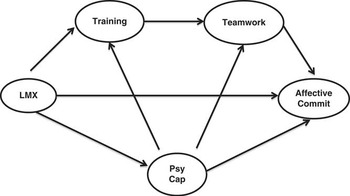
Employees with high affective commitment are loyal and emotionally attached to an organization (Allen & Meyer, 1990). There are some known antecedents of affective commitment including LMX, training and teamwork (Meyer, Stanley, Herscovitch, & Topolnytsky, 2002; Paul & Anantharaman, Reference Paul and Anantharaman2004; Brunetto, Farr-Wharton, & Shacklock, Reference Brunetto, Farr-Wharton and Shacklock2012a, Reference Brunetto, Farr-Wharton and Shacklock2012b) and therefore we expect to replicate these results. That is, we expect that high LMX will be associated with high affective commitment, and that high satisfaction with teamwork and training will be associated with high affective commitment. Further, Luthans et al. (Reference Luthans, Norman, Avolio and Avey2008) found that high PsyCap is associated with high affective commitment and therefore we expect to replicate this finding for US police officers. However, Dick (Reference Dulebohn, Bommer, Liden, Brouer and Ferris2011) argued for more research about the antecedents of police officers’ affective commitment, because past research has produced different results. For example, Dick (Reference Dulebohn, Bommer, Liden, Brouer and Ferris2011) found that for police officers in the United Kingdom, management support was the key antecedent, whereas in the case of Australian police officers, Noblet, Rodwell, and Allisey (Reference Noblet, Rodwell and Allisey2009) found that the main antecedents were psychological factors such as the perception of control, and physical factors such as the demand for their services. It is unclear what will be the main factors for US police officers. Therefore, based upon a review of the literature, we test the following hypotheses, which are represented in Figure 1:
Hypothesis 1 : High LMX is associated with high PsyCap.
Hypothesis 2 : High LMX is associated with high levels of satisfaction with training.
Hypothesis 3 : High LMX is associated with high levels of satisfaction with teamwork.
Hypothesis 4 : High LMX is associated with high levels of affective commitment.
Hypothesis 5 : High PsyCap is associated with high levels of satisfaction with training.
Hypothesis 6 : High PsyCap is associated with high levels of satisfaction with teamwork.
Hypothesis 7 : High PsyCap is associated with high affective commitment.
Hypothesis 8 : High training is associated with high levels of satisfaction with teamwork.
Hypothesis 9 : High training is associated with high affective commitment.
Hypothesis 10 : High teamwork is associated with high affective commitment.
Proposed research model. LMX=leader–member exchange; PsyCap=psychological capital

METHODS
The aim of this study was to examine the influence of one personal resource/trainee characteristic (PsyCap) and one organizational resource (LMX) upon US police officers’ perceptions of learning options – teamwork and training, and in turn, their affective commitment. Ethical approvals were obtained from the relevant university human research ethics committees, plus the police organization.
Sample
A cross-sectional design using a survey-based, self-report strategy was used to collect data from 588 US police officers that are at the frontline dealing with the public in one city in the United States. Over a period of 5 months (January–May inclusive, 2013) police officers were invited to complete a survey during their training sessions. Police officers were provided with an envelope and asked to seal their surveys before placing them in a sealed box for collection by the researchers. Respondents were 412 males, of whom three were sergeants, and 164 females, of whom three were sergeants, plus another 12 who failed to provide gender information. A large proportion of the respondents were rank-and-file police officers (non-sergeants).
Instruments
All variable items (not the demographics) were measured on a 6-point Likert-type scale, ranging from 1=‘strongly disagree’, to 6=‘strongly agree’, and where 3=‘slightly disagree’ and 4=‘slightly agree’. LMX was measured using a 7-item uni-dimensional scale (LMX-7), developed by Graen and Uhl-Bien (1995). A sample item was, ‘My supervisor understands my work problems and needs’. PsyCap was measured using the 4 subscales from Luthans, Vogelgesang, and Lester (Reference Luthans, Vogelgesang and Lester2006). Following Luthans, Vogelgesang, and Lester (Reference Luthans, Vogelgesang and Lester2006), we used the short form of the PsyCap instrument. This construct was operationalized as a second order, latent variable, comprising the four dimensions of PsyCap: efficacy, hope, resiliency and optimism (discriminant analysis removed two items from the instrument). Teamwork was measured using Rubin, Palmgreen, and Sypher’s (Reference Rubin, Palmgreen and Sypher1994) five-item version of an organizational culture survey developed by Glaser, Zamanou, and Hacker (Reference Glaser, Zamanou and Hacker1987), using employees’ levels of satisfaction as a function of teamwork, morale, information flow, involvement and supervision. Training was measured using the six-item instrument developed by Meyer and Smith (Reference Meyer and Smith2000), to quantify employee satisfaction with training. Lastly, affective commitment – the dependent variable – was measured using five items of Allen and Meyer’s (1990) commitment to the organization instrument, including ‘I feel strong ties with this [police service]’ (discriminant analysis resulted in the removal of one item from the analysis).
Data analysis
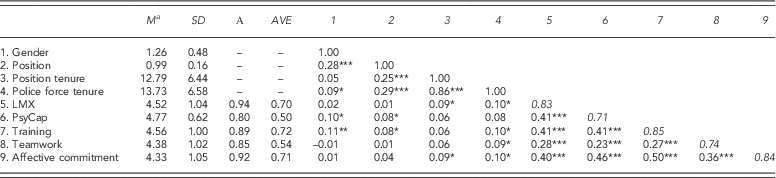
The structural and measurement model was examined using AMOS. Internal reliability coefficients and average variance estimates of the constructs are reported in the results table. Composite αs were between 0.80 and 0.92 while average variance estimates were >0.50. Discriminant analysis was undertaken by computing the Fornell and Larcker test. As shown in Table 1, square roots of the average variance estimates were greater than the intercorrelations between the constructs, indicating that the constructs had discriminant reliability. Common method bias check was undertaken using Harman’s one-factor test (Podsakoff, MacKenzie, Lee, & Podsakoff, Reference Podsakoff, MacKenzie, Lee and Podsakoff2003), which showed that the single largest factor was 31.7%, suggesting that common method bias was not a major concern in our study.
Descriptive statistics

Notes. n=588.
a Scale for means, 1=‘strongly disagree’, to 6=‘strongly agree’.
AVE=average variance estimates; LMX=leader–member exchange; PsyCap=psychological capital.
*p<.05; **p<.01; ***p<.001.
RESULTS
Table 1 presents the descriptive statistics and correlations. The mean of the five key variables showed that the police officers were somewhat satisfied with their workplace relationships, their training opportunities, the extent of group work and affective commitment towards the police force. The respondents reported somewhat positive levels of PsyCap (efficacy: M=4.87, SD=90; hope: M=4.82, SD=0.83; optimism: M=4.33, SD=1.03; and resilience: M=5.04, SD=0.70). Teamwork was found to have a negative association with female respondents and those who were married or in relationships, and this finding needs further exploration. Further, there was a positive association between respondents who had longer tenure in the police force and their workplace supervisor relationships.
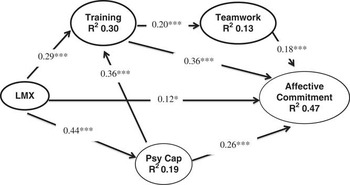
The findings indicate a good fit for both the measurement model as well as structural model. All hypotheses were supported, with the exception of Hypothesis 6 (High PsyCap is associated with high levels of satisfaction with teamwork), and the path coefficients and significance level of the paths were reported (see Figure 2). Path analysis of the measurement model showed good model fit (χ2/df=2.115, confirmatory fit index (CFI) =0.96, Tucker Lewis index (TLI)=0.95, root mean square error of approximation (RMSEA)=0.04, standardized root mean square residual (SRMR)=0.04). Factor loadings of the items ranged from 0.56 to 0.90, with the majority being >0.70.
Results. N=588. *p<.05; ***p<.001. LMX=leader–member exchange; PsyCap=psychological capital

The structural model showed that the data fitted the model well, as indicated by the goodness of fit indices (χ2/df=2.119, CFI=0.96, TLI=0.95, RMSEA=0.04, SRMR=0.04). Thresholds for determining these indices were based on those reported in Hair, Black, Babin, and Anderson (Reference Hair, Black, Babin and Anderson2010) and explained in Hu and Bentler (Reference Hu and Bentler1999).
DISCUSSION
The aim of this study was to use two theoretical lenses (POB and SET) to better understand the influence of one trainee characteristic (the personal resource – PsyCap) and one organizational resource (LMX) on police officer’s perception of learning options – teamwork and training, and in turn, affective commitment. Formal police training is perceived as inadequate for preparing police for policing activities and therefore they rely on ‘on-the-job’ incidental learning from the supervisor and other police to fill the gaps in skills and knowledge (Caro, Reference Chen and Klimoski2011). Hence, previous research had focused largely on how learning outcomes were impacted by workplace relationships, especially the support of a supervisor and the quality of teamwork.
This paper added to the literature first by examining the impact of the supervisor on PsyCap and learning options for police and found that it did impact employee perceptions of training. As stated, research by Combs, Luthans, and Griffith (Reference Combs, Luthans and Griffith2008) has tested and found that training satisfaction outcomes were enhanced if training in PsyCap occurred beforehand because it increased their motivation to learn. We did not provide any training in PsyCap. However, our analysis suggests that US police officers had at least some level of PsyCap (self-efficacy, hope, resilience and optimism) and that together, the findings show that LMX and PsyCap accounted for almost a third of police officers’ satisfaction with training. However, PsyCap did not directly impact learning from other police in the form of teamwork learning. One explanation could be that police officers’ levels of PsyCap is too low to enhance teamwork without a specific intervention to increase PsyCap. Further research is required to understand this finding.
In this study, we examined the impact of the supervisor not just on training outcomes, but also on the perceptions of PsyCap for police officers. SET was used to understand how the quality of officers’ relationships with their supervisors, as evident through their workplace actions (such as providing feedback and re-enforcing key learnings), provides a strong organizational impetus for employees to perceive training as positive (Berman et al., Reference Berman, Bowman, West and Van Wart2012; Brunetto et al., 2012, Reference Brunetto, Shacklock, Teo, Farr‐Wharton and Nelson2015). SET argues that an effective supervisor is one that provides adequate resources (including learning options), knowledge and support so that employees can capably and competently negotiate work tasks (Dulebohn, Bommer, Liden, Brouer, & Ferris, Reference Daily and Bishop2002; Cropanzano & Mitchell, Reference Cropanzano and Mitchell2005).
In particular, we examined the extent to which the quality of the relationship with the supervisor impacted police officers’ training satisfaction outcomes in two ways, first, by impact their PsyCap and second, by impacting their training satisfaction. Previous research shows that an effective supervisor has been found to enhance the PsyCap of his/her employees by affirming and mentoring their self-efficacy, optimism and hope and also building employees resilience by role modelling the same personal attributes in a positive way (Story et al., Reference Story, Youssef, Luthans, Barbuto and Bovaird2013). The findings from this study confirm the association of LMX and PsyCap for US police officers, with LMX accounting for approximately a fifth of their PsyCap (see Figure 2). Hence, the findings indicate that the supervisor has both direct and indirect impacts upon training, first, by impacting indirectly upon training via PsyCap, and second, by directly impacting upon training satisfaction.
A second emerging outcome from the research is the strong link between learning options within the organization. The public sector is characterized by a resource-constrained environment. Thus, despite the need for training to improve employees’ capabilities, the funding is often simply unavailable. We found that for US police officers, training satisfaction accounted for 13% of teamwork satisfaction, suggesting that only some of those who received training were able to then share their new knowledge and skills with others via their teamwork activities. The relatively low percentage of those police officers sharing their new learning with others provides an opportunity for managers to consider new ways of transferring skill development more intensely from those who have received training, to those who need those skills but who did not, or could not, receive the training. Teamwork normally only involves those immediate colleagues sharing similar shifts and therefore, managers may need to consider new ways of spreading the benefits of skills/knowledge acquired in training by some, to those police officers that have not had the same opportunities. An alternative explanation is that the learning from formal training was so poor it was not worth passing on; such an explanation has some support in the police training literature (Caro, Reference Chen and Klimoski2011; Werth, Reference Werth2011).
Another aim of this study was a response to Dick’s (Reference Dulebohn, Bommer, Liden, Brouer and Ferris2011) call for more research examining the factors affecting police officers; affective commitment. Consequently, a third finding of this paper is the combined impact of the antecedents – LMX, PsyCap and learning options – upon affective commitment. Our findings for US police indicate that almost half of affective commitment can be explained by the combined impact of LMX, PsyCap, training and teamwork. Yet, the mean rating for affective commitment suggests that these police officers were barely ‘slightly committed’ to their organization, which means that management needs to consider ways of increasing their commitment. One implication of this finding is that if management wants its police officers to be more committed, the solution involves (a) improving relationships with the supervisor, (b) upskilling them in PsyCap, (c) upskilling them in other relevant competencies – especially critical thinking (Caro, Reference Chen and Klimoski2011) required in policing and/or (d) improving teamwork opportunities and processes.
In terms of limitations of this study, the issue to minimize in this type of research (using survey data) is any common method bias. As stated, common method bias check was undertaken using Harman’s one-factor test (Podsakoff et al., Reference Podsakoff, MacKenzie, Lee and Podsakoff2003), which showed that the single largest factor was 31.7%, and this suggested that common method bias was of no major concern in the current study. A further limitation is that the study was conducted in one police organization and in one country and therefore other research is needed to support (or not) our findings.
CONCLUSION
In a context of large amounts of resources being directed at police training and the expectations of what training and development should deliver to the employee and the public they serve, there remains debate about why learning options are not as effective as expected. One lesson from past research is that management needs to consider ways of improving workplace relationships because it provides the best path for improving the supply of resources (including learnings), information and support for employees so that they can undertake their tasks effectively (Dulebohn et al., Reference Daily and Bishop2002; Cropanzano & Mitchell, Reference Cropanzano and Mitchell2005), and hence we used SET for this study. Thus, our first contribution is that we have identified evidence-based approaches to increase training effectiveness and work outcomes for police officers. Specifically, we found that upskilling in PsyCap is likely to deliver added benefits for both individuals and their work outcomes, because high PsyCap is associated with good employee outcomes (Avey, Wernsing, & Luthans, Reference Avey, Wernsing and Luthans2008; Avey et al., Reference Avey, Reichard, Luthans and Mhatre2011; Avey, Richmond, & Nixon, Reference Avey, Richmond and Nixon2012). That is, the lesson from POB is that, at a time when training budgets are shrinking and training requirements options need to be prioritized, PsyCap offers potential. Specifically, if there are not enough resources for formal training, then one avenue to help address that shortage is to improve informal training from supervisors and other more skilled police officers, having developed the PsyCap in those who are going to receive the training.
In terms of the other contributions of this study, we have also clarified the role of the supervisor–subordinate relationship in influencing affective commitment via PsyCap, which is worthwhile because we know that PsyCap can be developed and actually increases the effectiveness of training when trainee levels are developed prior to the training. Notably, we identified that nearly half of police officers’ affective commitment can be accounted for by the combined effect of their relationship with their supervisors, their training satisfaction, teamwork and PsyCap. Given the very high costs of training police officers and the known link between increased affective commitment and lowered turnover, this is an important contribution for the management of police turnover. Finally, from a theoretical perspective, we found combining the two frameworks (SET and POB) to be useful for examining the role of supervisor–subordinate relationships and a trainee characteristic in police officers’ learning and work outcomes.