Introduction
The maximum time-to-rescue of survivors after earthquakes is relevant knowledge because it determines the timing when search and rescue activities are terminated and the agenda for the transition to community recovery efforts. Obviously, when too short, it also carries the risk of missing entrapped survivors. Unfortunately, this post-quake phase, with the exception of the 1992 Marmara (Turkey) quake, has not been studied appropriately and extensively because of the lack of specific tools capable of catching and analyzing its multi-factorial nature.
The first reference to this problem goes back to General Pietro Colletta and was published in 1834.Reference De Santo, Bisaccia and De Santo 1 In The History of the Kingdom of Naples from 1734 to 1823, he extensively described the 1783 series of earthquakes in Calabria and Sicily (Italy), in which the epicenter was in the Plain of Palmi. Colletta wrote about survivors, the lack of specific organization of rescue attempts, and the need to prolong search and rescue in order to save as many lives as possible.
Various reports have recently addressed, on more solid bases, the problem of rescued people both in medical journals as well as in the media.Reference Colletta 2 - Reference Goddard 9 A specific survey also was conducted by careful analysis of medical and media reports for quakes occurring in the years 1985-2004. That survey, using the maximum time-to-rescue, indicated that, with the exception of one study, no survivors were documented in any earthquake after 14 days.Reference Basu 10
The Messina and Reggio Calabria earthquake (5:20 am on December 28, 1908) lasted 30 to 40 seconds and measured 7.1 on the Richter scale. Its epicenter was under the Strait of Messina, which separate the island of Sicily from the province of Reggio Calabria. As reported in international newspapers, a city once known for its beautiful harbor and impressive architecture was suddenly transformed to the “city of the dead.” There were more than 80,000 victims over a population of 140,000. More than 50,000 people were left homeless, since 90% of the buildings in Messina were turned down, including city hospitals. The quake was followed by a tsunami with 13-meter-high waves, which caused massive destruction across the coast and another estimated 2,000 deaths.
It is considered the worst seismic event in Europe in history. Military ships from Russia, USA, France, and Great Britain provided first aid. There were four medical reports, but none addressed the problem of “time-to-rescue.”Reference Macintyre, Barbera and Smith 11 - Reference D’Antona and Damascelli 14 Even today, that quake is quoted in medical literature because, from its details, one may trace the roots of crush syndrome with renal injury.Reference Caminiti 15 - Reference Vanholder, Sever, Erek and Lameire 18 The quake and its sequelae had extraordinary coverage by newspapers. The disaster had some peculiarities. It occurred at a time when, in Italy and worldwide, neither rescue teams nor centers equipped to deal with major disasters were available. No technology existed for localizing people under debris; rescue depended on their cries being heard. Neither light nor heavy machinery were available; all rescue operations required manual work. Interestingly, following the quake, an order to stop search and rescue activities was prepared but never issued.
The aim of this study was to assess, by using newspaper reports, the maximum time-to-rescue under debris of the 1908 Messina and Reggio Calabria earthquake. This relates to the number of victims, which was double that of any earthquake in the years 1985-2004, as recently analyzed.Reference Yokota 19
Methods
The study analyzed all information related to the Messina earthquake reported in 11 national newspapers which provided extensive coverage of the daily events connected with the disaster. The newspapers published between January 2 and January 31, 1909 were scrutinized. The analysis was performed on data available from the fifth to the 31st day after the quake.
A lower limit of five days was fixed by taking into account the medical and the media reports of the 1999 Marmara earthquake in Turkey (17,118 deaths). For that quake, it is available the excellent database provided by The Turkish Society of Nephrology (Nişantaşı, İstanbul) and by the Renal Disaster Relief Taskforce of the International Society of Nephrology (Brussels, Belgium), which indicate that the maximum entrapment survival time was 5.6 days. Media reports for the Marmara quake indicate a maximum entrapment time of 6.2 days. Reference Basu 10 The average maximum entrapment was therefore just below six days. So, the determination of the maximum time-to-rescue in excess of five days after the Messina quake seemed an appropriate objective. The list of newspapers that were analyzed includes: Corriere della Sera, Milan; Giornale di Sicilia, Palermo; Il Giornale d’Italia, Rome; Il Giorno, Rome; Il Mattino, Naples; Il Roma, Naples; Il Secolo, Milan; L’Avanti, Rome; La Tribuna, Rome; La Vita, Rome; and L’Ora, Palermo.
A data sheet was prepared on which the details of each person rescued on a day-to-day basis, as reported by each newspaper, were recorded. For each person, data were collected about the post-quake day rescued, name, age (exact years when available and stating whether adult or child), the place of rescue (town, street), the rescue unit and its commander, symptoms complained of when emerging from ruins, and the availability of fluids and food. Notes on any specific circumstance related to rescue also were recorded. All data were cross-checked, and when at least two newspapers agreed on the relevant details of the rescued person, the data were considered valid.
Results
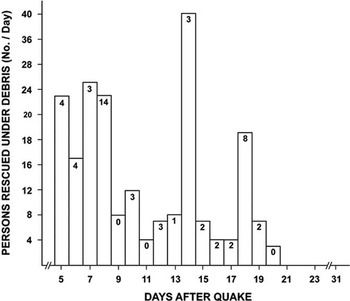
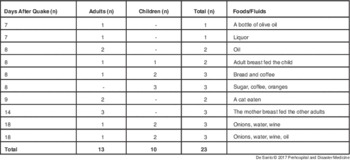
A total of 225 persons survived five to 20 days after the quake and the subsequent tsunami; 51 (22.6%) were children (Figure 1). At the time of rescue, the subjects were thirsty, dehydrated, and asked for water. Of the rescued persons, 22 (9.8 %) gave evidence of some availability of foods and fluids while under the rubble (Table 1).
Temporal Pattern of Post-Quake Rescue. Note: The height of the bars indicates the total number of persons rescued/day. Numbers in the upper part of the bars indicate the number of children. A total of 225 persons were rescued, 51 of them (22.6%) were children.

Characterization of 23 Survivors (13 adults and 10 children) for whom Access to Foods and Fluids was Reported (Data from 11 National Newspapers)

Discussion
The present study indicates that the maximum time-to-rescue after the Messina and Reggio Calabria Earthquake was 20 days. On day 20, the last three persons were pulled out alive from debris (Figure 1). The study also shows that thirst was the main complaint and dehydration the main finding. For a minority (9.8 %) of people, the availability of foods and fluids was thought to have helped survival.
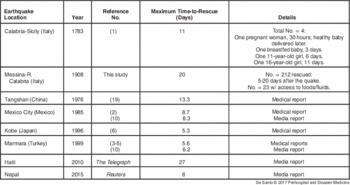
The data show that survival times under debris were in excess of the average of 5.6 days calculated in the database prepared by experts for the 1999 Marmara earthquake (Table 2). The data presented here derive from the earliest reports for historical earthquakes in which such data were collected. The data also indicate that the short search and rescue times adopted in 2015 in Nepal carry the risk of missing survivors.Reference Goddard 9 However, the risk might be minimized by recent technology, including the ability to detect heart beats under as much as 13 meters of debris. Had the rescuers in Messina adopted the maximum entrapment time derived from the Marmara study, the whole group of survivors of the disaster in Messina might have been lost. Even adopting a more permissive limit of 14 days, 43 persons in the Messina earthquake would have died by default.
Reports on Maximum Time-to-rescue Following Earthquakes in the Period 1783-2010

The key to understanding the present findings on the 1908 disaster might be linked to the lack of an order to suspend the search and rescue operations, as happened recently in Nepal. In Nepal, on May 4, 2015, the government asked assisting foreign countries to stop search and rescue efforts and to return home since there was (apparently) no hope of finding more people alive (The Irish Times; May 4, 2015; 13.15 News, World-Asian Pacific).
It is known that in 1909, an order to stop search and rescue was prepared. However, it was never issued because newspapers learned of the order and opposed it. In addition, survivors were being discovered every day up to the 20th day after the earthquake, thus making such an order inappropriate. After 20 days, there were no more reports on survivors.
Current evidence is that urban search and rescue (USAR) operations are the most time-consuming and technically demanding. The length of time from the occurrence of the quake until the time of extrication from under the rubble is crucial to effectively decrease the death toll. Nevertheless, a survival paradox is evident from medical literature: the longer the extrication time, the lesser the gravity of underlying medical condition in the survivors, and hence the highest chance of long-term survival - a complex ethical issue. Several knowledge gaps on the factors that affect rescue time in USAR still exist. As authoritatively reported, at least seven factors affect the practice pattern: (1) lesson learned and best practice; (2) rescue technology; (3) community involvement; (4) information systems; (5) technology integration; (6) crisis management; and (7) available budget.Reference Sheng 20
Limitations
Several limitations apply to this study. As stated in Methods section, data were drawn from newspapers. Newspapers information may be as precise as those published in medical journals; nevertheless, at least two issues must be taken into account. Paradoxically, the initial rescue operation completely neglected the needs of surrounding areas as well as the city of Reggio Calabria. Reporters were mostly active in the city of Messina, so information on fatalities and rescue operations in equally damaged areas are lost. Even though almost all of the data came from reporters on the ground because of a documented lack of official daily reports, either by the government or by rescue organizations, the chance of duplicate reports could not be completely excluded. Anyhow, all authors worked together in the development of the database: a copy of the newspapers along with the data sheets were carefully cross-checked before analysis as to reduce the risk of bias in data mining. Local magnitude, distance from epicenter, character of the infrastructure, type of buildings and quality of construction, timing of event and time-to-rescue and treatment, along with the reaction of the local population altogether, made the Messina earthquake a “perfect storm.” Sheer disorganization, poor coordination, minimal (if not any) technological equipment, the extent of the damaged area, the high proportion of the population involved, social conditions, lack of a precise disaster management plan, and even a clear determination on the exact location for reconstruction made this disaster and its management very peculiar.
Conclusion
This report, from a mere historical, “nonscientific” approach, aims to add to the current debate on the optimal maximum time-to-rescue. Even in an era of high technology, harmonization of the effectiveness of crisis management algorithms with ethical issues might be helped from those echoes from the past.
Acknowledgements
The authors would like to thank Dr. Concetta Caltabellotta (Library of the Faculty of Medicine, University of Palermo, Italy); Mrs. Patrizia Nocera, Mrs. Angela Pinto, and Mrs. Antonietta Pisani (National Library of Naples); Mrs. Rosaria Vollaro (Library of the University Federico II of Naples); and the people of the Newspaper Library Tucci of Naples, (all in Italy) for superb assistance. Heartfelt thanks are also due to Mrs. Filomena Bisaccia Tucciarone and Mrs. Ersilia Pifferi, Southington, Connecticut USA, for many interesting suggestions.