Introduction
The need to modify and redefine the concept of music education, which includes both, music teaching in general education and instrumental teaching practice, means providing more opportunities for each pupil to experience their own music making, from the spontaneous exploration of sounds to selecting and generating musical ideas into meaningful musical units (Oblak, Reference OBLAK2000; Wiggins, Reference WIGGINS, SULLIVAN and WILLINGHAM2002; Borota, Reference BOROTA2013; Hallam, Reference HALLAM2012; Jordan & Carlile, Reference JORDAN and CARLILE2013; McPherson, Reference MCPHERSON2016; Odena, Reference ODENA2016). Much attention has been paid to this topic particularly intensively over the past twenty years, and today, we can say that the concept of what musical creativity represents in music education is clearer (e.g. Sullivan & Willingham, Reference SULLIVAN and WILLINGHAM2002; Coulson & Burke, Reference COULSON and BURKE2013; Girdzijauskienė & Stakelum, Reference GIRDZIJAUSKIENĖ and STAKELUM2017). In an effort to bring teachers closer to the very concept of musical creativity in education, researchers also offer didactic solutions and models, with the intention of creating a stronger connection between research and practice (e.g. Higgins, Campbell, & McPherson, Reference HIGGINS, CAMPBELL and MCPHERSON2010; Wiggins, Reference WIGGINS2015; Webster, Reference WEBSTER and ODENA2016; Burnard & Murphy, Reference BURNARD and MURPHY2017; Vidulin, Reference VIDULIN2017; Martinović Bogojević, Reference MARTINOVIĆ BOGOJEVIĆ2020). Although musical creativity is incorporated into the curricula of many European countries (e.g. Fautley & Daubney, Reference FAUTLEY and DAUBNEY2019; Larsson & Georgii-Hemming, Reference LARSSON and GEORGII-HEMMING2019), there is still an open question as to both its implementation and realisation in specific educational contexts. This topic was also examined by the National Coordinators of the European Association for Music in Schools (EAS) at the 24th EAS Conference. The presence of music creativity in curricula and practice was analysed in the educational systems of 16 European countries. The conclusion of all 16 reports proposed a timely and more intense realisation of creative activities and teacher training through permanent qualifications improvement and the provision of clear didactic guidelines (Girdzijauskienė & Sakadolskienė, Reference GIRDZIJAUSKIENĖ and SAKADOLSKIENĖ2016).
Starting from the assumption that musical creativity is not implemented widely enough within compulsory music teaching (Črčinovič Rozman, Reference ČRČINOVIČ ROZMAN2009; Martinović Bogojević, Reference MARTINOVIĆ BOGOJEVIĆ2021a, Rotar Pance & Igličar, Reference ROTAR Pance and IGLIČAR2017), we examined the attitudes and experiences of specialist music teachers in the primary educational systems of these two countries. The issue of comparison between Montenegrin and Slovenian teachers was determined, not only by the historical background, which belonged to the common education system of the former Yugoslavia, but primarily by the comparative analysis of the two curricula in which numerous similarities were observed. The most significant similarities relate to the nine years of general primary education (from 6 to 14 years of age), which is divided into three three-year educational cycles. The compulsory subjects Music Culture (Montenegrin Muzička kultura) in Montenegro and Music Education (Slovenian Glasbena umetnost) in Slovenia are present in all nine grades of primary school and are realised through three musical activities: performing, listening and creating (Course Programme Music Culture, 2017; Course Programme Music Education, 2011). These activities arise from the very nature of music, its production, reproduction and perception (Oblak, Reference OBLAK2000). The listed similarities stem from the first major reform of the education system, which was implemented in Montenegro from the 2003/2004 school year and which was predominantly based on the concept of Slovenian primary education. That is how the new curricula, as well as textbooks for music education, were developed in cooperation with Slovenian experts. After almost two decades, no research has been done in Montenegro that might show the real state of teaching practice when it comes to creation as a musical activity. In Slovenia, research on this topic has been conducted sporadically (e.g. Oblak, Reference OBLAK2000; Črčinovič Rozman, Reference ČRČINOVIČ ROZMAN2009; Rotar Pance & Igličar, Reference ROTAR Pance and IGLIČAR2017), and thus, the scope for new insights is significant.
This research was conducted within the framework of Interdisciplinary Doctoral Studies in the Humanities and Social Sciences, in the field of Music Pedagogy at the Music Academy of the University of Ljubljana. In this paper, a part of the significant results will be presented, which give us an insight into the realisation of musical creativity in the teaching practice in what is a random sample of Slovenian and Montenegrin music teachers.
Creation as a curriculum-defined musical activity in Montenegro and Slovenia
The involvement of musical creativity in Slovenian music education dates back to the 1963/64 school year, when “experimental teaching” (Slovenian eksperimentalni pouk) as a project was conducted in Slovenian schools. The project formally lasted until 1971, and it exercised a long-term influence on the further development of music education in Slovenia. The primary goal of experimental teaching was the introduction of innovations and a change in the conception of music learning in primary schools and then the dissemination of this concept in educational practice. The key expert in the project was the prominent Slovenian music educator Breda Oblak. The project had far-reaching goals, reflected in the education reforms carried out at the beginning of the 1990s (Oblak, Reference OBLAK2016). From then until today, teaching methods, textbooks and didactic literature have been developed in Slovenia in which musical creativity attracts a lot of attention.
Creation as an activity in both programmes includes creative tasks which represent creativity in music and creativity with music (Oblak, Reference OBLAK2000). The former implies activities in which children make their own music from activities such as creating a rhythmical unit, supplementing a started melody or creating a musical accompaniment, to short improvisations, setting a melody to a given set of lyrics and vice versa. Creativity with music, by contrast, represents the expression of the musical experience of listening to music, where music is a stimulus for creativity expressed through other media (verbally, artistically or through movement/dance).
Comparative analysis has shown that in the Slovenian programme, creative musical activities are more precisely defined with a graduation from simpler to more complex creative tasks, which are directly related to the achievement of operational goals. As an example, some of the operational goals related to “creativity in music” are as follows:
Pupils create content and sound images; shape their own musical thoughts: supplement melodic and rhythmical units, music questions and answers, melodies to a given text and vice versa (1st cycle/age 6 to 8); by singing and/or rhythmically expression, supplement and create musical contents and forms. Pupils create the same, similar and different units; by instruments, they supplement and create different musical contents and forms (form of a song, cannon, rondo, theme, variation) (2nd cycle/age 9 to 11). Pupils are trained to use elements of musical improvisation and create vocal and instrumental musical contents. (3rd cycle/age 12 to 14) (for a more detailed analyses, see Martinović Bogojević, Reference MARTINOVIĆ BOGOJEVIĆ2021b).
Unlike the Slovenian programme, in the Montenegrin curriculum, “creation” is indicated as an activity that is combined with listening to or performing music, in order to achieve the intended learning outcomes. The activity of creating in the Montenegrin programme through nine school grades contains musical tasks, from creating musical accompaniments when performing songs to creating short improvisations at higher grades, when students already have a certain level of musical knowledge and musicianship. Teachers are given the freedom to devise tasks that fit the given frameworks that the creative activities in the programme prescribed. This is especially true for 20% of the total number of annual classes, which the teacher is free to create according to the needs of students and thus involve more creative activities, such as improvisation and composing. The overall impression is that these activities are better thought of as recommendations rather than requirements; this is indicated by the fact that the skills of pupils’ music making are not included through the umbrella educational outcomes which have to be achieved.
Although neither programme mentions “composing” as a part of the “creating” activity, this does not limit music teachers in the incorporation of composing into the regular classes to the extent that corresponds to the musical dispositions of pupils, their personal needs and the level of their musicianship. Composing, as a more complex creative process, can be more systematically realised within extracurricular activities, which take place with smaller groups, with time frameworks not restricted to the 45 minutes of one school lesson. Composing in Slovenian primary schools and high schools is also supported through the Slovenian Music Olympiad, a competition-festival (Lowe, Reference LOWE2018; Rotar Pance, Reference ROTAR PANCE2021) that encourages musically talented pupils to create original compositions (Rotar Pance, Reference ROTAR PANCE and HOZJAN2015, Reference ROTAR PANCE, MARKOVIĆ and BOGOJEVIĆ2018; Rotar Pance & Igličar, Reference ROTAR Pance and IGLIČAR2017). Teachers–mentors acquire competencies in the fields of supervising the compositional processes and preparing pupils for the competition-festival and the public presentation of their musical works. Such an opportunity, through similar competitions-festivals, has not been offered to Montenegrin music teachers.
One of the significant differences is the total number of lessons of music as an obligatory subject. During all nine primary school grades, Montenegrin pupils have 311 lessons (Course Programme Music Culture, 2017), while Slovenian pupils have 452 lessons (Course Programme Music Education, 2011), which is 141 lessons more. This difference was smaller (81 lessons) until 2017, when in Montenegro, prior to the last reform, the teaching of music in the 4th and 5th grade was realised within two classes per week.
The programmes in both countries contain a number of operational objectives/learning outcomes that focus, in the third cycle of primary school, on material covering music history, which does not leave enough time to devote more attention to creation. In Slovenia, pupils in the final three-year cycle of primary education can choose optional music subjects, providing them with 2 or 3 lessons per week. In Montenegro, as of the 2019/2020 school year, pupils in the final three-year cycle of primary education have had the choice of an optional course Music Workshop (Course Programme Music Workshop/Predmetni program Muzička radionica, 2019), with one lesson per week, which was introduced into the curriculum in order to encourage pupils to experience their own music making. Evidence of how many pupils in Montenegro have chosen this optional course over the past two years has not yet been examined.
Teachers’ Attitudes Towards the Representation of Music Activities in their Teaching Practice

Response scale: 1 – not at all, 2 – a little, 3 – medium, 4 – very, 5 – exceptionally.
Teachers’ Attitudes Regarding the Level of Fulfilment of the Learning Objectives in Creating

Response scale: 1 – never, 2 – rarely, 3 – sometimes, 4 – often, 5 – very often.
Teachers’ Attitudes Towards the Realisation of the Transfer of Musical Creativity to Other Media, Differences with Respect to Country

Response scale: 1 – never, 2 – rarely, 3 – sometimes, 4 – often, 5 – very often.
Teachers’ Attitudes Regarding the Aggravating Circumstances for the Realisation of Creativity, Differences with Respect to Country

Response scale: 1 – I strongly disagree, 2 – I disagree, 3 – I agree partly, 4 – I agree, 5 – I fully agree.
Study
The research problem
This research examines the attitudes and experiences of specialist music teachers in primary schools in both Montenegro and Slovenia related to creation as a musical activity. We presume that out of all the activities set out in the course programme, primary-school specialist music teachers realise the least creative musical activities. The focus of the research is on specialist music teachers who teach music in the second and final three-year educational cycles of primary schools in the two countries.
Research goals and research questions
The main goal of the research was to examine to what extent and in what way musical creativity is represented as an activity in practice, and what reasons hinder its systematic inclusion in the teaching process regarding the context of general music education in primary schools in Montenegro and Slovenia.
In relation to the research problem, the following research goals were determined:
-
To examine the level of frequency in the realisation of musical activities (performing, listening and creating) in the teaching practice.
-
To compare the extent to which teachers in Montenegro and Slovenia realise their educational objectives in the field of musical creativity.
-
To investigate the reasons that make it difficult to realise musical creativity during regular classes.
The following research questions arose from the research goals:
-
RQ1: What is the level of frequency of the realisation of musical activities (i.e. performing, listening and creating) in teaching practice of Montenegrin and Slovenian teachers?
-
RQ2: Is there a difference between Montenegrin and Slovene music teachers regarding the level of reaching the educational objectives related to musical creativity?
-
RQ3: To what extent do teachers agree that there are circumstances that make it difficult to implement creation in the teaching process?
Method
To examine the attitudes and experiences of music teachers in both Montenegro and Slovenia, a comprehensive survey questionnaire was designed for the purpose of this research, consisting of 34 questions. The introductory questions were intended for the socio-demographic data of the respondents (sex, age, years of service, educational level, type of studies and type of primary school). The majority of questions contained a 5-point Likert-type scale (16 questions), closed questions (six questions) and open-ended questions (three questions). In a number of questions, teachers had the opportunity to explain their views and statements (six sub-questions). The questions were divided into three main sections: the general views of teachers on musical creativity, the realisation of musical creativity in the teaching practice and the self-assessment of teachers’ competencies on musical creativity. This paper will present the results related to teaching practice, obtained by question Q9, Q 13, Q14 and Q15.
The content of the questionnaire was reviewed by two music educators from Montenegro and two from Slovenia, and feedback was obtained for its improvement. The questionnaire was prepared in Montenegrin and Slovenian by the authors of the research who are native speakers. Preliminarily, we conducted a pilot test of the questionnaire. The reliability of the questionnaire was checked using the method of the internal consistency of the rating scale. Cronbach’s coefficient was α = 0.830, which confirmed a satisfactory level of reliability for this survey. The consent of the Ethics Commission of the University of Ljubljana and the Ministry of Education of Montenegro was obtained for conducting the research. Primary school music teachers in Montenegro and Slovenia filled in the survey questionnaire in electronic form in March and April 2019 (Enklik survey 1KA, 2019). Respondents were recruited through study groups for music education that operate in the Institute of Education and Sports of the Republic of Slovenia and the Institute of Education of Montenegro. Teachers voluntarily completed the survey, and their anonymity was guaranteed.
Description of the sample
Music teachers in primary schools in both Montenegro and Slovenia participated in the research. The survey was conducted on a sample of 154 respondents. For each individual question, the number of respondents who gave an answer is provided, as well as a valid percentage.
In the sample of 154 teachers, 49% of the respondents were from Montenegro (N = 75) and 51% of the respondents were from Slovenia (N = 79). During the 2018/2019 school year, the absolute number of specialist music teachers in primary schools in Montenegro was 83.Footnote 1 The sample of surveyed teachers accounted for 86% of the absolute number, so this sample is considered highly relevant. In Slovenia, during the 2018/2019 school year, 315 teachers taught music education in primary schools.Footnote 2 The sample of Slovenian teachers is less relevant, as it represents only 25% of the total cohort. Although there is a significant difference in the percentage of the sample in relation to the total music teacher cohorts in the two countries, we sought to obtain comparable numbers on both subsamples.
Out of the total number of teachers, 15% stated that they were male, 81% that they were female, while seven (4%) respondents declined to provide this information. The structure according to age is such that the largest percentage of respondents (34%) are between 31 and 40 years of age, 30% of respondents are aged from 51 to 60, while 21% are aged 41 to 50. A significantly lower percentage (14 %) are teachers of younger age, from 21 to 30, while teachers who have reached 61 years of age make up only 2% of the total sample. Out of the total number of respondents, the largest percentage (62%) have completed four-year pre-Bologna bachelor’s degree. Only 4% of teachers had completed the level of Master’s studies according to the pre-Bologna system, while 12% of teachers completed Bologna studies with competencies for schoolwork.
Data analysis
The statistical processing of the results included the use of methods of descriptive statistics. Statistical processing and analysis was performed in the statistical package SPSS version 24 for Windows. The normality of the distribution was examined by the Kolmogorov–Smirnov and Shapiro–Wilk tests. As the numerical variables relating to questions Q9, Q13, Q14 and Q15 showed that their distribution deviated from the norm to a statistically significant degree, nonparametric statistical methods were used (Cohen, Manion, & Morrison, Reference COHEN, MANION and MORRISON2007; de Winter & Dodou, Reference DE WINTER and DODOU2010). The Mann–Whitney U test was used to examine the differences between the two modalities and with respect to the value of the numerical variable. To test the differences between the parameters, the Kruskal–Wallis H test was used in those cases where the differences between three or more modalities of the categorical variable were examined (i.e. the age of teachers), and with respect to the value of the numerical variable. The examination of the predictive properties of the independent variables was tested using univariant linear regression. The probability level of significance was set at p < 0.05.
Results and interpretation
RQ1: What is the level of frequency of the realisation of musical activities (i.e. performing, listening and creating) in teaching practice among Montenegrin and Slovenian teachers?
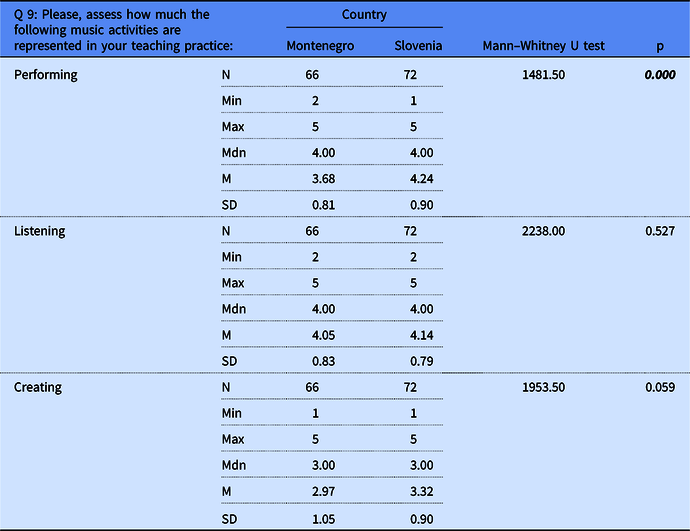
The median result (Mdn = 4) explains that performing and listening to music are the main activities on which the realisation of music teaching in both countries is based. No significant difference in the realisation of creation, which is carried out at a medium level, was found (Mdn = 3), U = 1953.50, p = 0.059. The obtained result is on the verge of significance, which may indicate a tendency for teachers in Slovenia to carry out this activity more often than their Montenegrin colleagues. A high level of significance was shown in the realisation of performance, which is more widely represented in Slovenian than in Montenegrin sample, U = 1481.50, p < 0.001.
RQ2: Is there a difference between Montenegrin and Slovene music teachers regarding the level of reaching the educational objectives related to musical creativity?
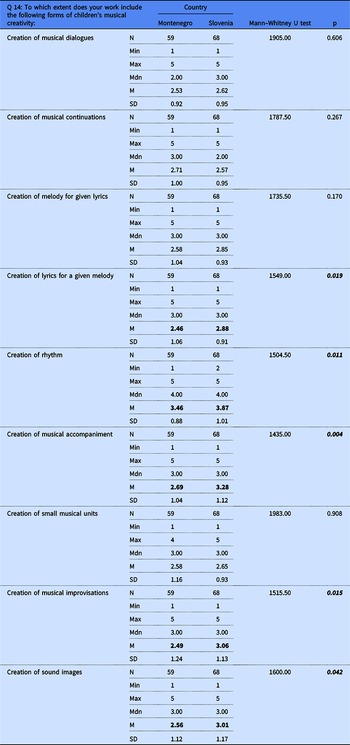
The obtained results tell us that this random sample of teachers uses the creation of rhythm most often from this list (Mdn = 4). Other forms of children’s musical creativity are moderately represented. The median for the majority of forms of creative musical activities is 3. The Mann–Whitney U test gave the results of the differences that show that teachers from Slovenia use the following forms of musical creativity more frequently than music teachers in Montenegro: the creating of musical accompaniments (U = 1435.0, p = 0.004), the creation of rhythm (U = 1504.50, p = 0.011); the creation of musical improvisations (U = 1515.50, p = 0.015); the creation of lyrics to a given melody (U = 1549.0, p = 0.019); and the creation of sound images (U = 1600.0, p = 0.042). Of the nine listed activities that are contained in the course programmes as educational objectives and are related to creativity in music, teachers in the Slovenian sample more often carry out five of the activities.
We examined whether certain forms of children’s musical creativity are equally or differently represented in the teaching practice of different age categories (i.e. 21–30; 31–40; 41–50; 51–60). Differences were tested by the Kruskal–Wallis H test. The statistical significance of this test is above the limit of 0.05, and we conclude that all age categories of teachers equally realise the listed forms of musical creativity. Didactic subjects are represented in teacher training programmes, regardless of the programme changes at higher music education institutions in the two countries. This is especially true in Slovenia, where didactic knowledge and skills related to musical creativity have been systematically introduced since 1998.
The representation of the following forms of children’s musical creativity is statistically significantly influenced by the teacher’s country of origin: the creation of lyrics to a given melody (Beta = −0.213, p = 0.016; 4% of variance explained), the creation of rhythm (Beta = −0.212, p = 0.017; 4% of variance explained), the creation of musical improvisations (Beta = −0.235, p = 0.008; 5% of variance explained), the creation of sound images (Beta = −0.196, p = 0.027; 3% of variance explained) and the creation of musical accompaniment (Beta = −0.262, p = 0.017; 6% of variance explained). This confirms that teachers in Slovenia in this sample are significantly more consistent in reaching the educational objectives relating to pupils’ creation of their own music (i.e. creativity in music).
The difference between Montenegrin and Slovenian teachers was also tested in relation to the realisation and achievement of educational outcomes from the creative processes where the experience of listening to music is transferred to other forms of media (i.e. creativity with music).
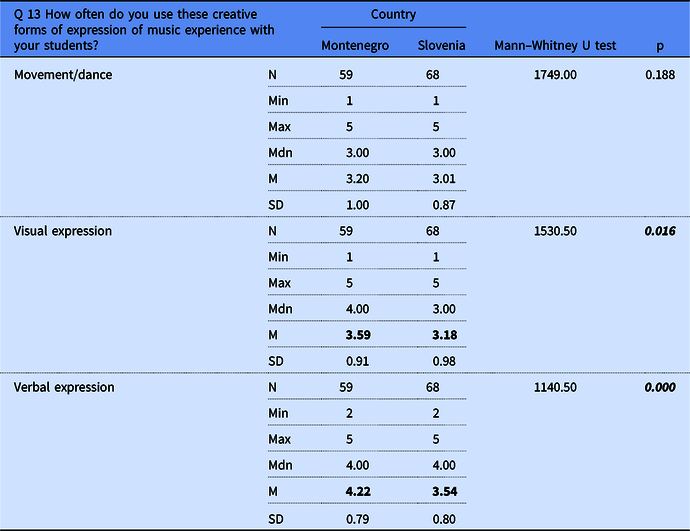
It turns out that visual expression, as a form of expressing a musical experience, is much more frequently used by teachers in this sample from Montenegro than teachers from Slovenia, U = 1530.50, p = 0.016. Teachers from Montenegro also use statistically significantly more verbal expression compared to their Slovenian colleagues, U = 1149.50, p < 0.001. There was no statistically significant difference in the expression of the musical experience through movement/dance between the two compared groups.
The country of origin of teachers statistically significantly influences the use of visual (Beta = 0.216, p = 0.015) and verbal expression (Beta = 0.393, p < 0.001). As the sample from Montenegro is highly relevant, the results lead to the conclusion that the teaching of music in Montenegrin schools is more focused on achieving educational outcomes through creative processes that are aimed at expressing the musical experience through verbal and artistic means, that is towards those processes in which non-musical products are created on musical stimuli.
RQ3: To what extent do teachers agree that there are circumstances that make it difficult to implement creation in the teaching process?
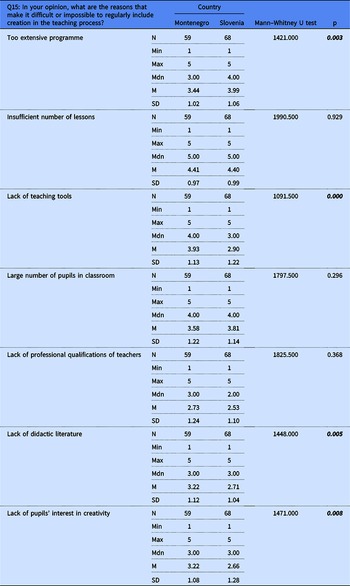
The results show the following statistically significant differences: teachers in this sample from Montenegro see a larger problem in the lack of teaching tools (ME: Mdn = 4 vs. SI: Mdn = 3), U = 1091.5, p < 0.001, the lack of pupils’ interest in creating (Mdn = 3), U = 1471.0, p = 0.008 and insufficient didactic literature (Mdn = 3), U = 1448.0, p = 0.005. Teachers from Slovenia see a larger problem in the excessive course programme (SI: Mdn = 4 vs. ME: Mdn = 3), U = 1421.0, p = 0.003.
When it comes to the reasons that make it difficult or impossible to regularly include creation in the teaching process, the country of origin of teachers has a statistically significant impact. The statistically significant influence of the country of origin is confirmed in relation to: having a too extensive programme (Beta = −0.154, p = 0.004; 6% of variance explained), a lack of teaching tools (Beta = 0.404, p < 0.001; as much as 16% of variance explained), a lack of didactic literature (Beta = 0.234, p = 0.008; 5% of variance explained) and a lack of pupils’ interest in creativity (Beta = 0.229, p = 0.007; 4.5% of variance explained). It was confirmed that the teachers in Slovenia in this sample believe that their programme is too extensive and that teachers in Montenegro lack both didactic literature and the tools needed for their work, as well as the fact that they notice that pupils are not interested in creating.
Discussion and limitations
This part of the results from the extensive doctoral research gives us an insight into the representation of musical creativity in curricula and teaching practice within music education in primary schools in both Montenegro and Slovenia. Regarding the first research question (What is the level of frequency of the realisation of musical activities (i.e. performing, listening and creating) in teaching practice among Montenegrin and Slovenian teachers?), the results showed that in the teaching practice of the random sample of Slovenian teachers, performing (i.e. singing and playing) is significantly more widely represented than in the sample of Montenegrin teachers, where listening to music is the most frequently accomplished activity (Table 1). Although creation is moderately represented, music teachers in the Slovenian sample realise more tasks related to “creativity in music” (Oblak, Reference OBLAK2000; Borota, Reference BOROTA2013). This is confirmed by the results obtained in relation to the second research question (Is there a difference between Montenegrin and Slovene music teachers regarding the level of reaching the educational objectives related to musical creativity?). The results show that the teachers in the Slovenian sample reach their educational objective to a greater extent in relation to the creating of musical accompaniments, the creation of rhythm, the creation of musical improvisations, the creation of lyrics to a given melody and the creation of sound images (Table 2). Thus, pupils in Slovenian primary schools have more experience in creating their own music, which is the essence of musical creativity (Higgins, Campbell, & McPherson, Reference HIGGINS, CAMPBELL and MCPHERSON2010; Wiggins, Reference WIGGINS2015; Burnard & Murphy, Reference BURNARD and MURPHY2017; Vidulin, Reference VIDULIN2017), and which contributes to the development of “creative thinking in music” (Webster, Reference WEBSTE, R, SULLIVAN and WILLINGHAM2002). On the other hand, teachers in the Montenegrin sample realise more activities that represent the transfer of music to other media, through artistic and verbal expression of musical experience (Table 3). Although this form of musical creativity is not directly related to the experience of music making, it encourages divergent listening which implies the development of imagination as an integral part of creative listening (Kratus, Reference KRATUS2017). In the research conducted by Črčinovič Rozman (Reference ČRČINOVIČ ROZMAN2009), teachers in Slovenia at that time also realised more activities related to the transfer of music experience to other media, so this research shows significant progress in the implementation of musical creativity in Slovenian primary schools. The reason why teachers in Slovenia in this sample engage in more creative activities in music than their Montenegrin colleagues is probably that creation as an activity has a greater tradition in Slovenian music education (Oblak, Reference OBLAK2016; Rotar Pance & Igličar, Reference ROTAR Pance and IGLIČAR2017).
The results related to the third question (To what extent do teachers agree that there are circumstances that make it difficult to implement creation in the teaching process?) suggest that teachers in Montenegro face more aggravating circumstances than their Slovenian counterparts. This refers to the lack of teaching tools, the lack of pupils’ interest in creating and insufficient didactic literature (Table 4). The lack of teaching tools can have a great impact on the realisation of creative musical tasks. For example, the lack of Orff instruments in the classroom may be reflected in fewer opportunities for students to create melodies, explore sounds or improvise. The surprising result was the high degree of agreement among Montenegrin teachers that one of the aggravating circumstances is the lack of interest of students in creation (Table 4). This might also open the question of the motivation that teachers provide to students and the extent to which they foster their creativity. Teachers from Slovenia of this sample see a larger problem in their excessive course programme (Table 4). School systems, with their clear structure, do not leave enough room to develop experimentation in music (Burnard, Reference BURNARD and ODENA2016), and it could be more difficult for Montenegrin teachers, given the number of regular music classes in primary school, which are represented in curricula with one class per week. In order for creative processes to develop, time is one of the basic preconditions that, among others, Sternberg and Williams (Reference STERNBERG and WILLIAMS1996) highlight through the seventh principle in their strategy for encouraging creativity – allowing time for creative thinking.
The limitations of this study are reflected in the approach to online surveying itself. Although it took about 15 minutes to complete the questionnaire, it is possible that due to open questions and explanations of teachers’ attitudes (which was not mandatory), a number of teachers did not complete the questionnaire. Although it is generally believed that nonparametric tests have less inference power than parametric tests, research has shown that the Mann–Whitney U test has the same power as the parametric test (t-test) when analysing Likert scale results (see de Winter & Dodou, Reference DE WINTER and DODOU2010). The research is also based on a much smaller sample of Slovenian teachers as opposed to the large sample of Montenegrin teachers, so we cannot talk about general conclusions, but about the tendency for musical creativity to be realised more in Slovenian schools than in Montenegrin ones.
Conclusion
On the basis of the research presented in this paper, we can conclude that musical creativity is present in the curriculum for musical education in both Montenegro and Slovenia, but on the basis of the survey results, it seems that music teachers in both countries predominantly practice musical creativity through performance and listening to music. The survey results provided by Slovenian music teachers demonstrate that the realisation of musical creativity is more widely present, but that here revisions to the curriculum should be considered, given the assessment provided by teachers that the current curriculum is overly excessive. The most notable results are related to the perception among Montenegrin teachers that there is a lack of teaching tools and didactic literature, which in their view complicates the performance of creative activities in the classroom; this suggests that educational policies around music in Montenegro need to be committed both to equipping classrooms more effectively and also improving the availability of teaching manuals and other didactic material. Future studies in this context might focus on teachers at music schools, which form an integral part of the state system of musical education in both countries, using specific, customised questionnaires. It might also be useful to conduct future research on a larger sample size and to include teachers from countries which share a similar concept of musical education at primary school, notably Croatia and Serbia.