Fighting at the forefronts, providing medical care to patients, health care workers (HCWs) are under constant threat of contracting COVID-19. Reference Salman, Mustafa and Asif1 Data across the globe show that HCWs are increasingly being infected with COVID-19. In Pakistan, more than 10 000 HCWs have been infected with COVID-19, and many lost their lives to it. 2
The continuous spread of COVID-19, risk of getting infection and transmitting it to loved ones, increased work load, physical exhaustion, shortage of personal protective equipment, and the need to make ethically difficult decisions on rationing of care can profoundly influence the physical as well as mental health of HCWs. This constant stress can trigger a variety of psychological manifestations such as anxiety, depression, sleep disturbances, panic attacks, posttraumatic stress symptoms, and helplessness. Reference Pappa, Ntella and Giannakas3 People adopt various coping methods to deal with adversity or traumatic experiences. Positive coping can evoke positive emotions and behaviors leading to better responses to adversity, whereas negative coping styles are not ideal at managing anxiety and stress. Reference Eisenberg, Shen, Schwarz and Mallon4
To initiate necessary measures to protect the mental well-being and mitigate vulnerability of HCWs amid the COVID-19 pandemic, the current study was aimed to assess generalized anxiety and depression among Pakistani HCWs during the ongoing pandemic. Furthermore, we also evaluated coping strategies adopted by them to manage aforementioned psychological distress.
Methods
Study Design, Settings, and Population
A web-based, cross-sectional survey was conducted among HCWs (doctors, nurses, and pharmacists) of the Punjab Province of Pakistan. Those who were unwilling to participate, could not understand the English language, health care assistants, and other hospital staff were excluded.
Ethical Approval
This study was approved by the Research Ethics Committee of the Department of Pharmacy Practice, Faculty of Pharmacy, The University of Lahore (REC/DPP/FOP/17). An online informed consent was obtained from participants. There was no identifying information on the questionnaire. In addition, survey respondents were provided a clear explanation about the confidentiality of their responses.
Sampling
The sample size for this study was calculated using the Daniel sample size equation: n = Z 2 P(1-P)/d 2 . Reference Daniel5 By keeping a 95% confidence interval, 50% expected proportion/prevalence, and 5% precision, a minimum sample of 384 HCWs was required. We used an exponential non-discriminative snowball sampling for data collection (April 15–May 20, 2020). The initial set of invitees included 10 health professionals (4 medical doctors, 3 pharmacists, and 3 nurses). This set of invitees forwarded the questionnaire to their colleagues/coworkers whom they considered suitable for the study, and this second set forwarded the questionnaire in the same way, and so on.
Data Collection Tool
Google Forms were used to disseminate (via WhatsApp and Facebook messenger) the online self-completed questionnaire to assess the psychological effects of COVID-19 among HCWs and coping strategies adopted by them. As the medical, pharmacy, and nursing education in Pakistan is entirely English-medium, there was no need to translate the questionnaire into the Urdu language. Reference Salman, Mustafa and Asif1,Reference Salman, Mustafa and Asif6,Reference Salman, Mustafa and Rao7 The questionnaire consisted of 2 parts (Supplementary file). Part I collected demographic data of the responders (eg, age, gender, occupation, hospital name, experience, duty during the pandemic), whereas Part II contained the below-mentioned scales to determine anxiety, depression, and coping strategies.
Outcome Measure
We used generalized anxiety scale (GAD-7) to assess anxiety among respondents. Reference Spitzer, Kroenke and Williams8 It had 7 items, each of which was scored 0 (“not at all”) to 3 (“nearly every day”), providing a 0 to 21 score. The total score was categorized into 4 severity groups: minimal-none (≤ 4), mild (5–9), moderate (10–14), and severe (≥ 15). The patient health questionnaire (PHQ-9) was used to assess depression. It contained 9 items, each of which was scored 0 (not at all) to 3 (nearly every day), providing a 0–27 score. The total score was categorized into 5 severity groups: minimal-none (≤ 4), mild (5–9), moderate (10–14), moderately severe (15–19), and severe (≥ 20). Reference Kroenke, Spitzer and Williams9 In the present study, respondents’ achieving scores ≥ 10 on GAD-7 and PHQ-9 were considered as having anxiety and depression, respectively.
The Brief-COPE scale was used to assess the coping strategies adopted by HCWs during the COVID-19 pandemic. Reference Carver10 It contained 28 items, each of which was scored from 1 (“I have not been doing this at all”) to 4 (“I have been doing this a lot”). This scale explored the 14 coping methods: self-distraction, active coping, denial, substance use, use of emotional support, use of instrumental support, behavioral disengagement, venting, positive reframing, planning, humor, acceptance, religion, and self-blame. Possible scores for each subscale ranged from 2 to 8, with higher scores indicating a higher tendency to utilize the corresponding coping style.
Data Analysis
All the data were entered and analyzed using IBM SPSS version 22 for Windows (IBM Corp, Armonk, NY). 11 Continuous data were presented as mean (M) and standard deviation (SD), whereas categorical data were expressed as number and percentages. Age was classified into young adulthood (18–35 years), middle age (36–55 years), and seniors (≥ 56 years). Reference Petry12 Moreover, HCWs were grouped into frontline or second-line workers according to their duties during the pandemic. HCWs who were directly engaged (diagnoses, treatment, and care of patients) with COVID-19 patients were defined as frontline workers. Reference Rossi, Socci and Pacitti13 The independent t-test and analysis of variance (ANOVA) test were performed, where applicable, to compare difference of anxiety, depression, and coping strategy scores among demographic variables. Welch’s ANOVA was performed instead of the classic ANOVA when the assumption of homogeneity of variances was violated. Moreover, for trichotomous or polychotomous variables, a series of post-hoc analysis (Tukey’s HSD and Games-Howell test, where applicable) were performed to assess significance among intergroup variables. A P-value of less than 0.05 was considered statistically significant.
Results
A total of 428 HCWs responded to the survey, with 398 HCWs providing consent and being included in the study (participation rate 93%). Demographics of the respondents are shown in Table 1. Mean age of respondents was 28.67 years (SD = 4.15), with female preponderance (56%). About 52% were physicians, whereas nurses and pharmacists accounted for 33.4% and 15.1%, respectively. Around 33% (isolation wards/quarantine facility = 28% and COVID-19 intensive care units = 5%) were directly engaged in managing COVID-19 patients, and 32.9% reported they have received COVID-19 infection prevention training. There was no significant difference (P > 0.05) of demographics (age, gender, experience, and occupation) among frontline and second-line HCWs. Additionally, no statistically significant difference of demographics was seen among HCWs who received infection prevention training and those who did not.
Anxiety and depression assessments based on respondents’ demographics

* Welch’s ANOVA was used instead of classic ANOVA, as the assumption of homogeneity of variances was violated.
The mean anxiety and depression scores were 6.83 (SD = 4.44) and 6.72 (SD = 5.14), respectively. The frequencies of respondents having none–mild, moderate, and severe anxiety were 78.7%, 13.1%, and 8.3%, respectively. About 22% met the PHQ-9 scale’s criteria for depression (minimal–none 35.9%, mild 42.2%, moderate 12.8%, moderately severe 7.3%, and severe 1.8%). A comparison of anxiety and depression scores among respondents’ demographics is shown in Table 1. Female respondents were found to have significantly higher anxiety (P = 0.003) and depression (P = 0.001) scores than male respondents. Significant differences of anxiety score were observed in young and middle age HCWs (P = 0.032). Depression score was significantly higher among frontline workers and those who did not receive infection prevention training (Table 2).
Analysis of anxiety and depression among frontline and second-line workers

HCWs, health care workers.
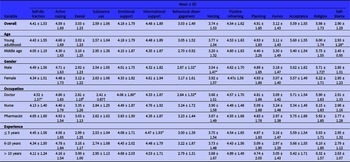
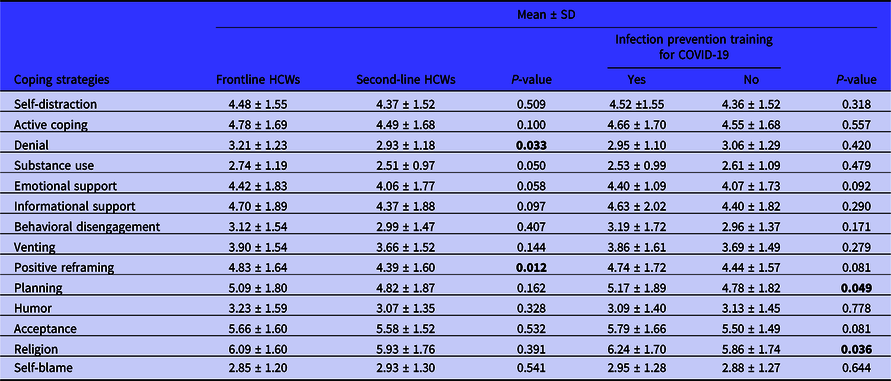
As shown in Table 3, the mean score was highest for religious coping (M = 5.98, SD = 1.73) followed by acceptance (M = 5.59, SD = 1.55) and coping planning (M = 4.91, SD = 1.85), whereas it was the lowest for substance use (M = 2.59, SD = 1.06) followed by self-blame (M = 2.90, SD = 1.29). The relationship of demographics with various coping strategies is described in Table 3. There was no significant difference of coping styles among age categories except for self-blame (P = 0.041). Females were observed to have significantly higher scores for behavioral disengagement (P = 0.040), venting (P = 0.015), and religious/spiritual coping (P = 0.003) than males. Amongst HCWs categories, statistically significant difference was seen for self-distraction (P = 0.023), denial (P < 0.001), substance use (P = 0.003), seeking emotional support (P = 0.033), and behavioral disengagement (P = 0.030). Furthermore, as shown in Table 4, there was no significant difference of all the coping styles among frontline and second-line HCWs except for denial (P = 0.033) and positive reframing (P = 0.012).
Coping strategies adopted by the study participants

*P < 0.05; † P < 0.01; ¥ P < 0.001.
Comparison of coping strategies between frontline and second-line health care workers

HCWs, health care workers.
A subgroup analysis was carried out to determine significance among intergroup variables. Nurses had significantly higher coping style scores on denial (P < 0.001), substance use (P = 0.001), and behavioral disengagement (P = 0.046) than doctors, and higher scores on emotional support (P = 0.049) than pharmacists.
Discussion
A recent position paper has underscored the dire need of quality data on the psychological effects of the COVID-19 pandemic across the whole population and vulnerable groups, and on brain function, cognition, and mental health of patients with COVID-19. Reference Holmes, O’Connor and Perry14 Since HCWs are amongst the high-risk groups for getting COVID-19 and are particularly vulnerable to a variety of mental health problems, the present study was undertaken to provide insight on the impact of the COVID-19 pandemic on mental well-being of Pakistani doctors, nurses, and pharmacists fighting at the forefronts. Our findings revealed that prevalences of anxiety and depression were 21.4% and 21.9%, respectively. A recent review article pooled the data on the prevalence of depression, anxiety, and posttraumatic stress disorder (PTSD) from 65 studies involving 97 333 health care workers across 21 countries. Reference Li, Scherer, Felix and Kuper15 The calculated pooled prevalence of depression was 21.7% (95% CI: 18.3-25.2); of anxiety, 22.1% (95% CI: 18.2-26.3); and of PTSD, 21.5% (95% CI: 10.5-34.9).
The European and American quantitative studies have shown moderate and high levels of stress, anxiety, depression, sleep disturbance, and burnout, with diverse coping strategies and more frequent and intense symptoms among women and nurses, without conclusive results by age. Reference Danet16 Lai et al. observed that the nurses, women, frontline workers, and those working in Wuhan, China, had more severe degrees of all measurements of mental health symptoms (depression, anxiety, insomnia, and distress) than other HCWs. Reference Lai, Ma and Wang17 Consistent with these findings, we also found that females had significantly higher depression and generalized anxiety scores than males. Frontline workers and those who did not receive COVID-19 infection prevention training had significantly greater depression scores than others. However, contrary to previous studies, Reference Danet16–Reference Hayat, Arshed and Fiaz18 nurses were not found to have a higher degree of anxiety and depression than other HCWs. Similar to the results of Elbay et al. Reference Elbay, Kurtulmuş, Arpacıoğlu and Karadere19 and Rossi et al., Reference Rossi, Socci and Pacitti13 older in years was a protective factor for anxiety in our study.
Regarding the coping strategies, Eisenberg et al. have reported 2 major components, namely “avoidant coping” and “approach coping” in the Brief-COPE. Reference Eisenberg, Shen, Schwarz and Mallon4 The humor and religion subscales were not included in either component as they did not exclusively load on either of the abovementioned components. Avoidant coping was described by the subscales of denial, substance use, venting, behavioral disengagement, self-distraction, and self-blame. These coping styles are not ideal at managing anxiety and stress. Reference Eisenberg, Shen, Schwarz and Mallon4 On the other hand, approach coping is characterized by the subscales of active coping, positive reframing, planning, acceptance, seeking emotional, and informational support. Compared to avoidant coping, these have been associated with better responses to adversity, including adaptive practical adjustment, better physical health outcomes, and more stable emotional responding. Meyer categorized the strategies measured by the Brief-COPE into maladaptive and adaptive coping. Reference Meyer20 In addition to other subscales, religion and humor were considered as adaptive coping. In the present study, it was encouraging to see that our respondents’ scores for positive coping strategies were greater than avoidant or maladaptive coping (Table 3). Moreover, we found a moderate positive association between maladaptive coping and anxiety (r = 0.324; P < 0.001) and depression (r = 0.377; P < 0.001). Adaptive coping had a low degree association with anxiety (r = 0.269; P < 0.001) and depression (r = 0.146; P = 0.003). Our findings regarding the commonly used coping strategies to deal with stress, anxiety, and depression during the COVID-19 pandemic were consistent with the results of an earlier study among medical, pharmacy, allied health sciences, and other university students. Reference Salman, Asif and Mustafa21
Although we achieved our study objectives, our study had a few shortcomings. First, this study was conducted among HCWs from the Punjab Province of Pakistan, so our findings may not be generalized to the other provinces of the country. Second, this was an online survey administered using snowball sampling method, therefore, the issue of coverage error, referral bias, and selective participation may exist. Third, we computed the response rate by dividing the number of HCWs who agreed to participate (n = 398) with the total number of respondents (n = 428). As IP addresses and/or cookies were not used to assign a unique user identifier, we could not determine exact response rates (view rate [unique survey visitors divided by unique site visitors] and participation rate [agreed to participate divided by unique first survey page visitors]). Reference Eysenbach22 However, multiple entries from the same individual were prevented by checking “limit to one response” option in the “Google Forms” settings. Fourth, we used a self-administered questionnaire so disadvantages associated with self-report data (eg, introspective ability, response bias, and sampling bias) may be present. Fifth, the data of non-participants were not available for comparison. Last, the clinical assessment for the diagnosis of depression and generalized anxiety disorders as per criteria of the Diagnostic and Statistical Manual of Mental Disorders was not done. However, our findings offer valuable insight about the psychological impact of COVID-19 among frontline medical forces and their coping strategies.
Conclusions
Our study revealed that 21.4% and 21.9% of health care professionals had generalized anxiety and depression, respectively, during the first wave of the COVID-19 pandemic in Pakistan. Most frequently adopted coping strategies were religious/spiritual coping, acceptance, planning, active coping, and positive reframing. Findings draw attention to proactively take steps to protect the mental well-being, enhance resilience, and mitigate vulnerability of health care forces during the COVID-19 pandemic.
Supplementary material
To view supplementary material for this article, please visit https://doi.org/10.1017/dmp.2022.4
Acknowledgments
Authors are grateful to all of the health care workers for sparing their valuable time to fill out the study instrument. Moreover, as it was a COVID-19-related research article, this manuscript was uploaded as a preprint on the medRxiv. Reference Salman, Raza and Mustafa23
Author contributions
MS, TMK, and MHR conceived and designed the study. MS, ZUM, and NA conducted literature review and designed the study questionnaire. MS, NS, TMK, and HT conducted statistical analyses, with additional advice regarding analyses contributed by KH, THM, KS, FS, and YHK. MS drafted the manuscript, and all authors contributed to editing it and approved the final manuscript.
Conflict(s) of interest
None declared.