

‘Since Time immemorial Odense has had the Reputation as the ugliest Town in the Country. Undoubtedly, this reputation is the reason why it has now become the most beautiful.’Footnote 1 Such were the words of author Herman Bang on Odense in 1904. This article picks up on Bang's wondering as to the transformation of a Danish provincial town and its (self-)image in the heyday of urban improvement and industrial progress, which radically changed the social and physical reality of European cities – resulting in what Simon Gunn has termed a ‘re-imagining of the city as a whole’, closely connected to the influence of industrialization and the rise of bourgeois urban cultures.Footnote 2 This relationship between physical transformations of the urban environment and the re-imagining of civic culture has been studied widely, in particular for the nineteenth-century metropolises. A common theme of these studies has been the creation of an ordered, moral bourgeois public sphere.Footnote 3 Another strand of the historiography has argued for the importance of public culture and civic boosterism to the construction and projection of place identities in the shape of town histories, images and architecture, especially in ‘new’ industrial cities and provincial manufacturing towns.Footnote 4
Studies with a specific focus on visual culture as a source of place identities are rarer. Urban historians have primarily viewed topographical images as visual sources of information about the landscape and history of a certain area, whereas art historians have directed their attention towards general changes in aesthetics and style. But the images are valuable as sources that shed light on place identities, because they materialized, condensed, imagined geographies, and presented them to a larger audience than the printed materials – perhaps even made it into the pockets of visitors or onto the walls of local residents, reminding them of what made them proud of their town.
Of the rather limited field of cultural historical explorations into nineteenth-century urban imagery, most are concerned with major cities such as London and Paris.Footnote 5 Studies such as Layton-Jones’ Beyond the Metropolis and Arscott, Pollock and Wolff's ‘The partial view’ bring forward the potentials in studying visual representations of provincial, industrial cities – demonstrating the multifaceted and ambivalent nature of the visual language of urbanity, where the Athenaeum and the smoking chimney alike became viable symbols of civic pride.Footnote 6
This article picks up on these leads to explore further the potential of visual culture to broaden the understanding of how local, provincial identities were constructed and imagined in the dual process of industrialization and urbanization. While the mentioned studies may bring us beyond the metropolis, they still engage with large, industrial British cities. What I want to argue here is that similar imagined geographies can be found in Odense, a small Danish market and manufacturing town that experienced rapid urban growth in the second half of the nineteenth century, carried forward by new industries, but where the processes of industrialization and urbanization operated on a very different size – and timescale – than in Britain.
Provincial urbanization and industrialization
The narratives of urbanization and industrialization often seem inextricably entangled, whether they are celebratory accounts of progress or tales of human despair, of which the latter has been very influential in studies of nineteenth-century urban visual representations, particularly within a British context where industrialization had pervasive effects on towns and cities. The imagination of the industrial town is often dark and gloomy, echoing an age-old motif of corrupt civilization versus romantic past, clad in the robes of industrial despair and moral corruption, popularized by the social criticist Victorian novel.Footnote 7 As mentioned above, attempts have been made to nuance this dominant image and recast contemporary visions of the provincial, British manufacturing town in a more nuanced light.Footnote 8
Traditionally, Scandinavia, and Denmark in particular, have been viewed as neither remarkably industrial nor urban before well into the twentieth century. In agricultural Denmark, the narrative of industrialization and urbanization – or the lack thereof – has been tied into a pervasive and tenacious master narrative of Danish progress as carried forward by the co-operative movement and the commercialization of agricultural products for export from the 1880s, leaving the influence of early industrial development underexposed. This narrative has gained even more currency through its publication by Danish researchers in international research publications, to be recirculated by international colleagues and thus canonized.Footnote 9 While Scandinavia was far behind Britain in terms of industrial development, it did not stand out remarkably from the rest of Europe, as has earlier been argued.Footnote 10 Even though there were differences between the Scandinavian countries, for instance in their access to raw materials (where Denmark was lacking compared to Sweden and Norway), industrialization and with it the modern urban world came to Denmark early, according to historian Per Boje, not only to Copenhagen, but also to the old regional towns such as Odense, Aalborg and Aarhus. Despite numbers telling a story of a country driven forward by industrial development from early on, the narrative of agricultural Denmark persists.Footnote 11
Danish artists have contributed to the construction of this narrative, reflecting it in rolling fields and open landscapes, adorned with the occasional prehistoric monument. In general, industry (and urbanization along with it) is remarkably under-represented in Danish art – in particular during the nineteenth century – and when industrial buildings do appear, it often seems because they were ‘accidentally’ part of the much favoured landscape motives of the Danish golden age of painting.Footnote 12 These include landscapes which have been the topic of many an exhibition and publication by art historians.Footnote 13 Far fewer are the publications on urban imagery – almost without exception focused on Copenhagen or other metropoles and with a focus on ‘high art’ rather than more popular motives and mediums.Footnote 14 From the late 1880s, when industrialization gained impetus, images of human misery and its negative social consequences made their entry into Danish art, though in a limited number by a rather small groups of artists. While many of these new social realist artworks were urban in their setting, some also depicted the hard life of rural workers. The true medium of industrialization in a Danish context is photography, picturing workers and life inside the factory, but rarely representing the dual image of town and industry.Footnote 15 The present article aims to fill this gap in the current discussion on the master narrative of Danish history, while also offering a Scandinavian perspective to the field of studies into provincial urban transformation.
The development, staging and transformation of provincial urban identities in apparently peripheral, small Scandinavian industrial towns – where one might reasonably question whether it is even possible to talk about urbanity – may broaden our understanding of how urban imagery and the ideals embedded herein travelled, but also took different shapes in different places. The case-study of Odense confirms the transnational character of phenomena related to the bourgeois urban culture, but also sheds light on how the unique character and history of a town, and not least its ‘imagemakers’, shape local narratives and town images.Footnote 16 In other words, the focus of the article is the weaving together of places and people, of provincial, urban and industrial transformation in mind and matter, of narrative and visual representations into an imagined geography.
Odense – a peripheral urban centre?
The case in point is Odense, a Danish provincial town, an important regional centre of trade and administration in the Danish realm from medieval times with a prosperous trade driven by a small group of successful merchants. With a series of detrimental wars with Sweden, culminating in the advent of absolutism in 1660, which made Copenhagen the dominant capital, the town faced a century marked by crisis and slow regeneration, leading to a small urban renaissance during the late eighteenth century. Odense maintained its status as county capital of the island of Funen and remained the second largest town in the country, even though it housed no more than around 5,000 people at the turn of the nineteenth century. The main sources of income were market trading and a large community of skilled craftsmen, combined with small-scale manufactures. From around 1840, the town began a gradual transformation of industrialization, causing a growth both in industries and population, which rose from approximately 10,000 in 1840 to 20,000 by 1880, reaching nearly 40,000 by 1900. This growth coincided with the emergence of a new civic culture during the long nineteenth century, brought about, amongst other things, by a series of political reforms awarding boroughs increased autonomy. Commercial laws of the 1850s abolished the trade privileges of boroughs and guilds, causing walls and barriers protecting trade to fall, allowing towns to spread into the surrounding landscape. These were changes which spurred on a gradual, but comprehensive, transformation of the old medieval town. The ensuing mix of old and new, and the position as ‘first runner up’ to the capital makes Odense a suitable case for studying provincial ambitions and image-making at the intersection between transnational, metropolitan fashions, shifting ideas of urban prestige and local identities – and how these coalesced into an urban consciousness and the self-representation to go with it.
The purpose here is twofold: first, to trace how the imagery in visualizations such as maps, prints and paintings intertwine with the narratives found in historical topographic works, travel writings, guide books and newspapers to show how imagined geographies intertwined with changes in urban development, in particular shifts related to industrialization and its effect on Odense's urban qualities. Secondly, to explore further the representation of heritage and the built environment as a carrier of identity and prestige, but also a reflection of the imagined character of the local bourgeoisie. What were the central landmarks or points of orientation in the townscape and how did they come to embody not only narratives about the town, but also a civic society that increasingly sought to represent itself in a changing urban landscape? The article demonstrates how Odense, in the race for civic esteem, claimed an identity as a cultural centre, and how this identity was closely connected with a persistent narrative of the old, traditional town – with its lurking stereotypes of provincial backwardness and stagnation – but also how this narrative successfully merged with one of progress and foresight in an increasingly industrialized town.
As argued by Sweet, the identity of many towns was carried by stories of a glorious past, which played an important role in the shaping of civic pride.Footnote 17 This was true for Odense as well and our visual journey therefore begins with a brief exploration of the earliest visualizations and antiquarian descriptions of the city from the sixteenth and seventeenth centuries and the durable images established then. The main emphasis, though, will be on the long nineteenth century and the effects of industrialization and urban competition.
Early images – a stage for kings
The first written mention of Odense stems from 988, when the town was awarded episcopal privileges.Footnote 18 Placed centrally on the island of Funen, it functioned both as a regional administrative and commercial centre for the rich hinterland. From medieval times, the town grew steadily, trade and crafts flourishing, making renaissance Odense an internationally connected, commercial town and cultural centre. The earliest known depiction of Odense comes from a 1593 atlas, Braun and Hogenberg's Civitates Orbis Terrarum (see Figure 1).Footnote 19 It presents the town in a bird's-eye view, combining the features of a horizontal prospect and a street plan with elevated buildings.Footnote 20 This was a typical map of the time, produced centrally from a standardized template, adapted with input from local informants.Footnote 21 The map is not a representation of the town as it was in 1593, but rather what it had been, or more accurately an amalgam of times past and times present – a visual piece of history.Footnote 22 The skyline is dominated by the churches and the monasteries – perfectly in tune with the title's presentation of the town as Civitatis episcopalis Othenarum.Footnote 23 History lent importance to spaces and buildings, just as the past events presented in the accompanying text seem to dictate what is depicted in the visual rendering. The most dominant piece of architecture – the gothic cathedral – is ascribed meaning as the burial site of the city's patron saint, King Canute.Footnote 24 The church of the former Franciscan monastery is described as the burial site of kings and queens. Another prominent space is identified as Forum regium sive novum, a renaissance style square established by the king in 1580, purposed for a ceremony of royal allegiance, represented in the map by the ceremonial stand and described in length on the back. The map is a precursor of the later antiquarian tradition of topographical images focusing on places and buildings that had been sites of seminal events, thus intended to contribute to the narrative of Odense as a stage for history as much as to convey precise information about the town. In terms of style, the map, with its two figures in the foreground and the town placed within a green landscape, crosses the border between the classic map and the panoramic city view, which would become so prominent in the centuries to come.Footnote 25
The first known depiction of Odense from the atlas, Civitates Orbis Terrarum, published between 1593 and 1617. The representation is most likely closer to an image of the town in the time before and around the Danish reformation in 1536 (Odense City Museums).

Antiquarian nostalgia
The representation of Odense as a stage for history continued with travel descriptions and topographical works from the sixteenth and seventeenth centuries. Here as well, buildings and monuments relating to a grand past and the royal presence in town are central navigation points in text and images. Of particular interest are the churches with their royal and noble burials as embodiments of history. It was a given that any visitor on a tour was brought to the cathedral.Footnote 26
Characteristic of the seventeenth and eighteenth centuries’ antiquarian representations is Resen's Atlas Danicus from the 1670s. Its elevated view of Odense shares several landmarks with Braun's map and likewise a written description anchored in memorable past events.Footnote 27 The map was reprinted in Pontoppidan's Den Danske Atlas from 1763 (with the subtitle ‘The Danish Theatre, or the Stage of Ancient and Contemporary Denmark’).Footnote 28 As suggested by its title, the work was, like its predecessors, intended to present Danish towns and regions as stages for a history in the making.Footnote 29 The accompanying text, after a short paragraph on geography, swiftly moves on to the etymology of Odense's name, which refers to the mythical king and god Odin (Woden), believed to have had a castle or temple here and thus considered the founder of the town – a story which features in most of the topographical and travel writings of the time. Visually, the story was represented in a wooden board placed on the mayor's house, one of the oldest civic buildings in town, depicting a male, robed figure with a long beard, which popular wisdom dubbed an image of Odin and a reference to the fact that his royal palace – and the first city hall – had stood on this very spot.Footnote 30
This habitual tour of the antiquities as well as the etymological interest in the town name was of course not unique for Odense, but a common feature of early modern travel writings and topographical works.Footnote 31 The genre created a geography of heritage with a set of physical and imagined landmarks that proved resilient in the narrative of Odense through the centuries to come: the story of an ancient mercantile city, favoured by kings and nobles. The vivid popular imagination of Odin lived on well into the nineteenth century, when an English visitor warned fellow travellers not to ask about the origins of the town's name lest they be subjected to countless stories thereof.Footnote 32 Only slowly was it replaced by a toponymic explanation linking the origin of the name to a sacred place of devotion to the old Norse gods.
The ancient city by the river
As in other places, visual representations of Odense in the eighteenth and early nineteenth centuries are dominated by the distant prospect of the town's ‘skyline’, defined by church spires and most prominently, of course, the cathedral, viewed across green fields from the south, adorned with the typical grazing cattle or promenading figures.Footnote 33
Whereas the distant prospect of the town amongst the fields is common across city imagery, a local version developed from around the 1840s where artists zoom in for a closer view of the river below the city with the cathedral towering above. An early example is a watercolour drawing from 1836 by a local artist, Johan Henrik Hanck, presenting the cathedral with green gardens and the river just visible in the bottom of the image. A text declares it as ‘A View into the Heart of Odense.’ Rather than a view of the central square beside the church, Hanck chose to paint the church from this perspective to bring in the surrounding nature, suggesting these to him were central features of Odense.Footnote 34 The lack of a high vantage point from which to ‘take in’ the townscape as known from many other cities probably contributed to the popularization of the view from the river.Footnote 35 With the construction in 1844 and 1858 of two new bridges across the river a little further east, which served as perfect vantage points, the motive of the cathedral towering above green gardens and the river slowly flowing below became one of the most used – and a motive, which continues to thrive well into the twentieth century – even until today (see Figure 2).
The cathedral seen from the gardens by the river – a motive and viewpoint which would become one of the most used and is still to be found in present-day tourist guides to Odense (Johan Henrik Hanck/Odense City Museums).

Moreover, the cathedral with its reference to both the patron saint Canute and its noble monuments remained a strong reminder of historic greatness. The narrative of the old city, populated by nobles and royal professionals, became inextricably intertwined with the image of Odense as a cultural centre, faithful to history and tradition. Finally, the view of the cathedral above the green riverbank was in perfect accordance with picturesque ideals celebrating nature and heritage.Footnote 36
The gardens along the river had been frequent motifs in travel writings since the eighteenth century. When the Atheneum (established in 1838) erected its new library and assembly rooms just north of the river in the 1880s, the building's façade looked onto the river rather than the town square by which it was built. Hence, depictions included the green tableau of the river – and images of the river almost inevitably included the building. Accordingly, descriptions of the Atheneum often focused as much on the gardens and the social life unfolding here than on the library itself. The production of a certain imagined and visual geography relating to the gardens along the river thus shaped the built environment, reinforcing this very placemaking. Towards the second half of the nineteenth century nearly all images feature a small bourgeois company taking in nature from a rowboat or, later on, a steamboat (possibly on their way to the nearby forest that offered restaurants and dancing) – reflecting an increasing awareness of the leisure life of the new financial and cultural elite.
The Janus-faced image of the old town
Visitors to Odense in the late eighteenth and early nineteenth centuries praise the presence of the crooked streets and old timbered houses as a trait which makes Odense interesting – at least to those of an antiquarian mind – but also noted how the town was gradually improving with new buildings, pavements and the like. Travel writings and testimonies of how locals presented their town to guests give a clear image of the important role heritage and histories of Odense's grand past played in the self-representation and identity of the town. Care seems to have been taken to keep it that way, even as new ideals of urban improvement made their imprint. In 1857, the city council demolished one of the renaissance buildings in the central square to create a large open space with an unhindered view of the iconic cathedral. Furthermore, restorations cleared the church of early modern buildings cluttering its outer walls to reconstruct the ‘clean’ gothic cathedral which so eminently symbolized the town's ancient history.
Not everyone was impressed by the scenery of old Odense and its tall tales of great kings and merchants past, though. English writer Horace Marryat visited Odense in the summer of 1859 and noted in his travel journal:
Oh for the meadow of Menved! Its eight square miles of haycocks! Stuffy oppressive Funen! We may grow used to it, but at present we despise her ‘prettiness’ from our hearts’ core. At last comes Odense – not a bad town, with long streets and fine churches. A canal alone connects it with the fiorde. Despicable place! A city-capital, too, of a Danish island – and no water save a murmuring brook! No historic interest can ever make up for such a disappointment.Footnote 37
Marryat's description echoes the master narrative of Denmark, in particular Funen, as primarily agricultural (and in the eyes of many foreigners also despotic – a narrative established by Robert Molesworth's influential descriptions of Danish absolutism and the Danish mentality anno 1692).Footnote 38
Clearly apprised of Odense's historic splendours, Marryat found his expectations unfulfilled. After a day of seeing the sites, he conceded that the town might have had ‘a world of fine company in her days of splendor … But Odense is out of fashion now; her palace untenanted.’ Upon leaving the next day, he gave his evaluation: ‘I have done my best to like Odense, but can't.’Footnote 39 Marryat's experience of Odense was far from that of pastoral idyll, but rather a backward, rural provincial dump – an image shared by other observers.
A depiction of the central square, Flakhaven, found in an 1863 rendering in Illustreret Tidende, gave a similar impression. The print was accompanied by a text explaining how Odense was moving ‘full steam ahead’, even sometimes distancing the capital, as with the introduction of public water supply and gas lighting in 1853. The town refuses to be outdone and if so, races to emulate any new institutions in Copenhagen. ‘Even so’, the text continues, ‘Odense remains most interesting through the things which are unique to it, rather than those shared with the capital’ – such as the cathedral and its lively market squares – depicted on a quiet afternoon, prompting one to exclaim ‘that Odense is, after all, a pretty little town’.Footnote 40 The somewhat sarcastic description referred to a local inclination to consider Odense the first among equals, for instance with the introduction of new scientific inventions and infrastructural improvements, such as the establishment of a public water and gas supply in 1853.Footnote 41 Meanwhile, viewed from the outside – and in particular the capital – Odense's claim to urbanity was somewhat pretentious.
Promptly, a local periodical reacted to the print, which its author deemed not only incorrect in its details, but also reactionary. The author remarked how the artist had placed himself with his back flat against precisely the cathedral, so extolled, to capture a view of Odense where a central feature was the outhouse of the school building. Moreover, the rooster and the solitary girl gave an impression of a half-empty, worn down and almost rural setting with no signs of modern city life. Rather, he would have seen the image replaced with a view of the newly erected Albani quarter south of the river, connected via a new cast iron bridge to the great square. It was ‘the most splendid, beautiful and important … as well as the “tallest”’ neighbourhood, to which the author further remarked – with reference to the local pride in history – that ‘the old Odin would in his later Years move south of the River, if not the Railway Station amongst other things held him back’ (see Figures 3 and 4).Footnote 42
Two different images of a town anno 1863; above, a less flattering view of the town hall square in Odense; below, an image of the new Albani quarter under construction nearby. The two images presented two different versions of Odense – one was an old town in decay with worn down buildings and a rural atmosphere; the other a city of modern buildings along straight, wide roads (Odense City Museums).

To the insulted citizen, this new monumental neighbourhood was the true representation and materialization of Odense as a town of progress – and a town of which history would approve.Footnote 43 It had straight, wide roads with enormous industrial buildings such as the brewery – built beautifully in a gothic style with ‘1 million bricks’ as one duly impressed observer recounts.Footnote 44 Meanwhile, history was present still in the new town, named as it was after the patron saint, whose relics King Canute had brought to Odense, and with the historic references of its architecture – as was fashionable across European cities. The Albani brewery both in name and its gothic architecture – also broadly fashionable at the time – pointed to a glorious past. Right next to it stood the new court house and prison with its architectural references to the architecture of an Italian castello. Across the road was a new public hospital built with inspiration from renaissance Italy.
Further down, the Free Masons erected their new assembly house, next to the combined public steam kitchen and bathhouse. These were of course among the important buildings shown in guides and illustrated magazines of the time to exhibit the development in Odense. By the green riverside, large villas built by factory owners and city officials were beginning to appear from the 1870s. These were soon joined by more modest houses for master craftsmen and further out, near a newly established foundry, by small workers’ houses with gardens – prompting praise for a town that offered even its workers green, airy and healthy homes, rather than the tall and crowded tenement buildings spreading on the outskirts of larger cities – such as Aarhus, Denmark's third largest town and Odense's provincial rival.Footnote 45
The entrepreneurial town
The conflict over the image from Illustreret Tidende lends insight into a shifting understanding of Odense's character. As the steady influx of people grew and the town spread beyond its medieval borders, the balance between old and new was in flux. Furthermore, the appearance of industries gave rise to a new narrative of the entrepreneurial town. This coincided with a change in the local administration of market towns, hitherto governed by a royally appointed magistrate, since 1720 with the aid of a small advisory committee of prominent burghers (de eligerede borgere). Further independence was gained when an ordinance from 1837 replaced this committee with a council of delegates elected by and among the more well-off burghers, seemingly sparking an increased civic consciousness across Danish boroughs – although the greatest change came with the establishment of a city council in 1869 (albeit until 1919 under the watchful eye of a royally appointed mayor).
In 1838, plans for an exhibition of products and a permanent salesroom were aired; meanwhile, discussions of the establishment of an Association of Industry opened, though without results until 1858.Footnote 46 Around 1850, Odense's industry was well developed and ranged across a wide spectrum, making it the natural choice for hosting the second National Meeting of Industry in 1858 (the first had been held in Copenhagen). From newspapers and reports, we may follow the party as they journeyed by boat along the river to behold the two newly established cast iron bridges and across the town to visit the main industrial establishments – excursions which clearly reflect an understanding of Odense as an industrial town.Footnote 47
In a speech given to the Trade Association in March 1884, bank director, industrialist and member of the primarily conservative city council, Lorenz Bierfreund, offered his views on town development. He evoked an image of the slumbering town to which he had arrived in 1840, presenting itself as any other provincial town, with dilapidated buildings and without the sounds and pulse of city life. Only intermittently was it brought to life by the local aristocracy populating their winter residences and town dancefloors, or the carts of traders rolling in to the markets – on regular days, the dead silence haunting the bumpy road made palpable the lack of industrious spirit. Development then took a turn around 1845 when a breath of fresh air came to the city's trade and industry, coinciding with political reforms; changes that, according to Bierfreund, soon secured Odense an eminent place among Danish towns. The change was evident in the many new private and public buildings, such as schools, a museum and the restored churches. Chief among these was the city hall ‘which is almost one of a kind, for a town the size of Odense’. Moreover, Bierfreund directed the attention to the many green paths around town and the improved pavement:
it is now beautiful and good, which is of great importance; as it is a known Fact which the Speaker himself has had the Opportunity to observe, that the Pavement of a City is a good Barometer for its material and spiritual Well-being; where it is good, there is a healthy and strong Life; but where one sinks into Holes and stumbles over Stones, there rules a lazy Spirit.Footnote 48
Keeping in mind that Bierfreund, a member of the city council and a prominent entrepreneur in trade and industry, was recounting a story of progress in which he himself had a strong hand, the narrative nonetheless reflects the nineteenth century's changing attitudes towards urban prestige. As demonstrated by Layton-Jones in an English context, commercial success gradually gained on antiquity and heritage as markers of urban prestige. The quality of a town was increasingly measured by its entrepreneurialism and the improvements of the physical townscape which became the symbols thereof – and the smoking chimney gained currency alongside the town hall in civic competition.Footnote 49
Though the shift may have happened a bit later in Odense than elsewhere, increased attention was given to improving the town as well as its image. This was reflected in the world of images, where the semi-distant prospect of the cathedral above the green lived on, but now with competition from a new popular style of montages, which took the observer on a pictorial tour of the town's prominent buildings and spaces, and thus served as an ideal means of displaying the newest improvements to the townscape.
Montages of a new civic identity
Prints dating from the first half of the nineteenth century are largely dominated by the distant prospect of the city with the cathedral towering above green pastures and the river slowly flowing by, but by the middle of the century prominent buildings and street scenes are making their entrance in prints sold by the local bookshops and circulated in various version around the middle of the nineteenth century. This was a type of image that followed a more general style also found in, for example, British prints of the time.Footnote 50 The choice of buildings shown in these montages gives an idea of what image the artist and printer thought would resound with the local audience or aid guests’ positive memories of their visit. In that sense, it presents an image of what was thought to be characteristic, but also a potential source of civic prestige.Footnote 51 The graphic montage was a favoured medium for the self-representation of the Danish industrial bourgeoisie, which also made its impact on urban imagery.Footnote 52
As the montages change over time, they offer an insight into a changing imagination of the city. Whereas older images of the city may have favoured historic buildings – which due to their prominence in the skylines also featured in the distant prospects – the new montages balance these with new buildings representing the economic and cultural capital of the town, such as a series of prospects from 1847 presenting a mix of heritage, commercial and educational institutions, the theatre and several green spaces and pleasure gardens for socializing.Footnote 53 An 1852 montage features a centrepiece image with the iconic view of the cathedral in the green where a smoking chimney competes with the cathedral spire for prominence on the skyline (Figure 5). The surrounding vignettes present a combination of historic and new buildings, among which are the new lyceum, built in an elegant neo-classical style; the new harbour tollhouse from 1833; and lastly a reference to recent accomplishments with the new bridge, Frederiksbro, completed in 1844 as the first Danish cast iron road bridge by one of the prominent local establishments, M.P. Allerup's foundry – and a physical manifestation of industriousness. The prospect illustrates how industry, heritage and nature complement each other – no attempt is made to mask the signs of industrial enterprise.Footnote 54
This 1852 montage represents Odense as a combination of old and new: picturesque views and smoking chimneys of industry – something which is generally absent from prospects of Odense (Odense City Museums).

A city map published in 1860 for a topographical publication featured vignettes of the most important historical and new public buildings. The map also featured the major industrial complexes visited at the National Meeting of Industry of 1858. A contemporary series of prints include, apart from the obligatory central squares and public buildings, views of the new gasworks and waterworks, both established in 1853 – placing Odense as a frontrunner in the race for infrastructural improvements. In 1874, Lauritzen published Odense in Images – a guidebook to Odense and its nearest surroundings with historical descriptions, illustrated with 14 portraits and 58 prospects. Five full-page coloured prints show the cathedral and the royal castle, but also three magnificent new buildings, erected through the initiative of members of the commercial and industrial elite of Odense: a bank, the Free Masons house and the assembly house of the Association of Industry and Crafts. A substantial number of pages is devoted to the history of institutions and the architectural heritage of the city, leading naturally to the present-day commercial and industrial enterprises, which were awarded an entire section of the book and roughly a quarter of its images, not including the portraits of the entrepreneurs themselves – a reflection of how ‘the Town in recent Times has made a Strong Move towards becoming a Factory Town’.Footnote 55
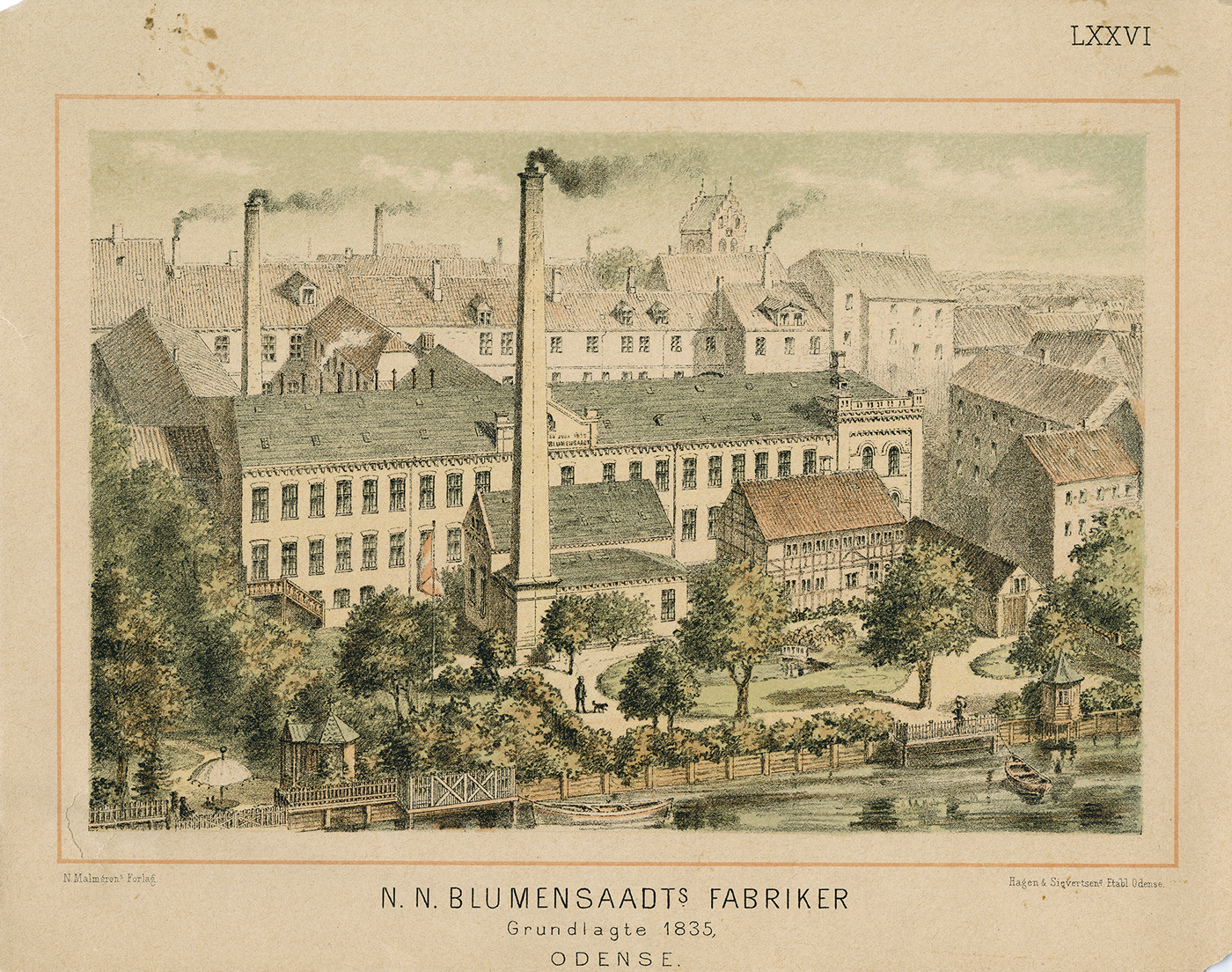
Another example of the graphic print as a medium for the industrial class's celebration of their success was a large collection of coloured lithographs of Denmark’ s Industrial Establishments published 1887–90, described as ‘A Book for the entire Industry, its Exponents, Supporters and Friends.’Footnote 56 The prospects are bird's-eye views, showing off both façades to the streets as well as the entire complex of buildings and courtyards to the back. The smoking chimneys, as signs of industriousness, blend in perfectly with the green surroundings included in many of the images (see Figure 6).Footnote 57
An image from an 1880s publication series of Danish industrial establishments showing N.N. Blumensaadt's factories, a local producer of soaps. This as well as several other images from Odense include either the river with sailing rowboats or iconic historic buildings (Odense City Museums).
Advertising Odense
Another source of imagining the industrious city was the new genre of printed advertisements, found in newspapers, directories, guidebooks, on trade cards, bills and letters, which soon became the most widespread source of visual representations of provincial towns.Footnote 58 Images of shops and manufacturers often included small townscapes that conveyed ideas of city identities, such as a small catalogue of drawings published by shop owners and industrial establishments in Odense from 1891.Footnote 59 While many were classic views of shop windows, entrances and shop locales, others made references to established landmarks and iconic views in their marketing. The front of the booklet was adorned with the classic view of cathedral above river and spread among the advertisements were idyllic views from around town. A maker of mineral water marketed his products with a view of the famous gardens of the Atheneum; similarly, other factories took care to show their establishments from a viewpoint in which the river was visible.Footnote 60 This fits well with Layton-Jones’ argument of how industrial manufactures were marketed as an integrated part of the provincial urban fabric, and how in the early nineteenth century industrial expansion, aesthetic beautification and civic prestige were complementary rather than conflicting.Footnote 61 This was also true for Odense in the late nineteenth century.
The industrial enterprises that appeared in both the old centre and particularly on the outskirts of town from the 1840s clearly made their way into the printed and mental imagery of Odense. Meanwhile, the established narrative of old Odense stood its ground and in general the paucity of chimneys representing industry, which fuelled much of the growth and expansion of Odense in the second half of the nineteenth century, is noteworthy – except of course in advertisements picturing the industrial establishments themselves. Rather, images and advertisements from many manufacturers and retailers included the characteristics of the old and green cityscape, and the stylish culture of shopping streets.Footnote 62 Likely this was partly due to the fact that before the chimneys grew large and numerous in the 1870s, the distant prospect with its romanticized image of the city gradually went out of fashion and was replaced by images of buildings and street life in the town centre.Footnote 63
Increasingly, images from Odense showcased the many new public buildings representing civic accomplishment in the shape of education, culture and urban improvement. In 1885, Odense hosted the Danish National Exhibition of Industry. Interestingly, the accompanying memorial booklet includes neither industrial establishments nor any of the usual historic buildings, save the iconic cathedral by the river (viewed at two different distances from the new bridges and at street level surrounded by new buildings). Instead, it boasts the exhibition building, the monumental new city hall, museum and railway station – thus showcasing important nodal points in the built cultural infrastructure to support the (further) development of an urban, civic society – which simultaneously served to project an image of a successful town to outsiders and sustain class distinctions in public social life.Footnote 64 The development in Odense was thus a good example of the continued importance of stressing the link between wealth and culture – as industry and wealth on its own were symbols of decadence and spiritual depravation.Footnote 65
The town of the councillors of state
Around 1900, journalist C.C. Clausen published a guide to Odense. In it, he contrasted Odense to Aarhus, which had by that time taken Odense's place as the second largest Danish town after Copenhagen:
Aarhus, despite being a thousand Years old, is a Town from yesterday, no History has taken place here, its History and Greatness is in the Future … Odense, in contrast, is a Town with an old and famous History, there, so much points to the Past, both Houses and Institutions … which gives the City's life a particular, refined Patrician feel to it. Aarhus is a young and self-made Society, Odense an old, built on Heritage and Tradition.Footnote 66
Whereas Aarhus was characterized by force, liveliness and greater industriousness, Odense had class, greater finesse and a richer culture. The writer – a Copenhagen journalist – thus placed the living heritage at the very core of Odense's character. An official guide to the 1900 national agricultural show held in the town notes how Odense with its narrow, winding streets is easily discerned as an old town, even though it is characteristic that nearly all its public buildings are new and built within a few generations.Footnote 67 Paintings and drawings from central streets and squares underscore this impression, as they rarely give open vistas along wide boulevards, but new impressive buildings towering above low houses, creating uneven lines in crooked streets. This was an aesthetic experience echoing across centuries in descriptions of Odense – oscillating between positive and negative connotations.
From around 1870 until the turn of the twentieth century, Odense was often popularly called the town of the councillors of state, referring to the group of men who had been instrumental in changing the face of the town. Councillor of state (etatsråd) was an honorary title often awarded to civil servants and later on also to influential businessmen. It carried no actual responsibilities or privileges apart from securing its holder's rank in the order of precedence – a symbolic hierarchy directing protocol, for instance seating at formal occasions and including members of the royal court. The name is often used somewhat sarcastically in the social democratic press to pinpoint the conservative character of Odense, and its meaning seems to have alternated between positive and derogatory uses. It referred, especially, to the city council, where several members held the title, which remained dominated by the political party Højre (Right) until 1915, and while Copenhagen and the other large provincial towns turned left, Odense did not see its first social democratic mayor until 1937. Many of its members were part of Odense's commercial and industrial elite, who in their capacity as members of the council, as private benefactors and builders had endowed Odense with many of its magnificent buildings and cultural institutions.
The narrative of the town of the councillors of state thus linked stories of a grandiose, noble past with the image of an entrepreneurial, wealthy town with a thriving civic culture, materializing in buildings such as a new museum, theatre, archive, lyceum and a centrally heated, electrified hotel – all in an architectural style to match the heritage. Together, old and new created a cultural infrastructure which served as a solid foundation for urban prestige.
The new urban spaces were frequently represented with the aid of new mediums such as the photographic postcard, which ushered in a further move towards telling the story of Odense as a cultural capital. The new postcards prominently feature the grand architecture, favoured spaces and cultural institutions of the bourgeoisie. Particularly, the view of the newly established street Jernbanegade leading from the new railway station past the regional archive, the lyceum, theatre, museum and Grand Hotel to the main shopping street was popular in postcards and visual representations of Odense around the turn of the century (see Figure 7).
This 1904 postcard displays the physical transformation of Odense in the decades around the turn of the twentieth century; the new city hall completed in 1882, two views along the new promenade leading past the museum and Grand Hotel to the 1885 train station and a peek into the celebrated garden behind the Atheneum (Odense Bys Museer).

Contemporary observers remarked how there must have been careful thought behind this urban design as arriving strangers, when moving from Odense's new magnificent railway station towards the centre of town, would pass by these buildings and get the impression of a place ‘in which the aesthetic sense has not been laid to Rest in the all-devouring Grave of Materialism’.Footnote 68 The new street was the sublime representation of the town's wealth, but materialized in the shape of cultural institutions. Specifically, the composed attitude of Odense's bourgeoisie is a common trait highlighted in descriptions of Odense's transformation. When author and journalist Herman Bang visited in 1904, he noted how Odense had asserted itself in the race for prestige by preserving its built environment, and how the many new buildings blended harmoniously with the old. Odense may be a provincial capital, but a capital nonetheless with the fitting mindset, ‘People here have the Ambition of capital Inhabitants to represent their Place. And since they possess much Taste, they do so – appropriately.’Footnote 69 Even while becoming an industrial town, Odense had preserved its old traditions and cultural institutions – and clung to them as a source of identification. A similar narrative may be found in cities such as Edinburgh, where an imagination of the old city shaped urban development.Footnote 70
To some local commentators, the urban improvement priorities of the bourgeois elite was skewed. In 1898, the social democratic newspaper criticized the city council – or the ‘regiment of the councillors of state’ as they termed it – for wasting the town's funds on useless means rather than important infrastructure, such as a proper road to connect the town centre with the harbour.Footnote 71 Placed inland, Odense had no direct access to the open sea before a canal was dug between 1796 and 1804, but it remained somewhat disconnected from the centre of the town and continuously competed with the railway as the primary connection to the world. When a new tollhouse was built in 1899, a position next to the railway was chosen over the traditional place by the harbour. In 1900, an observer noted that ‘this was not where the town's heart lay’.Footnote 72 A hundred years after its initial opening, a deeper canal and larger harbour was opened in 1904 with great festivities and a royal visit, carving out a larger place for it in the popular imagination of Odense – but it would be some time before the harbour took centre stage in the representation of the town. We must look ahead to 1920 before a guidebook advised visitors who wanted to experience the pulse, bustle and progress of Odense to swing by the harbour, freight yard and warehouses – and to 1941 before the cover of a local guide featured a harbour scene.Footnote 73
According to C.C. Clausen, rather than a town of commerce such as Aarhus, Odense was a ‘Factory Town, where the tall Chimneys tower above the Town's Houses, from the top of the Watertower one may count 60–70 of them’. The smoking chimneys towering alongside old church towers, covering Odense in coal smoke and signposting the ‘town of the councillors of state’ as a town of progress are noted by other travellers as well.Footnote 74 But neither the harbour nor the factories were the main pride of Odense's bourgeoisie. In 1913, the local newspaper made the observation that when visitors came to Aarhus, they would be taken to the bustling life at the harbour, whereas visitors to Odense would invariably be invited to the Atheneum; one symbolized busy materialism and the other a striving for culture.Footnote 75 The preference for showing off precisely this gem was evidently connected to a clear notion of what best represented the character and self-understanding of the town and its inhabitants – and, importantly, contrasted it to its provincial rival Aarhus, which surpassed Odense as the second largest Danish town around 1900. The tranquil scenery in the green garden behind the Atheneum was also a favoured image of postcards from the early twentieth century, which was actually also the case for the harbour.
In 1915, a town guide – penned by the assistant editor of the local newspaper, J. Moreau – described how the ‘town of Odin’ had preserved itself and its character:
Something distinguished and withdrawn has lain over Odense from old Times; it does not only manifest itself in a noble old Culture, which still in many ways affect the Lives of the Citizens … it also shows itself in the old Buildings in the old part of the Town, which serves to honour the Men of the present Day, who protects them, when Progress allows it … ‘the town of the councillors of state’, Odense was called many years back, not only because at the time many citizens bore this title, but also because the whole Life of the town and its Physiognomie justified this name.Footnote 76
Not only the preserved, but also new buildings supported the identification of the built environment with the character of citizens. This can be seen in a description of the new theatre opened in 1914, whose architecture, according to an observer, ‘aroused great delight. It was built in the predominant Odense-style … Everything in it resembled our bourgeoisie: Loveable, urban, solid, luminous.’Footnote 77 An historian of the city, writing in the 1880s, refers to several of the new public buildings as built in a ‘noble and clean’ or ‘noble and serious’ style.Footnote 78 This notion of a distinct Odense-style may reflect a wish to ascertain a local identity and pride, rather than a generic urban identity in imitation of the metropolitan style. In many respects, the preferred architectural style in Odense concurred with the historicist fashions of the time with Italian influences, gothic references and national-romantic decorative details. For instance, the magnificent new town hall, erected between 1880 and 1883, was built with inspiration from the Italian renaissance, but adorned with decorations drawing heavily on medieval gothic style with a clear reference to Odense's history and of course the cathedral across the square, which had recently been restored to its (somewhat freely imagined) gothic splendour by the very architect who was designing the new city hall.Footnote 79 Through building and transforming the town in accordance with the narrative of the past, Odense maintained its urban prestige as an old town. The enormous scale of the project – compared to for instance the town hall built in Aarhus in the 1850s – reflected the self-fashioning of the Odense bourgeosie during the late nineteenth century.Footnote 80
In the race for urban prestige, Odense thus followed the same trajectory as most other provincial, industrial towns in its ambition to imitate their capitals, but, as Sweet has argued, provincial towns likewise upheld and enforced their sense of local identity in this process of emulation – and history was an especially well-suited means of reinforcing local pride and identity.Footnote 81 Through building and transforming the town in accordance with the narrative of the past, Odense maintained its urban prestige as an old town. The case of Odense is an eminent example of how, as Stobart has shown for English industrial towns, history, traditional and cultural infrastructure were employed to rewrite material and industrial success into a narrative of elegance, culture and noblesse.Footnote 82 The old sociable associations with their traditions, as archaic as they may have been, remained a source of local pride and distinction – even if the occasional voice from the capital pointed their sardonic wit at their provincial ambition.
Conclusion
This article set out to explore further the potential of visual culture to broaden the understanding of how place identities were constructed and imagined in a small Danish provincial town during the dual process of industrialization and urbanization, at the intersection of transnational urban fashions and local physical, historical and political landscapes. I have shown that, while representations might have followed more generic fashions and aesthetic conventions of urban imagery, they both reflected and contributed to the construction and reproduction of a specific visual geography of Odense. This was a geography in which the combination of heritage and nature continued to play a central role even as industry made its influence known and transformed Odense more and more into a ‘Factory town’. Eerie prospects of a town clad in smoke were never prominent as aesthetic fashions shifted towards the depiction of street life before the chimneys grew in size and numbers during the last decades of the nineteenth century – later than the large industrial metropolises. Rather than supplant the traditional iconic images, representations of industry and commerce incorporated them – and thus sustained the narrative of the ancient, noble town.
Visual representations alongside written narratives show how Odense, in the competition for civic esteem, sublimated, first, the traces of age and history in the townscape, and, secondly, the signs of industry into an image of a cultural centre. In so doing, Odense merged a narrative of progress and economic success with tradition and distinction. In this imagined geography, images of new public buildings, representing an infrastructure of civic culture and illustrious associations, gradually replaced romantic images of heritage and nature as markers of urban prestige. Throughout the period, as the many new buildings, albeit gradually, irreversibly transformed the physical landscape of the town, the narrative of the ancient, regional centre remained essential to the perception of Odense and the character of its inhabitants.
As the twentieth century progressed, the narrative – and buildings – of the old, noble town was increasingly put under pressure by new urban ideals and the needs of mobility which dictated changes in the physical infrastructure of Odense. Commentators began noticing how the reflection of electric lights in glass and steel façades obfuscated former vistas of old houses along crooked streets.Footnote 83 As the political balance in the city council changed from conservative to social democratic in 1937, a new agenda of progress and improvement for the masses ushered in a break with tradition and the imagined geography of the town of the councillors of state was irrevocably a figment of the past.



