Beliefs and preferences serve as the foundation for models of political economy;Footnote 1 they are similarly central to the study of everything from elections and legislative voting to international relations.Footnote 2 Understanding of the sources and formation of beliefs is consequently critical for political science. Many sources shape political preferences: direct experience (of, for example, recession), elite framings and the mass media all give information conducing to particular viewpoints. Of particular importance, though, are social interactions: not for nothing is the process of preference formation usually called ‘socialization’. Parents, teachers, peers, fellow members of clubs and organizations – each provide cues about proper behaviour and the workings of society. Accordingly, all have received attention from scholars looking to trace the origins and evolution of individuals’ political beliefs.
Curiously, however, siblings have received relatively little attention as a source of socialization, despite their conspicuous place in the lives and perceptions of young people. In part, this is because it is hard to distinguish the independent effect of individuals’ sisters and brothers, since the same parents and, often, community influences that affect the individuals themselves also shape the siblings. Moreover, in most (but not all) households, all members share racial and socio-economic characteristics, further reducing the scope for identifying and isolating siblings’ specific influence.
Yet siblings do vary. Most importantly, they differ in sex – and do so in quasi-random ways that expedite empirical analysis. Psychologists and sociologists have extensively considered this variation in siblings’ sex, finding widespread effects on behavioural and educational outcomes. One of the more sizeable and consistent of these effects reflects the sex of the immediately older sibling. Throughout their youth, people tend to look up to and emulate their older siblings; the elder sibling closest in age, being most likely to serve as playmate and companion, has the greatest chance of impressing his or her views.Footnote 3 As a result, those whose next-older sibling is a sister are somewhat more apt to have conventionally feminine interests, while those following a brother tend to have more typically masculine interests.Footnote 4 Of course, systematic differences between male and female outlooks are common across a broad range of important political and economic issues. If elder siblings pull their younger siblings towards their own points of view, elder siblings of different sexes may then systematically redirect their juniors in opposite directions on issues with this sort of gender gap.
This article examines two dimensions of political belief with average differences between females and males: general left–right orientation and government activism. Women generally place themselves further to the left on ideological scales.Footnote 5 Similarly, compared to men,Footnote 6 women consistently are more likely to prefer a greater role for the state, particularly when considering the role of the state vis-à-vis the market.Footnote 7 Sibling socialization, therefore, suggests that those whose next-older sibling is female will tend to echo those more left-leaning, interventionist views. Data presented below from the 1994 United States General Social Survey indicate that this is indeed the case: compared to those following a brother in birth order, people following a sister identify as further left on the ideological spectrum and have less faith in the private sector's ability to solve social problems.
Siblings as Socializers
Siblings play only a small part in mainstream economics and political science. At best, these fields have acknowledged related influences of birth order and family size: older and younger siblings face divergent family dynamics growing up. As a result, firstborn children are more apt to get an education and run for office, while younger siblings tend to adopt more rebellious outlooks.Footnote 8 Occasionally, scholars combine these ideas with sibling sex and explore whether being, say, the firstborn son modulates other effects of birth order.Footnote 9 Outside the realm of family size and resource allocation in the childhood home, though, sisters and brothers rarely appear.
This sits uneasily with evidence from the other social sciences that siblings extensively affect each other's perceptions and behaviour.Footnote 10 The literatures on social and developmental psychology are especially emphatic about the persistent, influential effects that siblings have on one another; sociological studies add some broader context to sisters’ and brothers’ likely impact. Although these effects are larger and more studied among the young, when siblings are most apt to spend time together, many of the relevant psychological features show a high degree of persistence after adolescence.Footnote 11 For example, having siblings can alter basic, typically lifelong traits such as conscientiousness or extraversion.Footnote 12 In addition to these psychological effects, siblings affect behaviours – such as childbearing – that themselves influence political views.Footnote 13 When siblings have such a range of effects, it seems likely that they might also affect outcomes of direct political interest.
Political scientists’ reticence concerning siblings may stem from the empirical complexity of the topic. As a practical matter, siblings’ tendency in many societies to establish separate households makes it costly to gather information about them or interrogate them about their political beliefs: very few studies collect data on both sibling composition and interesting political beliefs. More theoretically, the same psychology literature that emphasizes the importance of siblings also suggests that siblings have a rich variety of potential effects, with many factors diffracting the relationship. The size of the age gap between siblings makes a difference,Footnote 14 as may family demographics such as socio-economic status.Footnote 15 In large families, the multiple overlapping dyads of significant interaction require considerable effort to disentangle. The possible influences of half-, step-, foster and adopted siblings further complicate matters, as do systematic variations in parental investment in different siblings.Footnote 16
Despite these intricate webs of effect, some straightforward, testable theories nevertheless emerge. One particularly promising source of effects is one's next-older sibling. Siblings who are near each other in age and rank within the family typically interact more with one another than do more disparate pairs; accordingly, more proximate siblings usually overlap most in outlook.Footnote 17 At the same time, sibling socialization tends to flow from older siblings to younger,Footnote 18 both through explicit attempts of older siblings to mould the younger and through younger siblings’ efforts to emulate the older.Footnote 19 These two processes mean that one's immediately older sibling tends to be especially influential in shaping personality and behaviour. This naturally does not inform outcomes for only children or eldest siblings, but it still affects large proportions of most countries’ populations.Footnote 20
The most obvious feature of the immediately older sibling to consider is that of sibling sex. Sibling sex is a much-studied matter with extensive theoretical and empirical heft.Footnote 21 Focusing on sibling sex pragmatically looks at a highly visible, persistent feature: even someone at great distance from, or out of contact with, siblings can reliably report their sexes. Sex is a socially salient characteristic throughout life, and a possible role for sibling sex echoes other, known political effects of family gender composition.Footnote 22 Most prominently, a parent's mix of sons and daughters affects issue preferences and voting behaviour.Footnote 23 Given the relative malleability of beliefs during youth, when interaction with siblings typically peaks, the potential influence of sisters or brothers may be even larger than that of daughters and sons. Finally, the determination of an older sibling's sex is typically random and exogenous to most political stimuli, serving as a natural experiment. This makes for clean, clear empirical analysis, with less need for complex models: as the classical justification for control variables requires that the confounding factors causally influence the independent variable of interest as well as the dependent variable, a plausibly exogenous independent variable such as sibling sex has little for extensive control variables.
What effects, then, might the next-older sibling's sex have on political preferences or beliefs? The most frequent finding is that siblings tend to conform: in the process of socialization, the younger sibling's tastes and ideas tend to converge towards those of the older. This holds across a range of outcomes, such as hobbies, educational experiences or attitudes towards smoking and alcohol consumption.Footnote 24 It even holds when the outcomes in question are sex-typed; people with an older sibling of the opposite sex are less apt to restrict their interests only to matters traditionally associated with their own sex.Footnote 25 All else equal, in other words, individuals whose immediately older sibling is female will be more likely to act in typically female ways, while those whose immediately older sibling is male will be more likely to follow commonly male patterns.
If this process extends to more directly political outcomes, those preferences showing a gender gap will show a parallel sibling-gender gap. A wide variety of political questions does exhibit consistent sex differences, whether for sociological or biological reasons (or the interaction of the two).Footnote 26 In many countries, for example, political participation differs between men and women.Footnote 27 Differences are even more striking on matters of public opinion. Men and women have divergent preferences over overtly gender-related issues such as sexual mores and family roles.Footnote 28 The different perspectives extend well beyond these realms, however, spanning policy issues from criminal justice to the environment.Footnote 29 Indeed, sex differences turn up even in very broad measures of partisanship and ideology.Footnote 30
How would an older sibling transmit these sorts of preferences to younger siblings? It is unlikely, after all, that children spend much time sharing information about explicitly political questions or otherwise directly socializing attitudes towards government policy.Footnote 31 Various means of influence are nevertheless possible. Siblings tend to shape attitudes towards risk, through both modelling and explicit discussions of likely consequences.Footnote 32 These socialization behaviours are most frequently studied and observed in proscribed activities – sexual relations, alcohol and drug abuse, and the like – but encompass many other issue areas as well.Footnote 33 Since risk aversion tends to influence preferences on a wide variety of political questions, sibling influences concerning risk may induce concomitant ideological shifts.Footnote 34 Other broad psychological factors besides risk may similarly beget sibling influences, though sex differences in risk attitudes are particularly well established.Footnote 35 In addition, siblings affect participation in organizations and extracurricular activities; when these involve groups with particular outlooks towards social relations, this may shape subsequent political beliefs. For example, girls tend to be more engaged with religion and church groups, while boys have historically been more likely to prefer competitive sports teams.Footnote 36 But people are generally more likely to join groups that their older siblings belong to, and therefore if these types of groups tend to involve or produce divergent social attitudes, sibling influence could also affect preferences. Finally, if policy preferences stem from self-interest, it may be that younger siblings are socialized to dislike policies that redound to the disadvantage of their elders. For example, if females suffer from discrimination, they may complain of it to their younger siblings and motivate opposition to policies that put women at a disadvantage.Footnote 37
Alongside these direct socializing influences of siblings, indirect socialization by third parties could also reflect sibling sex.Footnote 38 Younger siblings can observe the socialization by parents and others, including any sex-typed messages that they may transmit. Many parents attempt to avoid treating daughters differently from sons, but even they often subconsciously treat children of different sexes contrastingly from a very early age.Footnote 39 Traditionalist parents socialize their daughters still more differently from their sons.Footnote 40 While the parents target these sex-specific messages at the older child, they may naturally spill over to the younger as well, either reinforcing or countermanding the messages presented directly to that child. Since socialization by sex typically involves instilling different attitudes towards politics and competition, this could influence attitudes towards the matters considered below.Footnote 41
The most fundamental place to seek sibling influences in political belief would be in the most encompassing forms of ideology, the most salient of which is typically the left–right scale.Footnote 42 Sympathy towards positions on the left or right frequently leads to a host of other issue positions. Furthermore, this dimension of belief also correlates markedly with sex: women, on average, consistently fall to the left of men on the political spectrum.Footnote 43 The multiple processes that lead women to greater sympathy for the left should then leave older sisters more left-leaning than older brothers, on average. Following a sister in birth order is then more likely to expose an individual to left-leaning sentiments, while following a brother is relatively more likely to involve exposure to right-leaning attitudes. If these broad preferences transmit as hypothesized above, then, those whose next-older siblings are female would, all else equal, be further to the left than those whose next-older siblings are male.
Of course, abstract ideological identifications may translate only weakly into feelings about concrete issues, and therefore it is useful to have a more specific question of policy preference to supplement the left–right dimension. Along these lines, one of the most far-reaching differences in attitude between men and women concerns their relative keenness for state intervention. Women are more favourable than are men to an expanded role of the state.Footnote 44 This general preference shows up consistently across specific economic issues as well: whether considering tax rates, government budgets or state-owned enterprises, men are likelier to prefer the outcome with the smaller state and more expansive private sectorFootnote 45 – particularly in the United States.Footnote 46 There are several well-established sources of these gender gaps, as a variety of factors produce similar outcomes. Women's scepticism about markets may result from observing sex-based pay discrimination, from socialization that is less sanguine about competition or from their traditional role as consumers bearing disproportionate shares of household shopping responsibilities. Irrespective of the precise cause, women's relative reluctance to embrace the market recurs throughout the public opinion and political economy literatures – and such reluctance could spill over to younger siblings whom women help socialize. An individual whose next-older sibling is female, then, has a close, lifelong association with someone relatively likely to be acceptant of interventionist state activity. By contrast, if that next-older sibling is a brother, the association is instead more likely with someone more dubious of the state. With this example and influence, the younger sibling's preferences are likely to tack towards those of the older sibling. As a result, a person whose immediately older sibling is a sister is more likely to support state intervention than an otherwise identical person whose immediately older sibling is a brother.
These effects on ideology and attitudes towards state intervention could manifest themselves in various ways in practice. One possibility is that for two siblings of the same sex, the mechanism discussed here would not alter the expected position of the younger sibling. That is, two sisters – or two brothers – would start with the same predicted position, so that their positions could not converge further.Footnote 47 This mechanism nonetheless always predicts that those with an older sister will be further to the left and more sympathetic to state intervention than those with an elder brother: women because they lacked the market-friendly rightward pull of a brother and men because they experienced the state-friendly leftward influence of a sister. Still, those with a next-older sibling of the same sex would share their positions with only children or firstborns.
Alternatively, the older sibling could substitute for a more mixed set of influences on the younger sibling: cues from the older sibling could replace or drown out some effects from parents or a diverse group of peers or media sources. In this conception of sibling socialization, the preferences of both sexes will systematically shift from the sex's average. Women with older sisters, having experienced a particularly female-dominated set of influences, would be expected to be even more likely to support state intervention than would a woman without older siblings – who would in turn prefer more interventionist measures than would women with older brothers. A similar pattern would hold for men. In this case, though, those with older siblings of their own sex would be more ideologically extreme than those without any older sibling.
These types of sibling socialization have their limits. As mentioned above, socialization among children probably involves less explicit political content than does the influence of adults, which may diffuse any effects. It would in any event be unsurprising if a mechanism based on sibling sex mattered less than sex differences themselves do in empirical studies: the effect of being female is probably typically greater than the effect of having an older sister, whether because of other sorts of socialization (such as peers) or because of intrinsic biological distinctions. Also, some people partly establish their own independent identity by explicitly moving away from or totally rejecting their siblings’ beliefs and interests, just as parental socialization does not always stick. In addition, households with several children all of the same sex exhibit less consistent conformity to societal sex roles than do other family configurations.Footnote 48 That is, girls in a family without brothers tend to follow typically female interests and outlooks less often than do girls in a family that also includes sons. A Markov-chain model, with effects of all older siblings cascading down predictably through the younger siblings, is hence unlikely. Still, the immediately older sibling may have a socializing effect pulling towards their own sex role on average, even if some families do not reflect this pattern.
Data and Analysis
As mentioned above, public opinion surveys rarely include both substantive political questions and systematic information about siblings. The major exception is the 1994 American General Social Survey (GSS); most other polls and political questionnaires ignore siblings altogether, and even other iterations of the GSS do not contain the extensive data about brothers and sisters that the 1994 survey featured.Footnote 49 Since gender gaps have probably not changed qualitatively since 1994 (though they have narrowed in several dimensions),Footnote 50 the dataset probably still expresses the general relationship between gender gaps and sibling-gender gaps. The survey's inclusion of the crucial sibling data along with questions about ideology and attitude towards state intervention in the economy accordingly outweighs the drawback of oldish data. In addition, the slightly older dataset means that the births of most survey respondents – and their older siblings – antedate the ubiquitous availability of ultrasounds. This reduces the potential for selection effects in sibling gender, thereby enhancing the randomized, natural-experiment study design.Footnote 51 Consequently, the models below employ the 1994 GSS data, despite its conceded age.
Within this dataset, the first necessary task is to determine the sex of the respondent’s next-older siblings.Footnote 52 This is generally straightforward, as the GSS typically includes birth years and sexes for all siblings. There are, however, some more complicated cases. As values are reported for only the nine eldest siblings, complete data may not be available for respondents from very large families. If all nine reported siblings are older than the respondent, as occurs in a small number of cases, the next-older sibling may not appear in the data. In addition, multiple siblings born in the same year are ambiguous: they might be twins or separate births in the same year, especially if the siblings do not share a mother. These differing configurations produce differing expectations for the theory here, since twins tend to have a much weaker influence on sex roles than do older siblings and therefore are not counted as older siblings here.Footnote 53 It is quite common for respondents to share a birth year with siblings; these are clearly twins in most cases, but in some instances, they may instead be older or younger siblings.Footnote 54 Likewise, sometimes there appears to be a tie for next-older sibling, with multiple older siblings born the same year.
Where these ambiguities exist, they are frequently immaterial to the hypothesis, since both potential next-older siblings are of the same sex. Results presented below are robust to the exclusion of the remaining uncertain cases, which number fifty-one in total (out of 1,904 respondents with older siblings). Other questions concern step-siblings, half-siblings or adopted siblings, who may have been less available as a socializing factor, or deceased siblings, who might have died before they exerted a socializing influence. The data here do not provide usable information about the date of death of deceased siblings, but they do disclose which siblings are not full biological siblings. Using the data for full siblings changes the reported results only slightly.Footnote 55
For the first dependent variable, general political ideology, the GSS has several potential measures. The most direct measure asks respondents to place themselves on a seven-point scale where 1 represents ‘extremely liberal’ and 7 ‘extremely conservative’. This self-evaluation may be unreliable if respondents vary in their perception of what ideological positions these labels describe.Footnote 56 This problem may not be of great moment here, since the socialization mechanism under study contributes to perceived placement of ideological categories. Nevertheless, other measures of ideological position offer useful reassurance about the consistency of the measure.
One closely related variable in the two-party system of American politics is partisanship: closer association with the Democratic party tends to indicate more leftism, while Republicans tend to espouse a more rightist policy. This provides a more anchored perception of ideology, although it has its own drawbacks, most notably that in 1994 the Republicans’ transformation into the right-leaning party in the South was still quite recent, and partisan identifications might not yet have adapted to the change. But partisan sex differences have generally mirrored the explicitly ideological gender gaps.Footnote 57 As measured here, partisanship is also on a seven-point scale, with ‘strong Democrat’ at 1 and ‘strong Republican’ at 7.
A third measure of overall ideology, preferred candidate in the 1992 presidential election, amplifies both the strengths and weaknesses of the partisanship measure. Looking at specific candidates removes regional variation in partisan ideology that may afflict the other measures; at the same time, comparisons of Bill Clinton and George H. W. Bush may signal concerns about personality as well as ideology. Moreover, the 1992 election saw a large number of voters eschew both major parties in favour of an independent candidate, Ross Perot, whose ideological classification confuses the tidy left–right spectrum of the election.Footnote 58 To convert these complex possibilities into a measure of attitudes, the models below look only at those who supported either Clinton or Bush, indicating with a value of one those who voted for Bush and non-voters who profess to have preferred Bush in the election. For all three measures of ideology, then, higher values associate with the more right-leaning position; since women are more likely to prefer the left-leaning position, the hypothesis predicts that those with a sister for a next-older sibling will have lower scores on these measures than those whose next-older sibling is a brother.
The GSS also includes several questions related to the other dependent variable, the desired degree of government involvement in the economy. One asks respondents to rate how much they agree with the idea that private enterprise will solve America's problems. Another queries whether the respondent thinks the government should be doing more or less to solve national problems.Footnote 59 Two further variants of this latter question concern whether the government should do more to help particular subgroups, namely the poor and the sick. Answers for each question are on a five-point scale with higher values expressing greater preference for a smaller, less interventionist government.Footnote 60
As noted above, sibling sex greatly facilitates empirical analysis, because it is effectively a natural experiment. An older sibling's sex is typically randomly determined without any role for explicit selection effects, especially for full, biological siblings. The essentially exogenous nature of this random assignment is thus independent of typical causal factors, which alleviates the need for control variables: the randomization leads the effects of confounding factors to be equal across groups in expectation.Footnote 61 Nevertheless, persistent patterns in the decision to have a child may make it prudent to control for a variety of demographic factors.Footnote 62 In particular, Americans have a long-standing preference for having a child of each sex, which often leads to families continuing to have children until there is at least one son and one daughter.Footnote 63 If, as some have suggested, this practice is more common among those holding out for sons rather than daughters, it could systematically affect the likelihood of one's older sibling being female among affected sub-populations. Some groups may additionally have different propensities to have male or female childrenFootnote 64; if these groups also diverge in political preferences, any apparent effect of sibling sex may be spurious.
To allow for these possibilities, the models below include controls for the respondent's sex, age and minority status (that is, whether the respondent claims to be of a non-white racial group).Footnote 65 In addition, as proxies for other parental characteristics that may be relevant, the models include measures for several respondent characteristics at age 16. These include fundamentalism (measured on a three-point scale) to capture parental religiosity, the urbanness of the location of residence (ranging on a six-point scale from ‘non-farm in the countryside’Footnote 66 to ‘city of more than 250,000 inhabitants’) and a battery of dummy variables indicating the census division of residenceFootnote 67 to take regional factors into account.Footnote 68 Presumably, these characteristics of the respondents reflect elements of the childhood home or parents’ attitudes that could influence both potential sibling socialization effects and underlying propensity to hold particular political beliefs.
As an additional check of the robustness of the results, the models below also feature an alternative specification including controls for the respondent's current household income (on a twenty-one point scale) and education (in years). Although these cannot influence the independent variable of interest and therefore are unorthodox control variables, they are widely influential variables – particularly in socialization and preference formation – that may capture characteristics that relate to the accuracy and reliability of the sibling variables. Models including these variables are noted in the tables below under the column heading (b), matched with the otherwise identical baseline model headed (a).
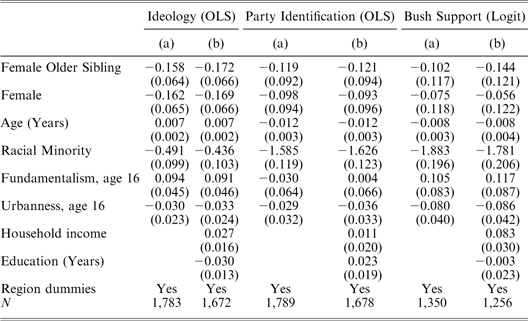
Table 1 shows the model results, using ordinary least squares (OLS)Footnote 69 regressions for the seven-point ideology and partisanship measures and logistic regression for the binary 1992 Presidential vote variable. In all six regressions, having a female next-older sibling takes the expected negative coefficient. Strengthening support for this expectation, being female also takes a negative coefficient, so that the effect of being a particular sex matches the effect of being influenced by a sibling of that sex. Although the coefficients imply a quite modest effect of sibling sex – the estimated difference between those with female and male older siblings is between 0.1 and 0.2 points on the seven-point ideology and party identification scales – these are comparable in magnitude to the estimated gender gap itself.Footnote 70 The effect of sibling sex also is substantial in comparison to other important influences on political preferences; for example, the sex of the next-older sibling has a larger estimated effect on the dependent variables than does a one-decade shift in age. Statistically, the coefficients are most significant for self-declared ideology itself, as might be anticipated from the most direct measure of outlook.
Models of Ideology

Note: Robust standard errors are shown in parentheses. In each model, the primary variables in (a) are augmented by Household income and Education variables in (b).
Meanwhile, the non-sex control variables also have plausible coefficients. Older people call themselves more conservative and yet are more likely to support and vote for Democrats, while minorities and people who grew up in more densely populated areas tend to be more on the left across all measures of ideology. Conversely, those who were more religious at sixteen years and those with higher incomes tend to be more conservative by these measures.Footnote 71
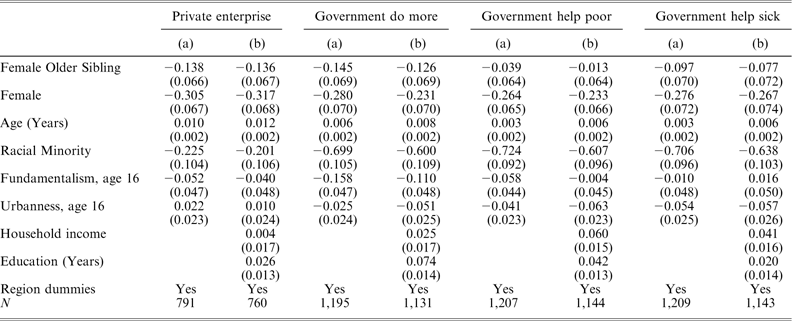
As noted above, though, gender gaps characterize not only overall ideological predisposition but also positions on more specific issues. Table 2 reports the regression models predicting attitudes towards government involvement in the economy. Across all four dependent variables, those who follow a sister in birth order are consistently more likely to welcome state intervention. However, although this effect matches expectation in direction and in being smaller than the effect of femaleness itself, it varies in magnitude and statistical power for different types of government activity. Most distinctively, government action on behalf of the poor sees a markedly weaker effect of sibling sex. With the other dependent variables, a female older sister has about one third of the predicted effect of being female; with helping the poor, the effect of sibling sex is less than one fifth that of the respondent's own sex, and the coefficient is not even one standard error away from 0.Footnote 72 The anomalously smaller effect of sisters in promoting government intervention on behalf of the poor may be a fluke, or it may perhaps stem from older brothers’ greater tendency to aggression and violence against their younger siblings.Footnote 73 This could induce sympathy for the downtrodden among younger siblings, which on this issue might partially counteract brothers’ socialization towards limited government. Regardless of the cause, sibling sex has a stronger effect for the other dependent variables. Reinforcing confidence in these estimates, control variables are also plausible in direction and effect. Women and racial minorities tend to be more favourable to government intervention; older people, the wealthier, and the better educated are generally less favourable.
OLS Models of State Intervention Opinion

Note: Robust standard errors are shown in parentheses. In each model, the primary variables in (a) are augmented by Household income and Education variables in (b).
Sibling Closeness
While the results support the idea that the sex of one's next-older sibling may influence one's own preferences, they provide little detail into how reliably it applies across individuals. Has the effect of sibling sex diminished among recent generations as gender roles have become less distinct? Are some individuals more susceptible to sibling influence? If the above effect of siblings in practice only applies in some cases – or applies more strongly in those cases – it would illuminate the mechanisms by which sibling socialization occurs.
Perhaps the most theoretically pressing dimension of the sibling relationship is the closeness of the siblings. Siblings who have a deeper emotional connection and those who have spent more time together are more likely to be conduits for ideological influence. Thus, closeness is conceptually relevant. Assuming such relevance also offers a potential means to check the plausibility of the mechanism looked at here in greater detail: people who are close to their next-older siblings should have their ideology more strongly influenced by those siblings’ sex than would those who are less close to their siblings. It is accordingly worth testing whether sibling closeness intensifies the ideological effect of sibling sex.
Unfortunately, the GSS does not contain direct measures of a particular sibling's influence. The closest available measure concerns how frequently the respondent spends an evening with a sibling, but this variable does not distinguish which sibling is involved; it thus may inflate the apparent closeness of respondents from large families or indicate closeness to the younger rather than the older sibling. In addition, this question is asked of only a small fraction (less than one-sixth) of the sample, resulting in small numbers of respondents and commensurately low reliability in measurement.
An indirect measure of sibling closeness is the difference in age between the respondent and the next-older sibling. Siblings closer in age tend to interact more and to have deeper emotional bonds, as might be expected from their increased likelihood of shared interests and typically longer shared residence in the parental home.Footnote 74 This suggests that the relative leftward influence of sisters compared to brothers will be largest when the siblings are close in age, progressively fading as the age gap widens. This measure has drawbacks besides its doubtless imperfect correlation with actual sibling closeness: large age gaps are selected, not randomized, and parents who choose to space childbirths out further tend to differ from other parents. In addition, the age gap itself may allow parents to devote more resources to children or otherwise differently treat those born closer or further from their siblings.Footnote 75 When studying the effect of age differences, then, the natural-experiment characteristic of the basic research design dissipates. The additional control variables included in the earlier regressions should, however, take into account the effects of likely confounding factors.
For modelling here, the measure of age gap is the natural logarithm of the difference in year of birth between the respondent and the next-older respondent, although a measure incorporating respondents’ months of birth produces similar results.Footnote 76 The logarithm is included to reduce the severe rightward skew in the distribution of age gaps.Footnote 77 The interactive relationship between the age gap and older sibling's sex is then modelled by the product of this logarithm with the female indicator variable.
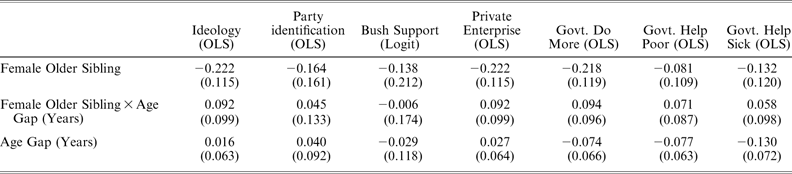
Table 3 reruns the full models of Tables 1 and 2 – that is, the versions which include income and educationFootnote 78 – disaggregating sibling effects by the age gap between the respondent and the next-older sibling. The theory above predicts a negative coefficient for having a female as a next-older sibling, as before: sisters should still exert leftward (and state-friendly) influence compared to brothers. But the interaction would be expected to have a positive coefficient, suggesting that for large age differences, the ideological influence of the next-older sibling's being female instead of male dwindles. The table omits control variable coefficients for brevity; they are very similar to those given in Table 1 in both size and direction.
Effect of Next-older Sibling Sex on Ideology, by Age Difference from Next-older Sibling

Note: Robust standard errors in parentheses; control variables omitted for brevity.
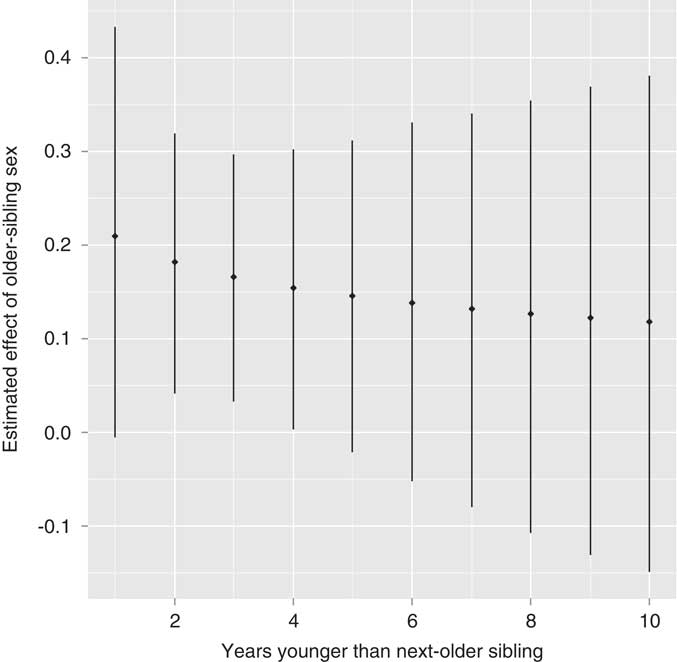
As before, older sisters consistently associate with more left-leaning policy preferences than older brothers do. The interaction has more mixed effects. In predicting the preference for George Bush in 1992, the coefficient is essentially nil and negatively signed. This contrary result may stem from candidate preference being the least tied of the three measures to political ideology. In the other six models, though, the interaction with the age gap moderates the effect of sibling sex: on both the ideology scale and the partisan identification scale, the interaction takes the expected positive coefficient (albeit smallish and imprecisely estimated).Footnote 79 The coefficients suggest that a sibling one year older than the respondent has just under twice the impact on ideology as does a sibling ten years older. Figure 1 illustrates this relationship graphically for Column 1 of Table 3. The point indicates the predicted move to the left (in points on the seven-point scale) from having a next-older sister instead of a next-older brother for each age gap from one to ten years.Footnote 80 The bars show the 95 per cent confidence interval on the estimated effect.Footnote 81
Sibling closeness and size of effect on ideology Note: Higher values indicate relatively larger liberalizing effects of the next-older sibling being female instead of male. Points indicated estimated values; bars show 95 per cent confidence intervals.

This result suggests that an older sibling's effect on political preferences diminishes as that sibling grows relatively older – and presumably more distant from the respondent. This is consistent with the model of sibling socialization presented above. Even though much older siblings probably have better formed political beliefs and could more explicitly convey meaningful political information to their siblings while the latter were forming a political consciousness, their effect on ideology appears weaker, at least by this rough measure.
Conclusion
Siblings, especially older siblings, serve as important socializing influences for many people. Most often, siblings provide influences similar on average to those of other family members and peers, since they themselves experience many of the same conditions and frequently travel in the same social networks. Perhaps as a result, their potential for independent influence remains masked. Yet some siblings are far from average in some ways. A sibling in prison, or one with disabilities, may exert a profound, observable effect, in directions yet to be studied – and so, in more quotidian ways, might an otherwise unremarkable sibling of a particular sex.
Here, the focus was on broad ideology and on one particular issue area, state activism, in which a gender gap in preferences translates into divergent effects of sisters and brothers. Women tend to be left-leaning and have more faith in the value of the public sector; so, as seen here, do their younger siblings. This speaks directly to the recent literature in political economy examining the extent and degree to which other people's positions influence individuals’ preferences.Footnote 82 It connects, moreover, to other spheres of inquiry. Other questions with sex-linked differences may see similar effects, if the findings here reflect broader trends in political psychology and public opinion. Nor need these processes be restricted to beliefs and preferences: siblings’ different propensities to participate in politics (or engage in other forms of political behaviour) may similarly set an influential example. As sociologists have intensively studied, siblings also affect behaviour such as educational attainment, which has its own broad influence on outcomes of political interest.
In pursuing the effects of siblings, many questions remain open. One surrounds the role of biology and genetics. Many analysts find that biological older brothers are particularly important in determining younger brothers’ sexual orientations, and this effect's failure to carry over to non-biological brothers raised in the same household suggests that socialization may not be the only way siblings shape socially relevant outcomes.Footnote 83 Pinpointing the extent of such biological outcomes is a task to which political science has only recently turned. Another set of questions for future research deals with other mechanisms by which sisters and brothers influence outcomes relevant for political science and economics. As a first cut at the many possible effects of siblings, this study focused on one small and relatively simple issue, the influence of the next-older sibling as suggested by that sibling's sex. But the full complement of siblings surely matters in their ways, and they are more than their sex. A more complete model of family influences might consider dimensions of sibling personality like dominance or intelligence that are present both in children and throughout life. This further study, however, is complicated by the highly limited availability of surveys including information about siblings as well as politics. Future research could profitably include more family-related questions in surveys; until such data are available, it may be easier to examine sibling influences in legislators or other political elites.
Family influences are naturally only one factor shaping preferences and behaviour. Still, with the psychological importance of the childhood household and later attachment to relations, they might constitute a particularly important influence, whether considering party labels, the proper size of government or beyond. Even as powerful new technologies allow the creation – and analysis – of ever more elaborate social networks, it is also worth considering homelier influences on political lives. Still more, it is worth taking an interdisciplinary approach to the social sciences: the important influences of psychology, sociology and economics are also likely to be fruitful sources of beliefs and behaviour for political science.