


Introduction
Agoraphobia (with or without a history of panic disorder) is often chronic and disabling. CBT is well established as an effective treatment for mild to moderate agoraphobia (e.g. Clark et al., Reference Clark, Salkovskis, Hackmann, Middleton, Anastasiades and Gelder1994). However, more severely agoraphobic clients find it hard to access services. Once engaged, avoidance often leads to missed appointments and drop-outs. More severe agoraphobia is associated with greater depression, low self-esteem, dependency and low self-efficacy than panic disorder (see Hackmann, Reference Hackmann, Tarrier, Wells and Haddock1998). Such factors can prolong treatment, or create stumbling blocks. Finally, whilst clinicians may accept the value of doing therapist-assisted behavioural experiments outside of the clinic, these can be hard to fit into busy schedules. Even where treatment is available, clients may not get the help they need.
NICE guidelines place emphasis on increasing access to effective psychological therapies. Aware of limitations in local provision, the authors reflected on alternative methods of providing effective treatment. We needed a workforce with sufficient mobility, flexibility and time to provide accessible cognitive therapy for agoraphobic clients. Our hypothesis was that appropriately trained volunteers would be able to provide an effective, inexpensive service to clients finding it hard to access care through normal channels.
Method
Service development
We appreciated that we needed to provide volunteers with suitable training and close supervision. We also intended to ensure proper selection of volunteers, referrals, and measures, good record keeping, and extra support for volunteers if needed. Initially, we approached potential volunteers with experience of working in mental health settings. We explained the nature of the work that would be required, and 12 research assistants (who were keen to gain clinical experience) expressed interest in the project. Most were psychology graduates, available for 6 months to a year, and able to treat at least one client each during that time. They were interviewed by the project leader and references were sought. They were issued with honorary contracts following CRB checks and clearance from Occupational Health. Volunteers were offered training, supervision and travelling expenses. Training sessions were offered every 6 months, and extra volunteers were recruited as required to ensure an adequate cohort.
Training, supervision and treatment
The training was offered by a consultant clinical psychologist in two full-day workshops, separated by a week. In the first workshop Clark's cognitive therapy for panic disorder (Clark et al., Reference Clark, Salkovskis, Hackmann, Middleton, Anastasiades and Gelder1994) was taught. The material included challenging catastrophic beliefs about causes and consequences of panic symptoms, using verbal discussion and behavioural experiments. The second workshop focused on common complications in severe agoraphobia. These included avoidance, leading to missed appointments, reluctance to do behavioural experiments, and hesitation about mentioning feared catastrophes. Clients may also have fears of being separated, abandoned, neglected or ridiculed in the event of having panic symptoms in public, or when alone. Suggestions were provided as to how to address such difficulties (see Hackmann, Reference Hackmann, Tarrier, Wells and Haddock1998). Volunteers were provided with a reading list. The workshops included practising behavioural experiments, some in public places (see Hackmann, Reference Hackmann, Bennett-Levy, Butler, Fennell, Hackmann, Mueller and Westbrook2004). Supervision was provided fortnightly in 90-minute group sessions by the consultant clinical psychologist. Attendance was compulsory and seen as providing extra training. Treatment was provided in the client's home or in their GP's surgery, and in relevant public places.
Referrals
Referrals were accepted from the local primary care mental health service, from GPs, and from secondary care services within Oxford. Clients were accepted if they met diagnostic criteria for agoraphobia (mild, moderate or severe), with a history of panic disorder. Exclusion criteria included having a primary diagnosis other than agoraphobia, or significant co-morbid problems (e.g. social phobia, PTSD, substance abuse, psychosis, personality disorder or severe depression). Each client was assessed (using DSM IV criteria) by a clinical psychologist, accompanied by their allocated volunteer. Initially, assessments were carried out in GP surgeries (if the client was able to attend) or in their home, but later all assessments were done at the client's home as a means of improving engagement. Measures were taken at each session, to ensure that scores were available if clients dropped out. An administrator ensured that proper records were kept, and that letters to referral agencies were sent at appropriate times.
Initial outcomes
After one year we measured treatment outcomes, and found the service was working well, both in terms of clinical outcomes and recruitment and training of volunteers. We then applied for funding for a more extensive project. The Lupina Foundation, which supports projects that improve access to treatment, provided us with funds for two part-time clinical psychologists (project lead 3 hours/week, junior psychologist 4 hours/week) and a part-time administrator to manage data entry, correspondence, etc.
Further analysis of the results, plus benchmarking against clinical outcomes from the local psychology department, resulted in the Primary Care Trust subsequently taking over the funding of the service, named the Lupina Service, which has since functioned as an adjunct to the local IAPT service.
Outcomes after the first 5 years
Over the first 5 years (2003 to 2008) 128 referrals were received. Of these, 34 (26.6%) met exclusion criteria and 20 (15.6%) failed to attend or cancelled the assessment session; 4 were excluded from the analysis (e.g. if treated elsewhere for a disorder other than agoraphobia) and 70 (54.7%) were accepted. Of the 70 accepted, 42 had completed treatment, 13 were still in treatment, so were not included in the analysis, and 15 had dropped out. The mean age of clients who completed treatment was 40 years (SD = 13.03), the majority (73.8%) being women with chronic problems (mean = 8 years, SD = 8.5). Clients were seen for an average of 12 sessions (SD = 5.88); 19% had received previous treatment for panic disorder.
Measures
The following measures were completed at every session.
Modified Agoraphobic Cognitions Questionnaire (Chambless, Caputo, Bright and Gallagher, Reference Chambless, Caputo, Bright and Gallagher1984, modified by Clark et al., Reference Clark, Salkovskis, Hackmann, Middleton, Anastasiades and Gelder1994). In the modified form, patients rate both the frequency of agoraphobic cognitions and the degree of conviction (severity) for each cognition on a 0-100 scale.
Fear Questionnaire (agoraphobia subscale) (Marks and Matthews, Reference Marks and Matthews1979). This measures agoraphobic avoidance.
Interpersonal Fear Questionnaire (Hoffart, Hackmann and Sexton, Reference Hoffart, Hackmann and Sexton2006). This measures feared interpersonal consequences of panic attacks (e.g. neglect, ridicule or separation). As in the ACQ, cognitions are rated for both frequency and severity.
The Beck Anxiety Inventory (Beck, Epstein, Brown and Steer, Reference Beck, Epstein, Brown and Steer1988) and The Beck Depression Inventory (Beck, Ward, Mendelson, Mock and Erbaugh, Reference Beck, Ward, Mendelson, Mock and Erbaugh1961).
Analysis
Having achieved encouraging clinical outcomes in the early stages of the project, we were keen to evaluate the service further. In addition to analysing our own clinical outcomes, we decided to carry out a benchmarking exercise with the clinical outcomes for agoraphobic clients treated in the local psychology service. The service was nationally recognized as a centre for CBT training and practice, with the vast majority of permanent staff stating CBT as their primary therapeutic approach (Westbrook and Kirk, Reference Westbrook and Kirk2005). It seemed reasonable to assume that clients referred with panic disorder with agoraphobia would have been treated using CBT. Our hypothesis was that the outcomes achieved by the Lupina Service volunteers would be equivalent to those of the psychologists.
Results
Lupina Service outcomes
An intent-to-treat analysis was carried out, using one-way repeated measures MANOVA, including all 7 outcome variables at pre- and post-therapy, with the last available observation carried forward for drop-outs. This shows highly significant overall improvement over time for all measures: F (7, 30) = 10.44, p < .001 [partial eta squared = 0.977].
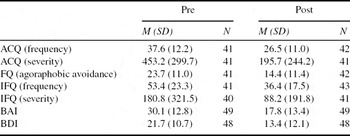
Univariate analyses show all 7 outcome variables improved significantly from pre- to post-treatment, all but one measure p < .001, (Interpersonal Fear Questionnaire, severity subscale, p < .02). See Table 1.
Lupina Service pre and post mean scores for each measure (ITT sample)

Benchmarking against local psychology service
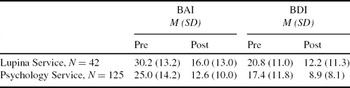
The data available for comparison purposes were limited. The only comparable measures routinely used by the psychology department were the Beck Depression and Beck Anxiety Inventories. Data were available for 125 clients treated by psychologists for agoraphobia. These were compared with that for the Lupina Service completers (see Table 2) using a repeated measures MANOVA. There were no significant differences involving Group (Lupina vs psychology service). Neither the overall Group effect, F (1,164) = 2.71, p = .070, nor the Group x Time interaction F (2,164) = 0.47, p = .624 was significant.
Comparison of Lupina Service outcomes on BAI and BDI with Psychology Service benchmark

Discussion
The results suggest that this inexpensive service provided an effective treatment for chronic agoraphobia. Many clients were helped who might not otherwise have accessed treatment. Volunteers could be more flexible, offering treatment at home or in public places, rearranging appointments if required, and offering some clients more intensive treatment. The volunteers valued the experience and many have gone on to complete training in mental health professions.
The overall effect size for the Lupina Service intervention was high (partial eta squared = 0.977), as were those for the individual measures used in the study (range η2 = 0.224-0.62). On the measures we compared, trained volunteers achieved results equivalent to those obtained by qualified clinical and counselling psychologists on measures of anxiety and depression, in clients with equivalent severity.
Our outcomes demonstrate that it is possible to train selected volunteers to treat clients requiring high levels of input and in vivo work in and around home. With adequate training and supervision similar provision might be an adjunct to CBT for other disorders, where in vivo work is required in the client's home (e.g. OCD).
Particular strengths of this project included the specific single-diagnosis training given, close supervision, weekly measures of target symptoms, provision of reading material, careful selection of clients and volunteers, and the possibility of returning the client to professional hands if they were not suitable for the volunteer to treat. Such a service would be of limited benefit without these constraints, as volunteers might soon be out of their depth.
There are several limitations of this project. The number of patients seen was relatively small and it would have been helpful to include an additional measure of functional outcome. The clinical measures available for benchmarking were not the most suitable as they did not directly measure panic nor agoraphobic symptoms; however, the benchmarking exercise did reinforce the impressive outcomes achieved by volunteers.
There was a 26% drop-out rate from the Lupina Service and there was a high rate of non-attendance at initial assessments, although this was reduced if assessments were done at home. The drop-out rate is significantly higher than that of Grey, Salkovskis, Quigley, Clark and Ehlers (Reference Grey, Salkovskis, Quigley, Clark and Ehlers2008), (8%), but comparable with rates in other studies of panic disorder treated with cognitive therapy, (e.g. 29.4 % in Wade, Treat and Stuart, Reference Wade, Treat and Stuart1998), and comparable with rates in all patients treated in the local psychology service (22.5%, Westbrook and Kirk, Reference Westbrook and Kirk2005). It would be interesting to explore engagement issues using qualitative methods and then consider how to secure firmer engagement. We also note that most volunteers were only able to treat 1-3 clients before moving on, and a more stable workforce might achieve better results. Long term follow-up would be of interest.
Acknowledgements
The authors would like to thank those involved in the setting up and management of the Lupina Service, particularly June Dent and Philip Roys, the Lupina Service volunteers and the service administrators. Additionally, we would like to thank Dr Ceri Jones and David Westbrook for help with data analysis. We are particularly grateful to the Lupina Foundation for funding the pilot phase of the project.



Comments
No Comments have been published for this article.